
Revision Notes
AQA A Level Law (7162): Property Offences – Revision Notes
Recall notes on theft (ss1-6) and robbery (s8) of the Theft Act 1968, with a case for each element and common traps, for AQA A Level Law 7162 Paper 1.
- Subject
- Law
- Level
- A LEVELS
- Topic
- Criminal law
- Author
- Marlbridge Academic Team
- Updated
- Reviewed by
- Aizaz Raoof Ali (what this means)
Aligned to AQA A Level Law (7162), For teaching from September 2017 onwards, A-level exams 2019 onwards. Official specification .
Syllabus page (what it covers and how it is assessed): AQA A Level Law.
Syllabus points this page covers
7162
- Property offences
Found an error? Report a correction.
Need help with this topic? Request a free trial class for A Level Law (7162).
Condensed notes for the section 3.2 row Property offences: theft (s1 Theft Act 1968) and robbery (s8). No other property offence is on the specification. For explanation and a worked problem, use the property offences study guide.
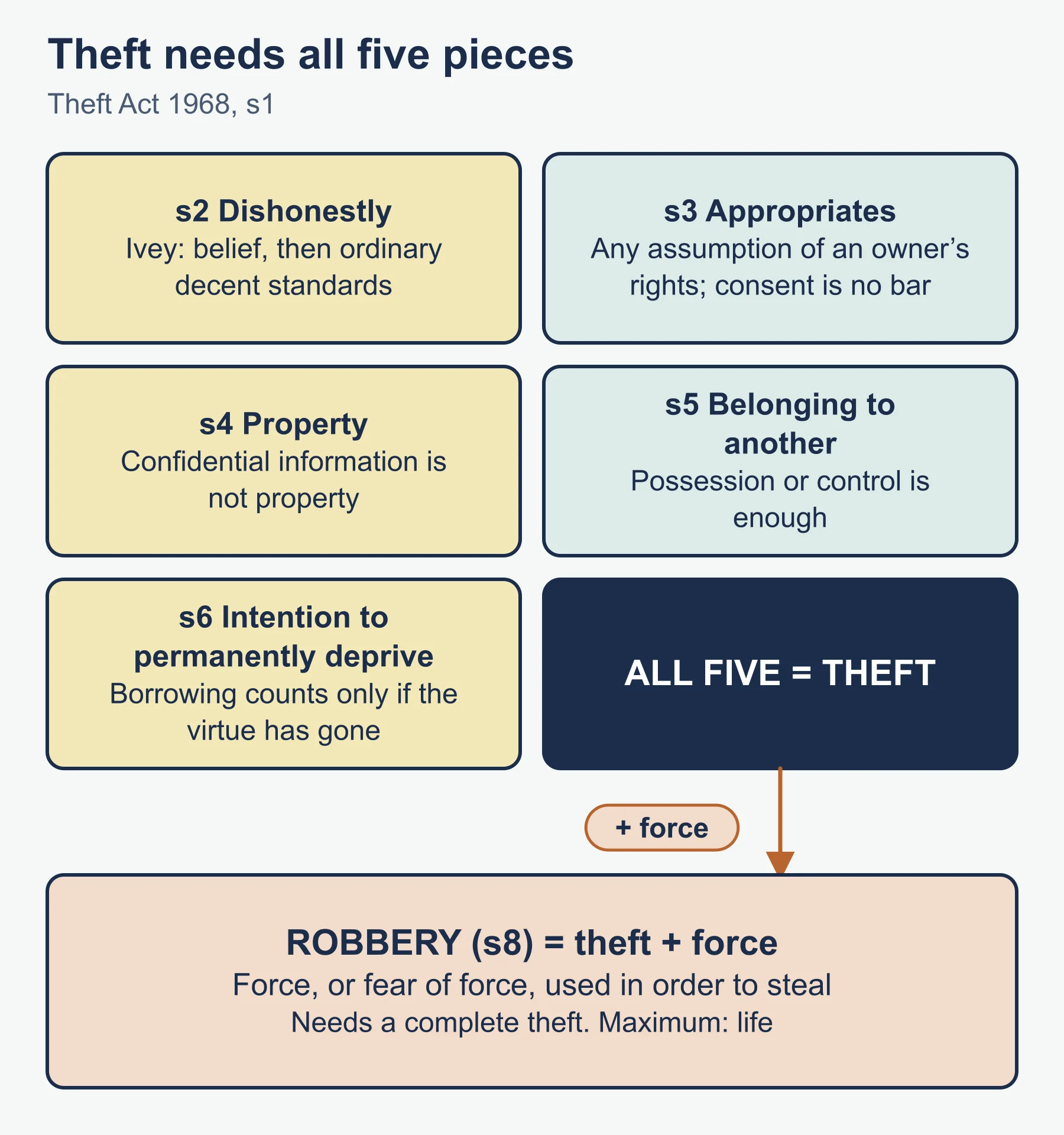
Theft in one line
s1(1): dishonestly appropriates property belonging to another with the intention of permanently depriving the other of it. Either way; maximum seven years.
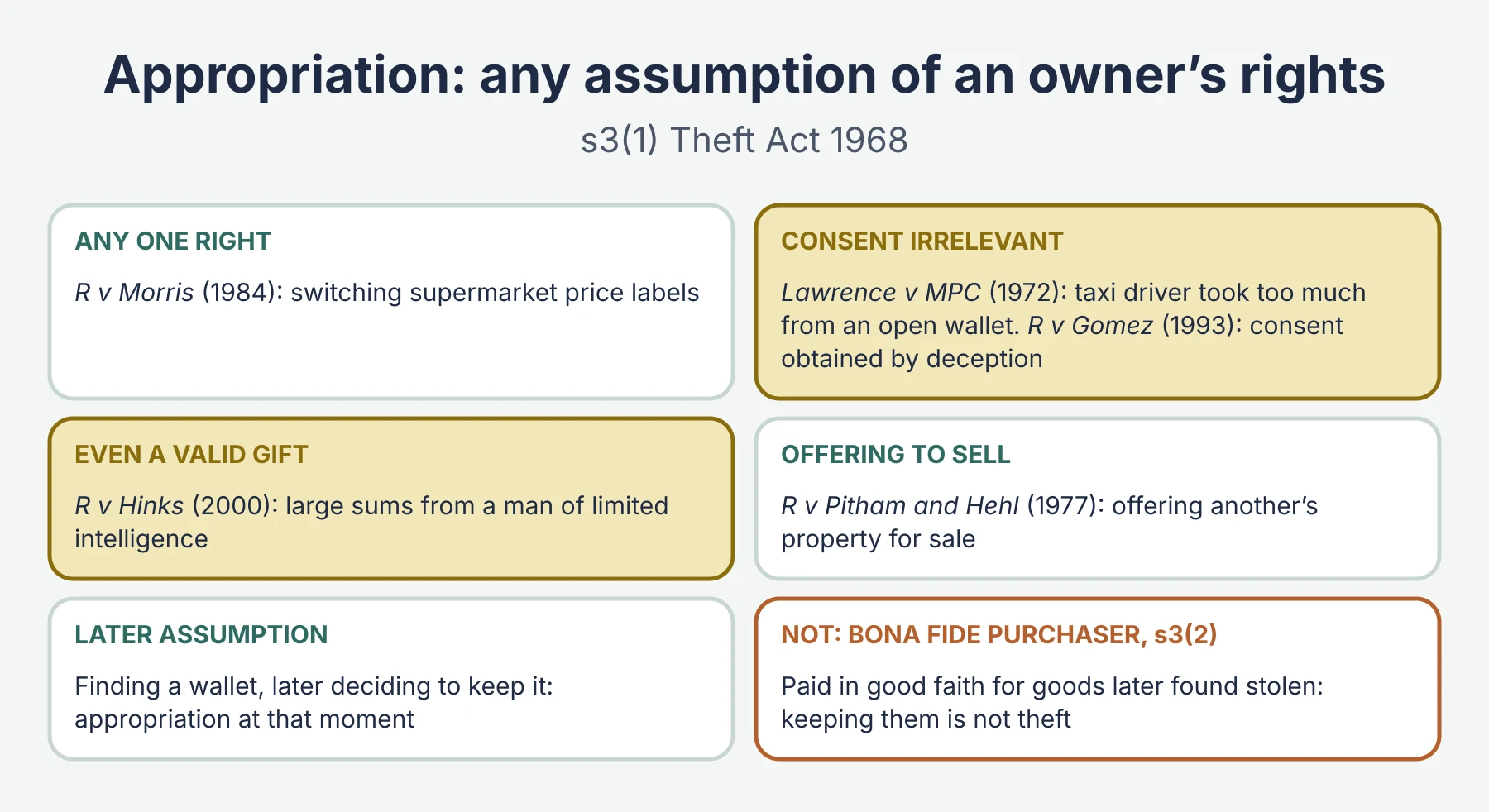
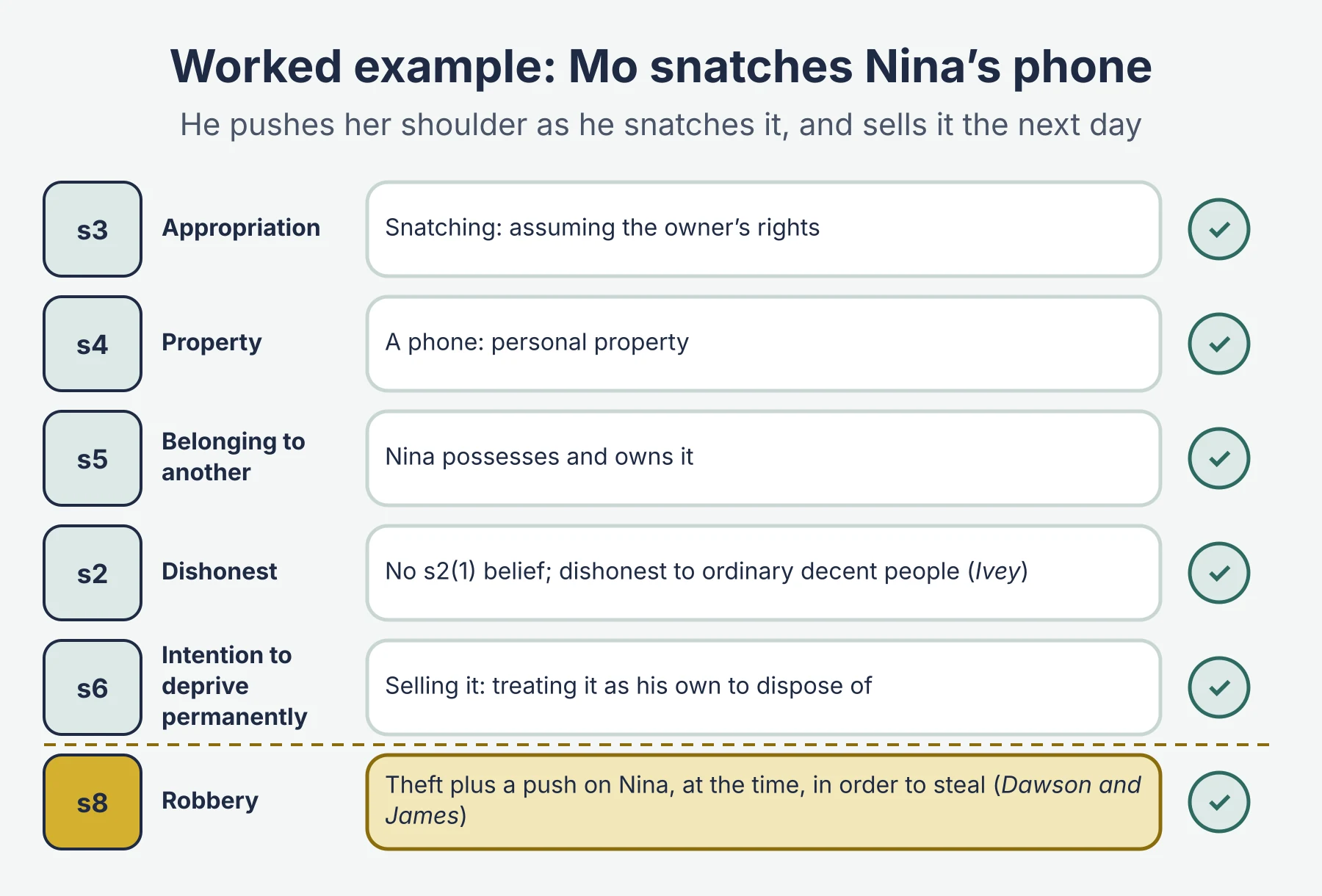
Appropriation (s3)
| Rule | Case |
|---|---|
| Assumption of any one right of an owner | Morris (1984): switching labels |
| Consent irrelevant | Lawrence (1972); Gomez (1993) |
| Valid gift can be appropriated | Hinks (2000) |
| Offering to sell | Pitham and Hehl (1977) |
| Later assumption by keeping or dealing | s3(1) |
| Good faith purchaser protected | s3(2) |
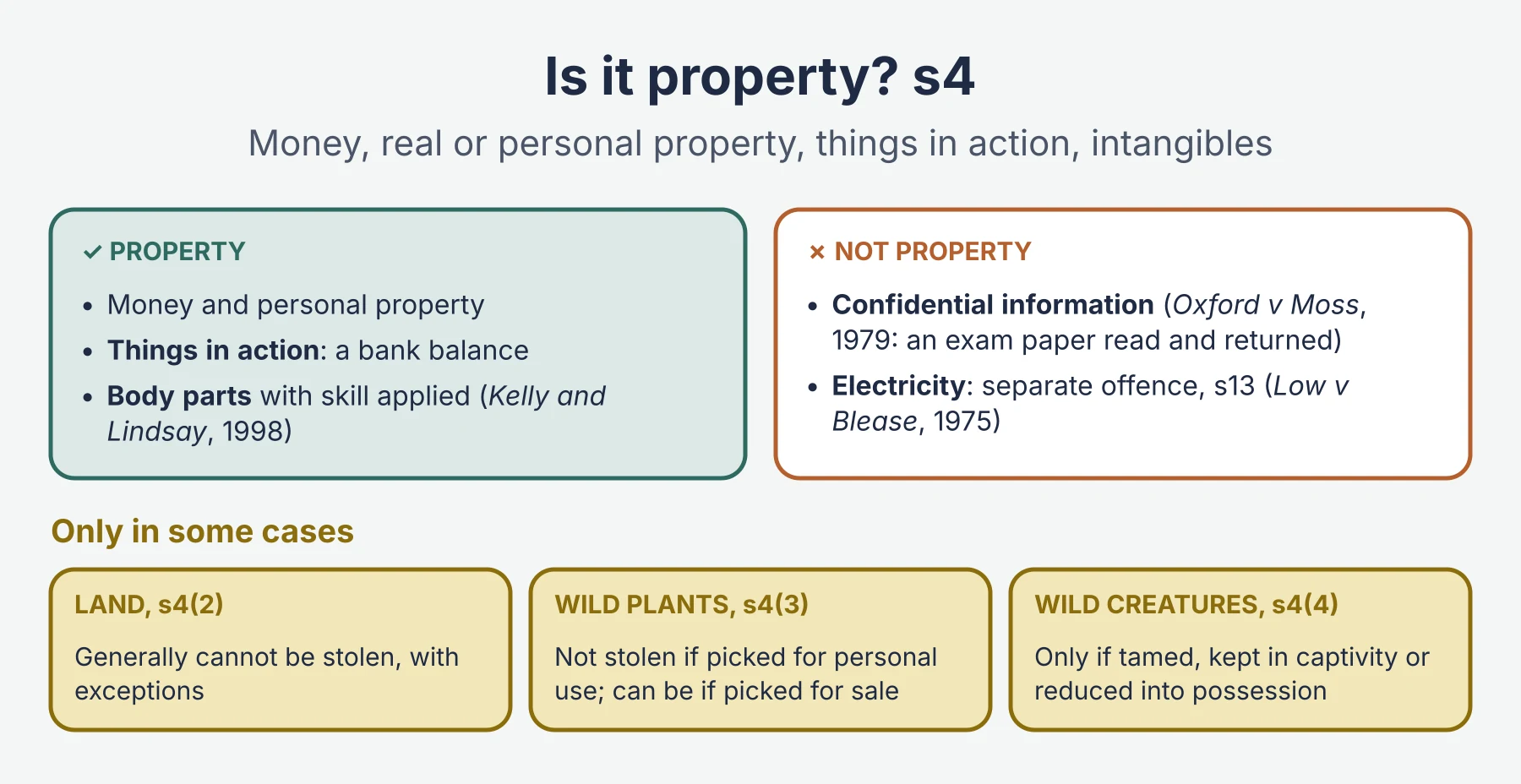
Property (s4)
- Money, real and personal property, things in action, other intangible property.
- Not property: confidential information (Oxford v Moss, 1979); electricity (separate s13 offence; Low v Blease, 1975).
- Body parts with skill applied (Kelly and Lindsay, 1998).
- Land mostly excluded (s4(2)); wild plants for personal use excluded (s4(3)); wild creatures only if tamed, kept or reduced into possession (s4(4)).
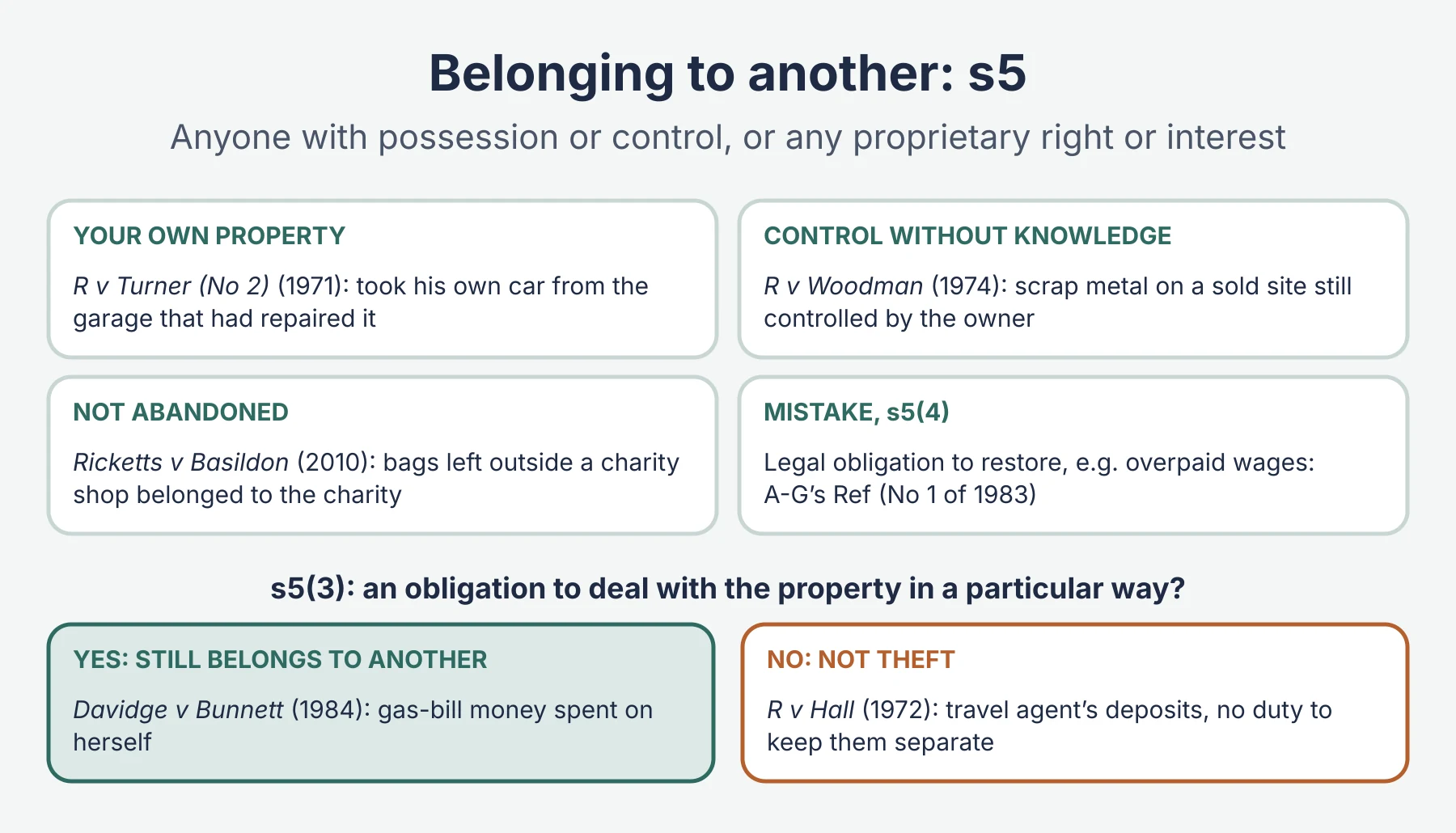
Belonging to another (s5)
| Rule | Case |
|---|---|
| Possession or control is enough, even against the owner | Turner (No 2) (1971) |
| Control without knowledge | Woodman (1974) |
| Property left for a charity is not abandoned | Ricketts v Basildon Magistrates’ Court (2010) |
| Obligation to deal with it in a particular way, s5(3) | Davidge v Bunnett (1984); contrast Hall (1972) |
| Got by mistake with obligation to restore, s5(4) | A-G’s Ref (No 1 of 1983) (1985) |
Dishonesty (s2)
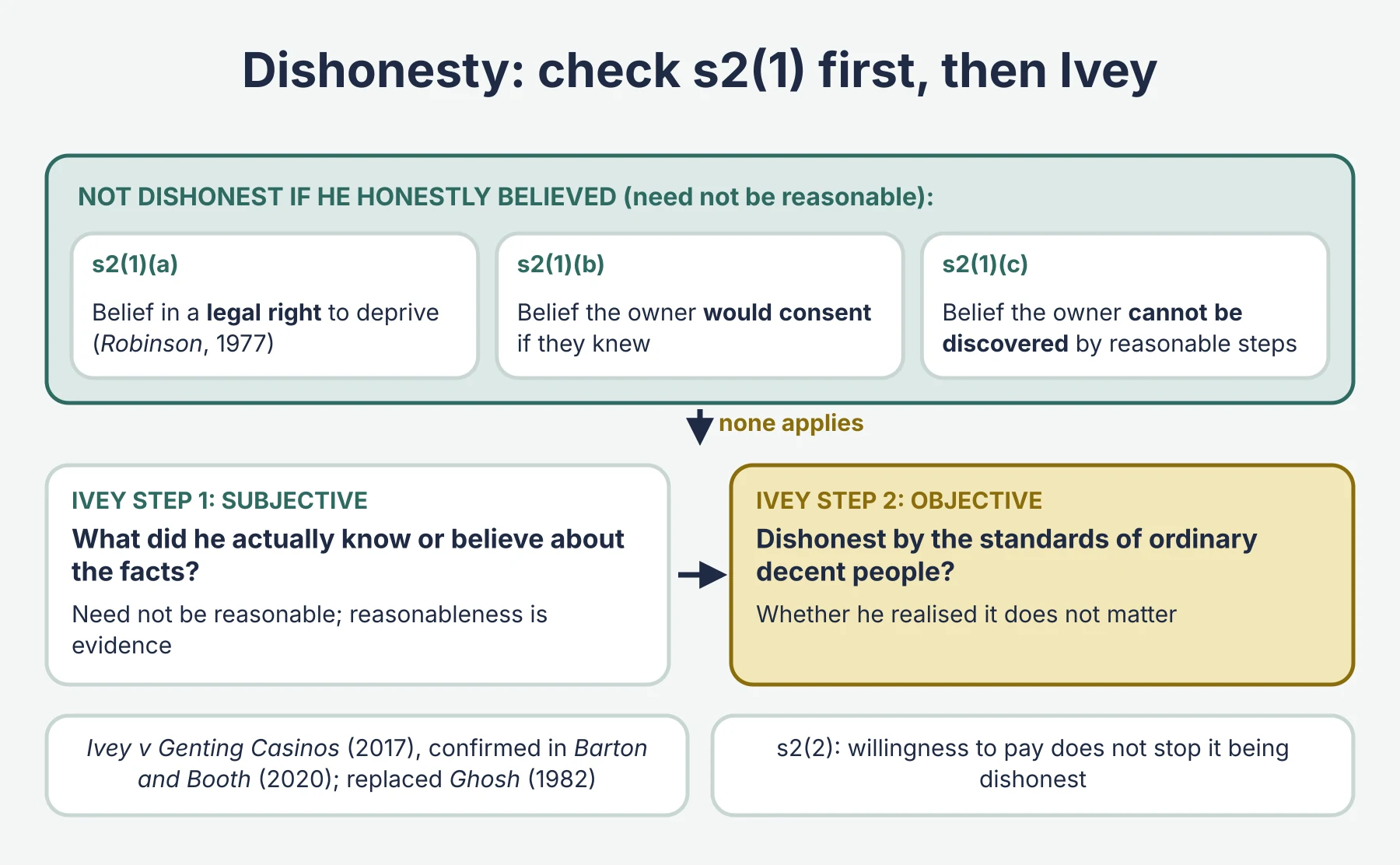
Not dishonest (s2(1)), honest belief only:
- (a) legal right to deprive (Robinson, 1977);
- (b) owner would consent;
- (c) owner cannot be found by reasonable steps.
s2(2): willingness to pay does not prevent dishonesty.
Otherwise, Ivey v Genting Casinos (2017); Barton and Booth (2020):
- What did D actually know or believe about the facts?
- Was the conduct dishonest by the standards of ordinary decent people?
Ghosh (1982) no longer applies.
Intention to permanently deprive (s6)
| Rule | Case |
|---|---|
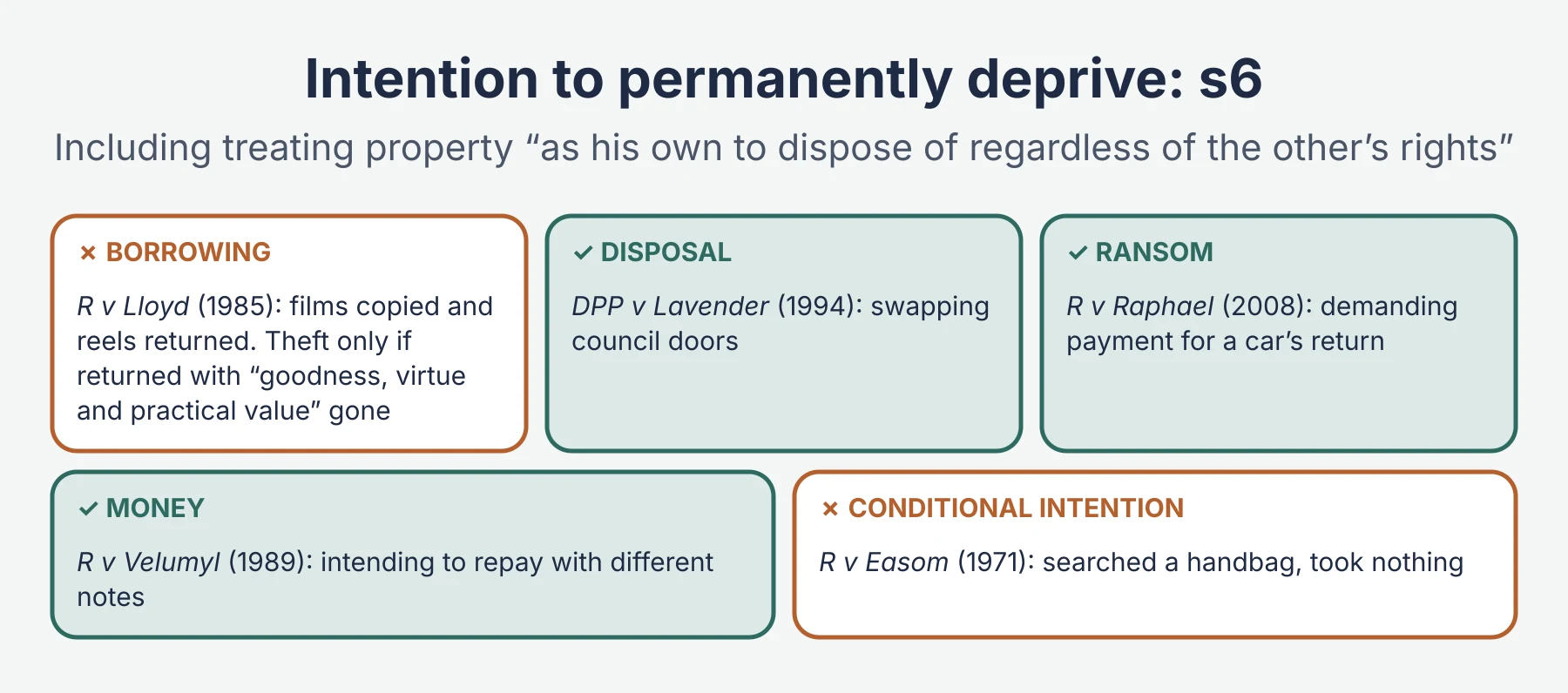
| Borrowing is ITPD only if goodness, virtue and practical value gone | Lloyd (1985) |
| Treating as own to dispose of | DPP v Lavender (1994); Raphael (2008) |
| Money replaced with different notes | Velumyl (1989) |
| Conditional intention is not enough | Easom (1971) |
Robbery (s8)
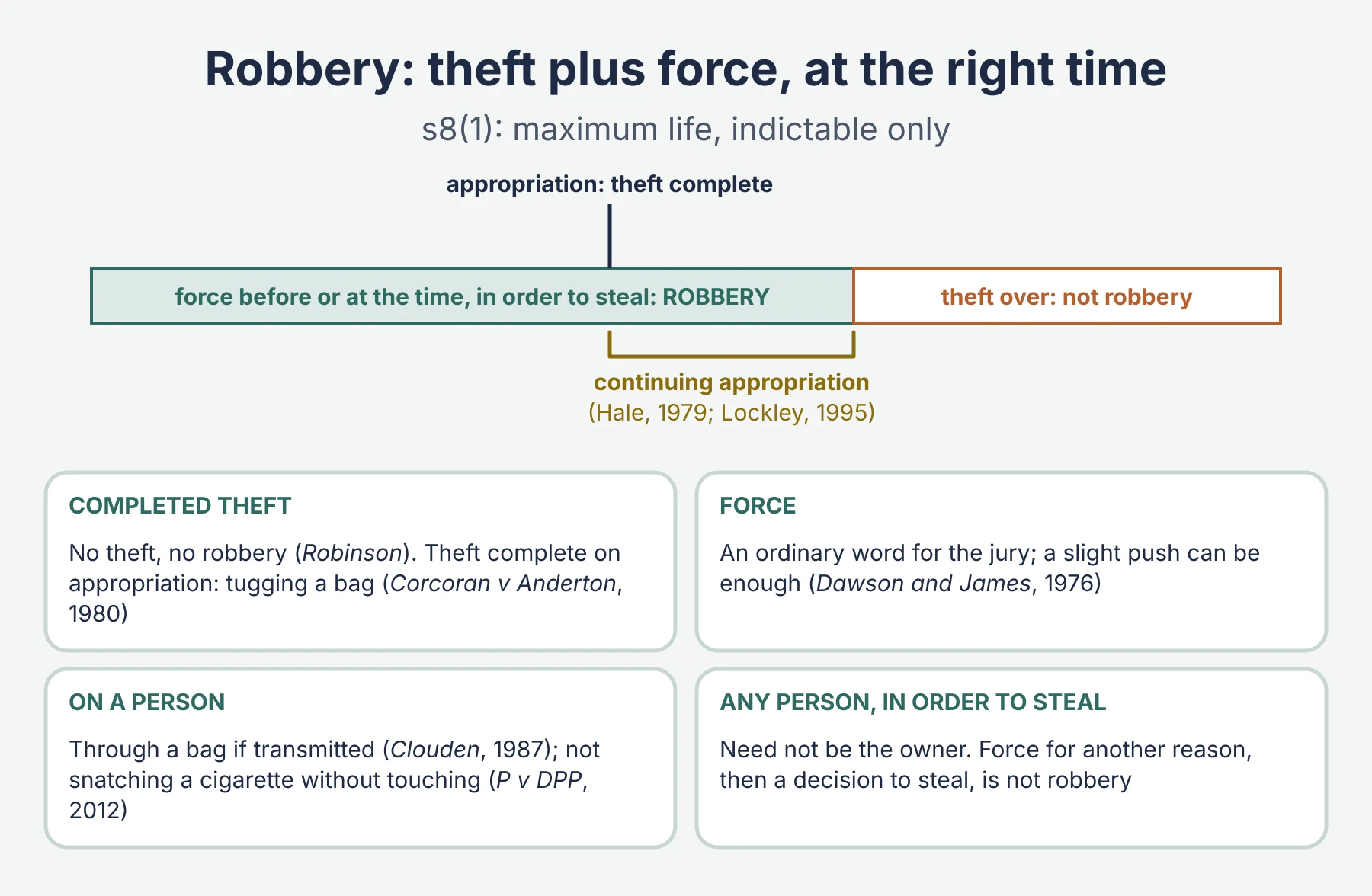
Definition: steals, and immediately before or at the time, and in order to do so, uses force on any person, or puts or seeks to put any person in fear of force then and there. Indictable only; maximum life.
| Element | Case |
|---|---|
| Completed theft required | Robinson (1977) |
| Theft complete at appropriation | Corcoran v Anderton (1980) |
| Force is an ordinary word; slight force enough | Dawson and James (1976) |
| Force on property transmitted to person | Clouden (1987); not P v DPP (2012) |
| Continuing appropriation | Hale (1979); Lockley (1995) |
Key terms
| Term | Meaning |
|---|---|
| Appropriation | Any assumption of the rights of an owner |
| Thing in action | A right enforceable by legal action, such as a bank balance |
| Proprietary right or interest | A legal or equitable ownership interest in property |
| Possession or control | Physical custody or power over property |
| Dishonesty | Judged by the Ivey test unless s2(1) applies |
| Intention to permanently deprive | Intending the owner to lose the property for good, or treating it as one’s own to dispose of |
| Continuing appropriation | Theft treated as ongoing while the thief is still “on the job” |
| Force | Ordinary word for the jury; need not be substantial |
Exam traps
- Consent does not prevent appropriation.
- A s2(1) belief need only be honest, not reasonable.
- Ghosh is no longer the test.
- Borrowing is not theft unless the goodness has gone.
- No completed theft means no robbery.
- Force used after the theft for another reason is not robbery.
- Burglary is not on this specification.
Self-test
- Which section defines appropriation?
- What did R v Gomez decide?
- What did R v Hinks add?
- Why was there no theft in Oxford v Moss?
- How could Turner steal his own car?
- What does s5(3) cover? Give a case.
- List the three s2(1) beliefs.
- State the two stages of the Ivey test.
- When is borrowing an intention to permanently deprive?
- What was decided in R v Robinson and why does it matter for robbery?
- When is a theft complete for robbery purposes?
- What did R v Hale decide?
Answers: 1. s3. 2. An appropriation can occur even where the owner consents, including consent obtained by deception. 3. Even a valid gift can be appropriated. 4. Confidential information is not property. 5. The garage had possession or control of it under s5(1). 6. Property received under an obligation to deal with it in a particular way; Davidge v Bunnett (1984). 7. Belief in a legal right to deprive; belief the owner would consent; belief the owner cannot be found by reasonable steps. 8. What was D’s actual knowledge or belief as to the facts; was the conduct dishonest by the standards of ordinary decent people. 9. Where it is for a period and in circumstances making it equivalent to an outright taking, such as when the goodness has gone (Lloyd). 10. An honest belief in a legal right to money meant no dishonesty, so no theft and therefore no robbery. 11. At the moment of appropriation (Corcoran v Anderton). 12. Appropriation can be a continuing act, so force used while still taking the goods can make it robbery.
Test yourself further with the property offences practice questions.
Related resources
-
Study guides
AQA A Level Law (7162): The Rules of Criminal Law
Where criminal rules come from, burdens of proof, specific and basic intent, judge and jury roles and a method for applying rules, for AQA A Level Law 7162.
Law · AQA · A Level
Read guide -
Practice questions
AQA A Level Law (7162): The Rules of Criminal Law – Practice Questions
Original practice questions with mark-scheme answers on criminal rule sources, burdens of proof, judge and jury and intent types for AQA Law 7162.
Law · AQA · A Level
Try questions -
Revision notes
AQA A Level Law (7162): The Rules of Criminal Law – Revision Notes
Recall notes on the sources of criminal rules, burdens of proof, judge and jury, specific and basic intent and the offence ladder for AQA A Level Law 7162.
Law · AQA · A Level
Revise topic
Get free revision emails (optional)
Occasional emails with practice questions, worked explanations and links to free resources for the qualification and subjects you choose. No spam, and you can unsubscribe from any email. The free tools on this site never need an email.