
Study Guides
AQA A Level Law (7162): Property Offences
Theft under ss1-6 and robbery under s8 Theft Act 1968, section by section with leading cases and a worked problem, for AQA A Level Law 7162 Paper 1.
- Subject
- Law
- Level
- A LEVELS
- Topic
- Criminal law
- Author
- Marlbridge Academic Team
- Updated
- Reviewed by
- Aizaz Raoof Ali (what this means)
Aligned to AQA A Level Law (7162), For teaching from September 2017 onwards, A-level exams 2019 onwards. Official specification .
Syllabus page (what it covers and how it is assessed): AQA A Level Law.
Syllabus points this page covers
7162
- Property offences
Found an error? Report a correction.
Need help with this topic? Request a free trial class for A Level Law (7162).
This guide covers the section 3.2 row Property offences in AQA A-level Law (7162). The specification names two offences only: theft (s1 Theft Act 1968) and robbery (s8 Theft Act 1968). Burglary, fraud and criminal damage are not on this specification, so do not spend time on them. Because theft is a statutory offence built from five sections, it rewards a disciplined, section-by-section approach; robbery adds force to a completed theft. For an overview of all the offences, see the Criminal Offences and Defences study guide.
Theft: the definition
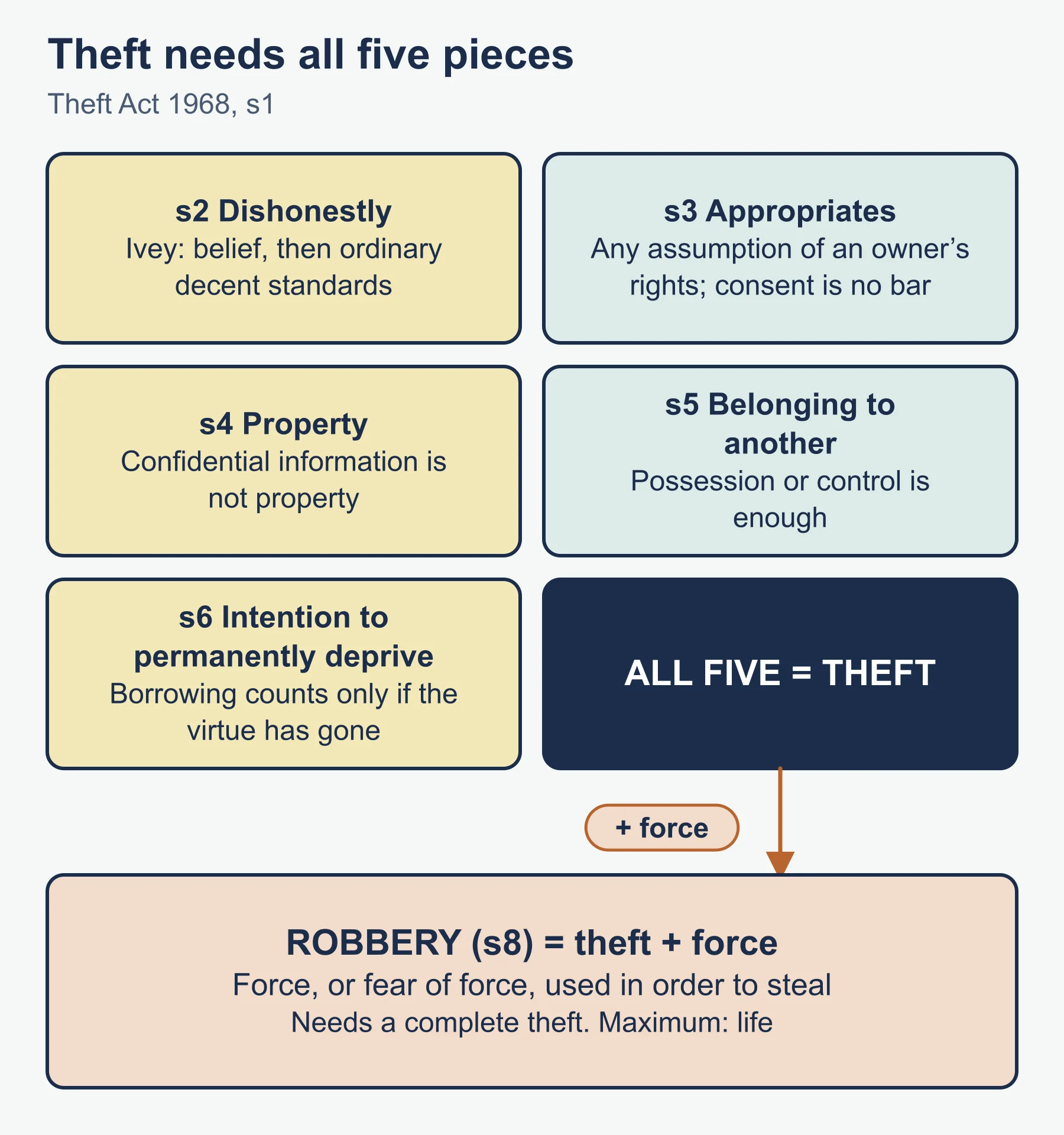
Section 1(1): “A person is guilty of theft if he dishonestly appropriates property belonging to another with the intention of permanently depriving the other of it.” Theft is triable either way, with a maximum of seven years.
| Element | Section | Actus reus or mens rea |
|---|---|---|
| Appropriation | s3 | Actus reus |
| Property | s4 | Actus reus |
| Belonging to another | s5 | Actus reus |
| Dishonesty | s2 | Mens rea |
| Intention to permanently deprive | s6 | Mens rea |
Appropriation (s3)
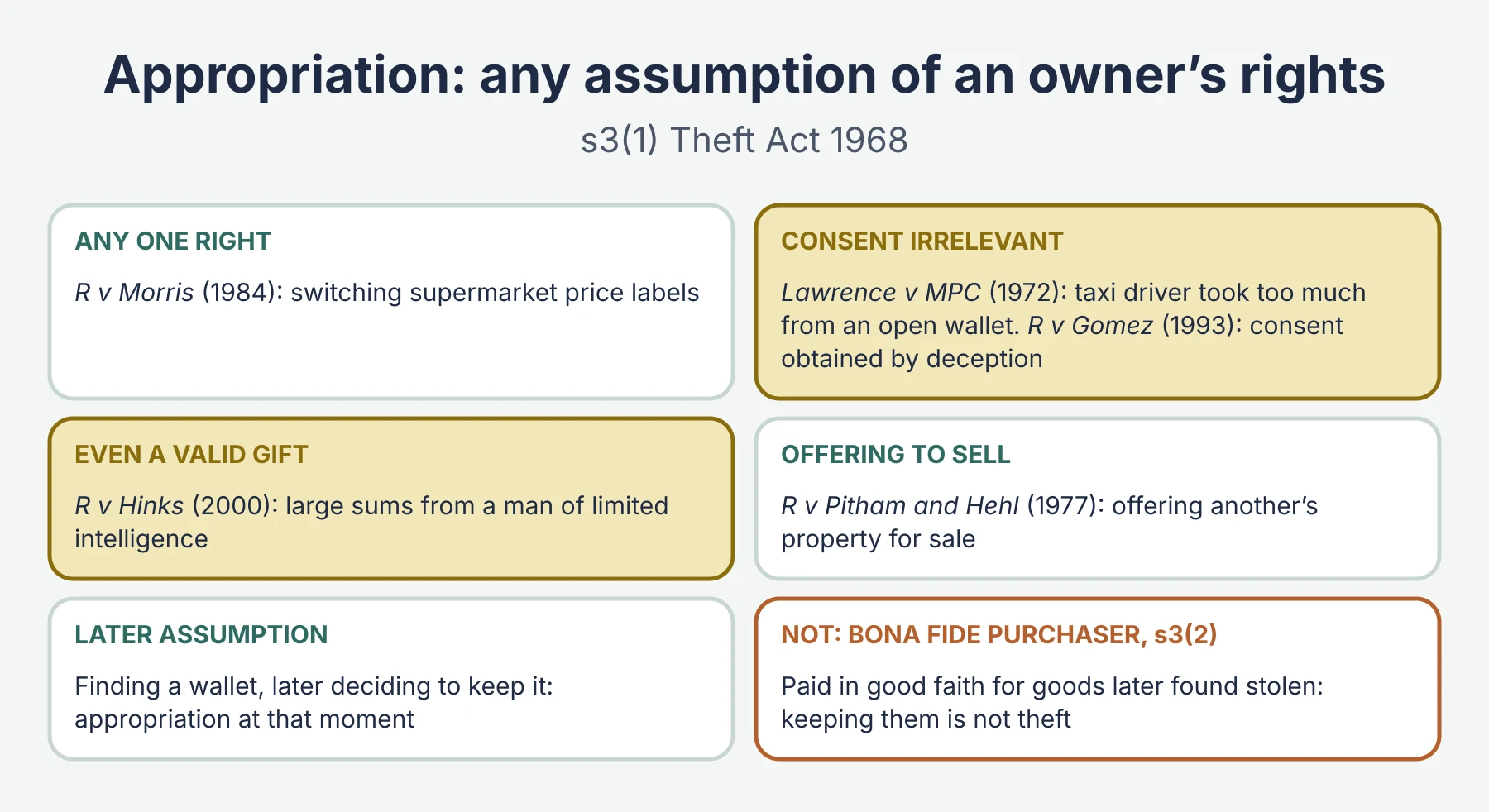
Section 3(1): “Any assumption by a person of the rights of an owner amounts to an appropriation”, including a later assumption of a right to property the defendant came by innocently, by keeping or dealing with it as owner.
- Any one right is enough. Switching price labels in a supermarket was an appropriation (R v Morris, 1984).
- Consent is irrelevant. A taxi driver who took too much money from a passenger’s open wallet appropriated it (Lawrence v MPC, 1972); a company manager who consented because of the defendant’s deception still had property appropriated (R v Gomez, 1993).
- Even a valid gift. A woman who received large sums from a man of limited intelligence appropriated them, though the gifts were valid in civil law (R v Hinks, 2000).
- Offering to sell another’s property is an appropriation (R v Pitham and Hehl, 1977).
- Later assumption. A person who finds a wallet and later decides to keep it appropriates it at that moment.
- Bona fide purchasers (s3(2)): a person who pays in good faith for goods later found to be stolen does not commit theft by keeping them.
Property (s4)
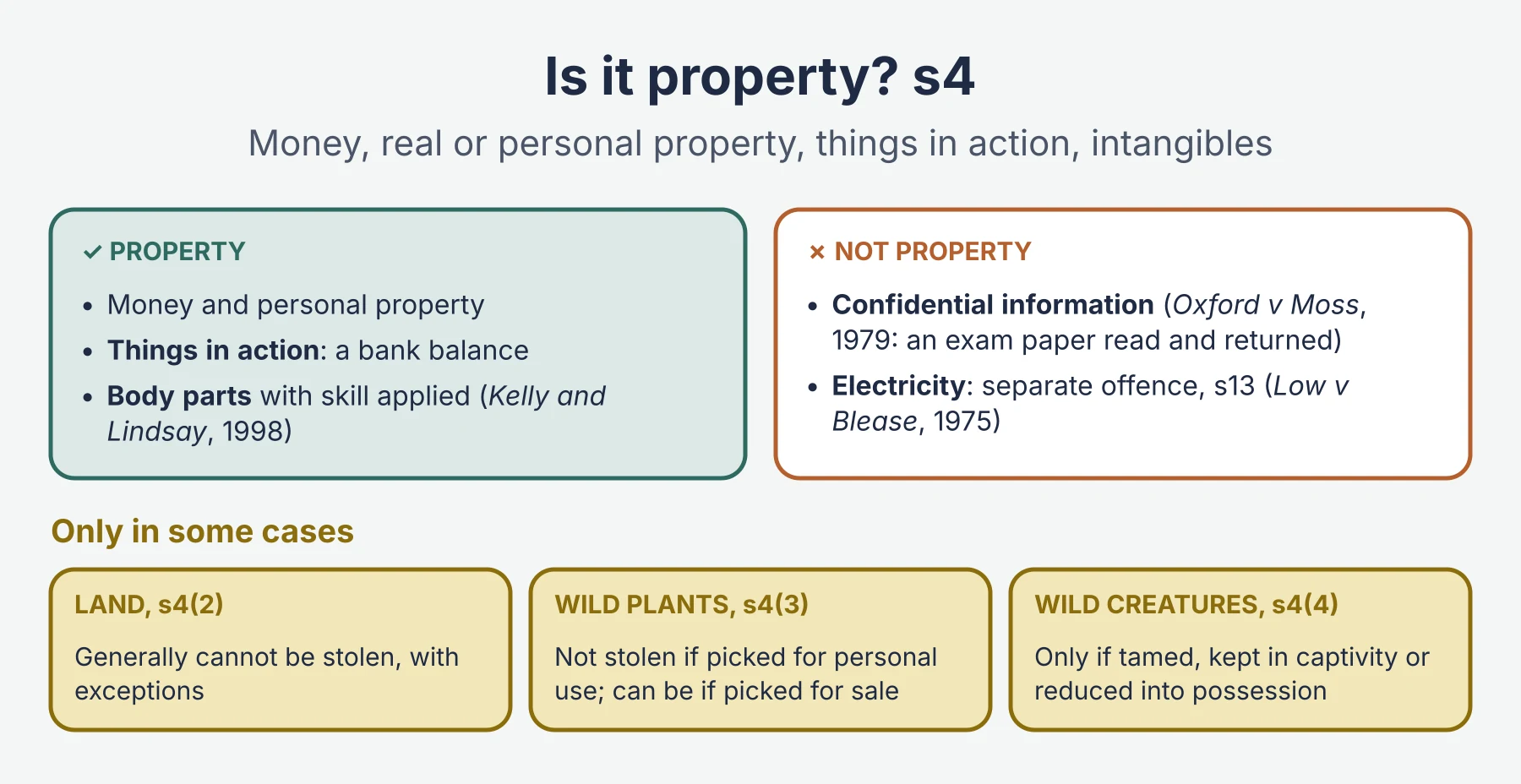
Section 4(1): “money and all other property, real or personal, including things in action and other intangible property”.
- Things in action include a bank balance, so stealing from an account is theft of a thing in action.
- Confidential information is not property: a student who read an exam paper and returned it did not steal the information (Oxford v Moss, 1979).
- Electricity is not property for theft; there is a separate offence of abstracting electricity (s13; Low v Blease, 1975).
- Body parts can become property where skill has been applied to them, for example preserved specimens (R v Kelly and Lindsay, 1998).
- Land generally cannot be stolen (s4(2)), with exceptions; wild plants picked for personal use are not stolen, but picking them for sale can be (s4(3)); wild creatures cannot be stolen unless tamed, ordinarily kept in captivity, or reduced into someone’s possession (s4(4)).
Belonging to another (s5)
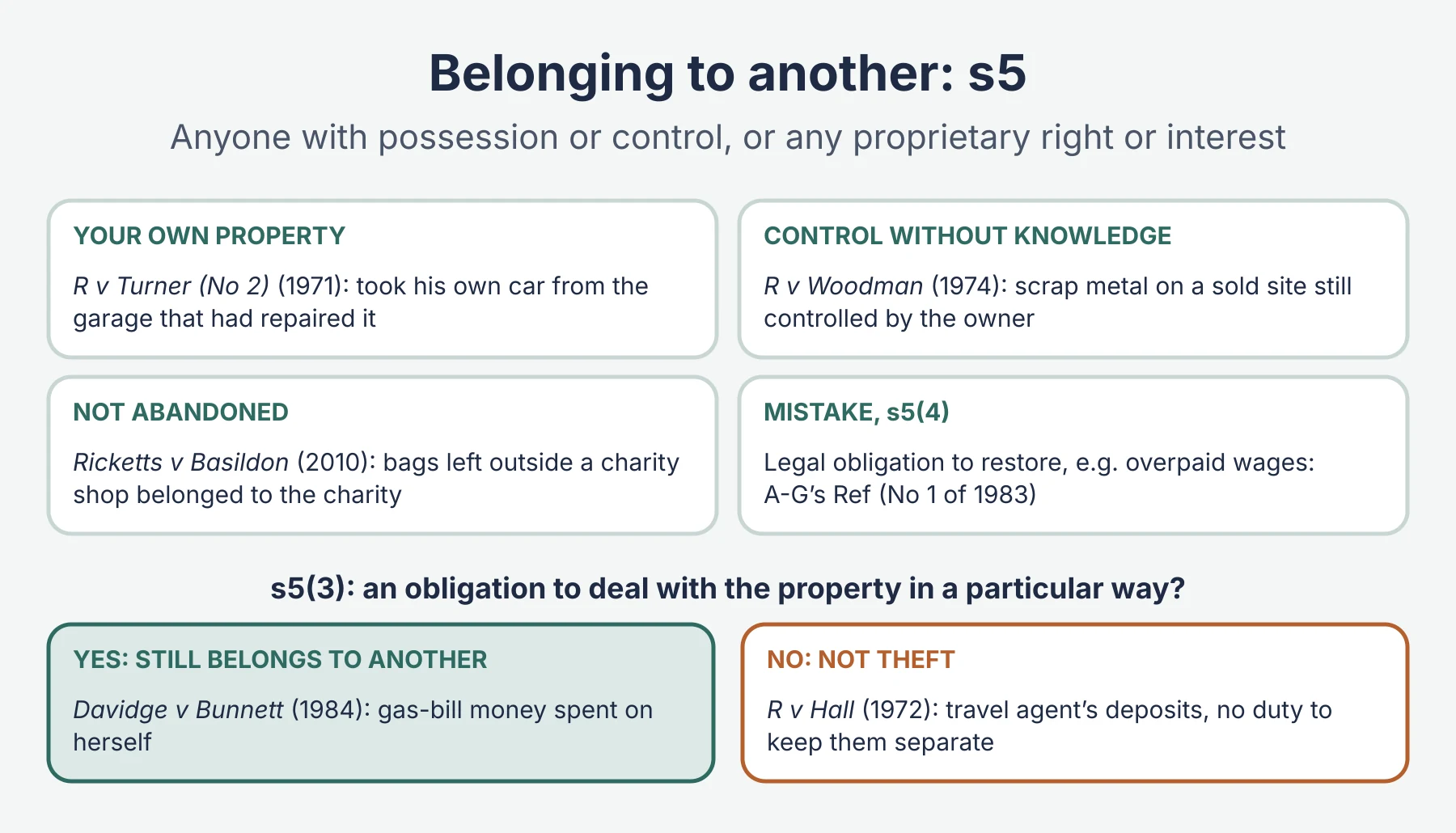
Section 5(1): property belongs to anyone having possession or control of it, or any proprietary right or interest.
- Your own property can be stolen from someone in possession: taking your own car from a garage that had repaired it was theft (R v Turner (No 2), 1971).
- Control without knowledge: scrap metal left on a sold site still belonged to the site owner who controlled it (R v Woodman, 1974).
- Abandoned or not? Bags left outside a charity shop belonged to the charity, not abandoned (Ricketts v Basildon Magistrates’ Court, 2010).
- Obligation to deal with property in a particular way (s5(3)): money given to pay a gas bill still “belonged” to the flatmates when the defendant spent it on herself (Davidge v Bunnett, 1984); but a travel agent who received deposits with no obligation to keep them separate was not guilty (R v Hall, 1972).
- Property got by mistake (s5(4)): where there is a legal obligation to restore it, such as overpaid wages, it is treated as belonging to the person entitled (Attorney-General’s Reference (No 1 of 1983), 1985).
Dishonesty (s2 and Ivey)
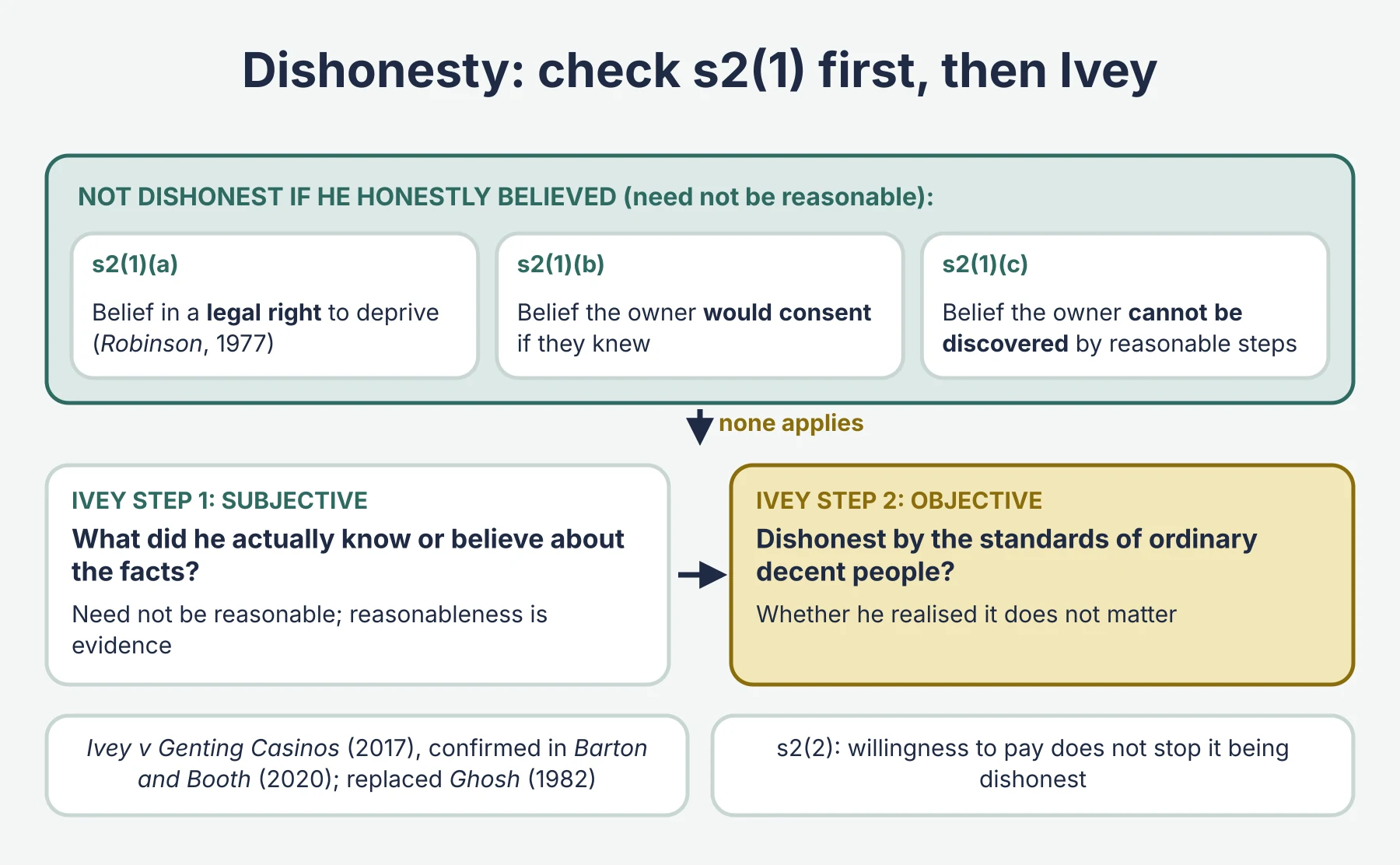
Section 2(1): a person is not dishonest if he appropriates property in the belief that:
- (a) he has the legal right to deprive the other of it;
- (b) he would have the other’s consent if the other knew of the appropriation and its circumstances; or
- (c) the person to whom the property belongs cannot be discovered by taking reasonable steps.
These beliefs need only be honestly held, not reasonable. In R v Robinson (1977) the defendant’s belief that he was entitled to money he was owed meant there was no theft, and so no robbery. Section 2(2): being willing to pay does not stop an appropriation being dishonest.
The Ivey test. If s2(1) does not apply, the jury applies the test from Ivey v Genting Casinos (2017), confirmed for criminal cases in R v Barton and Booth (2020):
- What was the defendant’s actual state of knowledge or belief as to the facts? (Subjective; the belief need not be reasonable, but reasonableness is evidence of whether it was held.)
- Given that belief, was the conduct dishonest by the standards of ordinary decent people? (Objective; it does not matter whether the defendant realised ordinary people would think so.)
This replaced the two-stage test in R v Ghosh (1982).
Intention to permanently deprive (s6)
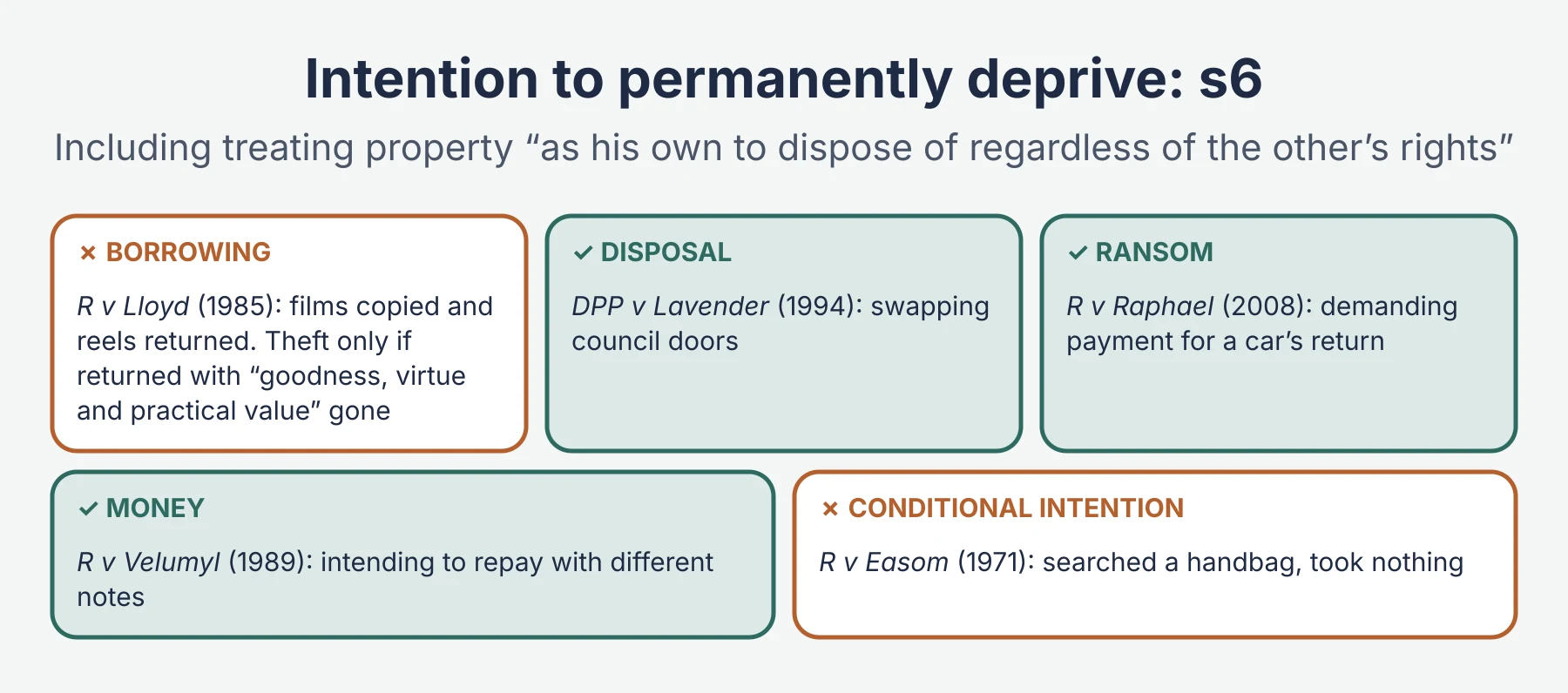
The defendant must intend the owner to lose the property permanently. Section 6(1) extends this to treating the property “as his own to dispose of regardless of the other’s rights”, and to borrowing or lending equivalent to an outright taking.
- Borrowing: borrowing is not theft unless the property is returned with its “goodness, virtue and practical value” gone. Copying films and returning the reels was not theft (R v Lloyd, 1985).
- Treating as one’s own: swapping council doors was disposal regardless of the council’s rights (DPP v Lavender, 1994); demanding payment for the return of a car was the same (R v Raphael, 2008).
- Money: taking cash intending to repay with different notes is an intention to permanently deprive of the original notes (R v Velumyl, 1989).
- Conditional intention: looking through a handbag for something worth taking, and taking nothing, is not theft of the contents (R v Easom, 1971).
Robbery (s8)
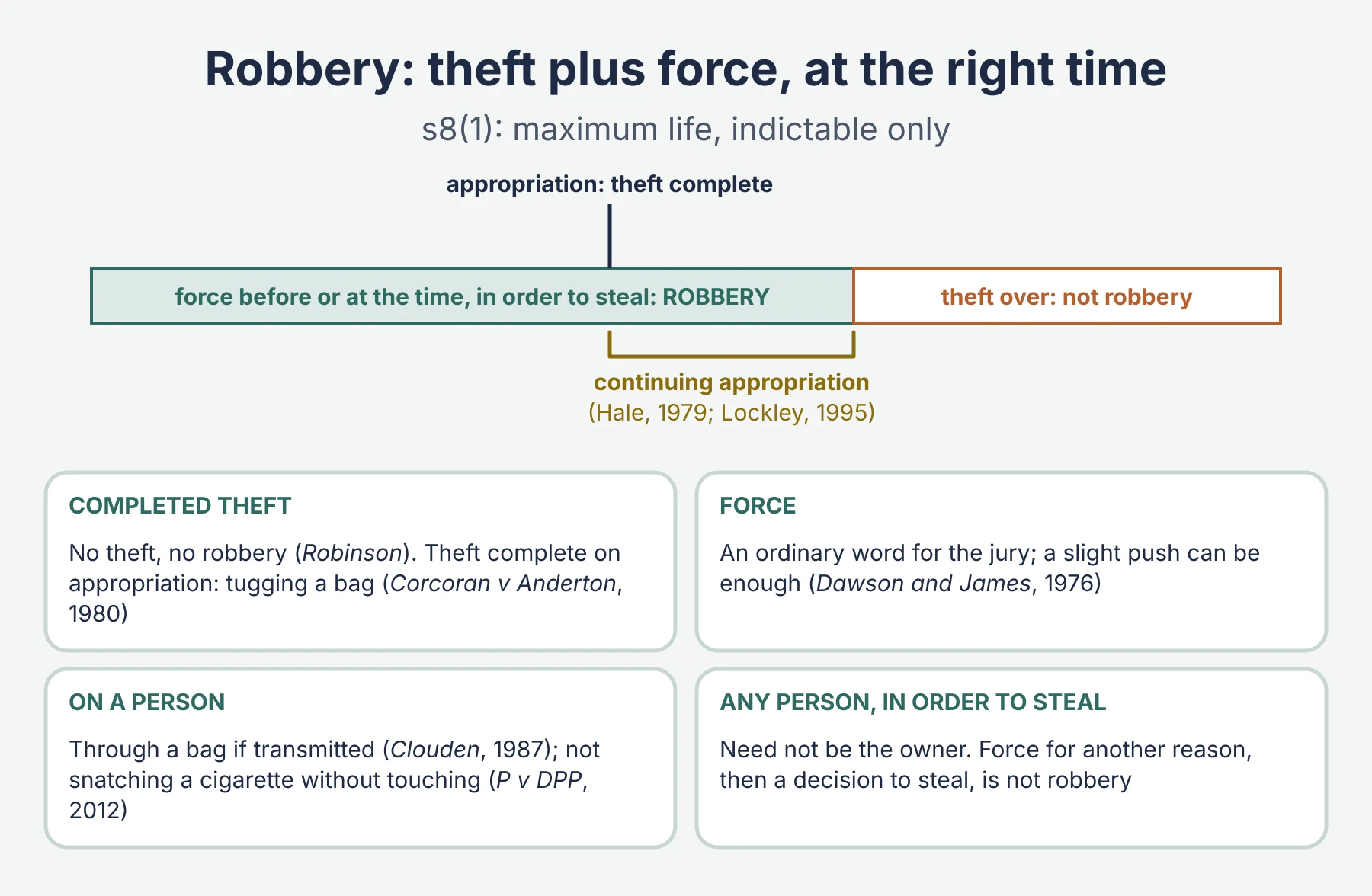
Section 8(1): a person is guilty of robbery “if he steals, and immediately before or at the time of doing so, and in order to do so, he uses force on any person or puts or seeks to put any person in fear of being then and there subjected to force”. Robbery is indictable only, with a maximum of life.
| Element | Rule | Cases |
|---|---|---|
| A completed theft | No theft, no robbery | R v Robinson (1977) |
| Theft is complete on appropriation | Tugging a bag is enough, even if it is dropped | Corcoran v Anderton (1980) |
| Force | An ordinary word for the jury; a slight push can be enough | R v Dawson and James (1976) |
| Force on a person | Force on a bag can count if transmitted to the victim | R v Clouden (1987); contrast P v DPP (2012), snatching a cigarette without touching the victim |
| Any person | The person threatened need not be the owner | s8(1) |
| Immediately before or at the time | Appropriation can be continuing | R v Hale (1979); R v Lockley (1995) |
| In order to steal | Force used for another reason, followed by a decision to steal, is not robbery | s8(1) |
Worked example
Mo snatches Nina’s phone from her hand as she walks along a street, pushing her shoulder as he does. He sells the phone the next day.
s3   Snatching = assumption of the owner's rights.     Appropriation: yes
s4   Phone = personal property.                        Property: yes
s5   Nina possesses and owns it.                       Belonging to another: yes
s2   No s2(1) belief; ordinary decent people would
     regard snatching as dishonest (Ivey).             Dishonest: yes
s6   Selling it = treating as his own to dispose of.   ITPD: yes
s8   Theft + push on Nina, at the time of stealing,
     in order to steal (Dawson and James).             Robbery: yes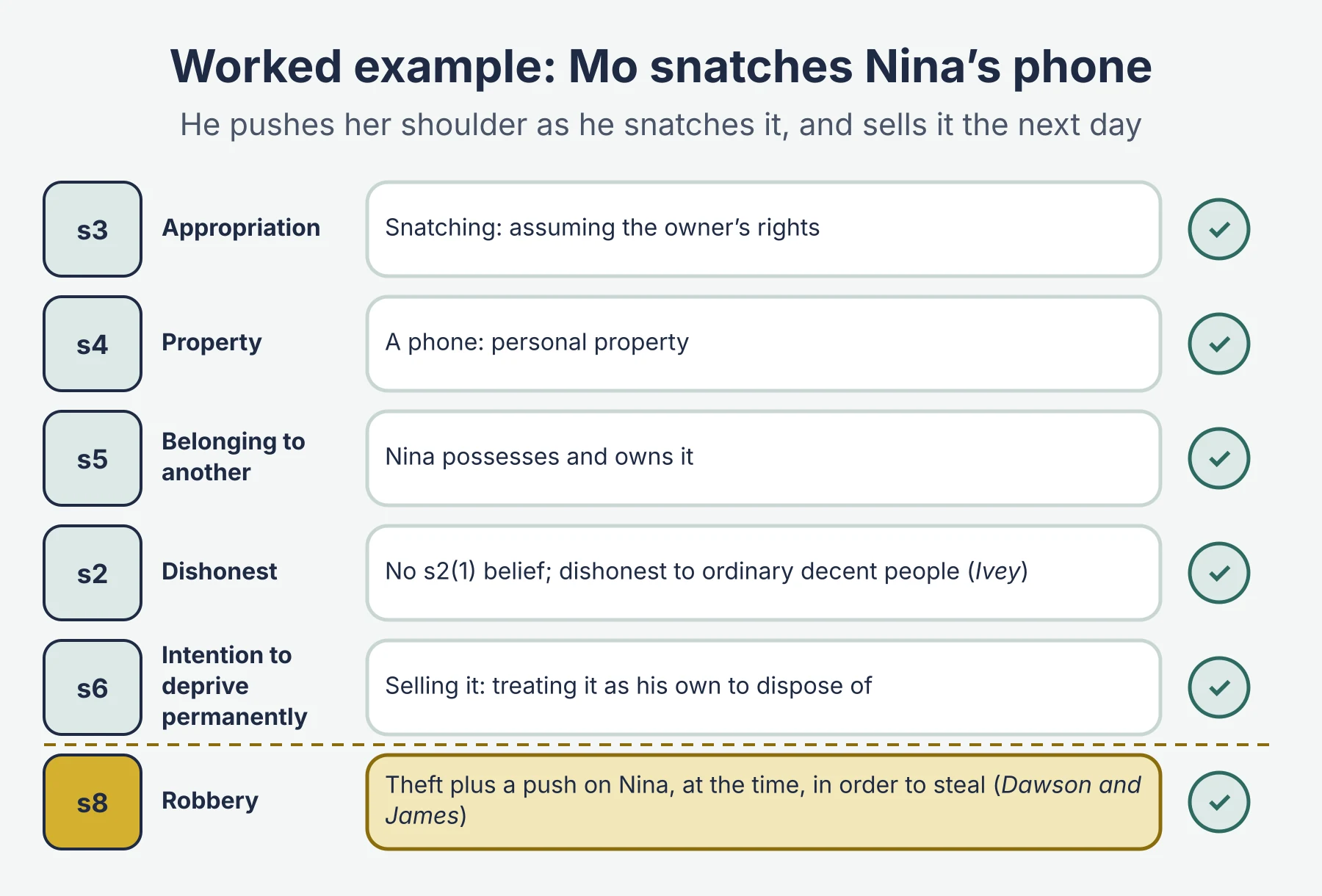
Common mistakes
- Saying consent prevents appropriation (Gomez and Hinks say otherwise).
- Using the old Ghosh test.
- Treating a belief in a legal right as needing to be reasonable.
- Calling borrowing theft without applying Lloyd.
- Finding robbery where there is no completed theft, or where force was used after the theft was over and for a different reason.
Exam technique
Work through ss3, 4, 5, 2 and 6 in a fixed order, giving a case for any element in doubt, then decide robbery under s8. Conclude on theft before you discuss robbery. For evaluation, the common themes are the breadth of appropriation after Gomez and Hinks, and the uncertainty of the Ivey test.
More resources on this topic
Property offences revision notes | Property offences practice questions
Related resources
-
Practice questions
AQA A Level Law (7162): Property Offences – Practice Questions
Original practice questions with mark-scheme answers on theft under ss1-6 and robbery under s8 Theft Act 1968 for AQA A Level Law 7162 Paper 1.
Law · AQA · A Level
Try questions -
Revision notes
AQA A Level Law (7162): Property Offences – Revision Notes
Recall notes on theft (ss1-6) and robbery (s8) of the Theft Act 1968, with a case for each element and common traps, for AQA A Level Law 7162 Paper 1.
Law · AQA · A Level
Revise topic -
Study guides
AQA A Level Law (7162): The Rules of Criminal Law
Where criminal rules come from, burdens of proof, specific and basic intent, judge and jury roles and a method for applying rules, for AQA A Level Law 7162.
Law · AQA · A Level
Read guide
Get free revision emails (optional)
Occasional emails with practice questions, worked explanations and links to free resources for the qualification and subjects you choose. No spam, and you can unsubscribe from any email. The free tools on this site never need an email.