
Revision Notes
AQA A Level Law (7162): Non-Fatal Offences Against the Person – Revision Notes
Recall notes on assault, battery and ss47, 20 and 18 with injury classification, mens rea and leading cases, for AQA A Level Law 7162 Paper 1.
- Subject
- Law
- Level
- A LEVELS
- Topic
- Criminal law
- Author
- Marlbridge Academic Team
- Updated
- Reviewed by
- Aizaz Raoof Ali (what this means)
Aligned to AQA A Level Law (7162), For teaching from September 2017 onwards, A-level exams 2019 onwards. Official specification .
Syllabus page (what it covers and how it is assessed): AQA A Level Law.
Syllabus points this page covers
7162
- Non-fatal offences against the person
Found an error? Report a correction.
Need help with this topic? Request a free trial class for A Level Law (7162).
Condensed notes for the section 3.2 row Non-fatal offences against the person: assault and battery, and ss47, 20 and 18 of the Offences Against the Person Act 1861. For explanation and a worked problem, use the non-fatal offences study guide.
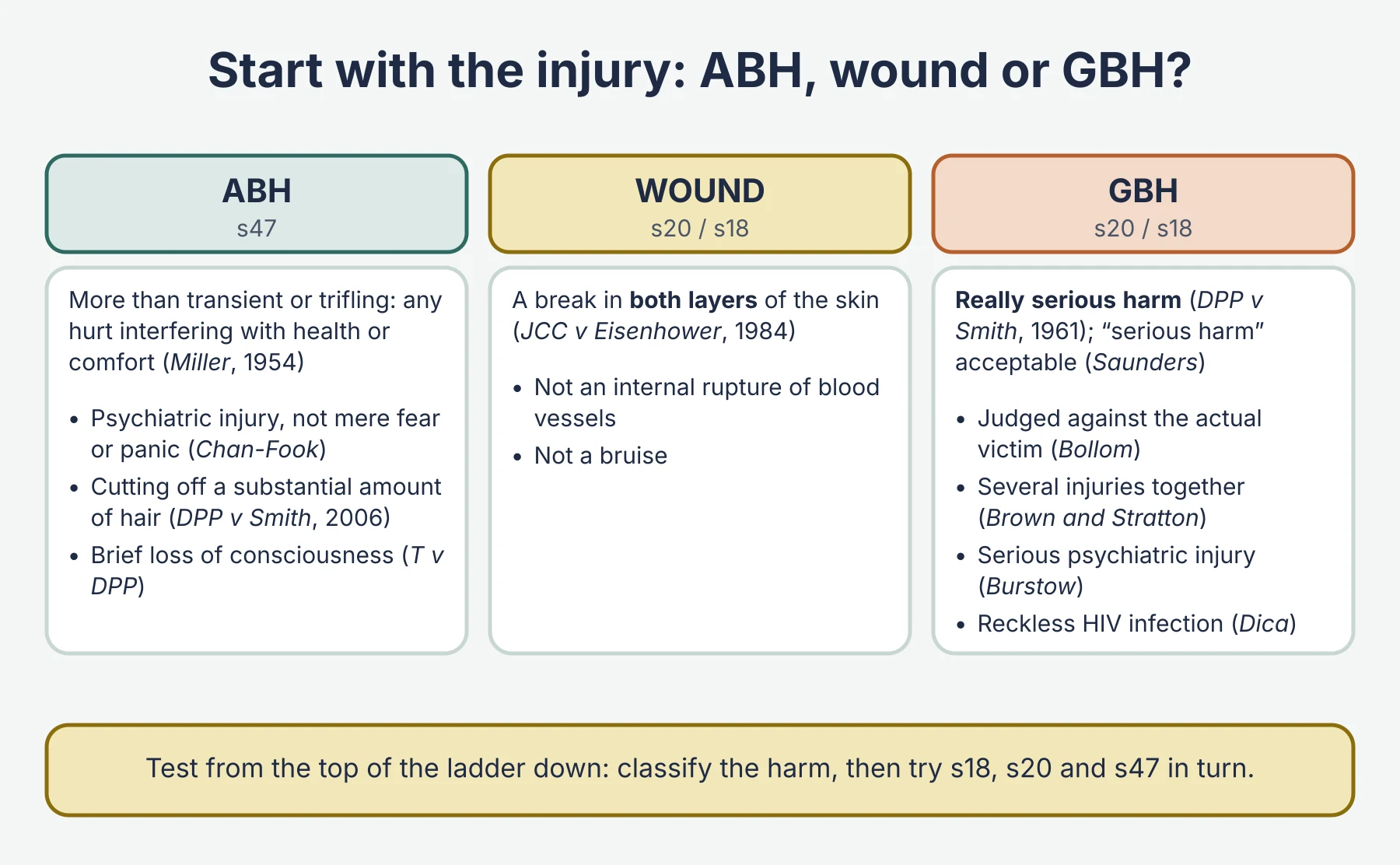
Step 1: classify the injury
| Injury | Level | Authority |
|---|---|---|
| No injury, victim expected force | Assault | Ireland (1997) |
| Touching, no injury | Battery | Collins v Wilcock (1984) |
| Bruising, grazes, minor cuts not through both skin layers, brief unconsciousness, recognised psychiatric injury, cut hair | ABH | Miller (1954); Chan-Fook (1994); T v DPP (2003); DPP v Smith (2006) |
| Break in both layers of skin | Wound | JCC v Eisenhower (1984) |
| Really serious harm, judged against this victim; serious psychiatric illness; HIV infection | GBH | DPP v Smith (1961); Bollom (2003); Burstow (1997); Dica (2004) |
Step 2: assault
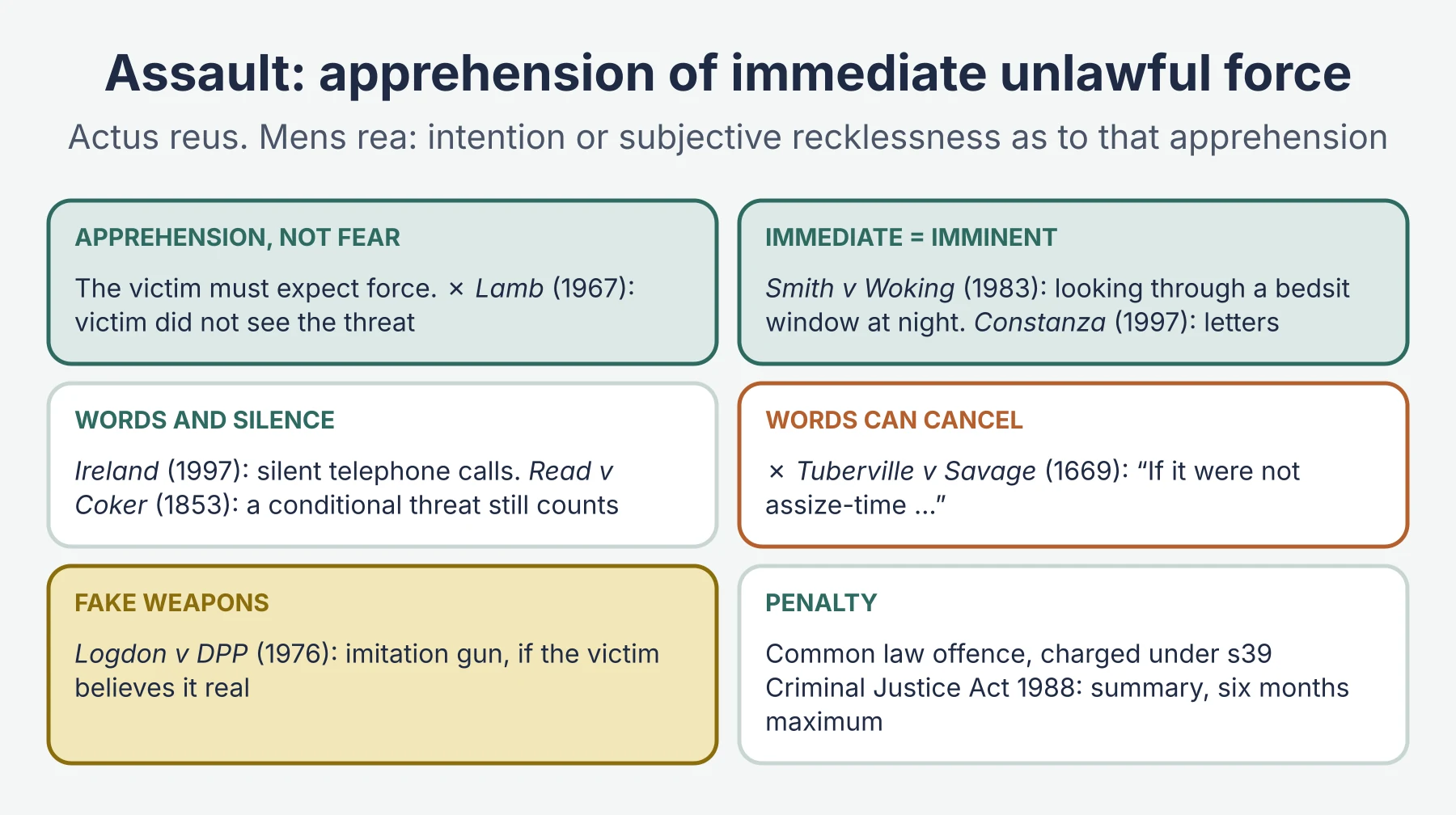
- Actus reus: causing apprehension of immediate unlawful force.
- No apprehension, no assault: Lamb (1967).
- Immediate = imminent: Smith v Woking (1983); Constanza (1997) letters.
- Words and silence: Ireland (silent calls); Tuberville v Savage (1669) words negating; Read v Coker (1853) conditional threat.
- Imitation weapon: Logdon v DPP (1976).
- Mens rea: intention or subjective recklessness as to causing apprehension (Savage; Parmenter, 1991).
Step 3: battery
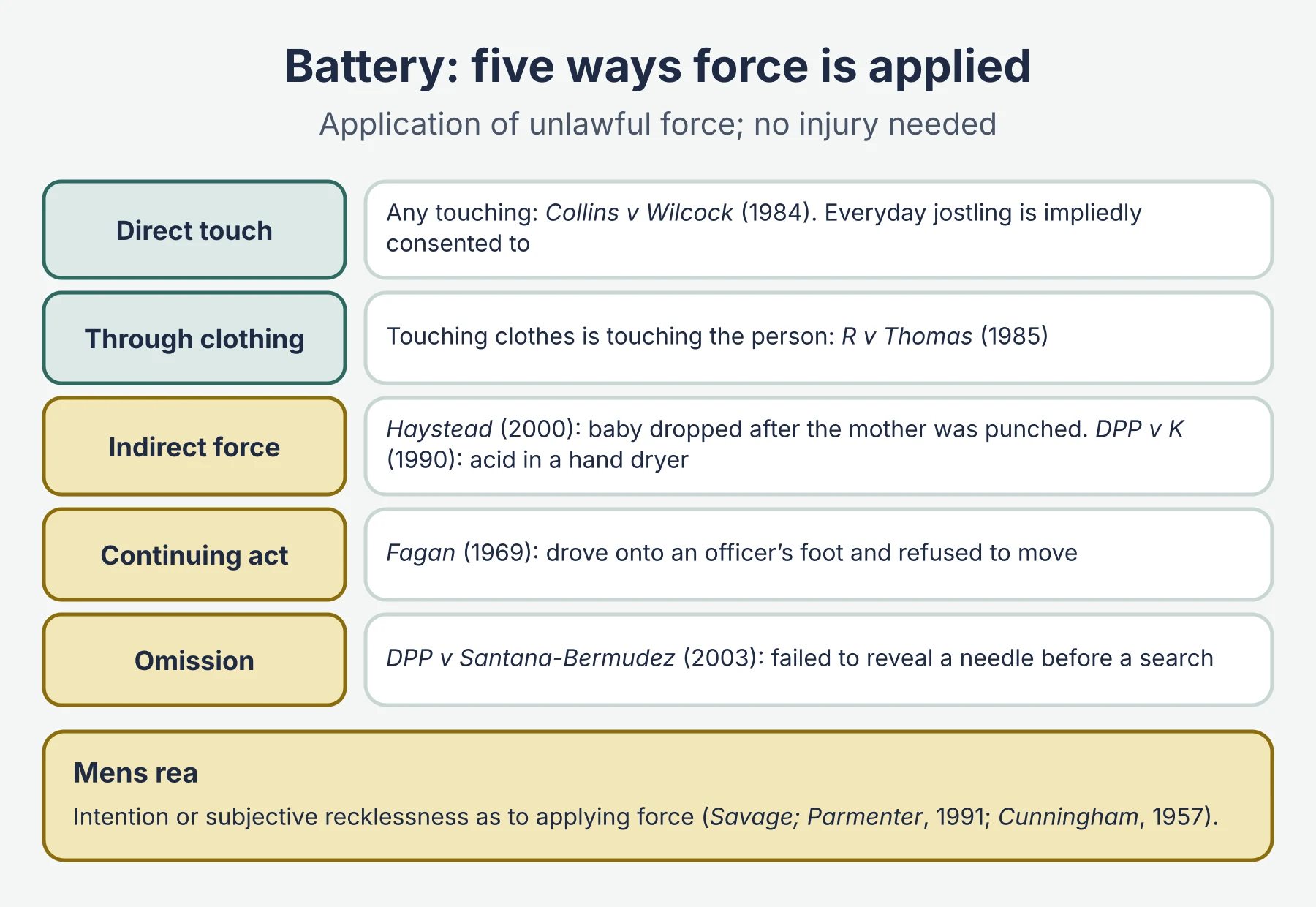
- Actus reus: application of unlawful force.
- Any touching: Collins v Wilcock; through clothes: Thomas (1985).
- Indirect: Haystead (2000); DPP v K (1990).
- Continuing act: Fagan (1969). Omission: Santana-Bermudez (2003).
- Mens rea: intention or subjective recklessness as to applying force.
Step 4: the 1861 Act offences
| s47 | s20 | s18 | |
|---|---|---|---|
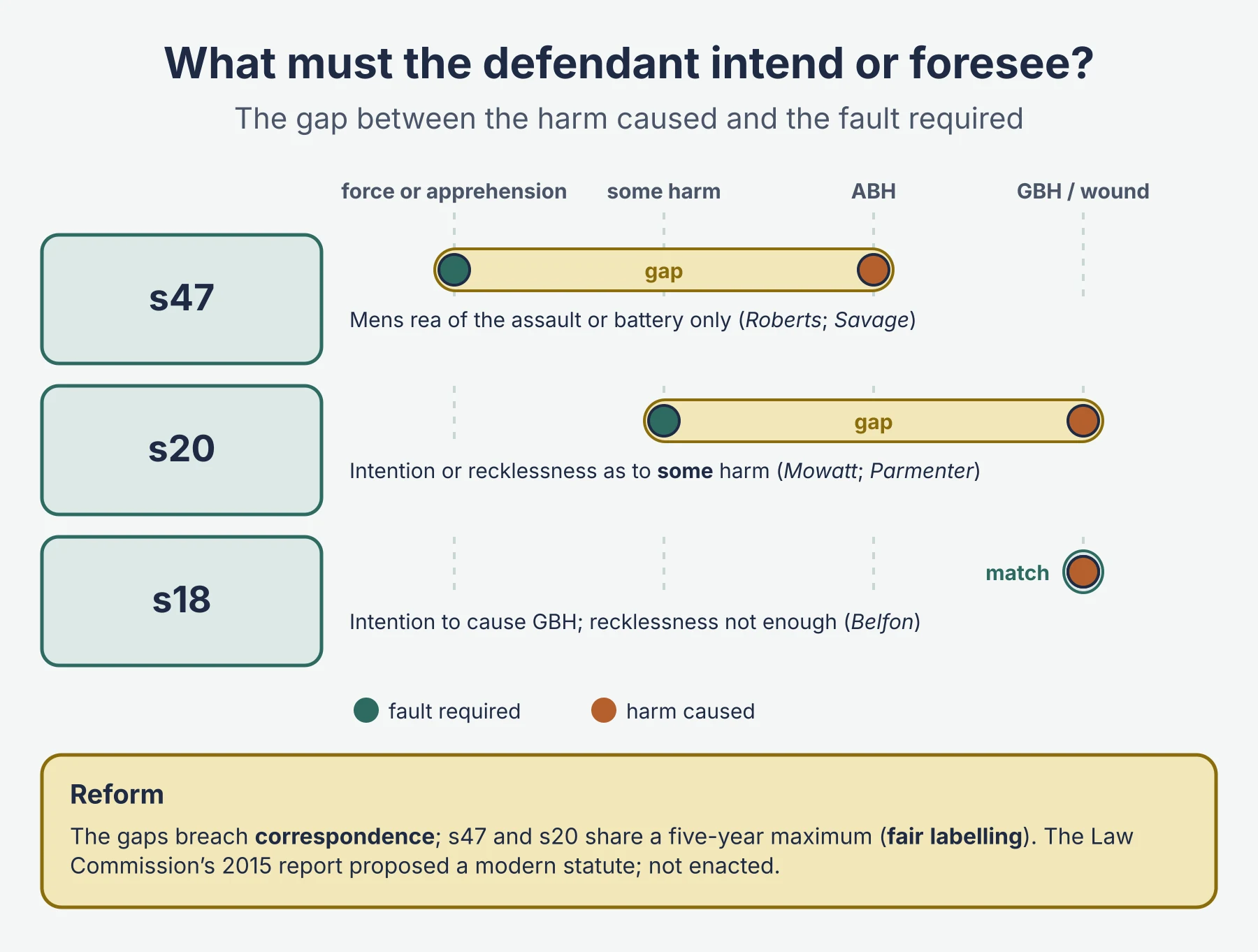
| Actus reus | Assault or battery occasioning ABH | Wound or inflict GBH | Wound or cause GBH |
| Mens rea | Mens rea of assault/battery only (Roberts, 1971; Savage) | Intention/recklessness as to some harm (Mowatt, 1968; Parmenter) | Intention to cause GBH (Belfon, 1976), or to resist arrest (Morrison, 1989) |
| Intent type | Basic | Basic | Specific |
| Maximum | 5 years | 5 years | Life |
“Inflict”: no force needed (Burstow). “Maliciously”: Cunningham (1957) subjective recklessness. Several injuries: can together be GBH (Brown and Stratton, 1998). Causation for s47: Roberts: victim’s foreseeable reaction.
Step 5: work down the ladder
Wound or GBH caused?
   yes -> intention to cause GBH (or to resist arrest)?  yes -> s18
                                                        no  -> foresaw some harm? yes -> s20
                                                                                 no  -> s47 if assault/battery mens rea
   no  -> ABH caused by an assault or battery?  yes -> s47
                                                no  -> force applied? battery : apprehension? assault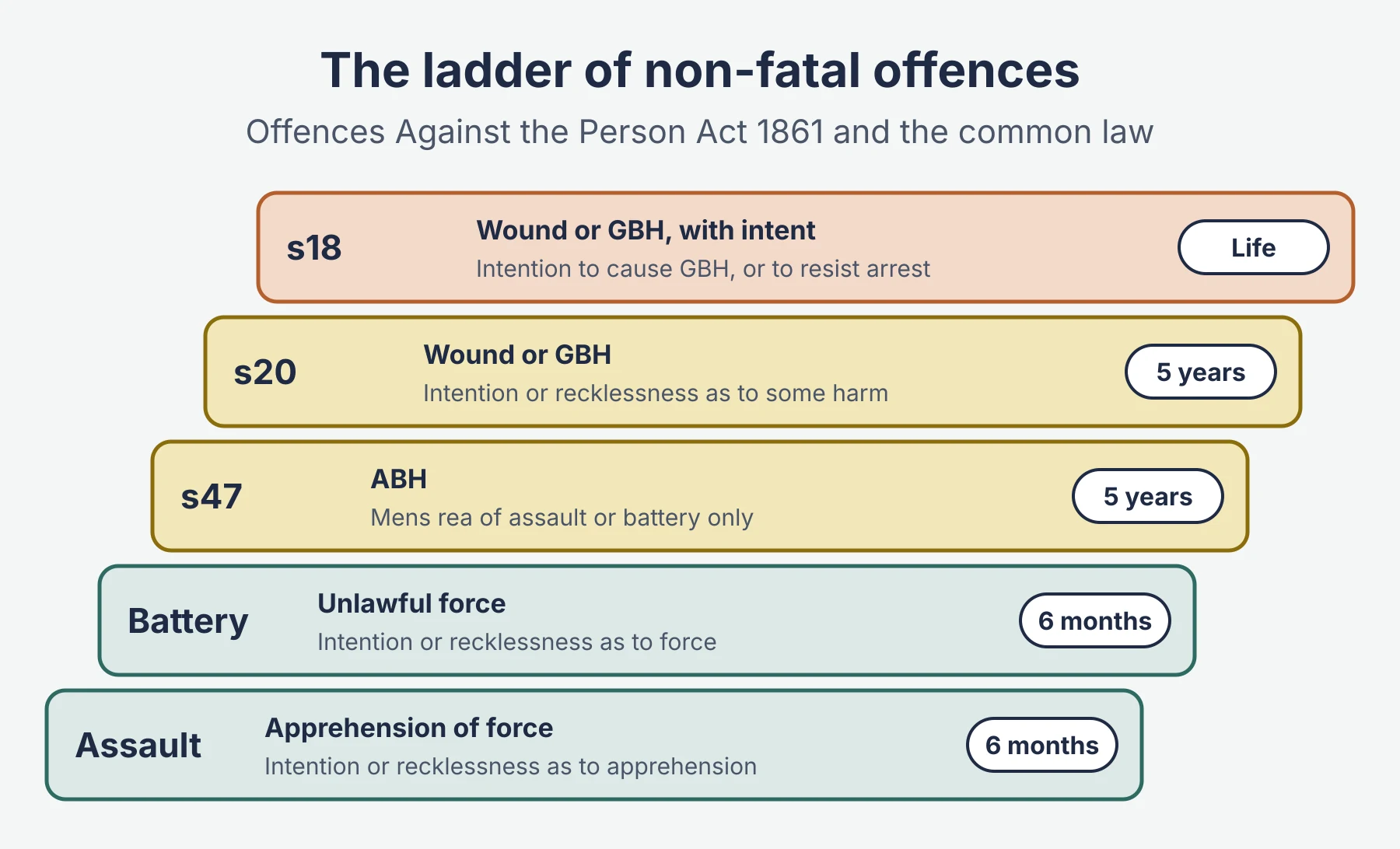
Mini applications
Scenario: A slaps B, leaving a red mark that fades in minutes.
- A red mark that fades quickly is probably transient or trifling, so not ABH (Miller).
- Force was applied intentionally: battery.
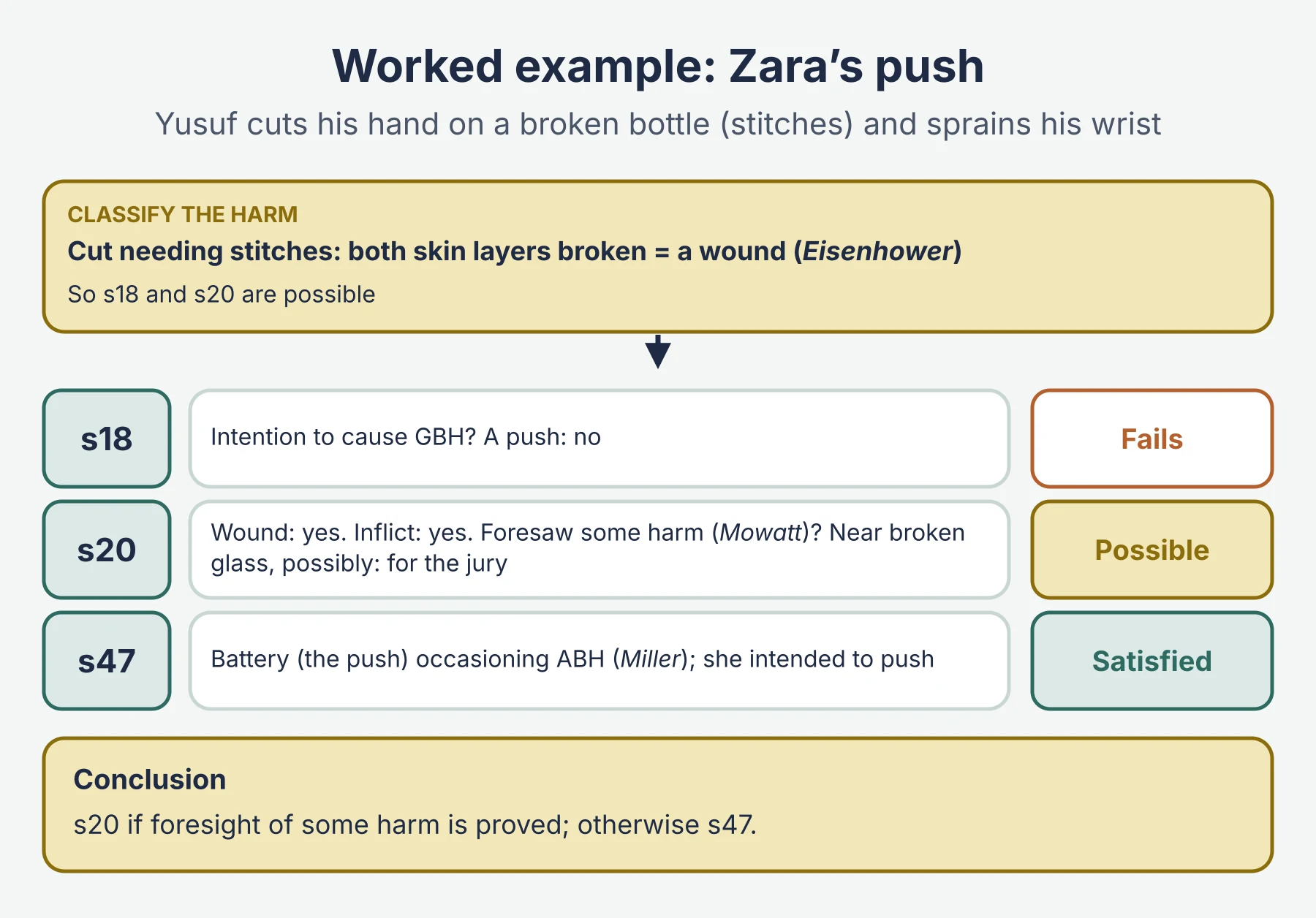
Scenario: C punches D, intending only to hurt; D’s eye socket is fractured.
- Fracture is GBH (DPP v Smith, 1961).
- No intention to cause GBH, so s18 fails.
- C intended some harm, so s20 (Mowatt).
Scenario: E shouts “I’m going to smash your face in” while walking towards F.
- F apprehends immediate force: assault.
- Words alone can be enough (Ireland).
Key terms
| Term | Meaning |
|---|---|
| Apprehension | Expectation of force, not necessarily fear |
| Immediate | Imminent, not necessarily instantaneous |
| Unlawful force | Force without consent or lawful justification |
| Occasioning | Causing |
| Actual bodily harm | Hurt or injury interfering with health or comfort, more than trifling |
| Wound | Break in both layers of the skin |
| Grievous bodily harm | Really serious harm |
| Maliciously | Intentionally or subjectively recklessly |
| Inflict | Cause; no application of force needed |
Evaluation points
- Correspondence breached: s47 (no foresight of harm), s20 (foresight of some harm for serious harm).
- Fair labelling: s47 and s20 share a maximum; “assault occasioning” covers batteries.
- Language: “maliciously”, “grievous”, “inflict” and “cause” are outdated or inconsistent.
- Reform: Law Commission report (2015) recommended a modern statute; not enacted.
- Defence of the law: judges have adapted the Act to psychiatric injury and disease (Burstow; Dica).
Exam traps
- Assault is about apprehension; battery is about force. A punch the victim sees coming is both.
- No injury is needed for battery.
- s47 needs no foresight of any harm.
- s20 needs foresight of some harm, not serious harm.
- Internal bleeding is not a wound.
- Recklessness is never enough for the GBH intent in s18.
Self-test
- What is the actus reus of assault?
- Which case shows that silent calls can be an assault?
- How can words prevent an assault? Give a case.
- Give a case on indirect battery.
- Define ABH, with an authority.
- Can psychiatric injury be ABH?
- What is the mens rea of s47?
- Define a wound.
- Which case says GBH is judged against the actual victim?
- What is the mens rea of s20?
- Is recklessness enough for s18?
- What is the maximum sentence for s20 and for s18?
Answers: 1. Causing the victim to apprehend immediate unlawful force. 2. R v Ireland (1997). 3. Words can show no force will be used; Tuberville v Savage (1669). 4. Haystead (2000) or DPP v K (1990). 5. Any hurt or injury calculated to interfere with health or comfort (Miller, 1954). 6. Yes, if it is a recognised psychiatric injury, not mere emotion (Chan-Fook, 1994). 7. The mens rea of the assault or battery only (Savage). 8. A break in both layers of the skin (Eisenhower). 9. R v Bollom (2003). 10. Intention or recklessness as to causing some harm (Mowatt). 11. No, there must be intention to cause GBH (Belfon) or to resist arrest. 12. Five years; life.
Test yourself further with the non-fatal offences practice questions.
Related resources
-
Study guides
AQA A Level Law (7162): Preliminary Offence – Attempt
Attempt under s1 Criminal Attempts Act 1981: more than merely preparatory acts, intention, impossibility and evaluation, with cases, for AQA A Level Law 7162.
Law · AQA · A Level
Read guide -
Practice questions
AQA A Level Law (7162): Preliminary Offence – Practice Questions
Original practice questions with mark-scheme answers on attempt: preparatory acts, intention and impossibility, for AQA A Level Law 7162 Paper 1.
Law · AQA · A Level
Try questions -
Revision notes
AQA A Level Law (7162): Preliminary Offence – Revision Notes
Recall notes on attempt under s1 Criminal Attempts Act 1981: actus reus cases, intention, impossibility and evaluation points, for AQA A Level Law 7162 Paper 1.
Law · AQA · A Level
Revise topic
Get free revision emails (optional)
Occasional emails with practice questions, worked explanations and links to free resources for the qualification and subjects you choose. No spam, and you can unsubscribe from any email. The free tools on this site never need an email.