
Revision Notes
AQA A Level Law (7162): Preliminary Offence – Revision Notes
Recall notes on attempt under s1 Criminal Attempts Act 1981: actus reus cases, intention, impossibility and evaluation points, for AQA A Level Law 7162 Paper 1.
- Subject
- Law
- Level
- A LEVELS
- Topic
- Criminal law
- Author
- Marlbridge Academic Team
- Updated
- Reviewed by
- Aizaz Raoof Ali (what this means)
Aligned to AQA A Level Law (7162), For teaching from September 2017 onwards, A-level exams 2019 onwards. Official specification .
Syllabus page (what it covers and how it is assessed): AQA A Level Law.
Syllabus points this page covers
7162
- Preliminary offence
Found an error? Report a correction.
Need help with this topic? Request a free trial class for A Level Law (7162).
Condensed notes for the section 3.2 row Preliminary offence: attempt under s1 Criminal Attempts Act 1981. For explanation and a worked problem, use the attempt study guide.
The offence
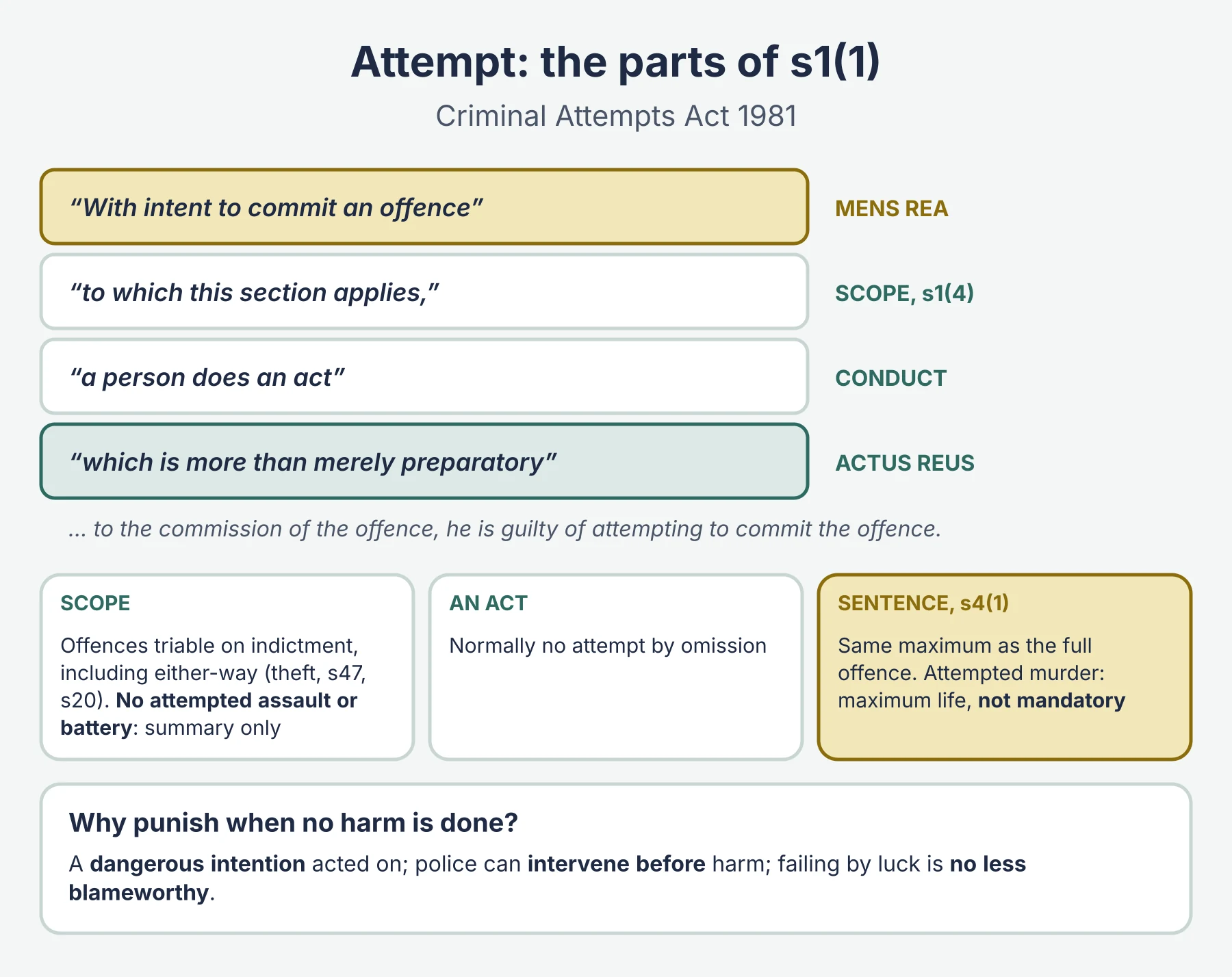
s1(1): with intent to commit an offence, a person does an act which is more than merely preparatory to its commission.
| Provision | Effect |
|---|---|
| s1(1) | Actus reus (act more than merely preparatory) and mens rea (intent) |
| s1(2) | Impossibility is no defence |
| s1(3) | D judged on the facts as he believed them |
| s1(4) | Applies to indictable (including either-way) offences, not summary ones |
| s4(1) | Same maximum sentence as the full offence |
| s4(3) | Judge: is there evidence? Jury: was the act more than merely preparatory? |
Actus reus cases
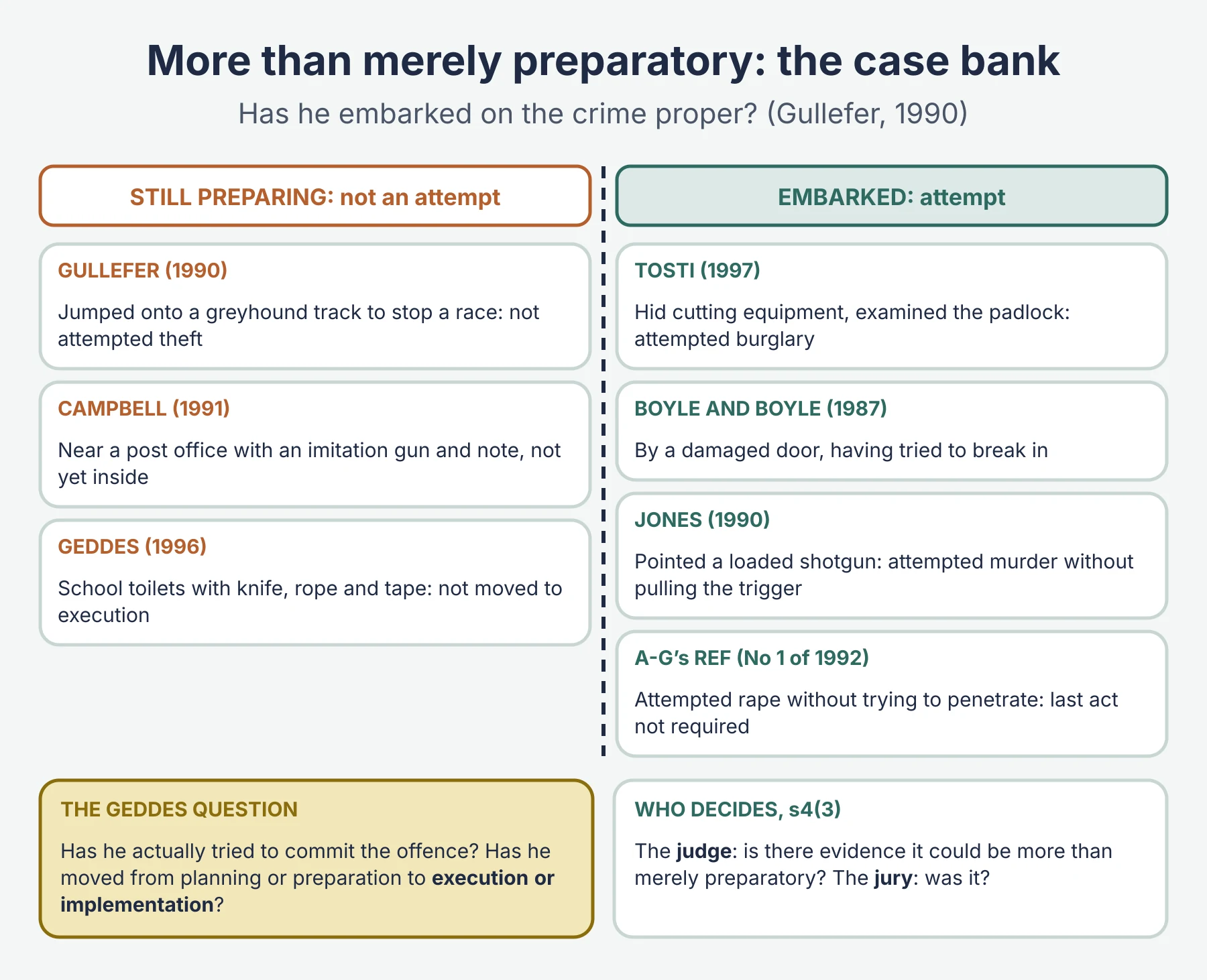
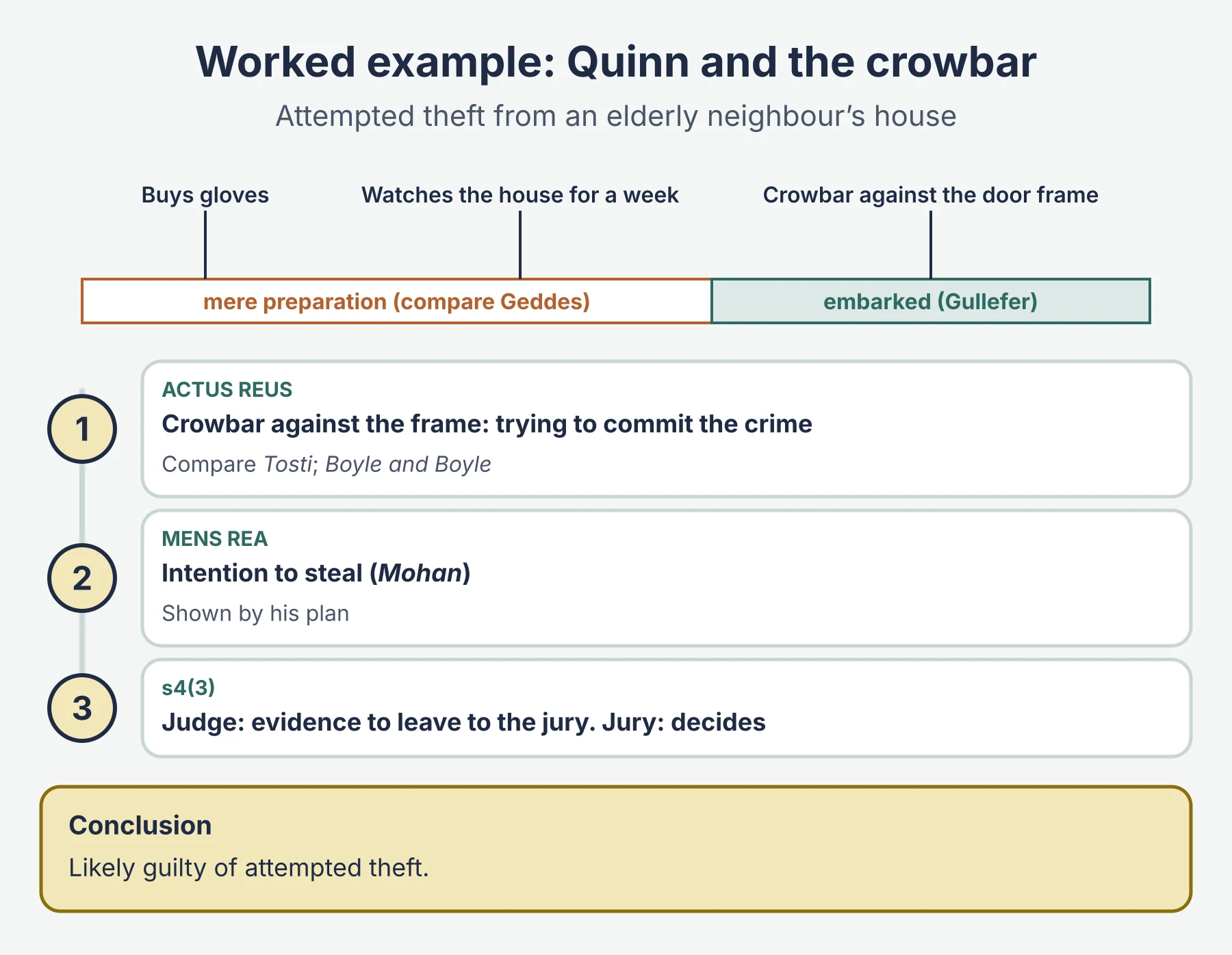
Test: has D “embarked on the crime proper”? (Gullefer, 1990). Has he moved from planning or preparation to execution or implementation? (Geddes, 1996). The last act is not needed.
| Not yet an attempt | An attempt |
|---|---|
| Gullefer (1990): on the track, still preparing | Jones (1990): loaded gun pointed at the victim |
| Campbell (1991): outside the post office | Tosti (1997): examining the padlock |
| Geddes (1996): in school toilets with kit | Boyle and Boyle (1987): at the damaged door |
| A-G’s Ref (No 1 of 1992) (1993): last act not needed |
Tip: in a problem, find the case with the closest facts and argue by analogy.
Mens rea
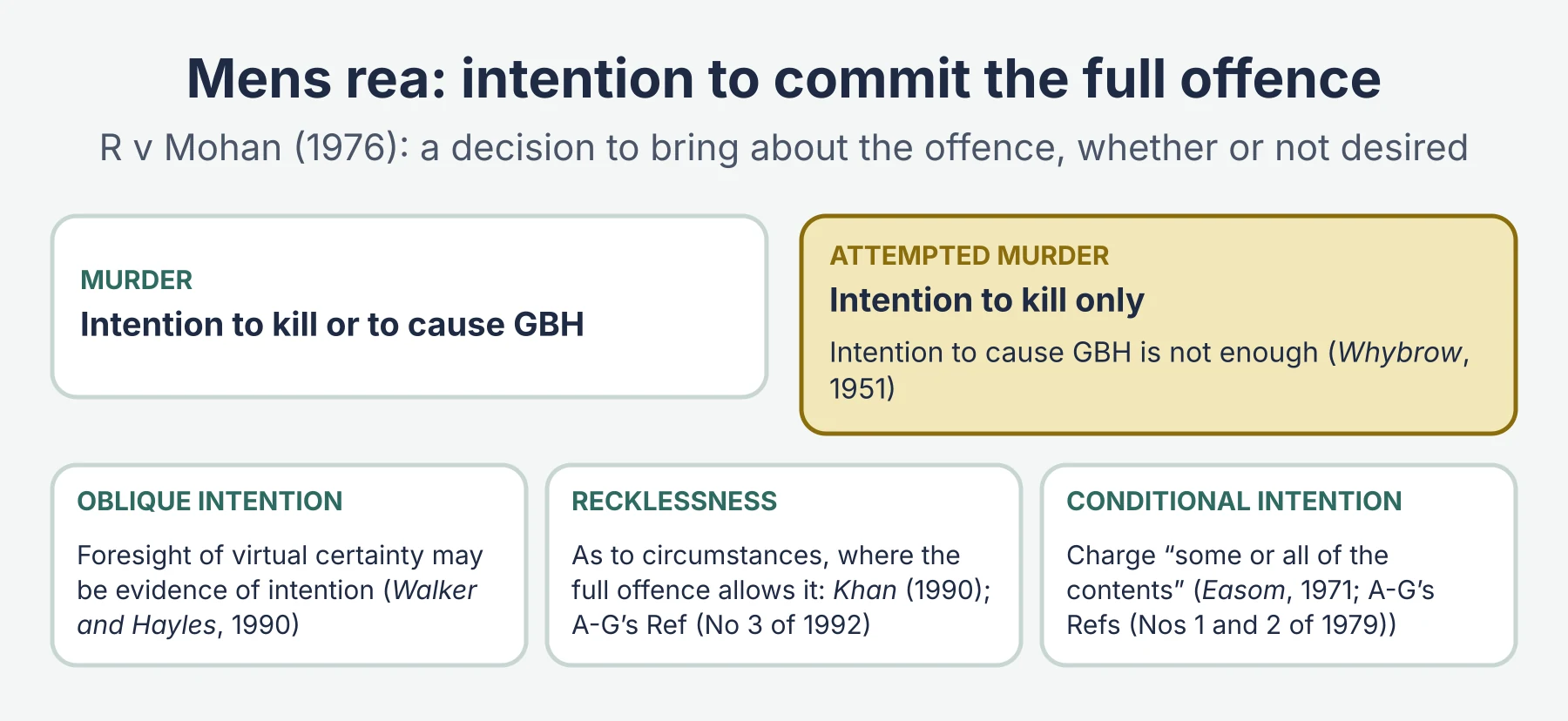
- Intention to commit the full offence: Mohan (1976): a decision to bring about the offence, whether or not desired.
- Attempted murder = intent to kill only: Whybrow (1951).
- Oblique intention possible: Walker and Hayles (1990).
- Recklessness as to circumstances can suffice: Khan (1990); A-G’s Ref (No 3 of 1992) (1994).
- Conditional intention: charge carefully (Easom, 1971; A-G’s Refs (Nos 1 and 2 of 1979)).
Impossibility
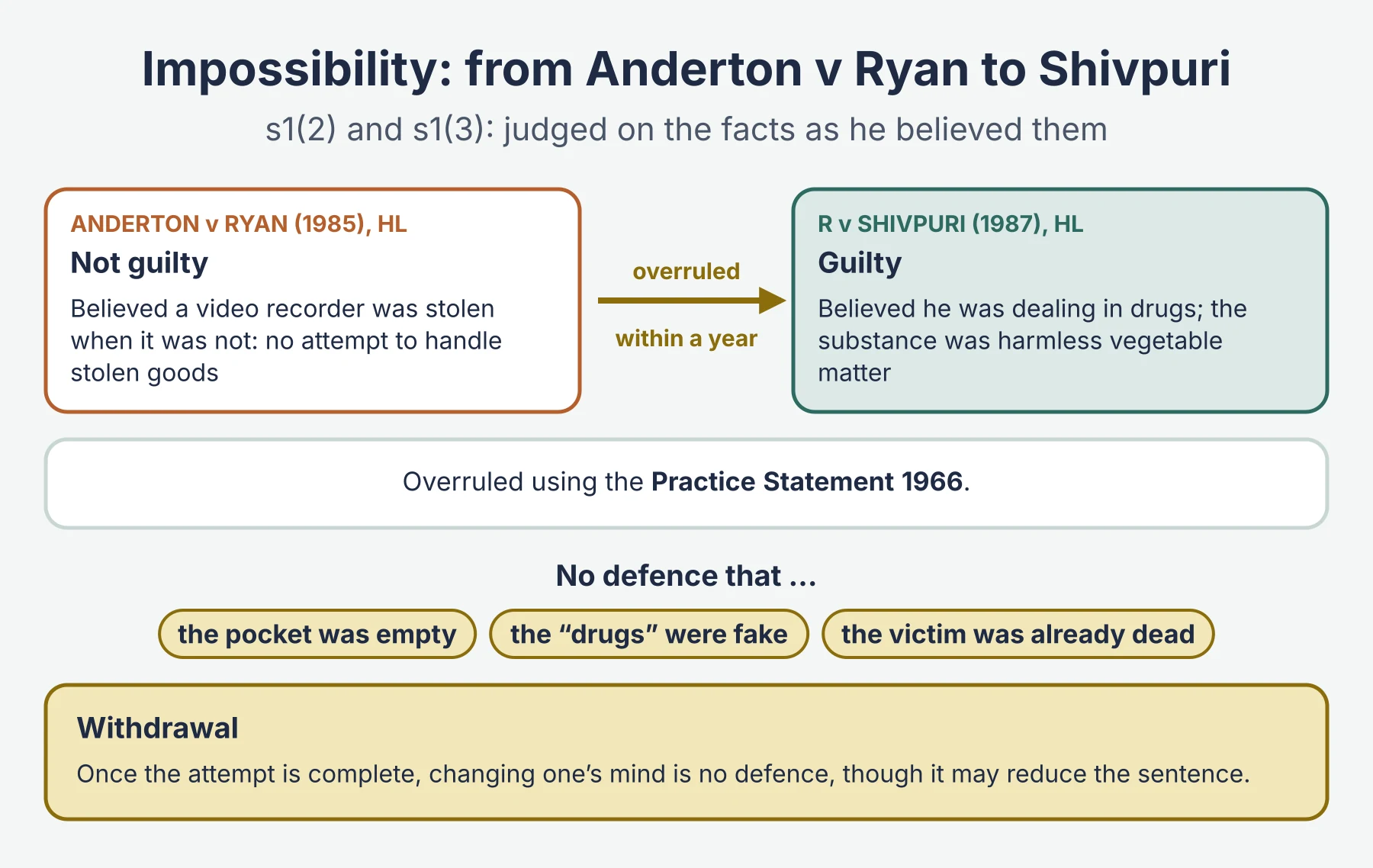
Anderton v Ryan (1985)  - HL: no attempt to handle goods believed stolen but not
        |
        | overruled using the Practice Statement 1966
        v
R v Shivpuri (1987)     - HL: guilty of attempting drug offence; substance harmless
Impossibility through facts (empty pocket, fake drugs, dead victim) is no defence under s1(2) and s1(3).
Answer sequence for an attempt problem
- Name the full offence and check it is not summary-only (s1(4)).
- Actus reus: compare the last thing D did with the closest case (Campbell, Geddes, Jones, Tosti).
- Note the s4(3) split between judge and jury.
- Mens rea: intention for the full offence; for murder, intent to kill only.
- Impossibility, if raised: s1(2), s1(3), Shivpuri.
- Conclude on the attempt; if it fails, check whether any completed lesser offence exists.
Mini application: X, intending to steal from a car, is seen trying door handles along a street.
- Trying handles is arguably the start of the theft itself, not mere preparation (compare Tosti).
- Intention to steal is shown by his conduct.
- Likely attempted theft, for the jury.
Key terms
| Term | Meaning |
|---|---|
| Inchoate offence | An offence that is incomplete or preliminary |
| More than merely preparatory | Beyond preparation; embarked on the crime proper |
| Last act test | Old test requiring the final act before the crime; no longer required |
| Specific intent | Attempt can be committed only with intention as to the full offence |
| Factual impossibility | The crime could not be completed because of the facts |
| Practice Statement 1966 | Allowed the House of Lords (now Supreme Court) to depart from its own decisions |
| Withdrawal | Changing one’s mind; no defence once the attempt is complete |
Evaluation points
- Vagueness: “more than merely preparatory” gives inconsistent outcomes (Campbell, Geddes versus Tosti): maximum certainty problem.
- Policy: police may have to wait until the victim is at risk (Geddes).
- Fault: subjective intention fits the fault principle; but intent to kill for attempted murder is narrower than murder.
- Harm: no harm caused, yet same maximum sentence.
- Impossibility: Shivpuri is logical given s1(3), but punishes a guilty mind with a harmless act.
- Reform: Law Commission consultation in 2007, including a criminal preparation offence; no change made.
Exam traps
- Requiring the last act.
- Using GBH intent for attempted murder.
- Citing Anderton v Ryan as good law.
- Attempting a summary offence such as battery.
- Forgetting to identify the full offence first.
Self-test
- State s1(1) Criminal Attempts Act 1981.
- What phrase did Lord Lane use in Gullefer?
- Why was Campbell not guilty of attempted robbery?
- Why was Jones guilty of attempted murder?
- What did A-G’s Reference (No 1 of 1992) decide?
- Who decides whether an act is more than merely preparatory?
- What mens rea is needed for attempted murder? Give a case.
- How did Mohan define intention for attempts?
- What does s1(2) say about impossibility?
- Which case overruled Anderton v Ryan, and how?
- Can a person attempt to commit battery?
- What is the maximum sentence for an attempt?
Answers: 1. If, with intent to commit an offence, a person does an act more than merely preparatory to its commission, he is guilty of attempting to commit it. 2. “Embarked on the crime proper”. 3. He had not entered the post office, so he was still preparing. 4. Pointing a loaded gun at the victim went beyond preparation, even though he had not pulled the trigger. 5. The last act is not required for an attempt. 6. The jury, if the judge finds there is evidence on which it could be so found (s4(3)). 7. Intention to kill; Whybrow (1951). 8. A decision to bring about the commission of the offence, so far as it lies within D’s power, whether or not desired. 9. A person may be guilty even though the facts make the offence impossible. 10. R v Shivpuri (1987), using the Practice Statement 1966. 11. No, it is a summary offence. 12. The same as for the full offence.
Test yourself further with the attempt practice questions.
Related resources
-
Study guides
AQA A Level Law (7162): Property Offences
Theft under ss1-6 and robbery under s8 Theft Act 1968, section by section with leading cases and a worked problem, for AQA A Level Law 7162 Paper 1.
Law · AQA · A Level
Read guide -
Practice questions
AQA A Level Law (7162): Property Offences – Practice Questions
Original practice questions with mark-scheme answers on theft under ss1-6 and robbery under s8 Theft Act 1968 for AQA A Level Law 7162 Paper 1.
Law · AQA · A Level
Try questions -
Revision notes
AQA A Level Law (7162): Property Offences – Revision Notes
Recall notes on theft (ss1-6) and robbery (s8) of the Theft Act 1968, with a case for each element and common traps, for AQA A Level Law 7162 Paper 1.
Law · AQA · A Level
Revise topic
Get free revision emails (optional)
Occasional emails with practice questions, worked explanations and links to free resources for the qualification and subjects you choose. No spam, and you can unsubscribe from any email. The free tools on this site never need an email.