
Study Guides
AQA A Level Law (7162): Capacity Defences
Insanity, automatism and voluntary and involuntary intoxication: tests, leading cases and the internal and external cause line, for AQA A Level Law 7162.
- Subject
- Law
- Level
- A LEVELS
- Topic
- Criminal law
- Author
- Marlbridge Academic Team
- Updated
- Reviewed by
- Aizaz Raoof Ali (what this means)
Aligned to AQA A Level Law (7162), For teaching from September 2017 onwards, A-level exams 2019 onwards. Official specification .
Syllabus page (what it covers and how it is assessed): AQA A Level Law.
Syllabus points this page covers
7162
- Capacity defences
Found an error? Report a correction.
Need help with this topic? Request a free trial class for A Level Law (7162).
This guide covers the section 3.2 row Capacity defences in AQA A-level Law (7162). The specification lists three: insanity, automatism and intoxication. They are grouped as “capacity” defences because each says that the defendant’s mental capacity at the time was so affected that he either lacked the mens rea or did not act voluntarily. They overlap, and the commonest exam task is to decide which applies: the answer depends on the cause of the condition. For an overview of all the defences, see the Criminal Offences and Defences study guide.
Insanity
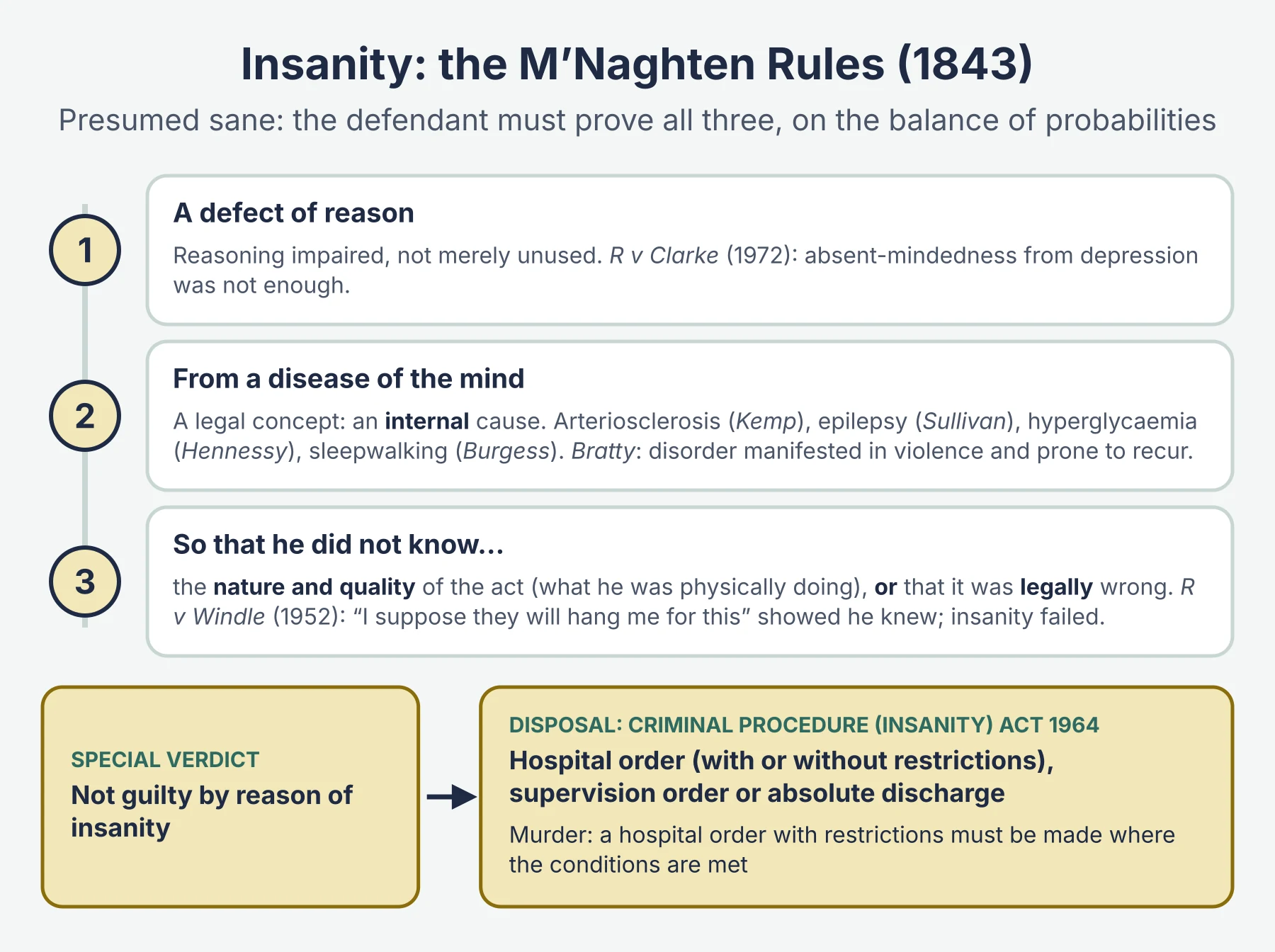
The M’Naghten Rules (1843). Everyone is presumed sane. To establish insanity, the defendant must prove, on the balance of probabilities, that at the time of the act he was:
- labouring under such a defect of reason,
- from disease of the mind,
- as not to know the nature and quality of the act he was doing, or, if he did know it, that he did not know what he was doing was wrong.
Defect of reason. The defendant’s powers of reasoning must be impaired, not merely unused. Absent-mindedness from depression, which led a woman to leave a shop without paying, was not a defect of reason (R v Clarke, 1972).
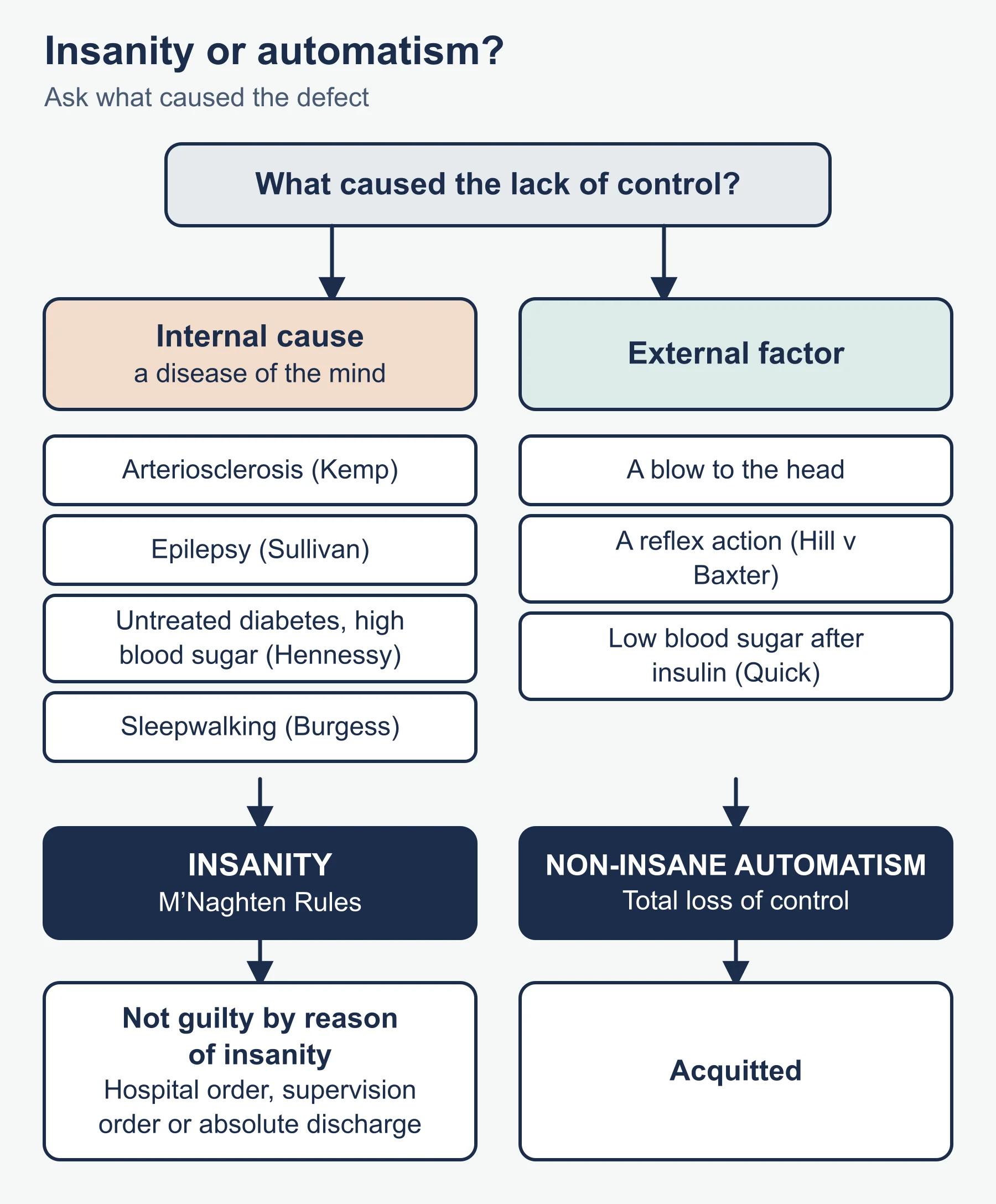
Disease of the mind is a legal, not a medical, concept. What matters is whether the cause is internal:
- Arteriosclerosis affecting the brain’s blood supply was a disease of the mind; the condition of the mind, not the brain, is what counts (R v Kemp, 1956).
- Epilepsy was a disease of the mind (R v Sullivan, 1984).
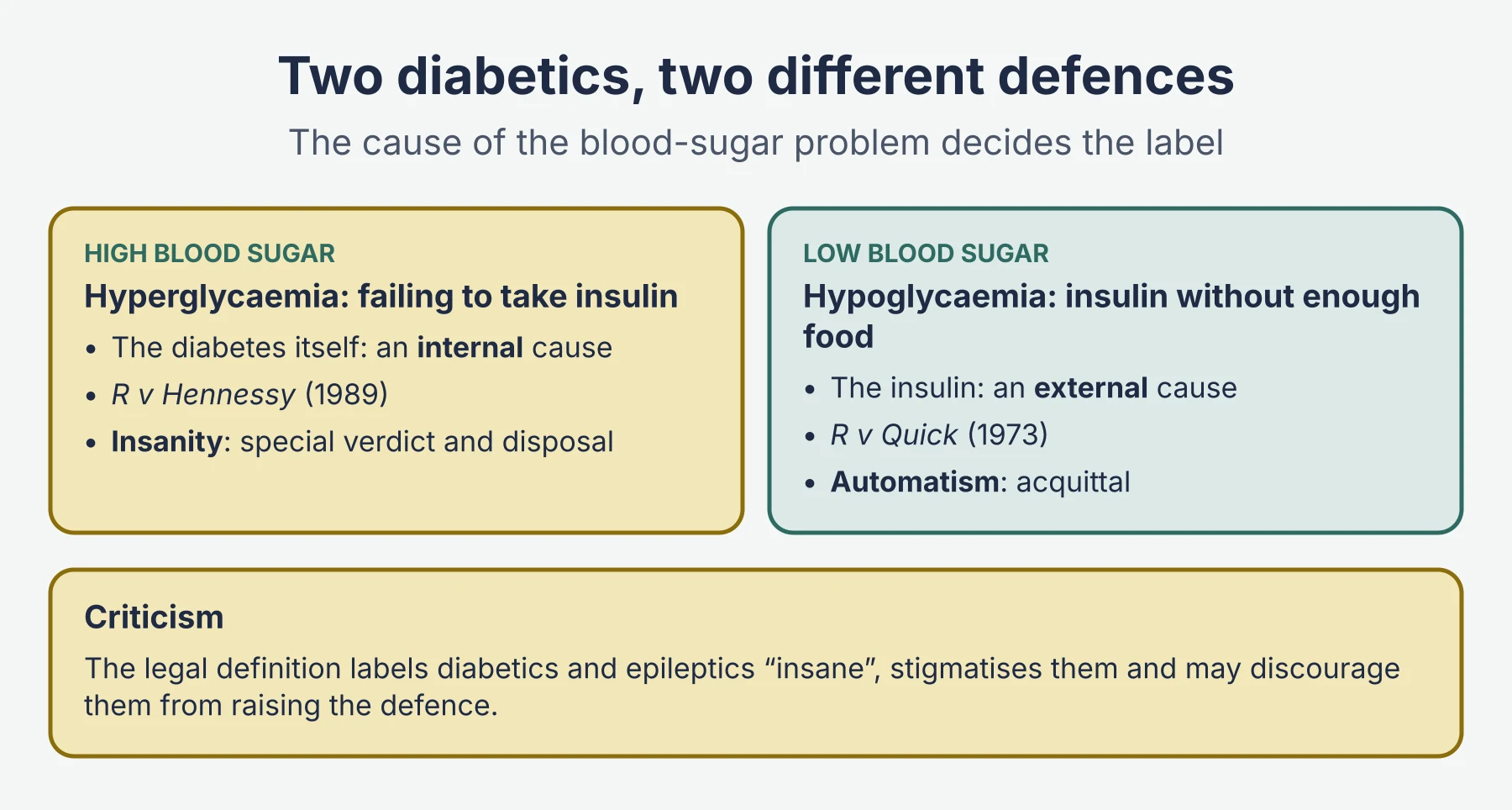
- Hyperglycaemia (high blood sugar from failing to take insulin) was a disease of the mind (R v Hennessy, 1989).
- Sleepwalking from an internal cause was insanity (R v Burgess, 1991).
- Lord Denning’s guide in Bratty v Attorney-General for Northern Ireland (1963): any mental disorder which has manifested itself in violence and is prone to recur is a disease of the mind.
Not knowing the nature and quality of the act means not knowing what one is physically doing. Not knowing it was wrong means not knowing it was legally wrong. In R v Windle (1952) the defendant, who said “I suppose they will hang me for this” after poisoning his wife, knew it was legally wrong, so insanity failed, even though he was mentally ill.
Verdict and disposal. The jury returns a special verdict of not guilty by reason of insanity. Under the Criminal Procedure (Insanity) Act 1964, as amended, the judge may then make a hospital order (with or without restrictions), a supervision order or an absolute discharge. For murder, where the conditions for a hospital order are met, a hospital order with restrictions must be made.
Automatism
Definition. In Bratty Lord Denning described an automatic act as one “done by the muscles without any control by the mind, such as a spasm, a reflex action or a convulsion”. Non-insane automatism is a complete defence leading to an acquittal, because there is no voluntary actus reus.
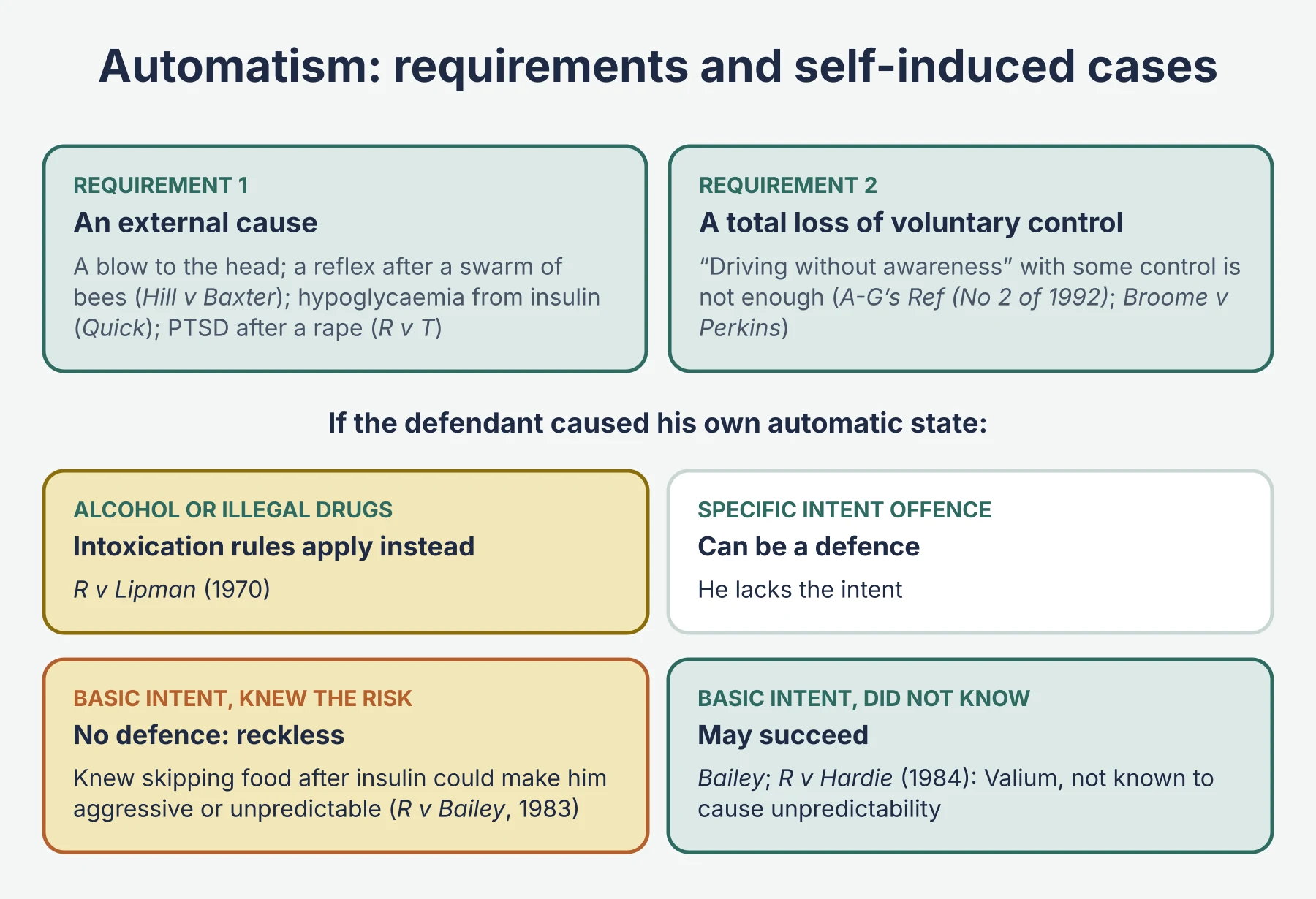
Requirements
- An external cause: for example a blow to the head, a reflex after being attacked by a swarm of bees (an example given in Hill v Baxter, 1958), or hypoglycaemia caused by taking insulin without eating enough (R v Quick, 1973). Post-traumatic stress disorder triggered by a rape was accepted as an external cause in R v T (1990).
- A total loss of voluntary control. Reduced or partial control is not enough: a driver who was “driving without awareness” but still had some control could not rely on the defence (Attorney-General’s Reference (No 2 of 1992), 1993; see also Broome v Perkins, 1987).
Self-induced automatism. Where the defendant caused his own automatic state:
- For specific intent offences, self-induced automatism can be a defence, since the defendant lacks the intent.
- For basic intent offences, it is no defence if the defendant was reckless in becoming an automaton, for example knowing that failing to eat after insulin could make him aggressive or unpredictable (R v Bailey, 1983).
- If the defendant did not know of the risk, the defence may succeed even for basic intent offences (Bailey; R v Hardie, 1984, where the defendant took Valium, a sedative, which he did not know could make him unpredictable).
- If the automatism results from voluntarily taking alcohol or illegal drugs, the intoxication rules apply instead (R v Lipman, 1970).
Intoxication
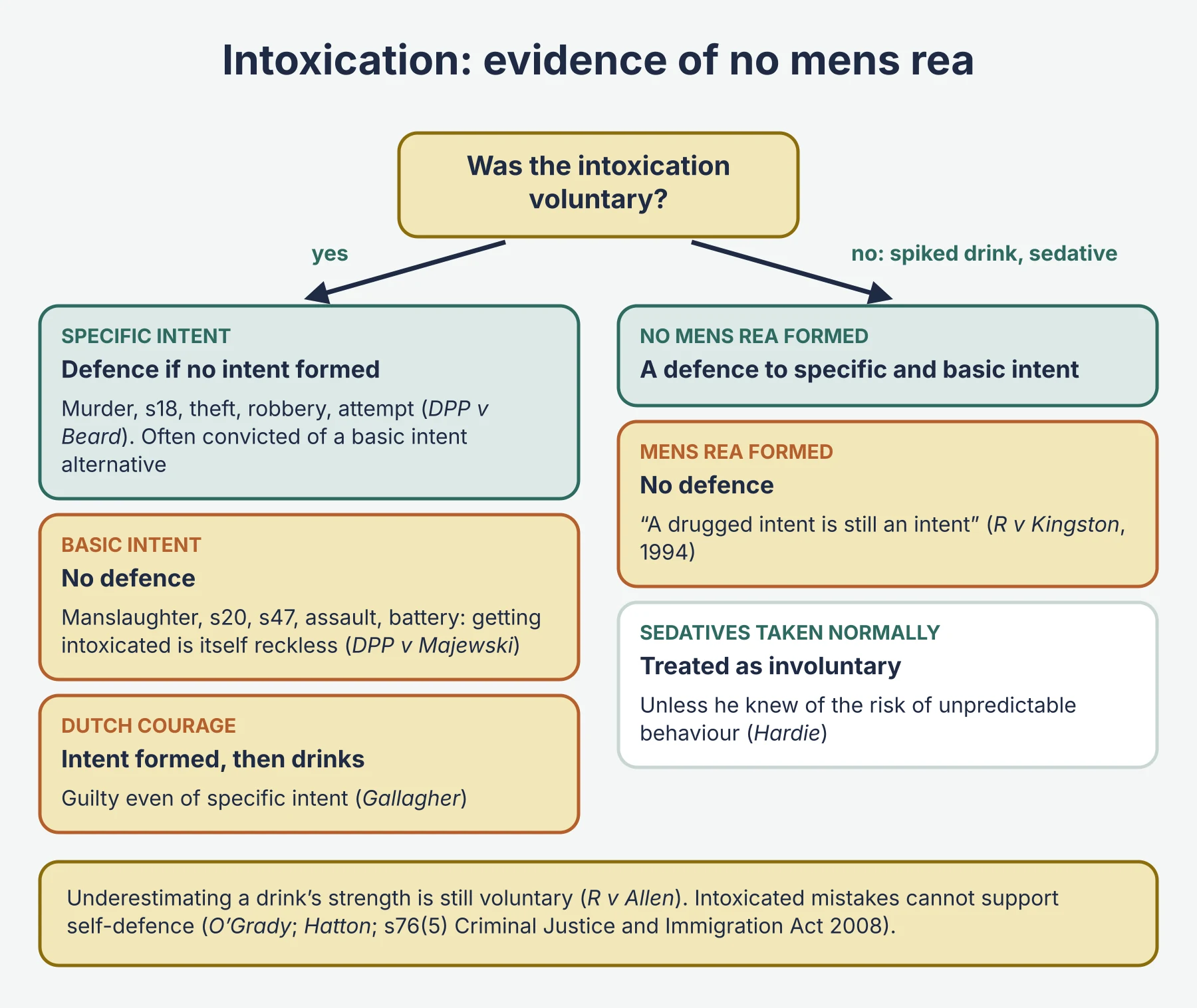
Intoxication is not really a defence in its own right; it is evidence that the defendant lacked mens rea. Whether that evidence is allowed depends on whether the intoxication was voluntary and whether the offence is specific or basic intent.
Voluntary intoxication
- Specific intent offences (murder, s18, theft, robbery, attempt): voluntary intoxication can be a defence if the defendant was so intoxicated that he did not form the intent (DPP v Beard, 1920). He will often be convicted of a basic intent alternative: manslaughter instead of murder, s20 instead of s18.
- Basic intent offences (manslaughter, s20, s47, assault, battery): voluntary intoxication is no defence, because becoming intoxicated is itself reckless (DPP v Majewski, 1977).
- Dutch courage: a defendant who forms the intent and then drinks to give himself the courage to act is guilty even of a specific intent offence (Attorney-General for Northern Ireland v Gallagher, 1963).
- Underestimating the strength of a drink knowingly taken is still voluntary intoxication (R v Allen, 1988).
Involuntary intoxication
This covers drinks spiked without the defendant’s knowledge and the unexpected effects of prescribed or non-dangerous drugs.
- It is a defence to both specific and basic intent offences if the defendant did not form the mens rea.
- If the defendant did form the mens rea, involuntary intoxication is no defence: “a drugged intent is still an intent” (R v Kingston, 1994), where a man whose coffee was drugged sexually assaulted a boy while still having the intention to do so.
- Sedative drugs taken in the normal way are treated like involuntary intoxication unless the defendant knew of the risk of unpredictable behaviour (Hardie).
Intoxicated mistakes
A mistaken belief caused by voluntary intoxication cannot be relied on for self-defence (R v O’Grady, 1987; R v Hatton, 2005; s76(5) Criminal Justice and Immigration Act 2008).
The cause decides the defence
| Cause | Defence | Effect |
|---|---|---|
| Internal disease affecting reasoning (epilepsy, hyperglycaemia, internal sleepwalking) | Insanity | Special verdict; disposal |
| External factor causing total loss of control (blow, reflex, hypoglycaemia from insulin) | Automatism | Acquittal |
| External but self-induced, reckless | Automatism fails for basic intent | Conviction possible |
| Alcohol or illegal drugs voluntarily taken | Voluntary intoxication | Specific intent only, if no intent formed |
| Spiked drink or unexpected effect of a sedative | Involuntary intoxication | Defence only if no mens rea |
Worked example
Ria, a diabetic, injects insulin and then skips breakfast. At work she becomes confused and pushes a colleague down stairs, breaking his arm. She knew that skipping meals after insulin could make her behave unpredictably.
Charge:     s20 (GBH - broken arm), a basic intent offence.
Cause:      hypoglycaemia from insulin = EXTERNAL (Quick), so automatism,
            not insanity (contrast Hennessy, hyperglycaemia).
Control:    confused - was it a total loss of control? (A-G's Ref No 2
            of 1992). If only reduced, the defence fails anyway.
Self-induced: she knew of the risk, so she was reckless (Bailey).
            Self-induced automatism is no defence to basic intent.
Conclusion: Automatism is unlikely to succeed; she may be guilty of s20.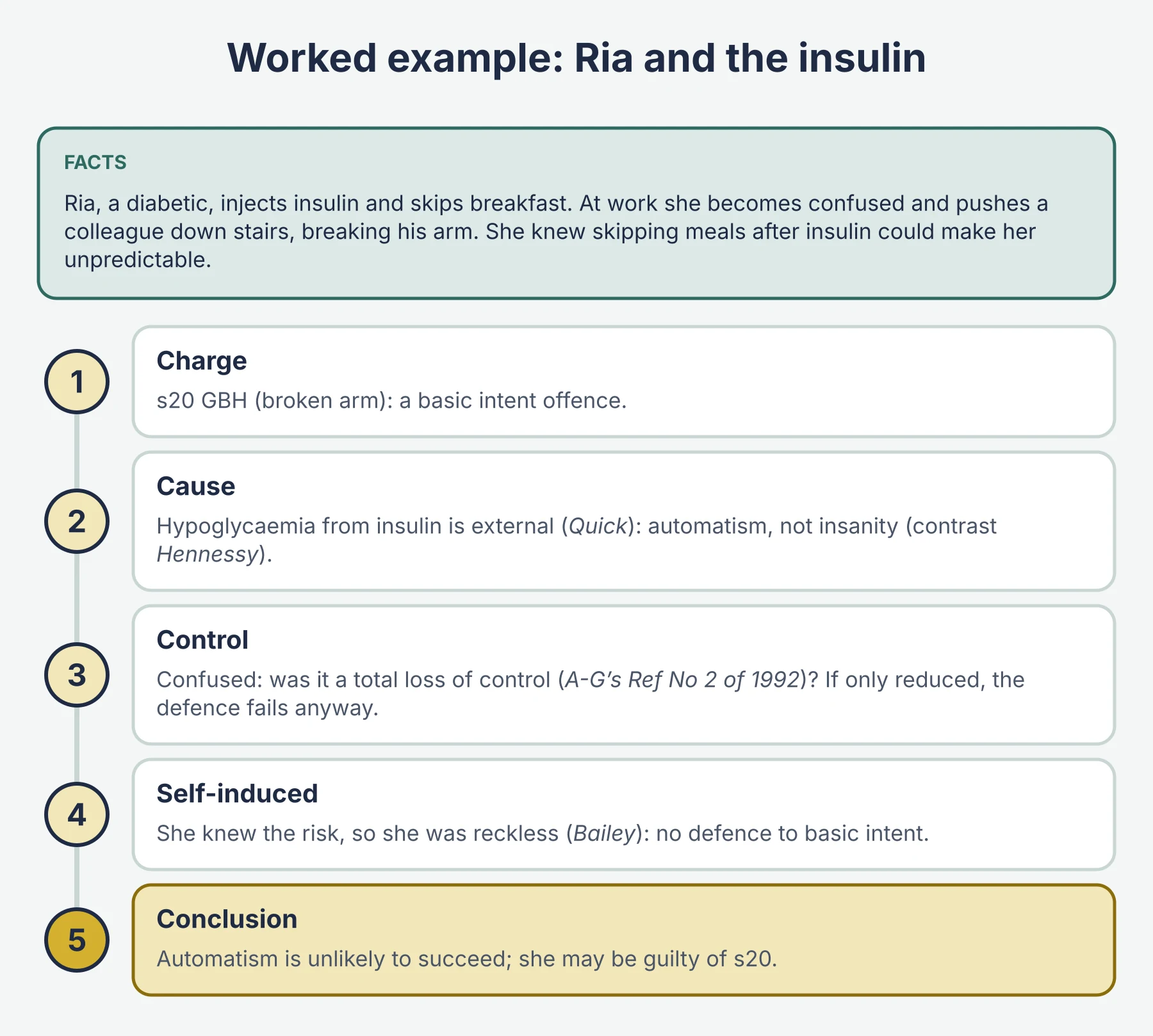
Evaluation
- Insanity’s legal definition labels diabetics and epileptics “insane”, stigmatises them and may discourage them from raising the defence; it also means two diabetics are treated differently according to whether their blood sugar was high or low.
- Windle’s “legally wrong” test excludes defendants who are seriously ill but know their act is illegal.
- The burden on the defendant for insanity sits uneasily with Woolmington.
- The Law Commission’s 2013 discussion paper on insanity and automatism proposed replacing the insanity defence with a new special defence of “not criminally responsible by reason of a recognised medical condition”; it has not been enacted.
- The Majewski rule is criticised as illogical because it ignores a genuine lack of mens rea, but defended as protecting the public from intoxicated violence.
Common mistakes
- Treating insanity as a medical question.
- Getting the diabetes cases the wrong way round.
- Accepting partial loss of control for automatism.
- Allowing voluntary intoxication as a defence to s20 or manslaughter.
- Forgetting Kingston: involuntary intoxication fails where the mens rea was formed.
Exam technique
Identify the cause of the condition first, then choose the defence. State its test, apply each element and state the outcome: special verdict, acquittal, conviction of a lesser basic intent offence or conviction as charged.
More resources on this topic
Capacity defences revision notes | Capacity defences practice questions
Related resources
-
Practice questions
AQA A Level Law (7162): Capacity Defences – Practice Questions
Original practice questions with mark-scheme answers on insanity, automatism and voluntary and involuntary intoxication for AQA A Level Law 7162 Paper 1.
Law · AQA · A Level
Try questions -
Revision notes
AQA A Level Law (7162): Capacity Defences – Revision Notes
Recall notes on insanity, automatism and intoxication with the M'Naghten test, internal and external causes and the Majewski rule, for AQA A Level Law 7162.
Law · AQA · A Level
Revise topic -
Study guides
AQA A Level Law (7162): Fatal Offences Against the Person
Murder, loss of control, diminished responsibility, unlawful act and gross negligence manslaughter, with cases and a worked problem, for AQA A Level Law 7162.
Law · AQA · A Level
Read guide
Get free revision emails (optional)
Occasional emails with practice questions, worked explanations and links to free resources for the qualification and subjects you choose. No spam, and you can unsubscribe from any email. The free tools on this site never need an email.