
Revision Notes
AQA A Level Law (7162): Capacity Defences – Revision Notes
Recall notes on insanity, automatism and intoxication with the M'Naghten test, internal and external causes and the Majewski rule, for AQA A Level Law 7162.
- Subject
- Law
- Level
- A LEVELS
- Topic
- Criminal law
- Author
- Marlbridge Academic Team
- Updated
- Reviewed by
- Aizaz Raoof Ali (what this means)
Aligned to AQA A Level Law (7162), For teaching from September 2017 onwards, A-level exams 2019 onwards. Official specification .
Syllabus page (what it covers and how it is assessed): AQA A Level Law.
Syllabus points this page covers
7162
- Capacity defences
Found an error? Report a correction.
Need help with this topic? Request a free trial class for A Level Law (7162).
Condensed notes for the section 3.2 row Capacity defences: insanity, automatism and intoxication. For explanation and a worked problem, use the capacity defences study guide.
Choose the defence by its cause
What caused the condition?
  Internal disease affecting reasoning ............... INSANITY
  External factor, total loss of control ............. AUTOMATISM
       ... but self-induced and reckless ............. no defence to basic intent
  Alcohol / illegal drugs, voluntarily taken ......... VOLUNTARY INTOXICATION
  Spiked drink / unexpected effect of a sedative ..... INVOLUNTARY INTOXICATION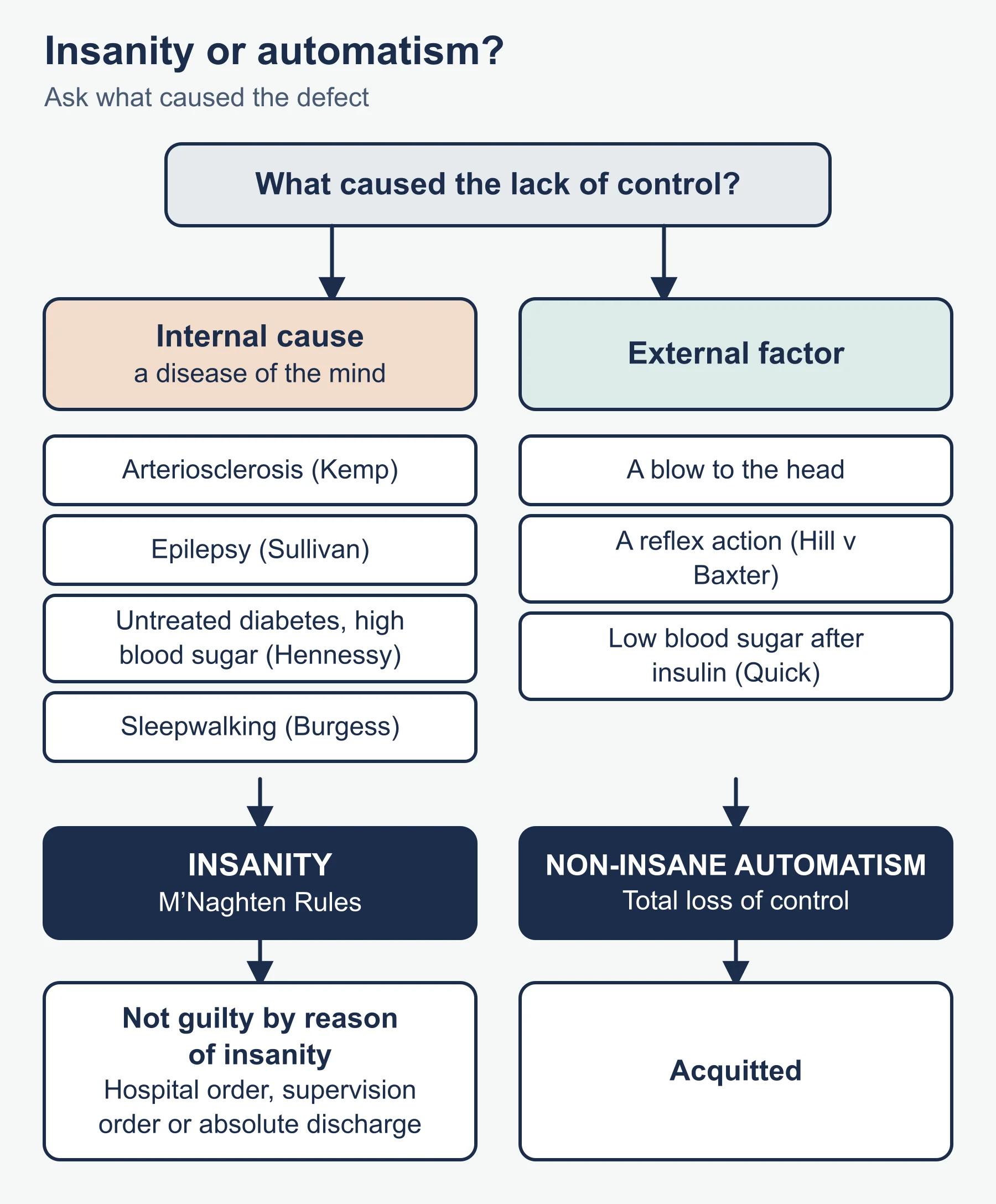
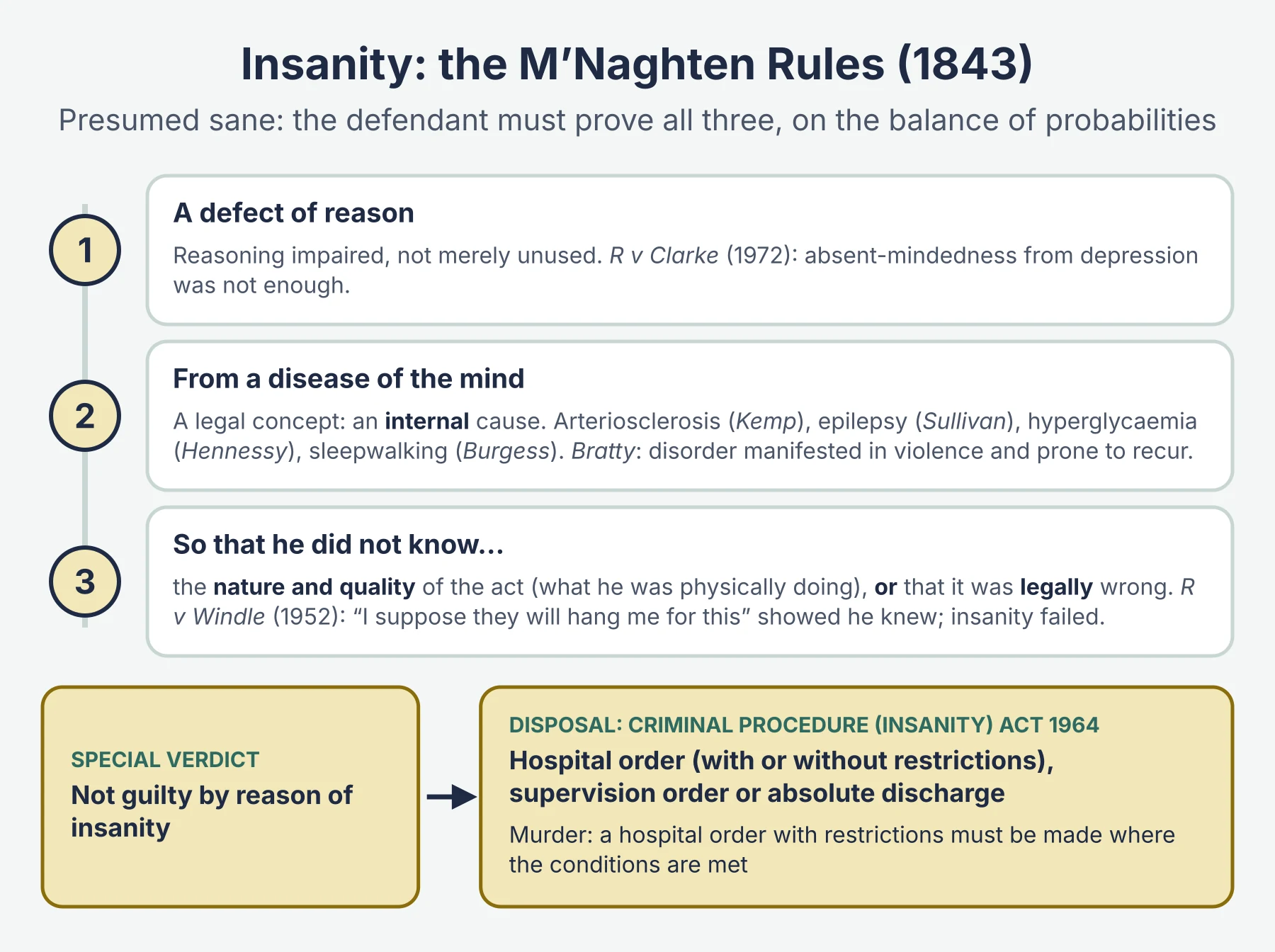
Insanity: M’Naghten Rules (1843)
D proves on the balance of probabilities:
| Element | Meaning | Cases |
|---|---|---|
| Defect of reason | Reasoning impaired, not just not used | Clarke (1972) |
| Disease of the mind | Internal cause; legal not medical; mind not brain | Kemp (1956); Sullivan (1984); Hennessy (1989); Burgess (1991); Bratty (1963) |
| Did not know nature and quality | Did not know what he was physically doing | — |
| Or did not know it was wrong | Legally wrong | Windle (1952) |
Outcome: not guilty by reason of insanity. Disposal under the Criminal Procedure (Insanity) Act 1964, as amended: hospital order (with or without restrictions), supervision order or absolute discharge; for murder, a restricted hospital order where the hospital order conditions are met.
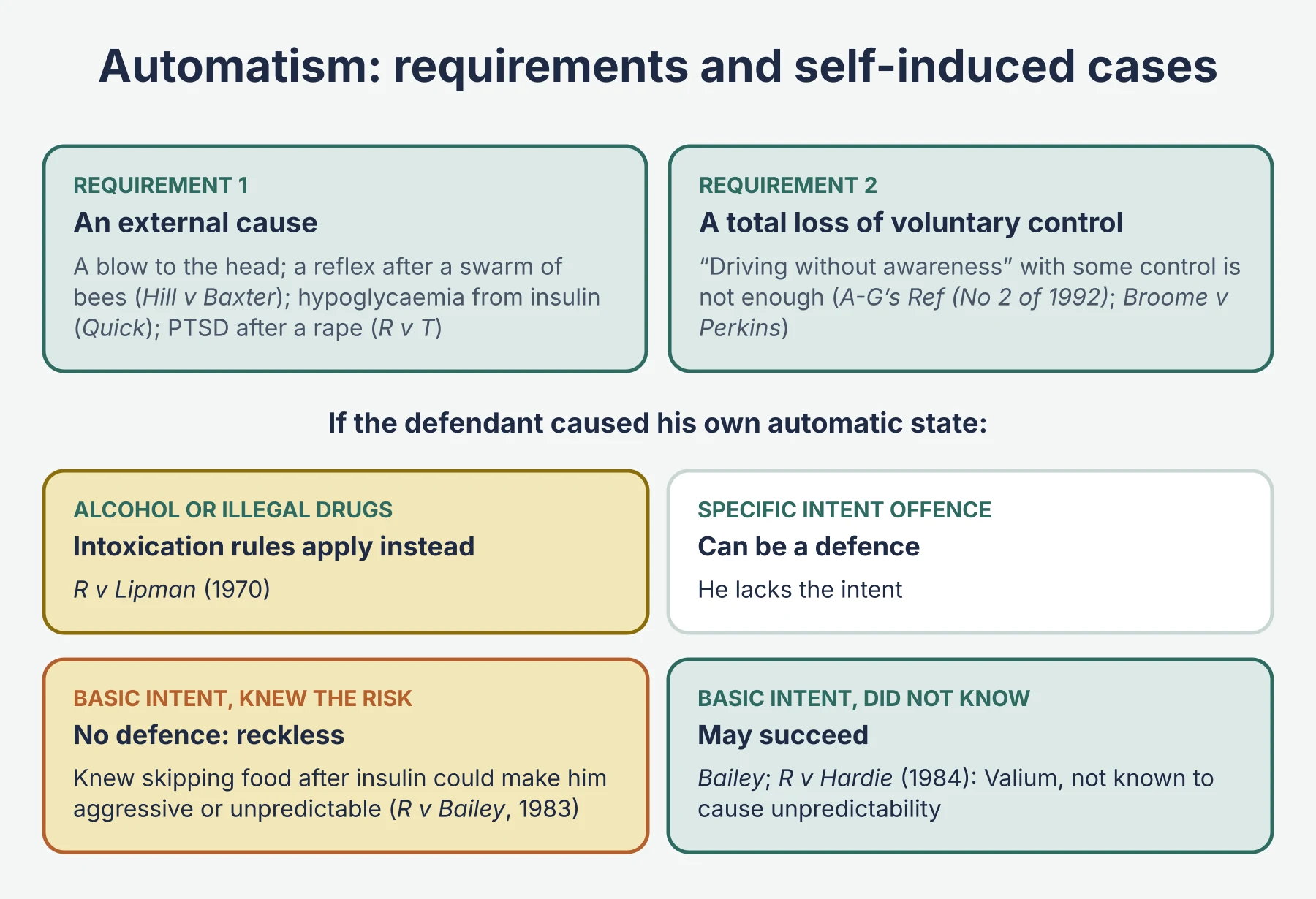
Automatism
- Bratty (1963): act done by the muscles without any control by the mind.
- External cause: Hill v Baxter (1958) bees example; Quick (1973) hypoglycaemia; T (1990) PTSD after rape.
- Total loss of control: A-G’s Ref (No 2 of 1992); Broome v Perkins (1987).
- Outcome: complete acquittal.
Self-induced automatism
| Offence type | D reckless about the risk | D unaware of the risk |
|---|---|---|
| Specific intent | Defence available | Defence available |
| Basic intent | No defence (Bailey, 1983) | Defence available (Bailey; Hardie, 1984) |
Automatism from voluntary drink or drugs follows the intoxication rules (Lipman, 1970).
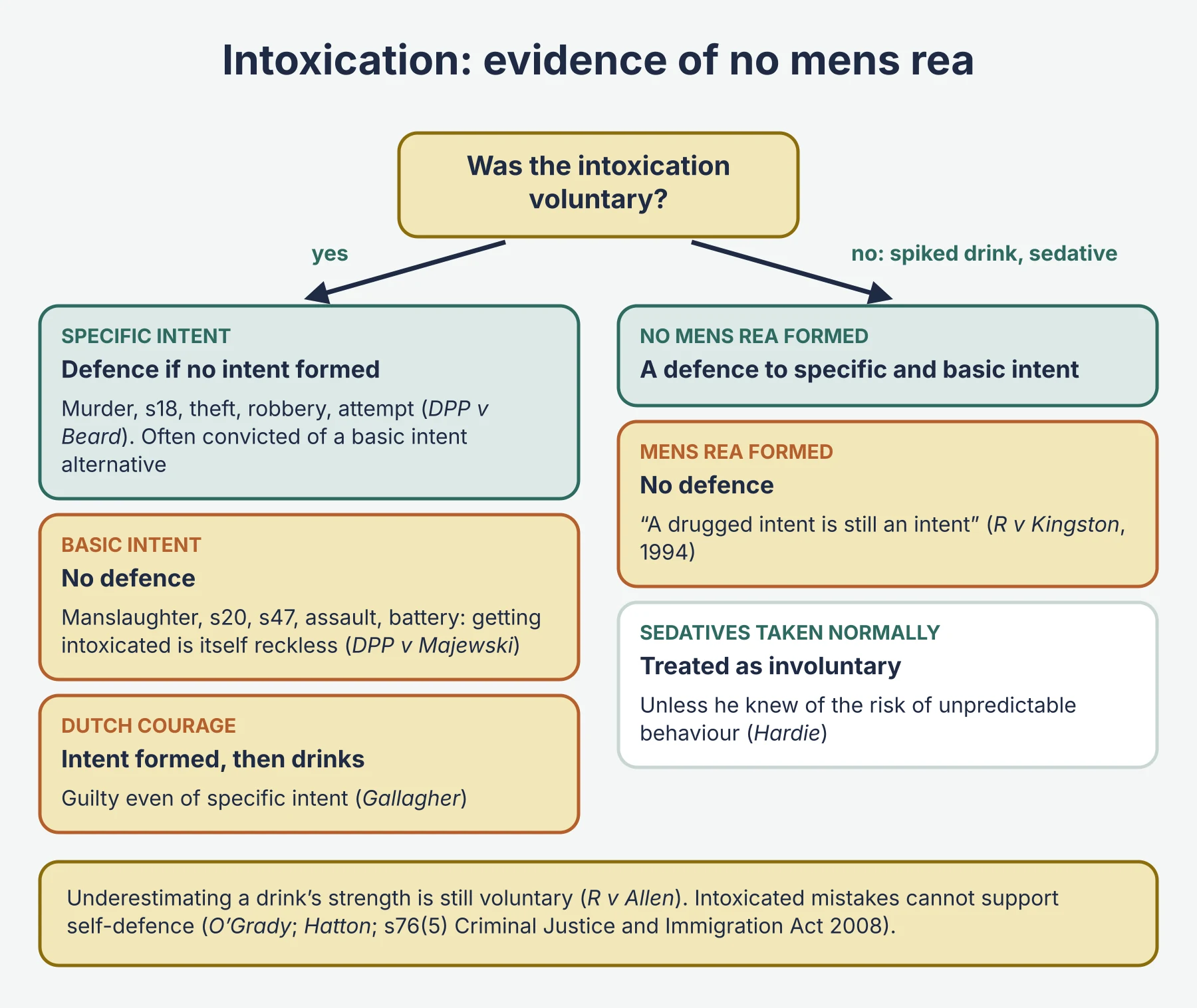
Intoxication
| Specific intent offence | Basic intent offence | |
|---|---|---|
| Voluntary | Defence if no intent formed (Beard, 1920), usually convicted of basic intent alternative | No defence (Majewski, 1977) |
| Involuntary | Defence if no mens rea formed | Defence if no mens rea formed |
| Mens rea formed anyway | No defence (Kingston, 1994) | No defence (Kingston) |
- Dutch courage: Gallagher (1963): no defence.
- Stronger drink than expected: still voluntary (Allen, 1988).
- Sedatives taken normally: treated as involuntary unless D knew of risk (Hardie).
- Drunken mistake in self-defence: not available (O’Grady, 1987; Hatton, 2005; s76(5) CJIA 2008).
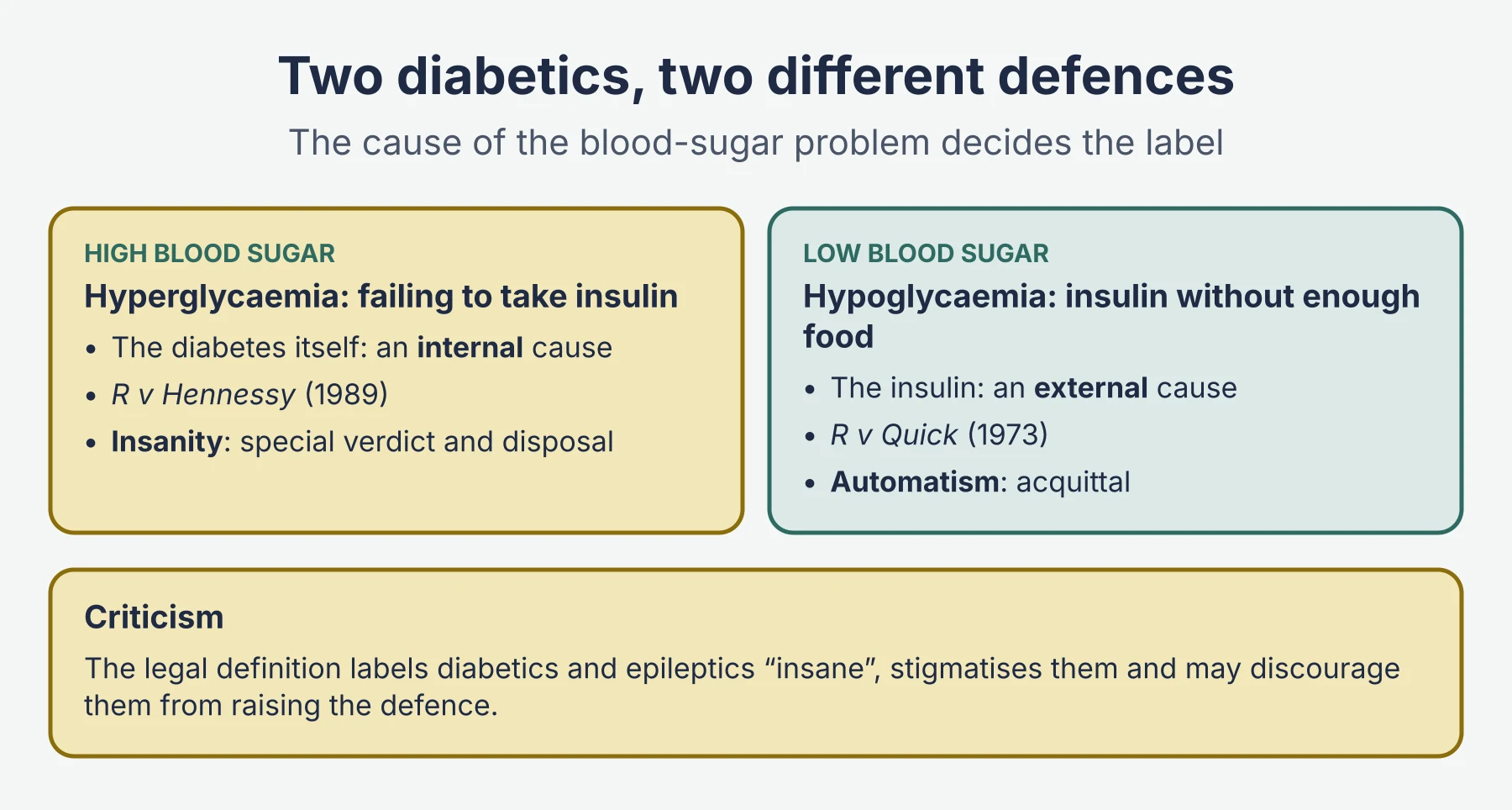
The diabetes pair
| Condition | Cause | Defence | Case |
|---|---|---|---|
| Hypoglycaemia (low sugar) | Insulin taken (external) | Automatism | Quick |
| Hyperglycaemia (high sugar) | Diabetes itself, insulin not taken (internal) | Insanity | Hennessy |
Finish with the outcome
Every capacity answer should end by naming the result, because the defences lead to very different places:
- Insanity: special verdict and a disposal, not a simple acquittal.
- Automatism: full acquittal, unless self-induced and reckless for a basic intent offence.
- Voluntary intoxication: acquittal of the specific intent offence, but usually conviction of the basic intent alternative (murder to manslaughter; s18 to s20).
- Involuntary intoxication: acquittal if no mens rea; conviction as charged if mens rea was formed.
Key terms
| Term | Meaning |
|---|---|
| Defect of reason | Impaired power of reasoning |
| Disease of the mind | Legal term for an internal condition affecting mental faculties |
| Special verdict | Not guilty by reason of insanity |
| Non-insane automatism | Total loss of control from an external cause; complete defence |
| Self-induced automatism | Automatism the defendant caused by his own conduct |
| Voluntary intoxication | Knowingly taking alcohol or drugs |
| Involuntary intoxication | Spiked drinks, or unexpected effects of medication |
| Dutch courage | Drinking to give oneself courage after forming the intent |
Evaluation points
- Insanity is a legal label that stigmatises epileptics and diabetics.
- The internal and external line produces the hypoglycaemia and hyperglycaemia anomaly.
- Windle excludes ill defendants who know the act is illegal.
- The reverse burden for insanity conflicts with Woolmington.
- Law Commission discussion paper (2013): proposed a “not criminally responsible by reason of a recognised medical condition” defence.
- Majewski ignores genuine lack of mens rea, but protects the public.
Exam traps
- Diabetes cases the wrong way round.
- Partial loss of control accepted as automatism.
- Voluntary intoxication offered for s20, s47 or manslaughter.
- Forgetting that involuntary intoxication fails if mens rea was formed.
- Calling insanity a medical test.
Self-test
- State the M’Naghten Rules.
- Why was there no defect of reason in R v Clarke?
- What did R v Kemp decide?
- What does “wrong” mean in the Rules? Give a case.
- Name the three disposals after a special verdict.
- Define automatism, with an authority.
- What did A-G’s Reference (No 2 of 1992) decide?
- When is self-induced automatism a defence to a basic intent offence?
- What did DPP v Majewski decide?
- What did R v Kingston decide?
- What is the Dutch courage rule?
- Which diabetic condition leads to insanity and which to automatism?
Answers: 1. D must prove a defect of reason, from disease of the mind, so that he did not know the nature and quality of his act or did not know it was wrong. 2. She was absent-minded, not deprived of the power to reason. 3. A physical disease affecting the mind (arteriosclerosis) can be a disease of the mind. 4. Legally wrong; Windle (1952). 5. Hospital order, supervision order, absolute discharge. 6. An act done by the muscles without any control by the mind (Bratty, 1963). 7. There must be a total loss of voluntary control. 8. When D was not reckless about the risk of becoming an automaton (Bailey). 9. Voluntary intoxication is no defence to basic intent offences. 10. Involuntary intoxication is no defence where D still formed the mens rea. 11. A defendant who forms the intent and then drinks to gain courage has no intoxication defence (Gallagher). 12. Hyperglycaemia leads to insanity (Hennessy); hypoglycaemia from insulin leads to automatism (Quick).
Test yourself further with the capacity defences practice questions.
Related resources
-
Study guides
AQA A Level Law (7162): Fatal Offences Against the Person
Murder, loss of control, diminished responsibility, unlawful act and gross negligence manslaughter, with cases and a worked problem, for AQA A Level Law 7162.
Law · AQA · A Level
Read guide -
Practice questions
AQA A Level Law (7162): Fatal Offences Against the Person – Practice Questions
Original practice questions with mark-scheme answers on murder, loss of control, diminished responsibility and manslaughter for AQA A Level Law 7162.
Law · AQA · A Level
Try questions -
Revision notes
AQA A Level Law (7162): Fatal Offences Against the Person – Revision Notes
Recall notes on murder, loss of control, diminished responsibility, unlawful act and gross negligence manslaughter with key cases, for AQA A Level Law 7162.
Law · AQA · A Level
Revise topic
Get free revision emails (optional)
Occasional emails with practice questions, worked explanations and links to free resources for the qualification and subjects you choose. No spam, and you can unsubscribe from any email. The free tools on this site never need an email.