
Study Guides
AQA A Level Law (7162): Necessity Defences
Self-defence and prevention of crime, duress by threats and duress of circumstances: tests, s76 CJIA 2008 and leading cases, for AQA A Level Law 7162.
- Subject
- Law
- Level
- A LEVELS
- Topic
- Criminal law
- Author
- Marlbridge Academic Team
- Updated
- Reviewed by
- Aizaz Raoof Ali (what this means)
Aligned to AQA A Level Law (7162), For teaching from September 2017 onwards, A-level exams 2019 onwards. Official specification .
Syllabus page (what it covers and how it is assessed): AQA A Level Law.
Syllabus points this page covers
7162
- Necessity defences
Found an error? Report a correction.
Need help with this topic? Request a free trial class for A Level Law (7162).
This guide covers the section 3.2 row Necessity defences in AQA A-level Law (7162). The specification lists three: self-defence/prevention of crime, duress and duress of circumstances. All three are complete defences, and all share an idea: the defendant committed what would otherwise be a crime because he faced a threat and responded to it. Where the capacity defences ask whether the defendant had the mental capacity to be liable, these ask whether his choice was justified or excused by the situation. For an overview of all the defences, see the Criminal Offences and Defences study guide.
Self-defence and prevention of crime
Sources. Self-defence (of oneself or another) is a common law defence. Prevention of crime is covered by s3(1) Criminal Law Act 1967: “A person may use such force as is reasonable in the circumstances in the prevention of crime, or in effecting or assisting in the lawful arrest of offenders or suspected offenders or of persons unlawfully at large.” Section 76 of the Criminal Justice and Immigration Act 2008 clarifies how both are applied. The defence covers any offence involving force, including murder.
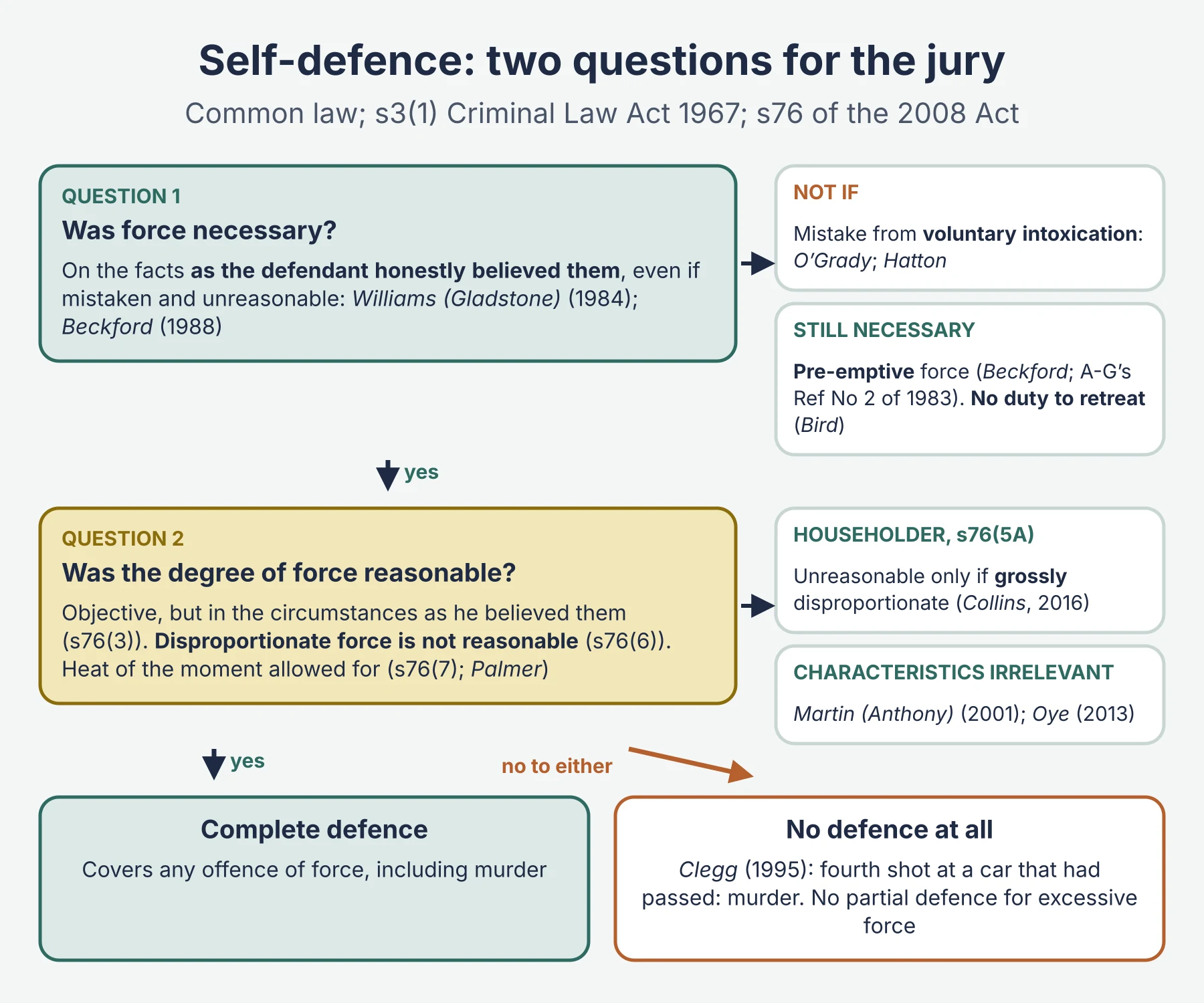
Two questions for the jury
1. Was force necessary? This is judged on the facts as the defendant honestly believed them to be, even if the belief was mistaken and unreasonable (R v Williams (Gladstone), 1984; Beckford v R, 1988; s76(3)–(4)). The reasonableness of the belief is relevant only to whether it was genuinely held. Exceptions:
- A mistaken belief caused by voluntary intoxication cannot be relied on (s76(5); R v O’Grady, 1987; R v Hatton, 2005).
- Pre-emptive force can be necessary: a person need not wait to be struck first (Beckford). Preparing petrol bombs to defend one’s shop against an expected attack could be lawful (Attorney-General’s Reference (No 2 of 1983), 1984).
- There is no duty to retreat (R v Bird, 1985), though the possibility of retreat is a factor in deciding whether force was reasonable (s76(6A)).
2. Was the degree of force reasonable? This is an objective question, but asked in the circumstances as the defendant believed them to be (s76(3)).
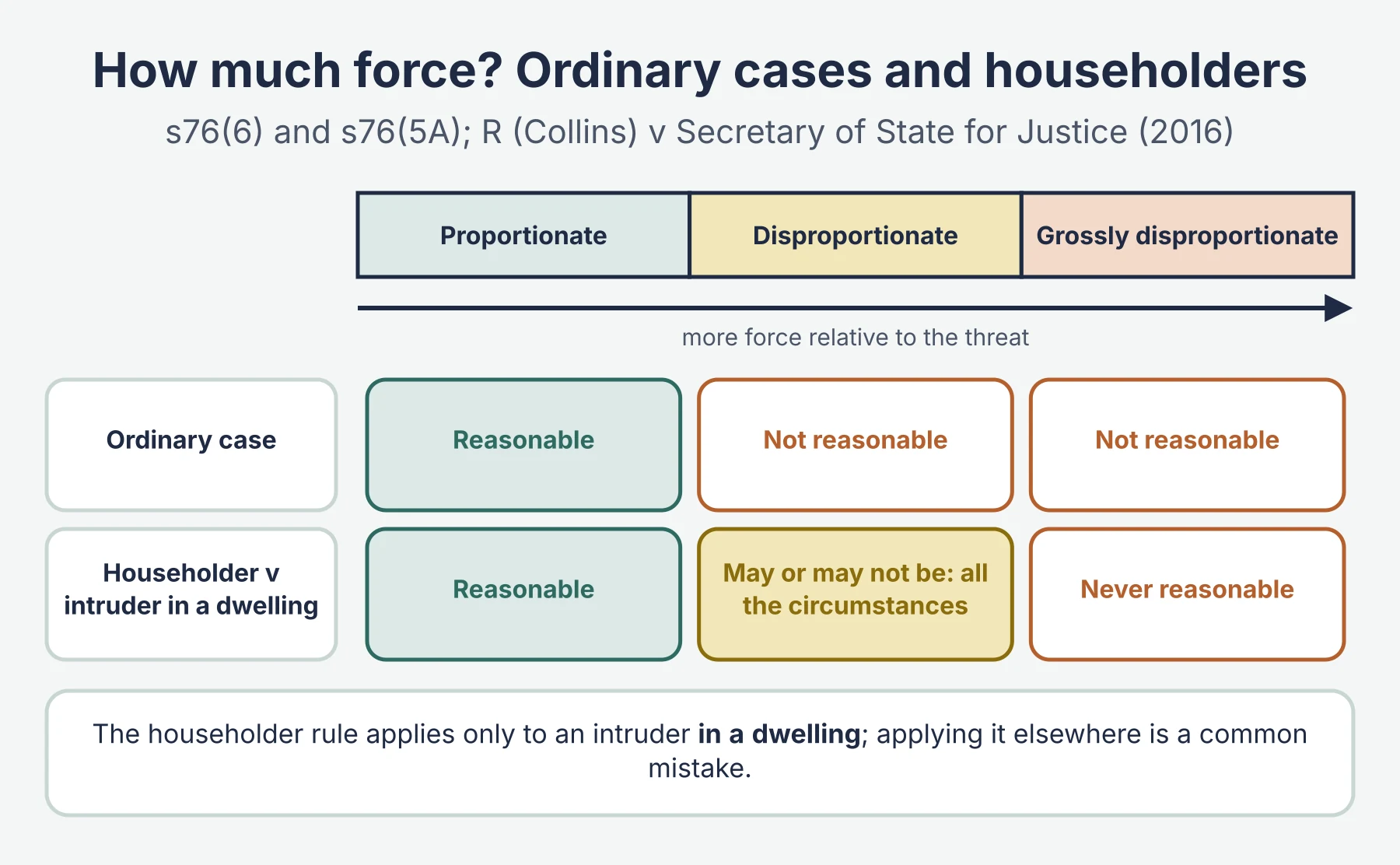
- Not reasonable if disproportionate (s76(6)).
- Allowance for the heat of the moment (s76(7)): a person acting for a legitimate purpose may not be able to weigh to a nicety the exact measure of necessary action, and evidence that he did only what he honestly and instinctively thought necessary is strong evidence that he acted reasonably. This reflects Palmer v R (1971).
- Householder cases (s76(5A)): where a person defends himself or others against an intruder in a dwelling, force is unreasonable only if it was grossly disproportionate. In R (Collins) v Secretary of State for Justice (2016) the court held that this is compatible with Article 2 ECHR: grossly disproportionate force is never reasonable, while disproportionate force may or may not be, depending on all the circumstances.
- The defendant’s characteristics are generally irrelevant to reasonableness. In R v Martin (Anthony) (2001) a farmer’s paranoid personality disorder could not make his shooting of a fleeing burglar reasonable, though it supported diminished responsibility. In R v Oye (2013) force used under an insane delusion was not judged by the delusion.
All or nothing. If the force was excessive, the defence fails completely. A soldier who fired a fourth shot at a car that had already passed his checkpoint was guilty of murder (R v Clegg, 1995). There is no partial defence of excessive self-defence, although loss of control based on fear of serious violence may reduce murder to manslaughter.
Duress by threats
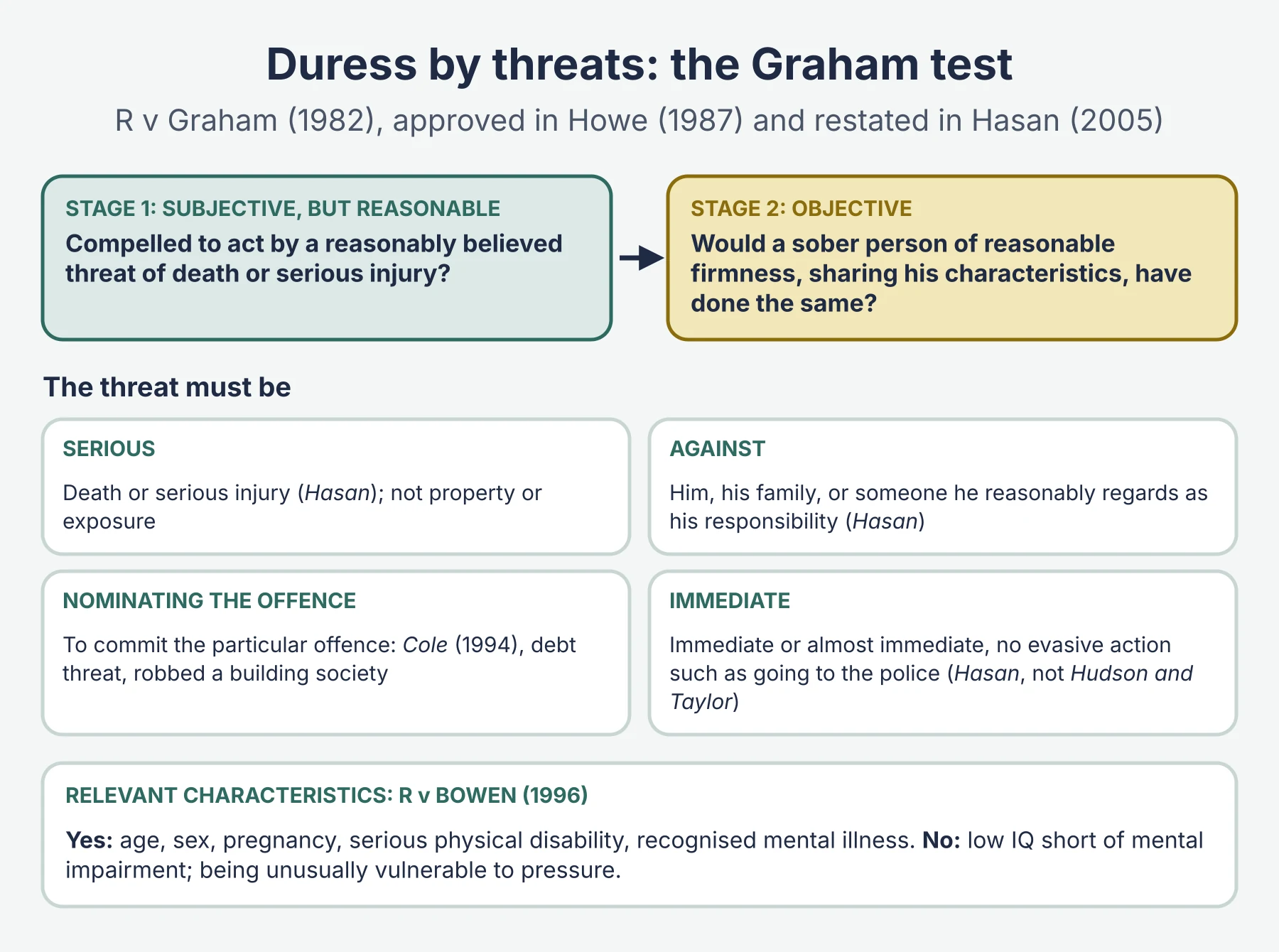
The test. From R v Graham (1982), approved by the House of Lords in R v Howe (1987) and restated in R v Hasan (2005):
- Was the defendant compelled to act because he reasonably believed that a threat of death or serious injury had been made? (Subjective belief, which must be reasonable.)
- Would a sober person of reasonable firmness, sharing the defendant’s characteristics, have responded in the same way? (Objective.)
The threat
- Must be of death or serious injury (Hasan); threats to property or of exposure are not enough.
- May be against the defendant, his family or a person for whom he reasonably regards himself as responsible (Hasan).
- Must be to commit the particular offence: a man threatened over a debt who robbed a building society was not “nominated” to commit robbery (R v Cole, 1994).
- Must be immediate or almost immediate, with no evasive action reasonably available, such as going to the police (Hasan, disapproving the broader approach in R v Hudson and Taylor, 1971).
Relevant characteristics (R v Bowen, 1996): age, sex, pregnancy, serious physical disability and recognised mental illness or psychiatric condition can be relevant, but not low IQ short of mental impairment, or being unusually vulnerable to pressure.
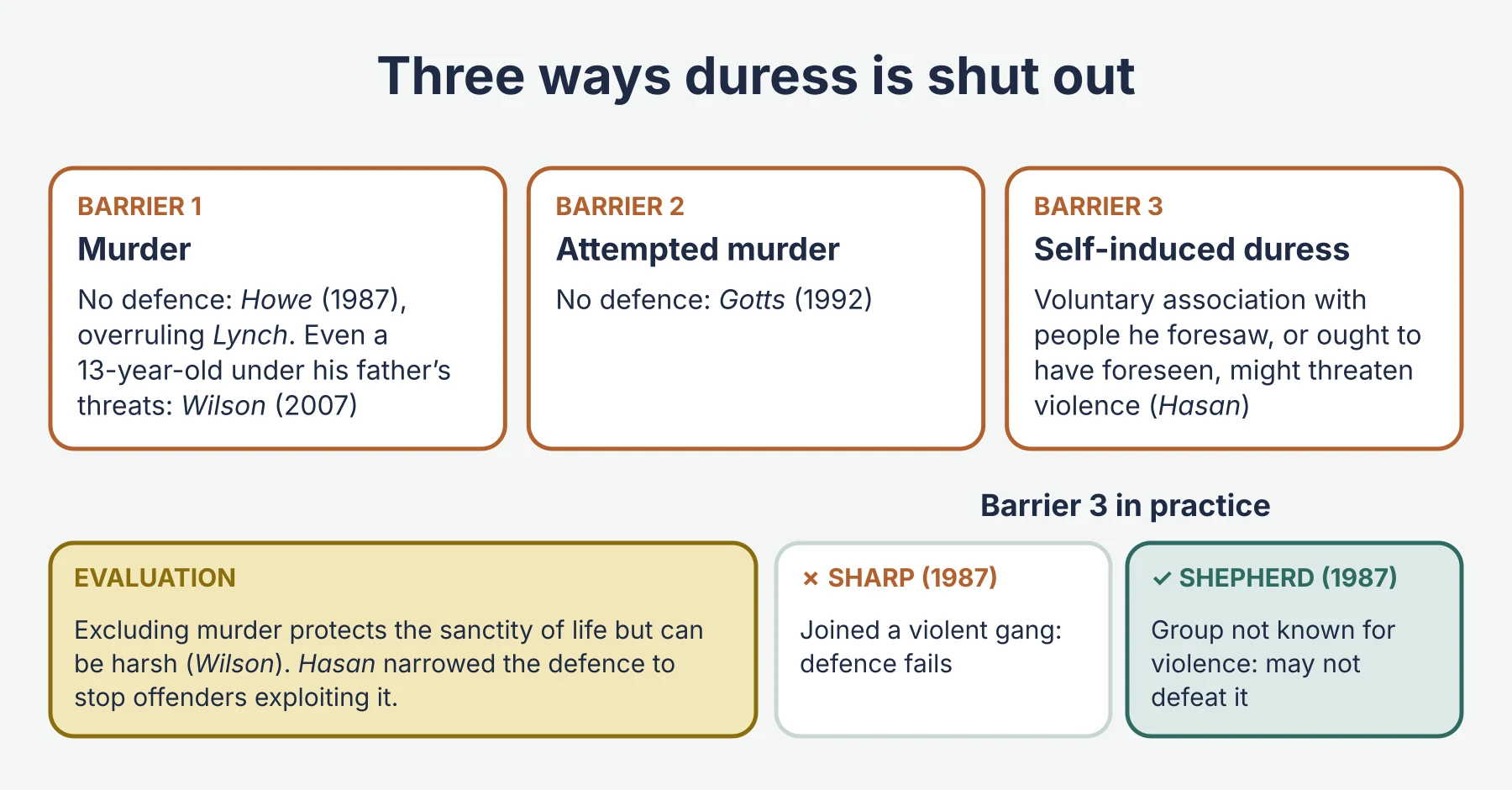
Self-induced duress. The defence is not available if the defendant voluntarily associated with people he foresaw, or ought reasonably to have foreseen, might subject him to compulsion by threats of violence (Hasan). Joining a violent gang defeats the defence (R v Sharp, 1987); joining a group not known for violence may not (R v Shepherd, 1987).
Offences excluded. Duress is no defence to murder (Howe, overruling Lynch in this respect), even for a 13-year-old acting under his father’s threats (R v Wilson, 2007), and no defence to attempted murder (R v Gotts, 1992).
Duress of circumstances
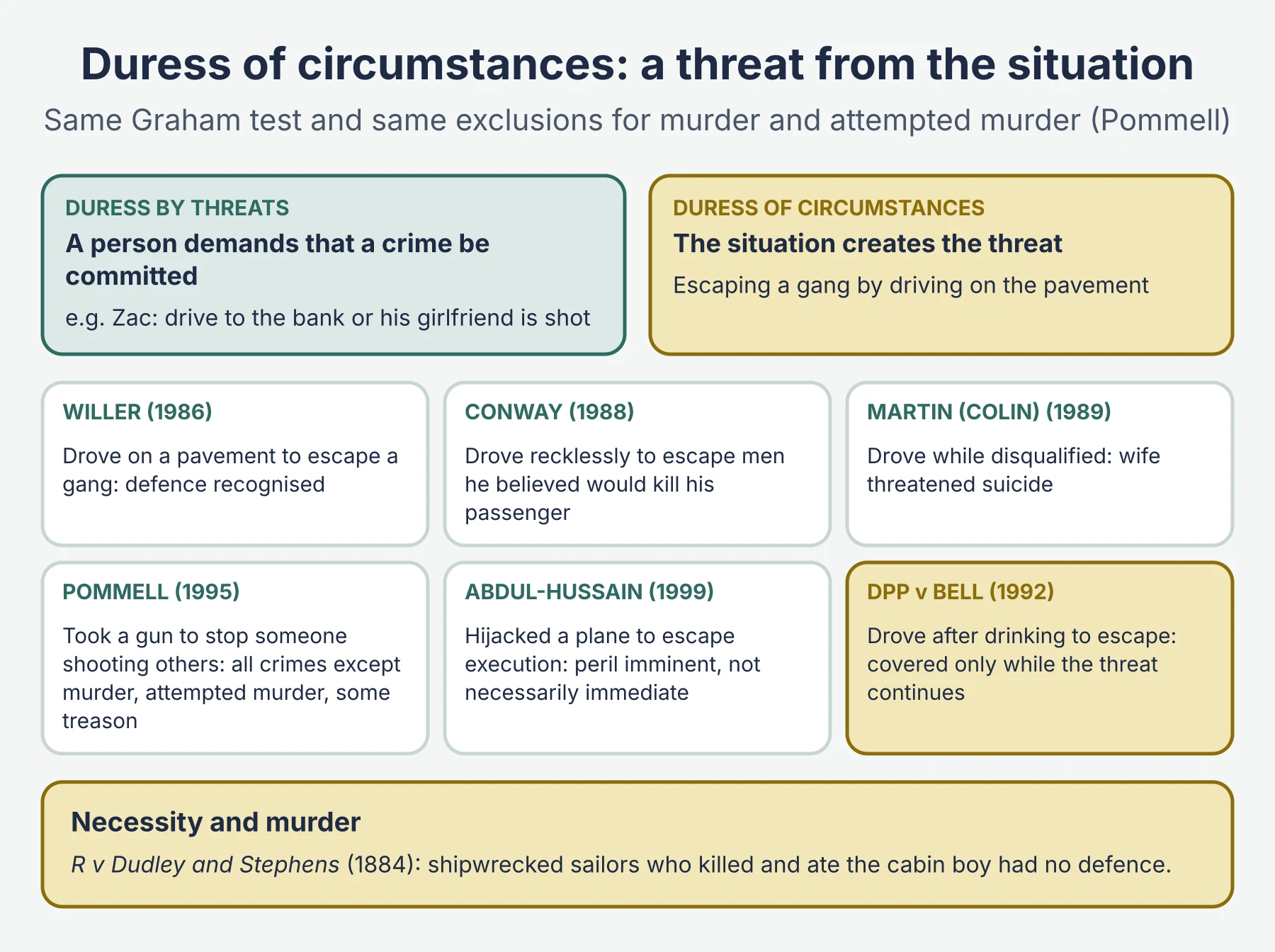
Here the threat comes from the situation, not from a person demanding that a crime be committed. The same two-stage Graham test applies, together with the same exclusions for murder and attempted murder (R v Pommell, 1995).
| Case | Facts | Point |
|---|---|---|
| R v Willer (1986) | Drove on a pavement to escape a gang threatening him | Recognised the defence |
| R v Conway (1988) | Drove recklessly to escape men he believed were trying to kill his passenger | Defence available |
| R v Martin (Colin) (1989) | Drove while disqualified because his wife threatened suicide | Defence available |
| R v Pommell (1995) | Took a gun from someone to stop him shooting others | Defence available to all crimes except murder, attempted murder and some forms of treason |
| R v Abdul-Hussain (1999) | Hijacked a plane to escape execution in Iraq | Peril must be imminent, though not necessarily immediate |
| DPP v Bell (1992) | Drove after drinking to escape men threatening him | The defence covers the offence only for as long as the threat continues |
Necessity and murder. R v Dudley and Stephens (1884), where shipwrecked sailors killed and ate the cabin boy to survive, established that necessity is no defence to murder.
Worked example
Zac is told by an armed man in a car park that his girlfriend, held in the car, will be shot unless Zac drives the man to a bank. Zac drives through red lights at speed. He had never met the man before.
Defence:   duress by threats (a person demands the offence).
Threat:    death of his girlfriend - someone he is responsible for (Hasan).
Nominated: the threat is linked to the driving offence (Cole).
Immediacy: gun present, no realistic chance to go to the police.
Graham:    (1) he reasonably believed the threat; (2) a sober person of
           reasonable firmness would have done the same.
Assoc.:    no voluntary association with criminals.
Offence:   driving offence, not murder - defence available.
Conclusion: duress likely to succeed; acquittal.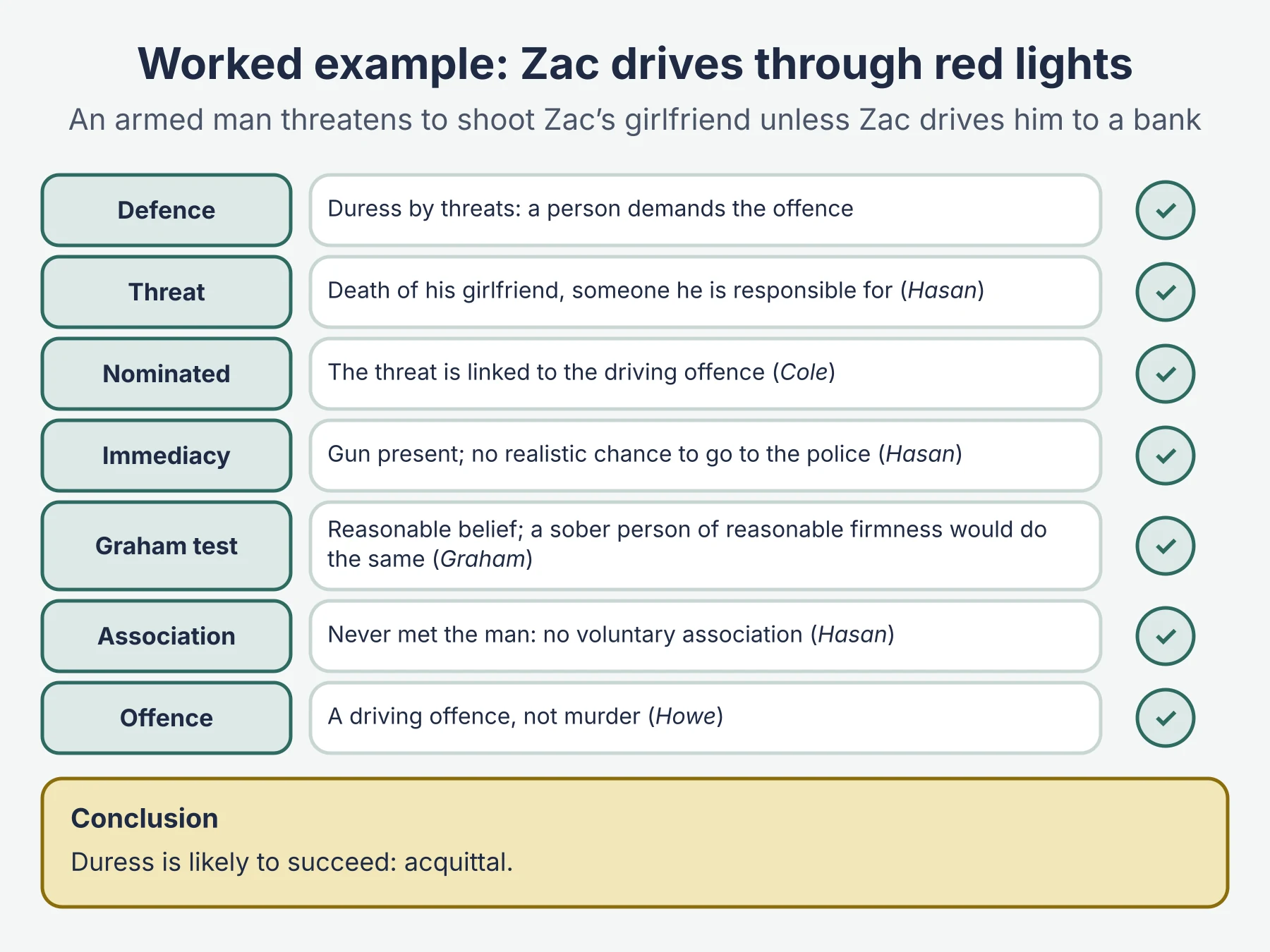
Evaluation
- Self-defence: the honest-belief rule protects people who make genuine mistakes but can acquit someone who killed on an unreasonable belief; the all-or-nothing rule can lead to a murder conviction for a police officer or householder who over-reacts in a frightening situation; the householder provision is criticised for protecting disproportionate force.
- Duress: excluding murder protects the sanctity of life but can be harsh on those, like the boy in Wilson, facing threats they could not reasonably resist; Hasan narrowed the defence to stop offenders exploiting it.
Common mistakes
- Using a reasonable-belief test for necessity in self-defence (it is honest belief).
- Calling self-defence a partial defence.
- Forgetting the householder “grossly disproportionate” rule, or applying it outside a dwelling.
- Offering duress for murder or attempted murder.
- Omitting the voluntary association rule.
- Mixing up duress by threats and duress of circumstances.
Exam technique
Name the defence, set out its test in stages, apply each stage to the facts with an authority and conclude on whether the defendant is acquitted. In homicide problems, consider loss of control as a fallback if self-defence fails because the force was excessive.
More resources on this topic
Necessity defences revision notes | Necessity defences practice questions
Related resources
-
Practice questions
AQA A Level Law (7162): Necessity Defences – Practice Questions
Original practice questions with mark-scheme answers on self-defence, prevention of crime, duress and duress of circumstances for AQA A Level Law 7162 Paper 1.
Law · AQA · A Level
Try questions -
Revision notes
AQA A Level Law (7162): Necessity Defences – Revision Notes
Recall notes on self-defence and prevention of crime under s76 CJIA 2008, duress and duress of circumstances, with key cases, for AQA A Level Law 7162.
Law · AQA · A Level
Revise topic -
Study guides
AQA A Level Law (7162): Non-Fatal Offences Against the Person
Assault, battery and ss47, 20 and 18 of the 1861 Act, element by element with cases, a worked problem and reform points, for AQA A Level Law 7162 Paper 1.
Law · AQA · A Level
Read guide
Get free revision emails (optional)
Occasional emails with practice questions, worked explanations and links to free resources for the qualification and subjects you choose. No spam, and you can unsubscribe from any email. The free tools on this site never need an email.