
Revision Notes
AQA A Level Law (7162): Necessity Defences – Revision Notes
Recall notes on self-defence and prevention of crime under s76 CJIA 2008, duress and duress of circumstances, with key cases, for AQA A Level Law 7162.
- Subject
- Law
- Level
- A LEVELS
- Topic
- Criminal law
- Author
- Marlbridge Academic Team
- Updated
- Reviewed by
- Aizaz Raoof Ali (what this means)
Aligned to AQA A Level Law (7162), For teaching from September 2017 onwards, A-level exams 2019 onwards. Official specification .
Syllabus page (what it covers and how it is assessed): AQA A Level Law.
Syllabus points this page covers
7162
- Necessity defences
Found an error? Report a correction.
Need help with this topic? Request a free trial class for A Level Law (7162).
Condensed notes for the section 3.2 row Necessity defences: self-defence and prevention of crime, duress, and duress of circumstances. For explanation and a worked problem, use the necessity defences study guide.
Self-defence and prevention of crime
Sources: common law; s3(1) Criminal Law Act 1967; s76 Criminal Justice and Immigration Act 2008. Complete defence, available to any offence involving force, including murder.
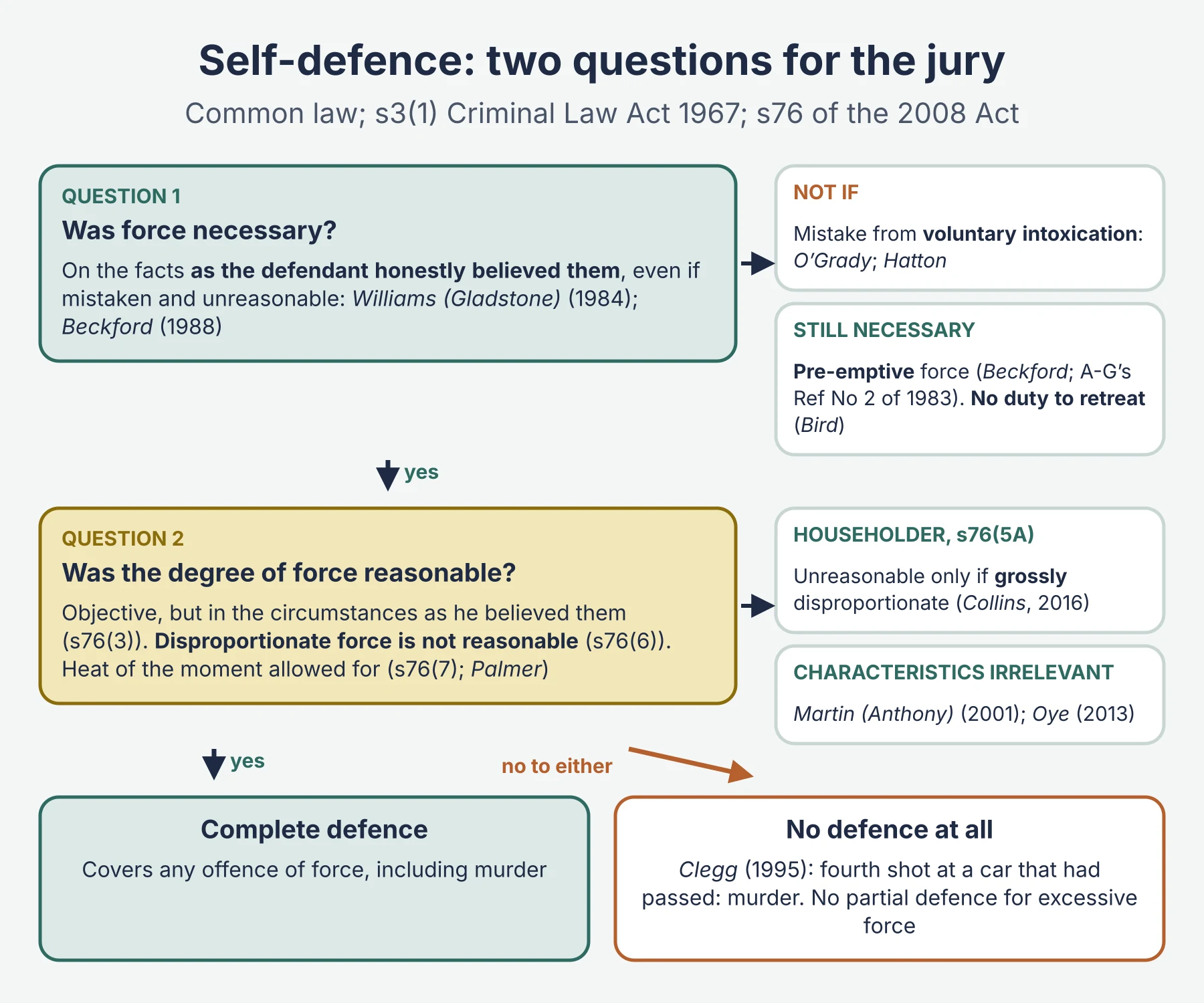
Stage 1: was force necessary? (facts as D honestly believed them)
| Rule | Authority |
|---|---|
| Honest belief, even if unreasonable | Gladstone Williams (1984); Beckford (1988); s76(3)–(4) |
| Not if mistake due to voluntary intoxication | s76(5); O’Grady (1987); Hatton (2005) |
| Pre-emptive force allowed | Beckford; A-G’s Ref (No 2 of 1983) |
| No duty to retreat; retreat is a factor | Bird (1985); s76(6A) |
Stage 2: was the force reasonable? (objective, in circumstances as D believed them)
| Rule | Authority |
|---|---|
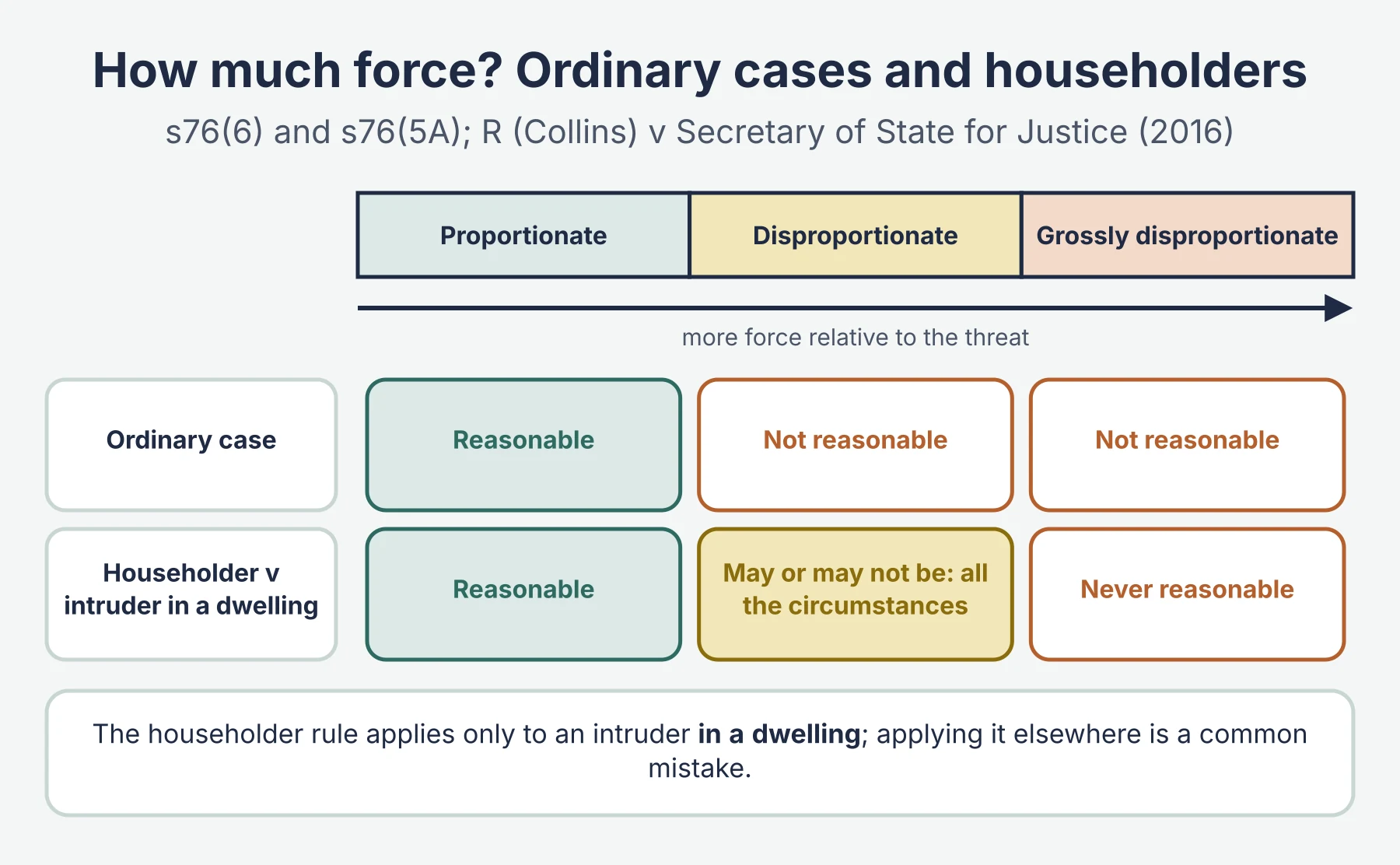
| Not reasonable if disproportionate | s76(6) |
| Cannot weigh to a nicety; instinctive action is strong evidence of reasonableness | Palmer (1971); s76(7) |
| Householder: unreasonable only if grossly disproportionate | s76(5A); R (Collins) v SSJ (2016) |
| D’s psychiatric condition not relevant to reasonableness | Martin (Anthony) (2001) |
| Insane delusions not the standard | Oye (2013) |
| Excessive force: defence fails entirely | Clegg (1995) |
Duress by threats
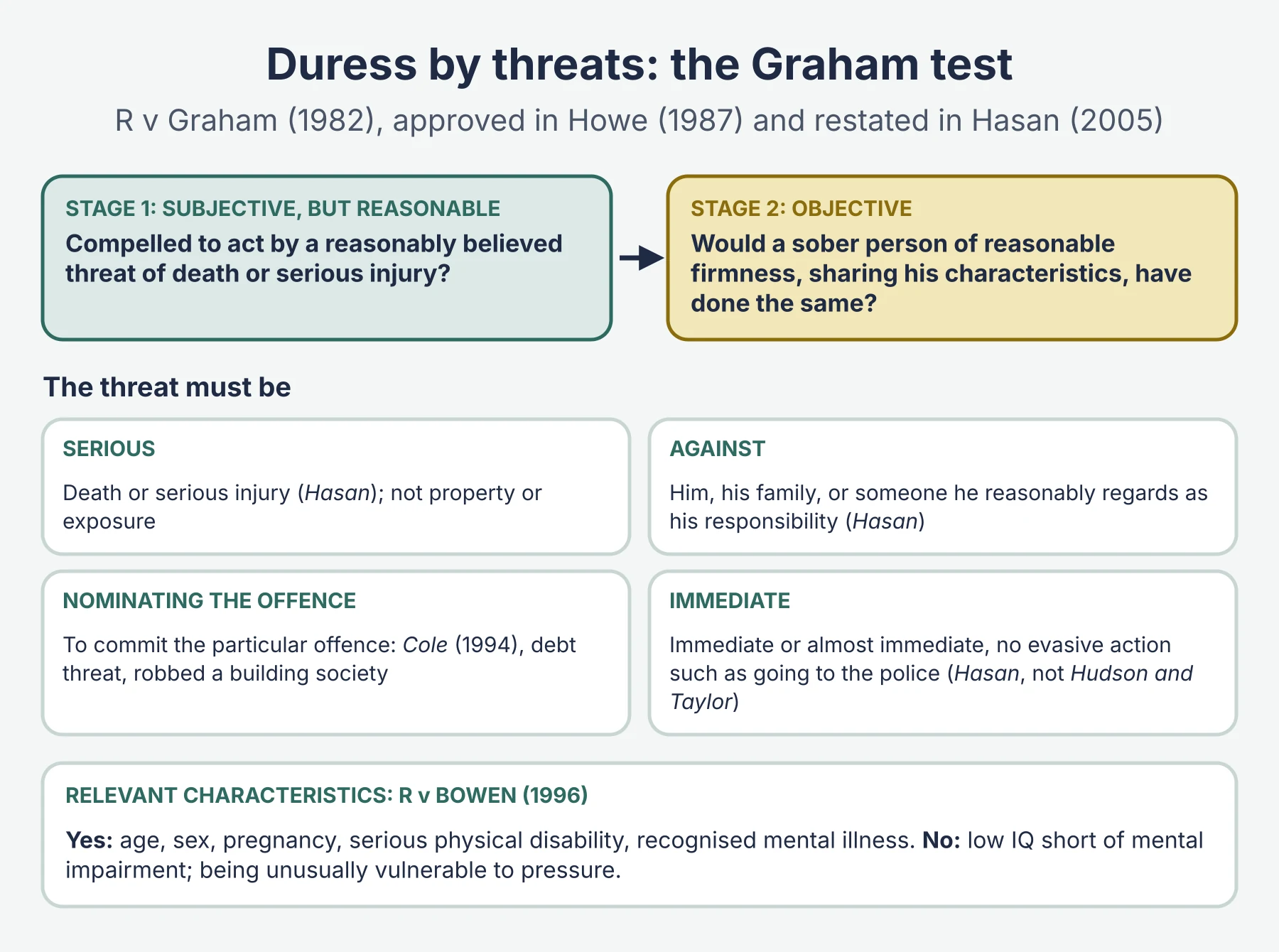
Graham test (1982; approved in Howe, 1987; Hasan, 2005):
- D reasonably believed a threat of death or serious injury had been made.
- A sober person of reasonable firmness sharing D’s characteristics would have responded the same way.
Limits from Hasan
- Threat of death or serious injury only.
- Against D, family, or someone D reasonably regards himself as responsible for.
- Directed at the commission of the particular offence (Cole, 1994).
- Immediate or almost immediate; no evasive action reasonably open (disapproving Hudson and Taylor, 1971).
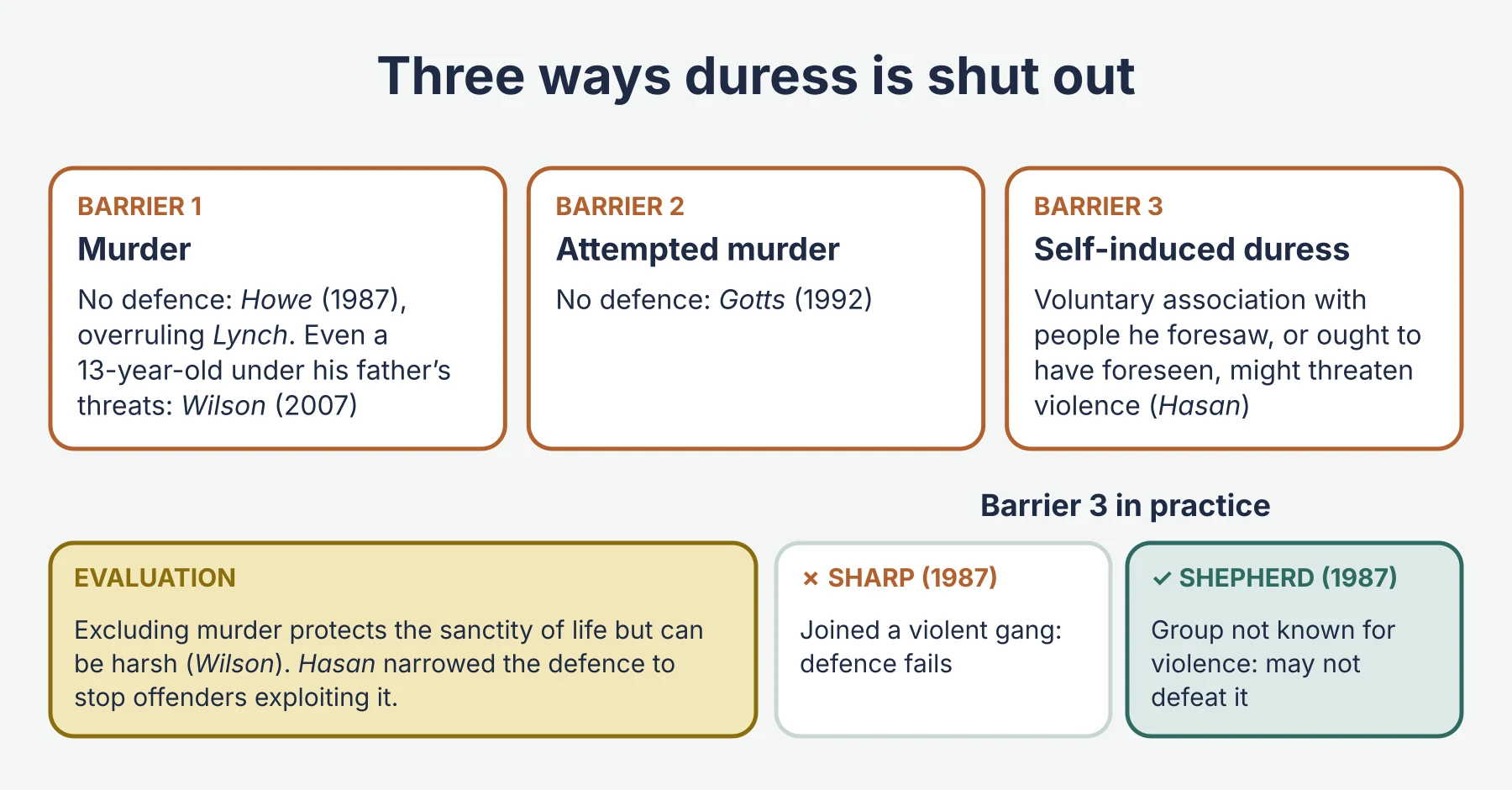
- No defence if D voluntarily associated with those he foresaw or ought reasonably to have foreseen would threaten violence (Sharp, 1987; contrast Shepherd, 1987).
Characteristics (Bowen, 1996): age, sex, pregnancy, serious physical disability, recognised mental illness or psychiatric condition. Not: low IQ short of impairment; vulnerability to pressure.
Excluded: murder (Howe; Wilson, 2007) and attempted murder (Gotts, 1992).
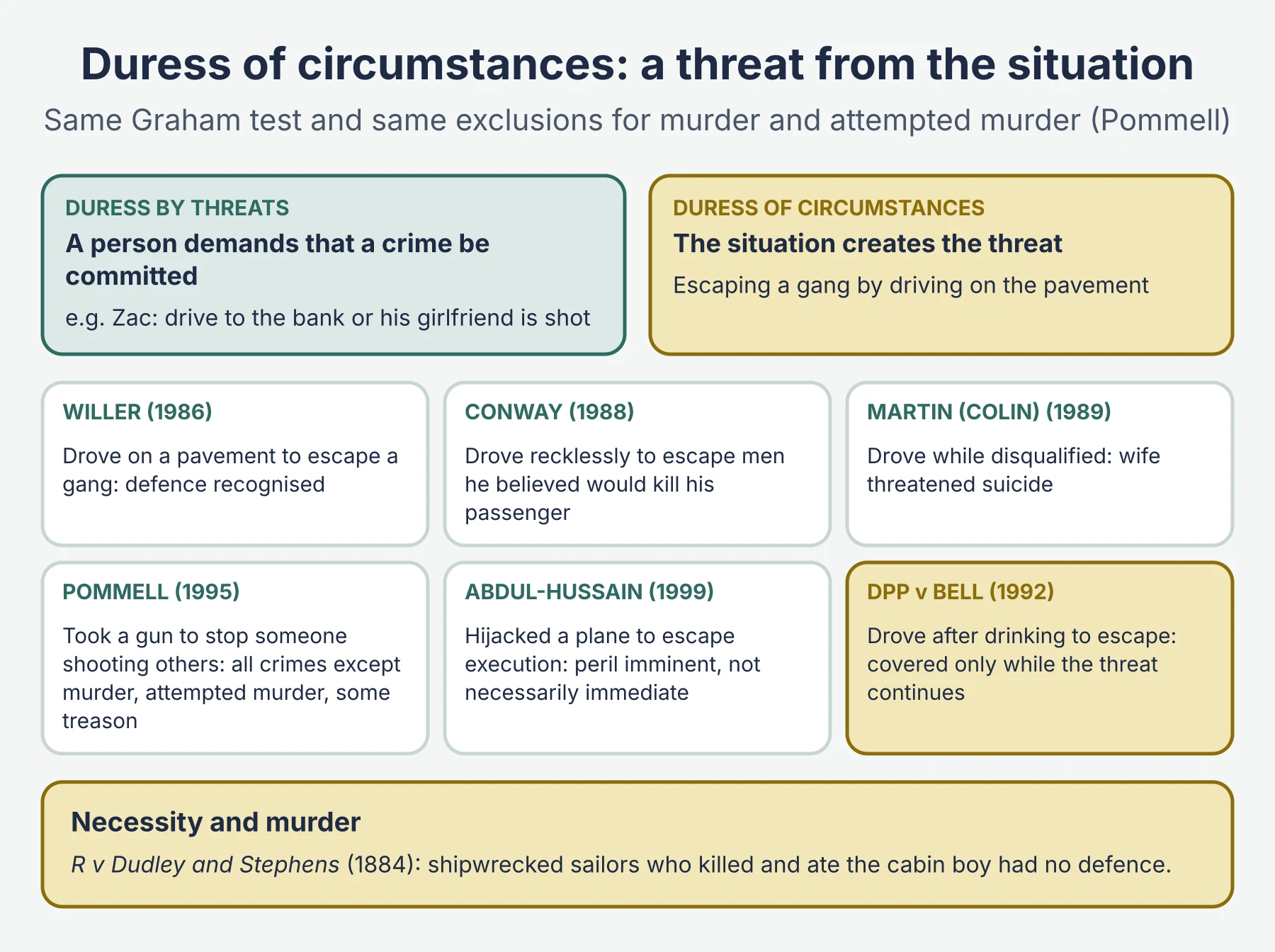
Duress of circumstances
- Threat from the situation, not a demand.
- Same Graham test and exclusions (Pommell, 1995).
- Cases: Willer (1986); Conway (1988); Martin (Colin) (1989); Abdul-Hussain (1999) imminent peril; DPP v Bell (1992) only while the threat lasts.
- Dudley and Stephens (1884): necessity no defence to murder.
Comparison
| Self-defence | Duress by threats | Duress of circumstances | |
|---|---|---|---|
| Source of danger | V’s attack (actual or believed) | Person demanding a crime | The situation |
| Belief | Honest | Reasonable | Reasonable |
| Response | Reasonable force | Reasonable firmness | Reasonable firmness |
| Murder? | Available | Not available | Not available |
| Effect | Acquittal | Acquittal | Acquittal |
Fallbacks when a necessity defence fails
- Excessive force in a killing: self-defence fails, but loss of control on the fear trigger (s55(3) Coroners and Justice Act 2009) may reduce murder to manslaughter; diminished responsibility may apply if there is a recognised medical condition (as in Martin (Anthony)).
- Duress fails for murder: no fallback within duress; consider loss of control or diminished responsibility on the facts.
- Duress lost through voluntary association: the defendant is convicted as charged.
Key terms
| Term | Meaning |
|---|---|
| Prevention of crime | Reasonable force to prevent crime or effect arrest (s3 CLA 1967) |
| Householder case | Defence against an intruder in a dwelling (s76(5A)) |
| Grossly disproportionate | Force so excessive it can never be reasonable |
| Pre-emptive strike | Force used before being attacked |
| Duress by threats | Defence where a person threatens death or serious injury unless D commits an offence |
| Duress of circumstances | Defence where the circumstances threaten death or serious injury |
| Voluntary association | Joining people known to use violence; defeats duress |
| Evasive action | A reasonable opportunity to escape or seek help |
Exam traps
- Honest belief for self-defence; reasonable belief for duress.
- Self-defence is all or nothing.
- Householder rule applies only to a dwelling and an intruder.
- No duress for murder or attempted murder.
- Check voluntary association in every gang scenario.
- A threat to property is not enough for duress.
Self-test
- Which statute covers force in the prevention of crime?
- Whose view of the facts decides whether force was necessary?
- When can a mistaken belief not be relied on?
- Is there a duty to retreat?
- What is the test for force in a householder case?
- What happened in R v Clegg?
- State the Graham test.
- Which characteristics are relevant under Bowen?
- What did R v Cole decide?
- When is duress lost through voluntary association?
- Which offences are excluded from duress?
- Give two cases on duress of circumstances.
Answers: 1. s3(1) Criminal Law Act 1967. 2. The facts as D honestly believed them. 3. When it was caused by voluntary intoxication (s76(5)). 4. No, but the possibility of retreat is a factor (s76(6A)). 5. Force is unreasonable only if grossly disproportionate (s76(5A)). 6. A soldier who fired after the danger had passed used excessive force; self-defence failed and he was guilty of murder. 7. Did D reasonably believe a threat of death or serious injury was made, and would a sober person of reasonable firmness sharing D’s characteristics have done the same? 8. Age, sex, pregnancy, serious physical disability, recognised mental illness or psychiatric condition. 9. The threat must be directed at the commission of the particular offence. 10. When D foresaw or ought reasonably to have foreseen that those he associated with might threaten him with violence (Hasan). 11. Murder and attempted murder (and some forms of treason). 12. Willer (1986) and Conway (1988).
Test yourself further with the necessity defences practice questions.
Related resources
-
Study guides
AQA A Level Law (7162): Non-Fatal Offences Against the Person
Assault, battery and ss47, 20 and 18 of the 1861 Act, element by element with cases, a worked problem and reform points, for AQA A Level Law 7162 Paper 1.
Law · AQA · A Level
Read guide -
Practice questions
AQA A Level Law (7162): Non-Fatal Offences Against the Person – Practice Questions
Original practice questions with mark-scheme answers on assault, battery, s47, s20 and s18 problems and evaluation for AQA A Level Law 7162 Paper 1.
Law · AQA · A Level
Try questions -
Revision notes
AQA A Level Law (7162): Non-Fatal Offences Against the Person – Revision Notes
Recall notes on assault, battery and ss47, 20 and 18 with injury classification, mens rea and leading cases, for AQA A Level Law 7162 Paper 1.
Law · AQA · A Level
Revise topic
Get free revision emails (optional)
Occasional emails with practice questions, worked explanations and links to free resources for the qualification and subjects you choose. No spam, and you can unsubscribe from any email. The free tools on this site never need an email.