
Revision Notes
AQA GCSE Business: Finance (8132) – Revision Notes
Condensed AQA GCSE Business Finance revision notes: sources of finance, cash flow, break-even, ARR, profit margins and statements, plus a self-test.
- Subject
- Business
- Level
- GCSE
- Topic
- Finance
- Author
- Marlbridge Academic Team
- Updated
- Reviewed by
- Salman Ahmad (what this means)
Aligned to AQA GCSE Business (8132), For first teaching from September 2017. Official specification .
Syllabus page (what it covers and how it is assessed): AQA GCSE Business.
Syllabus points this page covers
8132
- 3.6.1 Sources of finance
- 3.6.2 Cash flow
- 3.6.3 Financial terms and calculations
- 3.6.4 Analysing the financial performance of a business
Found an error? Report a correction.
Need help with this topic? Request a free trial class for GCSE Business (8132).
These notes condense section 3.6 Finance of the AQA GCSE Business (8132) specification, for first teaching from September 2017: 3.6.1 sources of finance, 3.6.2 cash flow, 3.6.3 financial terms and calculations and 3.6.4 analysing the financial performance of a business. For full explanations read the study guide, then test yourself with the practice questions.
Links: AQA GCSE Business hub, checklist and the free diagnostics. All businesses and figures are invented.
Key terms
| Term | Meaning |
|---|---|
| Internal finance | Money raised from within the business |
| External finance | Money raised from outside the business |
| Cash flow | Cash moving in and out over time |
| Net cash flow | Cash inflows minus cash outflows |
| Fixed costs | Do not change with output |
| Variable costs | Change with output |
| Total costs | Fixed plus variable |
| Revenue | Price multiplied by quantity sold |
| Profit / loss | Revenue minus total costs: positive is profit, negative is loss |
| Break-even output | Output where revenue equals total costs |
| Margin of safety | Actual output minus break-even output |
| Asset / liability | What the business owns or is owed / what it owes |
Sources of finance at a glance
| Internal | External |
|---|---|
| Retained profit | Family and friends, new share issue |
| Selling unwanted assets | Loan or mortgage, overdraft |
| Trade credit, hire purchase, government grants |
- Short term gap: overdraft, trade credit.
- Big, long-term purchase: loan, mortgage, share issue, hire purchase.
- No repayment: retained profit, share issue, many grants.
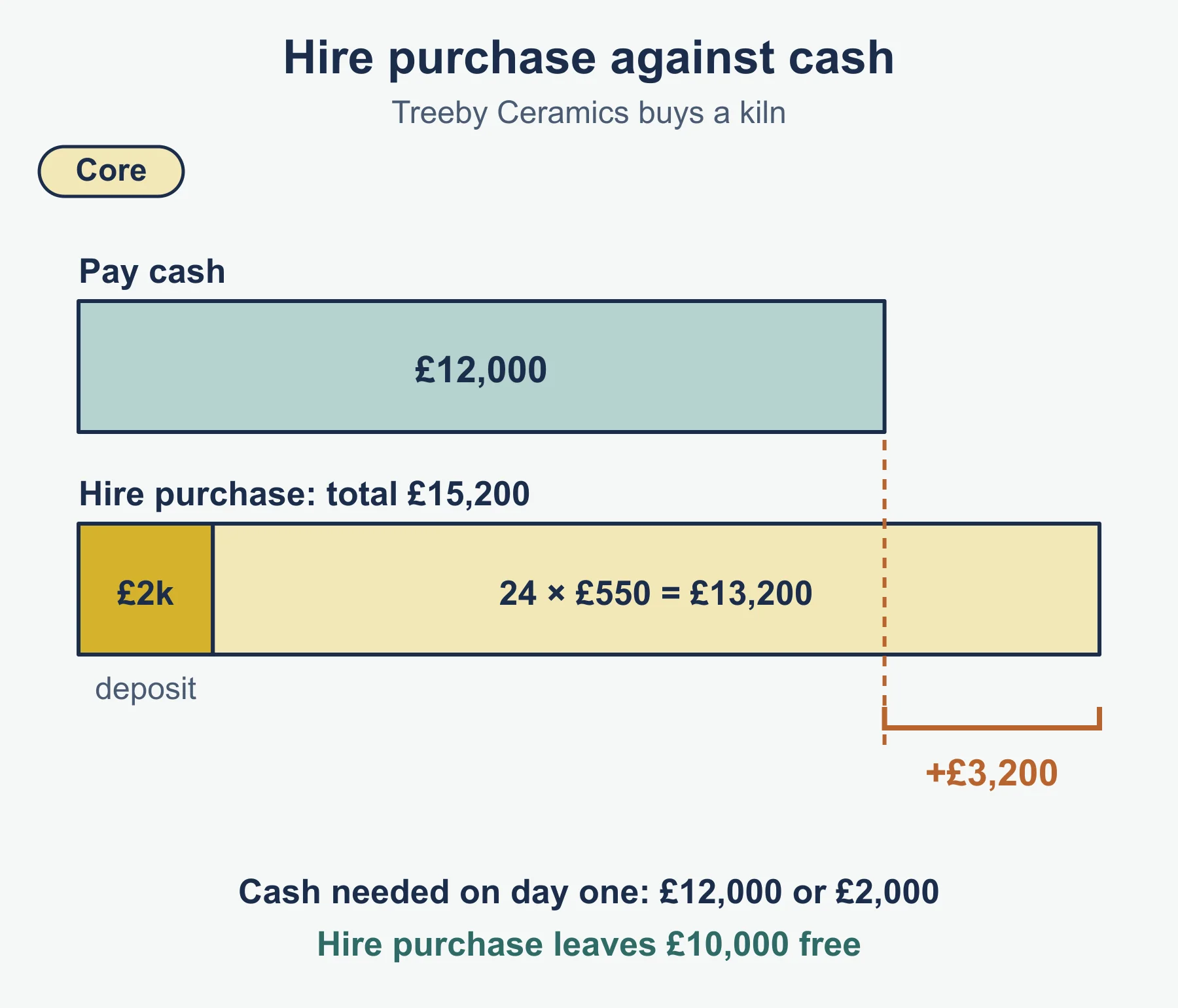
- Cost of borrowing: loans, overdrafts and hire purchase all cost more than the cash price or amount borrowed.
- Start-up: no retained profit, no track record, little security. Likely to use owner’s savings, family and friends, grants, or a loan with a plan to back it.
- Established: has retained profit, assets to sell, a record that lenders trust, and can offer security.
One-line trade-offs to memorise:
| Source | Plus | Minus |
|---|---|---|
| Retained profit | No interest | Limited, needs past profit |
| Selling assets | Quick cash | One-off, may lose useful asset |
| Family and friends | Flexible | Relationship risk |
| Share issue | No repayment | Control and profit shared |
| Loan or mortgage | Large sums | Interest, security, repayment |
| Overdraft | Flexible | Dear, can be withdrawn |
| Trade credit | Delays payment | Supplier goodwill |
| Hire purchase | Spreads cost | Costs more overall |
| Grant | Often no repayment | Conditions, competition |
Hire purchase reminder: total paid = deposit + (instalments x number of payments). Extra cost = total paid minus cash price. A £600 deposit plus 10 payments of £250 is £3,100 in total.
Method for “evaluate the suitability” questions:
- Say what the money is needed for and for how long.
- Pick one or two sources and give an advantage and a disadvantage of each, tied to the business.
- Compare them for new or established status.
- Reach a judgement and justify it.
Model evaluation shape: “A loan gives the large sum the kiln needs and spreads repayments (point). But interest raises costs and a young firm may struggle to provide security (counter-point). Because the equipment will last for years, a loan is better than an overdraft, provided forecast sales cover repayments (judgement).”
Cash flow
Formulas:
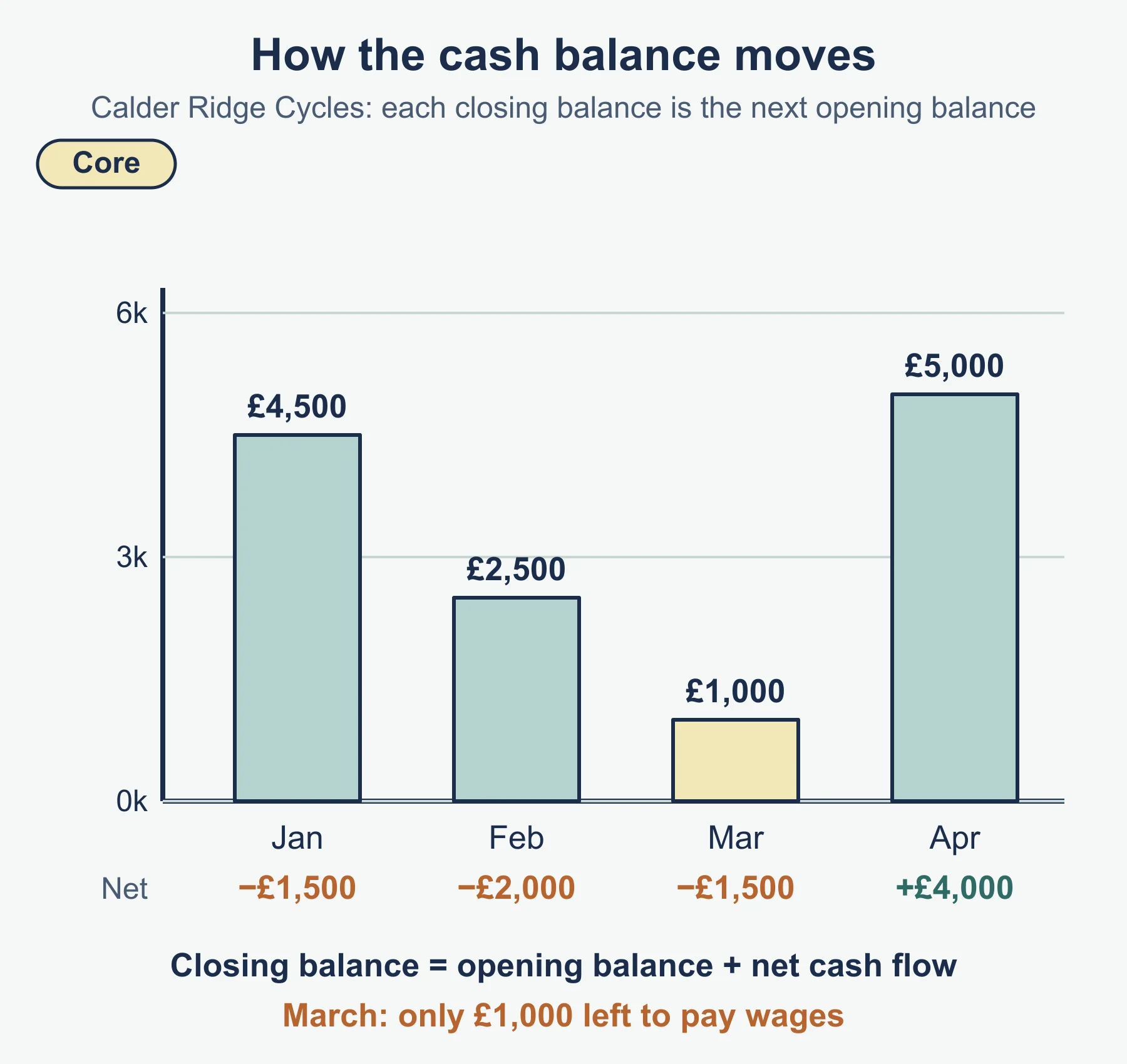
Net cash flow   = cash inflows - cash outflows
Closing balance = opening balance + net cash flow
Next opening    = this closing
Worked reminder (Pell Joinery): opening £2,200, inflows £9,100, outflows £10,000. Net cash flow = -£900. Closing balance = £1,300.
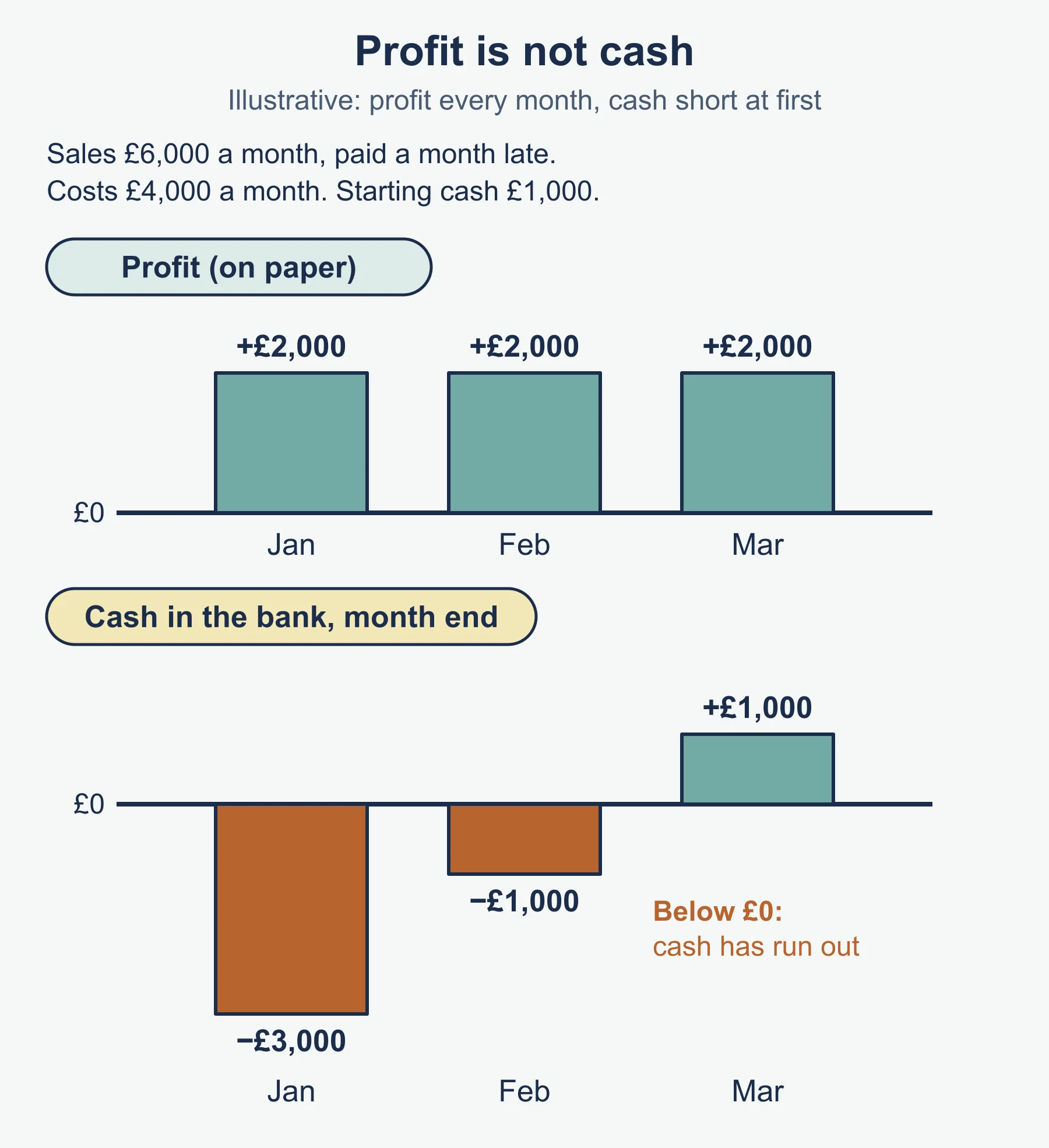
- Cash is not profit. Profit can exist on paper (credit sales) while cash is short. Cash can be high from a loan while the firm makes a loss.
- Problems: late payment of staff and suppliers, high-cost borrowing, loss of trust, insolvency.
- Forecasts are built to spot shortages, support loan applications and plan. They rely on estimates, so can be wrong.
- Solutions: re-schedule payments, overdraft, reduce outflow, increase inflow, find new finance. Always say what caused the problem before choosing.
Filling in a forecast table:
- Work out net cash flow for each month (inflows minus outflows).
- Add it to the opening balance to get the closing balance.
- Copy that closing balance into the next month’s opening balance.
- Work backwards if a figure is missing: inflows = closing - opening + outflows.
Interpreting a forecast: say whether the balance is positive or negative, which months are weakest, why that matters (wages, suppliers), and one sensible action. A low but positive balance is still a risk if a customer pays late.
| Solution | Best when |
|---|---|
| Re-schedule payments | Suppliers are flexible and the gap is short |
| Overdraft | The shortage is temporary |
| Reduce outflow | Costs are too high all year |
| Increase inflow | Customers pay slowly or sales are weak |
| New finance | The gap is large or long-term |
Costs, ARR and break-even
Total costs = fixed costs + variable costs
Revenue     = selling price x quantity
Profit      = revenue - total costs
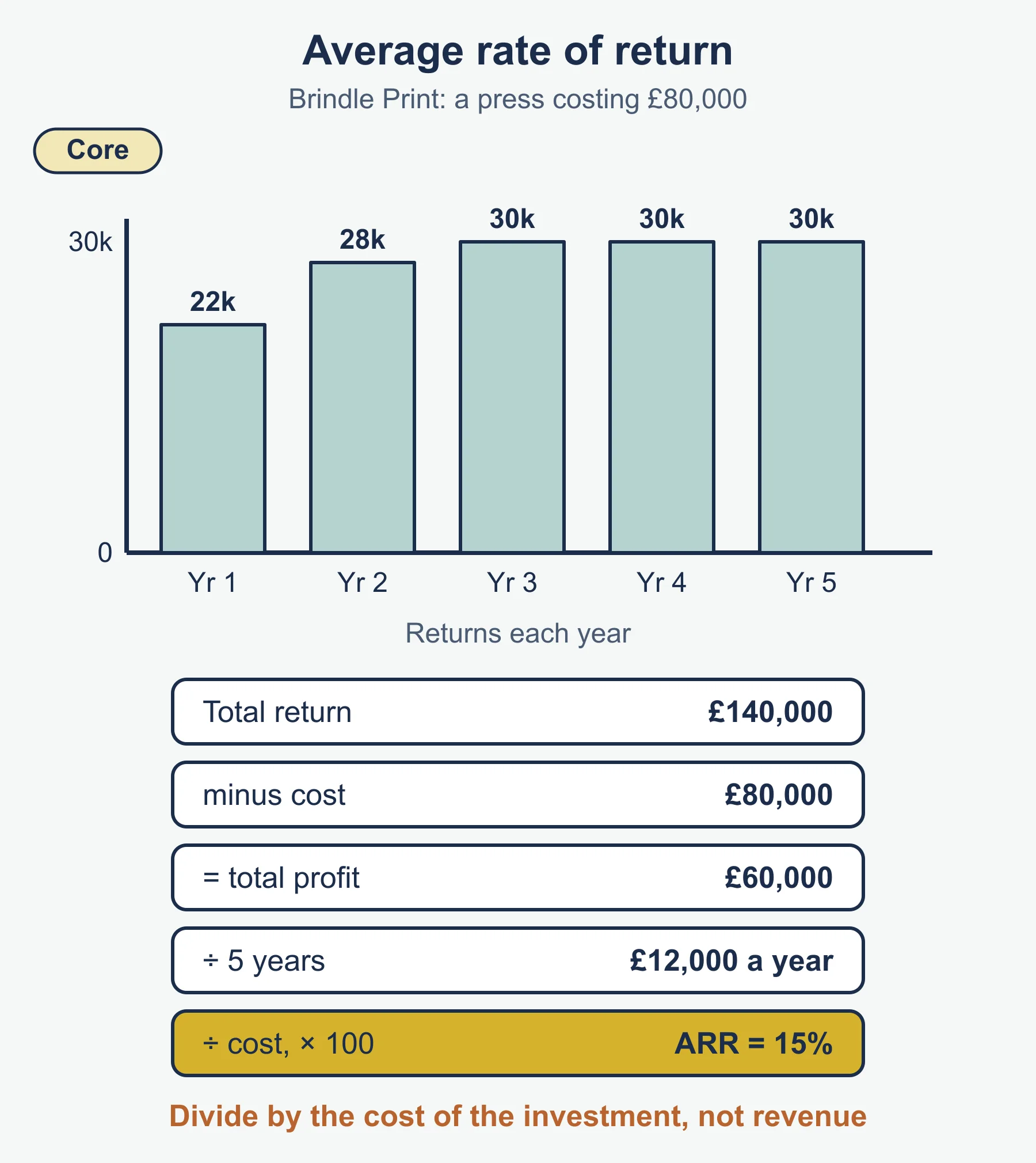
Average rate of return (standard form, as the specification gives no formula):
ARR = [(total return - cost of investment) / years] / cost of investment x 100Worked reminder: cost £20,000, total return £29,000 over 3 years. Profit £9,000; per year £3,000; ARR = 3,000 / 20,000 x 100 = 15%. A higher ARR is better, but compare it with other projects and the cost of borrowing. Investments covered: machinery, buildings, vehicles.
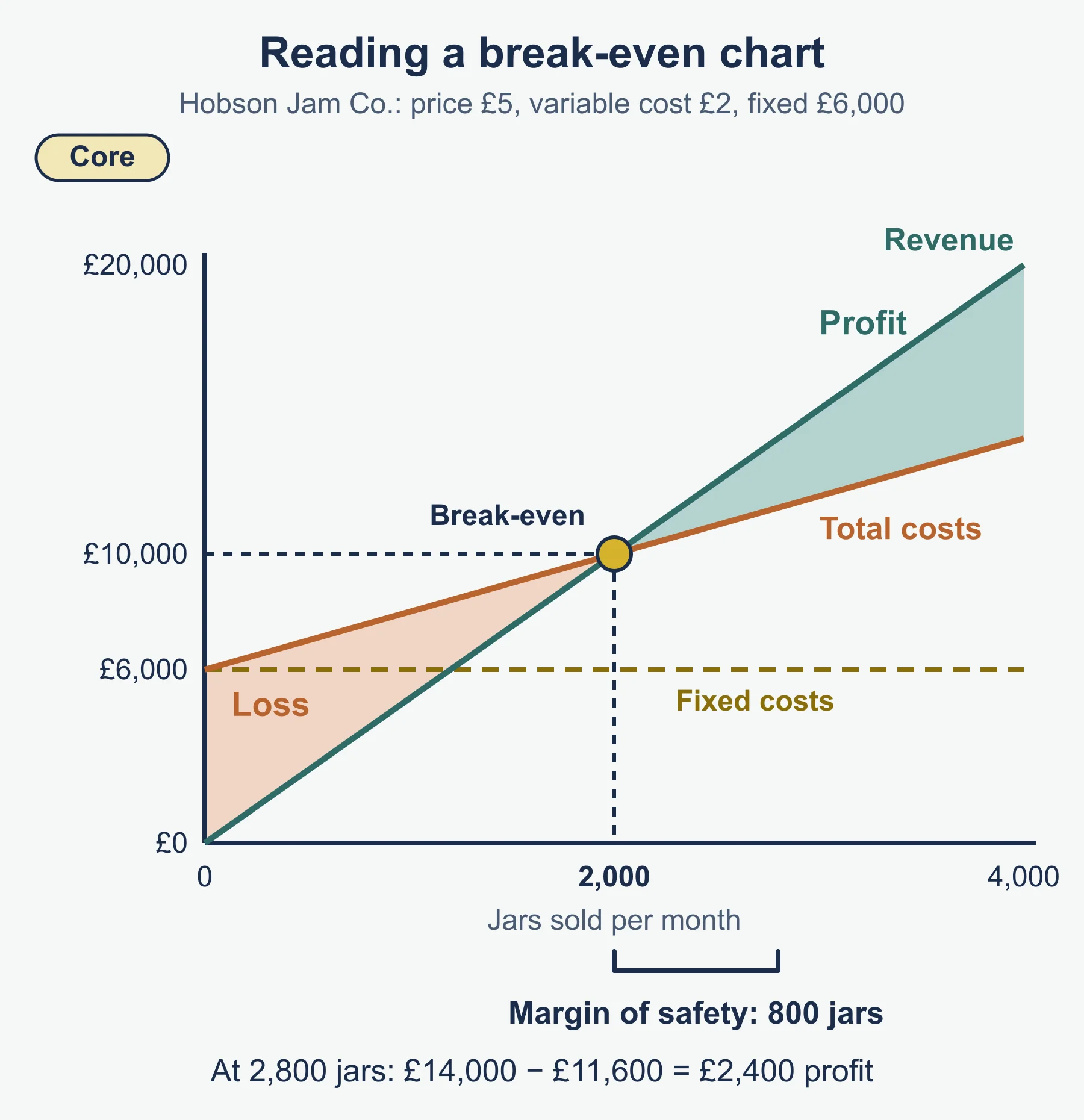
Break-even chart (you read it; you do not draw it or use the formula):
| Feature | How to read it |
|---|---|
| Fixed costs | Horizontal line |
| Total costs | Starts at fixed costs, slopes up |
| Revenue | Starts at zero, slopes up more steeply |
| Break-even | Where revenue and total costs cross |
| Loss area | Left of break-even |
| Profit area | Right of break-even |
| Margin of safety | Actual output minus break-even output |
Worked reminder: break-even is 900 units and the firm sells 1,150. Margin of safety is 250 units.
Value of break-even analysis: shows the sales needed to survive, helps a loan application, tests price and cost changes. Limits: assumes all output sells, constant price and variable cost per unit, depends on forecasts, ignores cash timing.
Financial statements
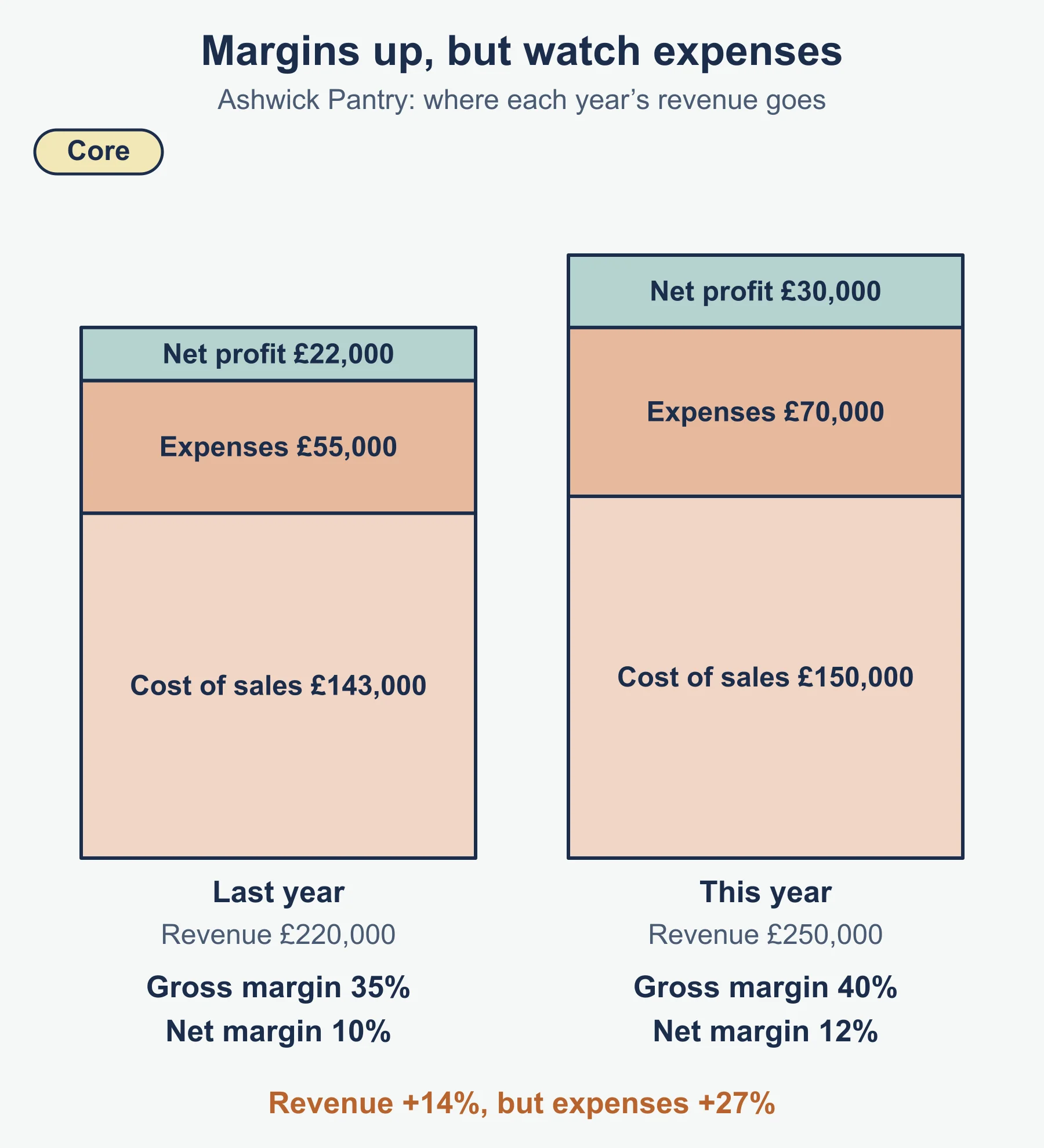
Income statement (over a period): sales revenue, cost of sales, gross profit, expenses, net profit.
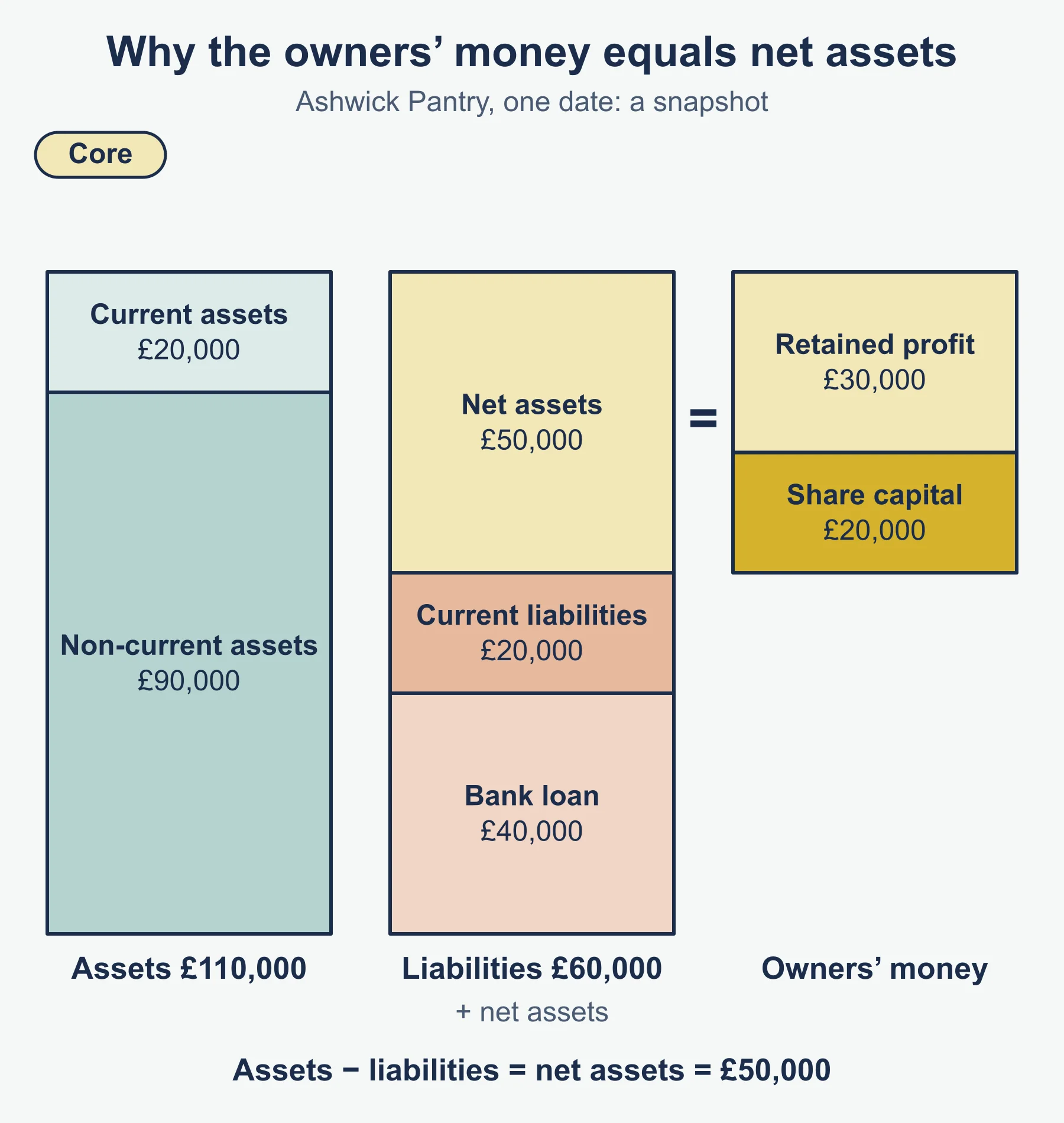
Statement of financial position (on one date, a snapshot in time): non-current assets, current assets (inventories, receivables, cash), current liabilities, non-current liabilities, net assets, and the owners’ funds (share capital and retained profit).
Gross profit = sales revenue - cost of sales
Net profit   = gross profit - expenses
Gross profit margin = gross profit / sales revenue x 100
Net profit margin   = net profit / sales revenue x 100
You are not given formulae in the exam, so memorise these.
Worked reminder (Pell Joinery): sales revenue £120,000, cost of sales £78,000, expenses £33,000.
| Line | £ | Margin |
|---|---|---|
| Gross profit | 42,000 | 35% |
| Net profit | 9,000 | 7.5% |
Judging performance: compare with the same business last year, with competitors, and with what each stakeholder wants (owners: profit; lenders: ability to repay; employees: security; suppliers: prompt payment). Financial statements help managers decide and help outsiders assess the business. They cannot show quality of products, staff morale or future plans.
Must-know distinctions
- Cash vs profit.
- Internal vs external finance.
- Fixed vs variable costs.
- Gross profit vs net profit.
- Income statement (a period) vs statement of financial position (a moment).
- Asset vs liability.
- Break-even output vs margin of safety.
- Overdraft (short term, flexible) vs loan (fixed amount, set repayments).
Quick self-test
- A firm’s break-even output is 900 units and it sells 1,150. What is its margin of safety?
- Calculate the ARR: cost £20,000, total return £29,000 over three years.
- Gross profit £18,000, sales revenue £90,000. Calculate the gross profit margin.
- Net profit £4,500, sales revenue £90,000. Calculate the net profit margin.
- Opening balance £2,200, inflows £9,100, outflows £10,000. Find the closing balance.
- Fixed costs £3,000, variable cost £2.50 a unit, 400 units made. Find total costs.
- State two internal sources of finance.
- Explain why a profitable business can run out of cash.
- Why is the statement of financial position called a snapshot?
- Give one disadvantage of an overdraft.
- Name two stakeholders who might read an income statement and one thing each wants to know.
Answers
- 250 units.
- 15%.
- 20%.
- 5%.
- £1,300.
- £3,000 + 400 x £2.50 = £4,000.
- Retained profit; selling unwanted assets.
- It may have sold on credit, so profit is recorded before customers pay, while it must pay suppliers and wages now.
- It shows assets and liabilities on one date only; the position changes the next day.
- Interest is high and the bank can withdraw it (either).
- Any two, such as a lender wanting evidence it can repay, and an employee wanting evidence the job is secure.
Where marks are usually lost
- Calling a closing balance “profit”.
- Not carrying the closing balance forward as the next opening balance.
- Using revenue instead of the investment cost as the divisor in ARR.
- Reporting the margin of safety as money when the question asks for units.
- Reading a break-even chart at the wrong axis.
- Listing generic pros and cons of a source without linking to the case.
- Writing “evaluate” answers with no judgement.
- Confusing assets with liabilities, or non-current with current.
- Giving a percentage with no working, or forgetting the percentage sign.
Frequently asked questions
Are formulae given in the AQA GCSE Business exam? No. You are not given formulae in the AQA GCSE Business (8132) exam, so memorise the formulas for profit, profit margins, cash flow and average rate of return.
Do I need to draw a break-even chart for AQA GCSE Business? No. You need to read and interpret a break-even chart, including the break-even output and margin of safety, but you do not draw one or use the break-even formula.
How do you calculate average rate of return? Subtract the cost of the investment from the total return, divide by the number of years, then divide by the cost of the investment and multiply by 100.
Why can a profitable business run out of cash? It may sell on credit, so profit is recorded before customers pay, while it still has to pay suppliers and staff now. Cash and profit are not the same.
What is the difference between an income statement and a statement of financial position? An income statement shows revenue, costs and profit over a period of time. A statement of financial position shows assets and liabilities on one date, a snapshot in time.
Official syllabus
Aligned to AQA GCSE Business (8132), first teaching from September 2017, published by AQA: section 3.6 Finance.
Get free revision emails (optional)
Occasional emails with practice questions, worked explanations and links to free resources for the qualification and subjects you choose. No spam, and you can unsubscribe from any email. The free tools on this site never need an email.
Related resources
-
Study guides
AQA GCSE Business: Finance (8132)
Study guide to AQA GCSE Business Finance: sources of finance, cash flow, break-even, average rate of return and financial statements, with worked examples.
Business · AQA · GCSE
Read guide -
Practice questions
AQA GCSE Business: Finance (8132) – Practice Questions
Original practice questions with worked answers on AQA GCSE Business Finance: sources of finance, cash flow, ARR, break-even and financial statements.
Business · AQA · GCSE
Try questions -
Study guides
AQA GCSE Business: Globalisation and Legislation (8132)
Study guide to globalisation, exchange rates and business law for AQA GCSE Business (8132), sections 3.2.4 and 3.2.5, with worked examples.
Business · AQA · GCSE
Read guide
Related articles
-
teaching
A Level tuition in Dubai: Cambridge or Pearson Edexcel International A Level?
Schools in Dubai and Abu Dhabi teach either Cambridge International AS & A Level or Pearson Edexcel International A Level. How the two are structured, why it matters for tuition, and how online classes from Lahore work.
9 October 2026
-
curriculum guides
Choosing subjects at IGCSE and A Level
How subject choices at 14 and 16 affect university options later, and how to keep pathways open without overloading a timetable.
28 July 2026
Studying this with a teacher
Working through Business GCSE?
This page is free and stays free. If you would rather be taught it, Marlbridge runs Business classes one-to-one and in small groups of up to 15, online in your own time zone. The first trial class is free. WhatsApp replies within an hour (8am–11pm Pakistan time, every day); email the same day.
AQA Business teachers at Marlbridge
