
Study Guides
AQA GCSE Business: Finance (8132)
Study guide to AQA GCSE Business Finance: sources of finance, cash flow, break-even, average rate of return and financial statements, with worked examples.
- Subject
- Business
- Level
- GCSE
- Topic
- Finance
- Author
- Marlbridge Academic Team
- Updated
- Reviewed by
- Salman Ahmad (what this means)
Aligned to AQA GCSE Business (8132), For first teaching from September 2017. Official specification .
Syllabus page (what it covers and how it is assessed): AQA GCSE Business.
Syllabus points this page covers
8132
- 3.6.1 Sources of finance
- 3.6.2 Cash flow
- 3.6.3 Financial terms and calculations
- 3.6.4 Analysing the financial performance of a business
Found an error? Report a correction.
Need help with this topic? Request a free trial class for GCSE Business (8132).
This guide covers section 3.6 Finance of the AQA GCSE Business (8132) specification, for first teaching from September 2017. It includes all four parts: 3.6.1 sources of finance, 3.6.2 cash flow, 3.6.3 financial terms and calculations, and 3.6.4 analysing the financial performance of a business. Finance is part of the content assessed in Paper 2. All figures are invented.
Use it with the revision notes and the practice questions. The course hub is at AQA GCSE Business, the printable list is the checklist, and you can test yourself with the free diagnostics.
Map of the topic
The specification also asks you to understand how operations, human resources, marketing and finance depend on each other, and how objectives are split into functional plans. The finance function plans and records the business’s money, sets budgets and supplies the information used to decide on loans, investment and pricing, so it influences what every other function can do. A loan or a new machine affects them all.
| Section | What you must be able to do |
|---|---|
| 3.6.1 Sources of finance | Know the internal and external sources; analyse advantages and disadvantages in a given situation; evaluate suitability for new and established businesses |
| 3.6.2 Cash flow | Explain why cash matters and what cash flow problems cause; complete and interpret parts of a cash flow forecast; separate cash from profit; evaluate solutions |
| 3.6.3 Financial terms and calculations | Fixed, variable and total costs; revenue, profit and loss; average rate of return; break-even output, margin of safety and break-even charts |
| 3.6.4 Financial performance | Purpose and components of the income statement and statement of financial position; assets and liabilities; gross and net profit margin; judge performance |
3.6.1 Sources of finance
Businesses raise money to start up, cover a cash gap or grow. Internal sources come from inside the business. External sources come from outside it.
| Source | Type | Main advantage | Main disadvantage |
|---|---|---|---|
| Retained profit | Internal | No interest, no outside control | Only exists if the firm has made profit; limited amount |
| Selling unwanted assets | Internal | Cash quickly, no repayment | One-off; may sell for less than the asset’s worth |
| Family and friends | External | Flexible, often cheap or interest-free | Can damage relationships; amounts are small |
| New share issue | External | No repayment; large sums possible | Owners share control and profit; only for companies |
| Loan or mortgage | External | Large sums over a long period; fixed repayments | Interest cost; security may be needed; must repay |
| Overdraft | External | Flexible, interest only on the amount used | High interest; bank can withdraw it |
| Trade credit | External | Delays payment to suppliers, so no cash needed now | Late payment can lose the supplier’s goodwill; discounts for prompt payment are lost |
| Hire purchase | External | Spreads the cost of equipment | Total paid is more than the cash price; item not fully owned until the last payment |
| Government grants | External | Often does not need to be repaid | Conditions attached; competitive and slow |
A mortgage is a long-term loan secured on property.
Choosing the right source
- Time. An overdraft or trade credit suits a short-term gap. A loan, mortgage or share issue suits a long-term purchase such as a building.
- Size. Retained profit rarely funds a large project.
- Business age. A new business has no retained profit and no track record, so banks may refuse it or charge more. Owners often rely on savings, family and friends, or a grant. An established business has retained profit and assets to sell, and can offer security, so loans and share issues are more realistic.
- Cost and control. Interest has to be paid whatever happens. New shareholders dilute control.
Worked example: hire purchase
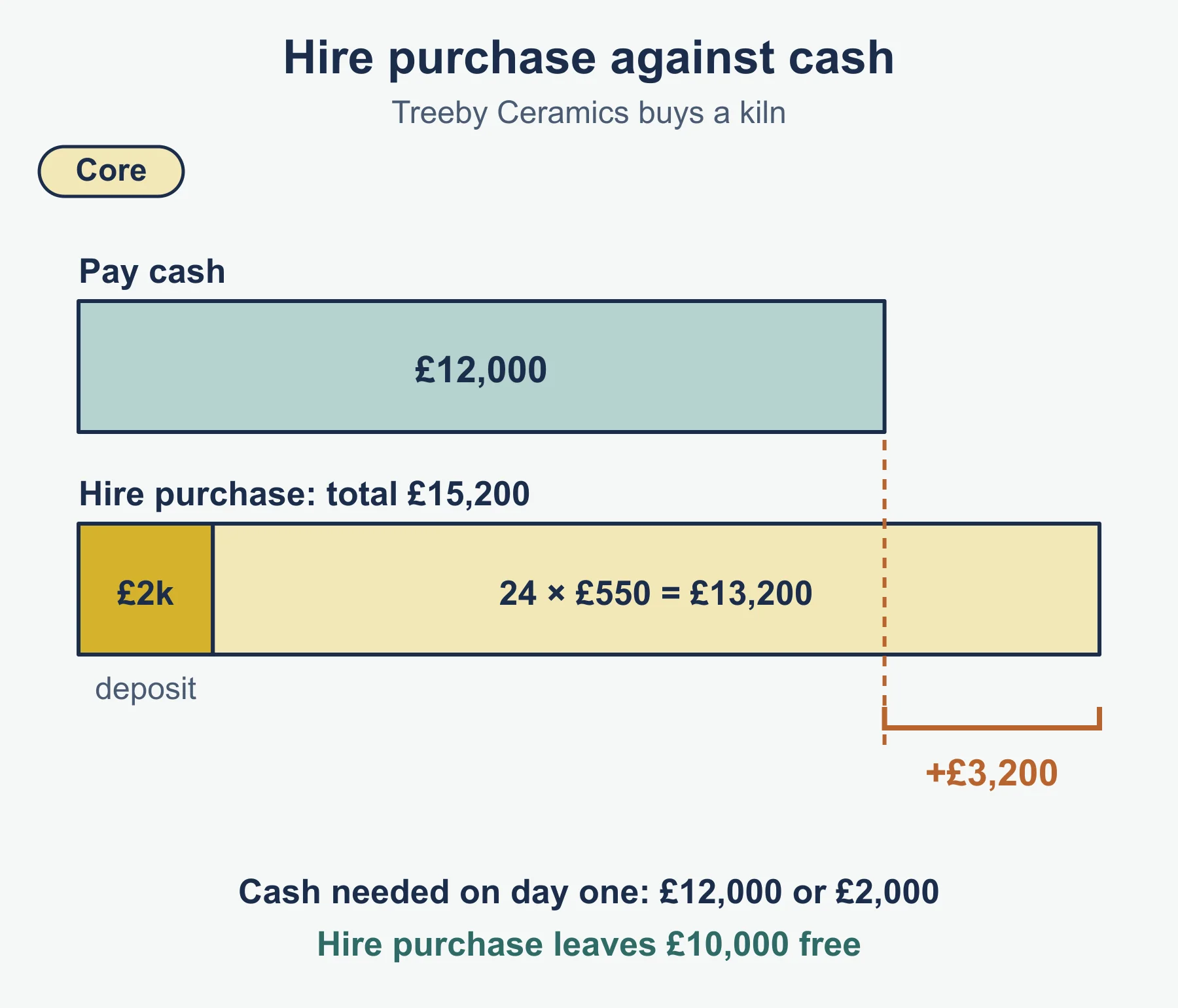
Treeby Ceramics wants a kiln with a cash price of £12,000. The hire purchase deal is a £2,000 deposit plus 24 monthly payments of £550.
Monthly payments: 24 x 550 = 13,200
Total paid:       2,000 + 13,200 = 15,200
Extra cost:       15,200 - 12,000 = 3,200
The deal costs £3,200 more than paying cash, but Treeby keeps £10,000 free at the start. For a young business with little cash, that may be worth it.
3.6.2 Cash flow
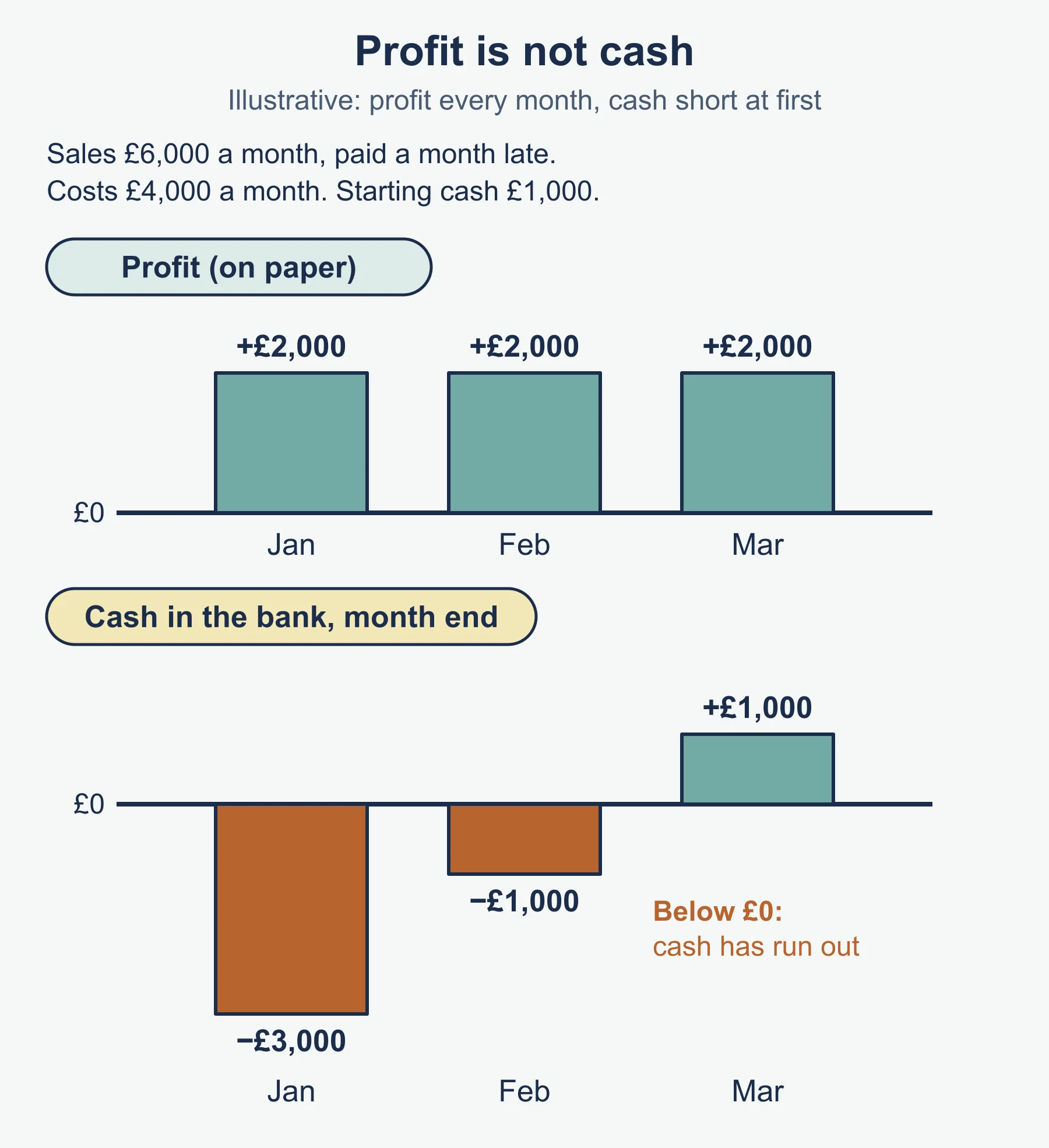
Cash is the money moving in and out of the business now. Profit is revenue minus costs over a period. They are not the same. A firm can sell goods on credit, record the profit at once, and still have no cash until the customer pays. A firm can also have cash in the bank because it took a loan, while making a loss.
Cash matters because wages, rent and suppliers must be paid on time. Consequences of cash flow problems: being unable to pay suppliers or staff, losing supplier trust, borrowing at high cost, missing opportunities, and in the worst case insolvency. Positive cash flow lets a business pay bills, hold a safety margin, invest and take opportunities.
Cash flow forecasts
A cash flow forecast predicts cash inflows and outflows for coming months. Businesses build one to see in advance when a shortage will occur, to support a loan application and to plan spending. You are not expected to construct a whole forecast, but you must complete and interpret sections of one.
- Cash inflows: cash sales, payments from customers, loans received, grants.
- Cash outflows: wages, materials, rent, loan repayments, tax.
- Net cash flow = cash inflows - cash outflows.
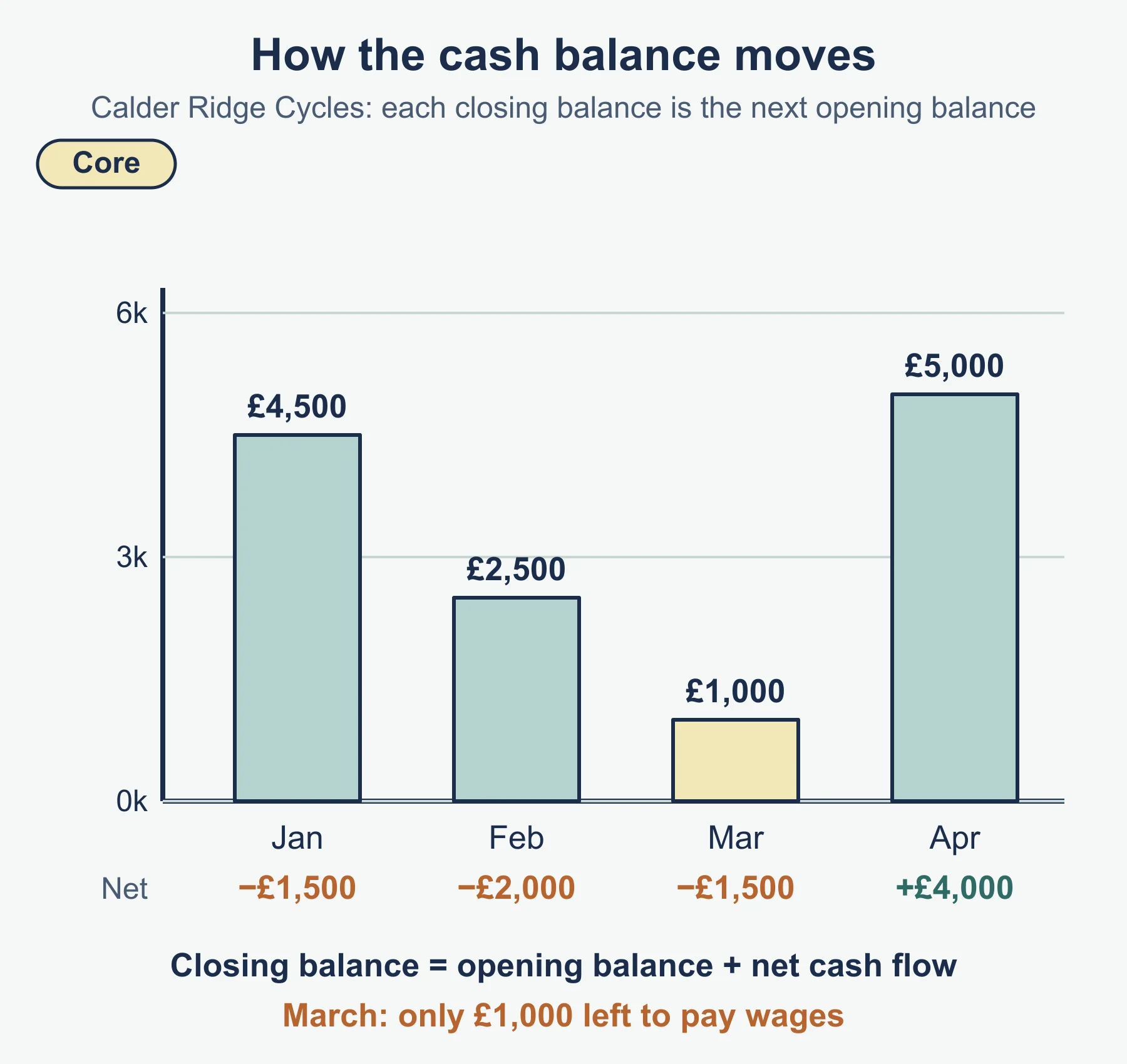
- Closing balance = opening balance + net cash flow.
- The closing balance for one month becomes the opening balance of the next.
Worked example: Calder Ridge Cycles
| £ | Jan | Feb | Mar | Apr |
|---|---|---|---|---|
| Opening balance | 6,000 | 4,500 | 2,500 | 1,000 |
| Cash inflows | 14,000 | 12,000 | 16,000 | 22,000 |
| Cash outflows | 15,500 | 14,000 | 17,500 | 18,000 |
| Net cash flow | -1,500 | -2,000 | -1,500 | 4,000 |
| Closing balance | 4,500 | 2,500 | 1,000 | 5,000 |
Check January: 14,000 - 15,500 = -1,500, and 6,000 + (-1,500) = 4,500. The balance never goes negative, but it falls for three months to only £1,000 in March, which is a thin cushion for a shop that must pay wages. Say what the figures show, why it matters and what to do.
Solving cash flow problems
| Solution | Why it helps | Limitation |
|---|---|---|
| Re-schedule payments (ask suppliers for longer) | Keeps cash in the business | Supplier may refuse or charge |
| Overdraft | Quick cover for a short gap | Interest is high; can be withdrawn |
| Reduce cash outflow (cut costs, delay purchases) | Costs nothing to arrange | Quality or growth may suffer |
| Increase cash inflow (discounts for prompt payment, chase debtors, promotions) | Brings cash in sooner | Discounts cut revenue; promotions need spending first |
| Find new sources of finance (loan, share issue, selling assets) | Larger amounts | Cost, control or one-off nature |
To evaluate, match the solution to the cause. A seasonal dip suits an overdraft. A permanent shortage caused by overspending needs lower outflows, not more borrowing.
3.6.3 Financial terms and calculations
- Fixed costs do not change with output in the short run (rent, insurance).
- Variable costs change with output (materials, packaging).
- Total costs = fixed costs + variable costs.
- Revenue (sales revenue) = selling price x quantity sold.
- Profit = revenue - total costs. If this is negative the business makes a loss.
Average rate of return
Businesses invest in new machinery, buildings and vehicles. The average rate of return (ARR) compares the yearly gain with the money invested. The specification does not print a formula here, so this is the standard form:
ARR = (average annual profit / cost of investment) x 100
average annual profit = (total return - cost of investment) / number of years
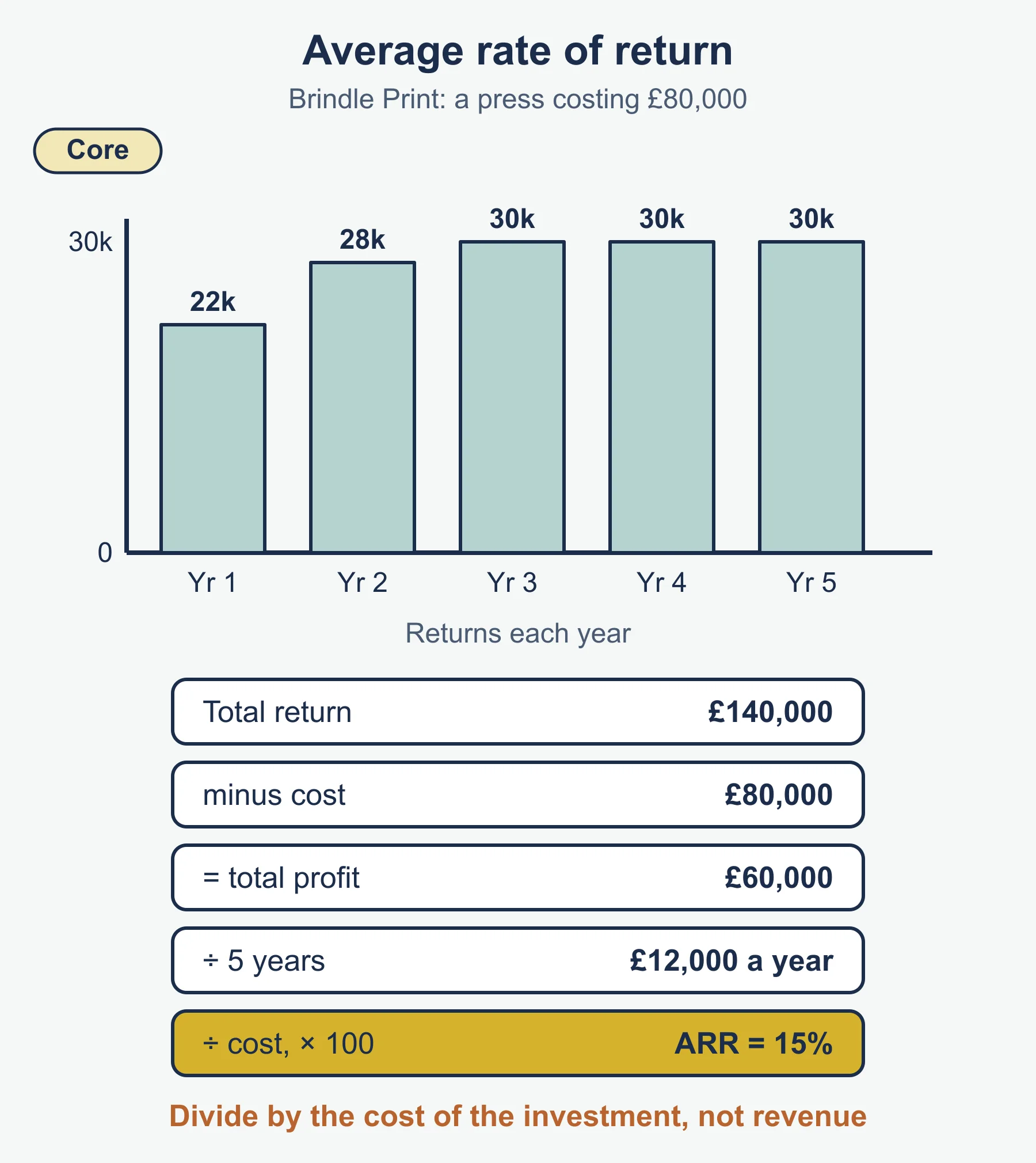
Worked example. Brindle Print considers a press costing £80,000. It expects returns of £22,000, £28,000, £30,000, £30,000 and £30,000 over five years.
Total return = 140,000
Total profit = 140,000 - 80,000 = 60,000
Average annual profit = 60,000 / 5 = 12,000
ARR = 12,000 / 80,000 x 100 = 15%
Compare the ARR with other projects or with the interest rate on borrowing. The figure rests on forecast sales.
Break-even
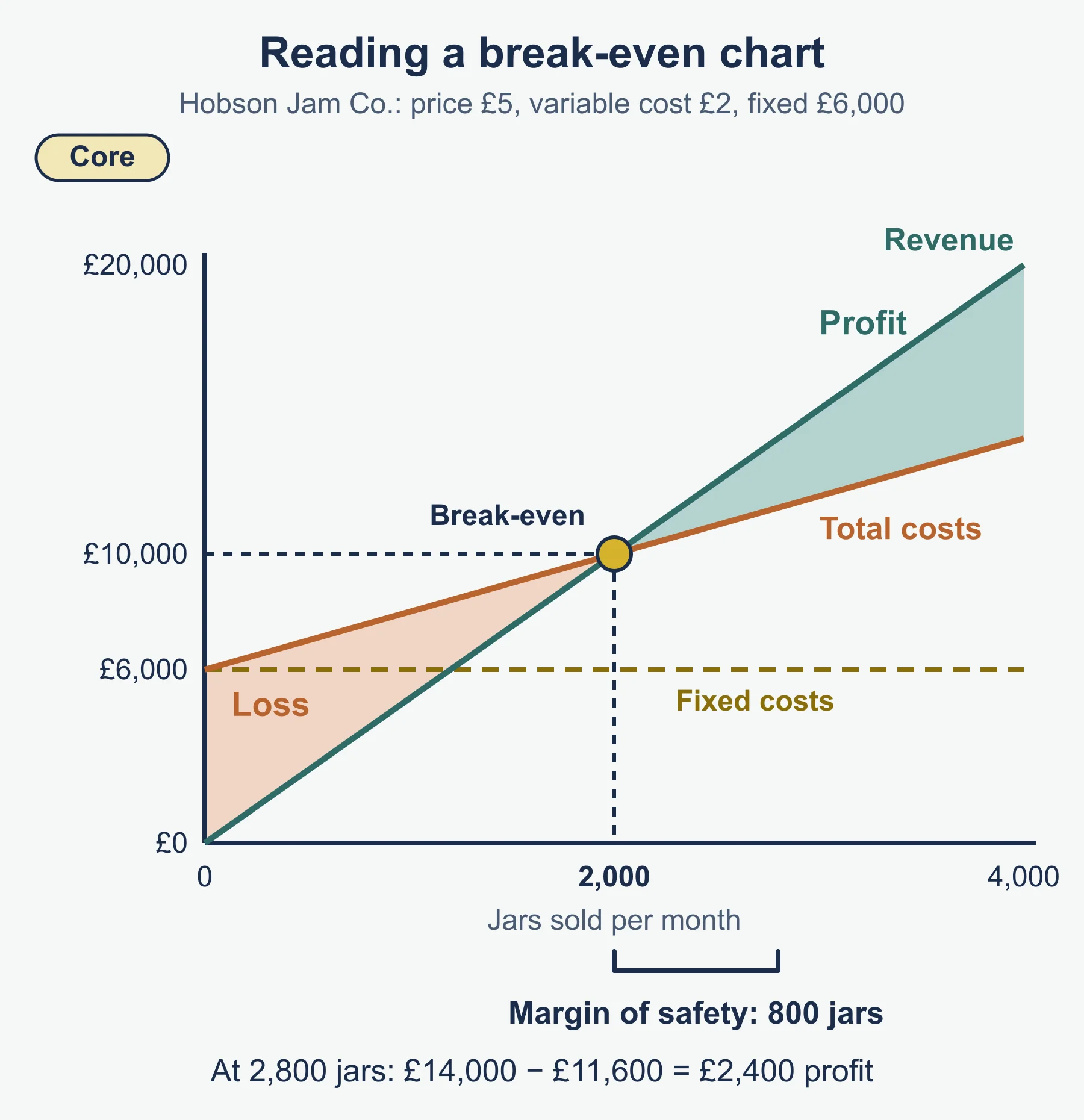
Break-even output is the number of units where revenue equals total costs, so profit is zero. The margin of safety is actual (or planned) output minus break-even output. You will not be asked to draw a break-even chart or use the break-even formula, but you must interpret a chart and read off values.
Hobson Jam Co. sells jars at £5. Variable cost is £2 a jar and fixed costs are £6,000 a month.
| Output (jars) | 0 | 1,000 | 2,000 | 3,000 | 4,000 |
|---|---|---|---|---|---|
| Revenue (£) | 0 | 5,000 | 10,000 | 15,000 | 20,000 |
| Total costs (£) | 6,000 | 8,000 | 10,000 | 12,000 | 14,000 |
Reading a chart of these lines:
- The fixed cost line is flat at £6,000.
- The total cost line starts at £6,000 and rises by £2 a jar.
- The revenue line starts at zero and rises by £5 a jar.
- The lines cross at 2,000 jars, where both equal £10,000. That is the break-even output.
- Below 2,000 jars there is a loss; above it, a profit.
- If the firm sells 2,800 jars, the margin of safety is 2,800 - 2,000 = 800 jars. Profit is the gap between the lines: 14,000 revenue - 11,600 costs = £2,400.
Value of break-even analysis. It shows the minimum sales needed, helps a start-up decide if a plan is realistic, supports loan applications and shows the effect of price or cost changes. Limits: it assumes everything produced is sold, that price and variable cost per unit stay constant, and it uses forecasts. It ignores demand and cash timing.
3.6.4 Analysing financial performance
Financial statements summarise a firm’s performance and position. Owners, managers, banks, investors, suppliers and employees use them to judge past results and make decisions, such as whether to lend or invest.
Income statement
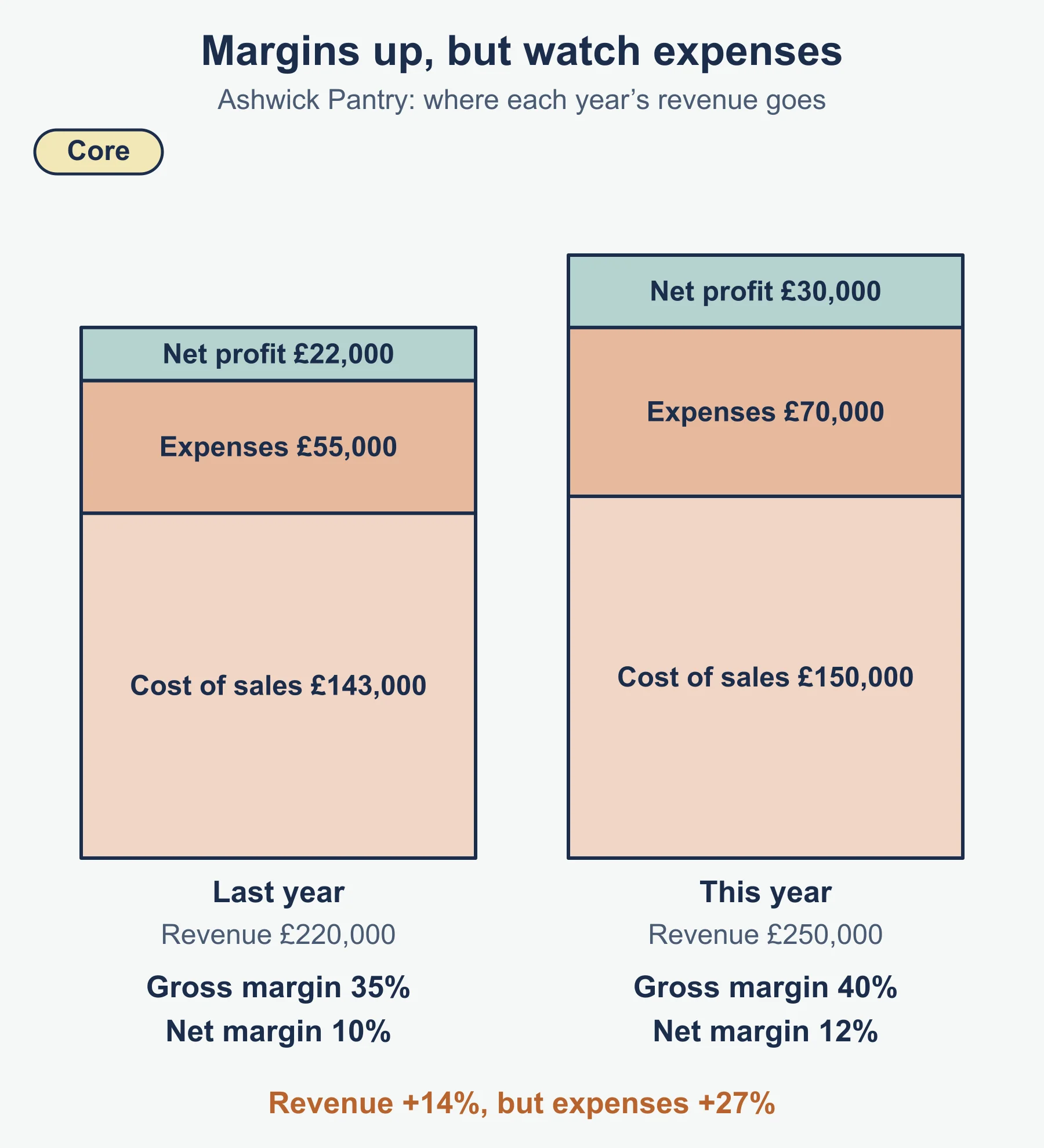
The income statement shows revenue, costs and profit over a period (usually a year). Main components: sales revenue, cost of sales (direct cost of the goods sold), gross profit (revenue - cost of sales), expenses (rent, wages, marketing) and net profit (gross profit - expenses).
Statement of financial position
The statement of financial position lists what a business owns and owes on one date, so it is a snapshot in time.
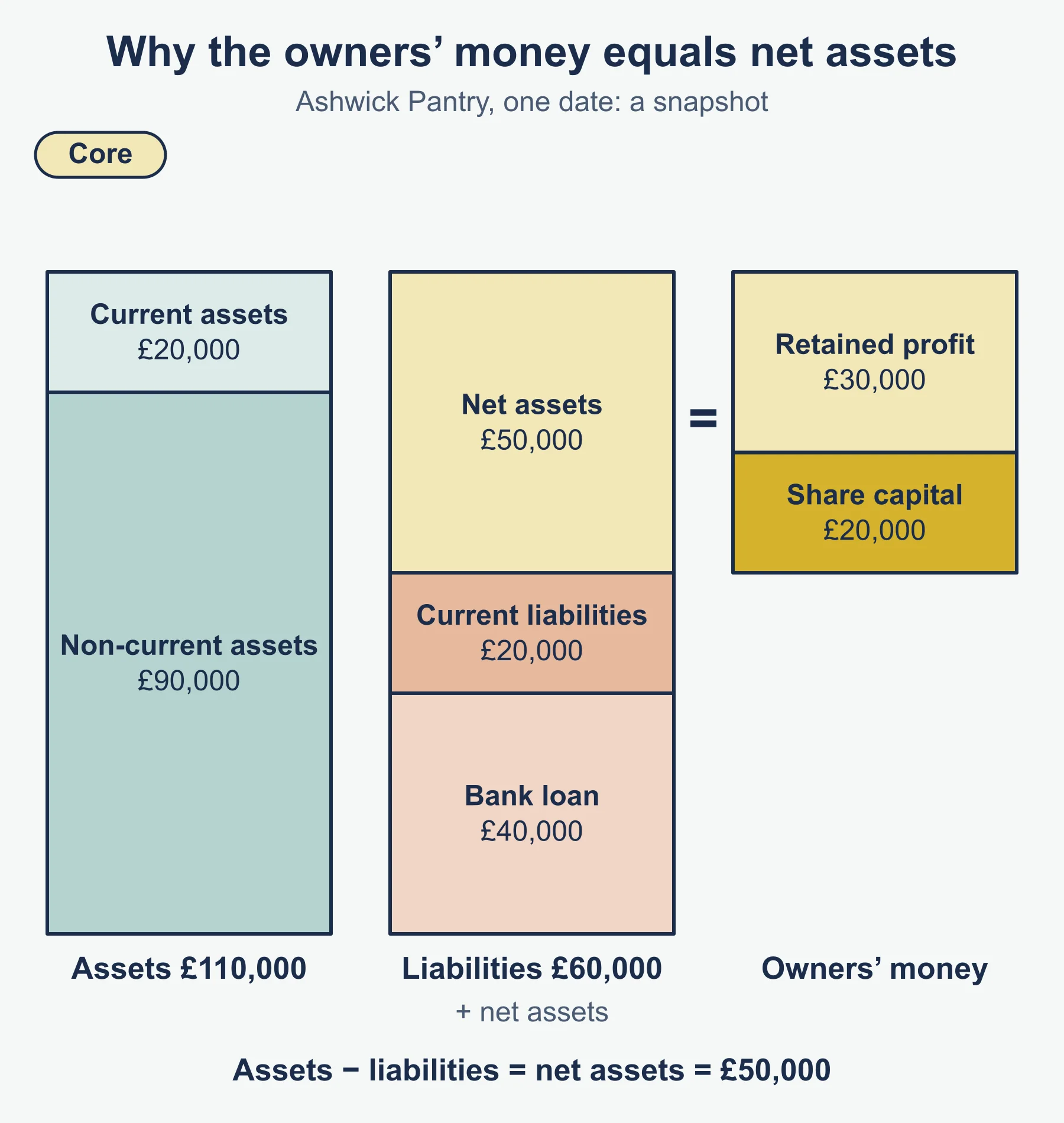
- Assets are what the business owns or is owed. Non-current assets last more than a year (vans, fittings). Current assets are inventories, receivables and cash.
- Liabilities are what the business owes. Current liabilities are due within a year (payables, overdraft). Non-current liabilities are longer term (a bank loan).
- Assets - liabilities = net assets, which equals the owners’ money in the business: share capital plus retained profit.
For Ashwick Pantry: non-current assets £90,000, inventories £12,000, receivables £3,000 and cash £5,000 give total assets of £110,000. Payables £14,000, an overdraft £6,000 and a bank loan £40,000 give liabilities of £60,000. Net assets are £50,000, matching share capital £20,000 plus retained profit £30,000.
Profit margins
You will not be given formulae in the exam, so learn these:
Gross profit margin = (gross profit / sales revenue) x 100
Net profit margin = (net profit / sales revenue) x 100| Ashwick Pantry (£) | This year | Last year |
|---|---|---|
| Sales revenue | 250,000 | 220,000 |
| Cost of sales | 150,000 | 143,000 |
| Gross profit | 100,000 | 77,000 |
| Expenses | 70,000 | 55,000 |
| Net profit | 30,000 | 22,000 |
| Gross profit margin | 40% | 35% |
| Net profit margin | 12% | 10% |
Making judgements
Judge performance by looking at: current performance (are margins healthy?), previous years (is the trend up?), competitors (are margins better or worse?) and stakeholders (owners want profit, lenders want security, employees want job stability, suppliers want prompt payment). Here both margins rose, but expenses grew by about 27% while revenue grew by about 14%, which an owner should watch. A good answer reaches a judgement.
Common errors
- Treating profit and cash as the same thing.
- Dividing by revenue when finding ARR, instead of by the cost of the investment.
- Saying an asset is a liability, or treating the statement of financial position as covering a period.
Frequently asked questions
What is the difference between internal and external sources of finance? Internal sources come from within the business, such as retained profit and selling unwanted assets. External sources come from outside, such as loans, overdrafts, share issues, trade credit, hire purchase and government grants.
Why is cash flow important even for a profitable business? Wages, rent and suppliers must be paid on time in cash. A business can make a profit on paper while running short of cash, which can lead to high-cost borrowing, loss of trust and even insolvency.
How do you read the break-even output from a chart? Find where the revenue line crosses the total cost line. Below that output the business makes a loss, and above it a profit.
How do you judge a business’s financial performance in AQA GCSE Business (8132)? Compare its profit margins with its previous performance, with competitors and with its own objectives, rather than looking at one year’s figures alone.
Official syllabus
Aligned to AQA GCSE Business (8132), first teaching from September 2017, published by AQA: section 3.6 Finance, covering 3.6.1 to 3.6.4.
Get free revision emails (optional)
Occasional emails with practice questions, worked explanations and links to free resources for the qualification and subjects you choose. No spam, and you can unsubscribe from any email. The free tools on this site never need an email.
Related resources
-
Practice questions
AQA GCSE Business: Finance (8132) – Practice Questions
Original practice questions with worked answers on AQA GCSE Business Finance: sources of finance, cash flow, ARR, break-even and financial statements.
Business · AQA · GCSE
Try questions -
Revision notes
AQA GCSE Business: Finance (8132) – Revision Notes
Condensed AQA GCSE Business Finance revision notes: sources of finance, cash flow, break-even, ARR, profit margins and statements, plus a self-test.
Business · AQA · GCSE
Revise topic -
Study guides
AQA GCSE Business: Globalisation and Legislation (8132)
Study guide to globalisation, exchange rates and business law for AQA GCSE Business (8132), sections 3.2.4 and 3.2.5, with worked examples.
Business · AQA · GCSE
Read guide
Related articles
-
teaching
A Level tuition in Dubai: Cambridge or Pearson Edexcel International A Level?
Schools in Dubai and Abu Dhabi teach either Cambridge International AS & A Level or Pearson Edexcel International A Level. How the two are structured, why it matters for tuition, and how online classes from Lahore work.
9 October 2026
-
curriculum guides
Choosing subjects at IGCSE and A Level
How subject choices at 14 and 16 affect university options later, and how to keep pathways open without overloading a timetable.
28 July 2026
Studying this with a teacher
Working through Business GCSE?
This page is free and stays free. If you would rather be taught it, Marlbridge runs Business classes one-to-one and in small groups of up to 15, online in your own time zone. The first trial class is free. WhatsApp replies within an hour (8am–11pm Pakistan time, every day); email the same day.
AQA Business teachers at Marlbridge
