
Revision Notes
AQA GCSE Business: Marketing (8132) – Revision Notes
Condensed AQA GCSE Business revision notes on marketing: segmentation, research methods, pricing, life cycle, Boston Matrix, promotion and place.
- Subject
- Business
- Level
- GCSE
- Topic
- Marketing
- Author
- Marlbridge Academic Team
- Updated
- Reviewed by
- Salman Ahmad (what this means)
Aligned to AQA GCSE Business (8132), For first teaching from September 2017. Official specification .
Syllabus page (what it covers and how it is assessed): AQA GCSE Business.
Syllabus points this page covers
8132
- 3.5.1 Identifying and understanding customers
- 3.5.2 Segmentation
- 3.5.3 The purpose and methods of market research
- 3.5.4 The elements of the marketing mix: price, product, promotion and place (4Ps)
Found an error? Report a correction.
Need help with this topic? Request a free trial class for GCSE Business (8132).
Condensed notes on 3.5 Marketing (3.5.1 to 3.5.4) from the 8132 AQA GCSE Business specification, first teaching September 2017. Fuller explanations and examples are in the study guide. Test yourself with the practice questions. Course hub: AQA GCSE Business. Checklist: AQA GCSE Business checklist. Not sure where to start? Use the free diagnostics. Marketing is examined in Paper 2. All examples are invented.
Customers (3.5.1)
The section opens by stating that operations, human resources, marketing and finance depend on one another, and that business objectives are split into functional plans with clear links between them. Marketing plans therefore follow from the objectives.
Identify and satisfy customer needs to:
- provide a product that customers will buy
- increase sales
- select the correct marketing mix
- avoid costly mistakes
- be competitive.
Segmentation (3.5.2)
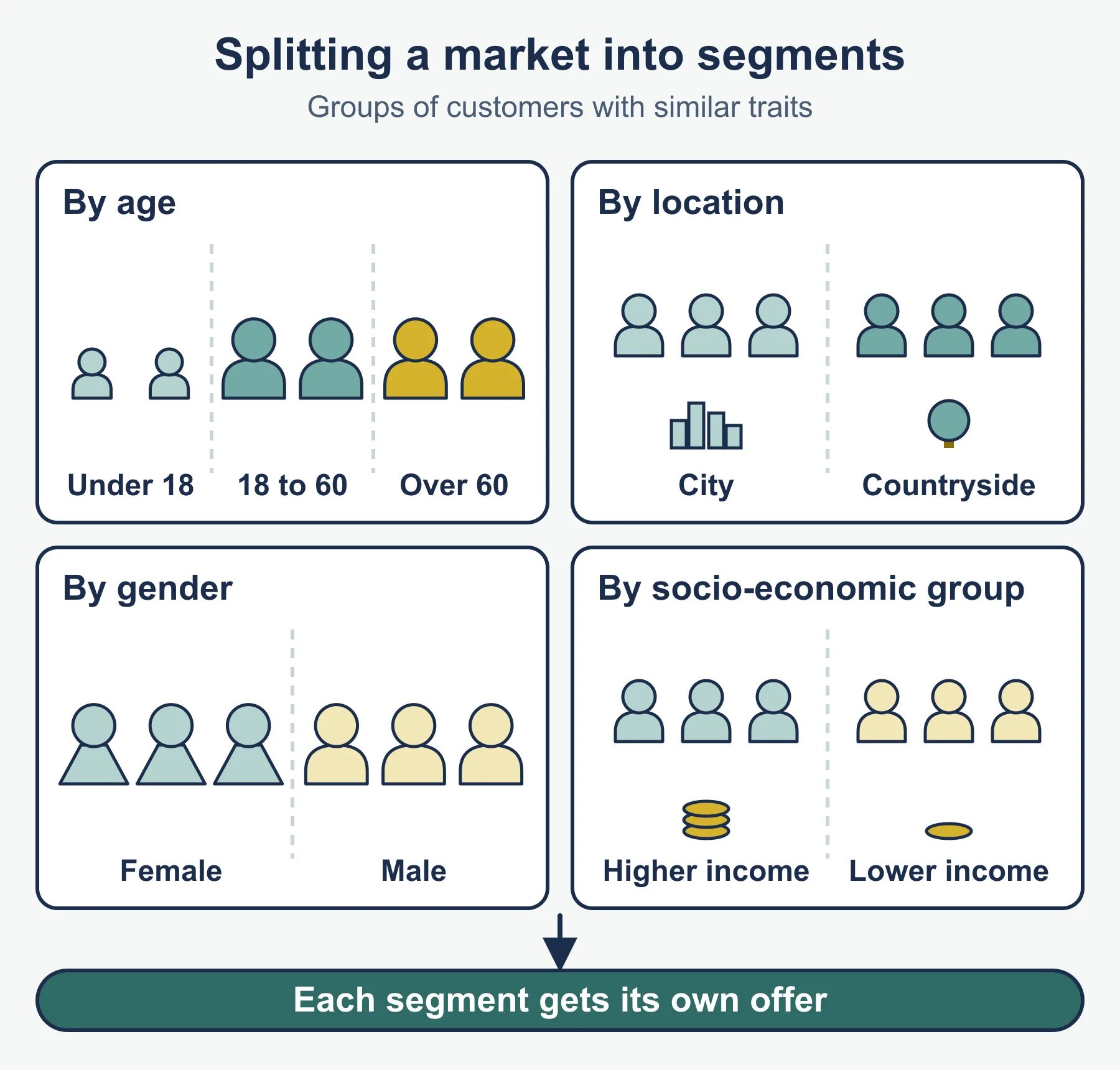
Splitting a market into groups so each can be targeted.
| Type | Quick example |
|---|---|
| Gender | Different ranges for men and women |
| Age | Toys for under-fives versus teenagers |
| Location | Raincoats stocked in wet regions |
| Income | Budget and premium versions |
Why: the mix fits the group, money is not wasted. Risk: too narrow a target limits sales.
Market research (3.5.3)
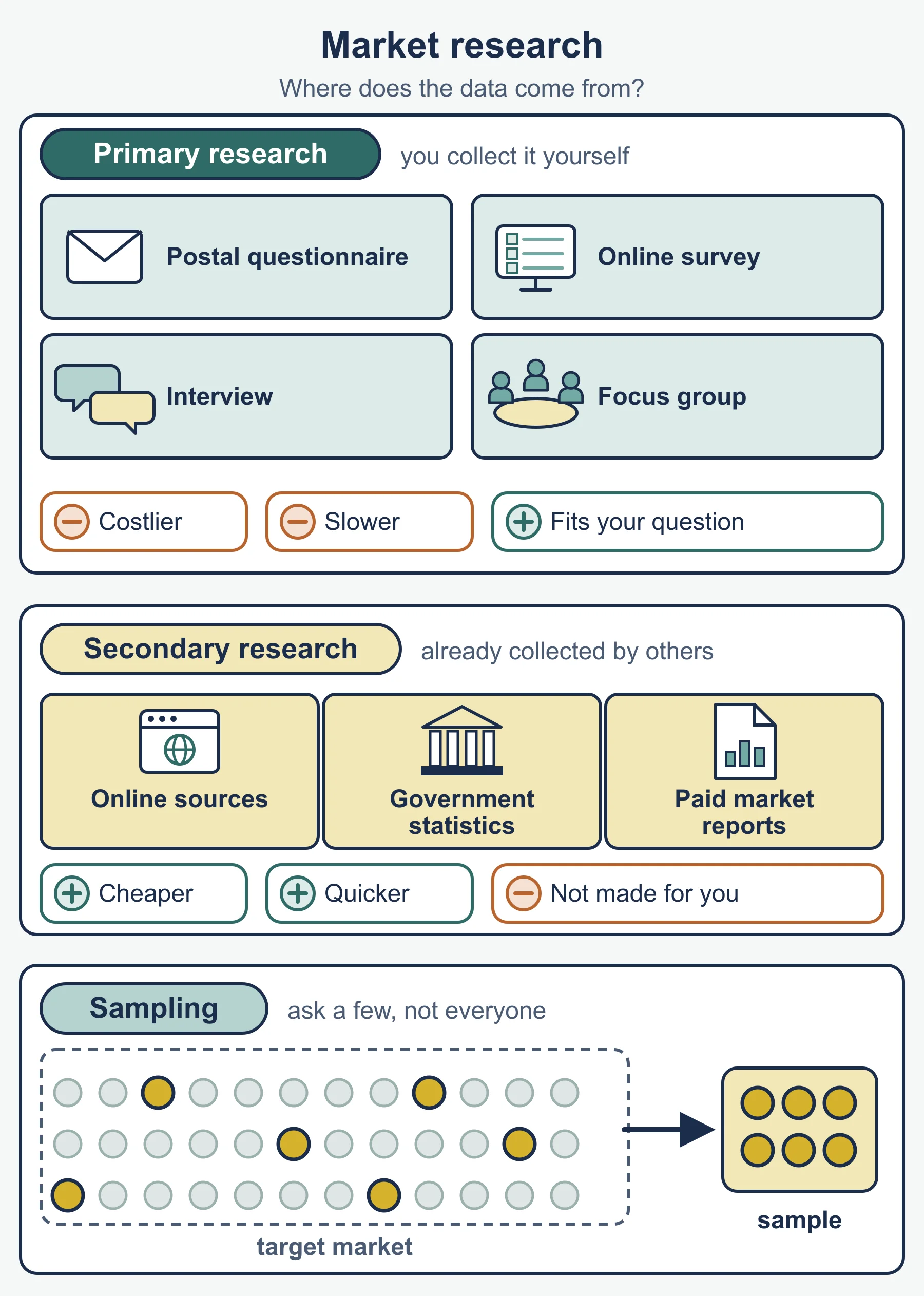
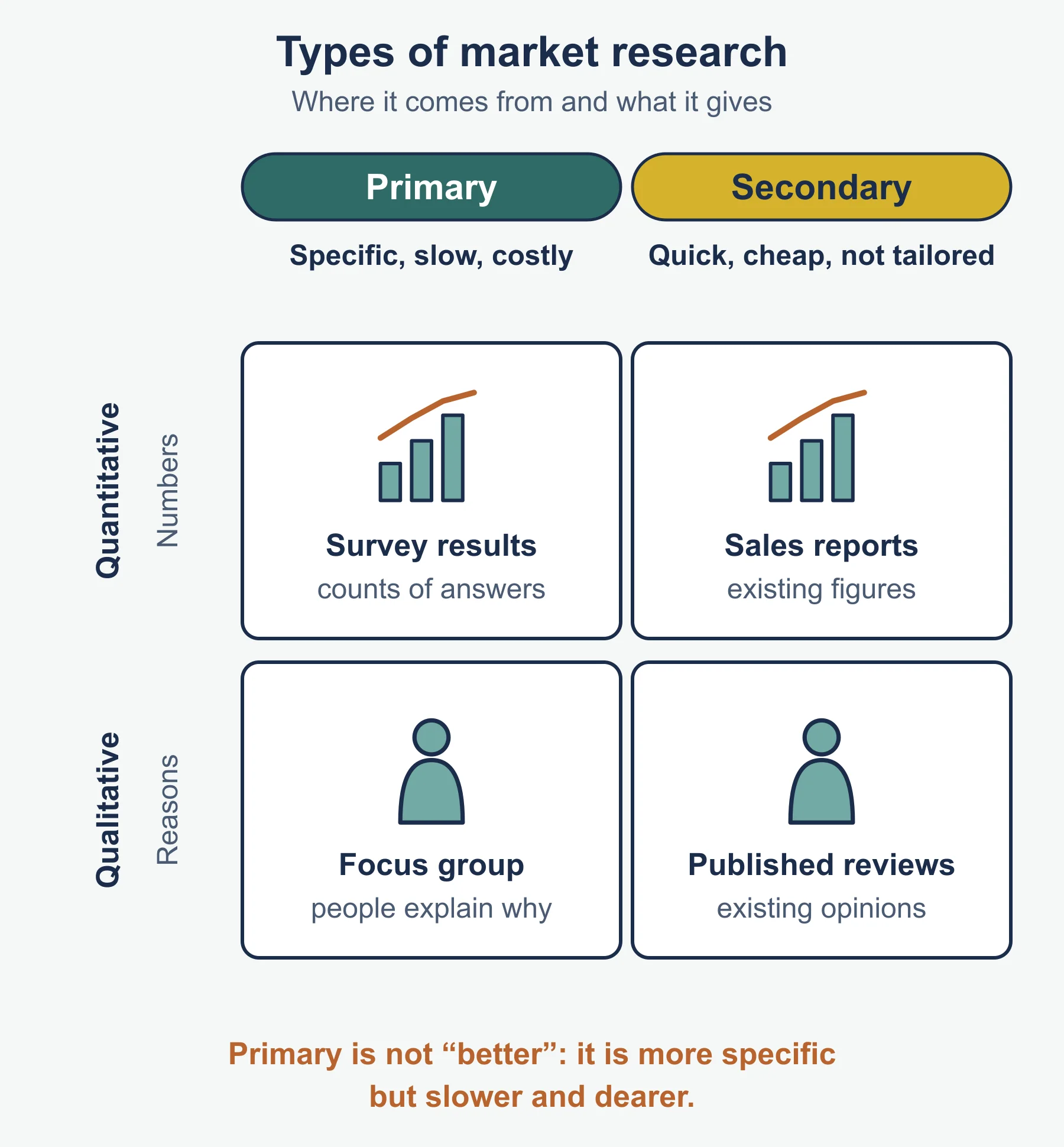
Purpose: spot opportunities, understand customers and competitors. Collect information on demand, competition and target market.
| Method | Primary or secondary | One benefit | One drawback |
|---|---|---|---|
| Questionnaire | Primary | Cheap, many people | Few replies |
| Survey | Primary | Large sample | Time and cost |
| Interview | Primary | Detailed answers | Slow, costly |
| Focus group | Primary | Reasons and opinions | Small, unrepresentative group |
| Internet research | Secondary | Fast, often free | Out of date or unreliable |
| Printed press | Secondary | Cheap, shows trends | May not fit the business’s need |
Must-know distinctions
- Primary = collected first-hand. Secondary = already exists.
- Quantitative = numbers (60% like the flavour). Qualitative = opinions and reasons (they find it too sweet).
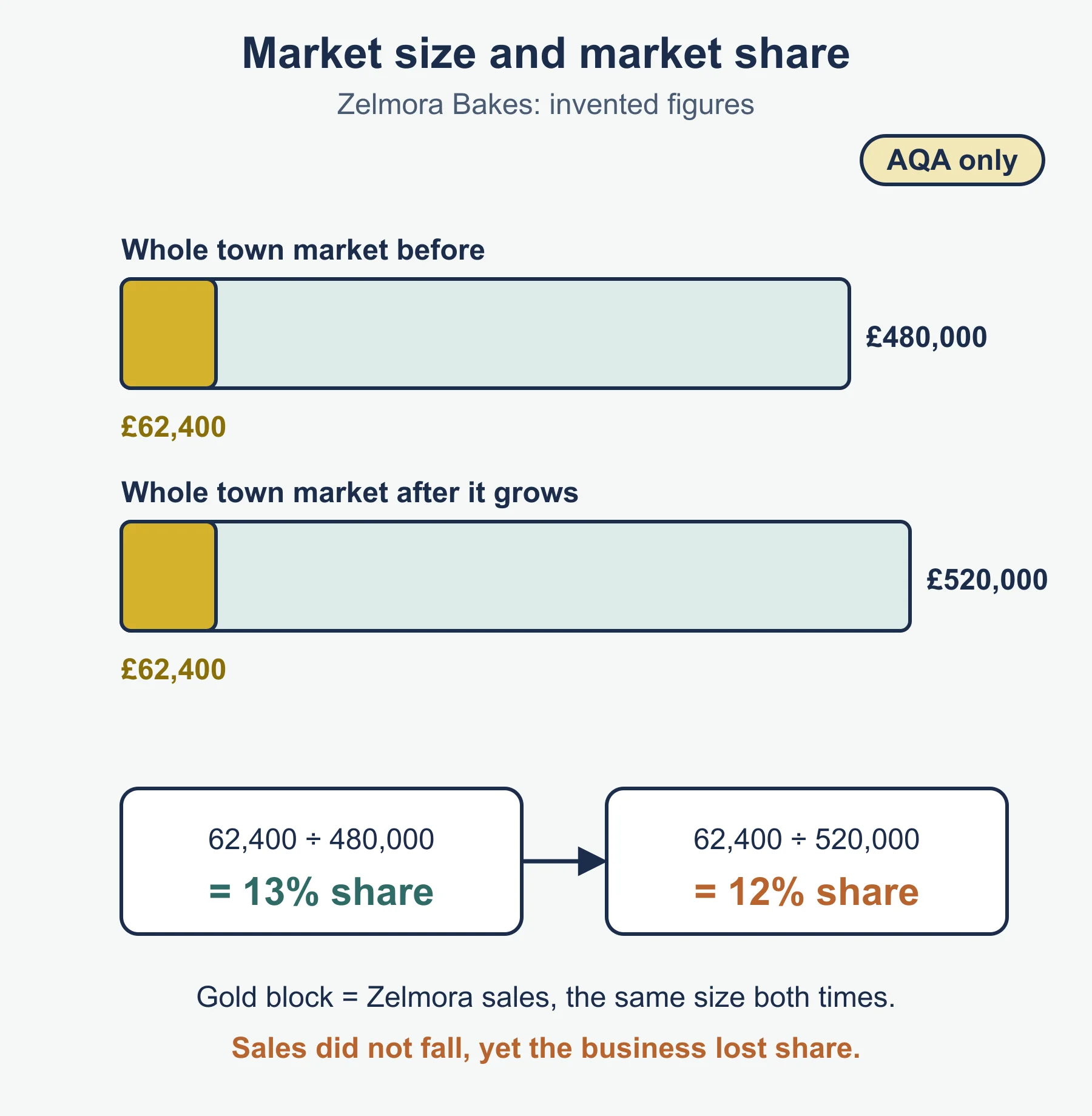
- Market size = total sales of everyone. Market share = one firm’s slice.
Formulas (standard forms)
| Measure | Formula |
|---|---|
| Share (%) | one firm’s sales ÷ everyone’s sales in the market × 100 |
| Growth (%) | change in market size ÷ starting size × 100 |
Worked reminder. Pinchbeck Pet Treats sells 9,000 units in a market of 150,000 units. Share = 9,000 ÷ 150,000 × 100 = 6%. The market grows 10% to 165,000. If Pinchbeck still sells 9,000 its share is 9,000 ÷ 165,000 × 100 = 5.5% (1 d.p.). Same sales, smaller share.
Method in steps for a data question
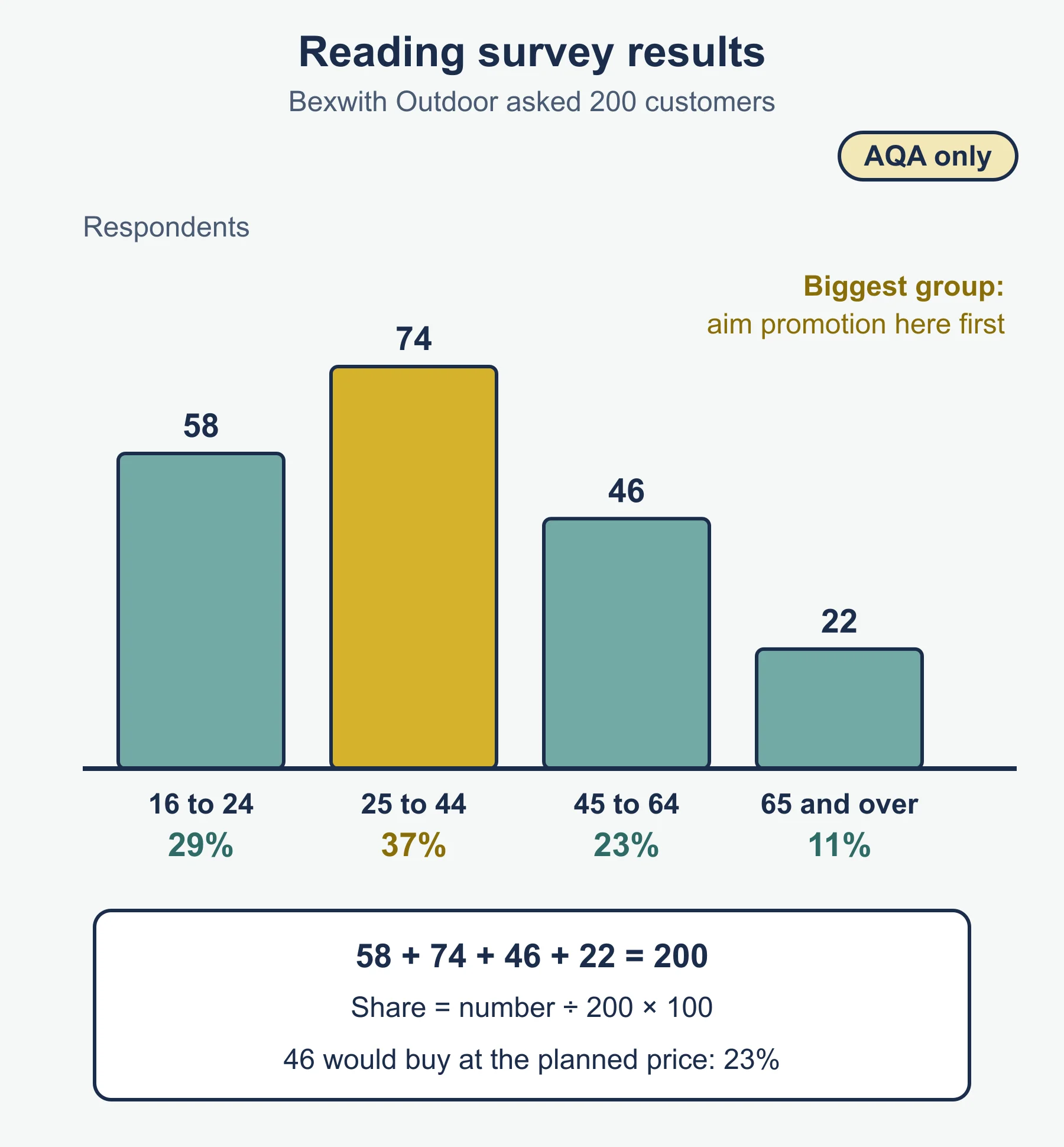
- Read the title, units and time period.
- Pick out the highest, lowest and any change.
- Calculate a percentage or share if asked.
- Say what it means for a decision, such as which group to target.
- Mention a limit, for example the sample is small or the data is old.
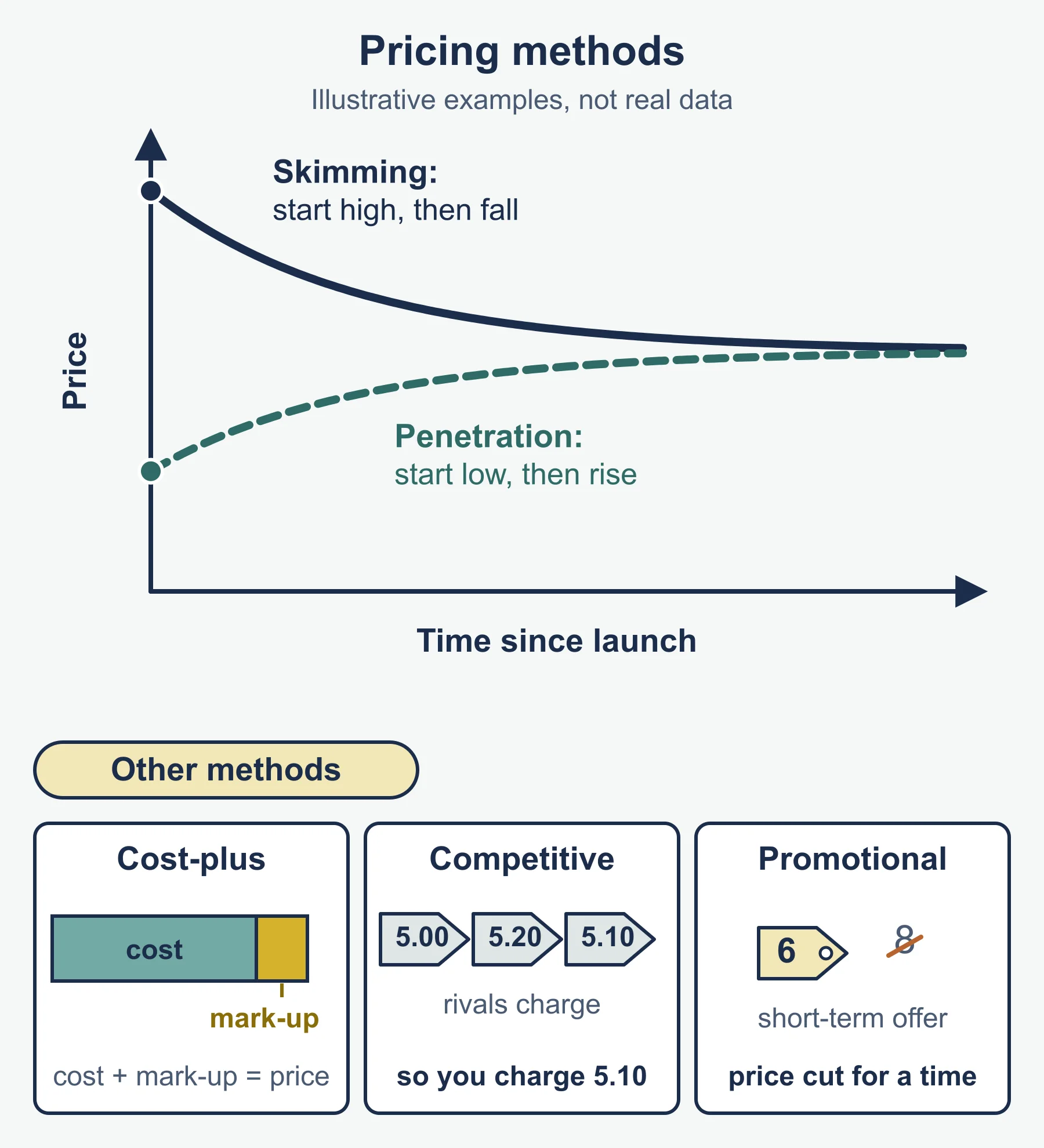
Price (3.5.4)
| Method | Key point |
|---|---|
| Price skimming | High at first, then lowered |
| Price penetration | Low at first to gain share |
| Competitive pricing | Close to rivals |
| Loss leader | Below cost to bring in customers |
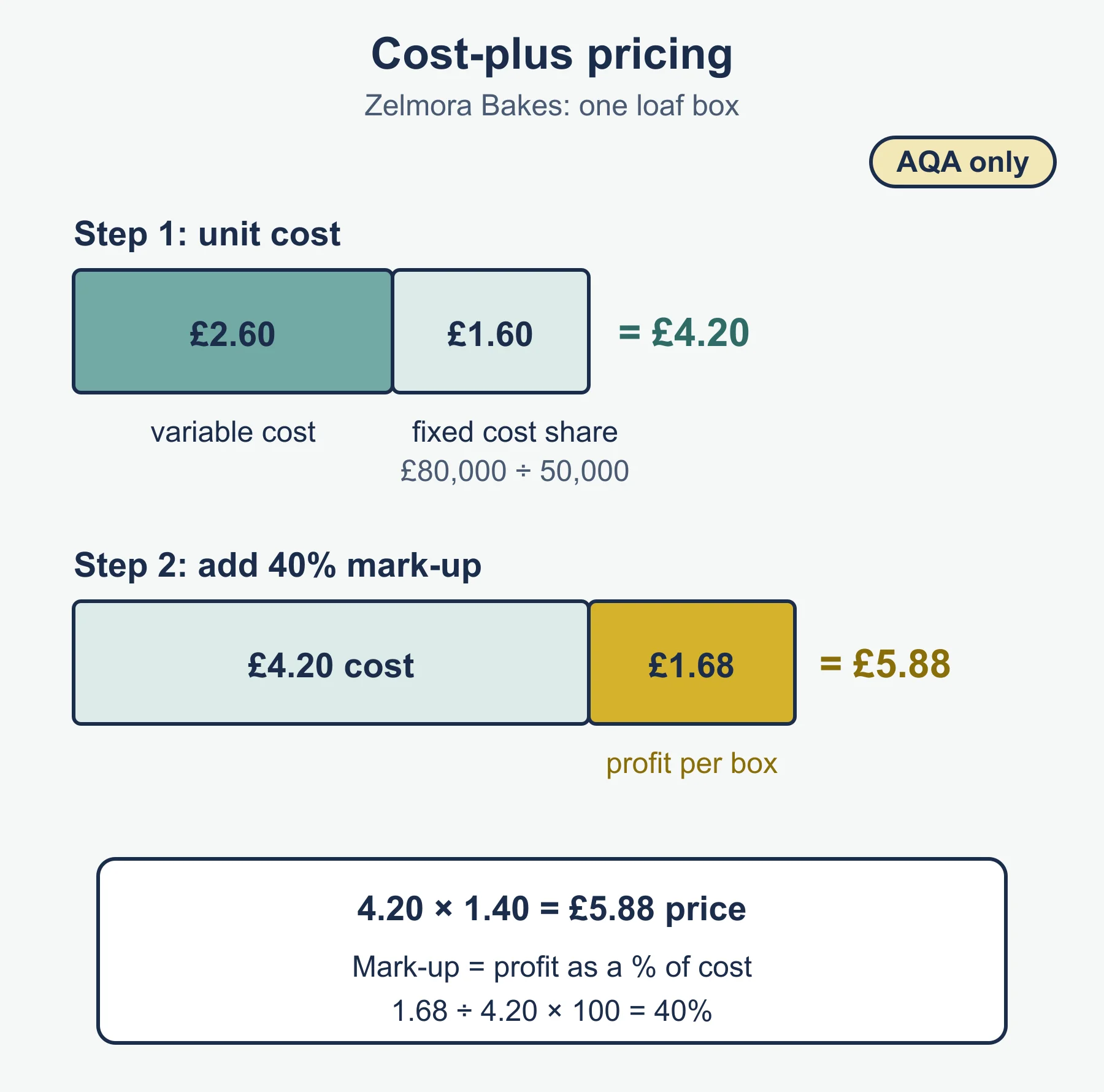
| Cost-plus | Unit cost plus mark-up |
Cost-plus reminder. A unit costs £12 and the mark-up is 25%. Price = 12 × 1.25 = £15. Profit per unit £3. Check the other way: a mark-up is profit as a percentage of cost, so selling at £18 on a £12 cost gives (18 − 12) ÷ 12 × 100 = 50%.
Factors: costs, nature of the market, degree of competition, product life cycle. Basic relationship: higher price, lower demand (likely).
Product (3.5.4)
- New products: benefits are sales and image; risks are cost and failure. Design, image and target market needs matter.
- USP: the feature that makes the product different. Brand image: how customers see it. Both help in a competitive market.
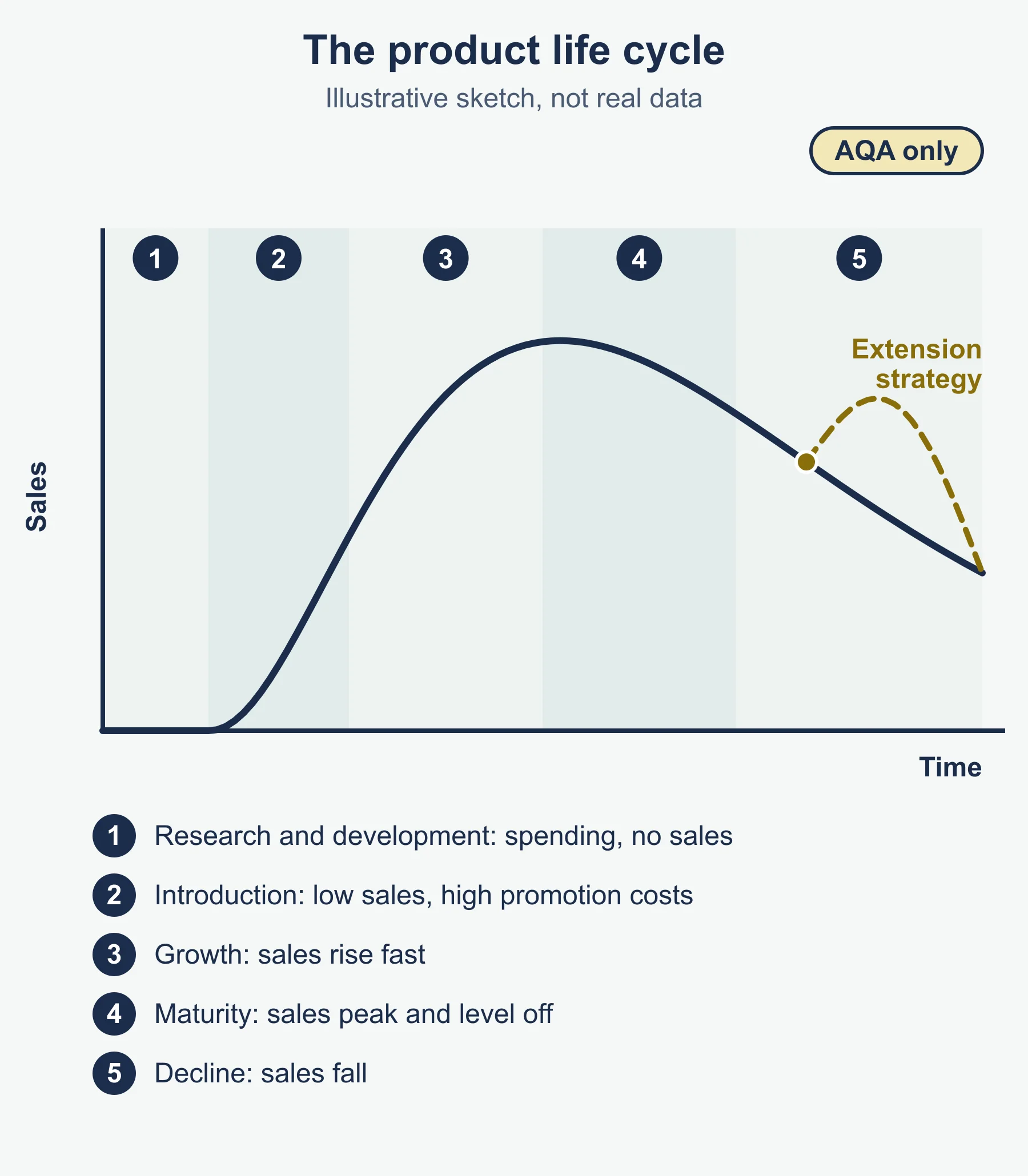
Product life cycle
| Stage | Sales | Typical action |
|---|---|---|
| Research and development | None | Spending, testing |
| Introduction | Low | Heavy promotion |
| Growth | Rising fast | Build share, widen distribution |
| Maturity | Peak, flat | Defend share |
| Decline | Falling | Extension strategy or withdraw |
Extension strategies: update packaging; add more or different features; change target market; advertising; price reduction. Evaluate by cost, speed, and whether rivals can copy.
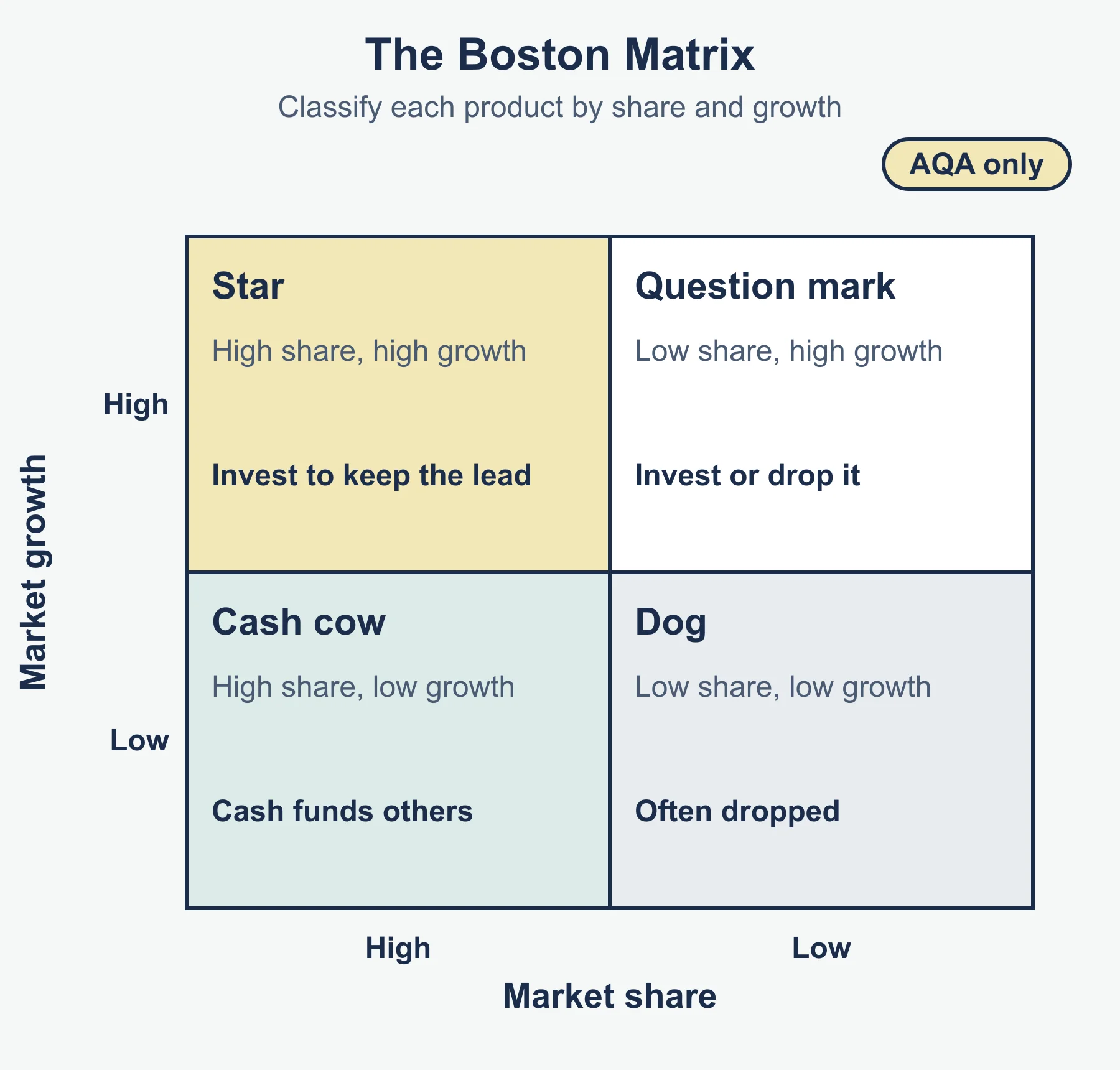
Boston Matrix (Boston Box)
| Category | Share | Growth |
|---|---|---|
| Star | High | High |
| Cash cow | High | Low |
| Question mark | Low | High |
| Dog | Low | Low |
Why use it: to broaden and balance the portfolio so that cash cows fund stars and question marks.
Promotion (3.5.4)
Reasons: inform or remind; create or increase sales; create or change image; persuade.
| Method | Benefit | Drawback |
|---|---|---|
| Newspapers, magazines | Targeted readership | Short life, cost |
| Television | Wide reach | Very costly |
| Internet | Targeted, measurable | Easily ignored |
| Billboards | Seen by passers-by | Little detail |
| PR | Cheap, credible | No control over coverage |
| Sales promotion (point of sale displays, 2 for 1, free gifts, samples, coupons, competitions) | Quick sales boost | Cuts profit; may not build loyalty |
| Sponsorship | Builds image | Cost; link to the event’s fortunes |
| Social media | Low cost, interactive | Negative comments spread |
Factors choosing the mix: finance available, competitor actions, nature of the product, nature of the market, target market.
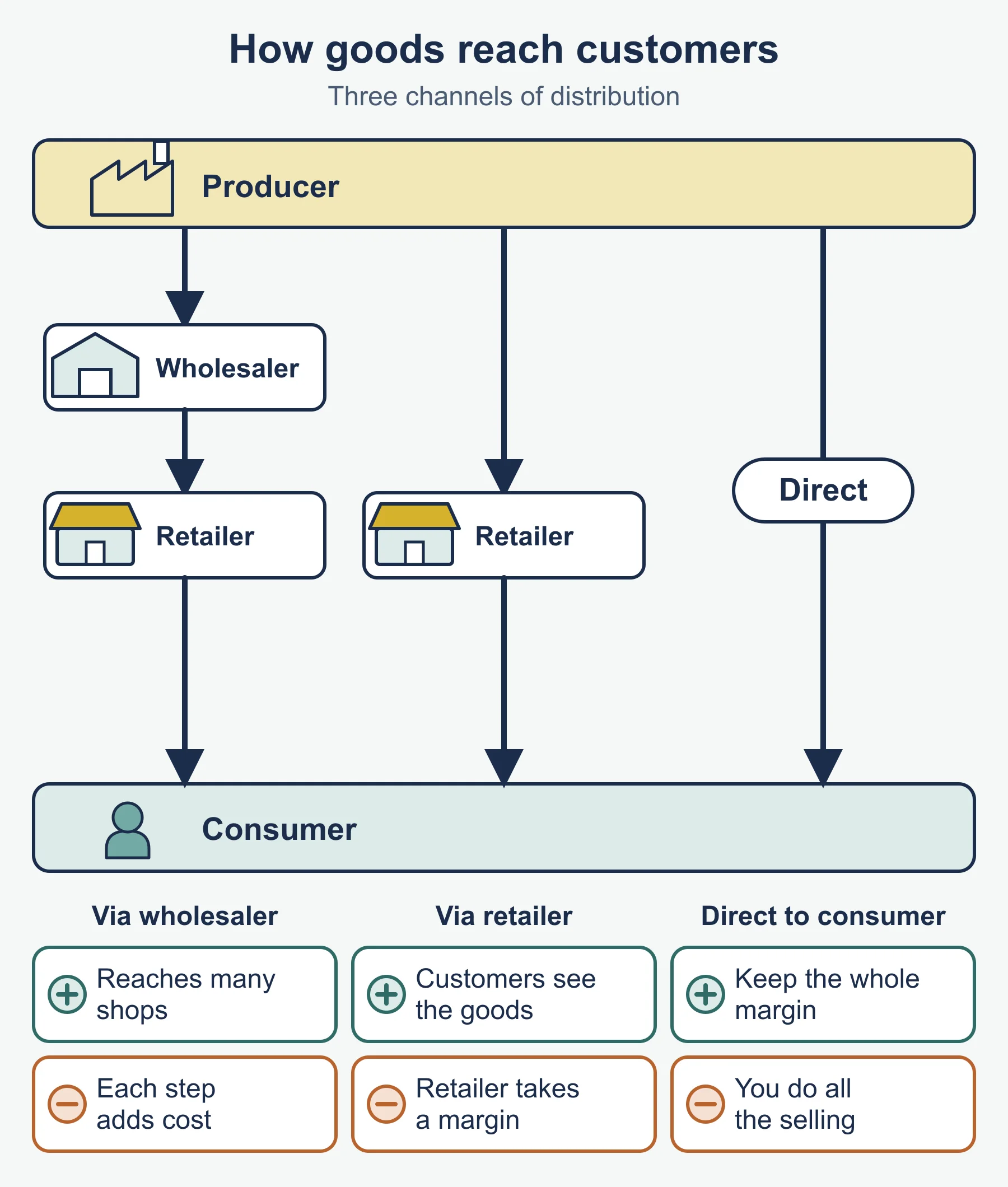
Place (3.5.4)
| Channel | Point to remember |
|---|---|
| Retailers | Reach the public; take a margin |
| Wholesalers | Bulk buyers; reach many shops |
| Telesales | Phone selling; personal, but can annoy |
For a scenario, ask: how many customers, how big is each order, does the customer need to see it?
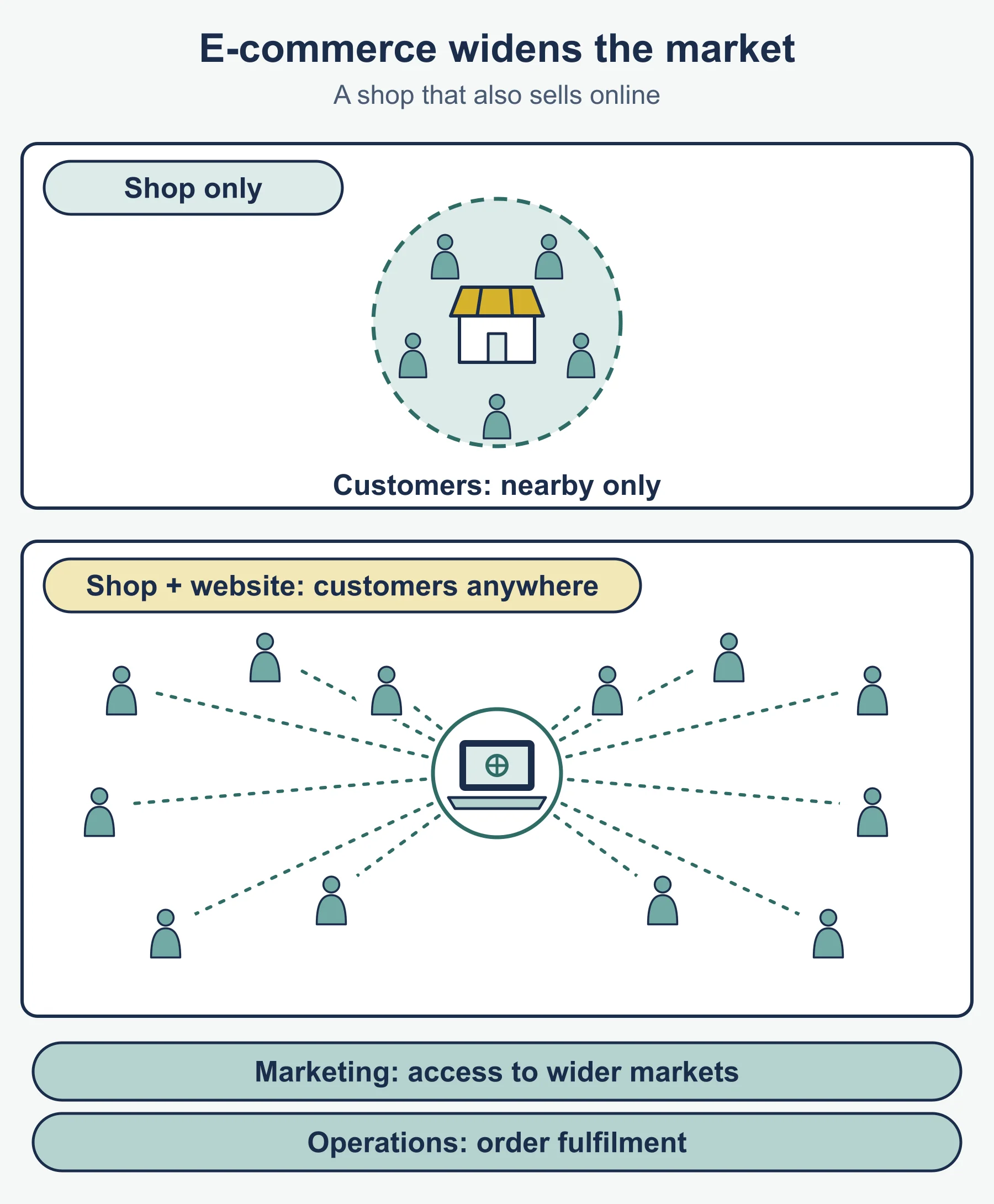
E-commerce and m-commerce
- Internet selling and mobile-device selling.
- Benefits: reach (including international markets), always open, lower premises costs.
- Drawbacks: security, delivery, cannot try the product, competition.
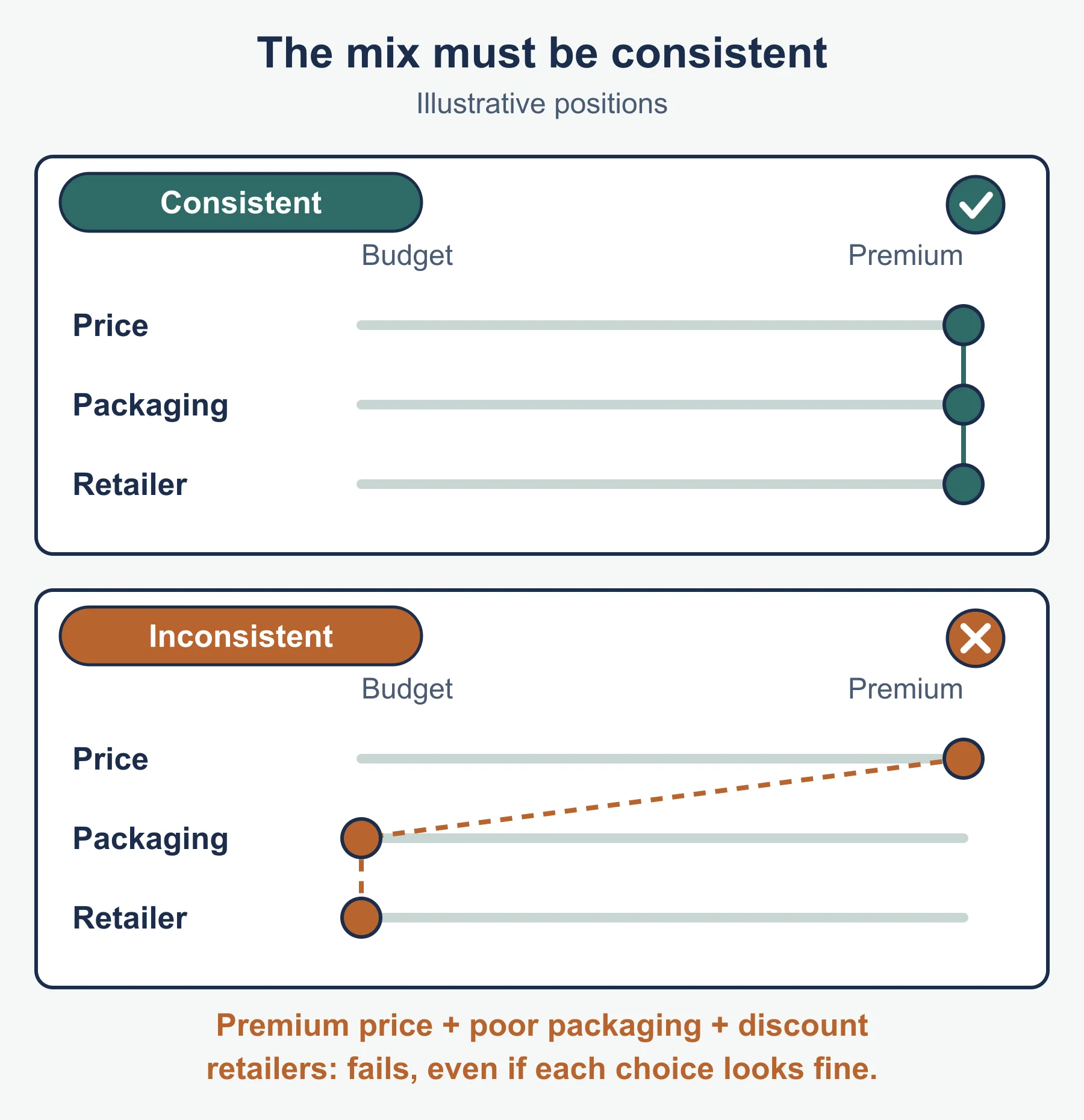
The mix together
- The 4Ps must fit each other and the target market.
- The mix changes over time (life cycle, rivals, technology). Recommend, justify with case facts, and judge.
Applying the 4Ps to a business
Worked reminder. Ottoway Kites is a small firm selling hand-made kites to families through its own website. Its target market is parents with children aged 5 to 12, on mid-range incomes.
- Product: a bright design, a USP of a repair guarantee, a strong brand image of quality.
- Price: competitive pricing near similar kites, since many rivals sell online; skimming would fail with so many close substitutes.
- Promotion: social media and photos from customers, because the budget is small and parents use these sites. Television would take most of the finance available.
- Place: its own website (e-commerce) plus a few toy retailers at holiday times.
Each choice links to a fact about the business. That link is what turns a description into analysis.
Command words in this topic
| Command word | What to do |
|---|---|
| State, identify, define | Give a short fact; no explanation needed |
| Calculate | Write the formula and working, then give the result with its unit or % |
| Explain | Give a point and a reason, with a link to the case |
| Analyse | Break a point into cause and effect, step by step |
| Evaluate, justify | Weigh both sides, then reach a judgement and give the reason for it |
| Recommend | Choose an option and support it using the case facts |
Linking the topic together
- Segmentation decides who the target market is, and research confirms what that group wants.
- The target market shapes all four Ps. Youth buyers may suggest low prices, social media and online sales.
- The life cycle stage affects price (skimming at introduction, cuts in decline), promotion (heavy at introduction) and place (more outlets in growth).
- The Boston Matrix looks at the whole portfolio, not one product, so a decline in one product may be fine if a star is rising.
- Market share is a measure of success for the marketing mix as a whole.
Quick self-test
- Give two reasons it is important to identify customer needs.
- Name the four types of segmentation in the specification.
- State one benefit and one drawback of a focus group.
- Is a newspaper article a primary or secondary source?
- A firm sells £45,000 in a market of £600,000. Calculate its market share.
- A unit costs £8. Find the price with a 50% mark-up.
- Which pricing method starts high and falls?
- Which Boston Matrix category has high share in a slow-growing market?
- Name two extension strategies.
- State two benefits of e-commerce.
Answers
- Provide a product customers will buy; avoid costly mistakes (also: increase sales, choose the mix, be competitive).
- Gender, age, location, income.
- Benefit: gives reasons and opinions. Drawback: small group may not represent the market.
- Secondary.
- 45,000 ÷ 600,000 × 100 = 7.5%.
- 8 × 1.5 = £12.
- Price skimming.
- Cash cow.
- For example updating packaging and price reduction.
- Wider reach, including international customers; open at all hours.
Where marks are usually lost
- Writing “market share” when the question asks for market size, or giving the share without a percentage sign.
- Listing benefits of a method with no application to the case business.
- Saying a method is “cheap” with no comparison.
- Forgetting that primary research is first-hand and secondary already exists.
- Describing the product life cycle but not saying what the business should do.
- Putting a cash cow in a fast-growing market.
- Recommending a mix with no link to the target market.
- Evaluation answers that stop at a list instead of reaching a justified judgement.
Frequently asked questions
What are the four types of segmentation in AQA GCSE Business (8132)? Gender, age, location and income. Segmentation lets a business fit its marketing mix to each group so money is not wasted.
What is the difference between primary and secondary market research? Primary research is collected first-hand, for example by questionnaires, interviews or focus groups. Secondary research already exists, for example on the internet or in the printed press.
What is the difference between price skimming and price penetration? Price skimming sets a high price at first and lowers it later. Price penetration sets a low price at first to gain market share.
What are extension strategies in the product life cycle? Actions to extend a product’s sales, such as updating packaging, adding more or different features, changing the target market, advertising or reducing the price.
How do you calculate market share? Divide one firm’s sales by total sales in the market and multiply by 100. Give the answer as a percentage, not a decimal.
Official syllabus
Source: AQA 8132 GCSE Business specification (first teaching September 2017), section 3.5 Marketing.
Get free revision emails (optional)
Occasional emails with practice questions, worked explanations and links to free resources for the qualification and subjects you choose. No spam, and you can unsubscribe from any email. The free tools on this site never need an email.
Related resources
-
Study guides
AQA GCSE Business: Marketing (8132)
Study guide to AQA GCSE Business Marketing: customers, segmentation, market research, the 4Ps, product life cycle, Boston Matrix and e-commerce.
Business · AQA · GCSE
Read guide -
Practice questions
AQA GCSE Business: Marketing (8132) – Practice Questions
Original questions with worked answers on AQA GCSE Business marketing: research, market share, pricing, life cycle, Boston Matrix, promotion and place.
Business · AQA · GCSE
Try questions -
Study guides
AQA GCSE Business: Setting business aims and objectives and Stakeholders (8132)
Study guide to AQA GCSE Business (8132) sections 3.1.3 and 3.1.4: business aims and objectives, why they change, and stakeholders with worked examples.
Business · AQA · GCSE
Read guide
Related articles
-
teaching
A Level tuition in Dubai: Cambridge or Pearson Edexcel International A Level?
Schools in Dubai and Abu Dhabi teach either Cambridge International AS & A Level or Pearson Edexcel International A Level. How the two are structured, why it matters for tuition, and how online classes from Lahore work.
9 October 2026
-
curriculum guides
Choosing subjects at IGCSE and A Level
How subject choices at 14 and 16 affect university options later, and how to keep pathways open without overloading a timetable.
28 July 2026
Studying this with a teacher
Working through Business GCSE?
This page is free and stays free. If you would rather be taught it, Marlbridge runs Business classes one-to-one and in small groups of up to 15, online in your own time zone. The first trial class is free. WhatsApp replies within an hour (8am–11pm Pakistan time, every day); email the same day.
AQA Business teachers at Marlbridge
