
Study Guides
AQA GCSE Business: Setting business aims and objectives and Stakeholders (8132)
Study guide to AQA GCSE Business (8132) sections 3.1.3 and 3.1.4: business aims and objectives, why they change, and stakeholders with worked examples.
- Subject
- Business
- Level
- GCSE
- Topic
- Business in the real world
- Author
- Marlbridge Academic Team
- Updated
- Reviewed by
- Salman Ahmad (what this means)
Aligned to AQA GCSE Business (8132), For first teaching from September 2017. Official specification .
Syllabus page (what it covers and how it is assessed): AQA GCSE Business.
Syllabus points this page covers
8132
- 3.1.3 Setting business aims and objectives
- 3.1.4 Stakeholders
Found an error? Report a correction.
Need help with this topic? Request a free trial class for GCSE Business (8132).
This guide covers sections 3.1.3 (Setting business aims and objectives) and 3.1.4 (Stakeholders) of the AQA GCSE Business (8132) specification, for first teaching from September 2017. Both sit in Topic 1, Business in the real world. The specification does not split this content by tier. Use the AQA GCSE Business hub and the printable checklist to track progress, and take a free 10-minute diagnostic to find weak spots.
Other pages cover the wider topic: the topic-level study guide, the topic revision notes and the topic practice questions. This guide goes deeper on these two sections. For quick recall use the revision notes for this unit, then test yourself with the practice questions.
What you must be able to do
| Section | Content point | What you must be able to do |
|---|---|---|
| 3.1.3 | What are business aims and objectives | Explain both terms and the main objectives: survival, profit maximisation, growth (domestic and international), market share, customer satisfaction, social and ethical objectives, shareholder value |
| 3.1.3 | Purpose of setting objectives; role in running a business | Explain why objectives are set and how they guide decisions |
| 3.1.3 | Changing objectives | Explain how and why objectives differ between businesses and change as they evolve |
| 3.1.3 | Use of objectives in judging success | Explain that success can be measured in ways other than profit |
| 3.1.4 | Main stakeholders and their objectives | Identify owners, employees, customers, local community and suppliers, and say what each wants |
| 3.1.4 | Impact and influence | Explain how business activity affects stakeholders and how stakeholders affect the business, including conflict |
Aims and objectives
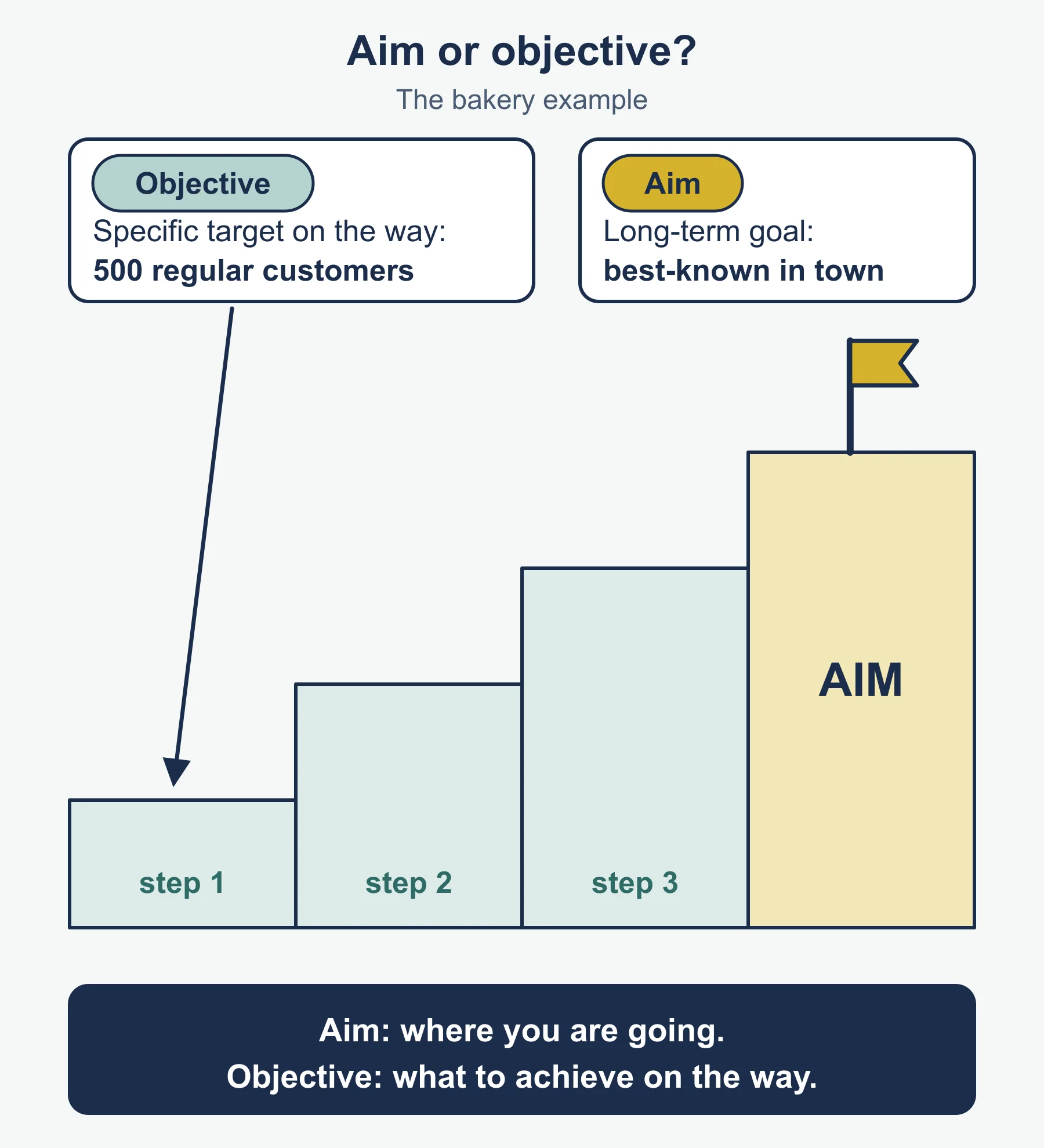
An aim is the long-term goal of a business, the general direction it wants to take. An objective is a more specific target that helps the business move towards the aim. The specification lists “what are business aims and objectives” as a content point, so be ready to define both. A simple way to hold them apart: an aim says where you are going, an objective says what you must achieve on the way.
Example: a bakery has the aim of becoming the best-known bakery in its town. One objective might be to reach 500 regular customers within a year.
The main objectives
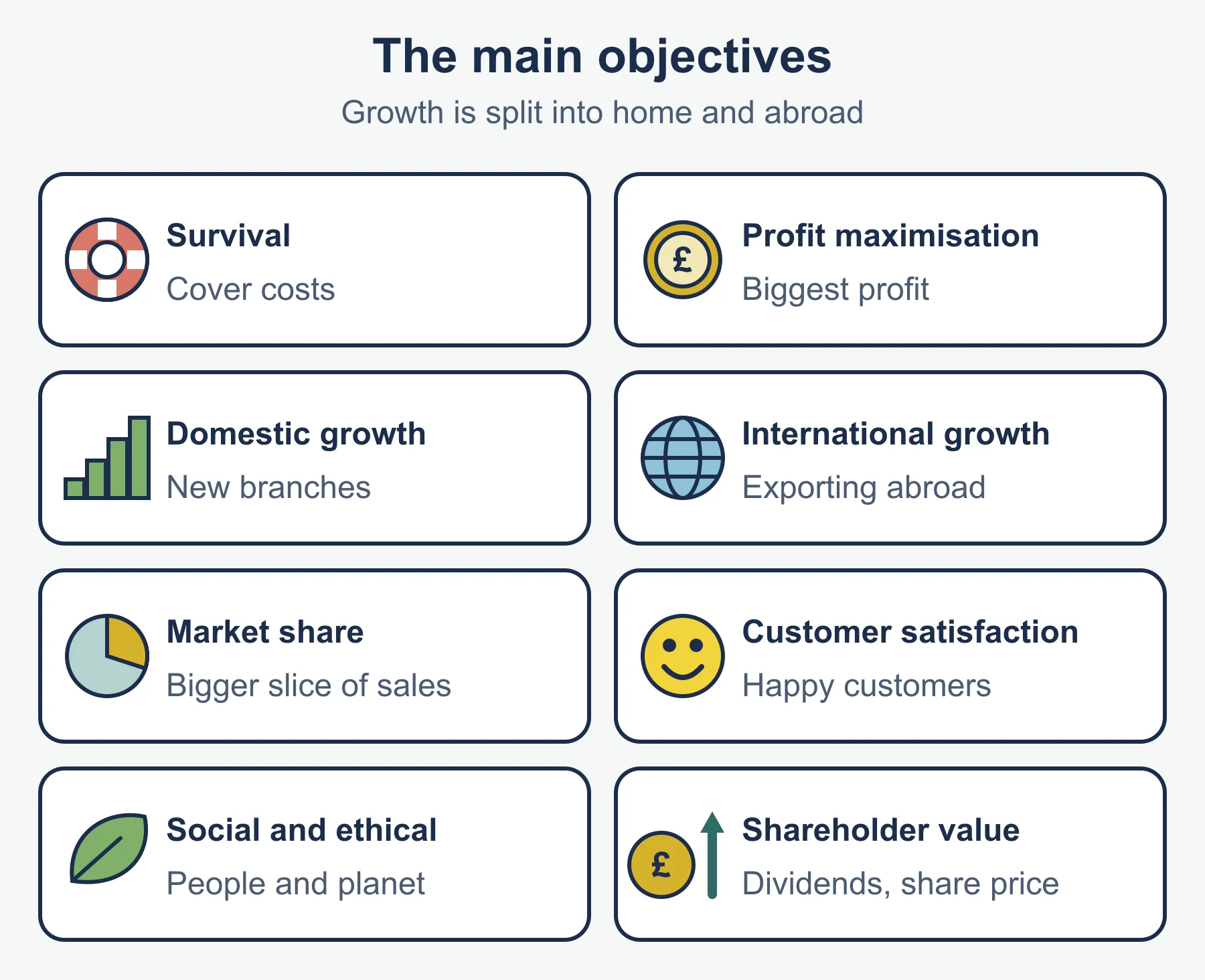
The specification names seven (growth counts once, split into domestic and international). For each, know the meaning and one way a business might pursue it.
| Objective | Meaning | A business might pursue it by |
|---|---|---|
| Survival | Staying in business and covering costs | Controlling cash, keeping prices competitive |
| Profit maximisation | Making the largest profit possible | Raising prices where customers will pay, cutting waste |
| Growth (domestic) | Getting bigger in the home market | Opening new branches, adding products |
| Growth (international) | Selling or operating in other countries | Exporting, opening overseas outlets |
| Market share | Taking a larger slice of total sales in the market | Promotion, lower prices, better products |
| Customer satisfaction | Customers are happy with what they buy | Better service, quality checks, handling complaints well |
| Social and ethical objectives | Doing good for people or the environment as well as earning money | Fair-trade sourcing, cutting packaging, supporting local causes |
| Shareholder value | Increasing the worth of shares and the dividends shareholders receive | Raising profit and the share price |
The standard form for market share is:
market share (%) = (business sales / total market sales) x 100
This is the standard form; the specification names market share as an objective and does not print a formula.
Worked example: market share and growth
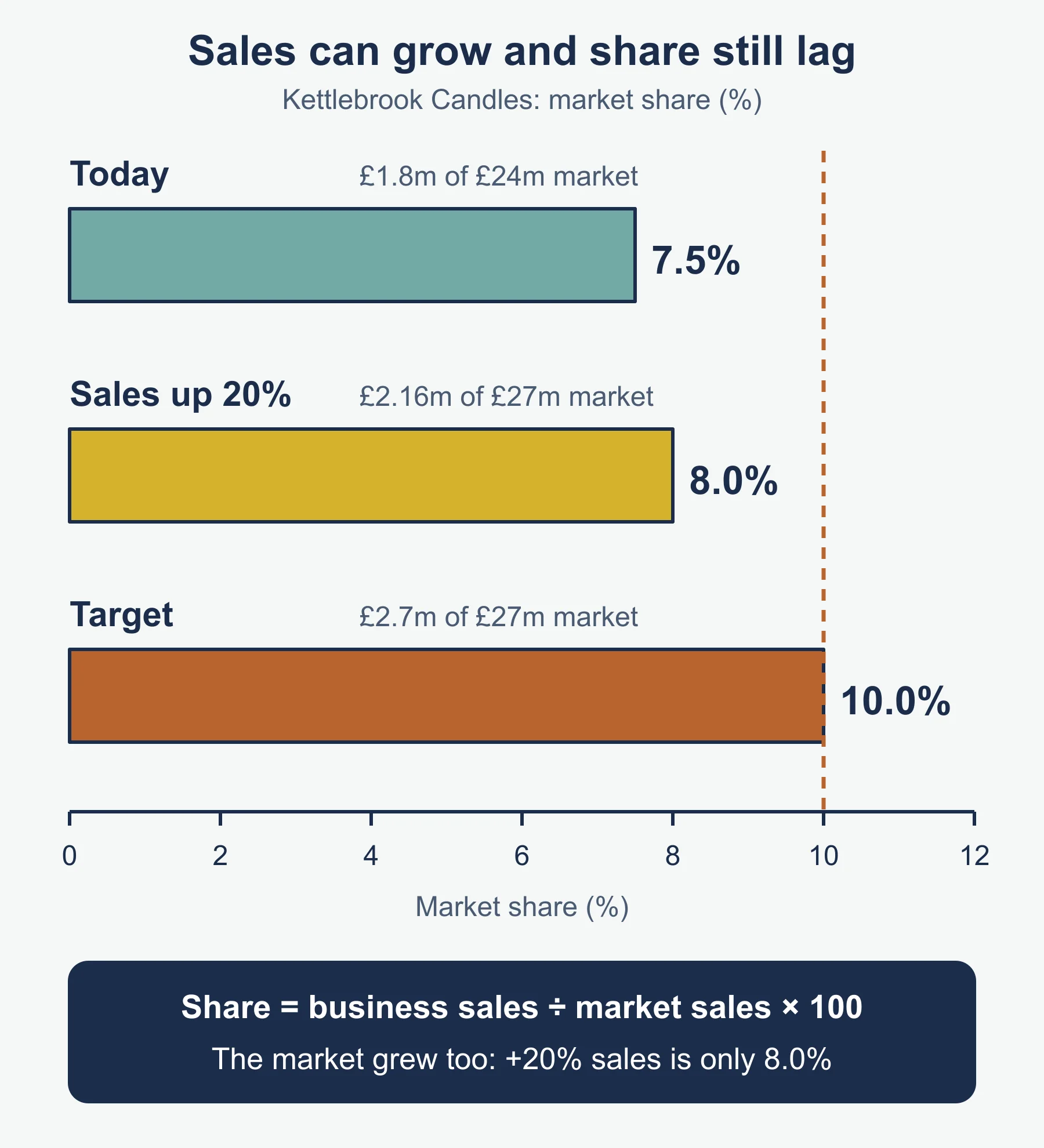
Kettlebrook Candles sells £1,800,000 of candles a year in a market worth £24,000,000.
- Market share = 1,800,000 / 24,000,000 x 100 = 7.5%.
- The owners set the objective of 10% market share in three years. The market is forecast to reach £27,000,000.
- Sales needed = 10% of 27,000,000 = £2,700,000.
- Required rise = 2,700,000 - 1,800,000 = £900,000. As a percentage of current sales: 900,000 / 1,800,000 x 100 = 50%.
Notice that sales could rise by 20% (to £2,160,000) and market share would still be only 2,160,000 / 27,000,000 x 100 = 8.0%. A business can grow in sales and still lose ground if the market grows faster.
Worked example: shareholder value
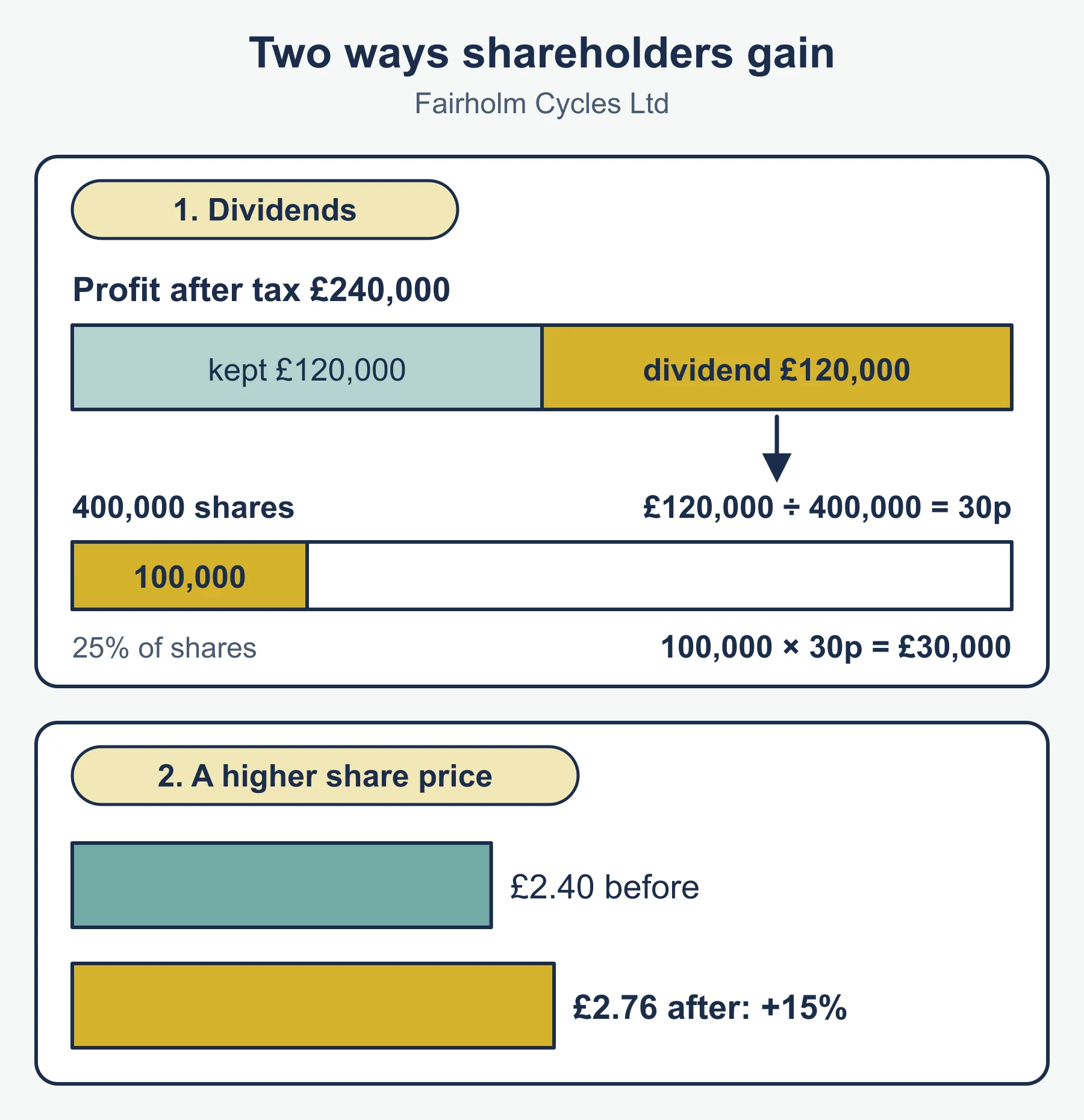
Fairholm Cycles is a private limited company with 400,000 shares. Profit after tax is £240,000 and the directors decide to pay half of it out as dividends.
- Total dividend = 240,000 x 50% = £120,000.
- Dividend per share = 120,000 / 400,000 = £0.30, or 30p.
- A shareholder with 100,000 shares (25%) receives 100,000 x 0.30 = £30,000.
If the share price rose from £2.40 to £2.76, the increase is 0.36 / 2.40 x 100 = 15%. Both the dividend and the rise in the share price add to shareholder value.
Purpose and role of objectives
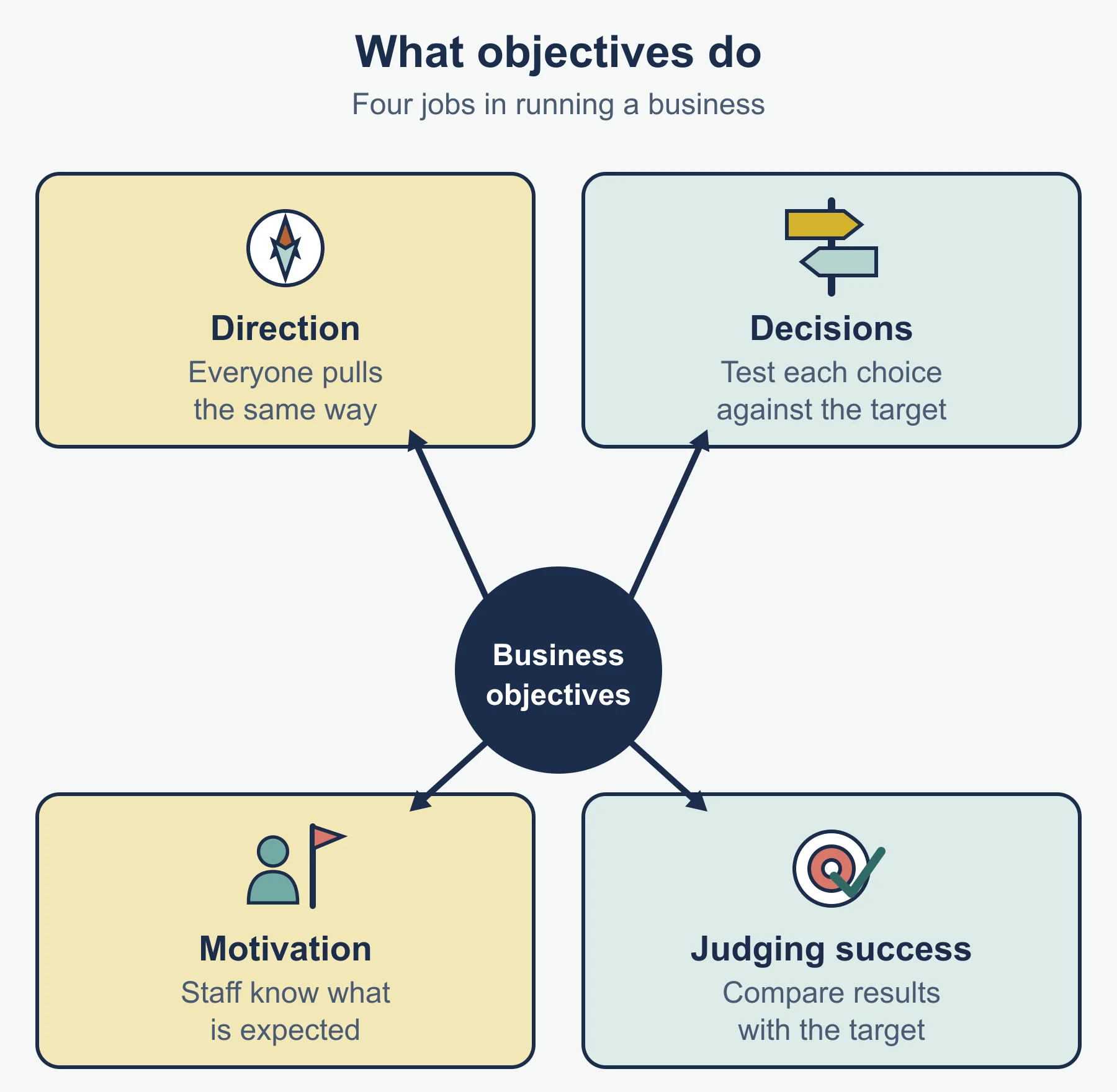
Objectives are not decoration in a business plan. They do real work:
- Direction. They tell everyone what the business is trying to achieve, so managers pull the same way.
- Decision making. Managers can test a choice against the objective. If the objective is market share, a price cut may make sense. If it is profit maximisation, it may not.
- Motivation. Staff with a clear target, such as a sales goal for the branch, know what is expected.
- Judging success. After a period, the business compares results with objectives. Missing a target prompts a change of plan; beating it may justify setting a higher one.
- Other parties. Lenders and investors read objectives to judge whether the business is worth backing.
Why objectives differ between businesses
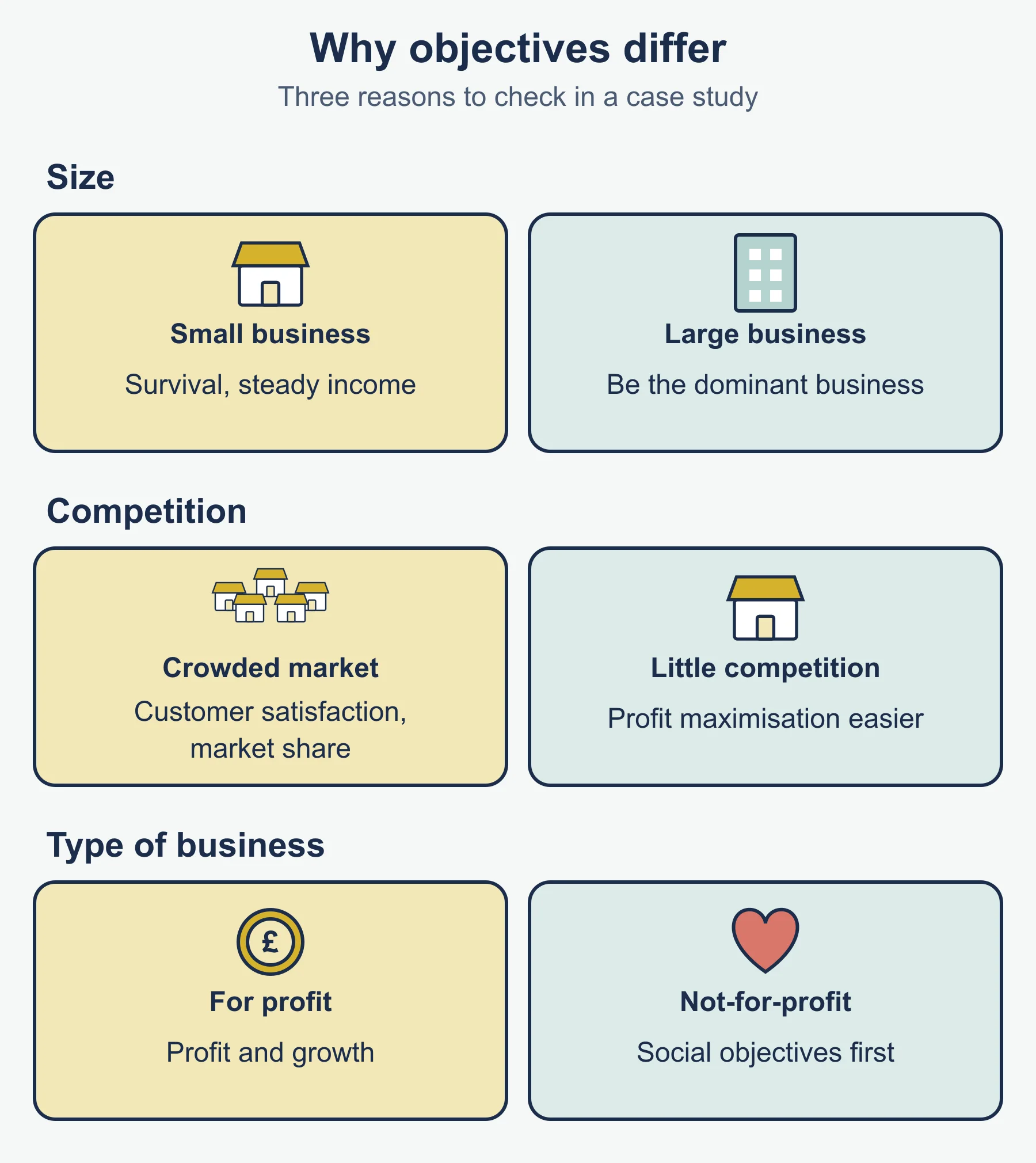
The specification names three reasons (the list begins “reasons include”). Use them as a checklist in case studies.
- Size. A small business often has survival or a steady income for the owner as its main concern. A large business can afford to aim at being the dominant business in the market.
- Level of competition. In a crowded market a business may focus on customer satisfaction or market share to avoid being squeezed out. With little competition, profit maximisation is easier to pursue.
- Type of business. Not-for-profit organisations, such as charities, put their social objectives first. They still need to cover costs to survive, but they measure success by what they achieve for the people they serve, not by profit.
Why objectives change as a business evolves
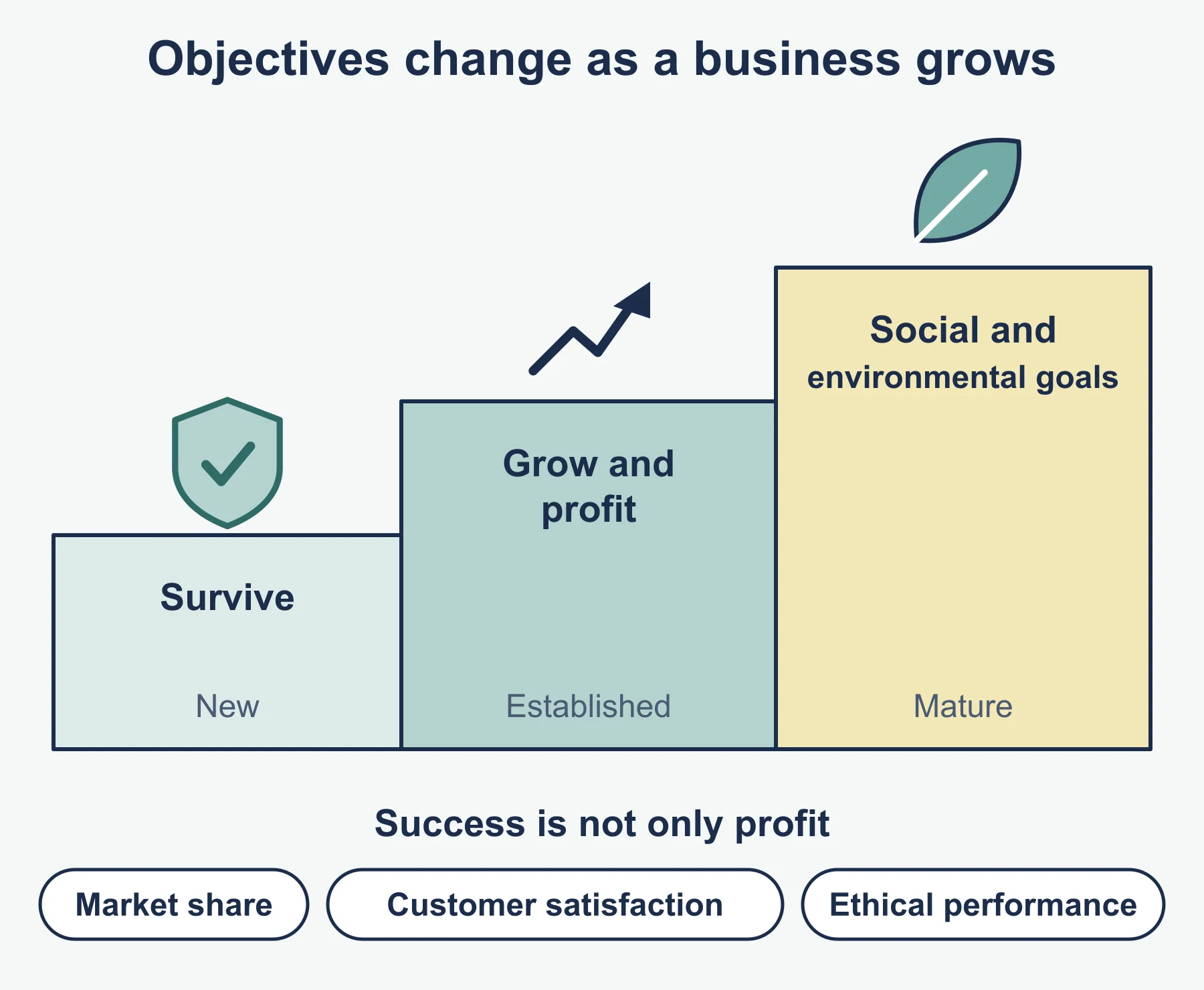
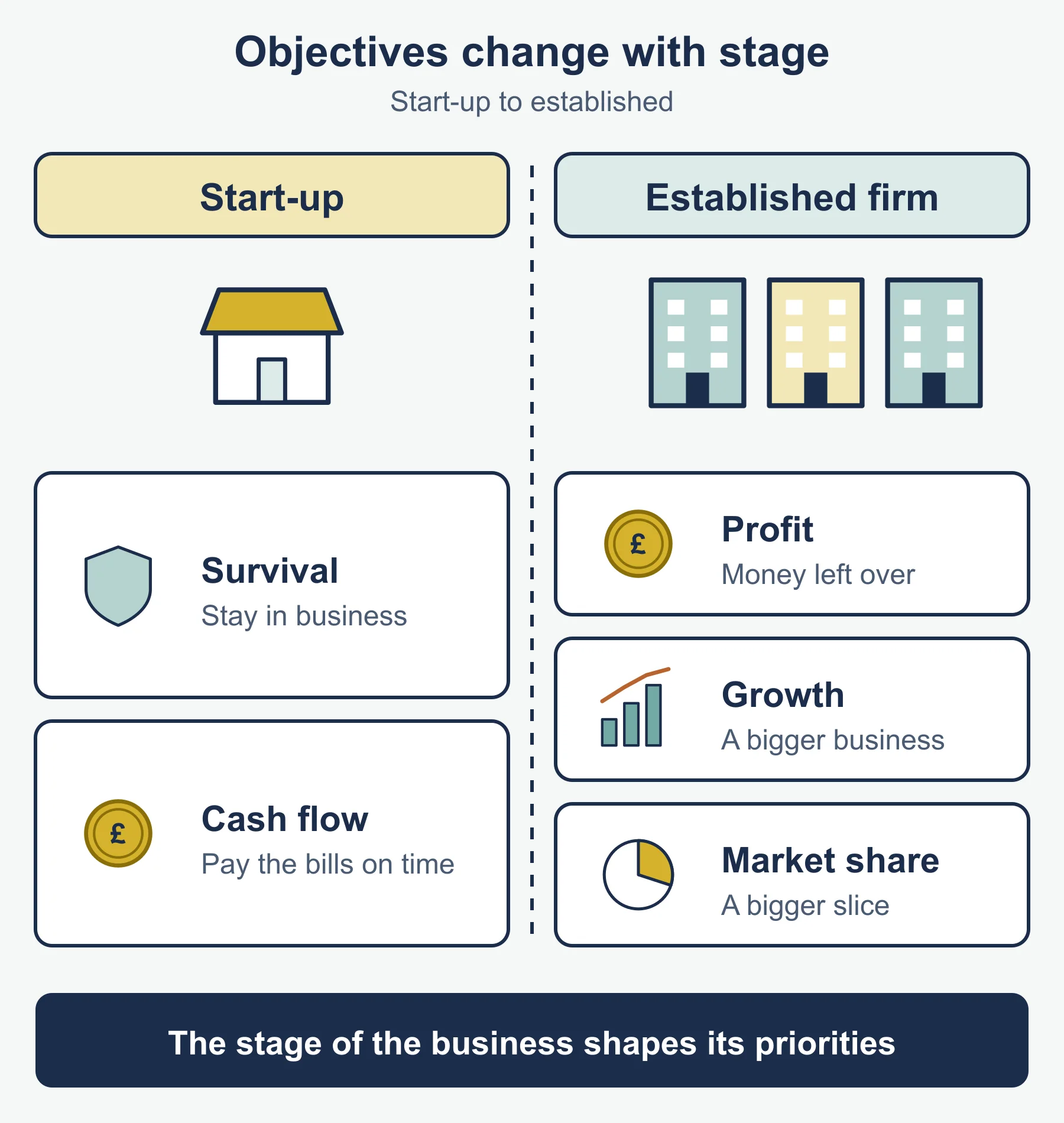
Objectives are not fixed. They change because the business, the market and the people around the business change.
| Stage | Typical objectives |
|---|---|
| Start-up | Survival, building a customer base, covering costs |
| Growing | Profit, growth, market share |
| Large and established | Becoming the dominant business in the market, international expansion, increasing shareholder value, ethical and environmental considerations |
A business may also change objectives after a shock such as a new competitor, a fall in demand or new customer attitudes. A firm that has survived for years may take on social and environmental objectives because customers expect it.
Success beyond profit
The specification states that success can be measured in other ways than profit. Examples: market share, number of customers, customer satisfaction scores, number of new products launched, staff turnover, carbon emissions cut, or money raised for a good cause. A business that makes less profit this year but wins a larger share of the market may be succeeding against its own objective.
Stakeholders
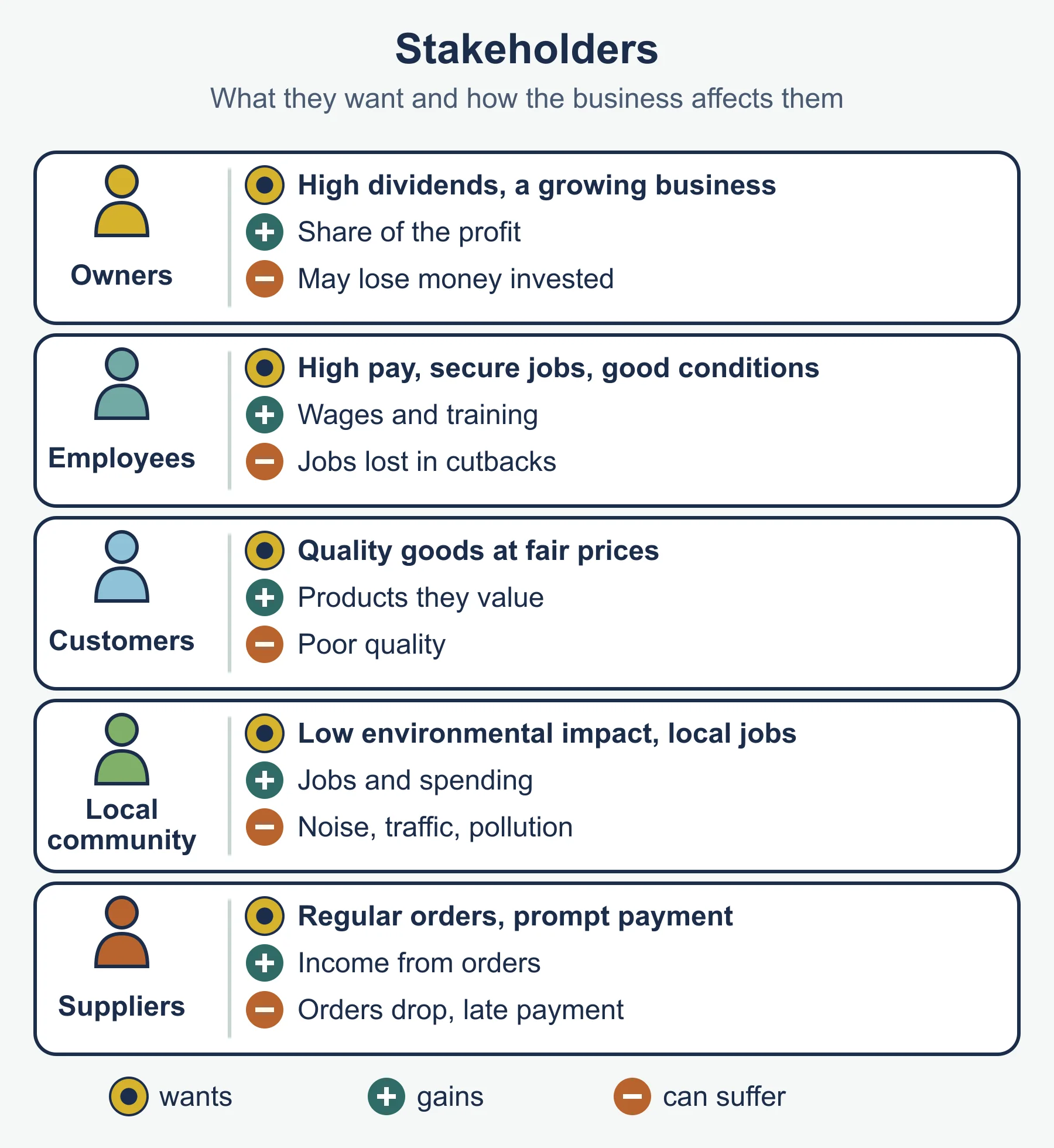
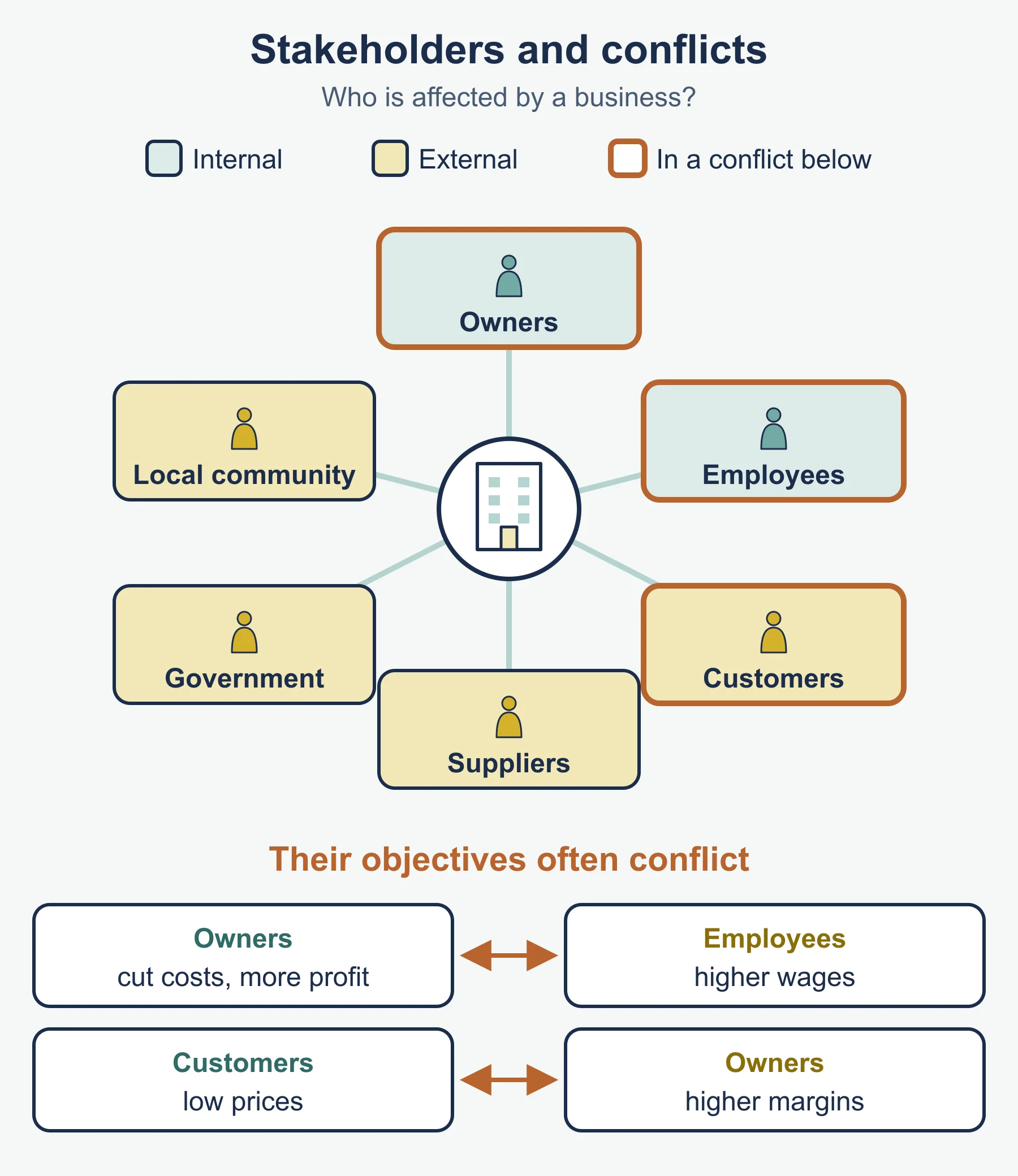
A stakeholder is an individual or group with a stake in what a business does, either because its decisions affect them or because they can affect its decisions. The specification names five main groups.
| Stakeholder | Main objective(s) | Typical impact of business activity on them |
|---|---|---|
| Owners | High dividend payments, a growing business | Gain from profit; risk losing money invested |
| Employees | Maximising pay, secure jobs, good conditions | Gain wages and training; lose jobs in cutbacks |
| Customers | Quality goods at fair prices, good service | Gain products they value; suffer from poor quality |
| Local community | Minimising environmental impact, local jobs | Gain jobs and spending; suffer noise, traffic, pollution |
| Suppliers | Regular orders, prompt payment, fair prices | Gain income; suffer if orders drop or payment is late |
Note the three objectives the specification names: maximising pay for workers, minimising environmental impact on the local community, and high dividend payments for owners.
Impact and influence
Two directions of effect matter, and strong answers use both.
- Business on stakeholders. A new factory gives jobs and orders, but also brings lorries and noise. A closure ends wages and supplier income.
- Stakeholders on business. Owners can change strategy. Employees can improve or damage output through effort, and can take industrial action. Customers decide whether to buy. Suppliers can raise prices or delay deliveries. A local community can object to plans or boycott a business.
Influence depends on power. A customer in a market with many rival firms can easily go elsewhere, so the business listens. A major supplier of a rare ingredient has strong influence over a small bakery.
Conflict between stakeholders
Stakeholders want different things, and a decision that helps one group often hurts another.
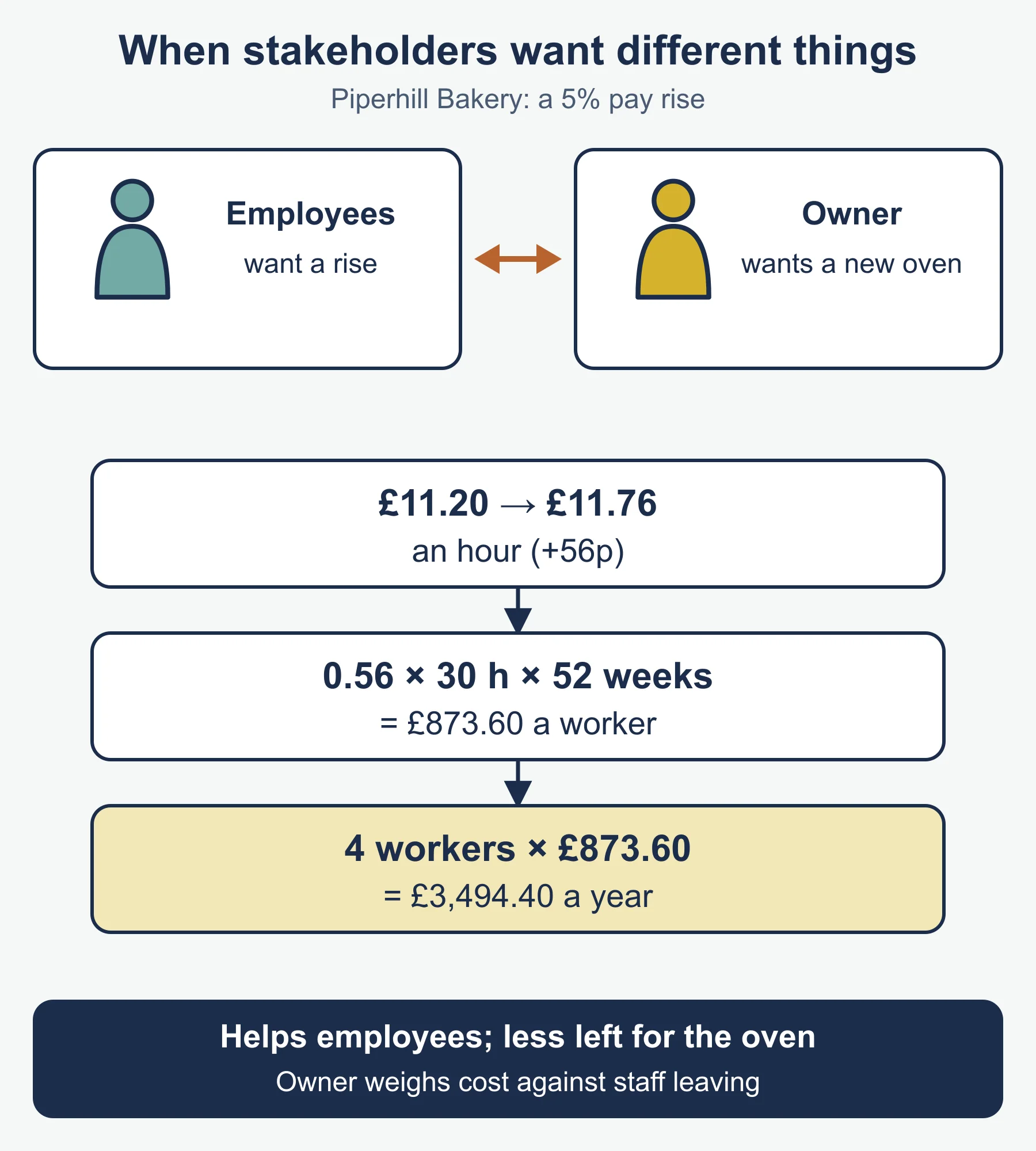
Worked example. Piperhill Bakery has four employees on £11.20 an hour. The owner wants profit for a new oven. The employees ask for a 5% rise.
- New rate = 11.20 x 1.05 = £11.76, a rise of 56p an hour.
- If each works 30 hours for 52 weeks, one worker’s extra cost = 0.56 x 30 x 52 = £873.60. For four workers: 4 x 873.60 = £3,494.40 a year.
The rise would help employees but cut the money available for the oven. The owner must weigh higher costs against the risk that unhappy staff leave. Conflict can also arise between customers (lower prices) and owners (higher profit), or between the community (less noise) and a business that wants longer opening hours.
How a business may respond: compromise, rank the groups by importance and power, consult stakeholders, or explain the reasons for a decision.
Common errors
- Writing “make profit” as the only objective. The specification expects the full set and the point that success is not only profit.
- Treating aim and objective as the same, with no link to a specific target.
- Saying a start-up has the same objectives as a large firm.
- Listing stakeholders without saying what each wants.
- Describing only one direction: how the business affects stakeholders, but not how they affect it.
- Naming a conflict but not saying whose interests win and why.
- Using a generic example instead of the business in the case study.
Next steps
Work through the practice questions, then check weak areas with a free diagnostic.
Frequently asked questions
What are the main stakeholders of a business in AQA GCSE Business (8132)? Owners, employees, customers, the local community and suppliers. Each has its own objectives, such as owners wanting high dividend payments and employees wanting to maximise pay.
Why do objectives differ between businesses? The specification gives reasons including the size of the business, the level of competition and the type of business. Not-for-profit organisations such as charities put social objectives first.
Can a business be successful without making a big profit? Yes. The specification states that success can be measured in ways other than profit, such as market share, customer satisfaction or meeting social and ethical objectives.
Why does stakeholder influence vary? Influence depends on power. A customer with many alternative suppliers can easily switch, and a business that depends heavily on one stakeholder group gives that group more influence.
Official syllabus
AQA GCSE Business (8132) specification, for first teaching from September 2017, published by AQA: sections 3.1.3 Setting business aims and objectives and 3.1.4 Stakeholders.
Get free revision emails (optional)
Occasional emails with practice questions, worked explanations and links to free resources for the qualification and subjects you choose. No spam, and you can unsubscribe from any email. The free tools on this site never need an email.
Related resources
-
Practice questions
AQA GCSE Business: Setting business aims and objectives and Stakeholders (8132) – Practice Questions
Original practice questions with worked answers on AQA GCSE Business (8132) 3.1.3 and 3.1.4: objectives, market share, dividends and stakeholders.
Business · AQA · GCSE
Try questions -
Revision notes
AQA GCSE Business: Setting business aims and objectives and Stakeholders (8132) – Revision Notes
Condensed revision notes for AQA GCSE Business (8132) 3.1.3 and 3.1.4: objectives, changing objectives, stakeholders, impact, influence and conflict.
Business · AQA · GCSE
Revise topic -
Study guides
AQA GCSE Business: The purpose and nature of businesses and Business ownership (8132)
Study guide to why businesses exist, enterprise, entrepreneurs and the five forms of ownership, with worked examples, for AQA GCSE Business 8132.
Business · AQA · GCSE
Read guide
Related articles
-
teaching
A Level tuition in Dubai: Cambridge or Pearson Edexcel International A Level?
Schools in Dubai and Abu Dhabi teach either Cambridge International AS & A Level or Pearson Edexcel International A Level. How the two are structured, why it matters for tuition, and how online classes from Lahore work.
9 October 2026
-
curriculum guides
Choosing subjects at IGCSE and A Level
How subject choices at 14 and 16 affect university options later, and how to keep pathways open without overloading a timetable.
28 July 2026
Studying this with a teacher
Working through Business GCSE?
This page is free and stays free. If you would rather be taught it, Marlbridge runs Business classes one-to-one and in small groups of up to 15, online in your own time zone. The first trial class is free. WhatsApp replies within an hour (8am–11pm Pakistan time, every day); email the same day.
AQA Business teachers at Marlbridge
