
Revision Notes
AQA GCSE Business: Setting business aims and objectives and Stakeholders (8132) – Revision Notes
Condensed revision notes for AQA GCSE Business (8132) 3.1.3 and 3.1.4: objectives, changing objectives, stakeholders, impact, influence and conflict.
- Subject
- Business
- Level
- GCSE
- Topic
- Business in the real world
- Author
- Marlbridge Academic Team
- Updated
- Reviewed by
- Salman Ahmad (what this means)
Aligned to AQA GCSE Business (8132), For first teaching from September 2017. Official specification .
Syllabus page (what it covers and how it is assessed): AQA GCSE Business.
Syllabus points this page covers
8132
- 3.1.3 Setting business aims and objectives
- 3.1.4 Stakeholders
Found an error? Report a correction.
Need help with this topic? Request a free trial class for GCSE Business (8132).
These revision notes condense sections 3.1.3 (Setting business aims and objectives) and 3.1.4 (Stakeholders) of the AQA GCSE Business (8132) specification, for first teaching from September 2017. For full explanations and worked examples, read the study guide. When you are ready, try the practice questions, and use the free diagnostics to check where you stand.
Wider topic pages: topic study guide, topic revision notes and topic practice questions. Course links: AQA GCSE Business hub and printable checklist.
Key definitions
| Term | Definition |
|---|---|
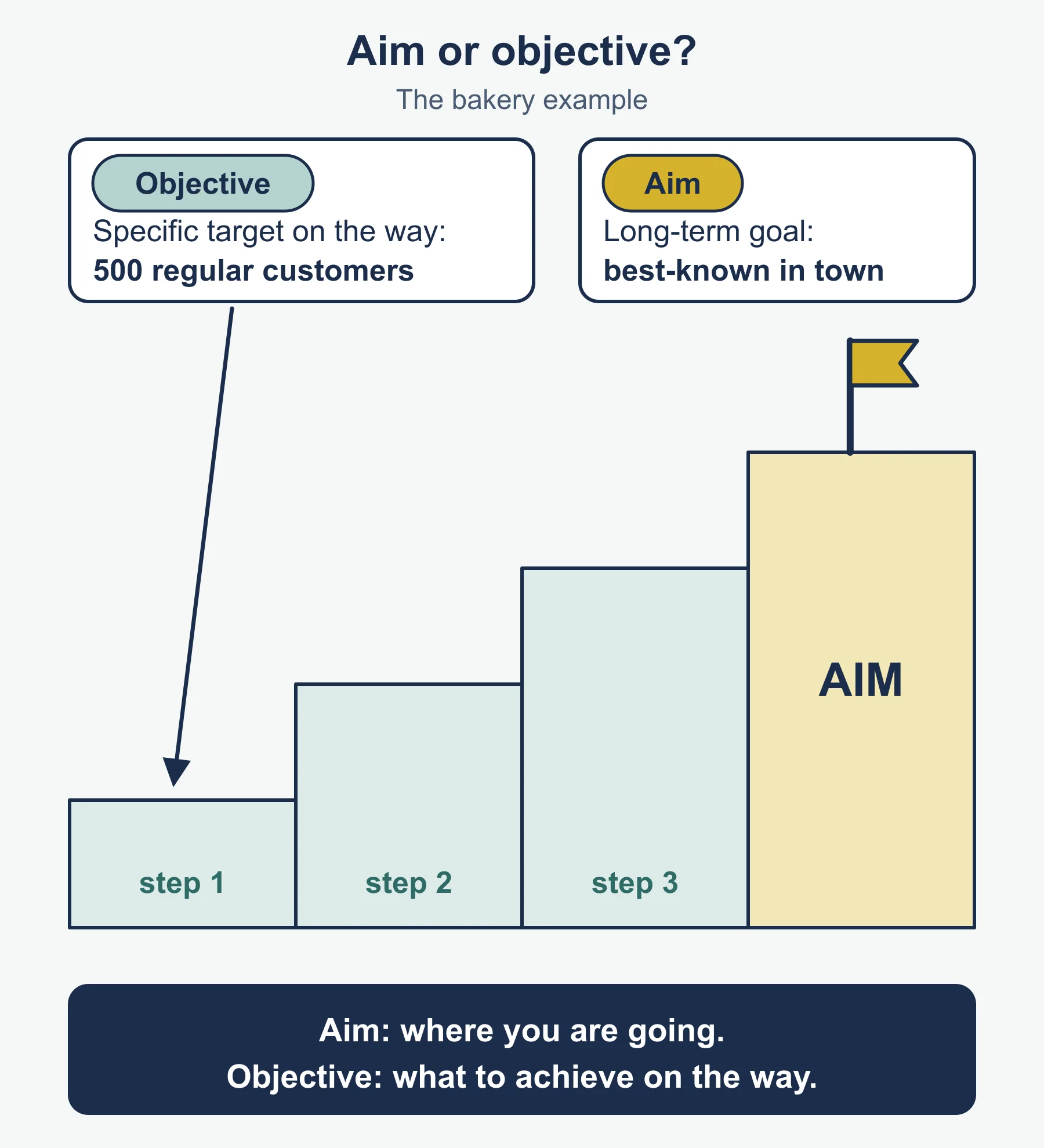
| Aim | The long-term goal or direction of a business |
| Objective | A specific target that moves the business towards its aim |
| Stakeholder | An individual or group with a stake in what the business does, whether affected by it or able to affect it |
| Not-for-profit organisation | An organisation (such as a charity) whose main purpose is not to make profit for owners |
| Shareholder value | The worth of a business to its shareholders, seen in share price and dividends |
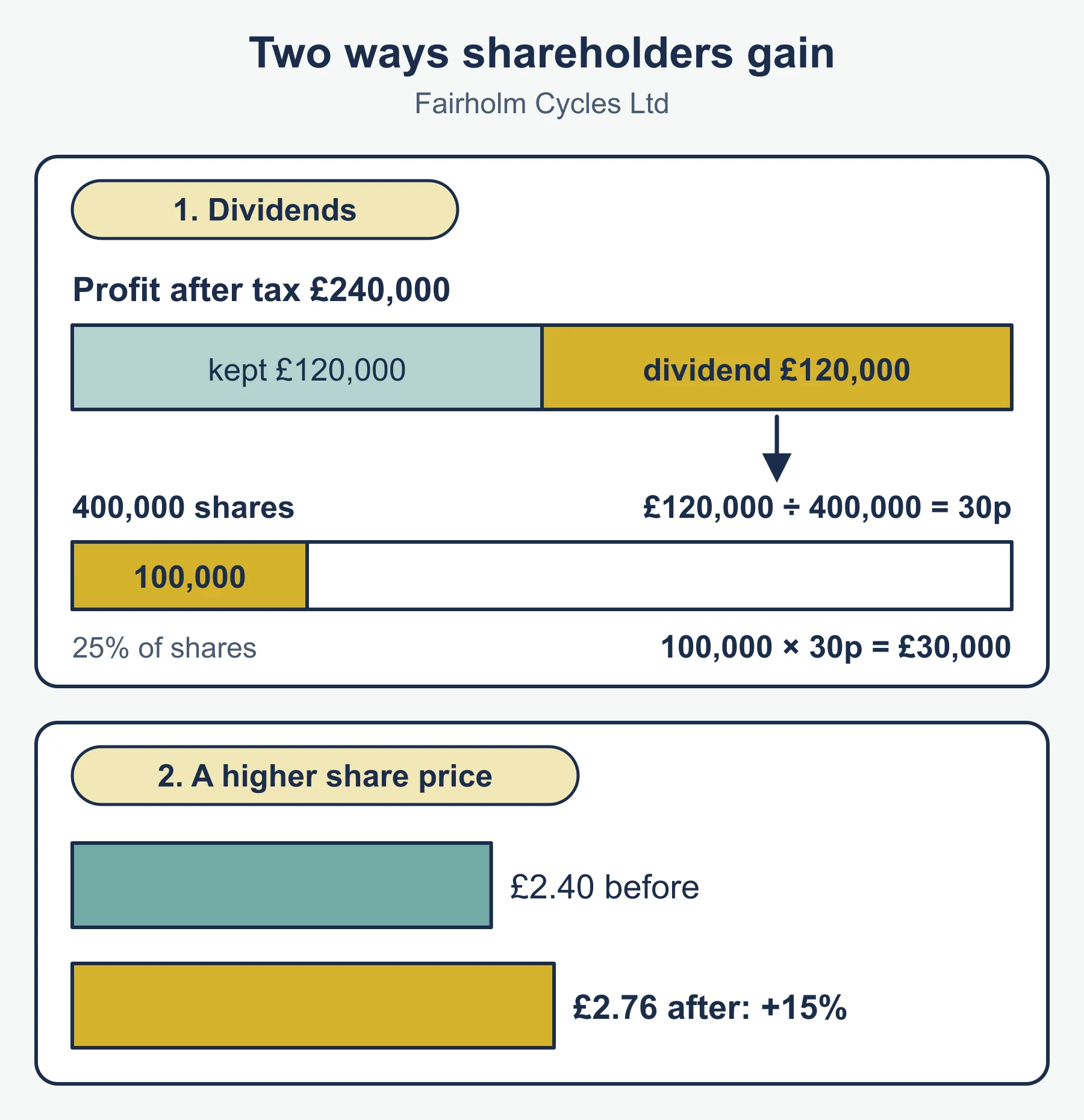
| Dividend | A share of profit paid to shareholders |
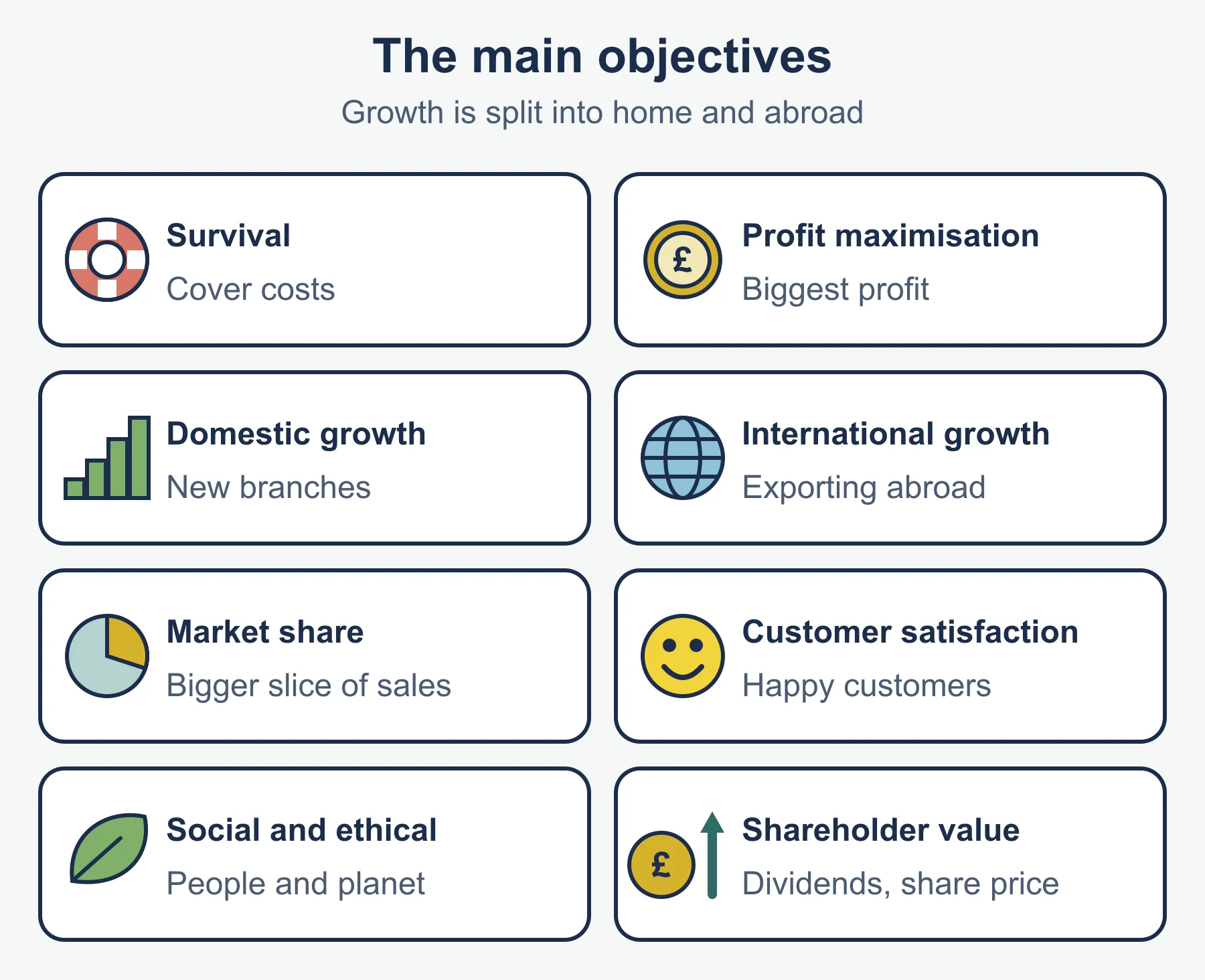
3.1.3 The objectives to know
- Survival: stay in business, cover costs. Main concern for start-ups.
- Profit maximisation: the highest possible profit.
- Growth: domestic (home market) and international (other countries).
- Market share: the proportion of total market sales the business has.
- Customer satisfaction: customers are happy with product and service.
- Social and ethical objectives: benefit people or the environment, not only owners.
- Shareholder value: higher share price and dividends.
Formulas (standard forms)
The specification names these objectives but does not print the formulas, so these are the standard forms.
| Measure | Standard form |
|---|---|
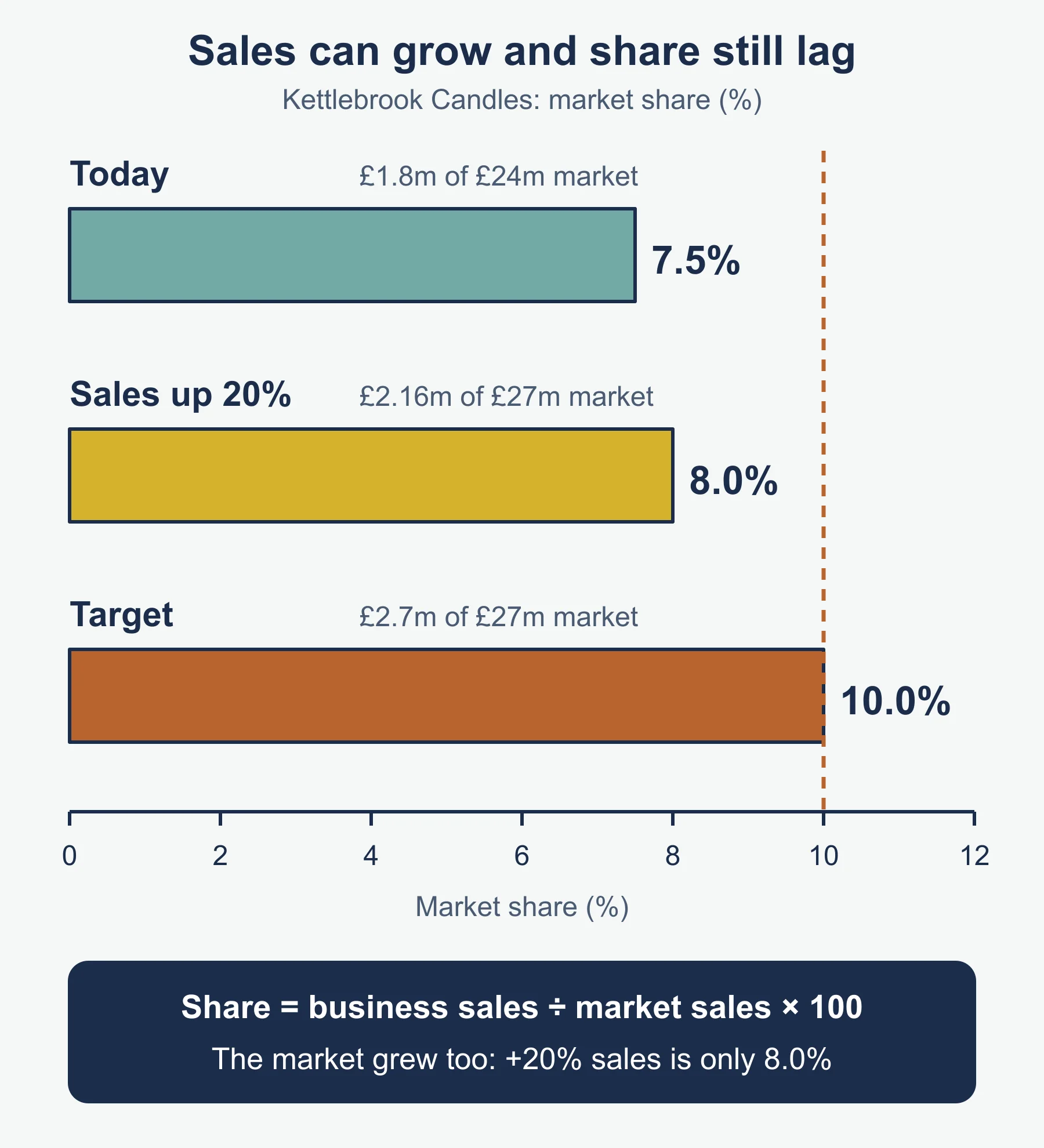
| Market share (%) | business sales / total market sales x 100 |
| Dividend per share | total dividend / number of shares |
| Percentage change | (new - old) / old x 100 |
Mini example. Heathermoor Pottery sells £360,000 in a £4.5m market. Market share = 360,000 / 4,500,000 x 100 = 8%. To reach 10% in the same market it needs 10% of 4,500,000 = £450,000.
Mini example. A company pays £90,000 in dividends on 300,000 shares: 90,000 / 300,000 = £0.30, so 30p per share. A holder of 60,000 shares receives 60,000 x 0.30 = £18,000. A share price rising from £4.25 to £5.10 is a rise of 0.85 / 4.25 x 100 = 20%.
Purpose and role of objectives
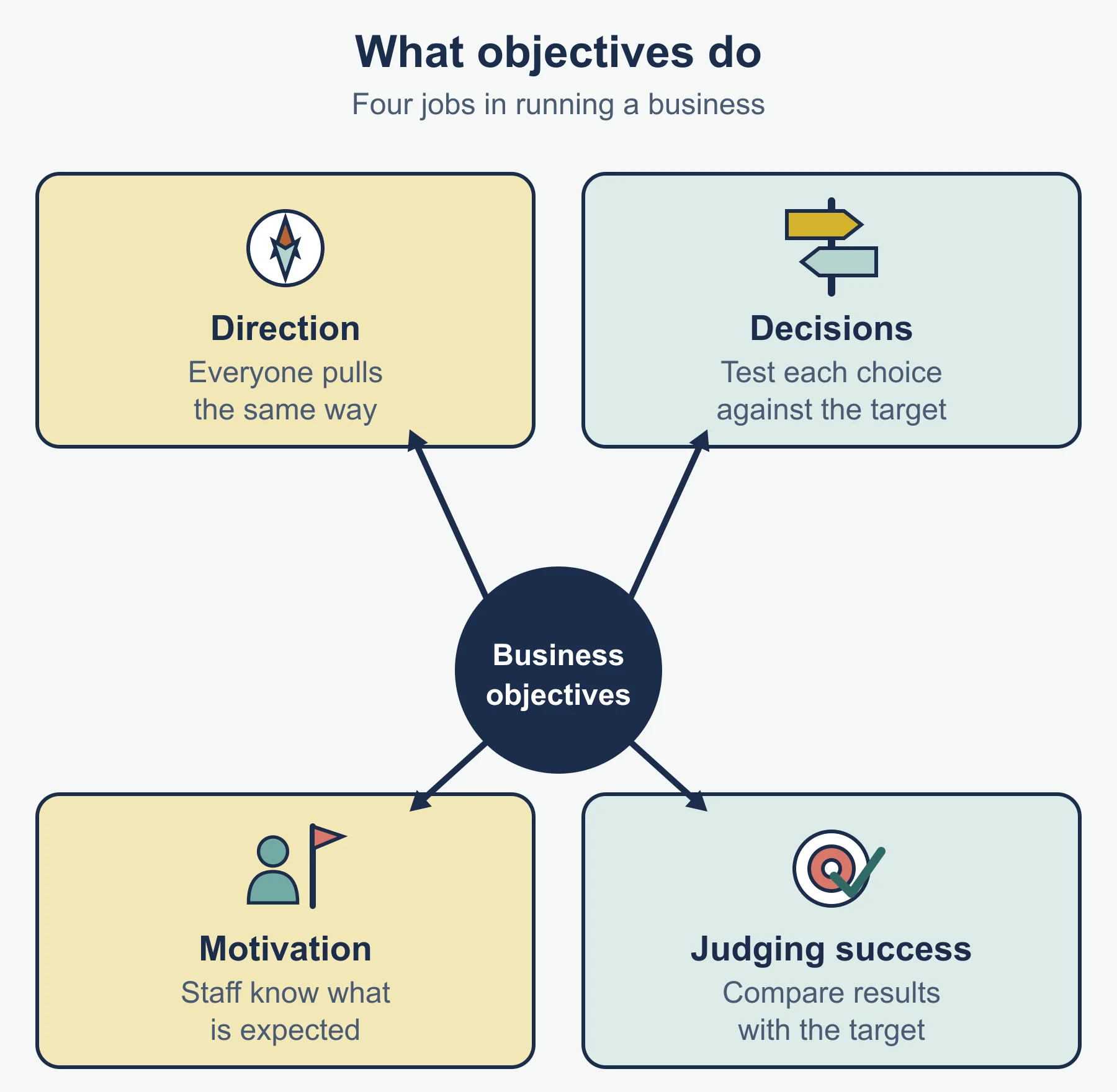
- Give direction and a shared target.
- Help managers make decisions by testing options against the objective.
- Motivate staff with clear targets.
- Allow success to be judged by comparing results with the target.
- Show lenders and investors what the business is trying to do.
Why objectives differ
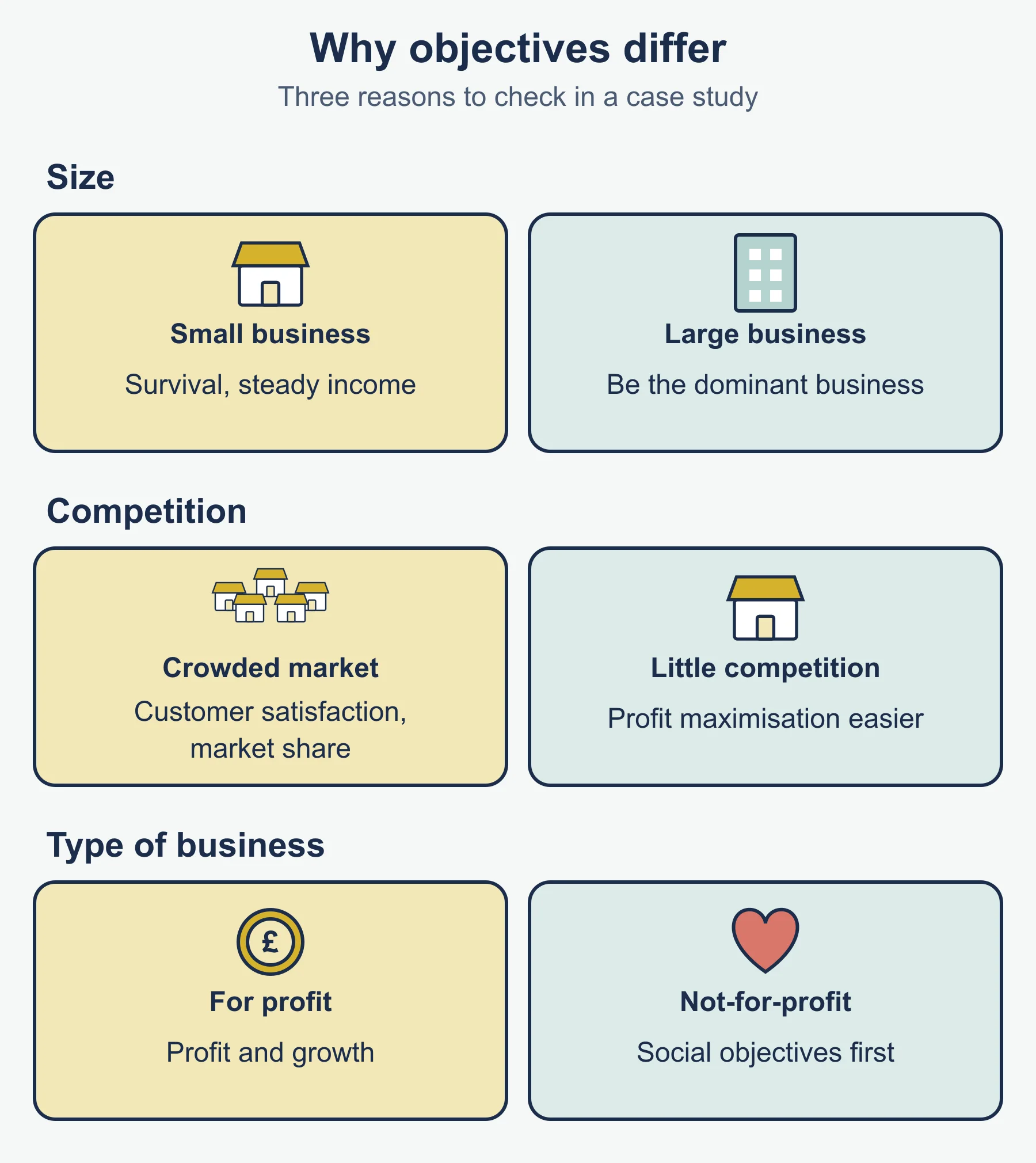
| Reason | Effect |
|---|---|
| Size | Small: survival, steady income. Large: dominance, international expansion |
| Level of competition | High: customer satisfaction, market share. Low: profit maximisation easier |
| Type of business | Not-for-profit: social objectives come first and success is not measured by profit |
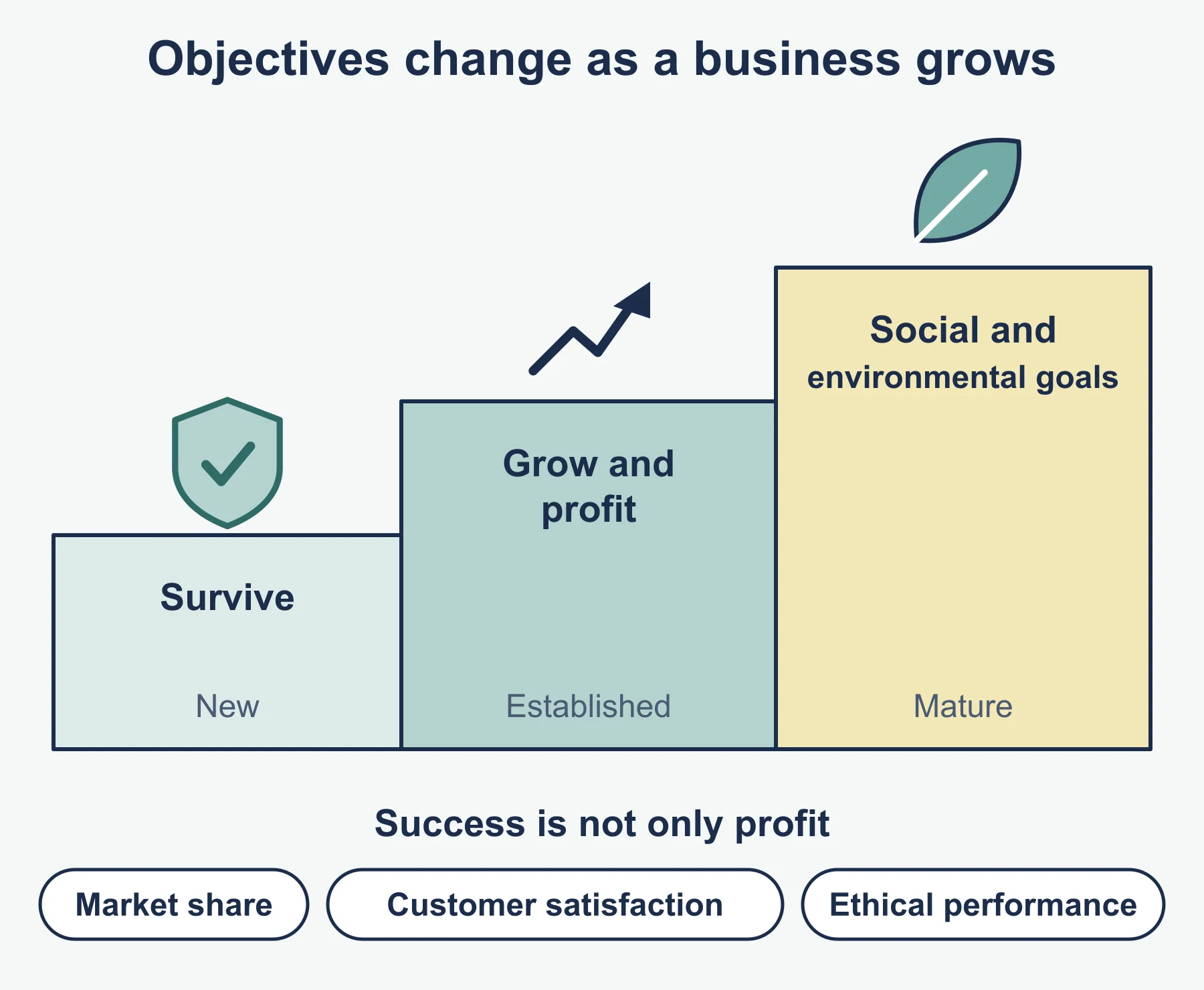
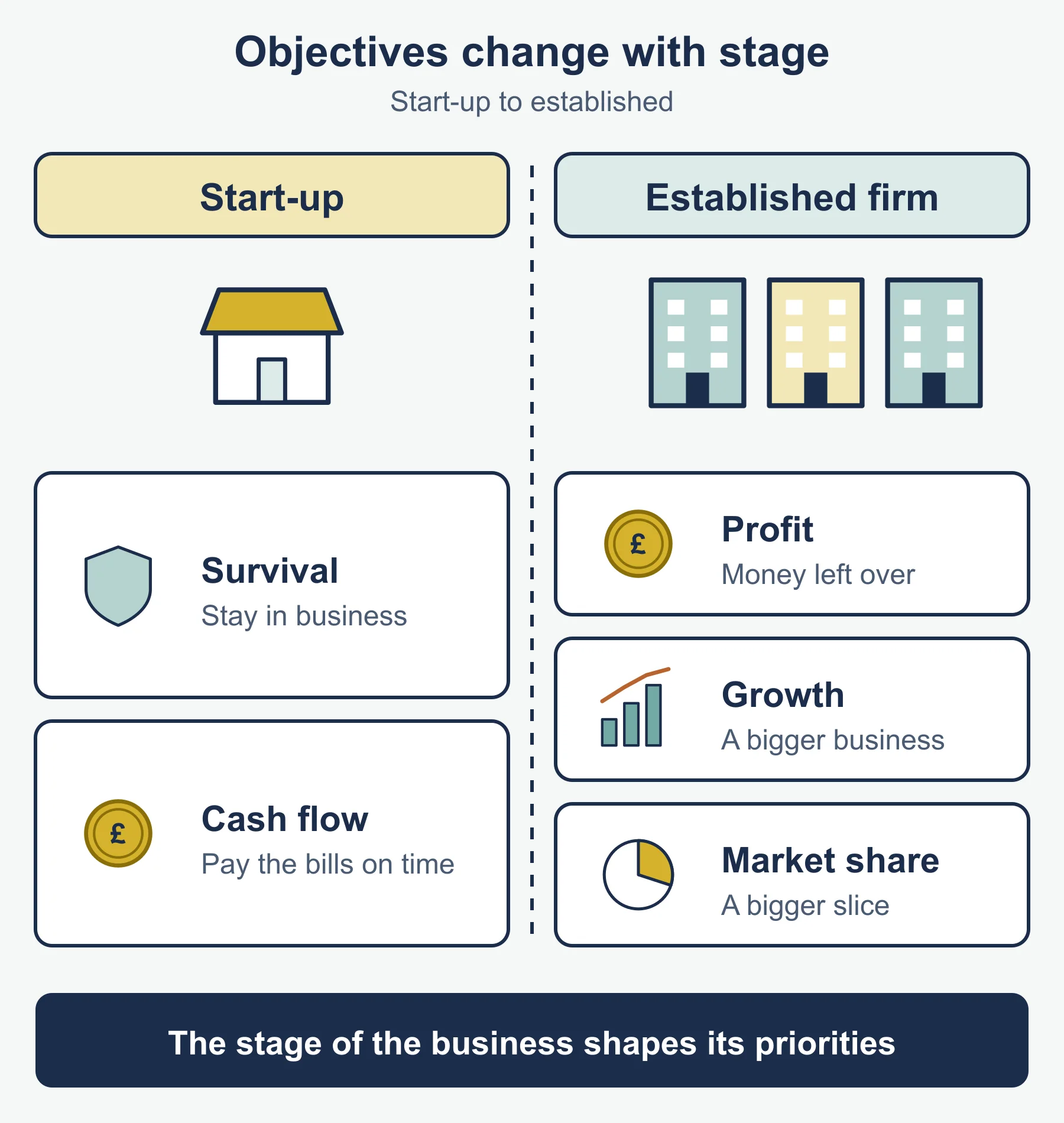
Why objectives change
| Stage | Typical objectives |
|---|---|
| Start-up | Survival, building customers, covering costs |
| Growing | Profit, growth, market share |
| Large and established | Dominant business in the market, international expansion, increasing shareholder value, ethical and environmental considerations |
Triggers for change: new competitor, falling demand, new technology, changing customer attitudes, growth in size, a change of owners.
Success is not only profit. Other measures: market share, customer satisfaction, number of customers, products launched, environmental targets, money raised for good causes.
3.1.4 Stakeholders
Main groups and their objectives
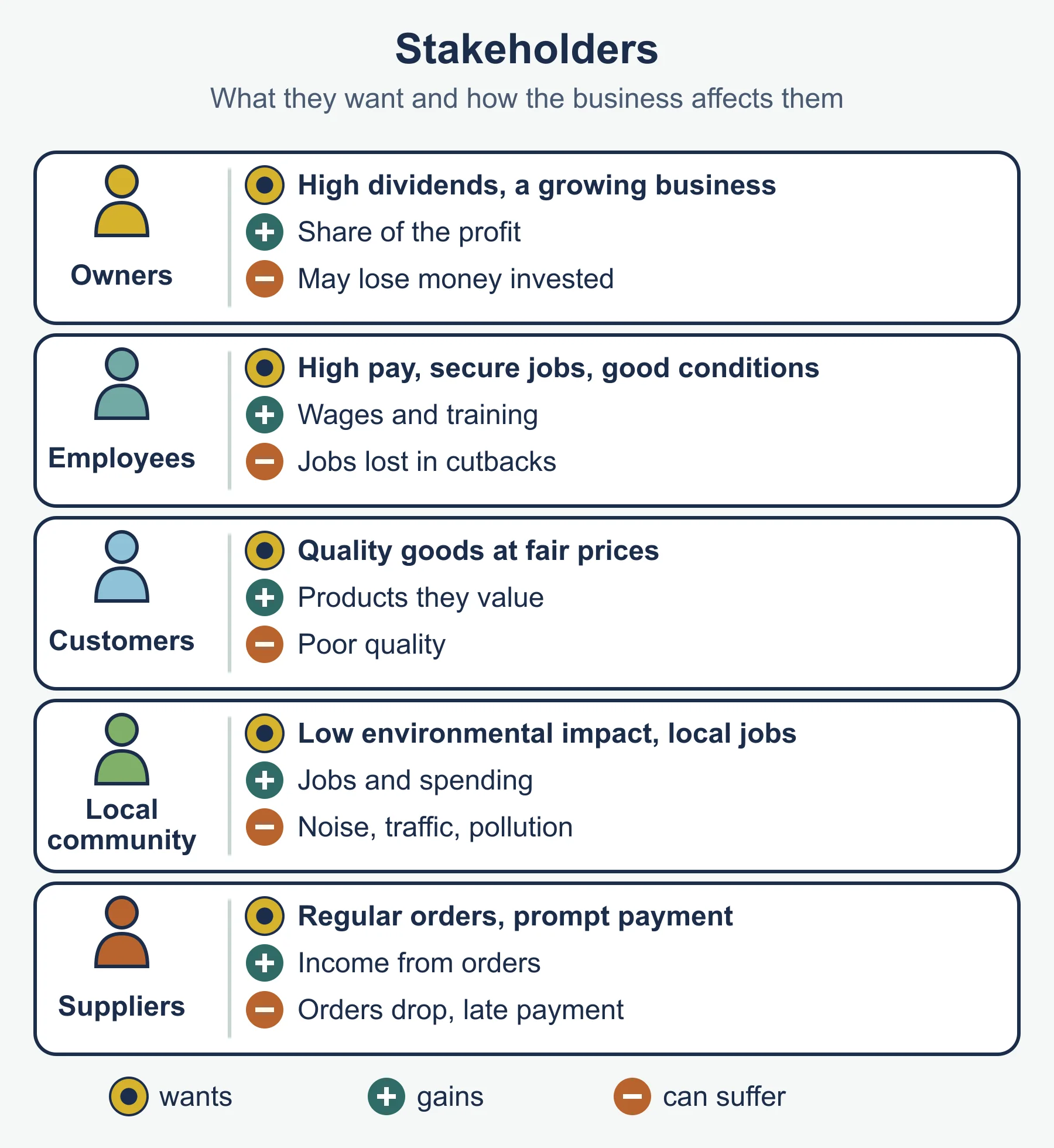
| Stakeholder | Main objective | Business activity can affect them by |
|---|---|---|
| Owners | High dividend payments, growth in value | Profit or loss |
| Employees | Maximising pay, job security, good conditions | Wages, redundancies, training |
| Customers | Quality, fair price, good service | Product quality, prices |
| Local community | Minimising environmental impact, local jobs | Noise, traffic, pollution, employment |
| Suppliers | Regular orders, prompt payment, fair prices | Order size, payment terms |
Influence of stakeholders on the business
- Owners: set aims, appoint managers, can sell the business.
- Employees: effort, quality of work, industrial action, leaving.
- Customers: choose whether to buy, complain, switch to rivals.
- Local community: object to plans, boycott, support or oppose.
- Suppliers: raise prices, delay deliveries, offer credit.
Influence is stronger when the stakeholder has alternatives or the business depends on them.
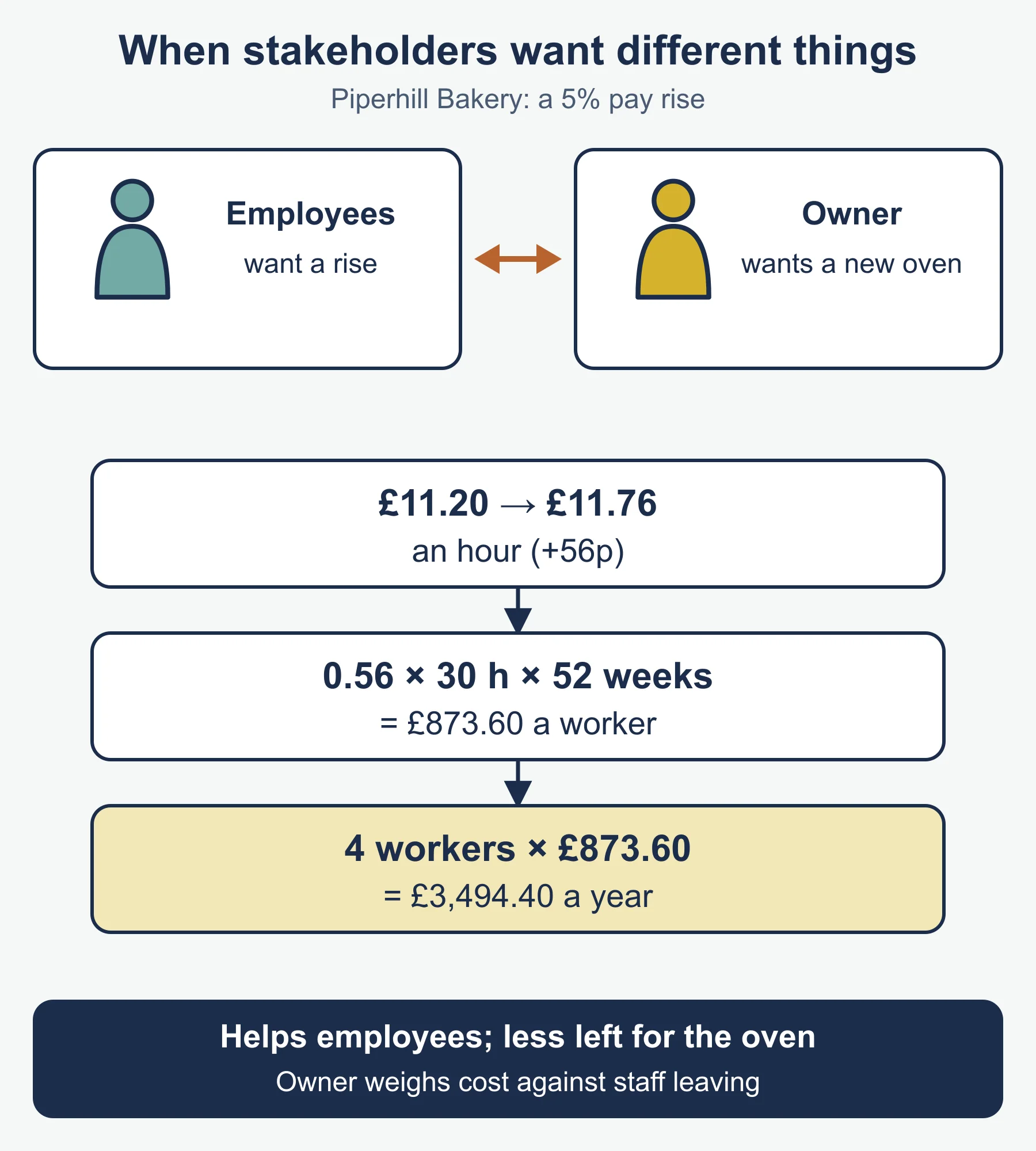
Method: analysing a stakeholder conflict in steps
- Name the two stakeholder groups.
- State what each wants (use the objectives above).
- Say why the same decision cannot satisfy both.
- Apply the numbers or details from the case study.
- Judge which group has more influence and what the business should do.
Must-know distinctions
| Pair | Difference |
|---|---|
| Aim v objective | Aim is the general direction; objective is a specific target |
| Survival v profit maximisation | Survival: cover costs and stay open. Profit maximisation: make as much as possible |
| Domestic v international growth | Home market v other countries |
| Profit v shareholder value | Profit is the surplus earned; shareholder value covers dividends and share price |
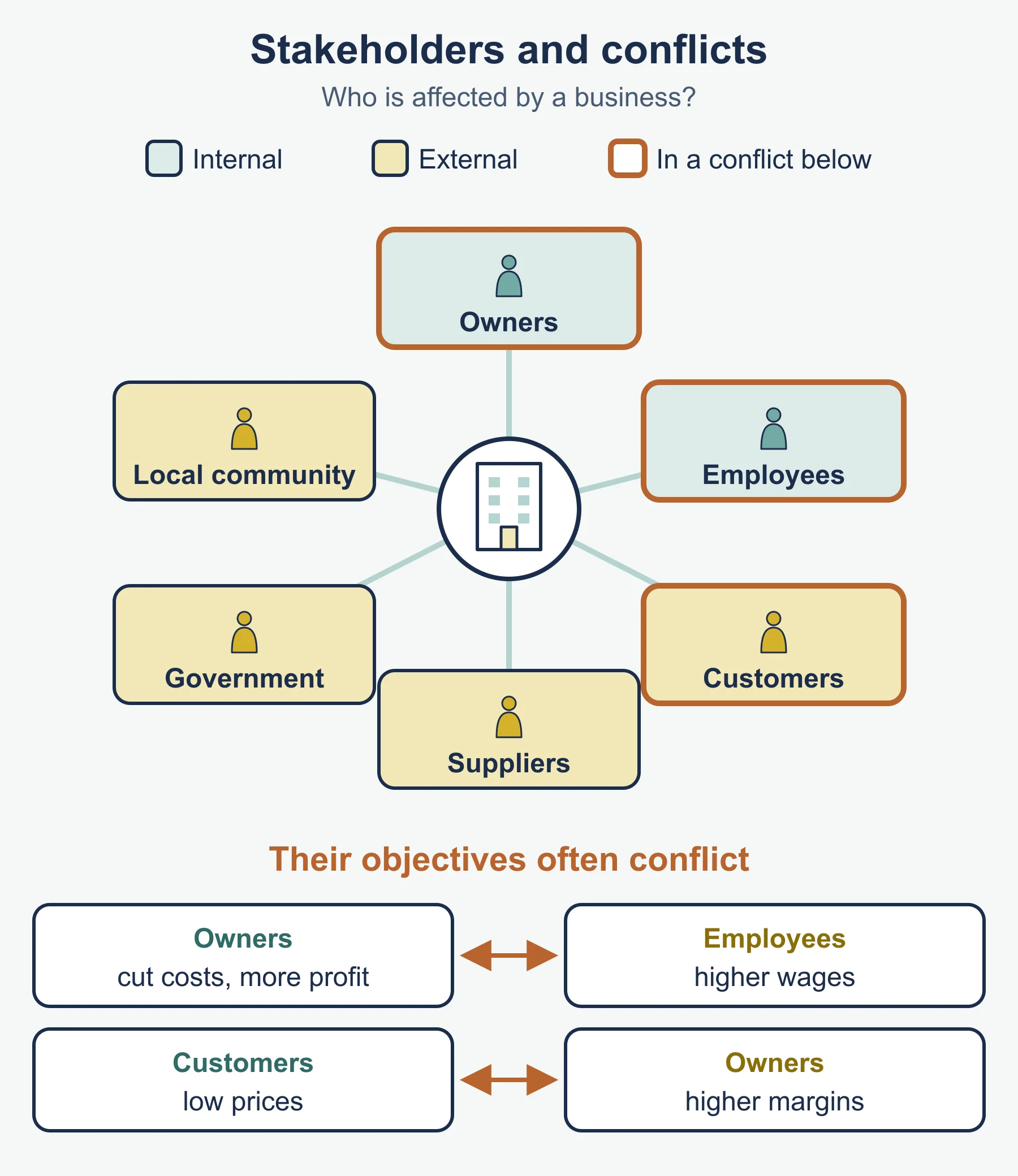
| Impact on stakeholders v influence of stakeholders | Impact: the business affects them. Influence: they affect the business |
Worked reminder: judging success against an objective
Heathermoor Pottery set a market share objective of 10% but reached 8%. Profit rose. Is it successful?
- State the result against the target: 8% against 10%, so the objective was not met.
- Note the other evidence: profit rose, so the business may still be healthy.
- Judge: success depends on which objective the owners care about most. Against the market share objective, the year fell short. Against profit, it did well.
This is the pattern for any “judging success” question: compare with the objective, bring in a second measure, then decide.
Case-study skills for these sections
- Identify: pick the objective from the wording in the case (for example “stay open through the winter” points to survival).
- Explain: make a point, say why it matters and tie it to the named business.
- Analyse: follow a chain of cause and effect, such as higher wages leading to lower profit leading to a smaller dividend for owners.
- Evaluate or justify: give reasons on both sides, then a clear judgement that says what the decision depends on, such as the size of the business, the stage it has reached or how strong the stakeholder is.
- Calculate: show the formula, the substitution and the unit (percentage, pence or pounds).
Quick self-test
- Define the term objective.
- Name the seven objectives the specification lists.
- A business has sales of £360,000 in a market worth £4.5m. Calculate its market share.
- Give two reasons why a start-up’s objectives differ from those of a large established business.
- Why might a charity not measure success by profit?
- Give one effect that a new factory could have on people living nearby.
- State the main objective of employees as stakeholders, in the specification’s words.
- Explain one way a stakeholder can influence a business.
- Give an example of a conflict between two stakeholders.
- A company pays £90,000 in dividends on 300,000 shares. What is the dividend per share?
Answers
- A specific target set by a business to help it achieve its aim.
- Survival, profit maximisation, growth (domestic and international), market share, customer satisfaction, social and ethical objectives, shareholder value.
- 360,000 / 4,500,000 x 100 = 8%.
- Any two: small size means survival is the priority; fewer resources limit growth; the large business can afford to aim for dominance, international expansion or shareholder value; a large business is more visible and under pressure over ethical and environmental matters.
- A charity’s purpose is social, so it judges success by what it achieves for its cause, though it still needs to cover its costs.
- For example noise, traffic or pollution from a factory, or extra jobs and local spending.
- Maximising pay for workers.
- For example customers choose to buy elsewhere, forcing a price cut; or employees take industrial action.
- For example owners want high dividend payments while employees want higher pay; both draw on the same profit.
- 90,000 / 300,000 = 30p per share.
Where marks are usually lost
- Giving only “make profit” when the question asks about a start-up, where survival is more likely.
- Defining aim and objective in the same words.
- Listing stakeholders with no statement of what each wants.
- Describing only how the business affects a stakeholder, never how the stakeholder affects the business.
- Naming a conflict but not explaining why both sides cannot be satisfied at once.
- Writing market share as a sales figure instead of a percentage.
- Forgetting that dividend per share needs the number of shares, not the profit.
- Ignoring the case study, so the answer could apply to any business.
- Reaching no judgement in an “evaluate” or “justify” question.
Frequently asked questions
What are the business objectives in AQA GCSE Business (8132) section 3.1.3? Survival, profit maximisation, growth (domestic and international), market share, customer satisfaction, social and ethical objectives, and shareholder value.
What is the difference between an aim and an objective? An aim is the long-term goal or general direction of a business. An objective is a specific target that moves the business towards that aim.
Why do business objectives change as a business grows? A start-up usually focuses on survival and covering costs, a growing business on profit, growth and market share, and a large established business on market dominance, international expansion and shareholder value.
What is the difference between the impact and the influence of stakeholders? Impact is how the business’s activity affects a stakeholder, such as noise from a factory. Influence is how a stakeholder affects the business, such as customers switching to rivals.
Official syllabus
AQA GCSE Business (8132) specification, for first teaching from September 2017, published by AQA: sections 3.1.3 Setting business aims and objectives and 3.1.4 Stakeholders.
Get free revision emails (optional)
Occasional emails with practice questions, worked explanations and links to free resources for the qualification and subjects you choose. No spam, and you can unsubscribe from any email. The free tools on this site never need an email.
Related resources
-
Study guides
AQA GCSE Business: The purpose and nature of businesses and Business ownership (8132)
Study guide to why businesses exist, enterprise, entrepreneurs and the five forms of ownership, with worked examples, for AQA GCSE Business 8132.
Business · AQA · GCSE
Read guide -
Practice questions
AQA GCSE Business: The purpose and nature of businesses and Business ownership (8132) – Practice Questions
Eleven original questions with worked answers on business purpose, enterprise and ownership structures for AQA GCSE Business (8132) 3.1.1 and 3.1.2.
Business · AQA · GCSE
Try questions -
Revision notes
AQA GCSE Business: The purpose and nature of businesses and Business ownership (8132) – Revision Notes
Condensed recall notes with tables and a self-test on business purpose, enterprise and legal structures for AQA GCSE Business (8132) 3.1.1 and 3.1.2.
Business · AQA · GCSE
Revise topic
Related articles
-
teaching
A Level tuition in Dubai: Cambridge or Pearson Edexcel International A Level?
Schools in Dubai and Abu Dhabi teach either Cambridge International AS & A Level or Pearson Edexcel International A Level. How the two are structured, why it matters for tuition, and how online classes from Lahore work.
9 October 2026
-
curriculum guides
Choosing subjects at IGCSE and A Level
How subject choices at 14 and 16 affect university options later, and how to keep pathways open without overloading a timetable.
28 July 2026
Studying this with a teacher
Working through Business GCSE?
This page is free and stays free. If you would rather be taught it, Marlbridge runs Business classes one-to-one and in small groups of up to 15, online in your own time zone. The first trial class is free. WhatsApp replies within an hour (8am–11pm Pakistan time, every day); email the same day.
AQA Business teachers at Marlbridge
