
Study Guides
AQA GCSE Business: Business location and Business planning (8132)
Study guide to the factors behind a business's location and to business planning, with worked cost and profit examples, for AQA GCSE Business.
- Subject
- Business
- Level
- GCSE
- Topic
- Business in the real world
- Author
- Marlbridge Academic Team
- Updated
- Reviewed by
- Salman Ahmad (what this means)
Aligned to AQA GCSE Business (8132), For first teaching from September 2017. Official specification .
Syllabus page (what it covers and how it is assessed): AQA GCSE Business.
Syllabus points this page covers
8132
- 3.1.5 Business location
- 3.1.6 Business planning
Found an error? Report a correction.
Need help with this topic? Request a free trial class for GCSE Business (8132).
This guide covers sections 3.1.5 Business location and 3.1.6 Business planning of the AQA GCSE Business (8132) specification, “For first teaching from September 2017”. Both sections sit in Topic 1, Business in the real world, which the specification lists as assessed in Paper 1 and in Paper 2.
Use it with the revision notes and the practice questions. The wider topic is covered in the Business in the real world study guide, the topic revision notes and the topic practice set. The course hub is AQA GCSE Business, the printable list is the course checklist, and you can test yourself with the free diagnostics.
What the specification asks for
| Section | You must be able to | Where it is covered below |
|---|---|---|
| 3.1.5 | Understand the factors that influence where a business is located, including proximity to the market, availability of raw materials, labour, competition and costs | Location |
| 3.1.6 | Understand why businesses create plans: setting up a new business, raising finance, setting objectives, and detailing how functions will be organised | Why plan |
| 3.1.6 | Understand the main sections of a business plan | Sections of a plan |
| 3.1.6 | Analyse the benefits and drawbacks of business planning | Benefits and drawbacks |
| 3.1.6 | Understand the difference between variable, fixed and total costs, and the concepts of revenue, costs, profit and loss | Financial terms |
The specification adds that you will not be expected to write a business plan. You are expected to understand one, use its terms and calculate with them.
Part 1: Business location (3.1.5)
Location is where a business chooses to operate: a shop, factory, office, workshop or warehouse. The decision matters because a poor site is expensive to leave. The specification names five factors. You can also meet others in a case study, so treat the five as the core and apply them to the business in front of you.
Proximity to the market
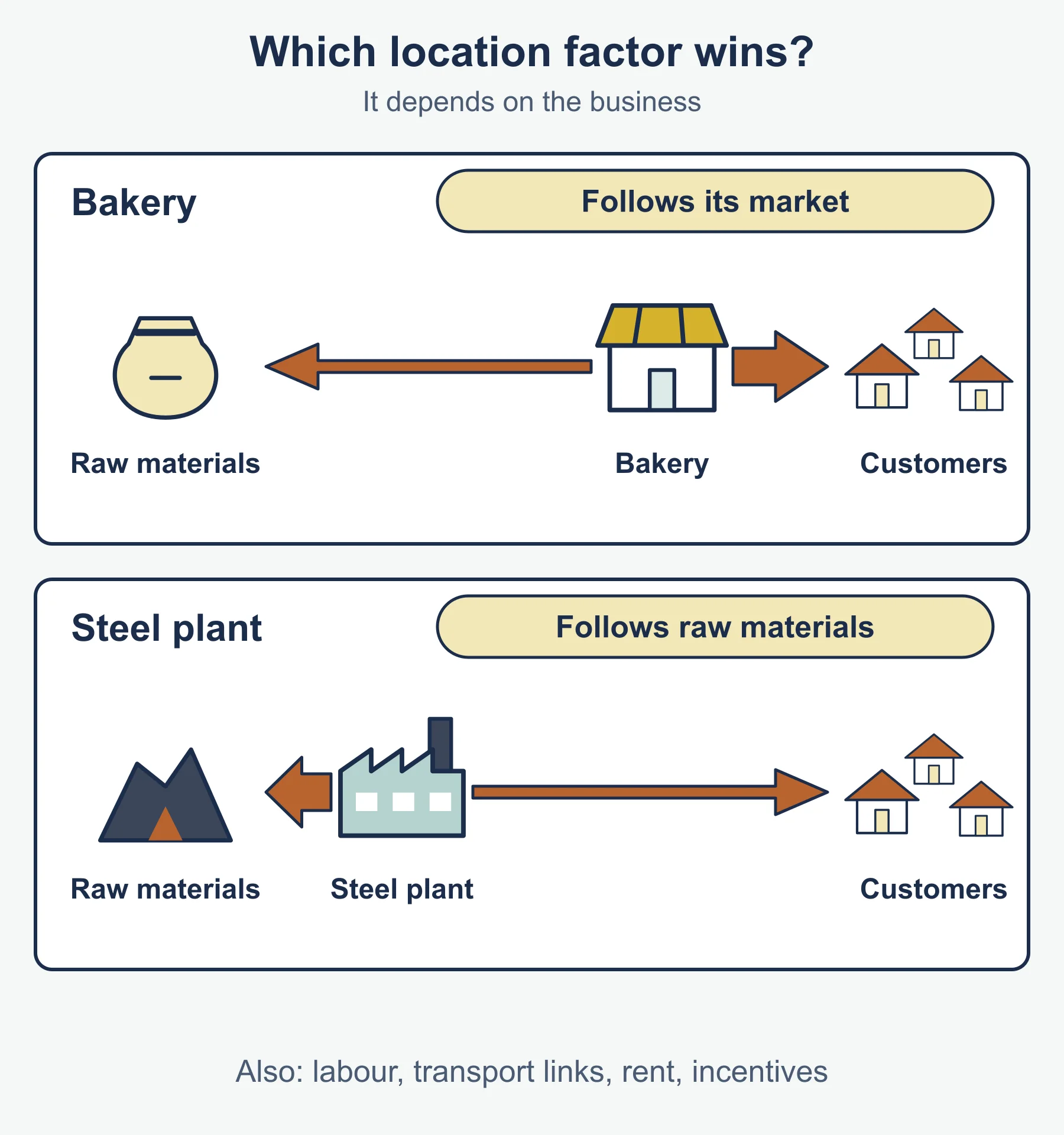
The market is where the customers are. Being close helps when customers come to you, as in a café, hairdresser or convenience shop, because passing trade is sales you did not have to advertise for. It also helps when the product is fragile, fresh or made to order, because short delivery times protect quality. Proximity matters less for a business that sells online and posts goods, though even then it needs good access to couriers and roads.
Availability of raw materials
Raw materials are the inputs that a business turns into its product. A business that uses bulky or heavy materials often locates close to its supplier, because carrying them a long way adds to transport costs. A business that uses small amounts of light materials has more freedom. Think about fresh inputs too: a food producer using milk or fruit that spoils quickly gains from a short journey.
Labour
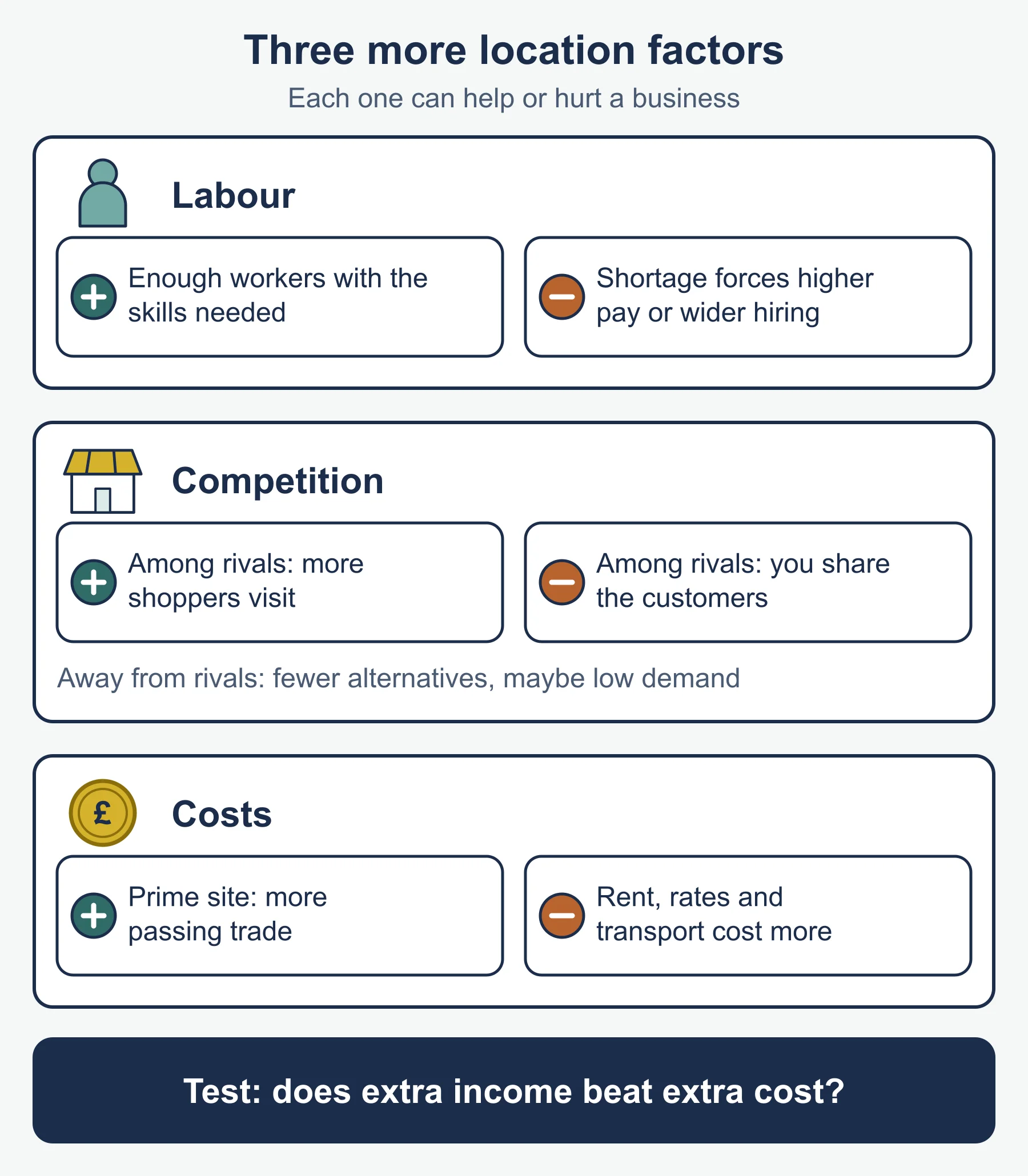
Labour means the supply of workers. Look for three things: whether there are enough people, whether they have the skills the business needs, and what wages are normal in the area. A specialist manufacturer may locate where skilled workers already live. A business needing unskilled or part-time staff may prefer a town where many people are looking for work. A site with a labour shortage can force the business to raise pay or recruit from further away.
Competition
Competitors can pull a location in two directions. Locating among rivals can bring in more customers to the area, as with a street of restaurants, but the business then shares them. Locating away from rivals gives local customers fewer alternatives, but there may be a reason nobody is there, such as low demand. A good answer says which effect is stronger for the business in the question.
Costs
Costs include the rent or purchase price of premises, business rates and utilities, transport costs for goods in and out, and wages. Prime sites in a busy centre usually cost more than edge-of-town or rural sites. The test is not “which is cheapest?” but “does the extra income from a more expensive site outweigh the extra cost?”
Worked example: weighing two sites
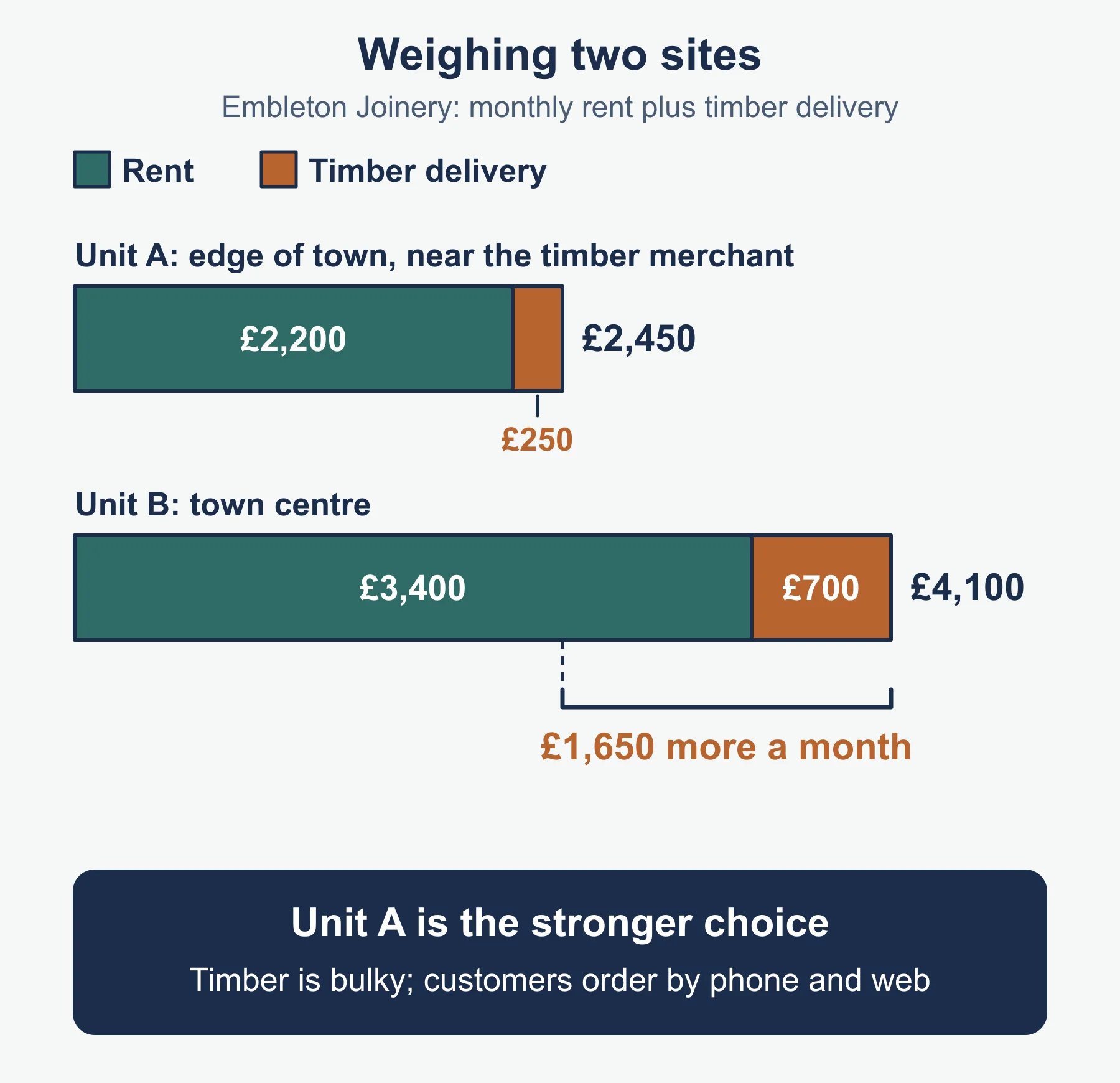
Embleton Joinery makes made-to-order wooden doors from large timber planks. It is choosing between two units.
| Monthly figure | Unit A: edge-of-town estate, near the timber merchant | Unit B: town centre |
|---|---|---|
| Rent | £2,200 | £3,400 |
| Timber delivery charges | £250 | £700 |
| Total of these two costs | £2,450 | £4,100 |
Unit B costs £4,100 − £2,450 = £1,650 more each month. The owner’s customers order by phone and website, so a town-centre shop window adds little. Timber is bulky, so the saving on delivery is real. Local joiners are available near both units. On these figures Unit A is the stronger choice, unless the business relied on passing customers.
Worked example: when a dearer site pays for itself
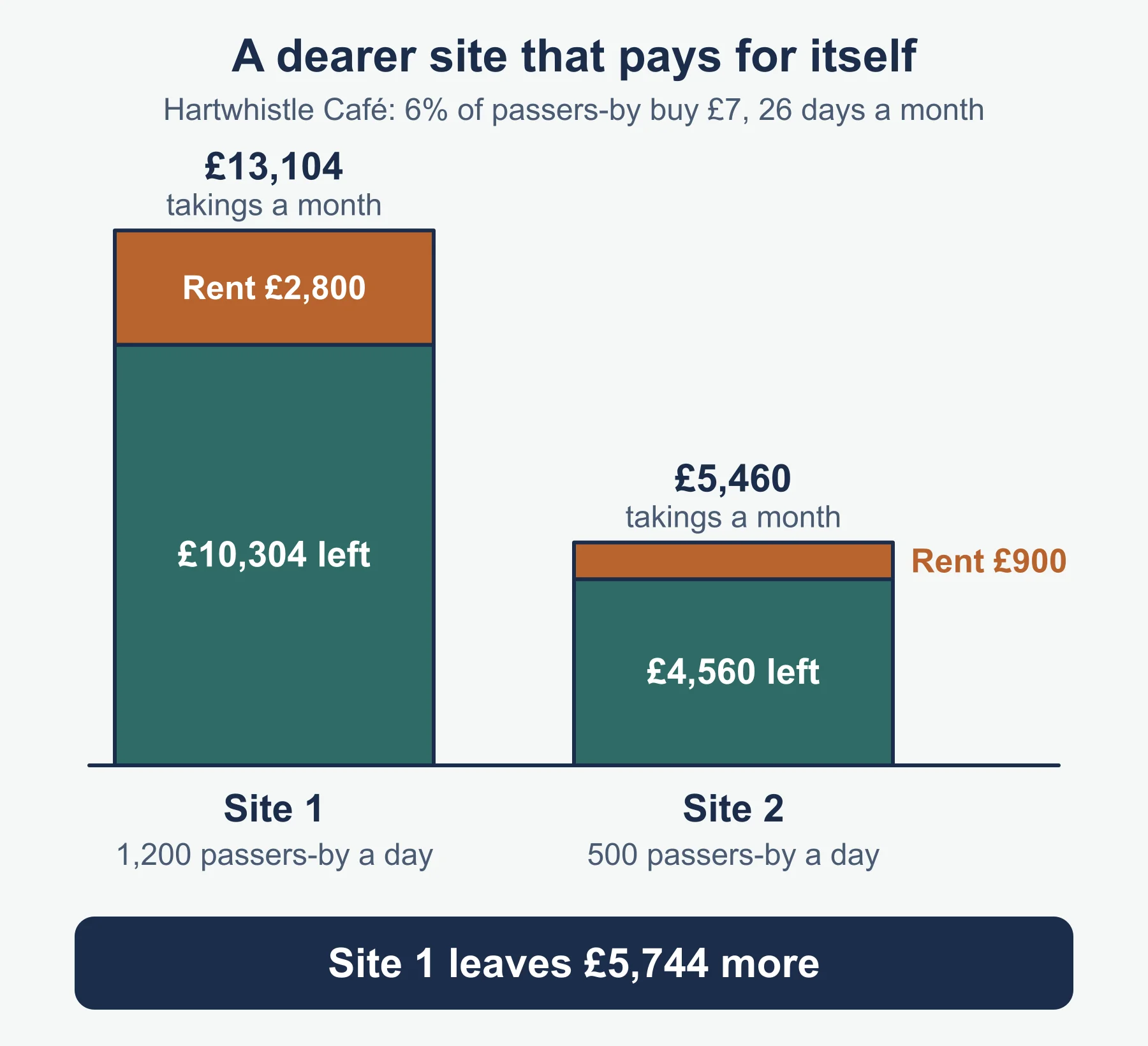
Hartwhistle Café is choosing between two sites. Site 1 has 1,200 passers-by a day and a rent of £2,800 a month. Site 2 has 500 passers-by a day and a rent of £900 a month. The owner estimates that 6% of passers-by buy, spending £7 on average, and trades 26 days a month. This is a simplified comparison that ignores all other costs.
Site 1: 1,200 × 0.06 = 72 customers a day. 72 × £7 = £504 a day. £504 × 26 = £13,104 a month. After rent: £13,104 − £2,800 = £10,304.
Site 2: 500 × 0.06 = 30 customers a day. 30 × £7 = £210 a day. £210 × 26 = £5,460 a month. After rent: £5,460 − £900 = £4,560.
Site 1 has the higher rent but leaves £10,304 − £4,560 = £5,744 more. Proximity to customers outweighs the higher cost here. The estimate of 6% is a forecast, and the conclusion depends on it. If the café at Site 1 faced three direct competitors within 200 metres, the 6% might fall, which is where the competition factor enters your evaluation.
Applying location factors in an exam answer
Weak answers list factors. Strong answers follow a chain: factor, effect on this business, consequence for costs or sales. For example: “The bakery needs fresh flour weekly (raw materials), so a site near the mill cuts transport costs, which lowers its variable costs per loaf.”
When asked to evaluate or justify a location, weigh at least two factors against each other, then decide which matters most for this business and why. State what would change your mind.
Part 2: Business planning (3.1.6)
Why businesses plan
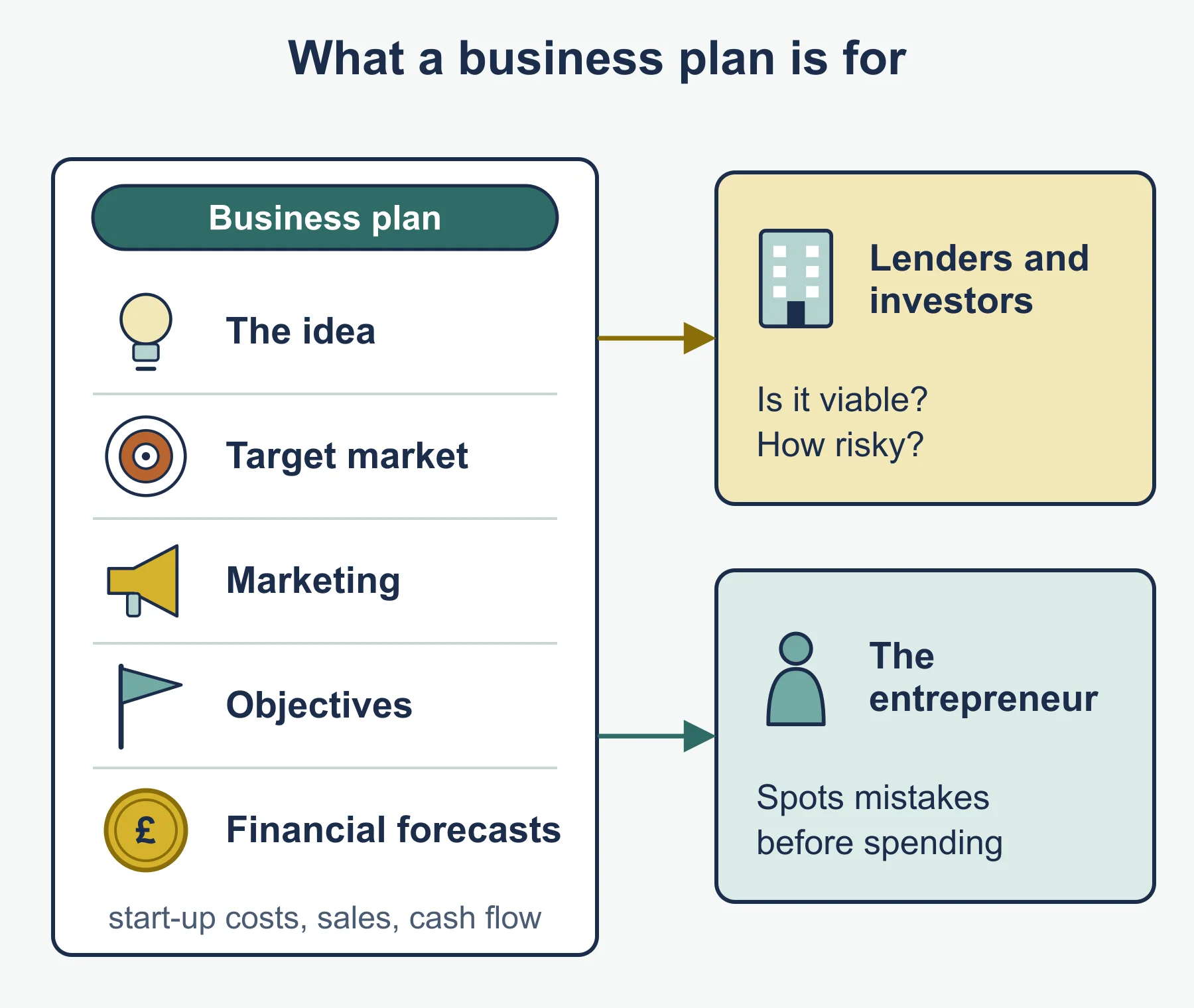
A business plan is a written document setting out what the business intends to do and how. The specification gives four reasons.
- Setting up a new business. The plan makes the owner test the idea on paper before spending money. It shows what must be bought, who the customers are and whether the numbers work.
- Raising finance. Banks and investors want evidence that the owner has thought it through and can repay or give a return. A plan is the main evidence a start-up can offer, because it has no trading history.
- Setting objectives. The plan states where the business wants to be, for example a number of customers or a level of sales in the first year. Objectives give the owner something to measure progress against.
- Detailing how functions will be organised. The plan explains who will do operations, marketing, finance and human resources, and how they will fit together.
Sections of a plan
The specification says you should understand the main sections of a business plan but does not set out a fixed list, so the sections below are the usual ones. Layouts differ between plans.
| Typical section | What it contains |
|---|---|
| Executive summary | A short overview of the whole plan |
| Business idea and objectives | What is sold, why, and what the business aims to achieve |
| Target market and market research | Who the customers are and the evidence they will buy |
| Marketing plan | Product, price, promotion and place |
| Operations | Premises, suppliers, equipment, how the product is made or delivered |
| People | Owners, managers, staffing needs |
| Financial forecasts | Start-up costs, expected revenue, costs, profit and cash flow |
If asked for a section “and why it matters”, link the content to a purpose. Financial forecasts matter to a lender because they show whether the business can repay.
Benefits and drawbacks of planning
When the command word is analyse, break the point into cause and effect and apply it.
Benefits
- Forces the owner to research the market and costs before committing money, so a weak idea may be dropped cheaply.
- Helps secure finance because lenders can judge risk.
- Gives targets, so the owner can compare actual results with the plan and act on gaps.
- Makes sure each function has a role, so tasks are not missed.
Drawbacks
- It takes time, and a new owner may have little to spare.
- The figures are forecasts. If sales or costs turn out different, the plan can mislead.
- A plan can go out of date quickly if the market changes, for instance a rival opens nearby.
- A rigid plan can discourage the owner from adapting to new opportunities.
A balanced judgement usually says planning is worth the effort, especially for a start-up seeking finance, provided the plan is reviewed and updated.
Financial terms and calculations
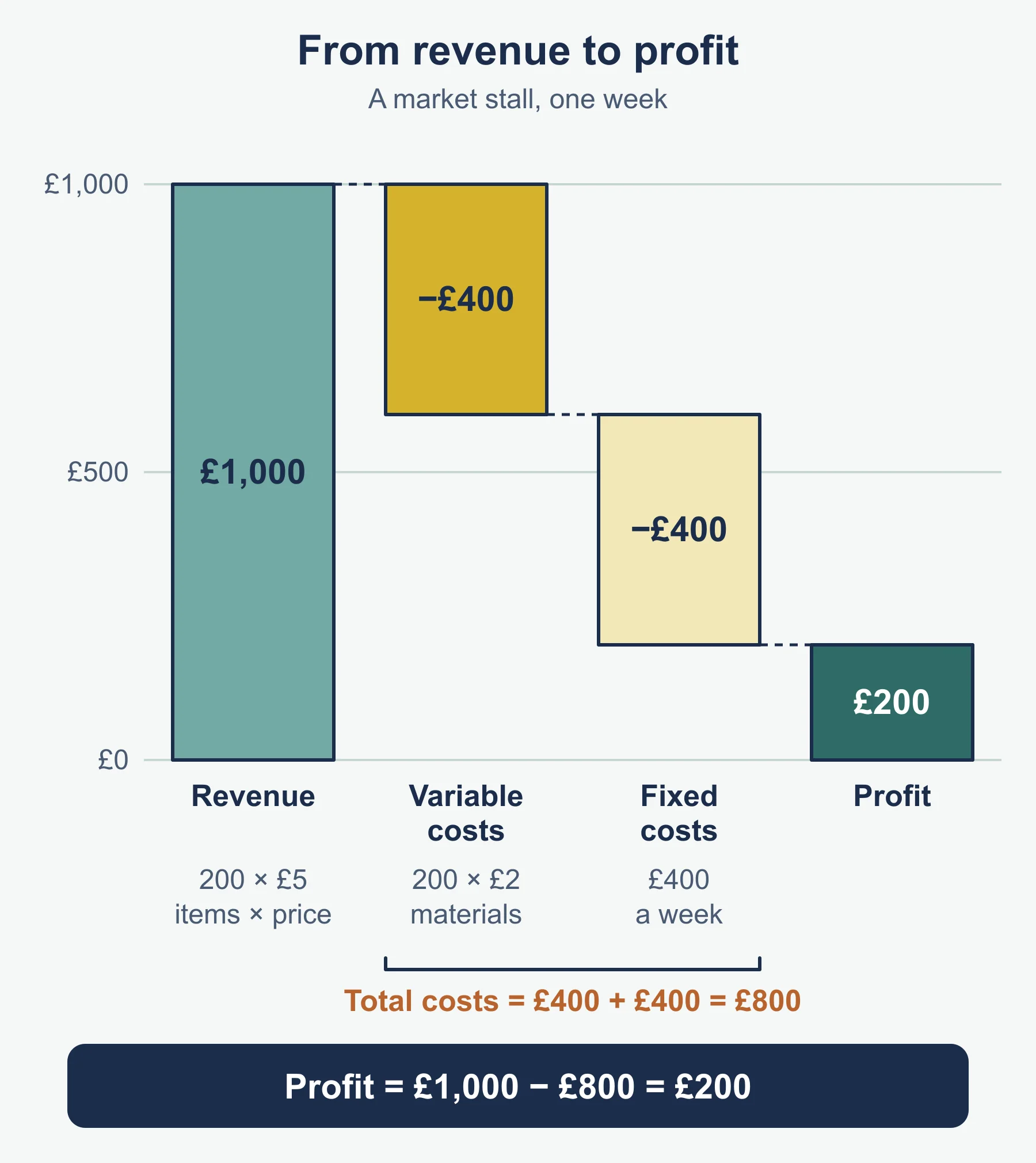
These are the terms the specification names. The formulas below are the standard forms, since the specification names the terms without writing formulas.
| Term | Meaning | Example |
|---|---|---|
| Fixed costs | Costs that do not change with output in the short run | Rent, insurance |
| Variable costs | Costs that change directly with output | Materials, packaging |
| Total costs | Fixed costs + variable costs | |
| Revenue | Income from sales = price × quantity sold | |
| Profit | Revenue − total costs | |
| Loss | Occurs when total costs are greater than revenue |
Total variable cost = variable cost per unit × quantity. Fixed costs stay the same however many units are made, so only variable costs rise with output.
Worked example: profit and loss
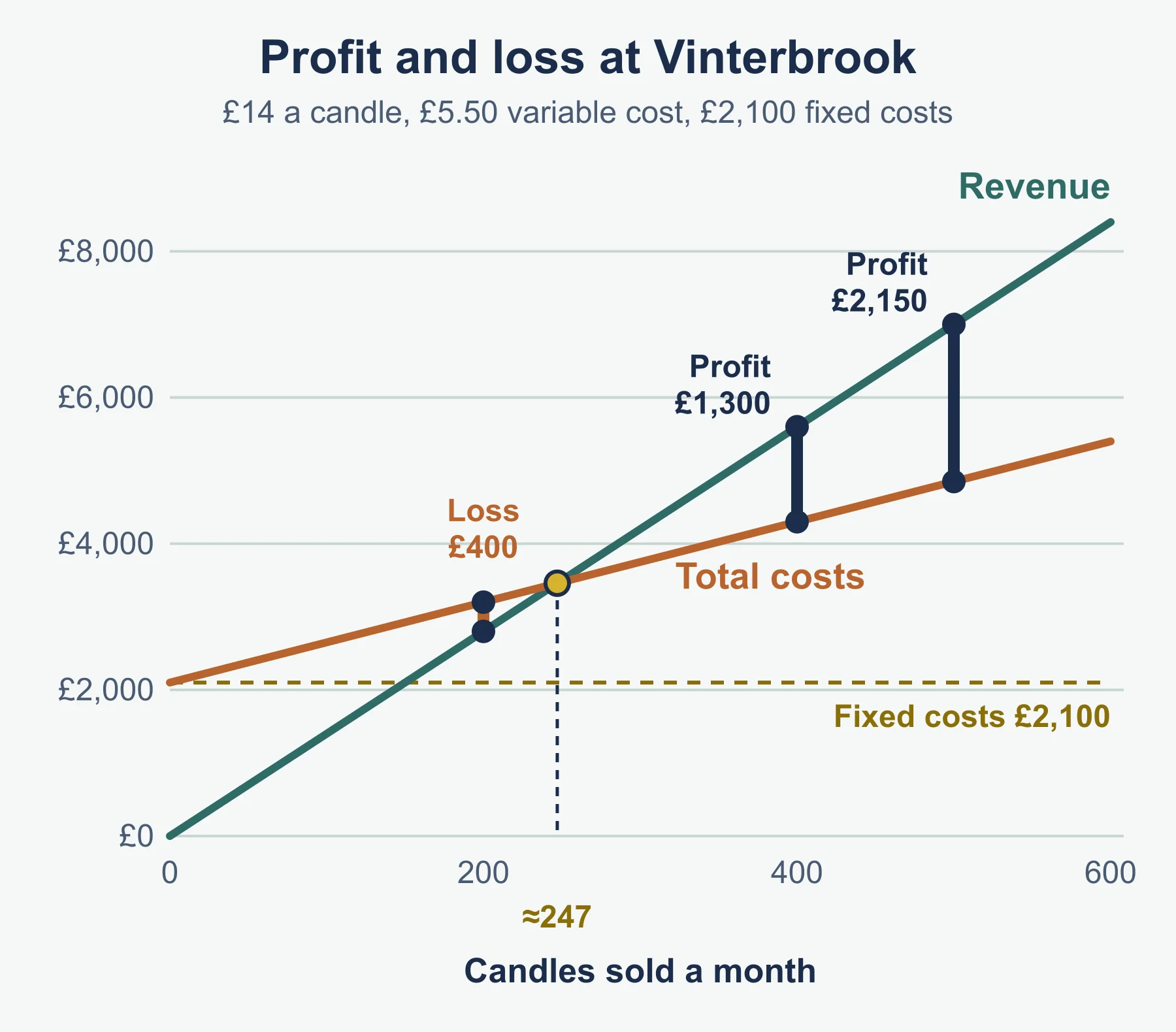
Vinterbrook Candles sells hand-poured candles at £14 each. Variable cost per candle (wax, jar, wick, label) is £5.50. Monthly fixed costs are £2,100, made up of £1,200 workshop rent, £150 insurance, £90 website fees and £660 other overheads.
If it sells 400 candles:
- Revenue = 400 × £14 = £5,600
- Total variable costs = 400 × £5.50 = £2,200
- Total costs = £2,200 + £2,100 = £4,300
- Profit = £5,600 − £4,300 = £1,300
If it sells only 200 candles:
- Revenue = 200 × £14 = £2,800
- Total variable costs = 200 × £5.50 = £1,100
- Total costs = £1,100 + £2,100 = £3,200
- Profit = £2,800 − £3,200 = −£400, a loss of £400
If it sells 500 candles, revenue is £7,000, total costs are £2,750 + £2,100 = £4,850, and profit is £2,150.
Notice that the fixed costs did not change in any of these. Revenue rose by £1,400 for each extra 100 candles and total costs rose by only £550, so profit rose by £850 each time. This is why a forecast of sales is the most important number in a plan.
Common errors
- Writing “near customers” as a location factor with no effect. Say what happens to sales or costs.
- Treating the cheapest site as automatically the best.
- Including fixed costs inside the cost per unit when the question asks for variable cost.
- Forgetting to multiply the variable cost per unit by the quantity sold.
- Calling a negative profit “profit of £400” instead of a loss of £400.
- Describing a business plan’s purpose only as raising finance and leaving out setting objectives and organising functions.
- Listing benefits of planning with no drawbacks when the question says “analyse” or “evaluate”.
- Confusing revenue with profit.
Next steps
Test recall with the revision notes, then try the practice questions.
Frequently asked questions
Why do businesses write a business plan? The AQA GCSE Business (8132) specification gives four reasons: setting up a new business, raising finance, setting objectives and detailing how the functions of the business will be organised.
What are the drawbacks of business planning? A plan takes time to research and write, its figures are only forecasts that may be wrong, it can go out of date if the market changes, and a rigid plan can stop the owner adapting to new opportunities.
What is the difference between revenue and profit? Revenue is income from sales, found by price times quantity sold. Profit is what is left after total costs are taken away from revenue; if total costs are greater, the business makes a loss.
How does competition affect where a business locates? It can pull in two directions. Locating among rivals can bring more customers to the area but means sharing them, while locating away from rivals means fewer competitors but possibly fewer customers passing.
Official syllabus
AQA GCSE Business (8132) specification, for first teaching from September 2017, published by AQA: sections 3.1.5 Business location and 3.1.6 Business planning.
Get free revision emails (optional)
Occasional emails with practice questions, worked explanations and links to free resources for the qualification and subjects you choose. No spam, and you can unsubscribe from any email. The free tools on this site never need an email.
Related resources
-
Practice questions
AQA GCSE Business: Business location and Business planning (8132) – Practice Questions
Original short-answer, calculation and case-study questions with worked answers on business location and business planning for AQA GCSE Business.
Business · AQA · GCSE
Try questions -
Revision notes
AQA GCSE Business: Business location and Business planning (8132) – Revision Notes
Condensed recall notes on location factors, the purpose and sections of a business plan, and fixed, variable and total costs, revenue and profit.
Business · AQA · GCSE
Revise topic -
Study guides
AQA GCSE Business: Expanding a business (8132)
A full study guide to expansion methods, economies and diseconomies of scale and average unit cost for AQA GCSE Business (8132) section 3.1.7.
Business · AQA · GCSE
Read guide
Related articles
-
teaching
A Level tuition in Dubai: Cambridge or Pearson Edexcel International A Level?
Schools in Dubai and Abu Dhabi teach either Cambridge International AS & A Level or Pearson Edexcel International A Level. How the two are structured, why it matters for tuition, and how online classes from Lahore work.
9 October 2026
-
curriculum guides
Choosing subjects at IGCSE and A Level
How subject choices at 14 and 16 affect university options later, and how to keep pathways open without overloading a timetable.
28 July 2026
Studying this with a teacher
Working through Business GCSE?
This page is free and stays free. If you would rather be taught it, Marlbridge runs Business classes one-to-one and in small groups of up to 15, online in your own time zone. The first trial class is free. WhatsApp replies within an hour (8am–11pm Pakistan time, every day); email the same day.
AQA Business teachers at Marlbridge
