
Study Guides
AQA GCSE Business: Expanding a business (8132)
A full study guide to expansion methods, economies and diseconomies of scale and average unit cost for AQA GCSE Business (8132) section 3.1.7.
- Subject
- Business
- Level
- GCSE
- Topic
- Business in the real world
- Author
- Marlbridge Academic Team
- Updated
- Reviewed by
- Salman Ahmad (what this means)
Aligned to AQA GCSE Business (8132), For first teaching from September 2017. Official specification .
Syllabus page (what it covers and how it is assessed): AQA GCSE Business.
Syllabus points this page covers
8132
- 3.1.7 Expanding a business
Found an error? Report a correction.
Need help with this topic? Request a free trial class for GCSE Business (8132).
This guide covers section 3.1.7 Expanding a business in the AQA GCSE Business (8132) specification, for first teaching from September 2017. It sits in the topic Business in the real world. The specification asks you to discuss the advantages and disadvantages of methods of growth, to understand economies and diseconomies of scale, and to calculate and interpret average unit costs.
Use it with the revision notes and the practice questions. For the whole topic, see the Business in the real world study guide, its revision notes and its practice questions. Course links: AQA GCSE Business hub, printable checklist and the free diagnostics.
What 3.1.7 covers
| Content point | What you must be able to do |
|---|---|
| Methods of expansion | Understand franchising, new stores, online selling, outsourcing, and external growth by merger or takeover |
| Benefits and drawbacks of expansion | Discuss the advantages and disadvantages of each method of growth |
| Economies of scale | Explain the unit cost advantages of growth, including purchasing and technical economies of scale |
| Diseconomies of scale | Explain why growth raises the risk of higher unit costs: poor communication, coordination issues and reduced staff motivation |
| Average unit cost | Calculate and interpret average unit costs |
Why a business expands
Expansion means the business gets bigger: more outlets, more customers, more output or more sales. A bigger business can spread its costs over more units, and it may earn more sales revenue. It can also be harder to run, more expensive to finance and more exposed to mistakes. The specification asks you to discuss both sides, so every method below has a benefit and a cost.
Methods of expansion
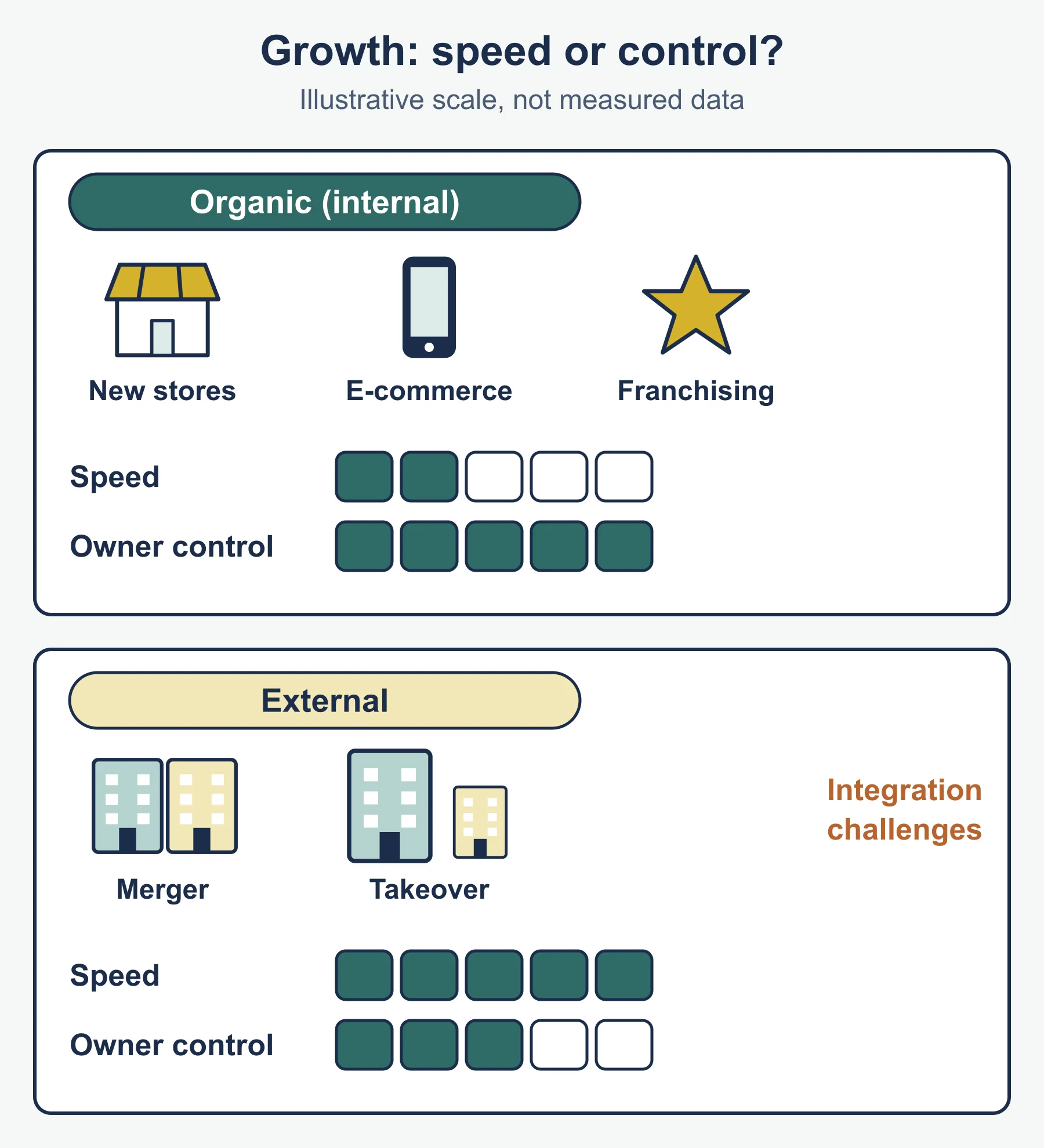
The specification lists the methods used by businesses when expanding. It names organic growth (franchising, opening new stores and e-commerce), outsourcing, and external growth (mergers and takeovers). Organic growth means growing from the business’s own activities. External growth means joining with or buying another business.
Opening new stores
The business copies its successful outlet in a new location.
- Advantage: the owners keep control, the brand stays consistent and the business reaches new customers.
- Disadvantage: each new store needs money for premises, fittings and staff, and a poor location can lose money.
Franchising
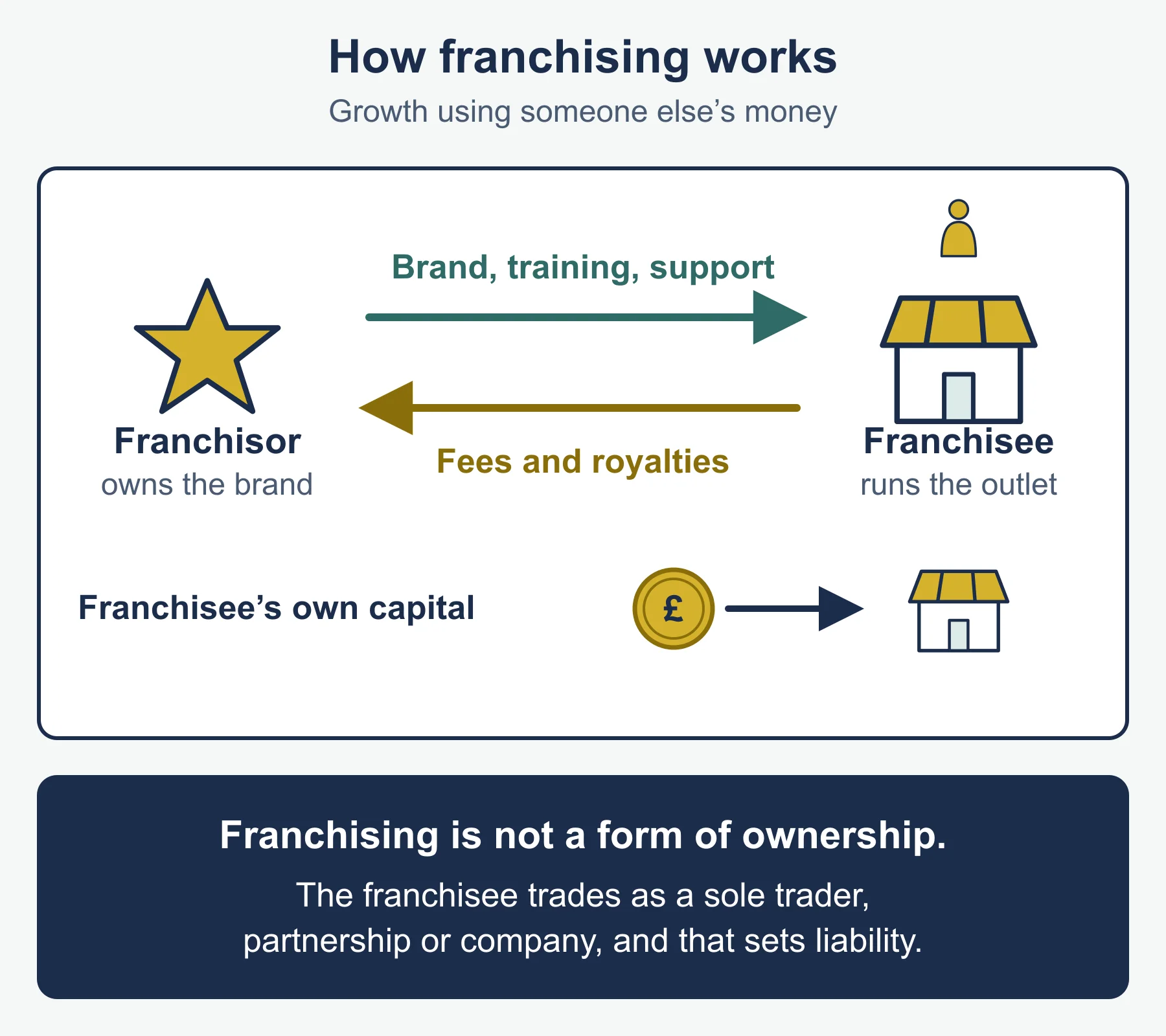
A franchisor lets a franchisee run an outlet using its name, products and methods. The franchisee usually pays an initial fee and a share of revenue.
- Advantage for the franchisor: fast growth with less of its own money, because the franchisee puts in capital and runs the outlet.
- Disadvantage for the franchisor: it gives up some of the profit and some control, and one badly run outlet can harm the brand everywhere.
- Franchisee: gets a known brand and support, but pays fees and has limited freedom.
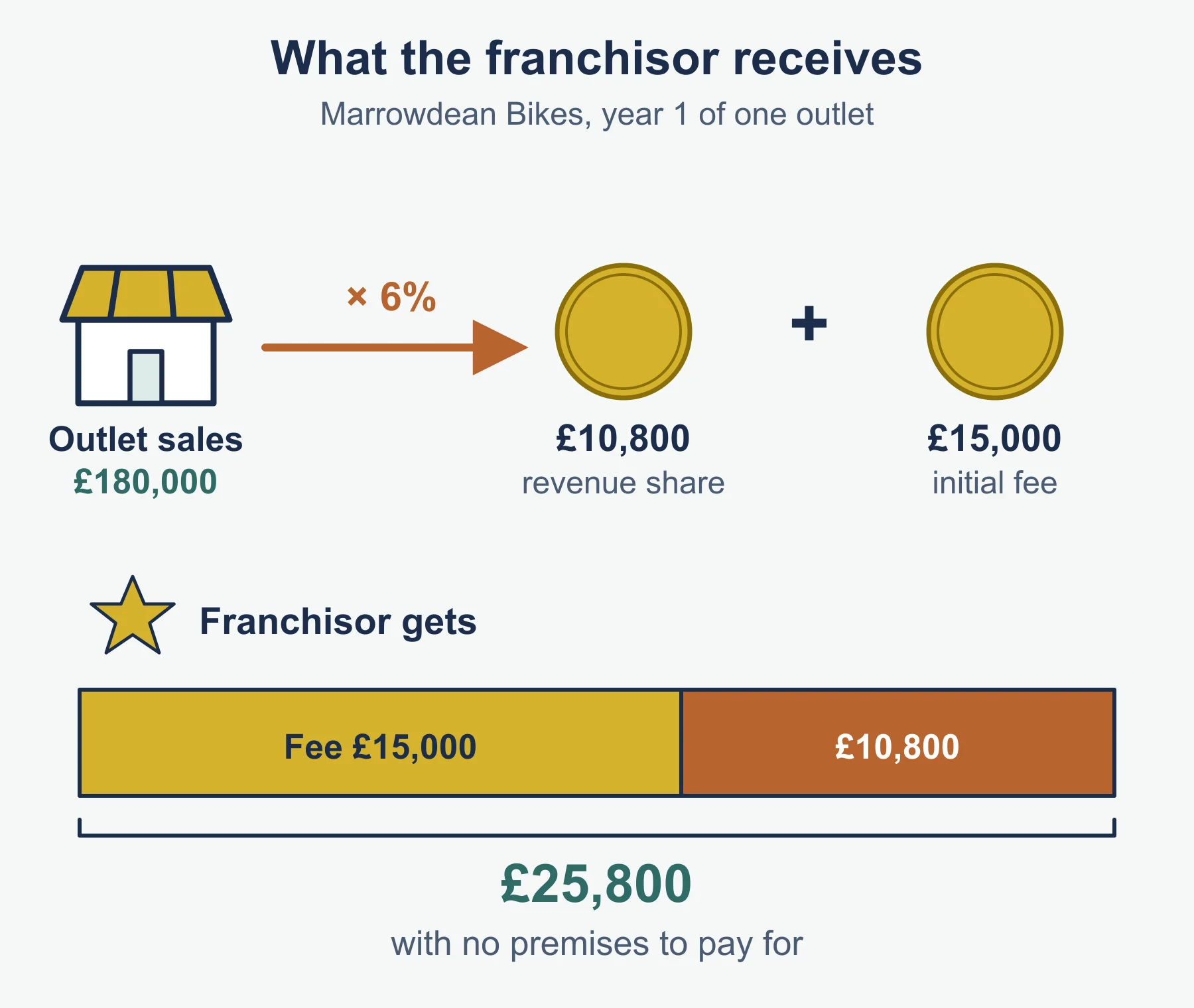
Worked example. Marrowdean Bikes sells a franchise for an initial fee of £15,000 plus 6% of the outlet’s annual sales revenue. One outlet has sales revenue of £180,000.
Revenue share = 6% x £180,000 = £10,800
Franchisor receives in year 1 = £15,000 + £10,800 = £25,800
The franchisor gains £25,800 without paying for the premises, but it must still check that the outlet meets its standards.
Expanding through e-commerce
The business sells online, usually as well as through its shops.
- Advantage: it reaches customers far beyond its location, and the shop is open at all hours.
- Disadvantage: it needs a good website, secure payments, delivery and returns systems, and it faces competition from many other websites. Customers cannot see or try the product first.
Outsourcing
Outsourcing means paying another business to carry out a task, such as packaging, delivery or payroll. The specification lists it among the methods used when expanding: it can let a business handle more work without building its own capacity.
- Advantage: the specialist may do the job more cheaply or better, and the business can focus on what it does best.
- Disadvantage: less control over quality and deadlines, and the supplier’s price may rise.
Mergers and takeovers
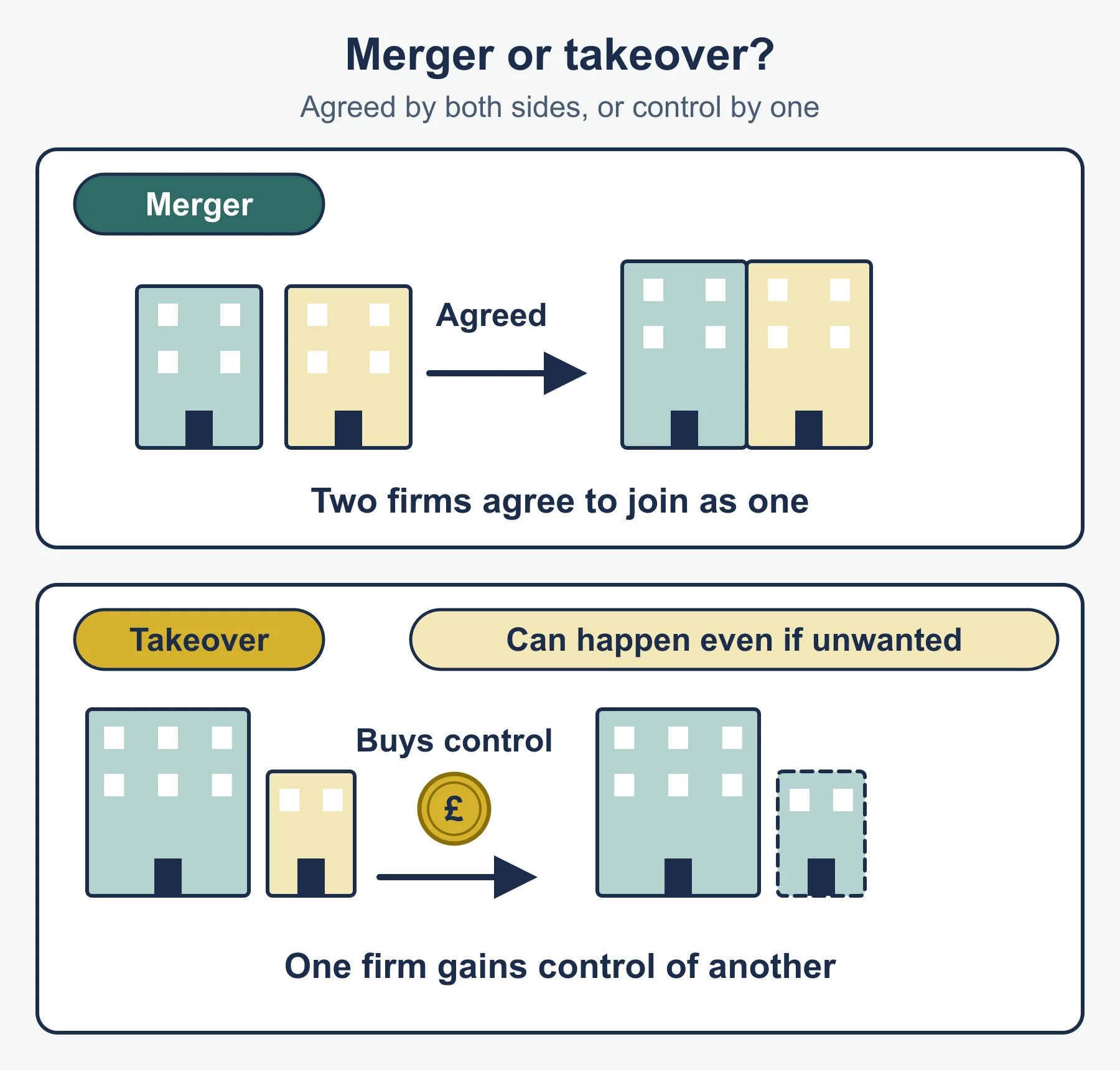
These are external growth. In a merger, two businesses agree to join and become one. In a takeover, one business buys enough of another to control it, which may happen even if the target does not want it.
- Advantage: growth is fast, and the business gains the other firm’s customers, brands, staff and premises at once.
- Disadvantage: it can be expensive, the two cultures may clash, some jobs may be lost, and the expected benefits may not appear.
Choosing a method
Compare the methods against the business in the question: how much money it has, how quickly it wants to grow and how much control the owners want. A small business with little capital may prefer franchising. A business with strong cash reserves may open new stores. A business that wants a rival’s customers quickly may consider a takeover.
Economies of scale
An economy of scale is a unit cost advantage from growth: as output rises, the average cost of each unit falls.
Two types are named in the specification.
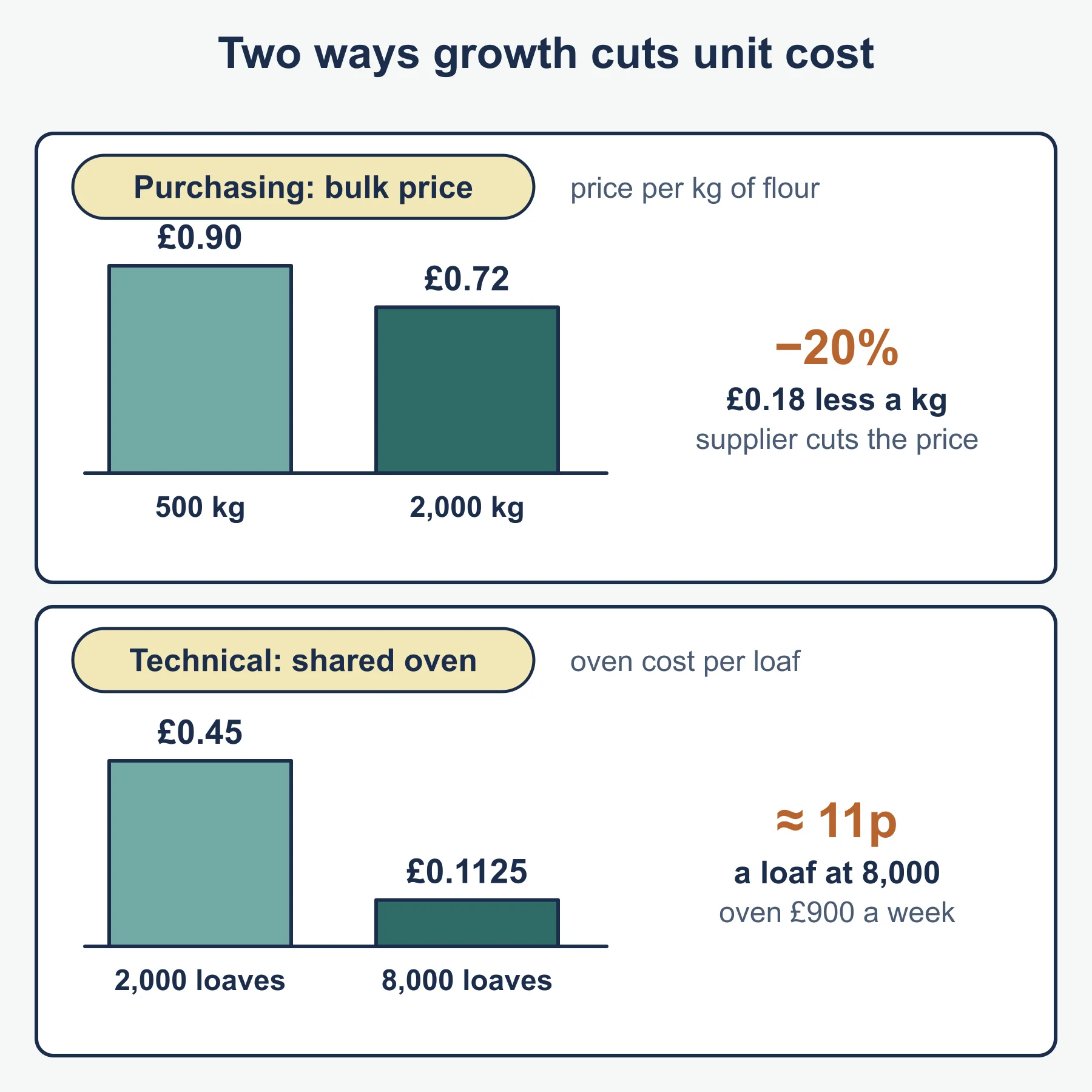
Purchasing economies of scale. A large business buys materials in bulk, so the supplier gives a lower price per unit. Gorselands Bakery pays £0.90 per kilogram of flour when it buys 500 kg, and £0.72 per kilogram when it buys 2,000 kg.
500 kg x £0.90 = £450
2,000 kg x £0.72 = £1,440
Saving per kg = £0.90 - £0.72 = £0.18  (a 20% lower price)
Technical economies of scale. A large business can use bigger or more specialised machinery and production methods, and the cost of that equipment is spread across more units. Suppose Gorselands leases an industrial oven for £900 a week.
Oven cost per loaf at 2,000 loaves = £900 / 2,000 = £0.45
Oven cost per loaf at 8,000 loaves = £900 / 8,000 = £0.1125
The same oven adds only about 11p to each loaf at the higher output.
Diseconomies of scale
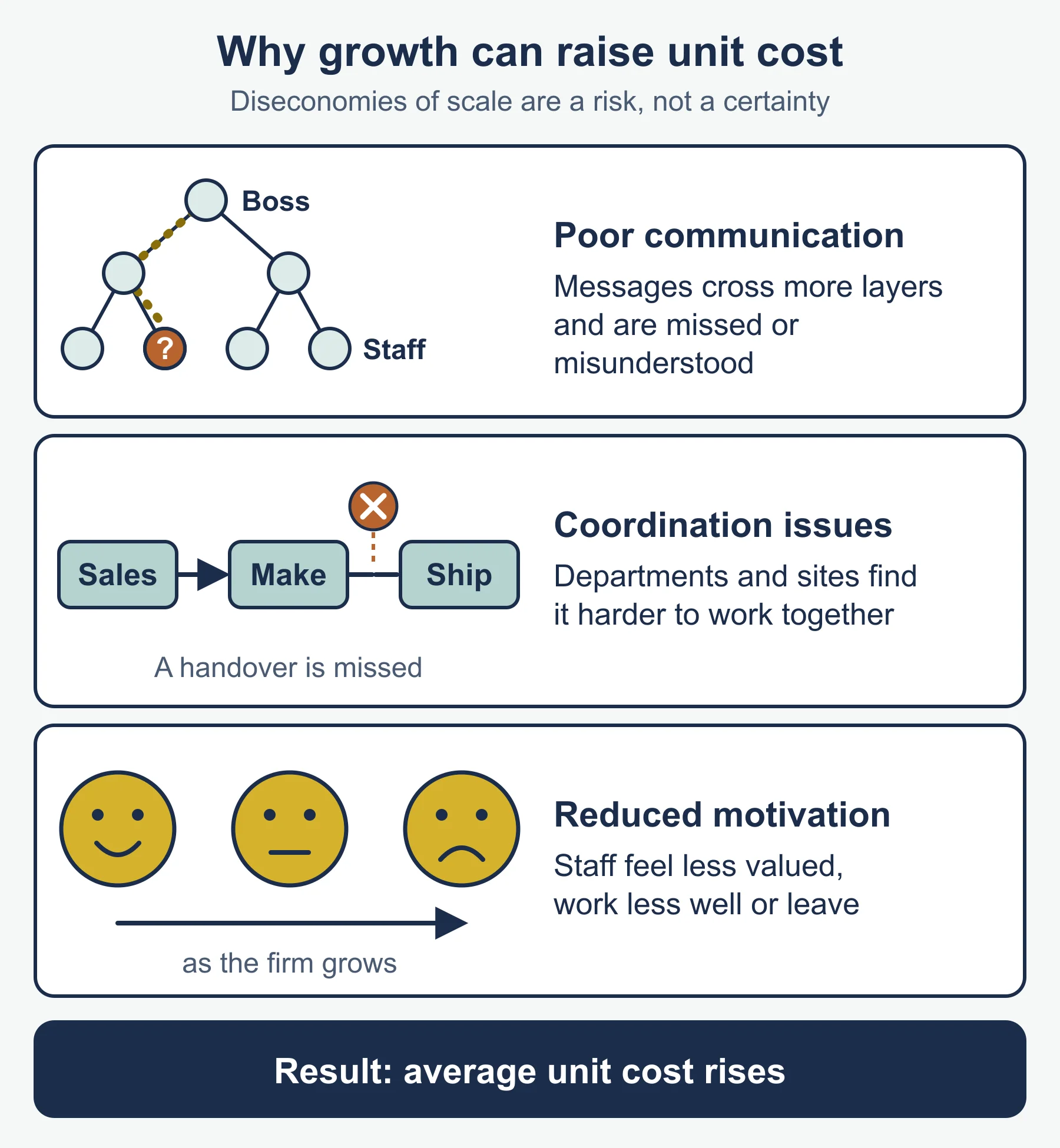
A diseconomy of scale is a rise in average unit cost caused by being too big. The specification says that with growth businesses increase the risk of diseconomies of scale occurring because of:
- poor communication: messages pass through more layers and take longer, so instructions are missed or misunderstood;
- coordination issues: it is harder to make departments, sites or teams work together, so work is repeated or delayed;
- reduced staff motivation: workers in a large organisation may feel less valued or less connected to its aims, so they work less well or leave.
These are risks, not certainties. A well-managed large business can avoid them.
Average unit cost
The standard form of the formula is:
Average unit cost = total cost / outputThe specification asks you to calculate and interpret it. The interpretation matters as much as the number.
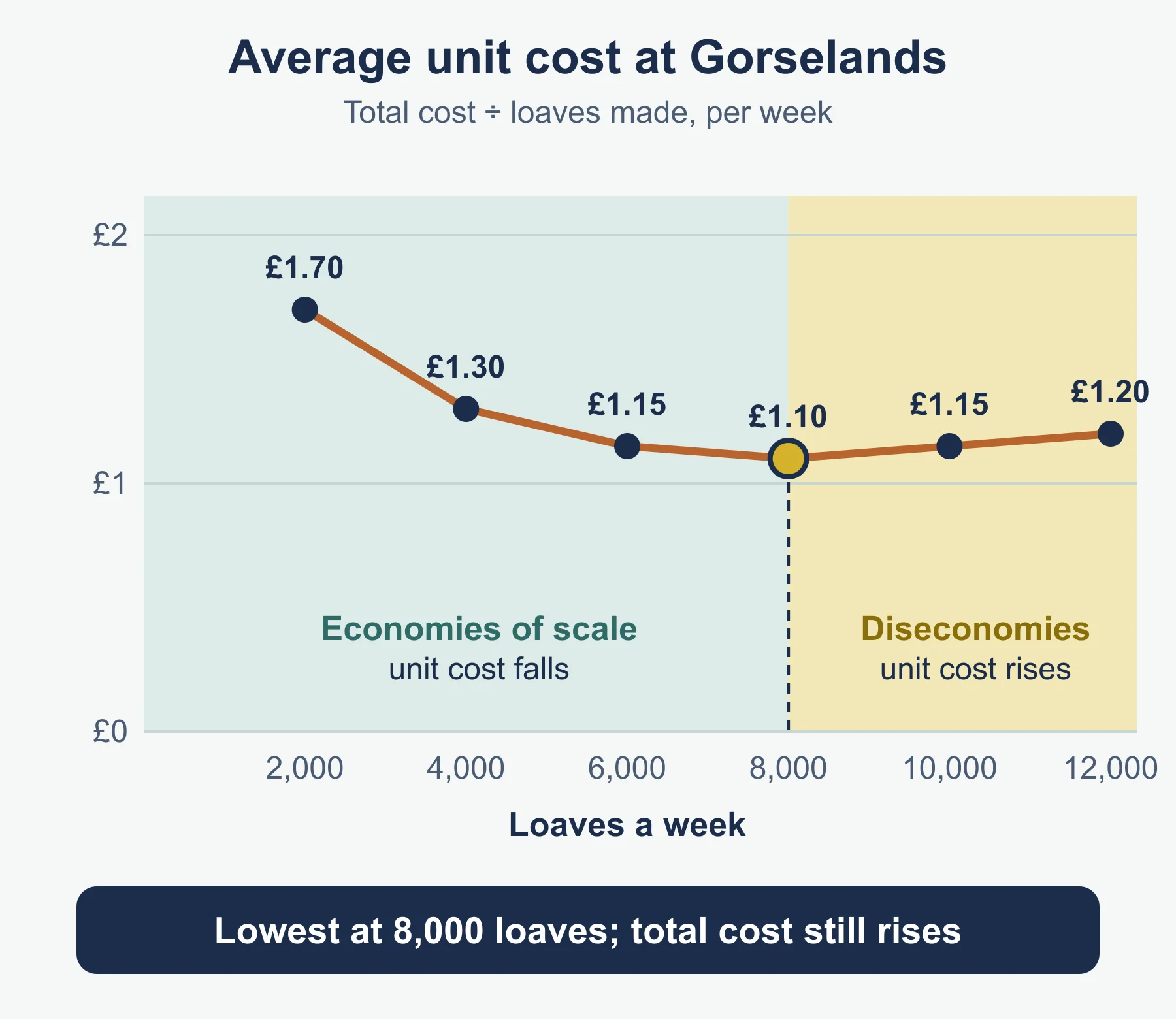
Worked example. Gorselands Bakery records its weekly total cost at different outputs of loaves.
| Output (loaves) | Total cost | Average unit cost |
|---|---|---|
| 2,000 | £3,400 | £1.70 |
| 4,000 | £5,200 | £1.30 |
| 6,000 | £6,900 | £1.15 |
| 8,000 | £8,800 | £1.10 |
| 10,000 | £11,500 | £1.15 |
| 12,000 | £14,400 | £1.20 |
Step 1: divide each total cost by its output, for example £8,800 / 8,000 = £1.10.
Step 2: describe the pattern. Average unit cost falls from £1.70 to £1.10 as output rises to 8,000 loaves. That is evidence of economies of scale.
Step 3: look for the turning point. Above 8,000 loaves the average unit cost rises to £1.15 and then £1.20. That suggests diseconomies of scale.
Step 4: conclude. The lowest average unit cost is at 8,000 loaves. Notice that total cost rises at every step. Economies of scale mean a lower cost per unit, not a lower total cost.
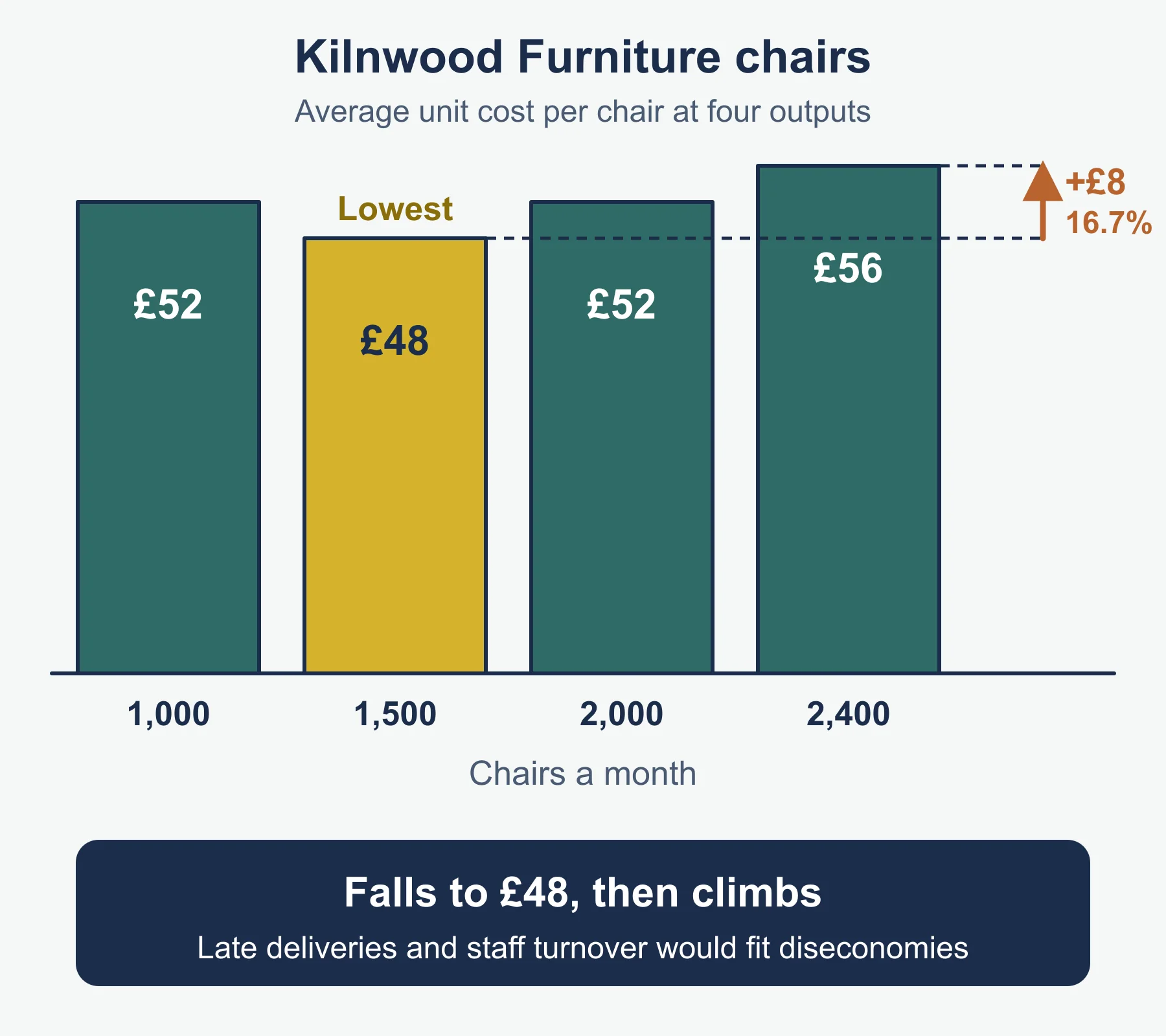
Second worked example, with a larger scale effect. Kilnwood Furniture makes chairs.
| Output (chairs a month) | Total cost | Average unit cost |
|---|---|---|
| 1,000 | £52,000 | £52 |
| 1,500 | £72,000 | £48 |
| 2,000 | £104,000 | £52 |
| 2,400 | £134,400 | £56 |
The average unit cost falls to £48 at 1,500 chairs, then climbs. Between 1,500 and 2,400 chairs it rises by £8, which is 16.7% (8 / 48 x 100). If the manager also reports late deliveries and staff turnover at the larger output, those would support communication, coordination and motivation as explanations.
When you interpret, say what happened, give figures, and link it to a cause that fits the business.
Putting it together in an answer
A strong “discuss” answer on growth:
- Names the method and says what it involves.
- Gives an advantage and a disadvantage, each explained in the business’s context.
- Uses average unit cost data if it is given.
- Weighs the points and reaches a judgement, for example that organic growth suits a cash-rich business that wants control, while a takeover suits one that needs speed.
Common errors
- Claiming that economies of scale cut the total bill. What falls is the average unit cost.
- Dividing output by total cost instead of total cost by output.
- Writing “buys in bulk” as the whole answer on purchasing economies. Say that the supplier’s price per unit falls, so the average unit cost falls.
- Mixing up technical and purchasing economies.
- Treating diseconomies as certain. The specification calls them a risk.
- Describing a merger and a takeover as the same thing. A merger is agreed by both sides; a takeover means one side gains control.
- Naming methods but never tying them to the business described in the stem.
Frequently asked questions
What is the difference between organic and external growth? Organic growth comes from the business’s own activity, such as opening new stores, and is usually slower but keeps more control. External growth means joining with or buying another business through a merger or takeover, which is faster but costly and can cause culture clashes.
How does franchising help a business expand? The franchisee pays fees and a share of revenue and provides the money to run the outlet, so the franchisor can grow quickly with less of its own capital. The drawback is less control over quality, so one poor outlet can damage the brand.
How do you interpret average unit cost figures? Describe the pattern with figures, find the output where average unit cost is lowest, and link the change to a cause. A fall suggests economies of scale; a later rise suggests diseconomies of scale.
Are diseconomies of scale certain when a business grows? No. AQA GCSE Business (8132) treats them as a risk that rises with growth, caused by poor communication, coordination issues and reduced staff motivation; a well-managed large business can avoid them.
Official syllabus
AQA GCSE Business (8132) specification, for first teaching from September 2017, published by AQA. This guide covers section 3.1.7 Expanding a business.
Get free revision emails (optional)
Occasional emails with practice questions, worked explanations and links to free resources for the qualification and subjects you choose. No spam, and you can unsubscribe from any email. The free tools on this site never need an email.
Related resources
-
Practice questions
AQA GCSE Business: Expanding a business (8132) – Practice Questions
Original questions with worked answers on growth methods, economies of scale and average unit cost for AQA GCSE Business section 3.1.7.
Business · AQA · GCSE
Try questions -
Revision notes
AQA GCSE Business: Expanding a business (8132) – Revision Notes
Condensed recall notes on growth methods, economies and diseconomies of scale and average unit cost for AQA GCSE Business section 3.1.7.
Business · AQA · GCSE
Revise topic -
Study guides
AQA GCSE Business: Setting business aims and objectives and Stakeholders (8132)
Study guide to AQA GCSE Business (8132) sections 3.1.3 and 3.1.4: business aims and objectives, why they change, and stakeholders with worked examples.
Business · AQA · GCSE
Read guide
Related articles
-
teaching
A Level tuition in Dubai: Cambridge or Pearson Edexcel International A Level?
Schools in Dubai and Abu Dhabi teach either Cambridge International AS & A Level or Pearson Edexcel International A Level. How the two are structured, why it matters for tuition, and how online classes from Lahore work.
9 October 2026
-
curriculum guides
Choosing subjects at IGCSE and A Level
How subject choices at 14 and 16 affect university options later, and how to keep pathways open without overloading a timetable.
28 July 2026
Studying this with a teacher
Working through Business GCSE?
This page is free and stays free. If you would rather be taught it, Marlbridge runs Business classes one-to-one and in small groups of up to 15, online in your own time zone. The first trial class is free. WhatsApp replies within an hour (8am–11pm Pakistan time, every day); email the same day.
AQA Business teachers at Marlbridge
