
Revision Notes
AQA GCSE Business: Expanding a business (8132) – Revision Notes
Condensed recall notes on growth methods, economies and diseconomies of scale and average unit cost for AQA GCSE Business section 3.1.7.
- Subject
- Business
- Level
- GCSE
- Topic
- Business in the real world
- Author
- Marlbridge Academic Team
- Updated
- Reviewed by
- Salman Ahmad (what this means)
Aligned to AQA GCSE Business (8132), For first teaching from September 2017. Official specification .
Syllabus page (what it covers and how it is assessed): AQA GCSE Business.
Syllabus points this page covers
8132
- 3.1.7 Expanding a business
Found an error? Report a correction.
Need help with this topic? Request a free trial class for GCSE Business (8132).
These notes condense section 3.1.7 Expanding a business from the AQA GCSE Business (8132) specification, for first teaching from September 2017. For full explanations and worked examples, read the study guide. Then test yourself with the practice questions.
Related pages: the topic-level Business in the real world revision notes, the AQA GCSE Business hub, the printable checklist and the free diagnostics.
The five content points
| Point | One-line recall |
|---|---|
| Methods of expansion | Franchising, new stores, e-commerce, outsourcing, mergers and takeovers |
| Benefits and drawbacks | Discuss both sides of each method, applied to the business |
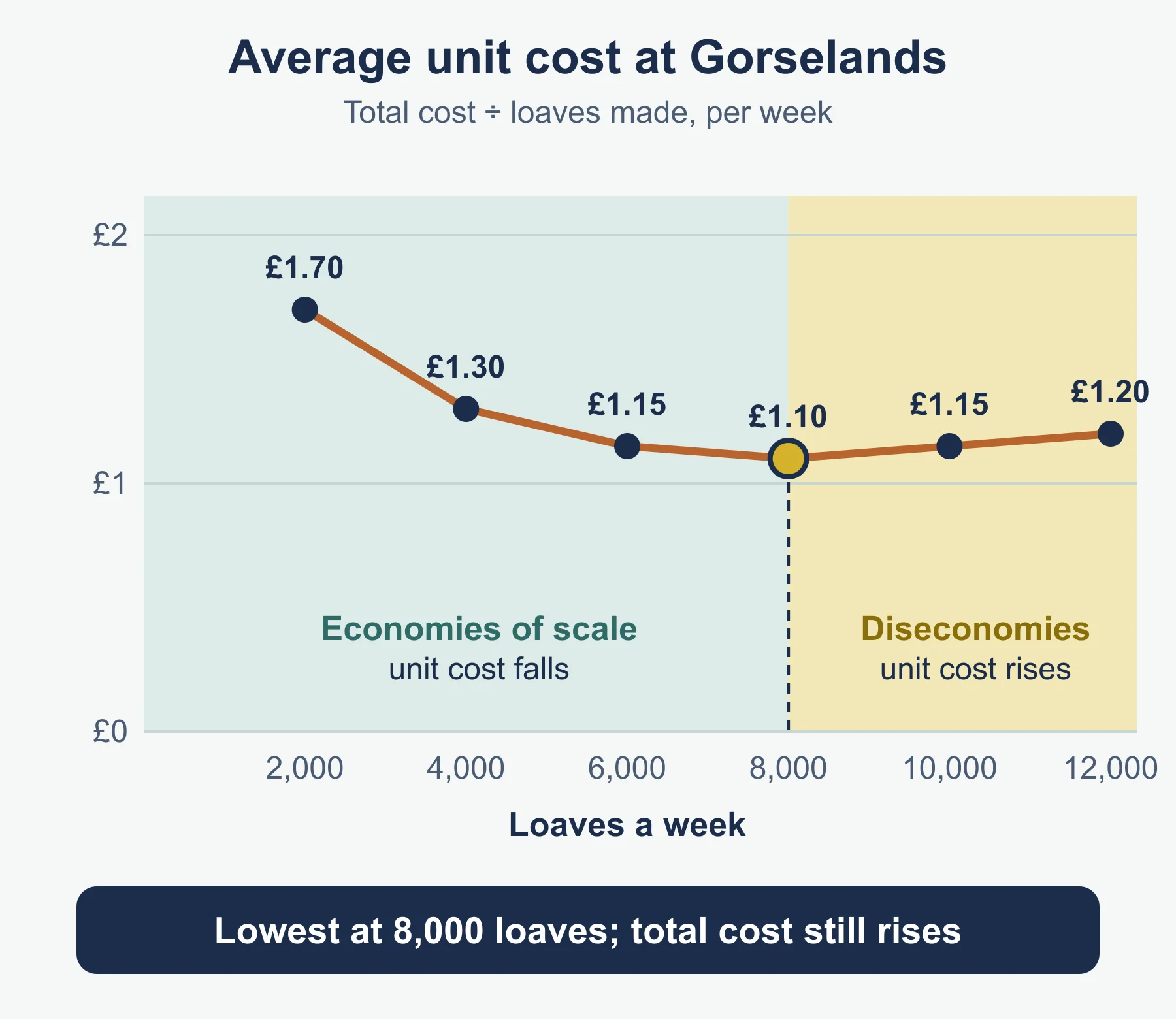
| Economies of scale | Average unit cost falls as output rises |
| Diseconomies of scale | Average unit cost rises when the business is too big |
| Average unit cost | Total cost divided by output; calculate and interpret |
Methods of expansion: benefits and drawbacks
| Method | Benefit | Drawback |
|---|---|---|
| Opening new stores | Owners keep control; same brand and methods; new customers | Costly premises and staff; a bad location may lose money |
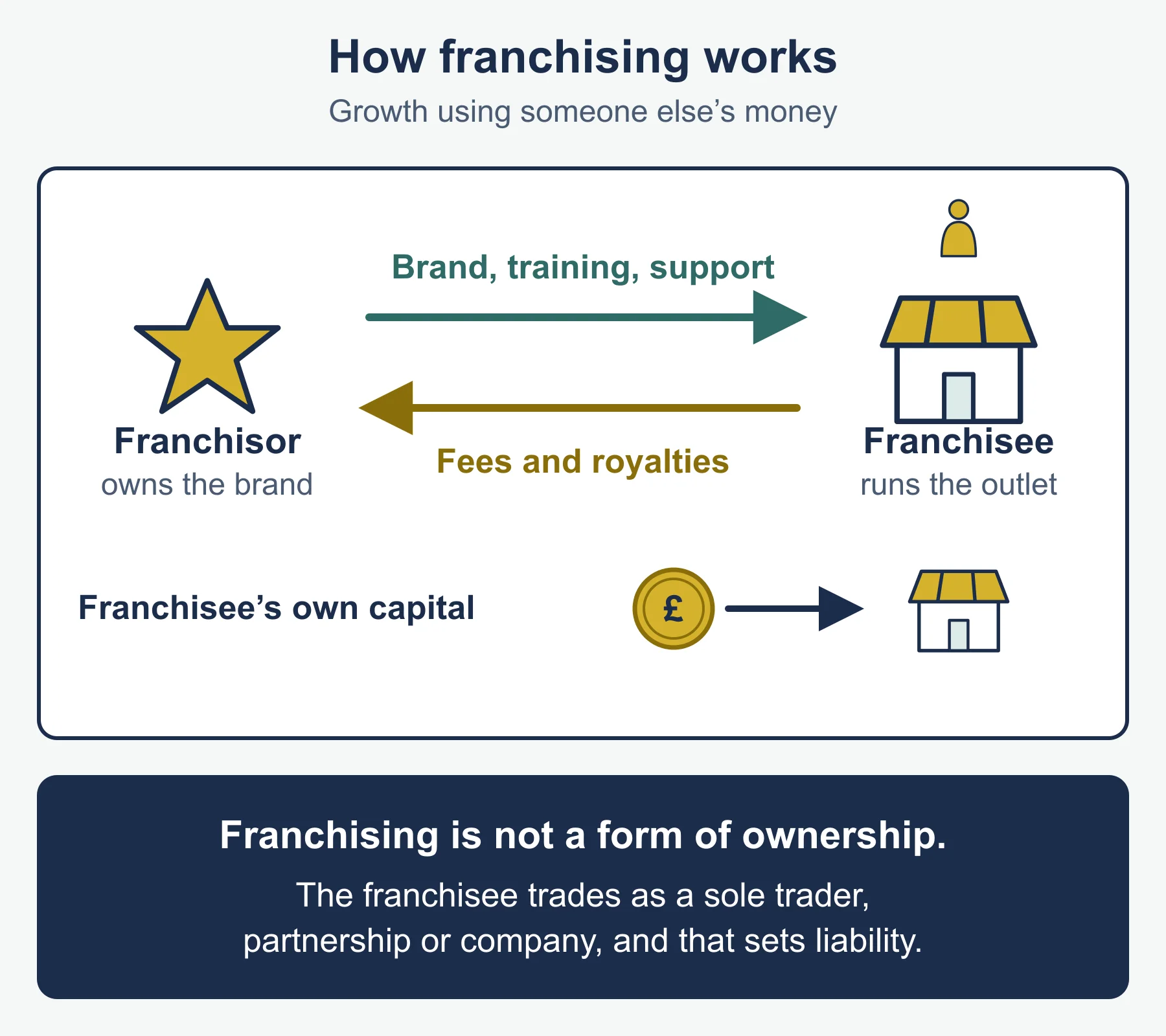
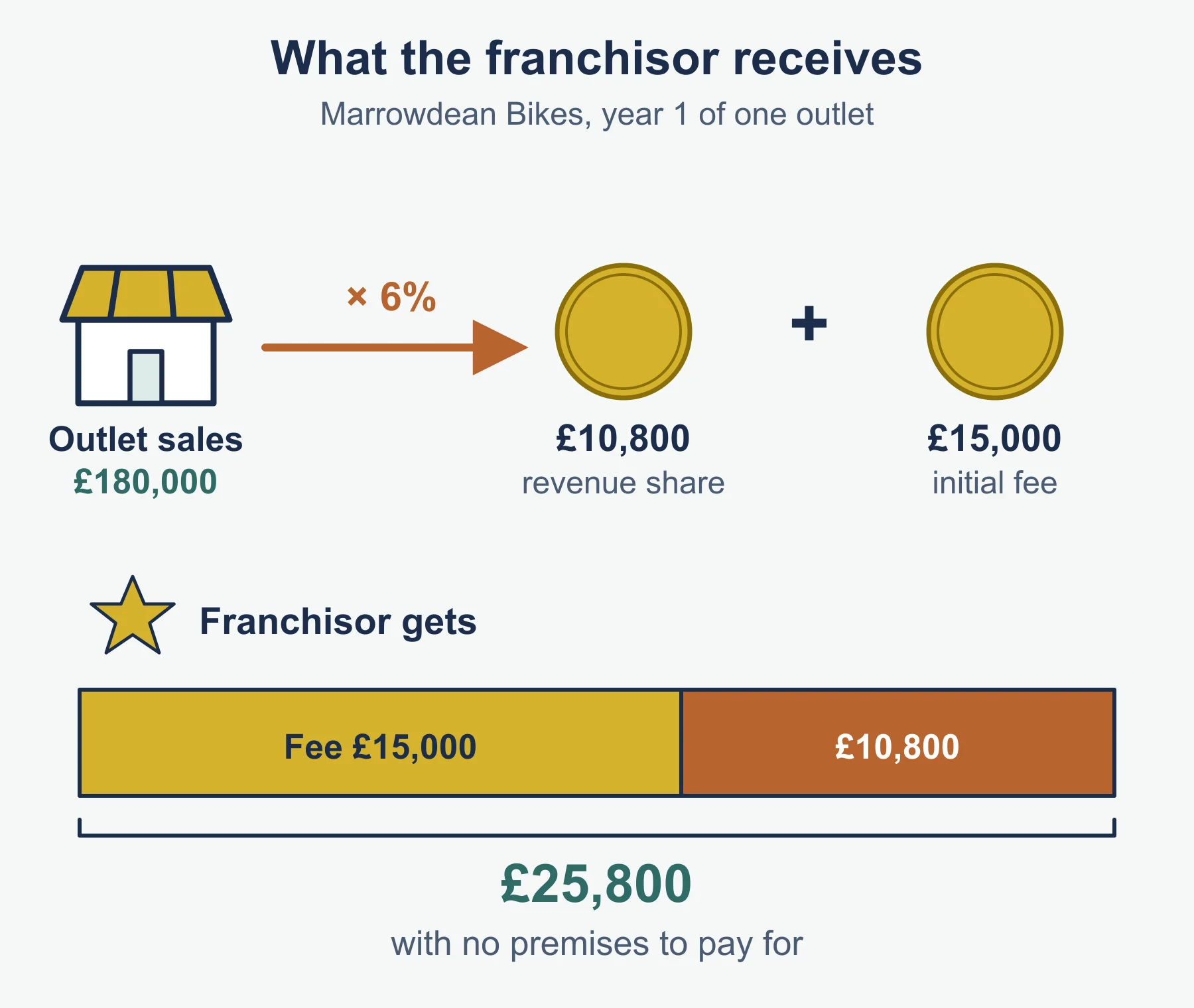
| Franchising | Fast growth using the franchisee’s capital; fees and a share of revenue come in | Less control; shares profit; one weak outlet harms the brand |
| E-commerce | Wider market; open at all times; no extra shop needed | Website, delivery and returns costs; many online rivals |
| Outsourcing | Specialist may be cheaper or better; business focuses on its core | Less control of quality and timing; reliance on the supplier |
| Merger | Joint resources, customers and skills; agreed by both sides | Cultures may clash; jobs may go; benefits may not appear |
| Takeover | Quick growth and immediate control of the target’s assets | Often expensive; staff and managers of the target may resist |
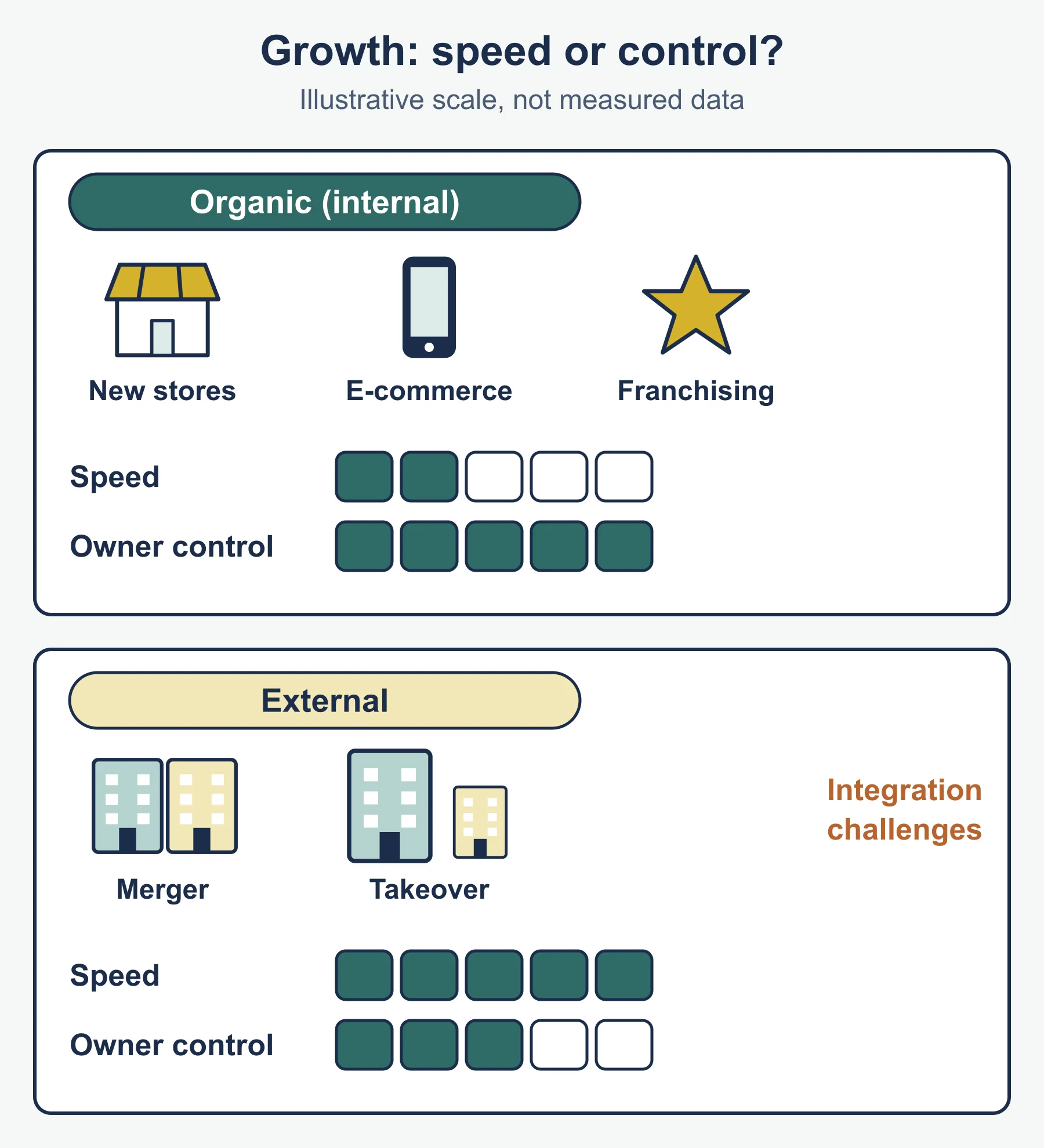
Organic growth (from the business’s own activity) is usually slower but gives more control. External growth (merger or takeover) is faster but costs more and carries integration risk.
Economies of scale
Definition: a unit cost advantage from growth, so average unit cost falls as output rises.
| Type | What happens | Example |
|---|---|---|
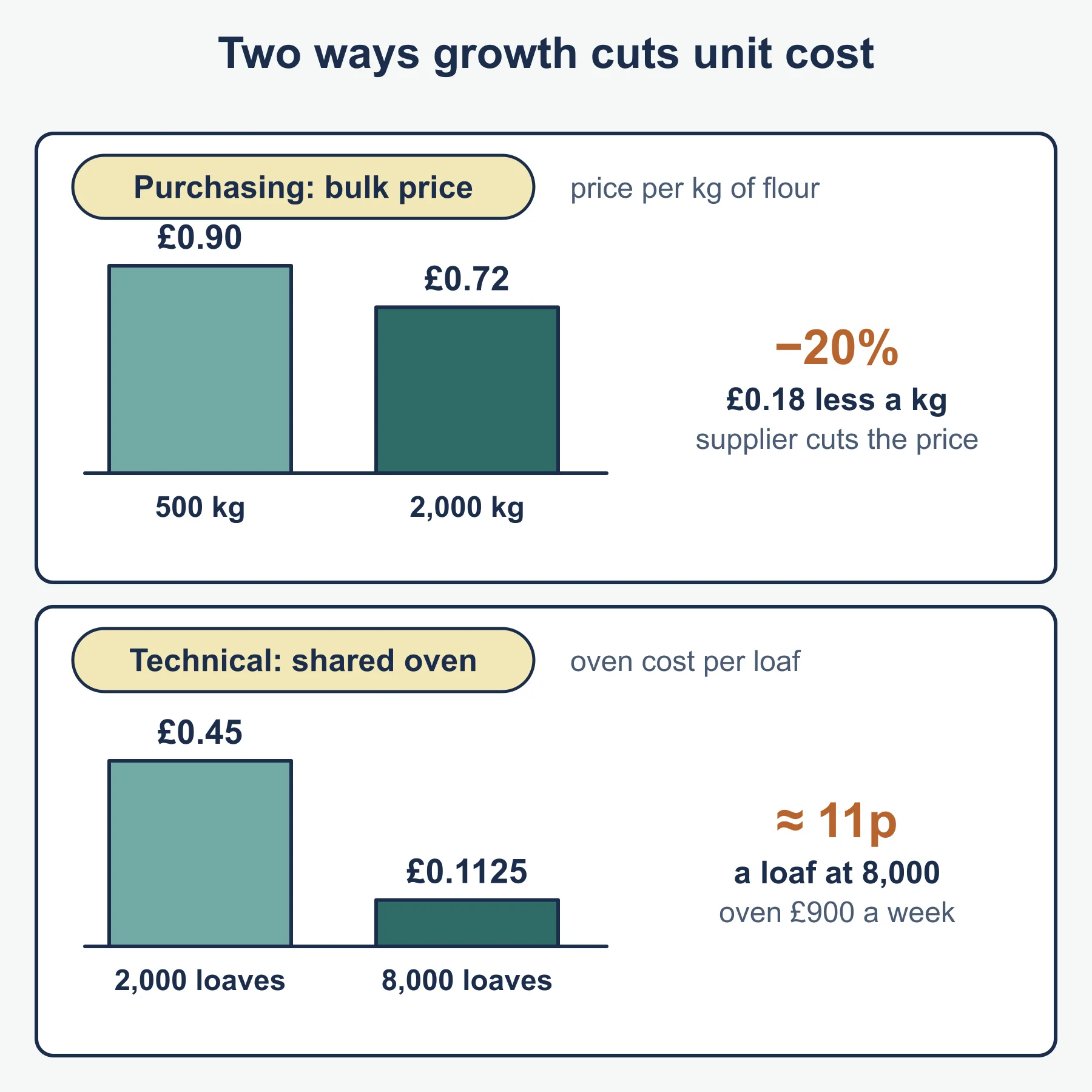
| Purchasing | Bulk orders earn a lower price per unit from suppliers | A pet-food maker pays 15% less per tonne when it orders larger loads |
| Technical | Larger or specialised machinery; its cost is spread over more units | A big printing press cuts the cost per leaflet |
Remember: total cost still rises. Only the cost per unit falls.
Diseconomies of scale
Definition: average unit cost rises because the business has grown too large.
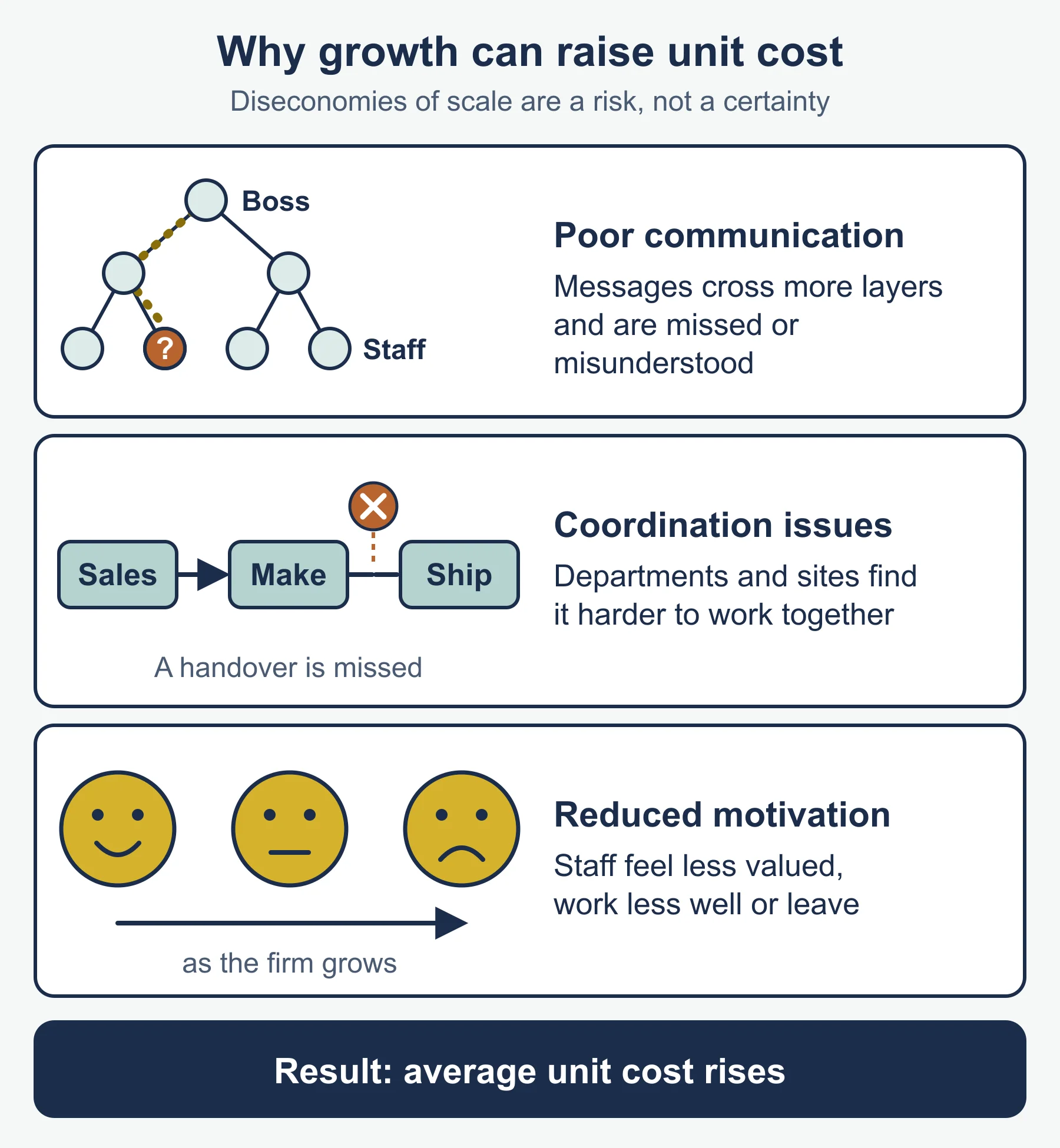
The three causes named in the specification:
- Poor communication.
- Coordination issues.
- Reduced staff motivation.
With growth, the risk of these increases. They are not guaranteed.
Cause and effect chain: more layers and sites, then slower messages and mistakes, then rework, delays and staff leaving, then higher cost per unit.
Average unit cost
Average unit cost = total cost / outputThis is the standard form of the formula.
Method in steps:
- Write the formula.
- Substitute total cost and output (check the units: pounds and items).
- Calculate and give the unit, for example £2.40 per unit.
- Compare with another output level.
- Interpret: fall means economies of scale; rise means diseconomies.
Worked reminder. A tile maker’s total cost is £90,000 for 12,000 tiles.
Average unit cost = 90,000 / 12,000 = £7.50 per tileRearranged: total cost = average unit cost x output. If the average unit cost is £3.40 and output is 15,000, total cost is £51,000.
Percentage change in average unit cost: (new - old) / old x 100. A fall from £5.00 to £4.20 is a fall of 16%.
Small worked reminders
Purchasing economy. A shop pays £8.00 per unit for an order of 200 units and £6.80 per unit for an order of 1,000 units. The price per unit is 15% lower on the larger order: (8.00 - 6.80) / 8.00 x 100.
Technical economy. A machine costs £1,200 a week to run. Spread over 400 units it adds £3.00 a unit (1,200 / 400). Spread over 3,000 units it adds £0.40 a unit (1,200 / 3,000).
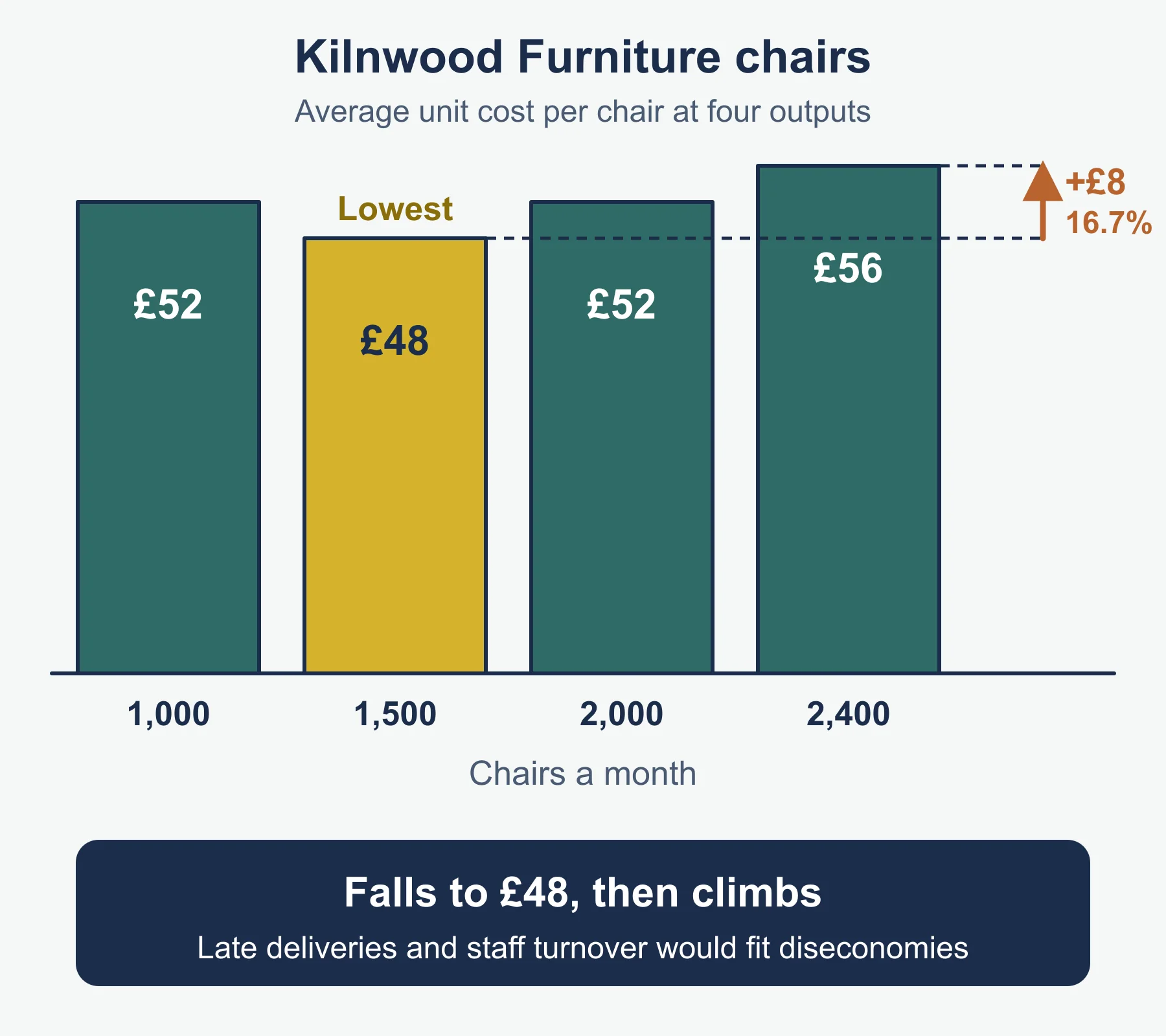
Diseconomy. Total cost is £4,200 at 1,400 units, so average unit cost is £3.00. At 1,600 units total cost is £5,600, so average unit cost is £3.50. The £0.50 rise is a 16.7% increase (0.50 / 3.00 x 100). Output grew, but each unit now costs more, which points to diseconomies of scale.
Command words in this topic
| Command word | Meaning |
|---|---|
| State, identify | A short answer with no reasoning needed |
| Define | Say what a term means, for example economies of scale |
| Calculate | Show the formula, substitution and answer with units |
| Explain | Give a point and a reason, linked to the business |
| Analyse | Develop a chain of reasoning: point, cause, effect on the business |
| Discuss | Give advantages and disadvantages, applied to the case |
| Evaluate, justify, recommend | Weigh both sides and reach a reasoned judgement |
Must-know distinctions
| Compare | Key difference |
|---|---|
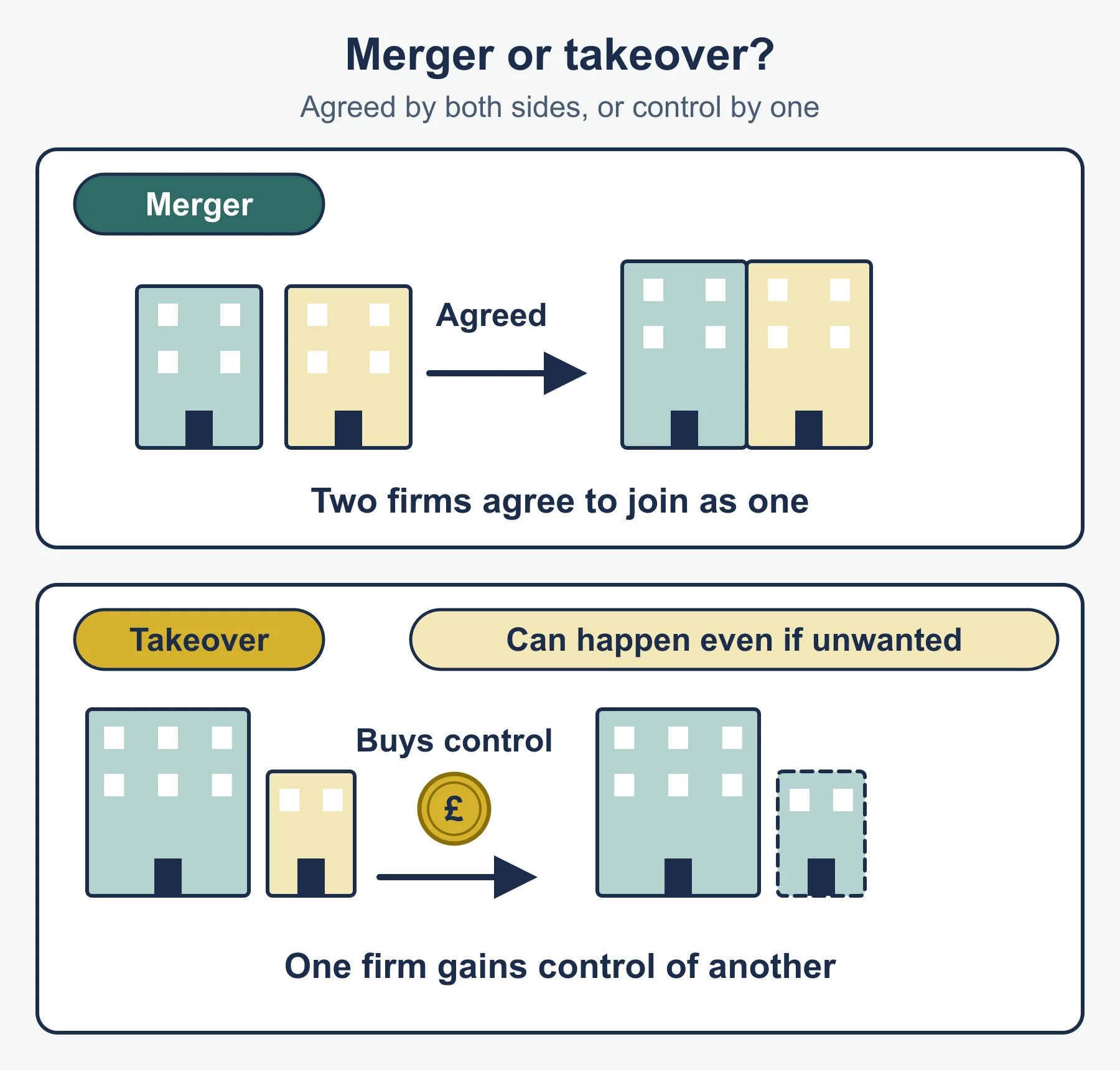
| Merger and takeover | Merger is agreed by both; takeover means one gains control |
| Purchasing and technical economies | Cheaper inputs per unit versus more efficient production methods |
| Economies and diseconomies | Unit cost falling versus unit cost rising as output grows |
| Total cost and average unit cost | Whole bill versus cost per unit |
| Organic and external growth | Own resources versus joining or buying another business |
| Franchisor and franchisee | Brand owner versus the person who runs the outlet |
Choosing between methods
| If the business… | It may favour… | Because |
|---|---|---|
| Has little capital but a strong brand | Franchising | The franchisee provides money and runs the outlet |
| Has healthy cash reserves and wants control | New stores | It keeps the brand and decisions in its own hands |
| Sells a product that posts easily | E-commerce | It reaches a wider market without new premises |
| Is stretched on a non-core task | Outsourcing | A specialist can take over the task |
| Wants a rival’s customers quickly | Takeover | It gains them at once, if it can afford the price |
Always test the suggestion against the facts in the stem. The same method can suit one business and not another.
Applying and evaluating
- Name the method, then explain a benefit and a drawback in the context of the case study.
- Use figures if the stem supplies them.
- For a judgement, weigh up cost, speed, control and risk, and say which matters most for this business and why.
- A reasoned conclusion is stronger when it names a condition, such as “provided the business has the cash reserves”.
Quick self-test
- State the formula for average unit cost.
- A business has a total cost of £90,000 and an output of 12,000 units. Calculate the average unit cost.
- Average unit cost is £3.40 and output is 15,000. Calculate total cost.
- Average unit cost falls from £5.00 to £4.20. Calculate the percentage fall.
- Name two causes of diseconomies of scale.
- Explain what a purchasing economy of scale is.
- Give one benefit and one drawback of franchising for the franchisor.
- Distinguish a merger from a takeover.
- A café’s total cost is £48,000 at 8,000 meals and £63,000 at 9,000 meals. Which output has the lower average unit cost, and what does it suggest?
- Give one drawback of outsourcing.
Answers
- Average unit cost = total cost divided by output.
- £90,000 / 12,000 = £7.50.
- £3.40 x 15,000 = £51,000.
- (5.00 - 4.20) / 5.00 x 100 = 16%.
- Any two of: poor communication, coordination issues, reduced staff motivation.
- A lower price per unit on materials or supplies because the business buys in bulk, which lowers average unit cost.
- Benefit: fast growth using the franchisee’s money (or fees and a share of revenue). Drawback: less control, so a badly run outlet can damage the brand (or it shares the profit).
- A merger is two businesses agreeing to join as one; in a takeover one business gains control of another, which the target may not want.
- £48,000 / 8,000 = £6.00; £63,000 / 9,000 = £7.00. The lower cost is at 8,000 meals. The rise to £7.00 suggests diseconomies of scale.
- Less control over quality or deadlines, or reliance on a supplier that may raise its price.
Where marks are usually lost
- Saying total cost falls when output rises. Write “average unit cost”.
- Dividing the wrong way round in the formula.
- Leaving out the unit, such as £ per unit, in a calculation.
- Describing purchasing economies as “cheaper” without saying the price per unit falls because of bulk orders.
- Naming a method but giving no benefit or drawback.
- Writing generic points that could apply to any business instead of using the case study.
- Treating diseconomies of scale as inevitable.
- Confusing franchising with outsourcing.
- Finishing a discuss question with no judgement.
Frequently asked questions
What are the methods of expansion in AQA GCSE Business (8132)? Franchising, opening new stores, e-commerce, outsourcing, and mergers and takeovers. Organic growth is usually slower but keeps more control than external growth.
What causes diseconomies of scale? The specification names three causes: poor communication, coordination issues and reduced staff motivation. They are a risk of growth, not a certainty.
Does total cost fall when there are economies of scale? No. Total cost still rises as output grows; it is the average unit cost, the cost per unit, that falls.
What is the difference between a merger and a takeover? A merger is two businesses agreeing to join together as one. A takeover is when one business gains control of another.
Official syllabus
AQA GCSE Business (8132) specification, for first teaching from September 2017, published by AQA. These notes cover section 3.1.7 Expanding a business.
Get free revision emails (optional)
Occasional emails with practice questions, worked explanations and links to free resources for the qualification and subjects you choose. No spam, and you can unsubscribe from any email. The free tools on this site never need an email.
Related resources
-
Study guides
AQA GCSE Business: Setting business aims and objectives and Stakeholders (8132)
Study guide to AQA GCSE Business (8132) sections 3.1.3 and 3.1.4: business aims and objectives, why they change, and stakeholders with worked examples.
Business · AQA · GCSE
Read guide -
Practice questions
AQA GCSE Business: Setting business aims and objectives and Stakeholders (8132) – Practice Questions
Original practice questions with worked answers on AQA GCSE Business (8132) 3.1.3 and 3.1.4: objectives, market share, dividends and stakeholders.
Business · AQA · GCSE
Try questions -
Revision notes
AQA GCSE Business: Setting business aims and objectives and Stakeholders (8132) – Revision Notes
Condensed revision notes for AQA GCSE Business (8132) 3.1.3 and 3.1.4: objectives, changing objectives, stakeholders, impact, influence and conflict.
Business · AQA · GCSE
Revise topic
Related articles
-
teaching
A Level tuition in Dubai: Cambridge or Pearson Edexcel International A Level?
Schools in Dubai and Abu Dhabi teach either Cambridge International AS & A Level or Pearson Edexcel International A Level. How the two are structured, why it matters for tuition, and how online classes from Lahore work.
9 October 2026
-
curriculum guides
Choosing subjects at IGCSE and A Level
How subject choices at 14 and 16 affect university options later, and how to keep pathways open without overloading a timetable.
28 July 2026
Studying this with a teacher
Working through Business GCSE?
This page is free and stays free. If you would rather be taught it, Marlbridge runs Business classes one-to-one and in small groups of up to 15, online in your own time zone. The first trial class is free. WhatsApp replies within an hour (8am–11pm Pakistan time, every day); email the same day.
AQA Business teachers at Marlbridge
