
Revision Notes
AQA GCSE Business: Business location and Business planning (8132) – Revision Notes
Condensed recall notes on location factors, the purpose and sections of a business plan, and fixed, variable and total costs, revenue and profit.
- Subject
- Business
- Level
- GCSE
- Topic
- Business in the real world
- Author
- Marlbridge Academic Team
- Updated
- Reviewed by
- Salman Ahmad (what this means)
Aligned to AQA GCSE Business (8132), For first teaching from September 2017. Official specification .
Syllabus page (what it covers and how it is assessed): AQA GCSE Business.
Syllabus points this page covers
8132
- 3.1.5 Business location
- 3.1.6 Business planning
Found an error? Report a correction.
Need help with this topic? Request a free trial class for GCSE Business (8132).
These notes condense sections 3.1.5 Business location and 3.1.6 Business planning of the AQA GCSE Business (8132) specification, for first teaching from September 2017. For full explanations and worked examples, read the study guide. When you are ready to write answers, use the practice questions.
Related pages: the Business in the real world study guide, the topic revision notes and the topic practice set. Course links: AQA GCSE Business hub, the printable checklist and the free diagnostics.
Business location (3.1.5)
The specification names five factors. For each one, remember the effect, not just the name.
| Factor | Pulls a business towards | Effect to state |
|---|---|---|
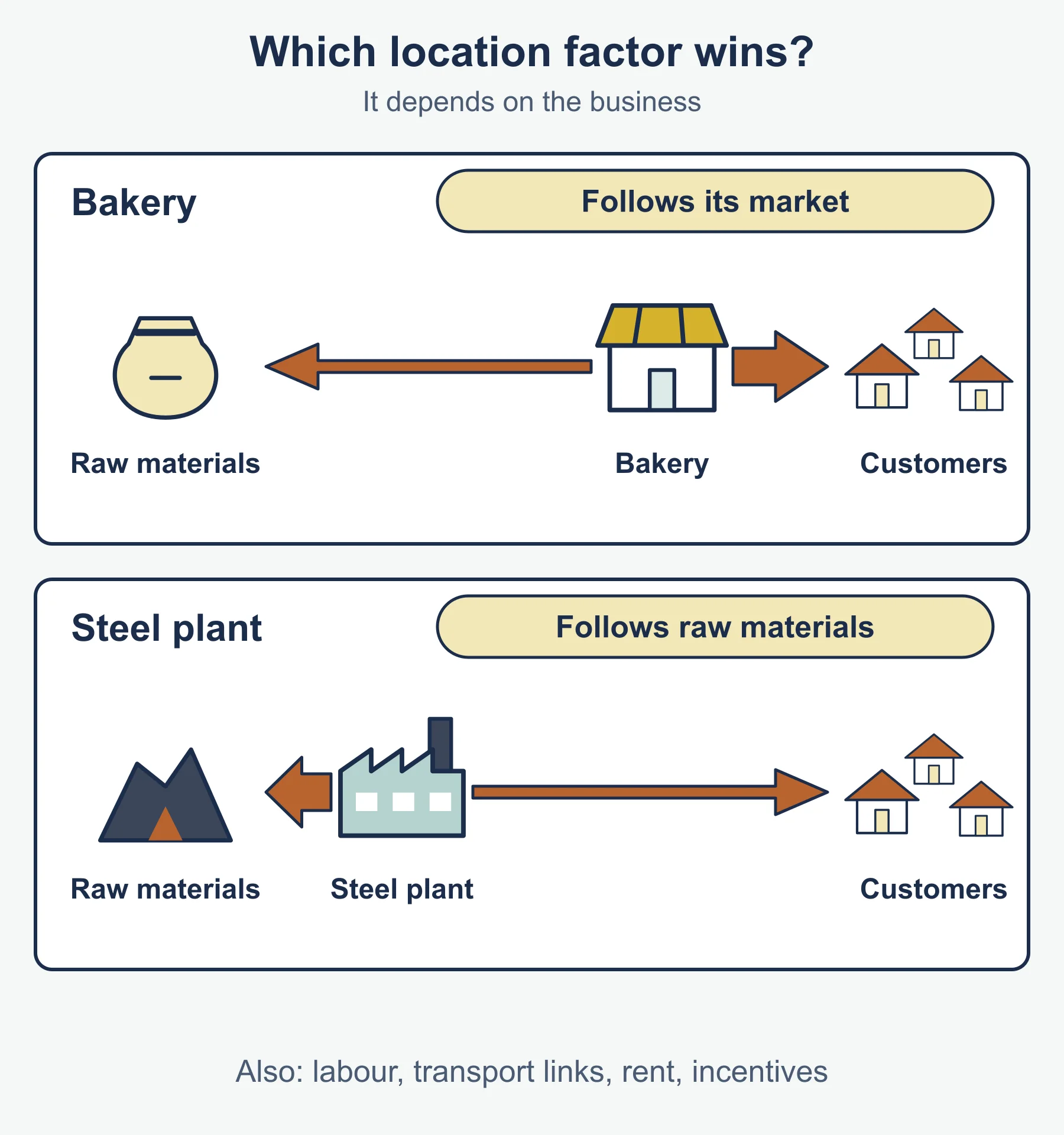
| Proximity to the market | Sites close to customers | More passing trade and sales; quicker, cheaper delivery of fresh or fragile goods |
| Availability of raw materials | Sites close to suppliers | Lower transport costs for bulky or perishable inputs |
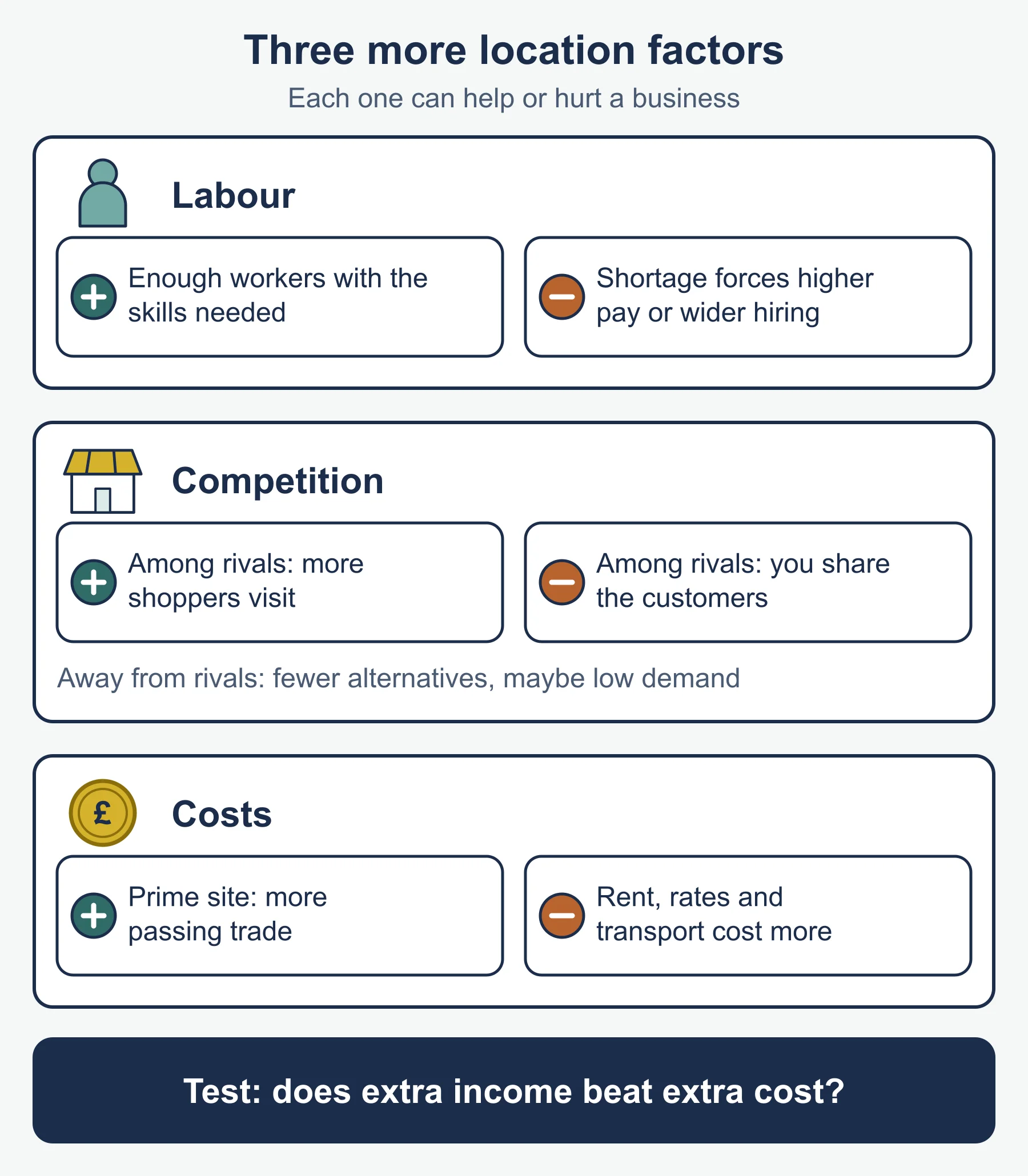
| Labour | Areas with the right workers | Enough staff with the right skills at a wage the business can afford |
| Competition | Either near or away from rivals | Near: more customers drawn to the area but shared. Away: fewer alternatives for customers but possibly low demand |
| Costs | Cheaper sites | Rent, rates, utilities, transport and wages; weigh against the income from the site |
Method for a location answer
- Pick the two or three factors that matter most for this business.
- For each, state the effect on sales or costs.
- Compare the options. A dearer site can be better if the extra sales are larger than the extra cost.
- Give a judgement and say what would change it, such as a rival opening nearby.
Must-know distinctions
- A business that sells to people who walk in cares most about the market. A business that makes heavy products from bulky inputs cares more about raw materials and transport.
- Online selling weakens the pull of the market but does not remove the need for good delivery links.
- Cheapest is not the same as best.
Quick location reminder
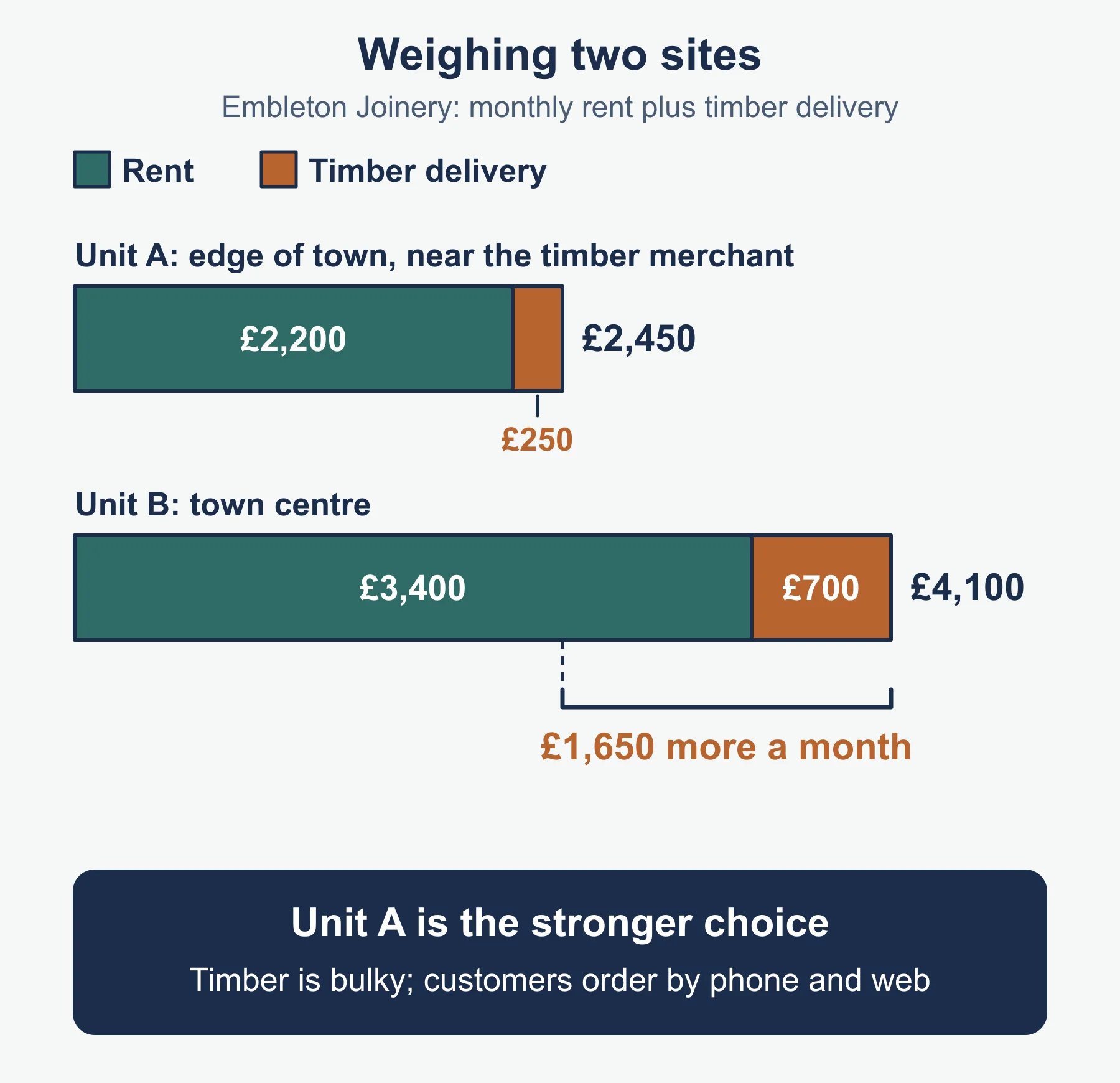
Quernby Cycles repairs bikes. A busy street costs £1,900 a month in rent and an out-of-town unit costs £800. The repair shop relies on customers dropping bikes off, so the busy street may bring more repairs. Whether it is worth £1,100 more a month depends on how many extra repairs it brings and what each one earns.
Business planning (3.1.6)
Purpose of a business plan
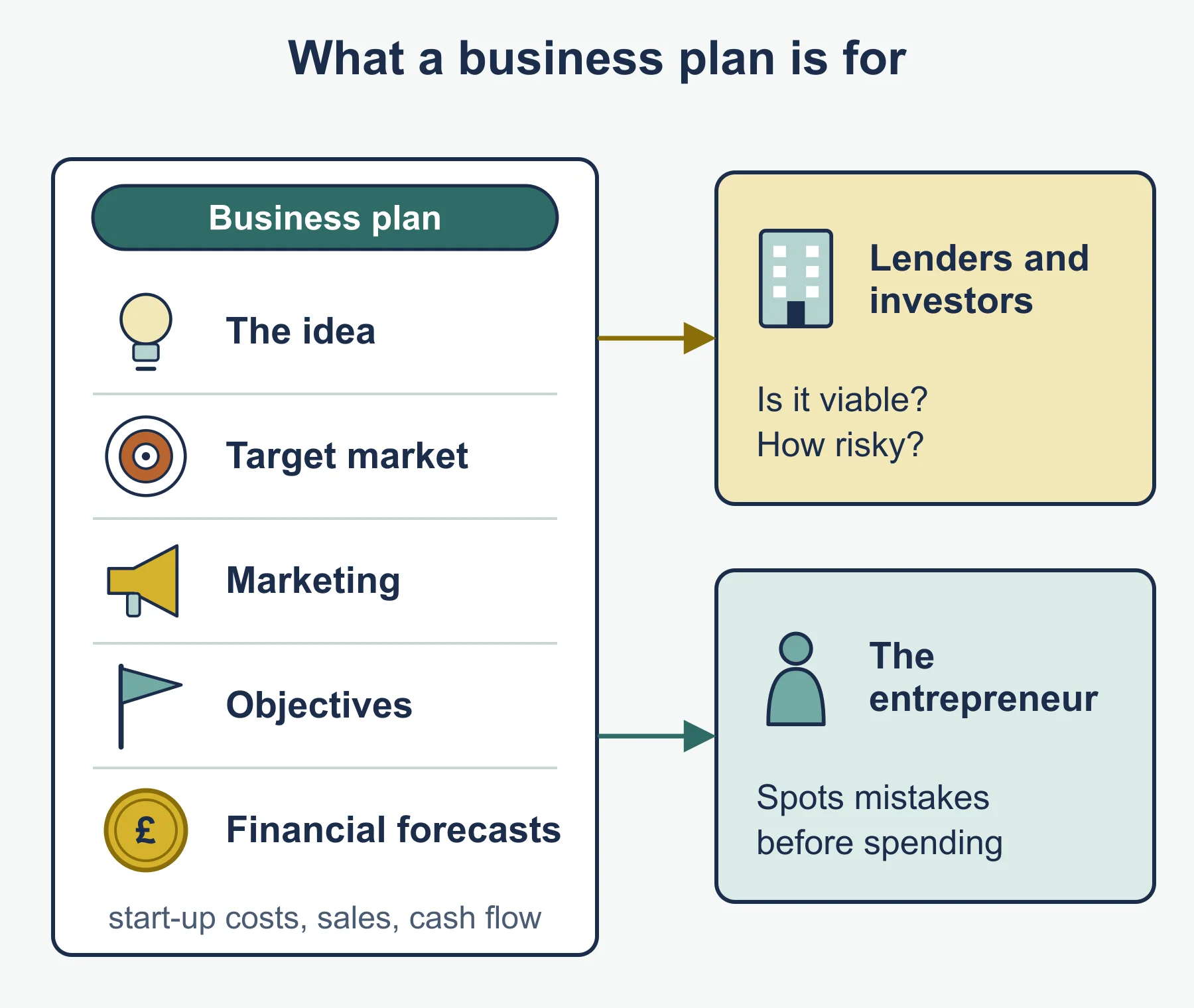
A business plan is a written document setting out what the business intends to do and how it will do it. The specification lists these reasons:
- importance in setting up a new business
- raising finance
- setting objectives
- detailing how functions of the business will be organised
Memory hook: Start, Fund, Aim, Organise.
The specification states that you will not be expected to write a business plan.
Main sections of a plan
The specification asks you to understand the main sections but does not give a fixed list. These are the usual ones.
| Section | One-line purpose |
|---|---|
| Executive summary | Short overview for a busy reader |
| Business idea and objectives | What is sold and what it aims to achieve |
| Target market and research | Who buys and the evidence of demand |
| Marketing plan | How the product will be sold |
| Operations | Premises, suppliers, equipment, processes |
| People | Owners and staff needed |
| Financial forecasts | Start-up costs, sales, costs, profit, cash flow |
Benefits and drawbacks
| Benefits | Drawbacks |
|---|---|
| Tests the idea on paper before money is spent | Takes time to research and write |
| Helps to raise finance because lenders can judge risk | Based on forecasts that may be wrong |
| Sets targets to measure progress | Can go out of date when the market changes |
| Shows who does what in each function | A rigid plan can slow a reaction to new chances |
For “analyse”, link a point to its consequence. Example: “Because the plan sets a sales target, the owner can compare actual sales with it and spot a shortfall early.”
For “evaluate”, reach a judgement. Planning is usually worth the effort, particularly for a start-up that needs finance, as long as the plan is reviewed.
Financial terms and calculations
The specification names the terms. The formulas below are the standard forms.
| Term | Definition or formula |
|---|---|
| Fixed costs | Costs that do not change with output (rent, insurance) |
| Variable costs | Costs that change with output (materials, packaging) |
| Total costs | Fixed costs + variable costs |
| Total variable costs | Variable cost per unit × quantity |
| Revenue | Price × quantity sold |
| Profit | Revenue − total costs |
| Loss | Total costs greater than revenue (profit is negative) |
Method in steps
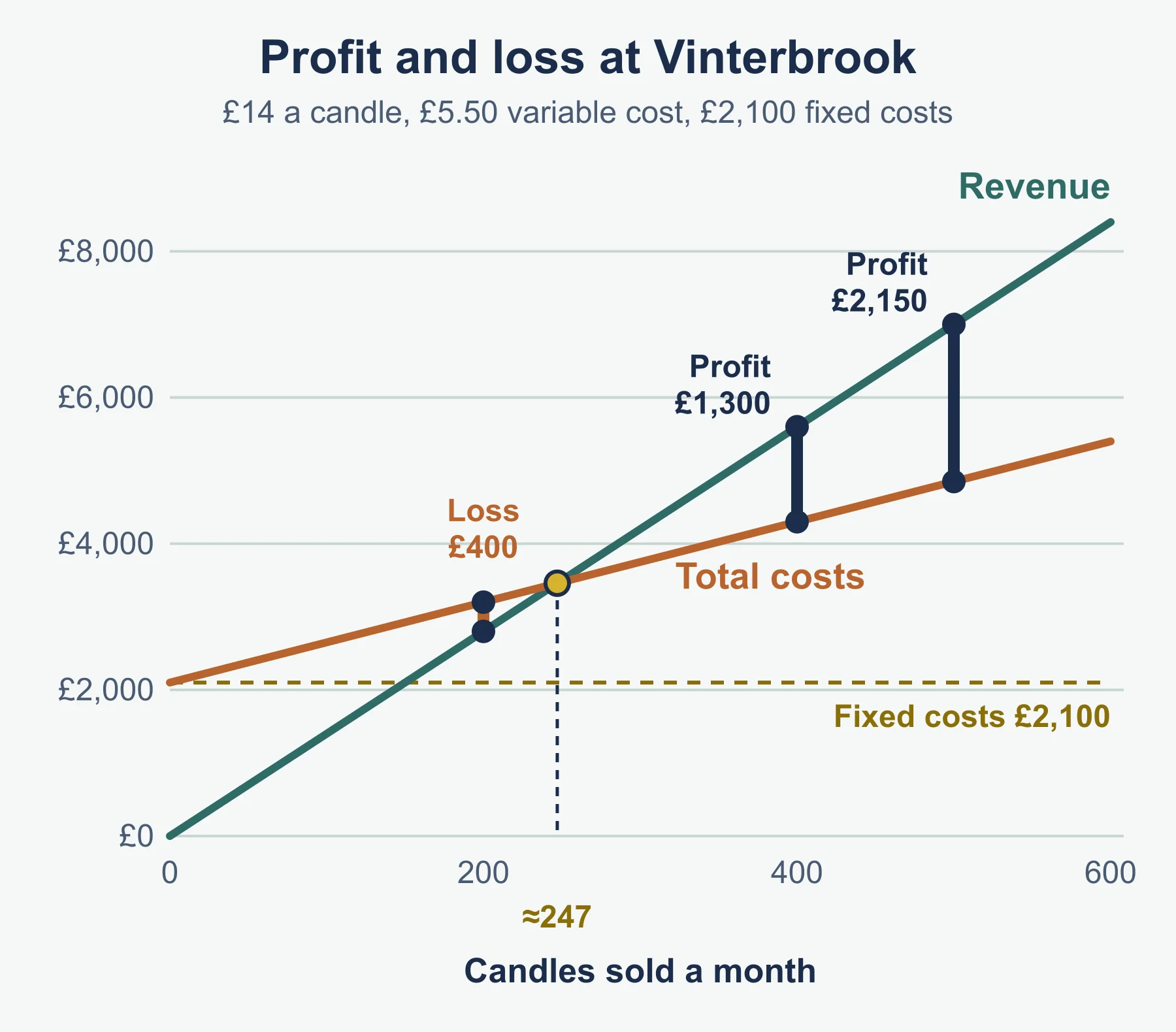
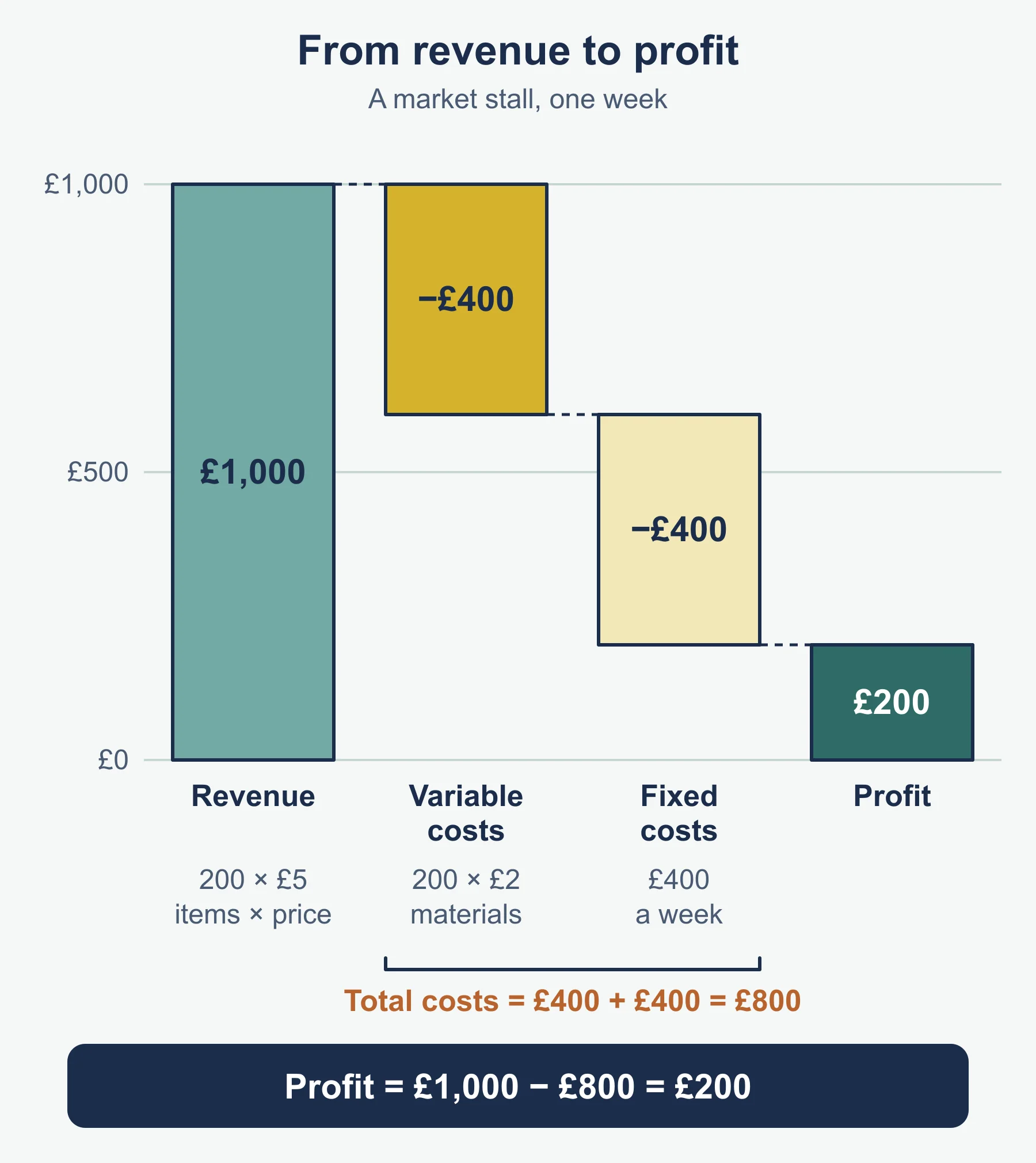
- Revenue = price × quantity.
- Total variable costs = variable cost per unit × quantity.
- Total costs = total variable costs + fixed costs.
- Profit = revenue − total costs. A negative answer is a loss.
- Write the unit (£) and say whether it is a profit or a loss.
Worked reminder
Quernby Cycles charges £40 for a standard service. The variable cost of each service (parts and cleaning materials) is £12. Fixed costs are £3,000 a month.
At 150 services: revenue £6,000, total variable costs £1,800, total costs £4,800, profit £1,200.
At 80 services: revenue £3,200, total variable costs £960, total costs £3,960, loss £760.
The fixed costs of £3,000 were the same in both months. Only the variable costs moved with the number of services.
Sorting costs quickly
Ask one question: if output doubles, does this cost double? If yes, it is variable. If it stays put, it is fixed.
| Usually variable | Usually fixed |
|---|---|
| Raw materials and ingredients | Rent of premises |
| Packaging | Insurance |
| Delivery charges per order | Website fees |
| Components bought for each item | Salaries paid regardless of output |
Some costs, such as electricity, can have both a fixed and a variable part. In an exam question the data will normally tell you which to use.
Command words for this topic
- State, identify: give the answer briefly, with no explanation.
- Define: give the meaning of a term accurately.
- Calculate: show each step, with units.
- Explain: give a point and develop it with a reason or consequence.
- Analyse: follow a chain of cause and effect, applied to the business.
- Evaluate, justify: weigh both sides and reach a reasoned judgement.
Quick self-test
- Name the five location factors listed in the specification.
- Explain why a bakery might choose a site near a flour mill.
- Give two reasons why a business plan is useful when raising finance.
- State two further reasons, other than raising finance, why a business writes a plan.
- Identify two sections that you would expect in a business plan.
- Give one drawback of business planning and explain it.
- Is business rent a fixed cost or a variable cost? Explain.
- A business sells 250 units at £6 each. Its variable cost is £2.20 per unit and fixed costs are £700. Calculate total costs.
- For the business in question 8, calculate the profit or loss.
- A different business has revenue of £4,000 and total costs of £4,650. State the result and its amount.
Answers
- Proximity to the market, availability of raw materials, labour, competition and costs.
- Flour is bulky, so a short journey lowers transport costs, and fresh supplies reach the bakery quickly. This lowers the cost of each loaf.
- It shows lenders the owner has researched the market and costs, and its forecasts let them judge whether the business can repay or give a return.
- Any two of: setting up a new business, setting objectives, detailing how the functions of the business will be organised.
- Any two of: executive summary, business idea and objectives, target market, marketing plan, operations, people, financial forecasts.
- For example, the figures are forecasts. If sales are lower than expected, the plan can mislead the owner and a lender. Other acceptable drawbacks are the time it takes and going out of date.
- Fixed. Rent is the same whatever the output, in the short run.
- Total variable costs 250 × £2.20 = £550. Total costs £550 + £700 = £1,250.
- Revenue 250 × £6 = £1,500. Profit £1,500 − £1,250 = £250.
- £4,000 − £4,650 = −£650, so a loss of £650.
Where marks are usually lost
- Naming a location factor without saying how it changes sales or costs.
- Choosing the cheapest site without checking whether income is lost.
- Using only one factor in an evaluation question when the data supports several.
- Forgetting that a plan helps the owner as well as the lender.
- Giving only benefits of planning when the command word asks you to analyse both sides.
- Including fixed costs when the question asks for total variable costs.
- Forgetting to multiply unit costs by quantity.
- Giving a loss as a positive figure with the word profit.
- Writing a final judgement that simply repeats the points made with no reasoning.
Frequently asked questions
What are the five location factors in AQA GCSE Business (8132)? Proximity to the market, availability of raw materials, labour, competition and costs. For each factor you use, say how it affects the business’s sales or costs.
Do I have to write a business plan in the AQA GCSE Business exam? No. The specification states that you will not be expected to write a business plan, but you need to understand its purpose, its main sections and the benefits and drawbacks of planning.
How can I tell if a cost is fixed or variable? Ask whether the cost would double if output doubled. If it would, it is variable, like raw materials or packaging; if it stays the same, like rent or insurance, it is fixed.
Is the cheapest location always the best choice? No. A dearer site can be better if the extra sales it brings are larger than the extra cost, so compare the options on income as well as costs.
Official syllabus
AQA GCSE Business (8132) specification, for first teaching from September 2017, published by AQA: sections 3.1.5 Business location and 3.1.6 Business planning.
Get free revision emails (optional)
Occasional emails with practice questions, worked explanations and links to free resources for the qualification and subjects you choose. No spam, and you can unsubscribe from any email. The free tools on this site never need an email.
Related resources
-
Study guides
AQA GCSE Business: Expanding a business (8132)
A full study guide to expansion methods, economies and diseconomies of scale and average unit cost for AQA GCSE Business (8132) section 3.1.7.
Business · AQA · GCSE
Read guide -
Practice questions
AQA GCSE Business: Expanding a business (8132) – Practice Questions
Original questions with worked answers on growth methods, economies of scale and average unit cost for AQA GCSE Business section 3.1.7.
Business · AQA · GCSE
Try questions -
Revision notes
AQA GCSE Business: Expanding a business (8132) – Revision Notes
Condensed recall notes on growth methods, economies and diseconomies of scale and average unit cost for AQA GCSE Business section 3.1.7.
Business · AQA · GCSE
Revise topic
Related articles
-
teaching
A Level tuition in Dubai: Cambridge or Pearson Edexcel International A Level?
Schools in Dubai and Abu Dhabi teach either Cambridge International AS & A Level or Pearson Edexcel International A Level. How the two are structured, why it matters for tuition, and how online classes from Lahore work.
9 October 2026
-
curriculum guides
Choosing subjects at IGCSE and A Level
How subject choices at 14 and 16 affect university options later, and how to keep pathways open without overloading a timetable.
28 July 2026
Studying this with a teacher
Working through Business GCSE?
This page is free and stays free. If you would rather be taught it, Marlbridge runs Business classes one-to-one and in small groups of up to 15, online in your own time zone. The first trial class is free. WhatsApp replies within an hour (8am–11pm Pakistan time, every day); email the same day.
AQA Business teachers at Marlbridge
