
Study Guides
AQA GCSE Business: Marketing (8132)
Study guide to AQA GCSE Business Marketing: customers, segmentation, market research, the 4Ps, product life cycle, Boston Matrix and e-commerce.
- Subject
- Business
- Level
- GCSE
- Topic
- Marketing
- Author
- Marlbridge Academic Team
- Updated
- Reviewed by
- Salman Ahmad (what this means)
Aligned to AQA GCSE Business (8132), For first teaching from September 2017. Official specification .
Syllabus page (what it covers and how it is assessed): AQA GCSE Business.
Syllabus points this page covers
8132
- 3.5.1 Identifying and understanding customers
- 3.5.2 Segmentation
- 3.5.3 The purpose and methods of market research
- 3.5.4 The elements of the marketing mix: price, product, promotion and place (4Ps)
Found an error? Report a correction.
Need help with this topic? Request a free trial class for GCSE Business (8132).
This guide covers 3.5 Marketing from the 8132 AQA GCSE Business specification (first teaching September 2017). It takes in all four parts of the section: 3.5.1 to 3.5.4. Marketing is assessed in Paper 2 (Influences of marketing and finance on business activity), which the specification describes as a 1 hour 45 minute written exam. All businesses and figures below are invented.
Companion pages: the practice questions and the revision notes. Related topics: expanding a business and globalisation and legislation. Course hub: AQA GCSE Business. Tick things off on the checklist. Want to find your weak spots first? Try the free diagnostics.
Map of the topic
| Section | What to master |
|---|---|
| 3.5.1 Identifying and understanding customers | Explain why identifying and satisfying customer needs matters |
| 3.5.2 Segmentation | Explain how and why businesses segment by gender, age, location and income |
| 3.5.3 Market research | Purpose, primary and secondary methods, qualitative and quantitative, using data, market size and share |
| 3.5.4 The 4Ps | Price, product (differentiation, life cycle, portfolio), promotion, place, e-commerce and m-commerce, and the mix as a whole |
Marketing is the set of activities a business uses to find out what customers want and then supply it, so that it sells more and stays competitive. It sits alongside operations, human resources and finance, and its plans should follow from the business objectives.
3.5.1 Identifying and satisfying customer needs
A business that knows what customers want can:
- provide a product or service that customers will buy
- increase sales
- select the correct marketing mix
- avoid costly mistakes, such as launching something nobody wants
- be competitive against rivals who are already meeting those needs.
Example: Bexwith Outdoor planned a range of heavy winter jackets. Before launch it found that most of its customers wanted light, packable waterproofs. Spending nothing on the heavy range avoided a costly mistake.
3.5.2 Segmentation
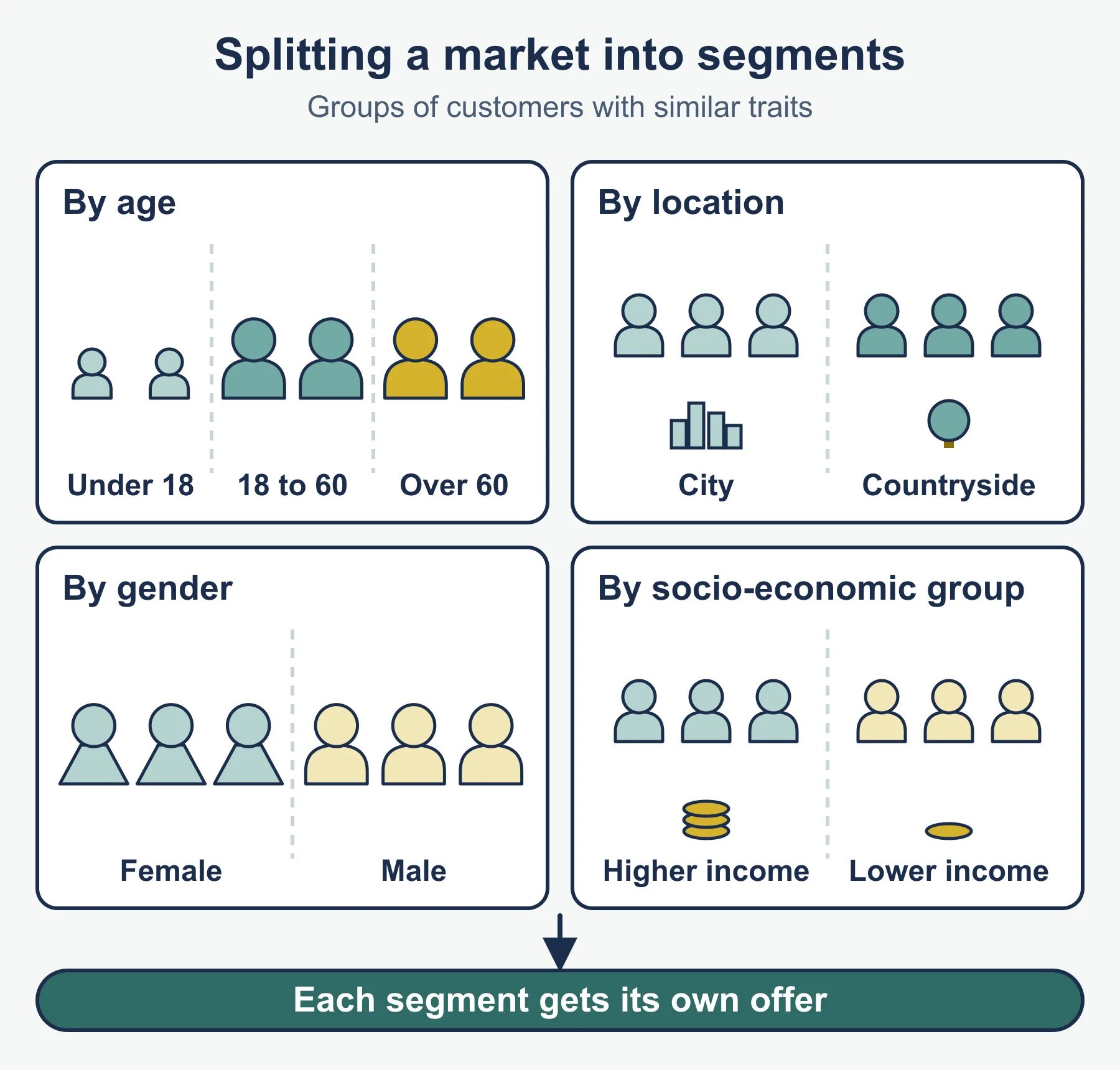
Segmentation splits a market into groups whose members share traits, so the business can aim at each group. The specification names four types.
| Type | How a business might use it |
|---|---|
| Gender | A clothing brand designs separate ranges and advertises in different places |
| Age | A games company offers a children’s version and an adult version |
| Location | A café chain stocks different products in a seaside town and in a city centre |
| Income | A furniture retailer sells a budget range and a premium range |
Why do it? A targeted product, price and promotion fit the group better, so money is not wasted on people who will never buy. The drawback is that a very narrow target can limit sales.
3.5.3 Market research
Purpose. Businesses research to identify market opportunities and to understand their customers and competitors better. They collect information about:
- demand: how much customers want the product
- competition: who else sells it, at what price and how well
- target market: who the customers are and what they like.
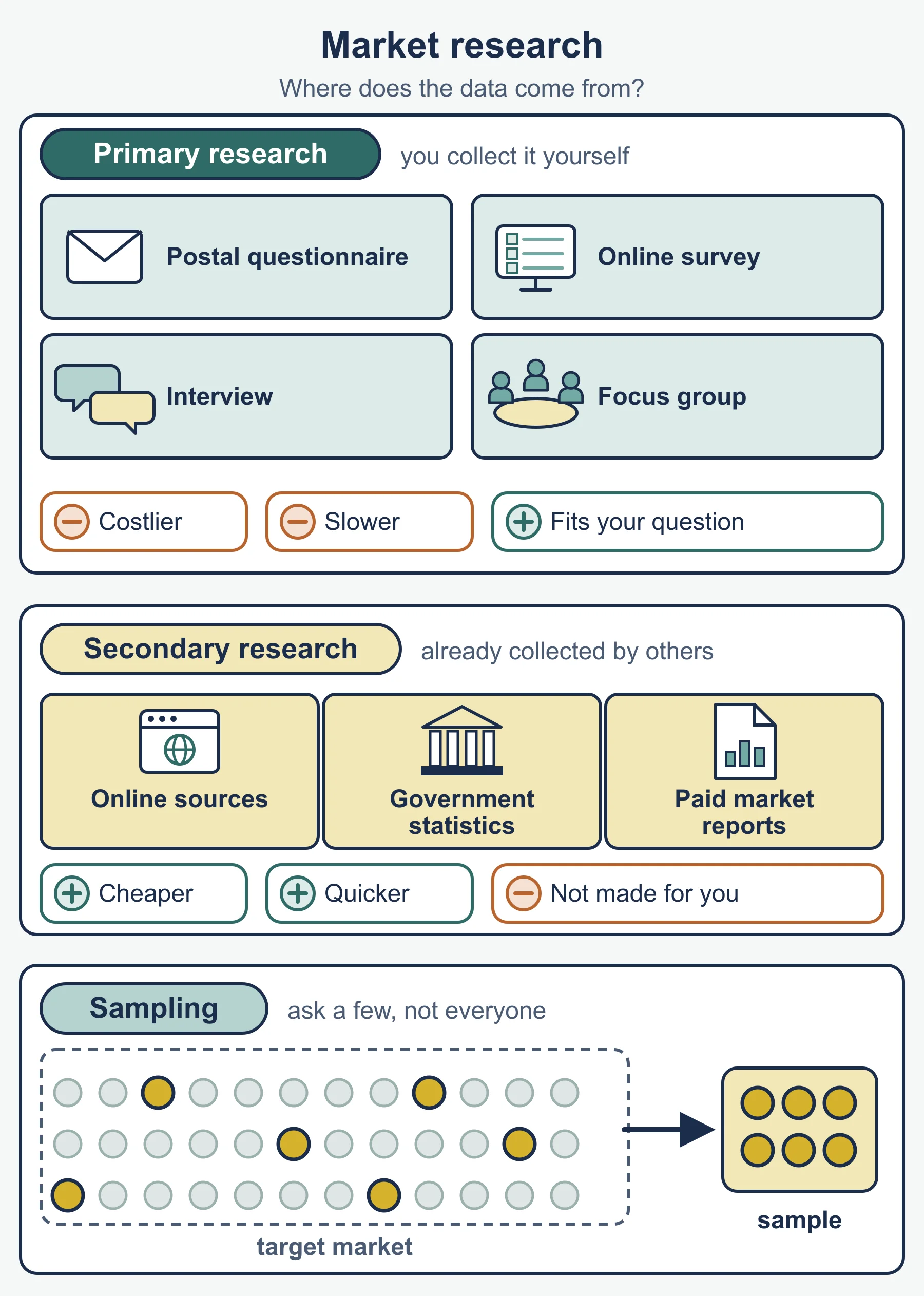
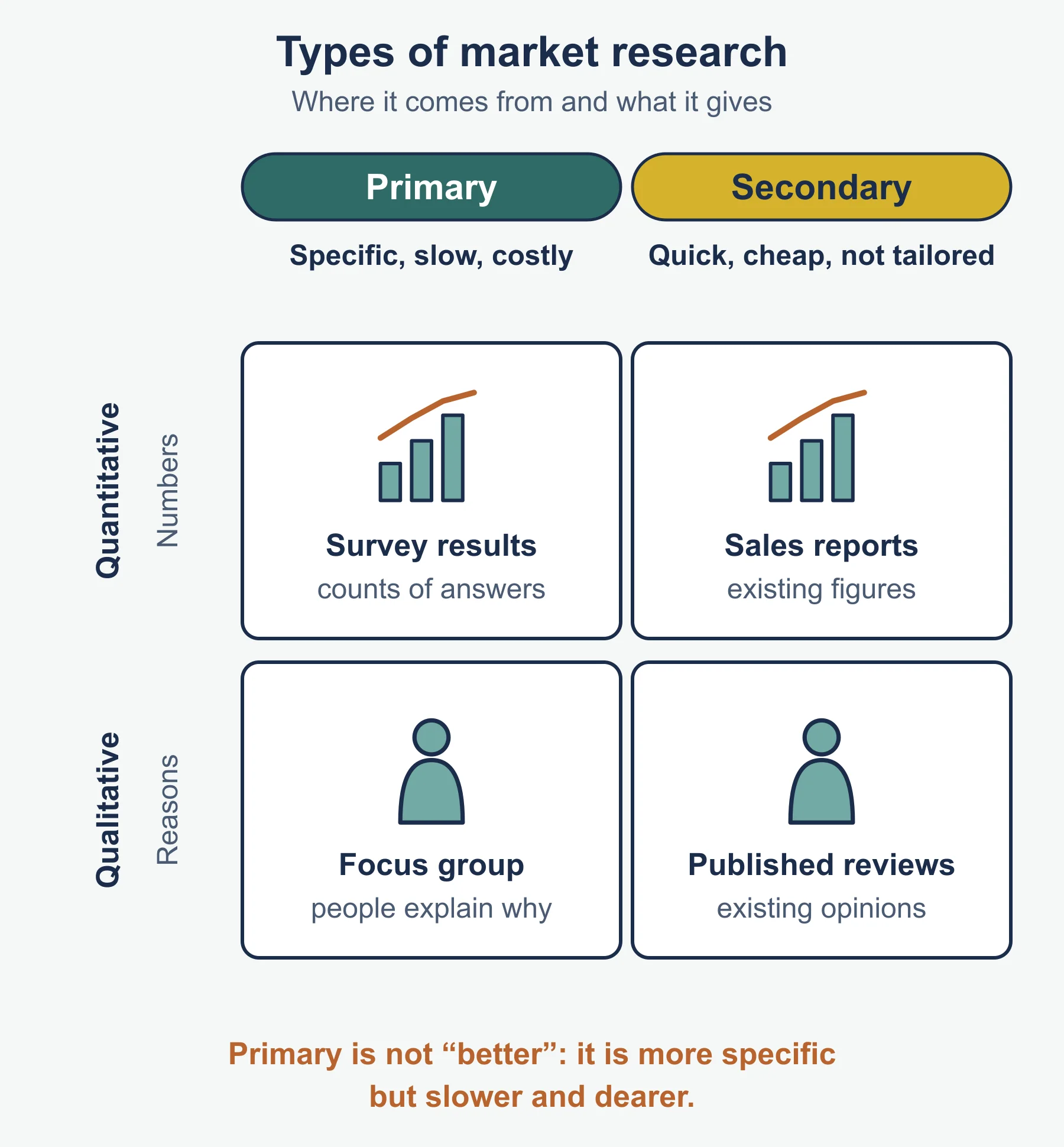
Primary and secondary research. Primary research means gathering fresh information directly from people to answer the firm’s own question. Secondary research draws on information someone else has already published.
| Method | Type | Benefit | Drawback |
|---|---|---|---|
| Questionnaires | Primary | Cheap to send to many people | Low response; people may not answer honestly |
| Surveys | Primary | Large sample gives reliable results | Takes time and costs money to analyse |
| Interviews | Primary | Detailed answers; questions can be explained | Slow and costly for each person; interviewer may influence answers |
| Focus groups | Primary | Reveals opinions and reasons | Small group may not represent the market; costly to run |
| Internet research | Secondary | Quick and often free | May be out of date or unreliable |
| Printed press, such as newspapers | Secondary | Cheap; reports on trends and competitors | May not match the business’s own needs |
Qualitative and quantitative. Quantitative research produces numbers and can be counted, for example 42% prefer online ordering. Qualitative research gives opinions, feelings and reasons, for example why customers feel that way. Focus groups and interviews tend to be qualitative; closed-question surveys tend to be quantitative.
Choosing a method. Match the method to the business. A tiny shop with little money may use a short questionnaire at the till and internet research. A firm launching a costly new product may pay for a large survey plus focus groups.
Using the findings. You must be able to interpret both kinds of finding and to read tables and charts.
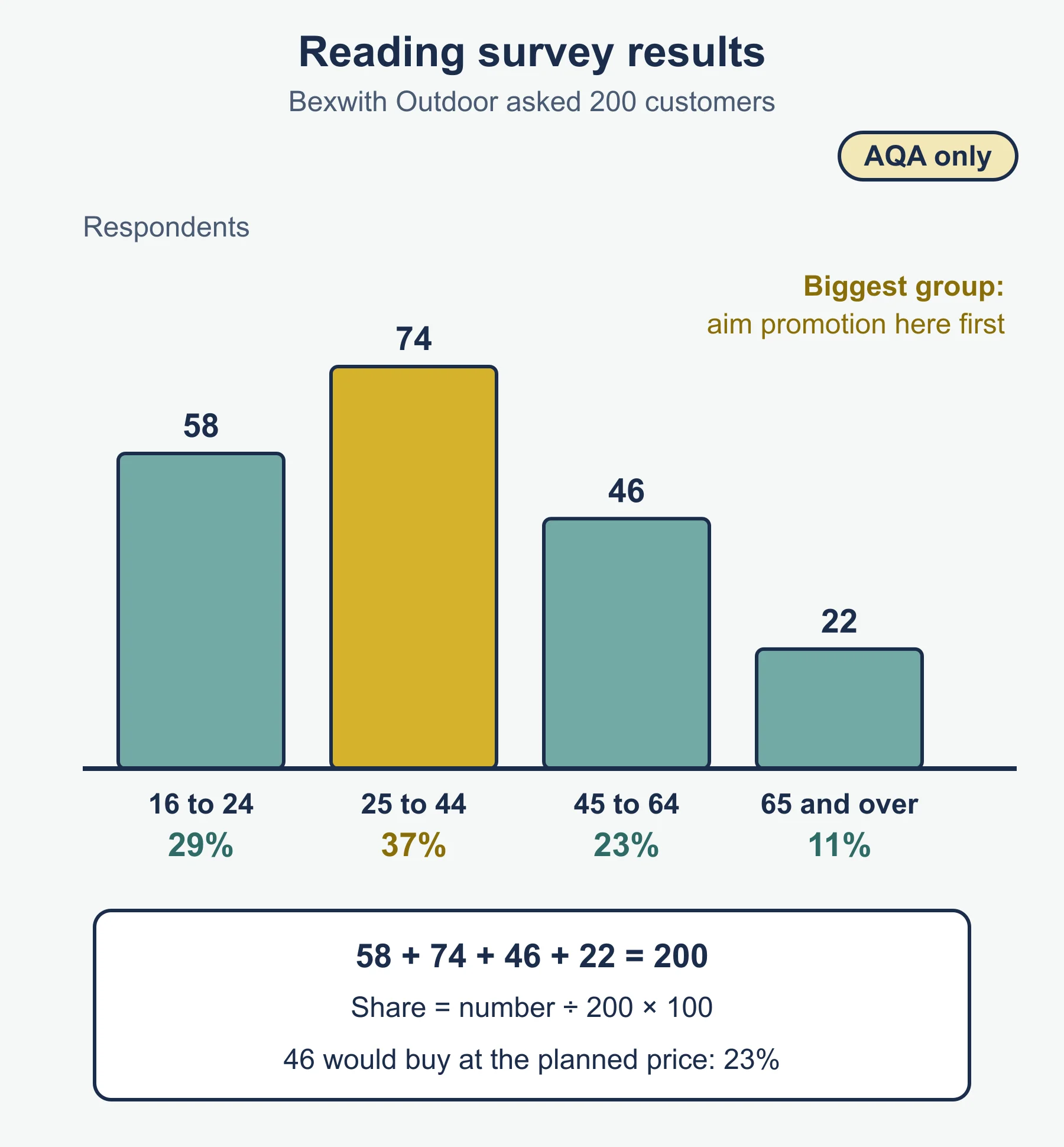
Worked example: Bexwith Outdoor surveyed 200 customers about a new waterproof.
| Age group | Respondents | Share of sample |
|---|---|---|
| 16 to 24 | 58 | 29% |
| 25 to 44 | 74 | 37% |
| 45 to 64 | 46 | 23% |
| 65 and over | 22 | 11% |
Check: 58 + 74 + 46 + 22 = 200. Each share is the number divided by 200 and multiplied by 100. The largest group is 25 to 44, so promotion should aim there first. Of the 200, 46 said they would buy at the planned price: 46 ÷ 200 × 100 = 23%. That is a useful figure, but only a comment from an interview would explain why 77% would not.
Market size and market share.
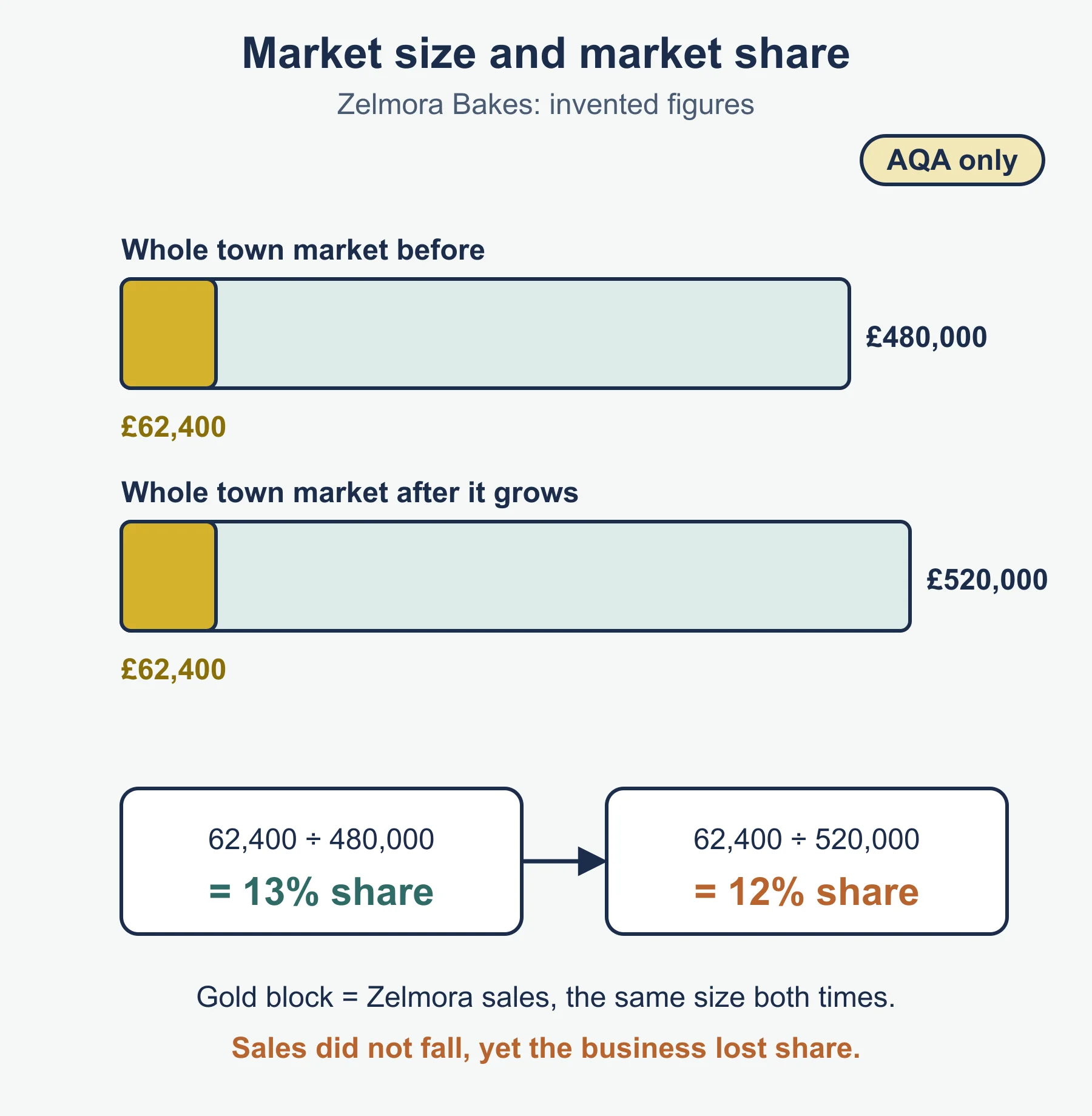
- Market size is what every firm in a market sells between them, measured by value or by volume over a period.
- Standard form: market share = (a firm’s sales ÷ total market sales) × 100.
Zelmora Bakes sells £62,400 of bread a year in a town market worth £480,000. Market share = 62,400 ÷ 480,000 × 100 = 13%. If the market grows to £520,000 and Zelmora’s sales stay the same, its share falls to 62,400 ÷ 520,000 × 100 = 12%. Sales did not fall, yet the business lost share.
3.5.4 The marketing mix: the 4Ps
Price
Pricing methods
| Method | Main features | Impact on the business |
|---|---|---|
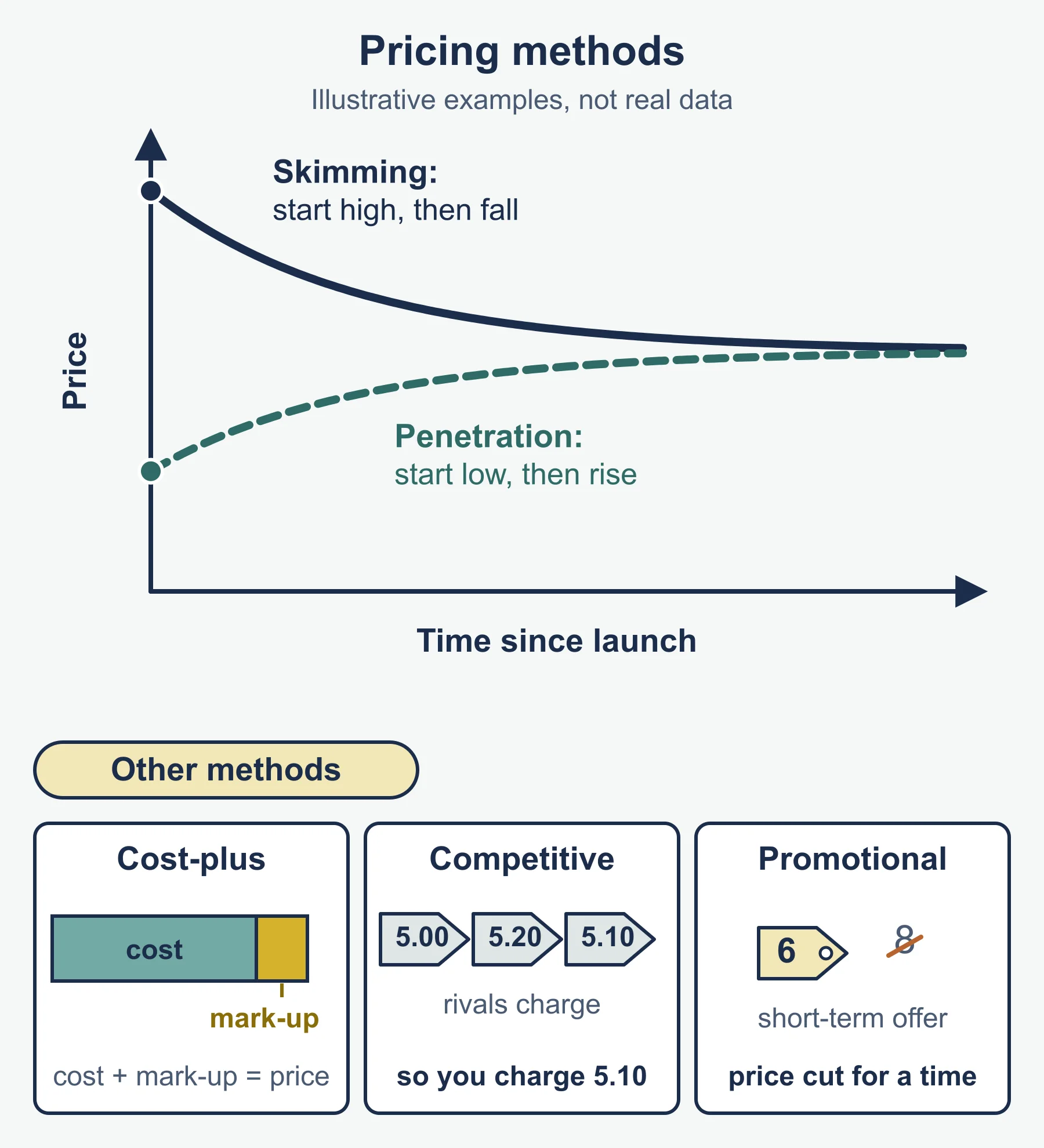
| Price skimming | High price at launch, lowered later | Large profit per unit from early buyers; may put off others and attract rivals |
| Price penetration | Low price at launch to win customers quickly | Builds market share fast; low profit per unit at first |
| Competitive pricing | Price set near rivals’ prices | Avoids price wars; limits the business’s own freedom |
| Loss leader | An item priced under its cost to bring shoppers in | Customers buy other items too; the lost money must be made back elsewhere |
| Cost-plus | Unit cost plus a mark-up | Simple and covers costs; ignores what customers will pay |
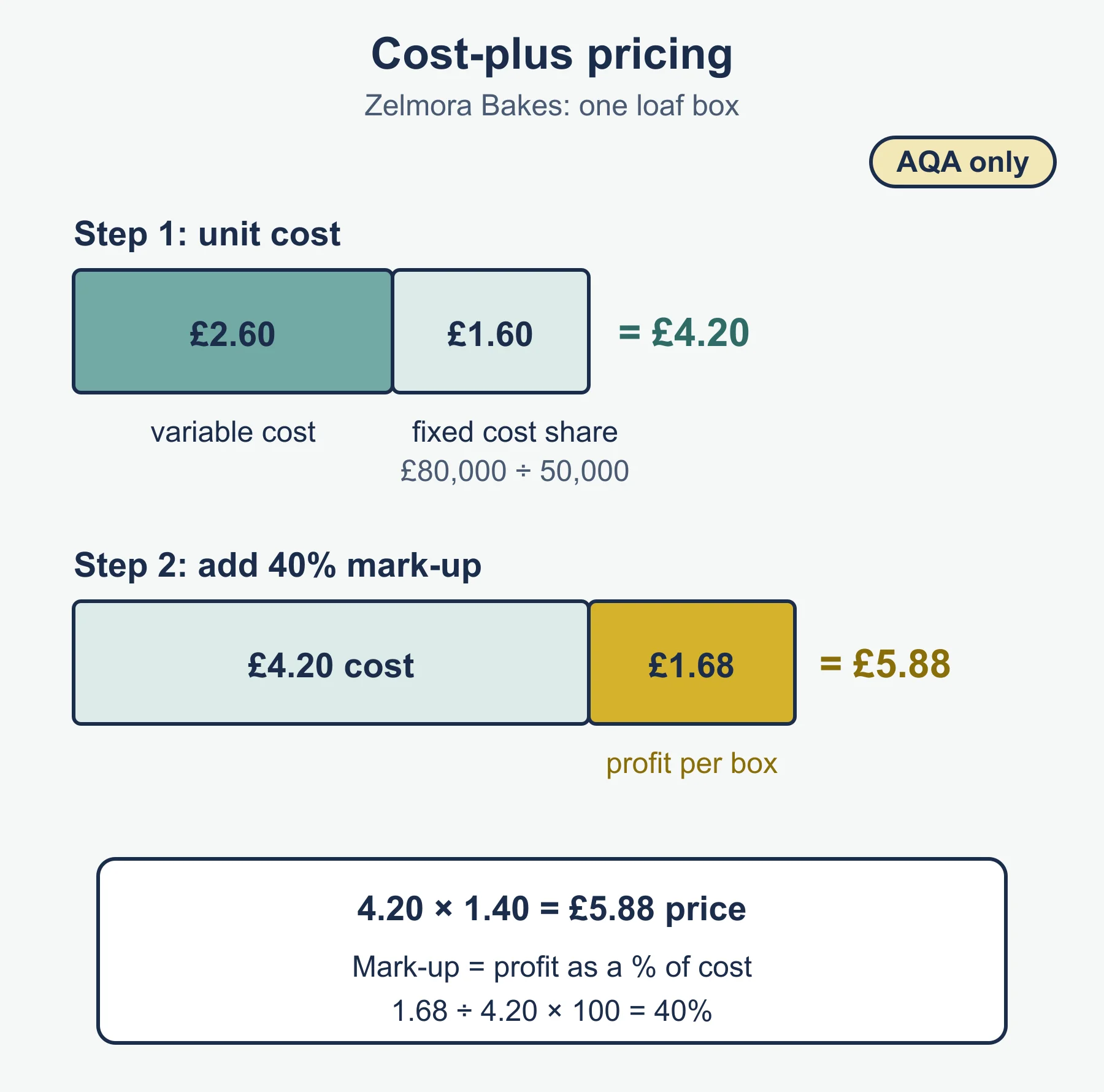
Worked cost-plus example. Zelmora Bakes has variable costs of £2.60 a loaf box and fixed costs of £80,000 a year, and expects to sell 50,000. Unit cost = 2.60 + 80,000 ÷ 50,000 = 2.60 + 1.60 = £4.20. With a 40% mark-up the price is 4.20 × 1.40 = £5.88, a profit of £1.68 on each box. Mark-up is profit as a percentage of cost (the standard form).
Factors influencing price. Internal: costs, and the stage of the product life cycle. External: the nature of the market and the degree of competition. As a business grows, falling unit costs may let it cut prices, while entering new markets may force it to match local rivals. To evaluate a method, link the factor to it. In a market with many close rivals, competitive pricing is more suitable than skimming. For a brand-new product with no rivals, skimming may work.
Price and demand. The basic relationship is that as prices rise demand is likely to fall, and as prices fall demand is likely to rise.
Product
New products. Benefits: new sales, a stronger image, an edge over rivals. Risks: development cost, and the product may fail. Good design, image and the needs of the target market should drive what is made.
Product differentiation. A unique selling point (USP) is a feature that sets a product apart from rivals, such as a unique recipe or a longer guarantee. Brand image is how customers see the brand. In a competitive market both help justify a higher price and keep customers loyal.
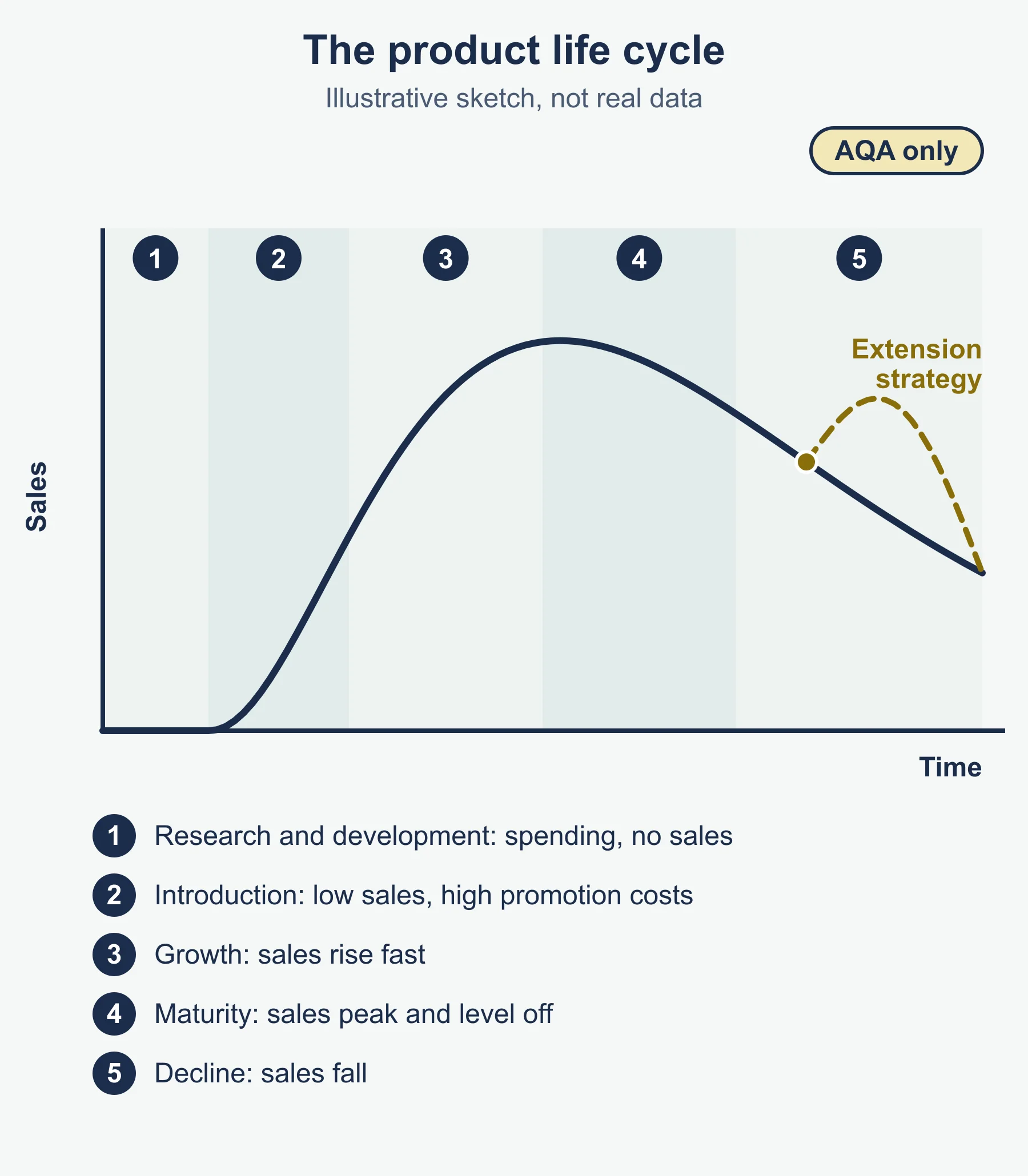
Product life cycle. Stages: research and development (spending, no sales), introduction (low sales, high promotion costs), growth (sales rise fast), maturity (sales peak and level off) and decline (sales fall).
Sales fall in decline, so businesses use extension strategies to prolong life:
- updating packaging
- adding more or different features
- changing target market
- advertising
- price reduction.
To evaluate them, ask whether the product still has a base of loyal buyers. A price cut gives a quick boost but cuts profit per unit and is easy for rivals to copy. New features cost money but can renew interest. Changing the target market works when the current one is saturated.
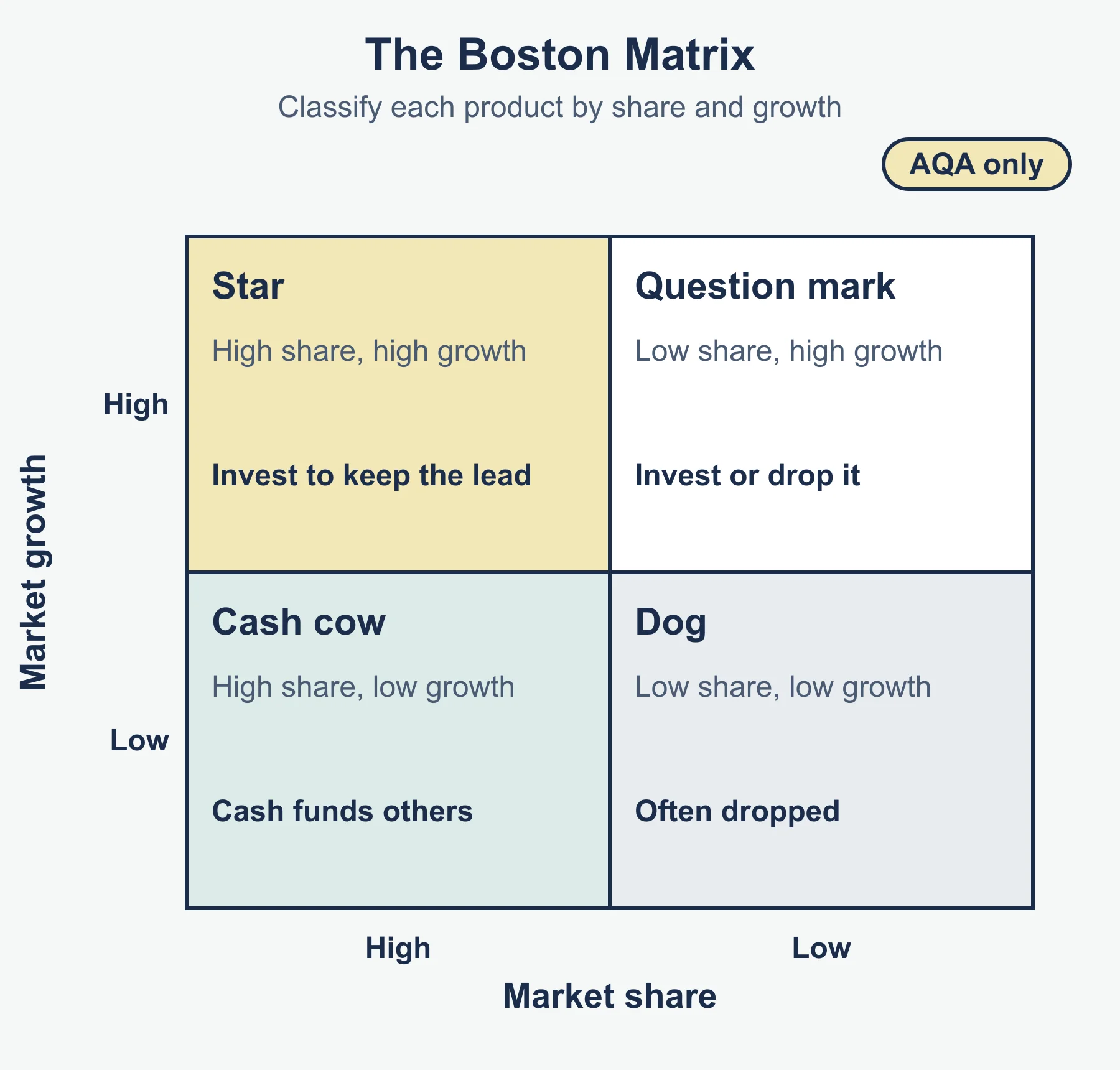
Product portfolio and the Boston Matrix. A portfolio is the range of products a business sells. Businesses broaden it to spread risk and balance it so that some products earn cash while others grow. The Boston Matrix classes each product by market share and market growth.
| Category | Market share | Market growth | Typical action |
|---|---|---|---|
| Star | High | High | Invest to keep the lead |
| Cash cow | High | Low | Keep selling; use its cash to fund others |
| Question mark (problem child) | Low | High | Decide whether to invest or drop it |
| Dog | Low | Low | Often dropped |
Promotion
Reasons: inform or remind customers, create or increase sales, create or change the image, and persuade customers to buy.
Methods
- Advertising in newspapers, magazines, television, the internet and billboards. Television reaches many people but costs a lot. Newspapers and magazines can be matched to a readership. Billboards are seen by passers-by. Internet adverts can be targeted and measured.
- PR (public relations): press releases and events that build a good image. It is cheap but the business does not control what is published.
- Sales promotion: point of sale displays, 2 for 1 offers, free gifts, samples, coupons and competitions. These boost sales quickly but may only attract bargain hunters.
- Sponsorship: paying to have the brand linked to an event or team.
- Social media: low cost, interactive and targeted, but bad comments spread quickly.
Choosing the promotional mix. Analyse: finance available, competitor actions, the nature of the product or service, the nature of the market and the target market. A small business with a small budget aimed at teenagers may pick social media. A large firm selling an everyday product to everyone may afford television.
Place
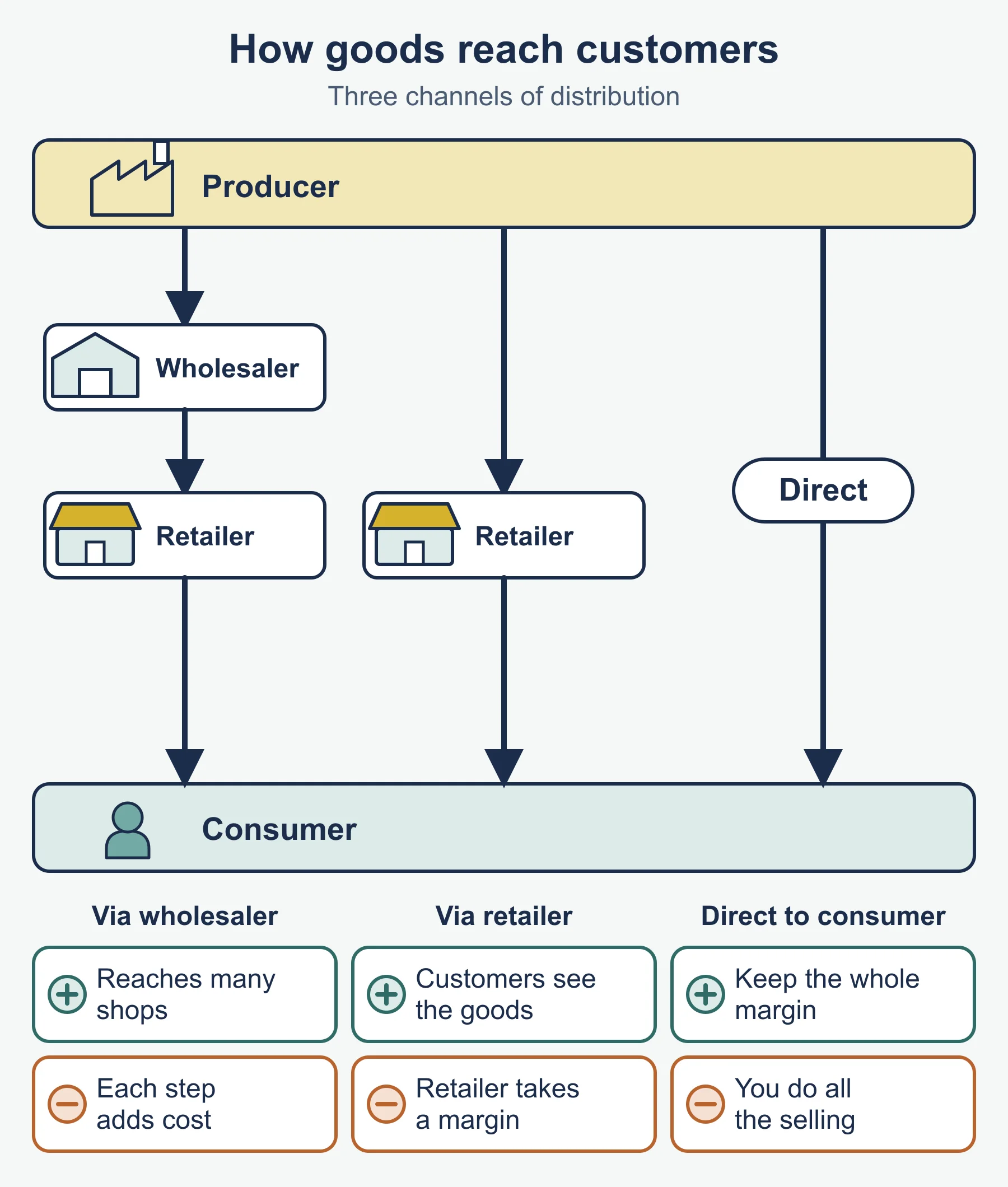
Place means the channels of distribution used to reach customers.
| Channel | Description | Suits |
|---|---|---|
| Retailers | Sell to the public | Products customers want to see and try |
| Wholesalers | Buy in bulk and sell to retailers | Makers who want to reach many shops with little effort, at a lower price per unit |
| Telesales | Selling by phone | Services needing explanation, or repeat orders |
Selling direct to customers or through a wholesaler also changes who earns the margin.
E-commerce and m-commerce
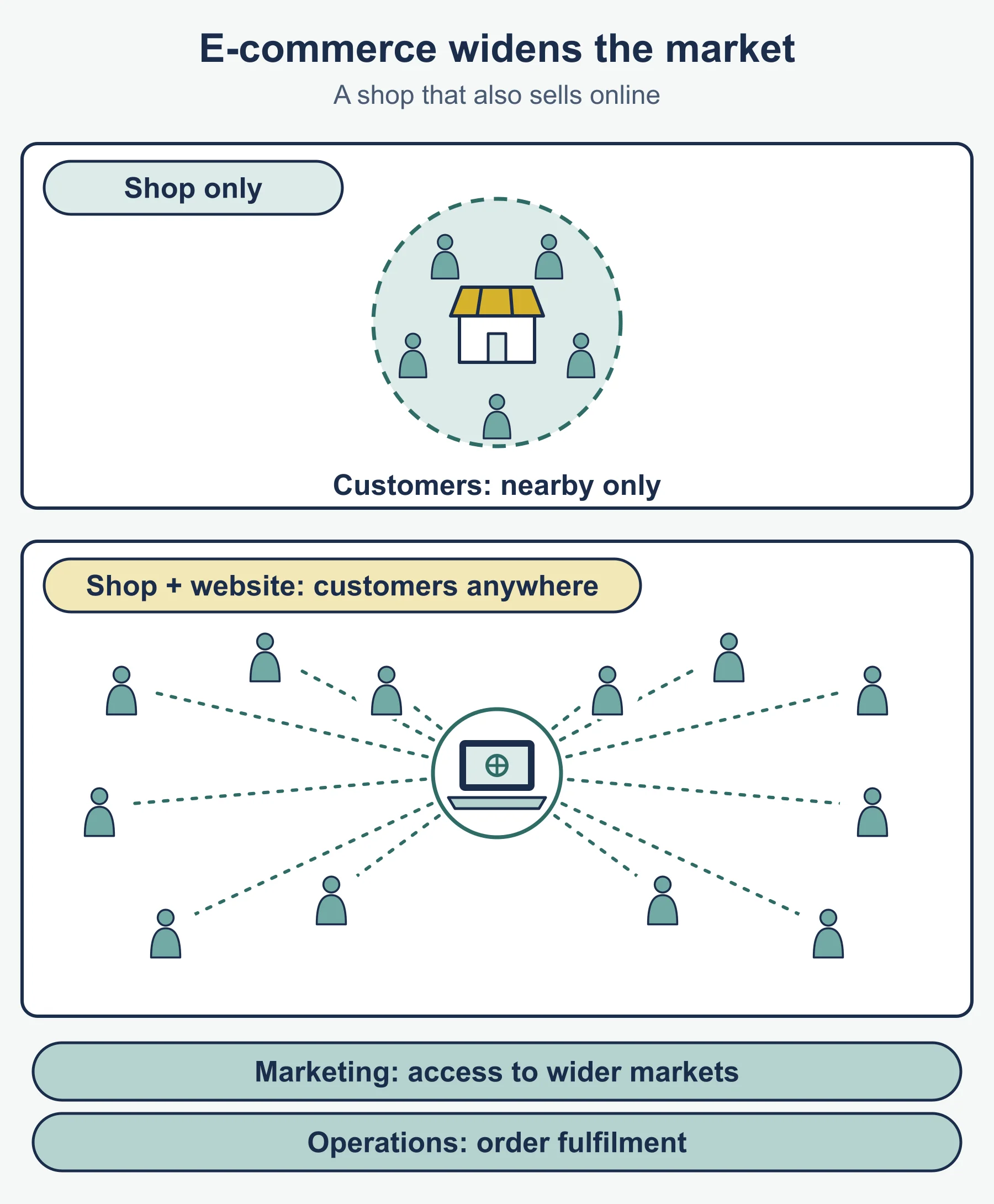
E-commerce is buying and selling over the internet. M-commerce is doing so on a mobile device such as a phone. Both are growing, and both let a business reach international markets without opening shops there.
- Benefits: wider reach, open at all hours, lower premises costs, easy data collection.
- Drawbacks: security and fraud risks, delivery costs and delays, customers cannot touch the product, strong online competition, and website costs.
The mix as a whole
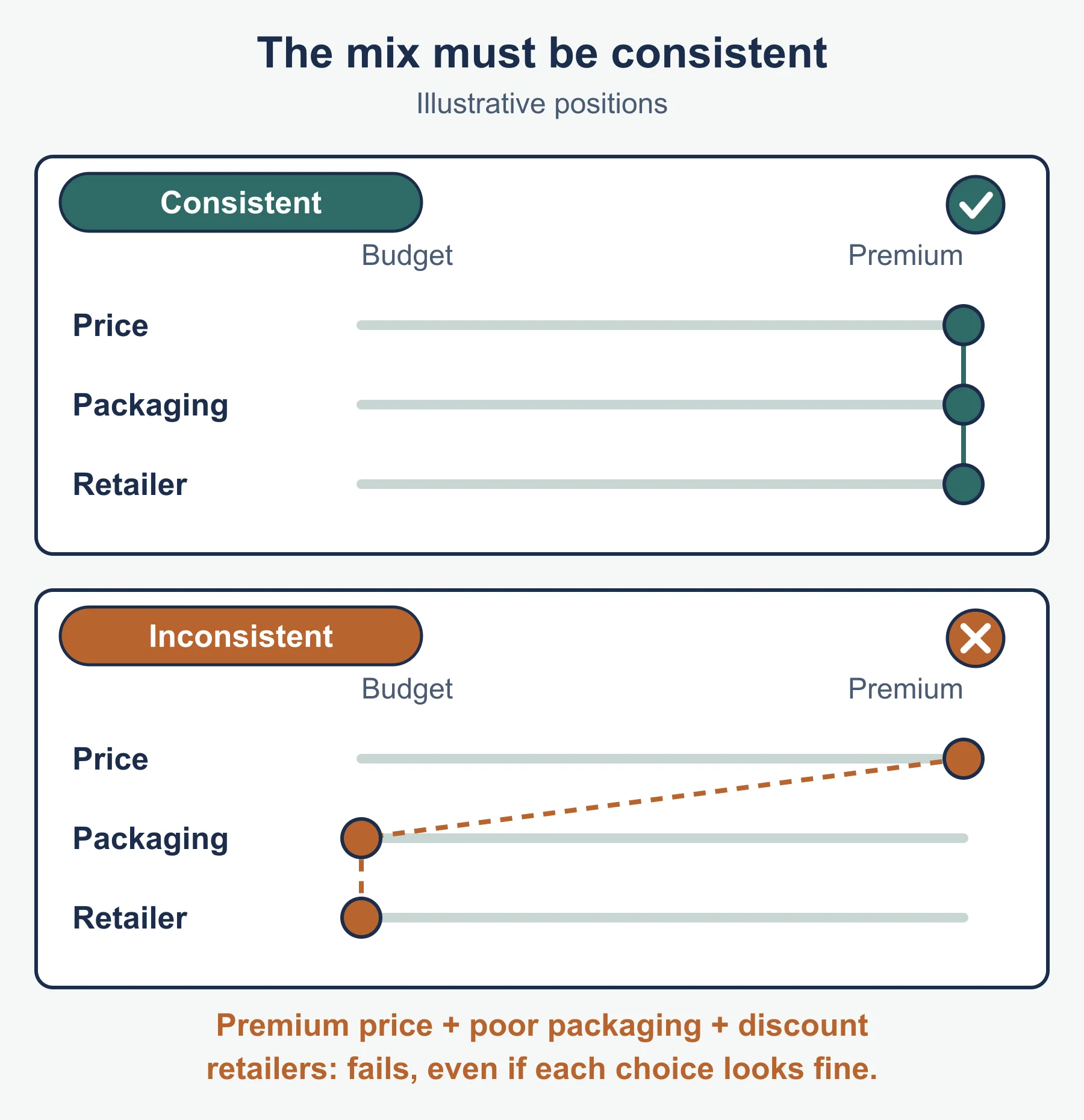
The four elements must fit together. A luxury product at a high price needs a premium image, upmarket retailers and careful promotion. A budget price with expensive television adverts would clash.
The mix changes over time. At introduction a business may spend heavily on promotion. In decline it may cut price and drop weak channels. When asked to recommend marketing activities for a business, state the target market, choose a mix that matches it, and justify each choice with a business fact from the case. A good evaluation weighs benefits against drawbacks and ends with a judgement.
Common errors
- Confusing market size (all sales) with market share (one firm’s percentage).
- Saying skimming and penetration both use low prices.
- Treating a loss leader as a loss for the whole business: it is meant to win other sales.
- Describing the stages of the product life cycle without linking them to sales or action.
- Giving a list of promotion methods with no reason why one suits the business.
Frequently asked questions
What are the pricing methods in AQA GCSE Business (8132)? Price skimming, price penetration, competitive pricing, loss leader and cost-plus pricing. Each has a different impact, for example skimming earns a large profit per unit from early buyers while penetration builds market share quickly.
What is a USP? A unique selling point is a feature that sets a product apart from its rivals. It helps differentiate the product and can support a stronger brand image.
What is the difference between e-commerce and m-commerce? E-commerce is buying and selling over the internet. M-commerce is doing so on a mobile device such as a smartphone.
Is a loss leader a loss for the whole business? No. The item is priced below cost to bring shoppers in, and the business aims to make up the lost margin when they buy other items.
Official syllabus
Source: AQA 8132 GCSE Business specification (first teaching September 2017), section 3.5 Marketing, parts 3.5.1 to 3.5.4.
Get free revision emails (optional)
Occasional emails with practice questions, worked explanations and links to free resources for the qualification and subjects you choose. No spam, and you can unsubscribe from any email. The free tools on this site never need an email.
Related resources
-
Practice questions
AQA GCSE Business: Marketing (8132) – Practice Questions
Original questions with worked answers on AQA GCSE Business marketing: research, market share, pricing, life cycle, Boston Matrix, promotion and place.
Business · AQA · GCSE
Try questions -
Revision notes
AQA GCSE Business: Marketing (8132) – Revision Notes
Condensed AQA GCSE Business revision notes on marketing: segmentation, research methods, pricing, life cycle, Boston Matrix, promotion and place.
Business · AQA · GCSE
Revise topic -
Study guides
AQA GCSE Business: Setting business aims and objectives and Stakeholders (8132)
Study guide to AQA GCSE Business (8132) sections 3.1.3 and 3.1.4: business aims and objectives, why they change, and stakeholders with worked examples.
Business · AQA · GCSE
Read guide
Related articles
-
teaching
A Level tuition in Dubai: Cambridge or Pearson Edexcel International A Level?
Schools in Dubai and Abu Dhabi teach either Cambridge International AS & A Level or Pearson Edexcel International A Level. How the two are structured, why it matters for tuition, and how online classes from Lahore work.
9 October 2026
-
curriculum guides
Choosing subjects at IGCSE and A Level
How subject choices at 14 and 16 affect university options later, and how to keep pathways open without overloading a timetable.
28 July 2026
Studying this with a teacher
Working through Business GCSE?
This page is free and stays free. If you would rather be taught it, Marlbridge runs Business classes one-to-one and in small groups of up to 15, online in your own time zone. The first trial class is free. WhatsApp replies within an hour (8am–11pm Pakistan time, every day); email the same day.
AQA Business teachers at Marlbridge
