
Study Guides
AQA GCSE Economics: Money and the financial sector (8136)
Study guide to AQA GCSE Economics 8136 3.2.5.1 and 3.2.5.2: the four functions of money, what counts as money, the Bank of England and high street banks.
- Subject
- Economics
- Level
- GCSE
- Topic
- The functions and definition of money; the Bank of England, banks and building societies
- Author
- Marlbridge Academic Team
- Updated
- Reviewed by
- Salman Ahmad (what this means)
Aligned to AQA GCSE Economics (8136), For first teaching from September 2017. Official specification .
Syllabus page (what it covers and how it is assessed): AQA GCSE Economics.
Syllabus points this page covers
8136
- 3.2.5.1 The role of money
- 3.2.5.2 The role and importance of the financial sector for the economy
Found an error? Report a correction.
Need help with this topic? Request a free trial class for GCSE Economics (8136).
Money is anything that is generally accepted as payment for goods and services; it works as a medium of exchange, a unit of account, a store of value and a means of deferred payment. The financial sector is the group of institutions, such as the Bank of England, commercial banks and building societies, that moves money from savers to borrowers and keeps the payment system working. AQA GCSE Economics (8136) sections 3.2.5.1 and 3.2.5.2 ask you to explain the functions of money, why money is more than notes and coins, the role of the Bank of England, and how high street banks help savers, borrowers and investment.
Both sections are in 3.2 How the economy works, assessed on Paper 2, with no tiers. Numbers are invented unless a real UK fact is stated. Pair this guide with the revision notes and the practice questions. Interest rates are covered in the interest rates guide and monetary policy in the fiscal and monetary policy guide. Course links: AQA GCSE Economics hub, checklist and free diagnostics.
Syllabus coverage
| Specification point | What you must be able to do |
|---|---|
| 3.2.5.1 Functions of money | Explain money as a medium of exchange, a unit of account, a store of value and a means of deferred payment |
| 3.2.5.1 Definition of money | Explain that money can be defined as more than the banknotes and coins in circulation |
| 3.2.5.2 The financial sector | Identify the main agents: the Bank of England, commercial banks and building societies |
| 3.2.5.2 The Bank of England | Explain its role in influencing interest rates and ensuring the stability of the financial system |
| 3.2.5.2 Other institutions | Explain how high street banks help fund investment and provide a service for savers and borrowers |
What are the four functions of money?
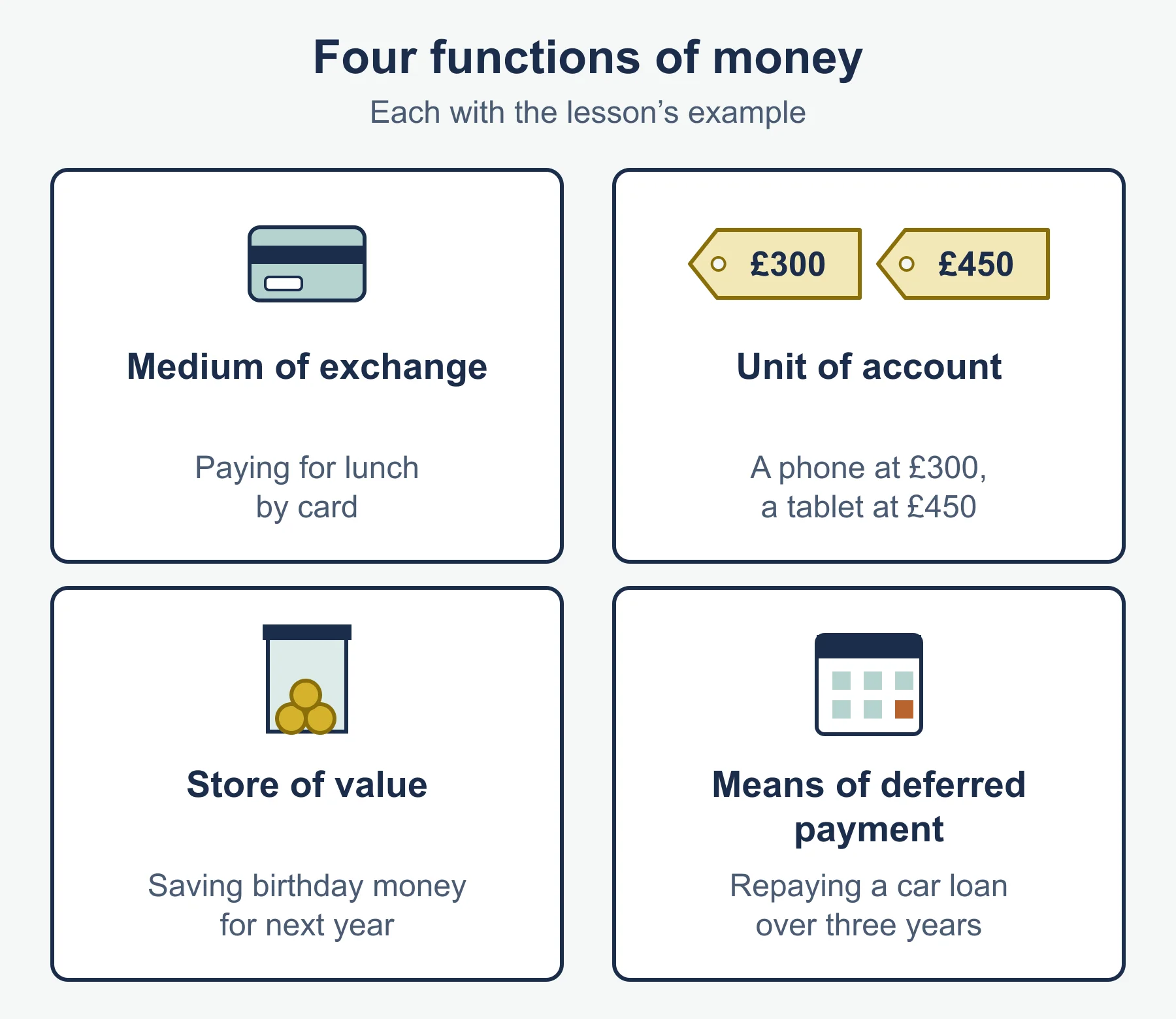
| Function | Meaning | Example |
|---|---|---|
| Medium of exchange | Money is accepted in return for goods and services, so people do not need to barter | Paying for lunch by card |
| Unit of account | Money gives a common measure of value, so prices can be compared | A phone priced at £300 and a tablet at £450 |
| Store of value | Money can be kept and used later without losing its usefulness | Saving birthday money for next year |
| Means of deferred payment | Money lets people buy now and pay later, because debts can be set in money terms | Repaying a car loan over three years |
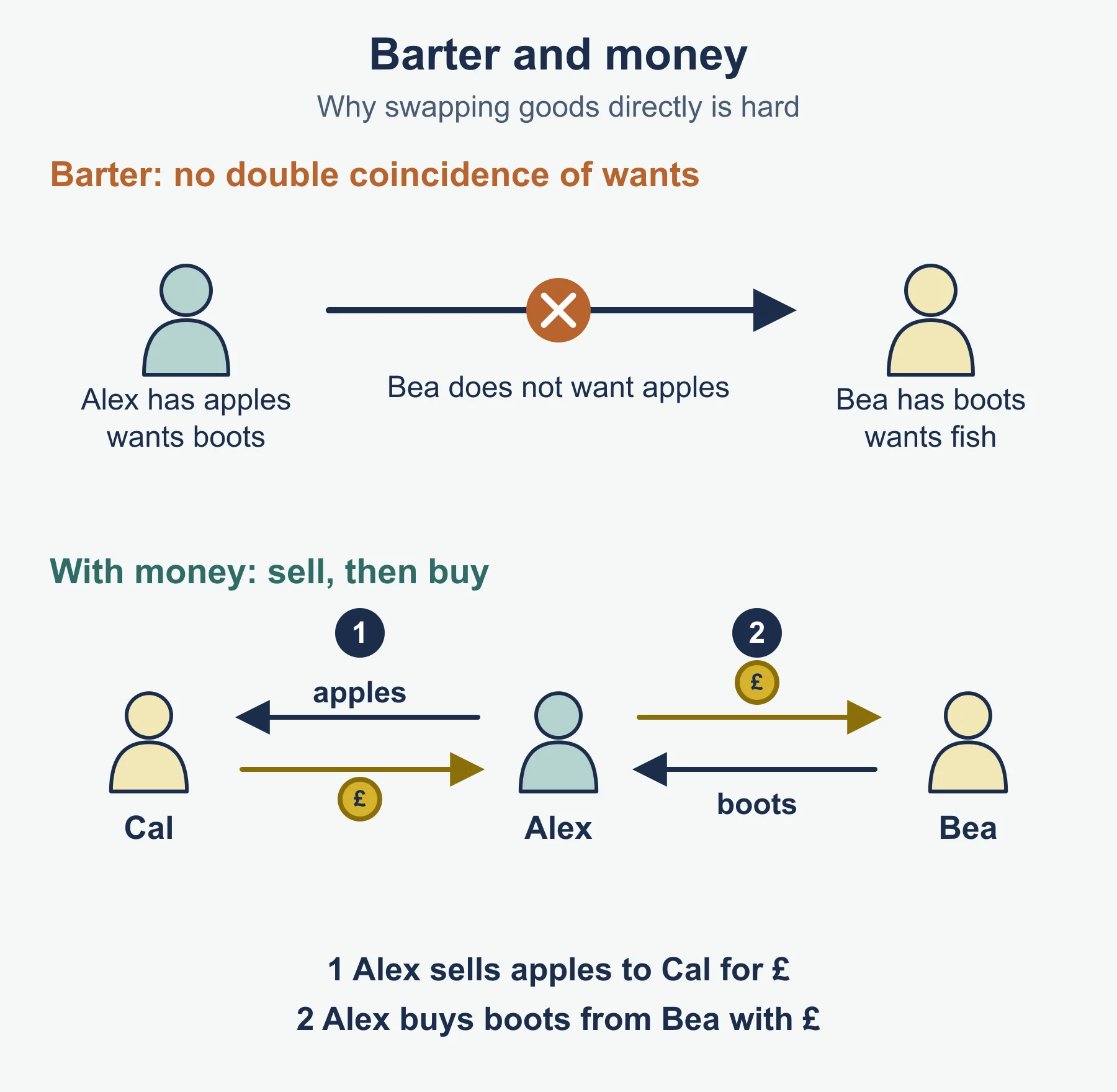
Without money, people would have to barter, swapping goods directly. Barter needs a double coincidence of wants: each person must have what the other wants at the same time, which makes trade slow and difficult.
Why inflation matters for money
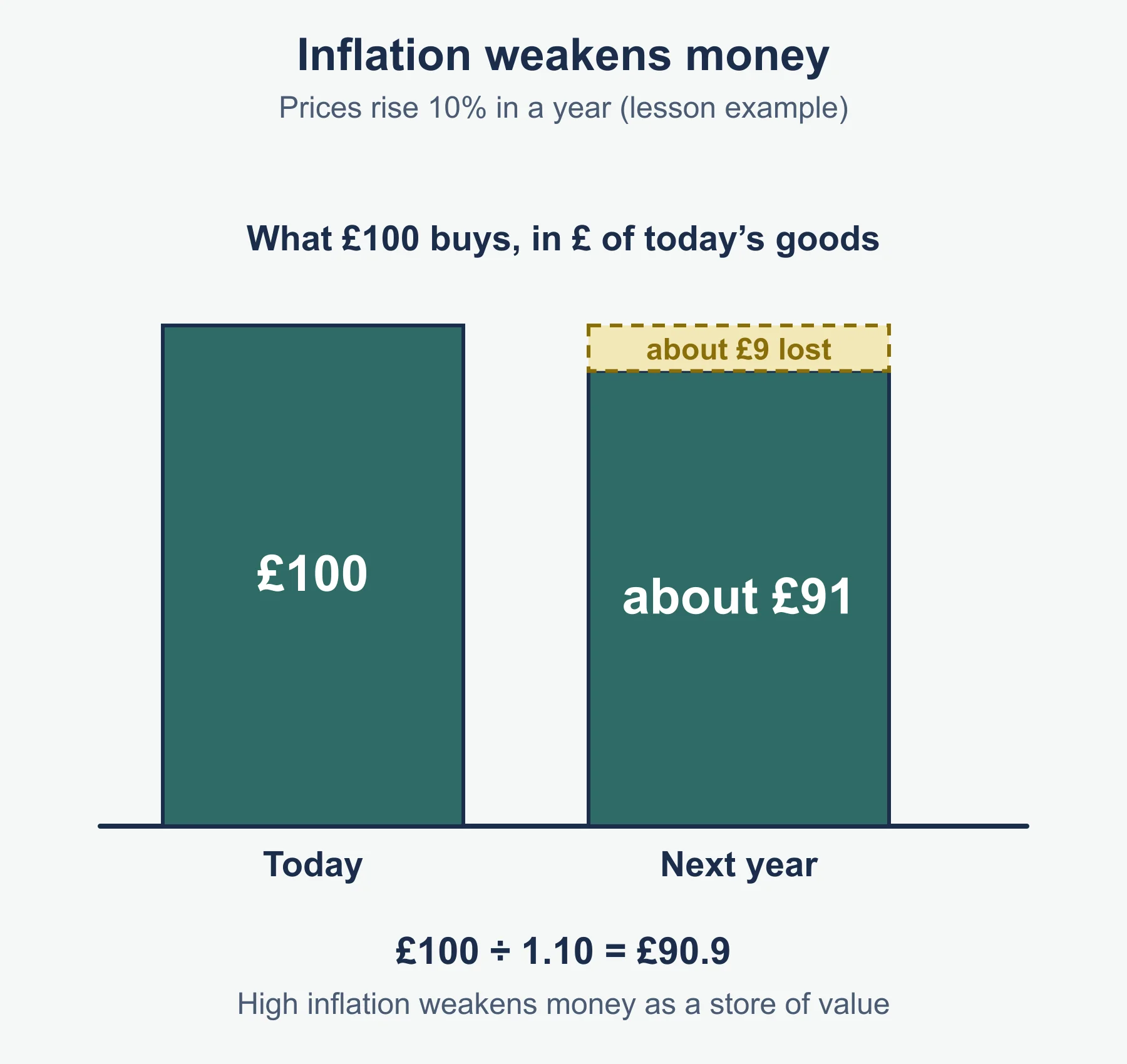
Money is a good store of value only if prices are stable. If prices rise by 10% in a year, £100 saved buys only about £91 of today’s goods next year (100 ÷ 1.10 = 90.9). High inflation weakens money’s role as a store of value and as a unit of account.
Why is money more than notes and coins?
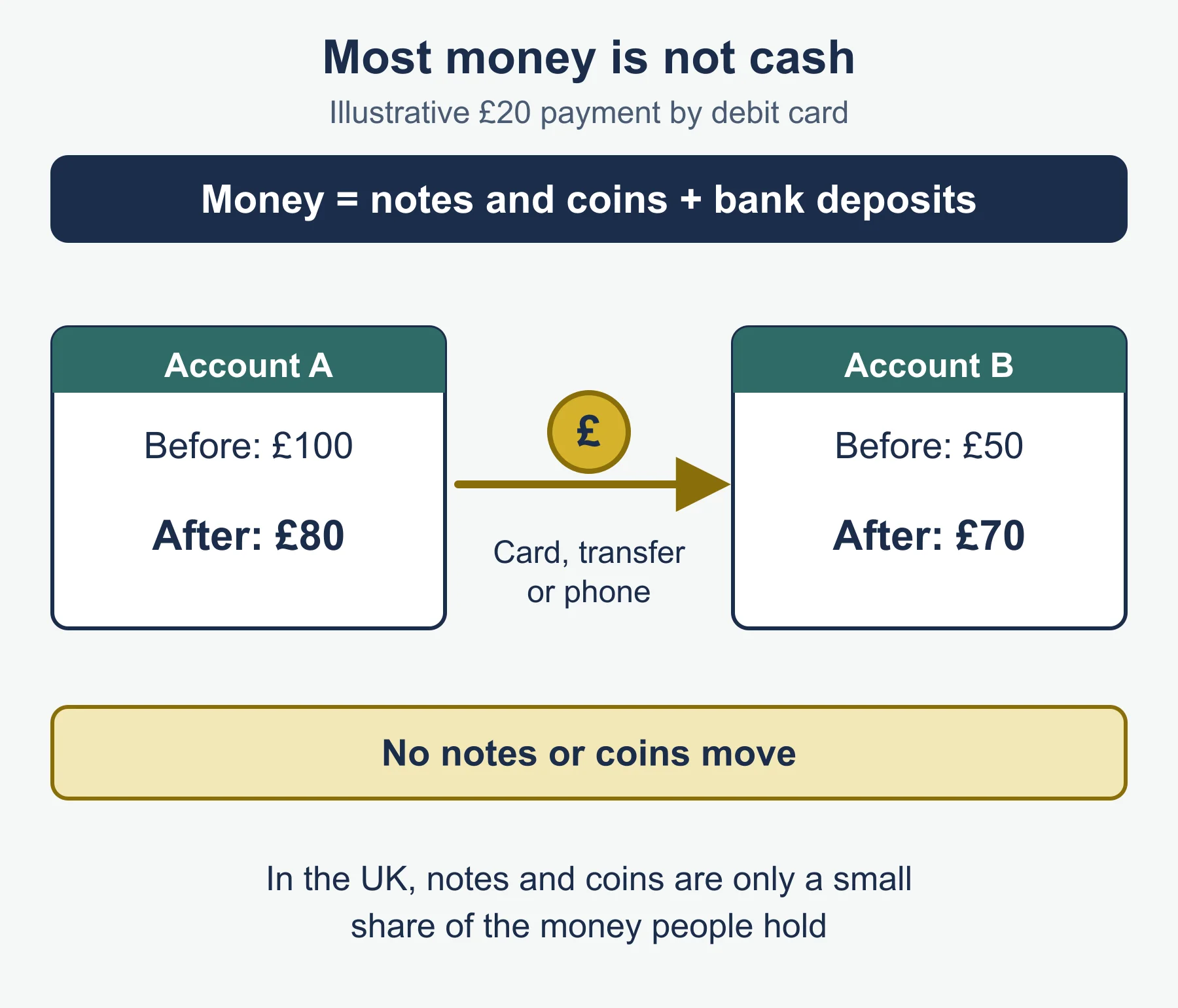
Most money in a modern economy is not cash. It exists as bank deposits: the balances in current and savings accounts. People pay with debit cards, bank transfers and phones, which move deposits from one account to another. So a definition of money includes bank deposits as well as the notes and coins in circulation. In the UK, notes and coins make up only a small share of the money people hold.
What is the financial sector?
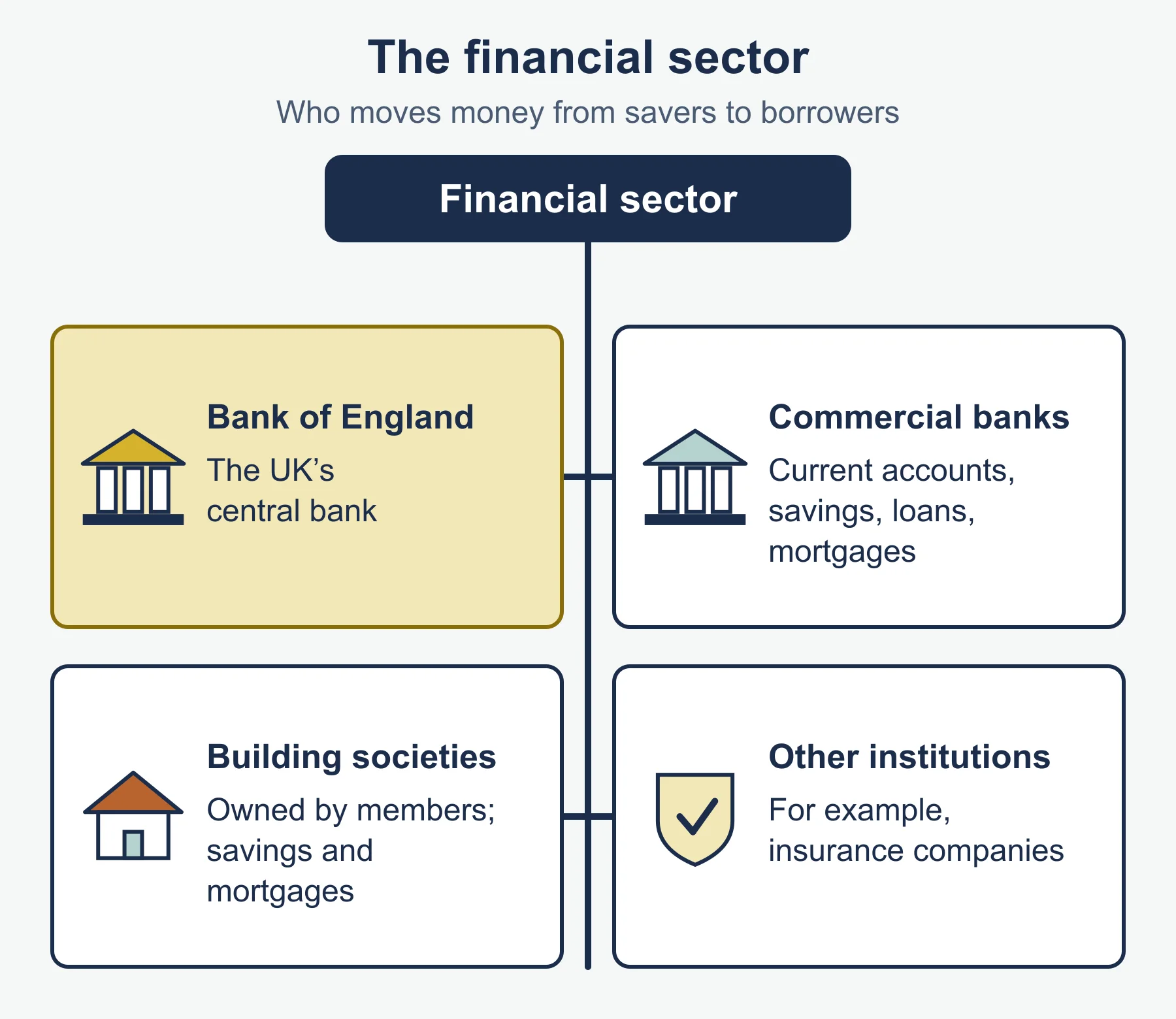
The financial sector includes:
- The Bank of England, the UK’s central bank;
- Commercial (high street) banks, which provide current accounts, savings accounts, loans and mortgages;
- Building societies, which are owned by their members (savers and borrowers) rather than shareholders and specialise in savings and mortgages;
- other institutions, such as insurance companies.
What does the Bank of England do?
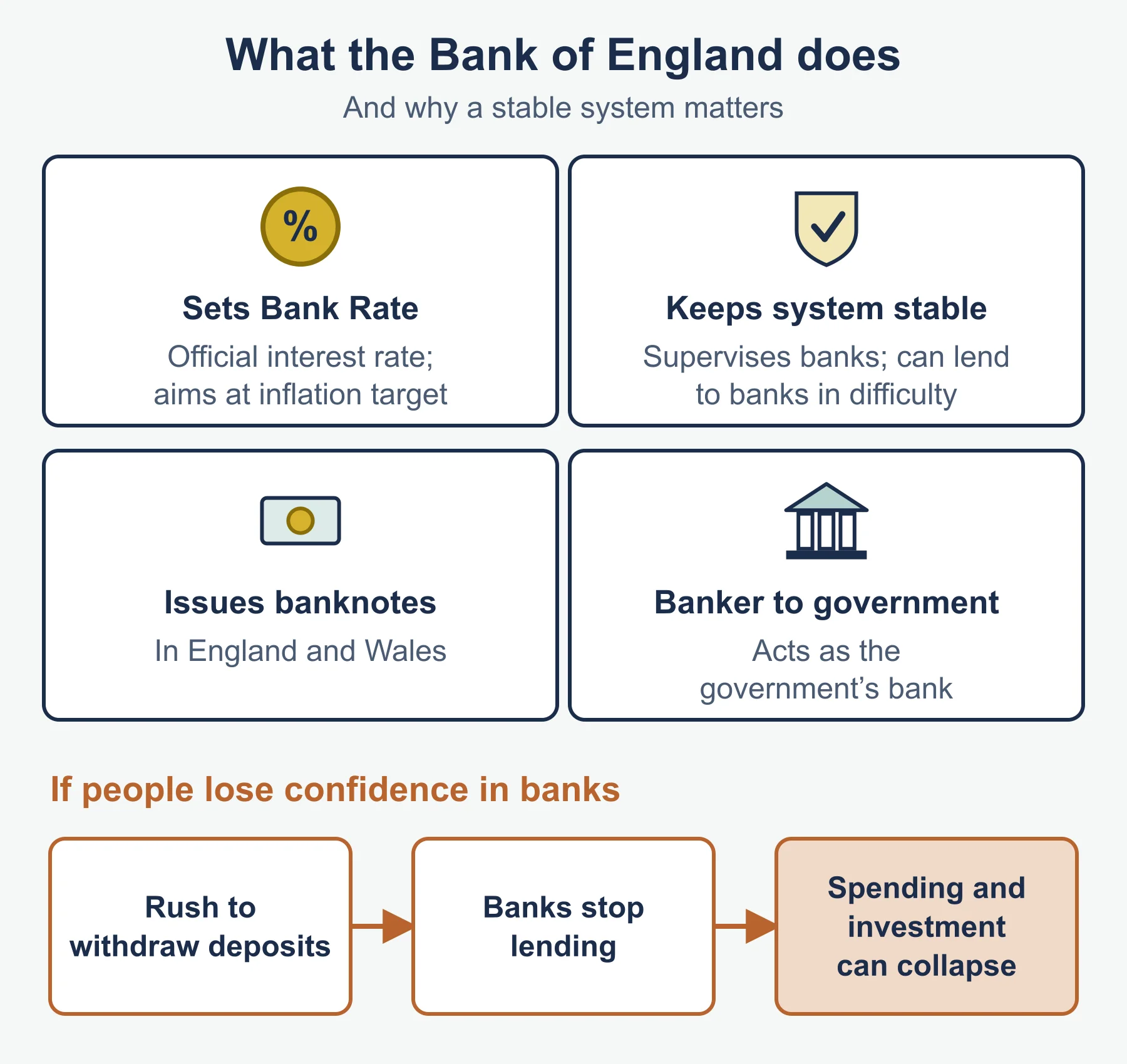
- Sets the Bank Rate: its Monetary Policy Committee sets the official interest rate, which influences the rates banks charge borrowers and pay savers. This is how it pursues the government’s inflation target.
- Keeps the financial system stable: it supervises banks so that they are safe and can repay depositors, and it can lend to banks in difficulty to stop a crisis spreading.
- Issues banknotes in England and Wales.
- Acts as the government’s bank.
A stable financial system matters because if people lose confidence in banks they may rush to withdraw deposits, banks may stop lending, and spending and investment can collapse.
How do high street banks help the economy?
- A service for savers: banks keep money safe and pay interest on savings.
- A service for borrowers: banks lend to households through loans and mortgages, so people can buy homes and cars before they have saved the full price.
- Funding investment: banks lend to firms so they can buy machinery, build premises and expand, which raises output and creates jobs.
- Payments: banks provide current accounts, cards and transfers, so money can be used as a medium of exchange quickly and safely.
Worked example: how a bank earns income (illustrative)
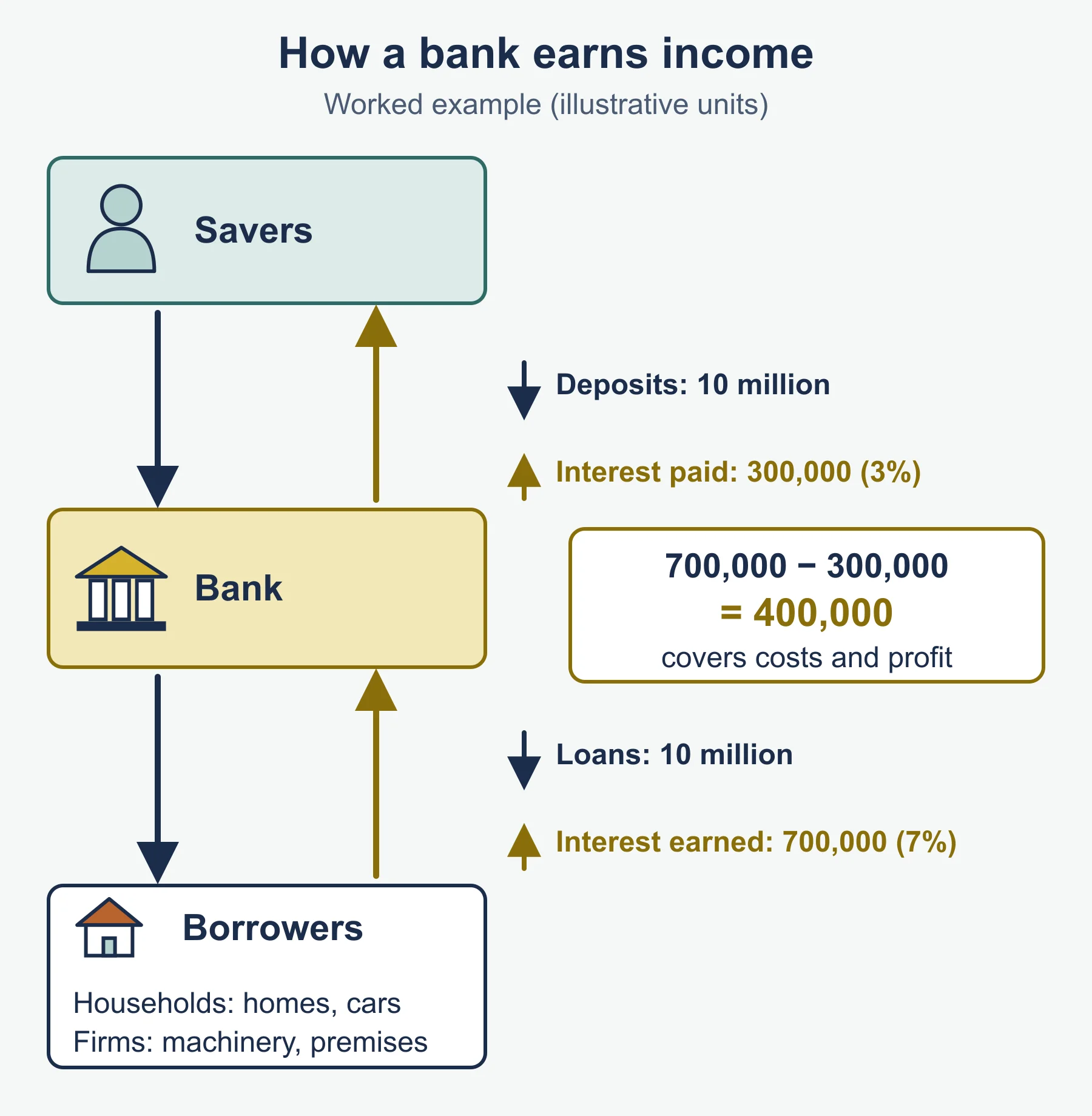
A bank pays savers 3% interest and lends at 7%. If it lends out 10 million units of deposits, it receives 0.07 × 10 million = 700,000 in interest and pays 0.03 × 10 million = 300,000 to savers. The difference of 400,000 covers its costs and profit. This gap is why banks want both savers and borrowers.
Why does the financial sector matter for the economy?
Without banks, savers’ money would sit idle and firms would find it harder to invest. By moving money from savers to borrowers, the financial sector helps growth and employment. It is also important to the UK economy directly, because financial services are a large employer and a major export.
Common errors
- Mixing up “store of value” and “means of deferred payment”: one is about saving, the other about paying debts later.
- Saying money is only cash.
- Saying the government sets UK interest rates; the Bank of England does.
- Describing building societies as identical to banks without noting they are owned by members.
Frequently asked questions
Why is barter inefficient? It needs a double coincidence of wants, so people must find someone who has what they want and wants what they have.
What is the main role of the Bank of England? It sets the Bank Rate to meet the inflation target and keeps the financial system stable.
How do banks help firms grow? They lend to firms so they can invest in machinery and buildings, raising output and creating jobs.
Official syllabus
AQA GCSE Economics (8136) specification, for first teaching from September 2017, published by AQA: sections 3.2.5.1 The role of money and 3.2.5.2 The role and importance of the financial sector for the economy.
Get free revision emails (optional)
Occasional emails with practice questions, worked explanations and links to free resources for the qualification and subjects you choose. No spam, and you can unsubscribe from any email. The free tools on this site never need an email.
Related resources
-
Practice questions
AQA GCSE Economics: Money and the financial sector (8136) – Practice Questions
Eleven original practice questions with worked answers for AQA GCSE Economics 8136 3.2.5.1 and 3.2.5.2: functions of money, banks and the Bank of England.
Economics · AQA · GCSE
Try questions -
Revision notes
AQA GCSE Economics: Money and the financial sector (8136) – Revision Notes
Condensed AQA GCSE Economics revision notes for 3.2.5.1 and 3.2.5.2: functions and definition of money, the Bank of England, banks and building societies.
Economics · AQA · GCSE
Revise topic -
Study guides
AQA GCSE Economics: The Economic Objectives of the Government (8136)
AQA GCSE Economics (8136) section 3.2.2 guide: stable prices, growth, full employment and the balance of payments, and why pursuing one can harm another.
Economics · AQA · GCSE
Read guide
Related articles
-
teaching
A Level tuition in Dubai: Cambridge or Pearson Edexcel International A Level?
Schools in Dubai and Abu Dhabi teach either Cambridge International AS & A Level or Pearson Edexcel International A Level. How the two are structured, why it matters for tuition, and how online classes from Lahore work.
9 October 2026
-
curriculum guides
Choosing subjects at IGCSE and A Level
How subject choices at 14 and 16 affect university options later, and how to keep pathways open without overloading a timetable.
28 July 2026
Studying this with a teacher
Working through Economics GCSE?
This page is free and stays free. If you would rather be taught it, Marlbridge runs Economics classes one-to-one and in small groups of up to 15, online in your own time zone. The first trial class is free. WhatsApp replies within an hour (8am–11pm Pakistan time, every day); email the same day.
AQA Economics teachers at Marlbridge
