
Study Guides
AQA GCSE English Language (8700): Critical Reading and Comprehension
AQA GCSE English Language 8700 guide to critical reading: inference, evidence, evaluating a statement, spotting bias and weighing different readings of a text.
- Subject
- English
- Level
- GCSE
- Topic
- Topic 1: Critical reading and comprehension
- Author
- Marlbridge Academic Team
- Updated
- Reviewed by
- Ammar Bilal (what this means)
Aligned to AQA GCSE English (8700), For first teaching 2015. Official specification .
Syllabus page (what it covers and how it is assessed): AQA GCSE English Language.
Found an error? Report a correction.
Need help with this topic? Request a free trial class for GCSE English Language (8700).
Critical reading is the skill underneath every reading question in AQA GCSE English Language (8700). Before you can analyse a metaphor or compare two writers, you have to understand what a text says, what it implies, and how far you trust it. This guide goes deeper into that skill than the paper-level guides do. For quick recall use the critical reading revision notes, and to test yourself use the critical reading practice questions.
What the specification includes
The first content bullet of 3.1.1 Critical reading and comprehension is long, and every part of it is examinable. In plain terms it asks you to:
- identify and interpret themes, ideas and information in literature and other high-quality writing;
- read in different ways for different purposes, and judge how useful, relevant and well presented content is;
- draw inferences and justify them with evidence;
- support a point of view by referring to the text;
- identify bias and misuse of evidence, telling apart statements that are supported by evidence from those that are not;
- reflect critically on a text, using its context and what you know from wider reading;
- recognise that a text can be read in more than one way.
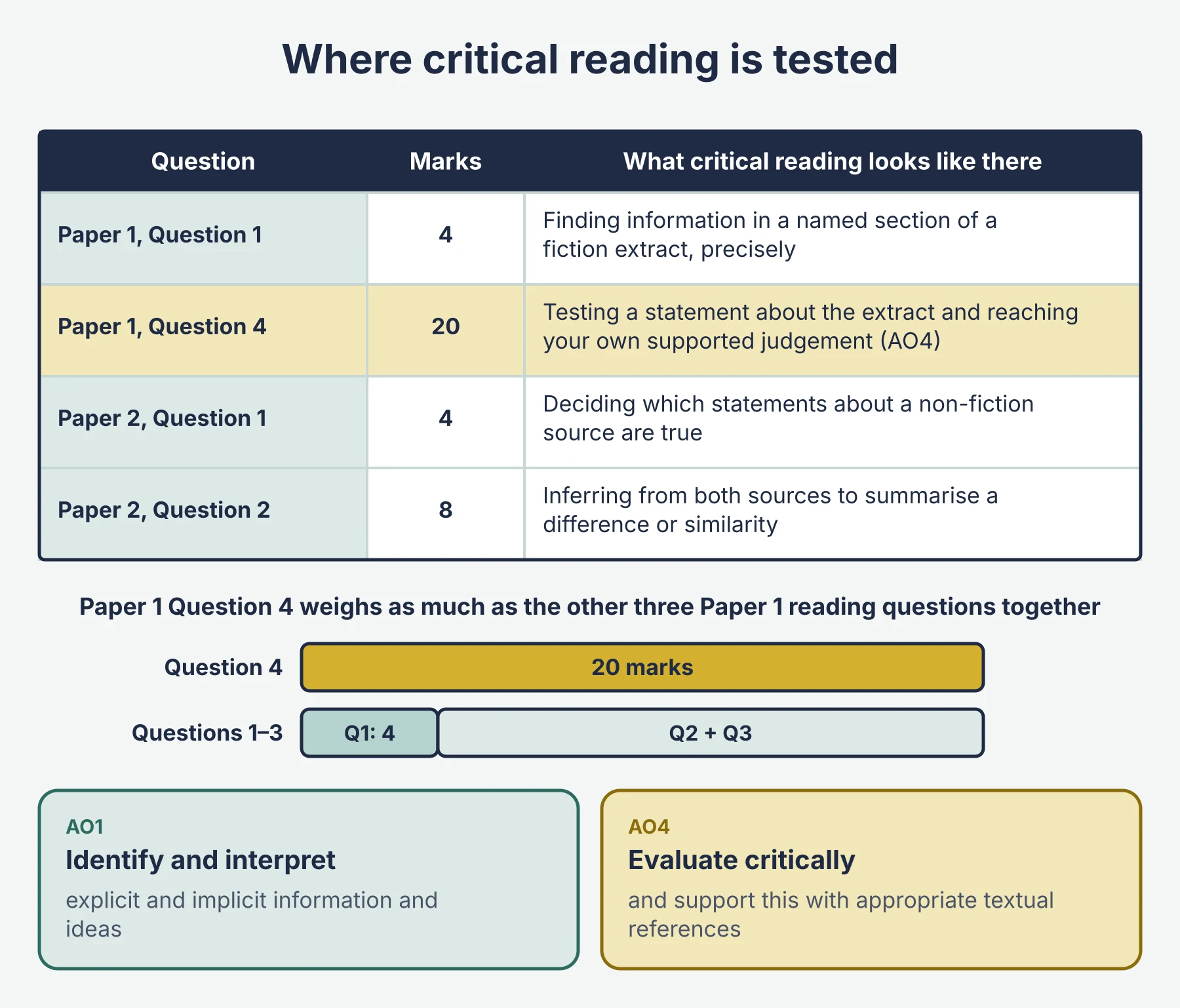
Two assessment objectives carry most of this: AO1 (identify and interpret explicit and implicit information and ideas) and AO4 (evaluate texts critically and support this with appropriate textual references).
| Where it is tested | What critical reading looks like there |
|---|---|
| Paper 1, Question 1 (4 marks) | Finding information in a named section of a fiction extract, precisely |
| Paper 1, Question 4 (20 marks) | Testing a statement about the extract and reaching your own supported judgement (AO4) |
| Paper 2, Question 1 (4 marks) | Deciding which statements about a non-fiction source are true |
| Paper 2, Question 2 (8 marks) | Inferring from both sources to summarise a difference or similarity |
Paper 1 Question 4 is the heaviest single test of this subtopic: it is worth as much as the other three Paper 1 reading questions together.
Key idea 1: explicit, implicit and the inference chain
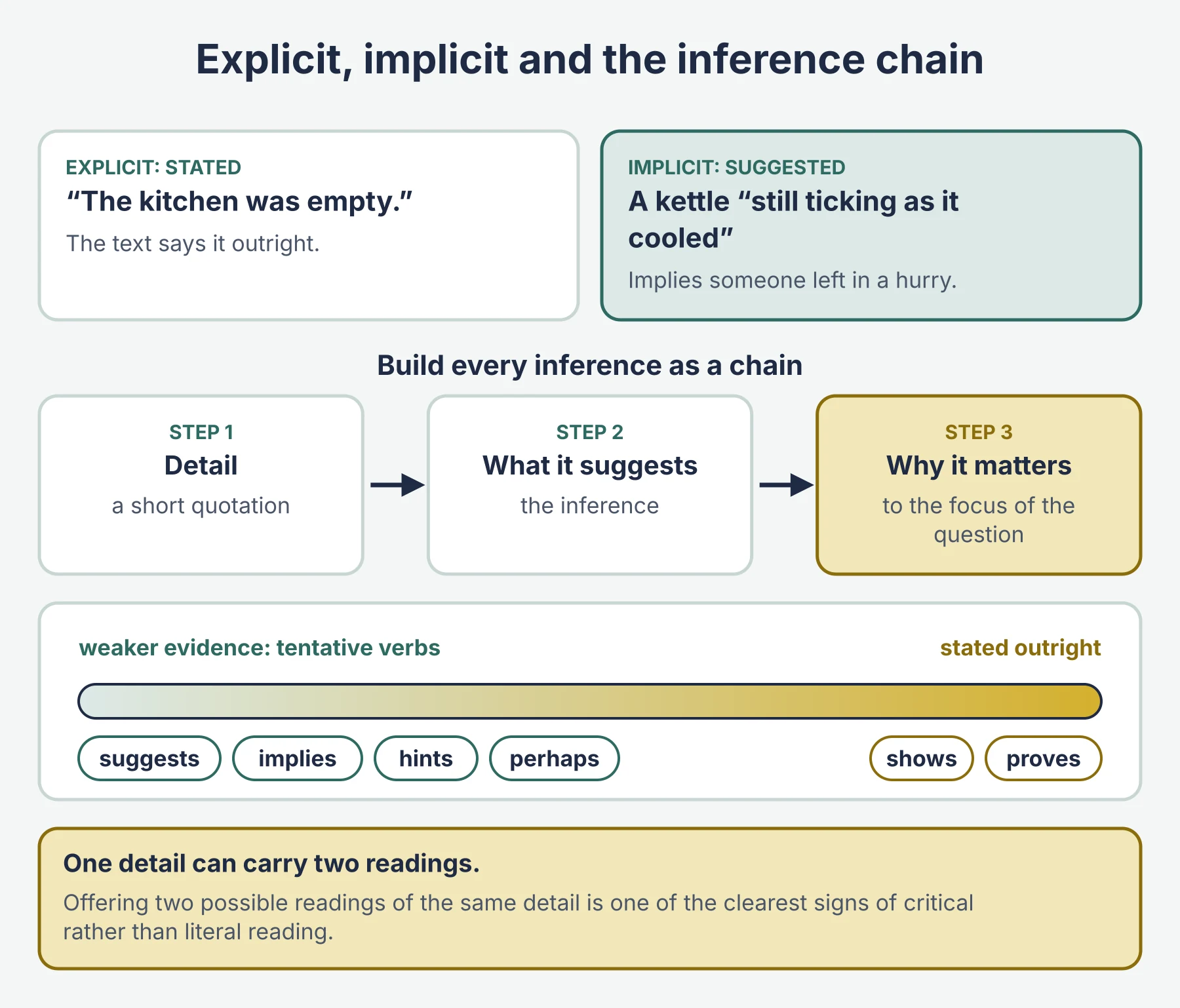
Explicit information is stated: “The kitchen was empty.” Implicit information is suggested: a kettle “still ticking as it cooled” implies that someone left in a hurry. An inference is only as strong as the evidence beneath it, so build every one as a chain:
Detail (short quotation) -> what it suggests -> why that matters to the focus of the questionUse tentative verbs that match the strength of the evidence: suggests, implies, hints, perhaps. Save shows and proves for what is stated outright. A single detail can carry more than one inference; offering two possible readings of the same detail is one of the clearest signs of critical rather than literal reading.
Key idea 2: reading in different ways for different purposes
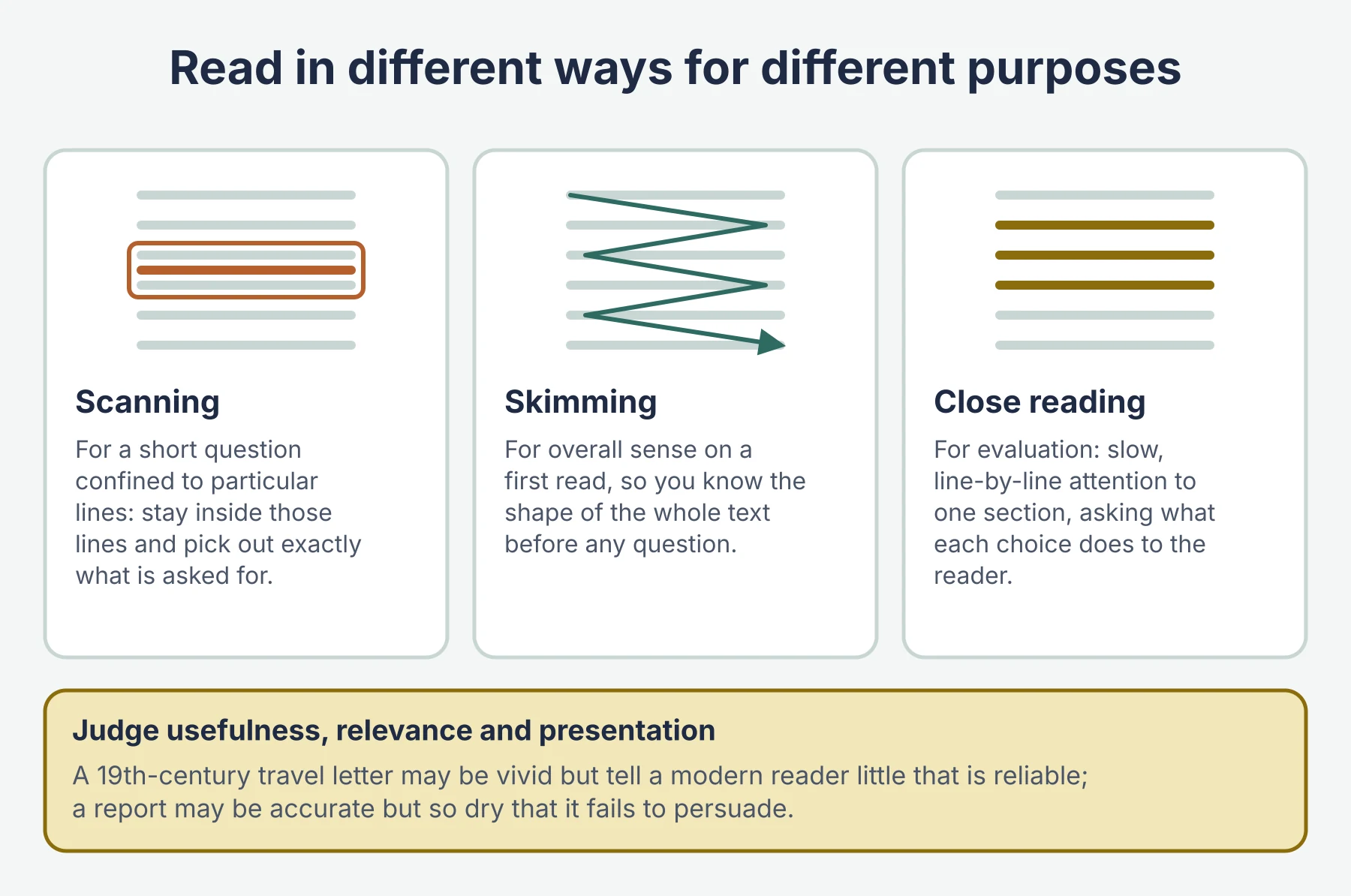
Each question needs a different kind of reading:
- Scanning for a short question confined to particular lines: stay inside those lines and pick out exactly what is asked for.
- Skimming for overall sense on a first read, so you know the shape of the whole text before any question.
- Close reading for evaluation: slow, line-by-line attention to one section, asking what each choice does to the reader.
Judging “usefulness, relevance and presentation” means asking whether a text does its job for its purpose. A 19th-century travel letter may be vivid but tell a modern reader little that is reliable about the place; a report may be accurate but presented so drily that it fails to persuade.
Key idea 3: evaluating a statement
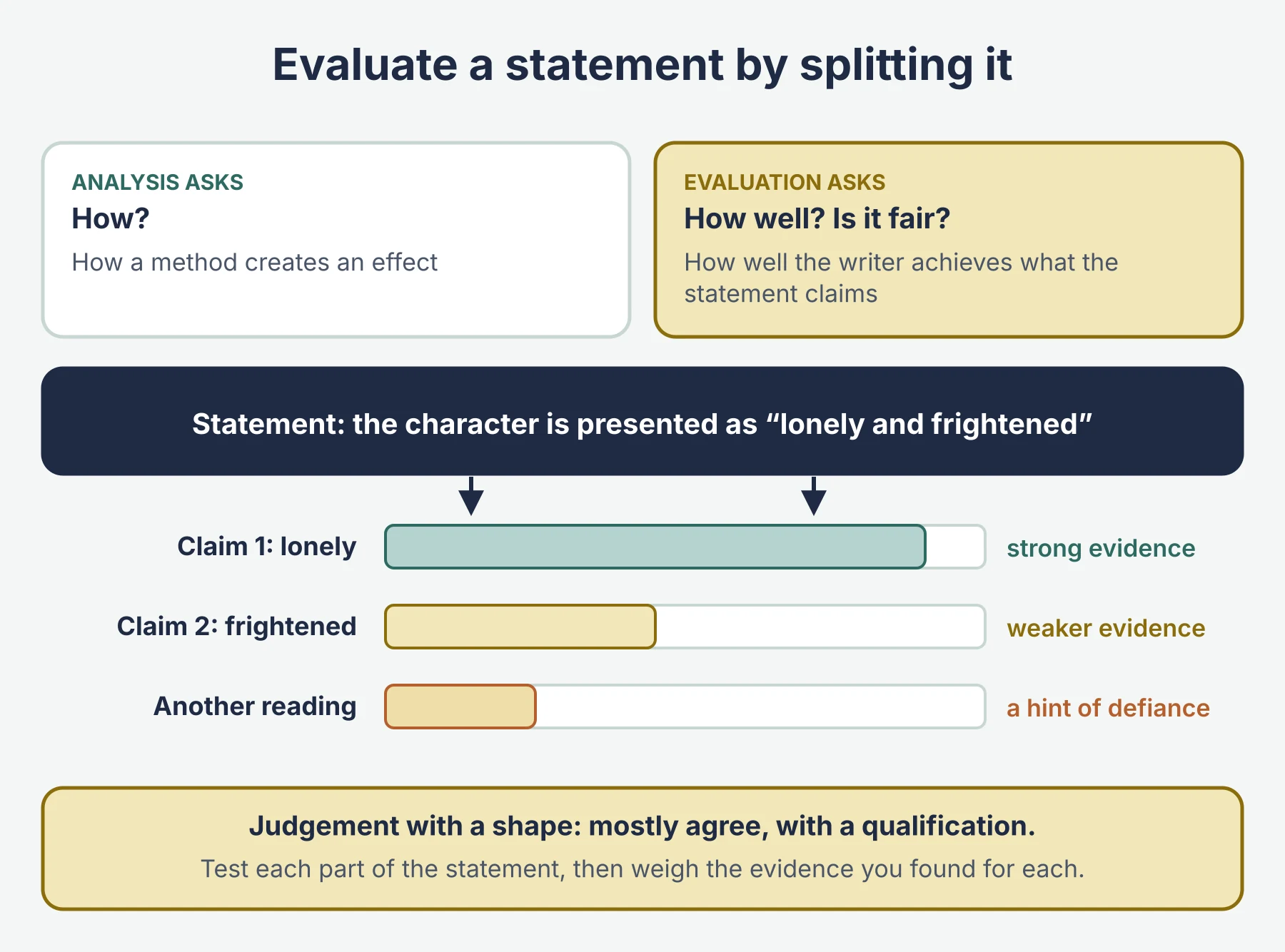
Paper 1 Question 4 gives you a view of part of the extract and asks how far you agree. Evaluation is not the same as analysis. Analysis explains how a method creates an effect; evaluation judges how well the writer achieves what the statement claims, and whether the statement is fair.
A reliable way to test a statement is to split it into its parts. If it says a character is presented as “lonely and frightened”, those are two claims. You might find strong evidence for loneliness, weaker evidence for fear, and a hint that the character is in fact defiant. That gives you a judgement with a shape: mostly agree, with a qualification.
Key idea 4: bias, evidence and unsupported claims
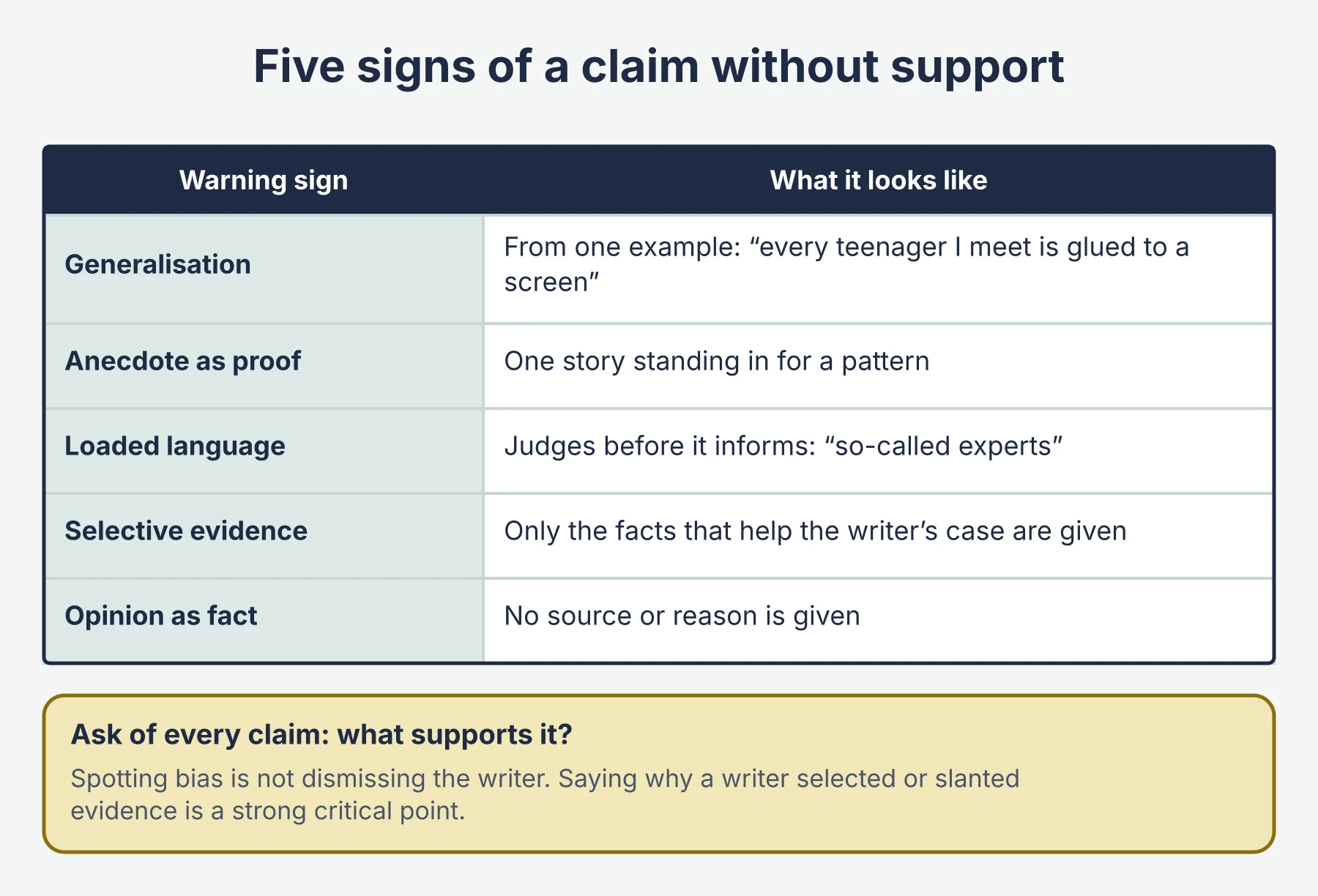
This part of the specification is mostly met in non-fiction, especially Paper 2’s sources. Ask of every claim: what supports it? Watch for:
- generalisation from one example (“every teenager I meet is glued to a screen”);
- anecdote presented as proof (one story standing in for a pattern);
- loaded language that judges before it informs (“so-called experts”);
- selective evidence, where only facts that help the writer’s case are given;
- opinion stated as fact, with no source or reason.
Spotting these is not the same as dismissing the writer. A biased text can still be powerful, and saying why a writer selected or slanted evidence is a strong critical point.
Key idea 5: context, wider reading and different responses
Use context only when it sharpens a reading. Knowing that a 19th-century writer assumed servants were part of every respectable household helps you see why a detail passes without comment. Wider reading helps you recognise conventions: a writer who withholds a character’s name may be building mystery, as many short-story openings do.
Recognising different responses means acknowledging, briefly and with evidence, another way to read a detail (“A reader could instead see her silence as calm control”), then saying which reading you find more convincing and why.
Worked example: testing a statement
The passage below is original, written for this guide.
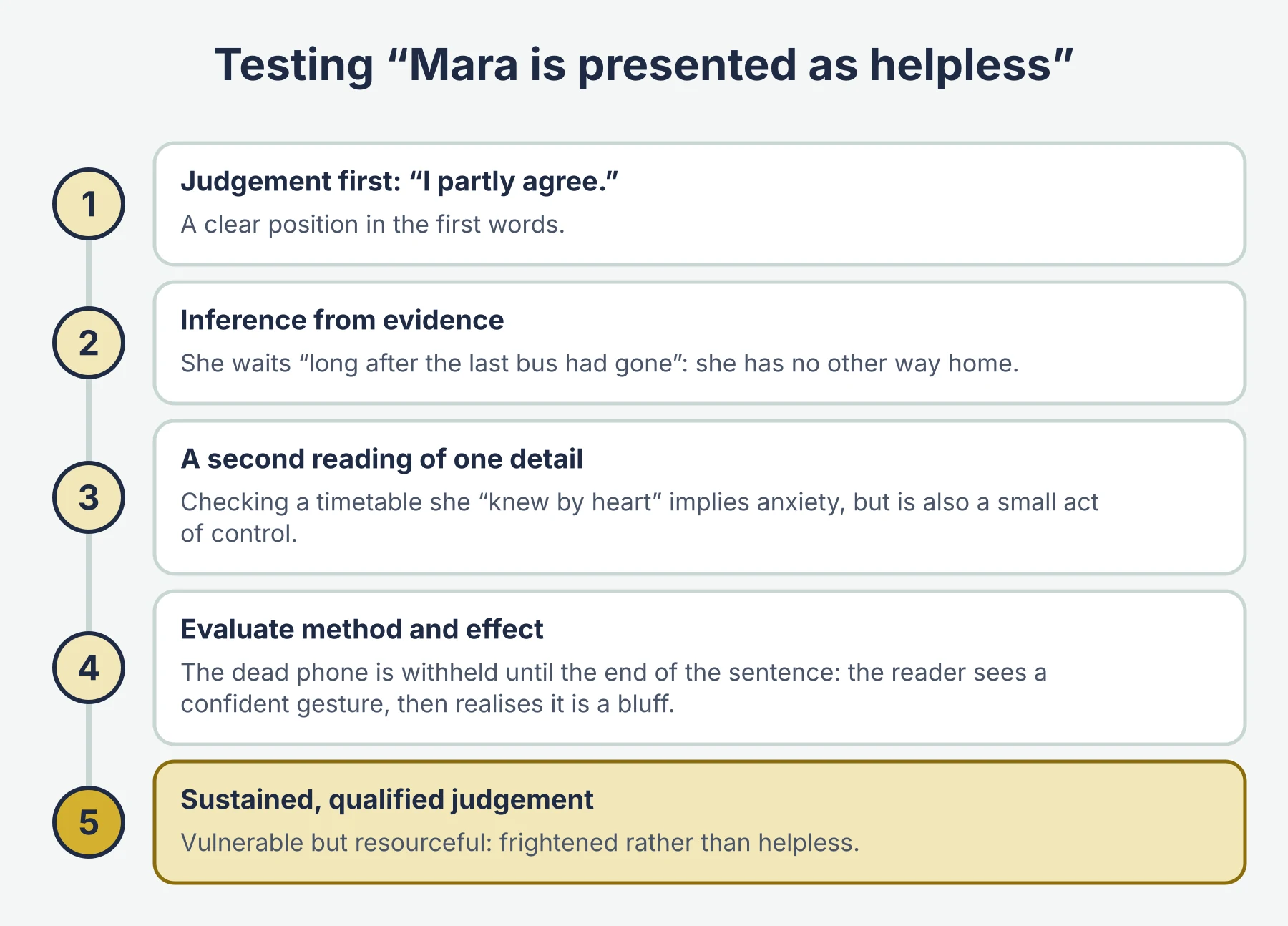
Mara waited at the bus stop long after the last bus had gone. She checked the timetable twice, though she knew it by heart. When a car slowed beside her, she stepped back into the shelter and pretended to read her phone, which had been dead since lunch.
Statement: “In this part of the story, the writer presents Mara as helpless.”
Model paragraph (annotated):
I partly agree. Mara is clearly stranded: she waits “long after the last bus had gone”, which suggests she has no other way home [inference from evidence]. Yet “helpless” is too simple. Checking a timetable she “knew by heart” implies anxiety, but it is also a small act of control, as if routine could keep her calm [second reading of one detail]. Most tellingly, she “pretended to read her phone, which had been dead since lunch”. The writer withholds the dead battery until the end of the sentence, so the reader first sees a confident gesture and then realises it is a bluff [evaluates method and effect]. Mara is vulnerable, but she is resourceful in protecting herself, so the writer presents her as frightened rather than helpless [sustained, qualified judgement].
Why this reaches higher levels: it gives a clear judgement in the first words, tests the key word of the statement, offers more than one reading of a detail, and evaluates the effect of the writer’s choice rather than only naming it.
Worked example: supported or unsupported?
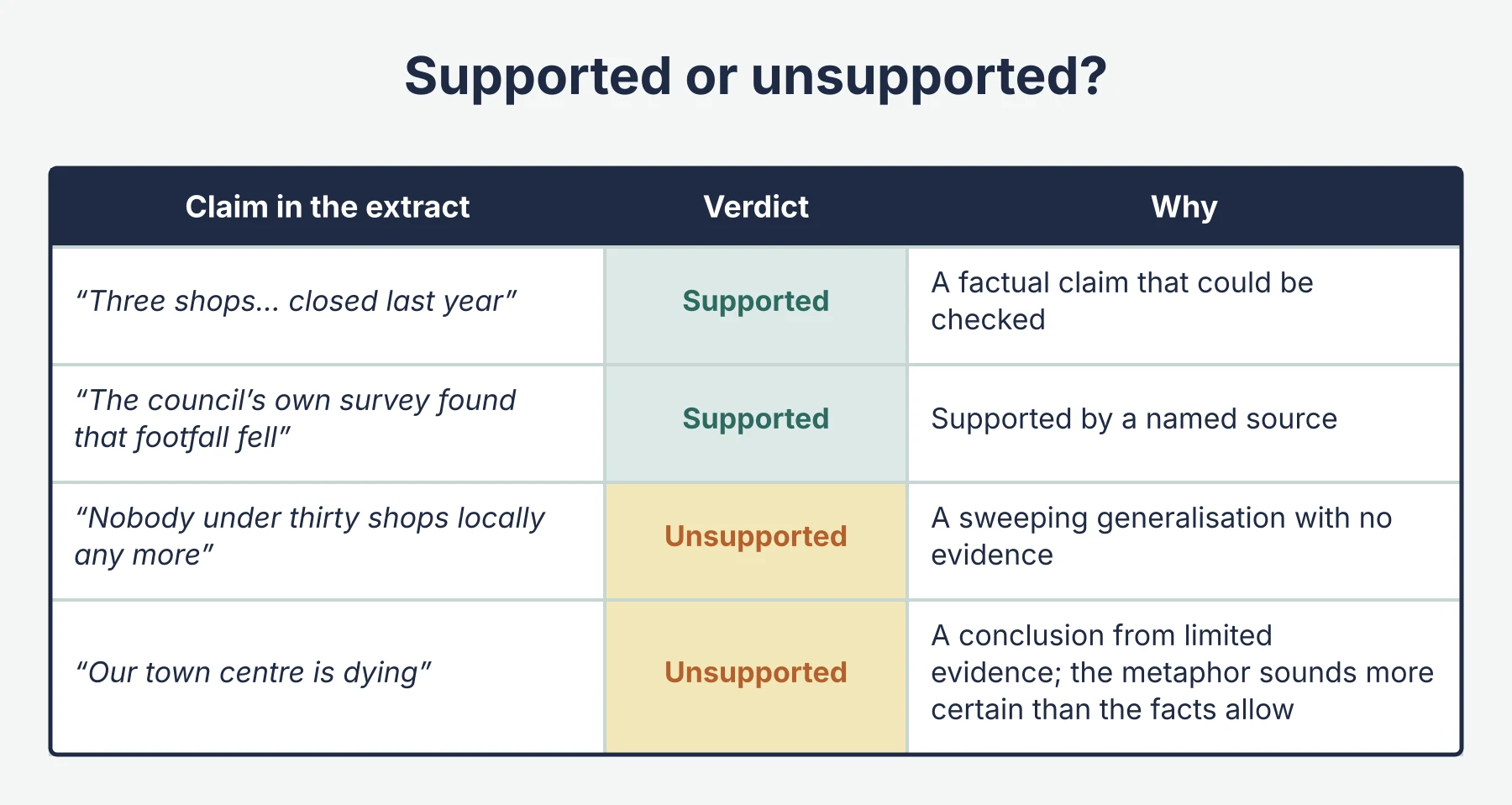
Original extract: “Our town centre is dying. Three shops on the high street closed last year, and the council’s own survey found that footfall fell between the two counts it carried out. Nobody under thirty shops locally any more.”
- “Three shops… closed last year”: a factual claim that could be checked; supported.
- “The council’s own survey found that footfall fell”: supported by a named source.
- “Nobody under thirty shops locally any more”: a sweeping generalisation with no evidence; unsupported.
- “Our town centre is dying”: a conclusion from limited evidence; the metaphor makes it sound more certain than the facts allow.
Common mistakes
- Treating implicit as invented. An inference must be traceable to a word or phrase in the text.
- Agreeing totally without testing. Simple agreement with the statement leads to description, not evaluation.
- Going outside the lines. Paper 1 Question 1 credits only information from the section named.
- Retelling the plot as if it were interpretation.
- Calling a text biased and stopping there, rather than explaining what is slanted and to what effect.
- Bolting on context that does not change how the text is read.
Exam technique by command word
- List: short, separate points from the specified lines; full sentences are not needed, but each point must be accurate and distinct.
- Choose… true statements: check each statement against the exact lines; watch for statements that are almost right but overstate or change a detail.
- To what extent do you agree?: open with your judgement, test each part of the statement, evaluate the writer’s methods, and end by restating a judgement that has been earned.
- Evaluate: keep linking effect to the statement’s focus. Ask “how successfully?”, not just “how?”.
Related: Paper 1 study guide | Paper 2 study guide | evaluating a writer’s choices study guide
Official syllabus
AQA GCSE English Language (8700) specification, for GCSE exams June 2017 onwards: 3.1.1 Critical reading and comprehension (critical reading and comprehension), assessment objectives AO1 and AO4, and the Paper 1 and Paper 2 question structure.
Related resources
-
Practice questions
AQA GCSE English Language (8700): Critical Reading and Comprehension – Practice Questions
Original AQA GCSE English Language 8700 critical reading practice on short invented passages: inference, true statements, bias and evaluating a view.
English · AQA · GCSE
Try questions -
Revision notes
AQA GCSE English Language (8700): Critical Reading and Comprehension – Revision Notes
Condensed AQA GCSE English Language 8700 notes on critical reading: inference chains, AO1 and AO4, evaluating statements, bias and a 12-question self-test.
English · AQA · GCSE
Revise topic -
Study guides
AQA GCSE English Language (8700): Evaluating a Writer's Choice of Vocabulary, Form, Grammar and Structure
AQA GCSE English Language 8700 guide to analysing and evaluating vocabulary, grammar, form and structure, with annotated language and structure paragraphs.
English · AQA · GCSE
Read guide
Get free revision emails (optional)
Occasional emails with practice questions, worked explanations and links to free resources for the qualification and subjects you choose. No spam, and you can unsubscribe from any email. The free tools on this site never need an email.