
Study Guides
AQA GCSE English Language (8700): Evaluating a Writer's Choice of Vocabulary, Form, Grammar and Structure
AQA GCSE English Language 8700 guide to analysing and evaluating vocabulary, grammar, form and structure, with annotated language and structure paragraphs.
- Subject
- English
- Level
- GCSE
- Topic
- Topic 1: Critical reading and comprehension
- Author
- Marlbridge Academic Team
- Updated
- Reviewed by
- Ammar Bilal (what this means)
Aligned to AQA GCSE English (8700), For first teaching 2015. Official specification .
Syllabus page (what it covers and how it is assessed): AQA GCSE English Language.
Found an error? Report a correction.
Need help with this topic? Request a free trial class for GCSE English Language (8700).
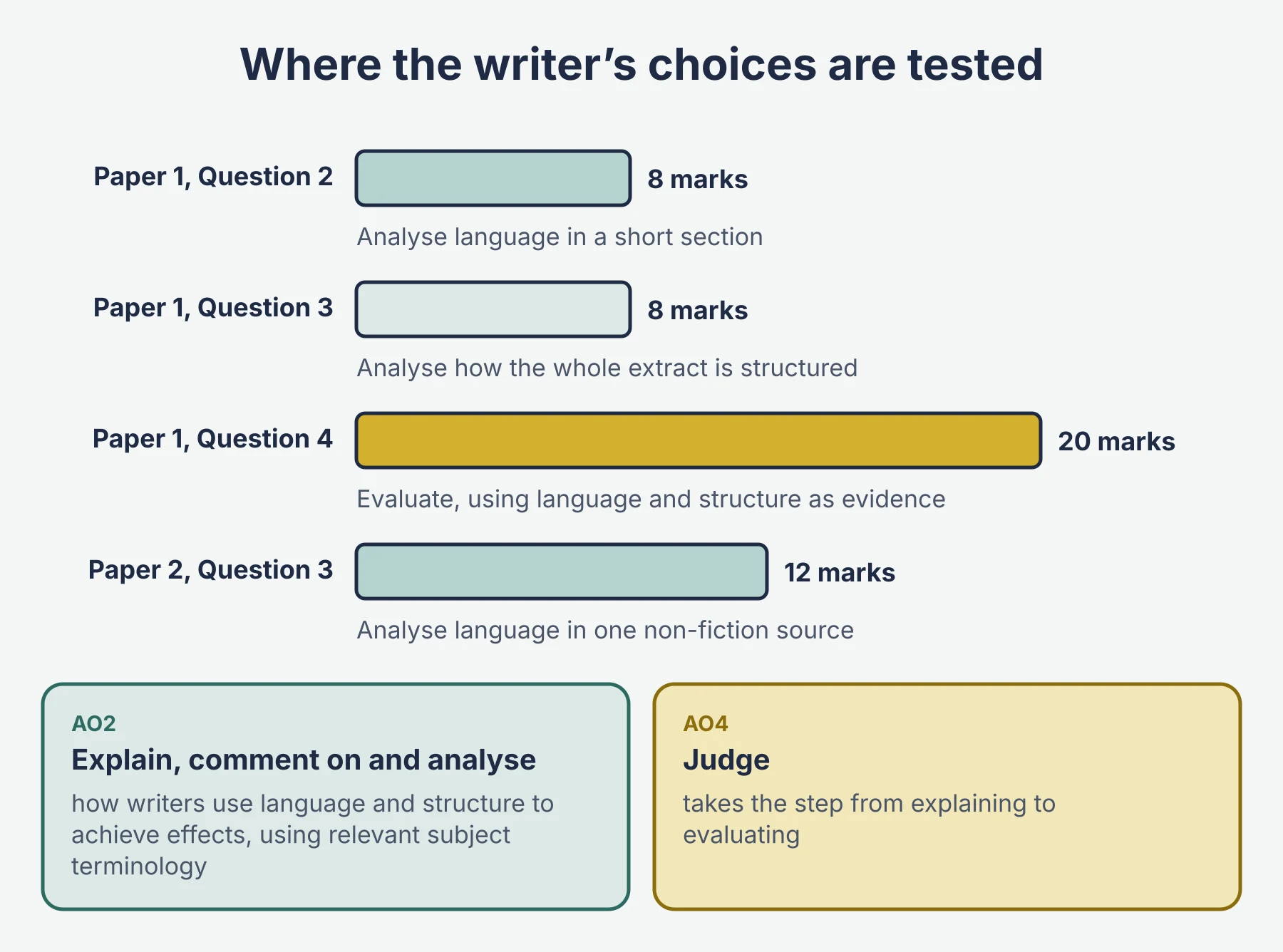
This strand of 3.1.1 is the analytical core of the reading questions in AQA GCSE English Language (8700). The specification asks you to explain and illustrate “how vocabulary and grammar contribute to effectiveness and impact, using linguistic and literary terminology accurately”, “paying attention to detail”, and to analyse and evaluate “how form and structure contribute to the effectiveness and impact of a text”. It is assessed chiefly by AO2 (explain, comment on and analyse how writers use language and structure to achieve effects and influence readers, using relevant subject terminology), with AO4 taking the step from explaining to judging. For quick recall use the revision notes on evaluating a writer’s choices, and to test yourself use the practice questions on evaluating a writer’s choices.
Where it is tested
| Question | Marks | What it asks you to do |
|---|---|---|
| Paper 1, Question 2 | 8 | Analyse language in a short section of the fiction extract |
| Paper 1, Question 3 | 8 | Analyse how the whole extract is structured |
| Paper 1, Question 4 | 20 | Evaluate, drawing on language and structure as evidence |
| Paper 2, Question 3 | 12 | Analyse language in one non-fiction source |
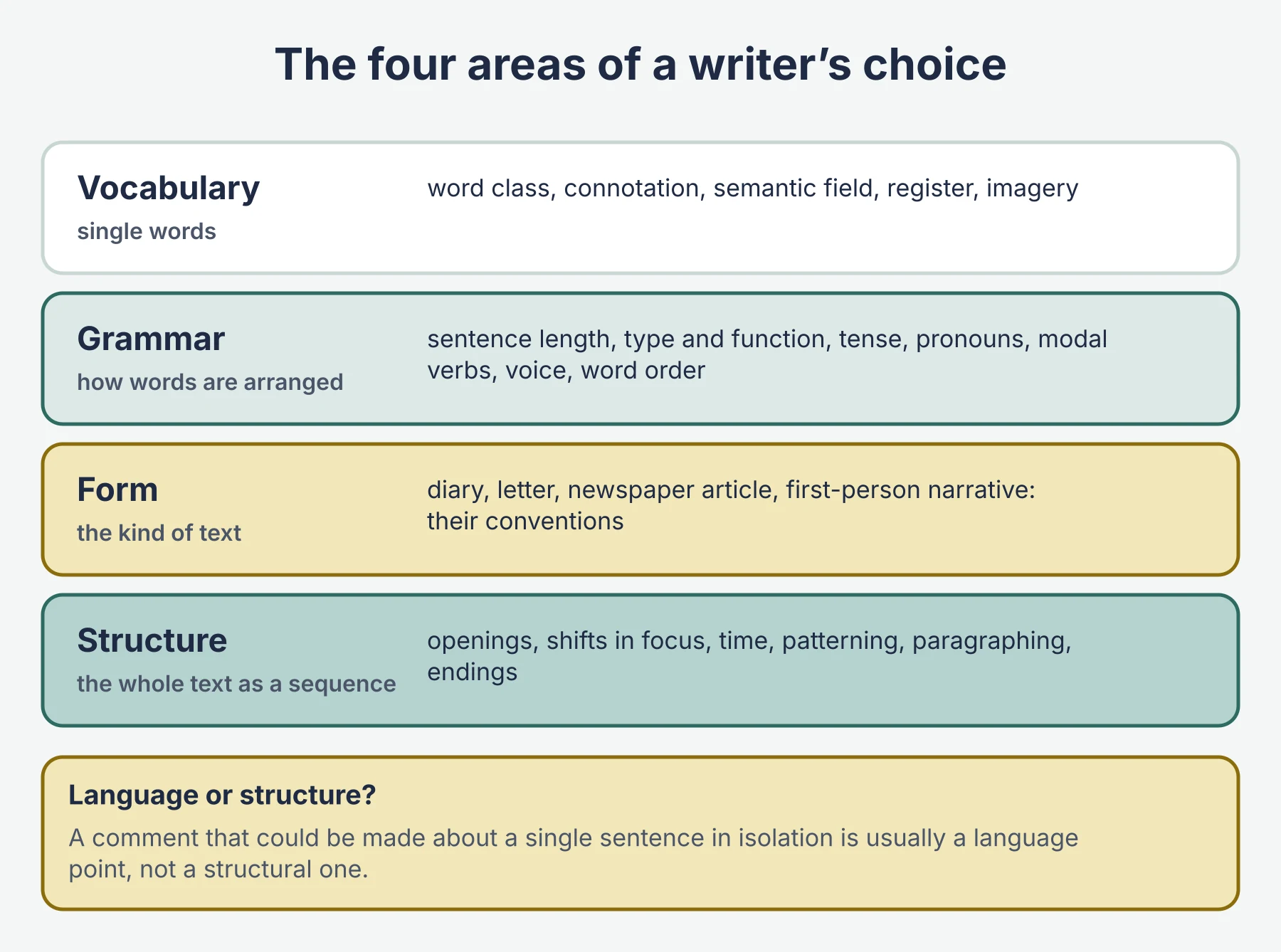
The four areas of choice
Vocabulary
Look at individual words and what they carry beyond their dictionary meaning.
- Word class: is the force of the sentence in a verb (“the wind clawed”), an adjective, or an adverb?
- Connotation: “home” and “house” denote the same place but carry different associations.
- Semantic field: a cluster of words from one area (illness, war, religion) builds an idea across a passage.
- Register: formal, informal, technical or archaic vocabulary signals a relationship with the reader.
- Imagery: metaphor, simile and personification; ask what is being compared to what, and why that comparison.
Grammar
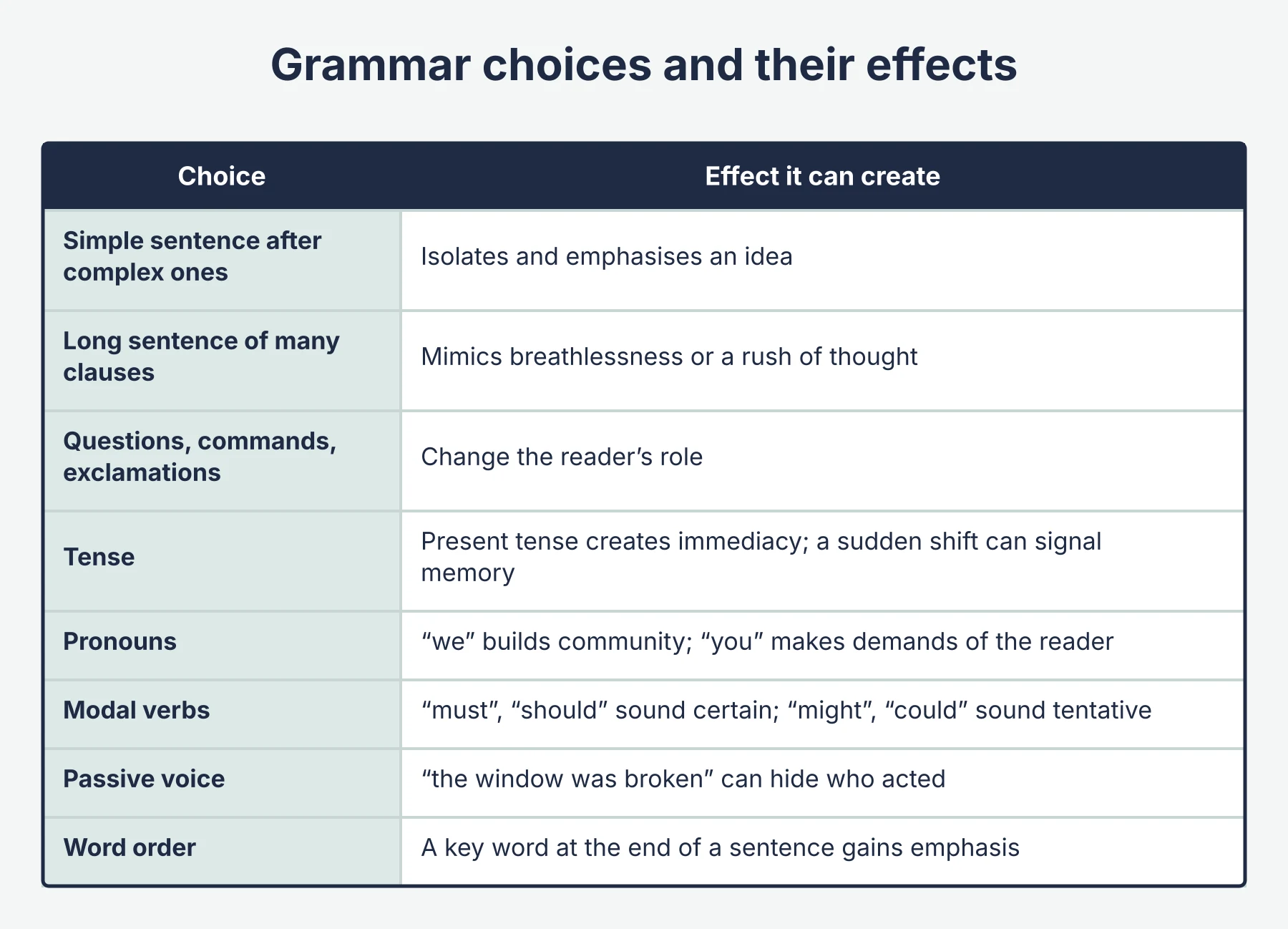
Grammar is about how words are arranged, and it creates effects just as vocabulary does.
- Sentence length and type: a simple sentence after several complex ones isolates and emphasises an idea; a long sentence built from many clauses can mimic breathlessness or a rush of thought.
- Sentence function: questions, commands and exclamations change the reader’s role.
- Tense: the present tense can create immediacy; a sudden shift in tense can signal memory.
- Person and pronouns: “we” builds community; “you” makes demands of the reader.
- Modal verbs: “must” and “should” sound certain; “might” and “could” sound tentative.
- Active and passive voice: the passive (“the window was broken”) can hide who acted.
- Word order: placing a key word at the end of a sentence gives it emphasis.
Form
Form is the kind of text and the conventions it follows. A diary invites intimacy and immediacy; a letter addresses a particular reader; a newspaper article aims at a wide public; a first-person narrative limits what the reader knows to one mind. Ask how the writer uses, or breaks, the expectations of the form.
Structure
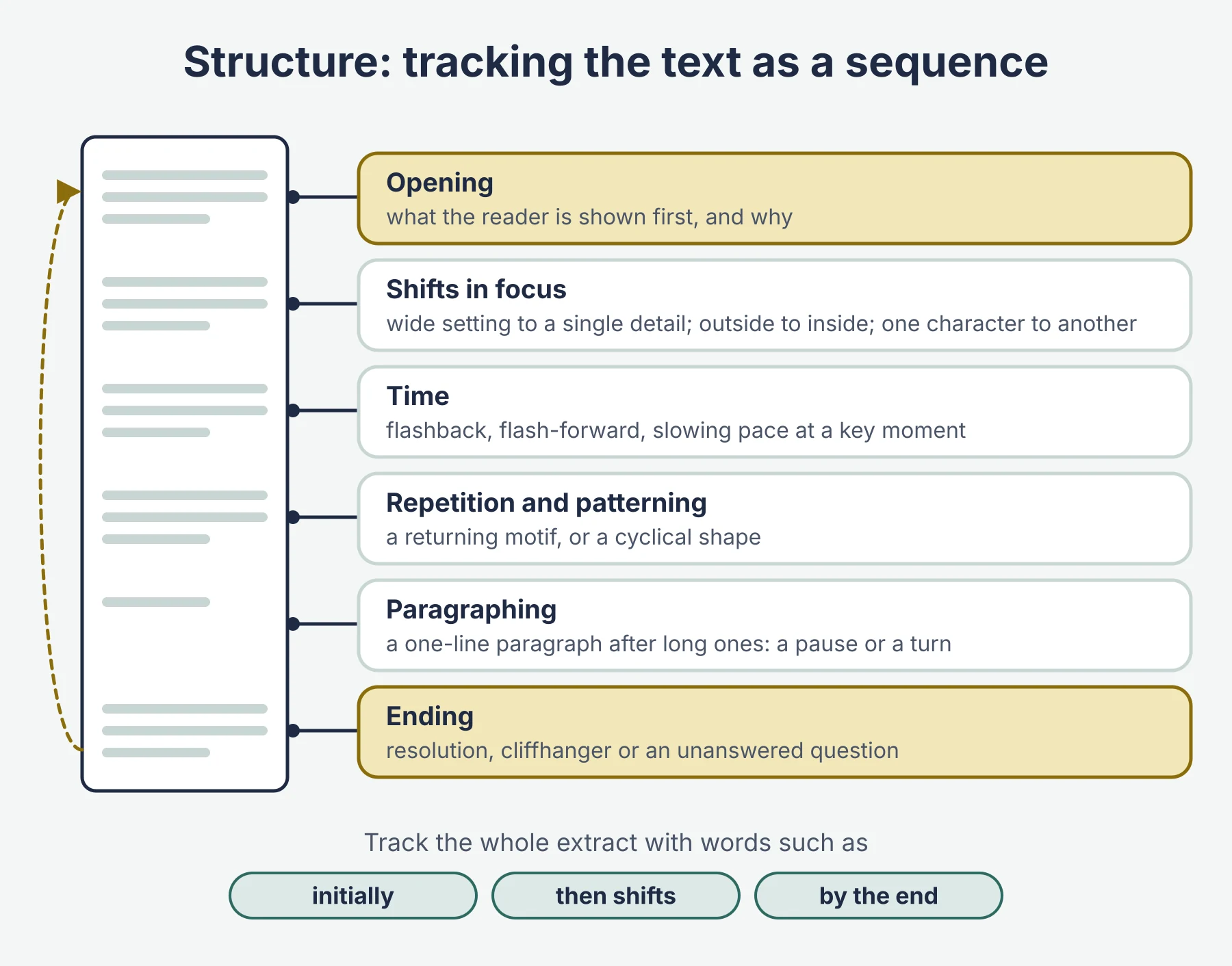
Structure is the order and shape of the whole text, and it is what Paper 1 Question 3 assesses.
- Openings: what the reader is shown first and why.
- Shifts in focus: from wide setting to a single detail, from outside to inside, from one character to another.
- Time: flashbacks, flash-forwards, a slowing of pace at a key moment.
- Repetition and patterning: a motif that returns, or a cyclical structure that ends where it began.
- Paragraphing: a one-line paragraph after long ones creates a pause or a turn.
- Endings: resolution, cliffhanger or an unanswered question.
Structure is about the text as a sequence. A comment that could be made about a single sentence in isolation is usually a language point, not a structural one.
From explaining to evaluating
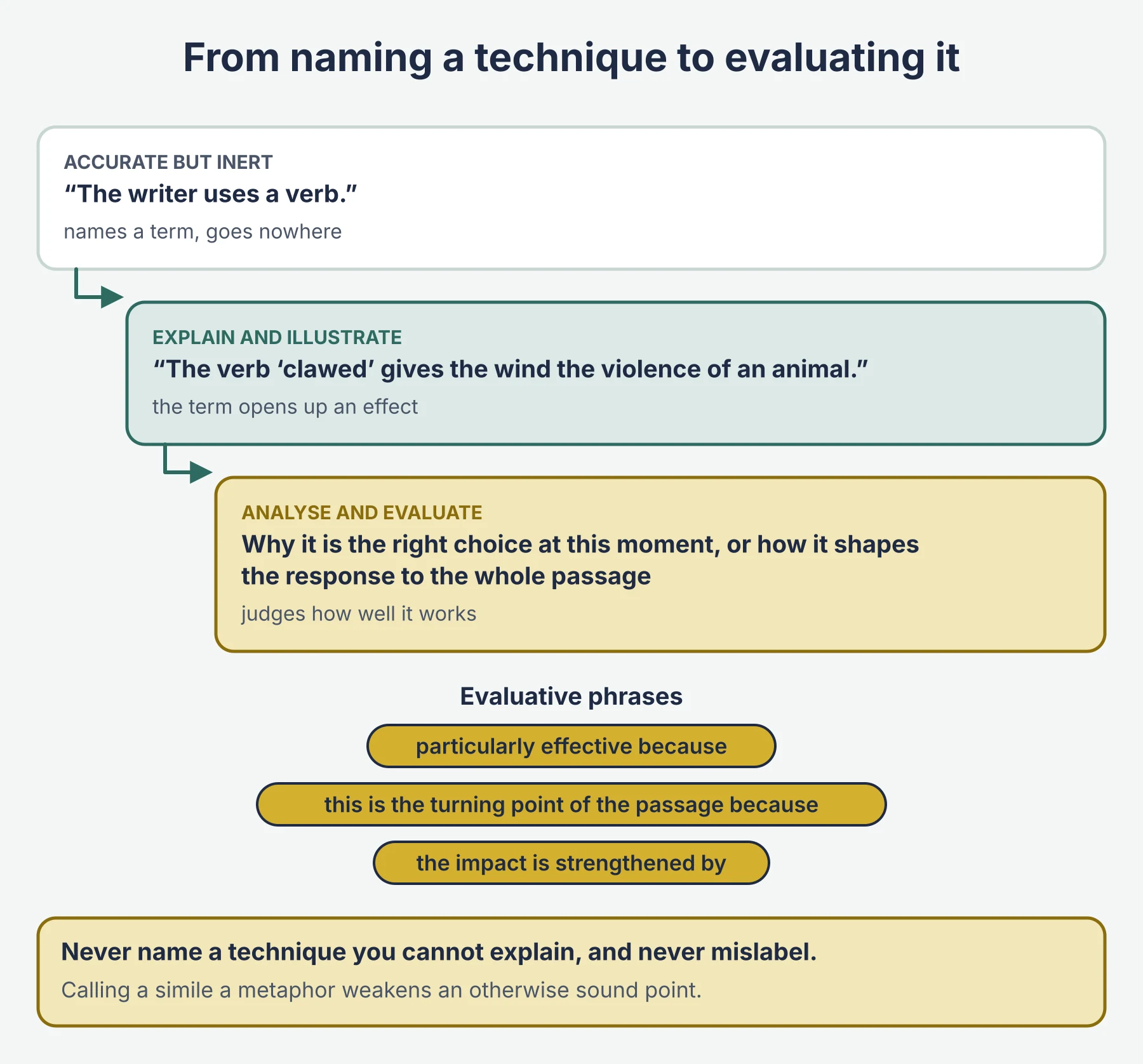
The specification uses two kinds of verb: explain and illustrate (show how a choice works, with a quotation) and analyse and evaluate (judge how well it works). An explanation says what a metaphor suggests. An evaluation says why it is the right choice at this moment, or how it shapes the reader’s response to the whole passage. Evaluative phrases include “particularly effective because”, “this is the turning point of the passage because”, and “the impact is strengthened by”.
Using terminology accurately
Terminology earns credit only when it is accurate and leads somewhere. “The writer uses a verb” is accurate but inert. “The verb ‘clawed’ gives the wind the violence of an animal” uses the term to open up an effect. Never name a technique you cannot then explain, and never mislabel: calling a simile a metaphor weakens an otherwise sound point.
Worked example
The passage below is original, written for this guide.
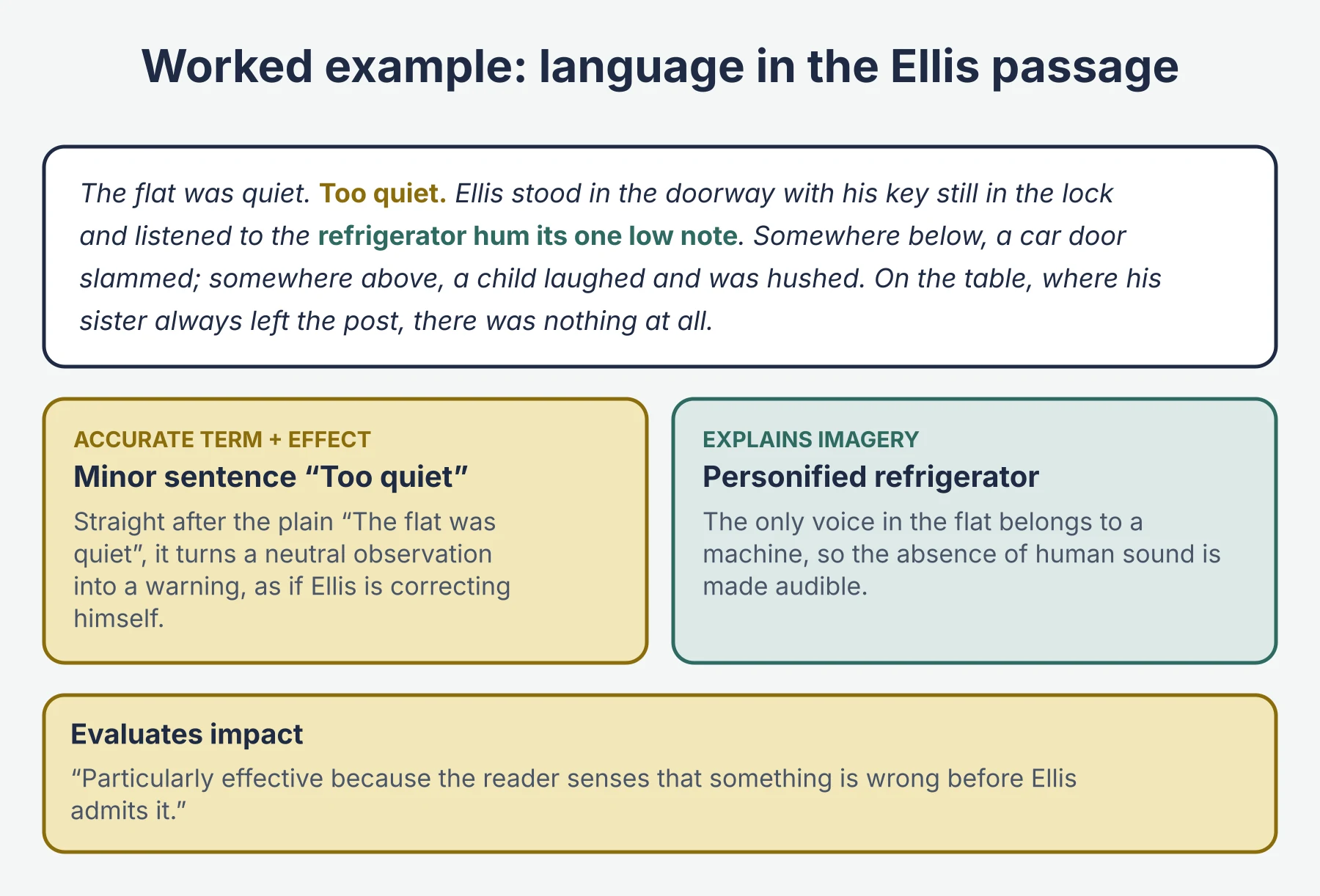
The flat was quiet. Too quiet. Ellis stood in the doorway with his key still in the lock and listened to the refrigerator hum its one low note. Somewhere below, a car door slammed; somewhere above, a child laughed and was hushed. On the table, where his sister always left the post, there was nothing at all.
He did not call her name. He knew, already, that she had gone.
Language paragraph (annotated):
The writer uses the minor sentence “Too quiet” to make the silence threatening [accurate term]. Coming straight after the plain statement “The flat was quiet”, it turns a neutral observation into a warning, as if Ellis is correcting himself [effect, with attention to detail]. The personified refrigerator, humming “its one low note”, deepens this: the only voice in the flat belongs to a machine, so the absence of human sound is made audible [explains imagery]. This is particularly effective because the reader senses that something is wrong before Ellis admits it [evaluates impact].
Structure paragraph (annotated):
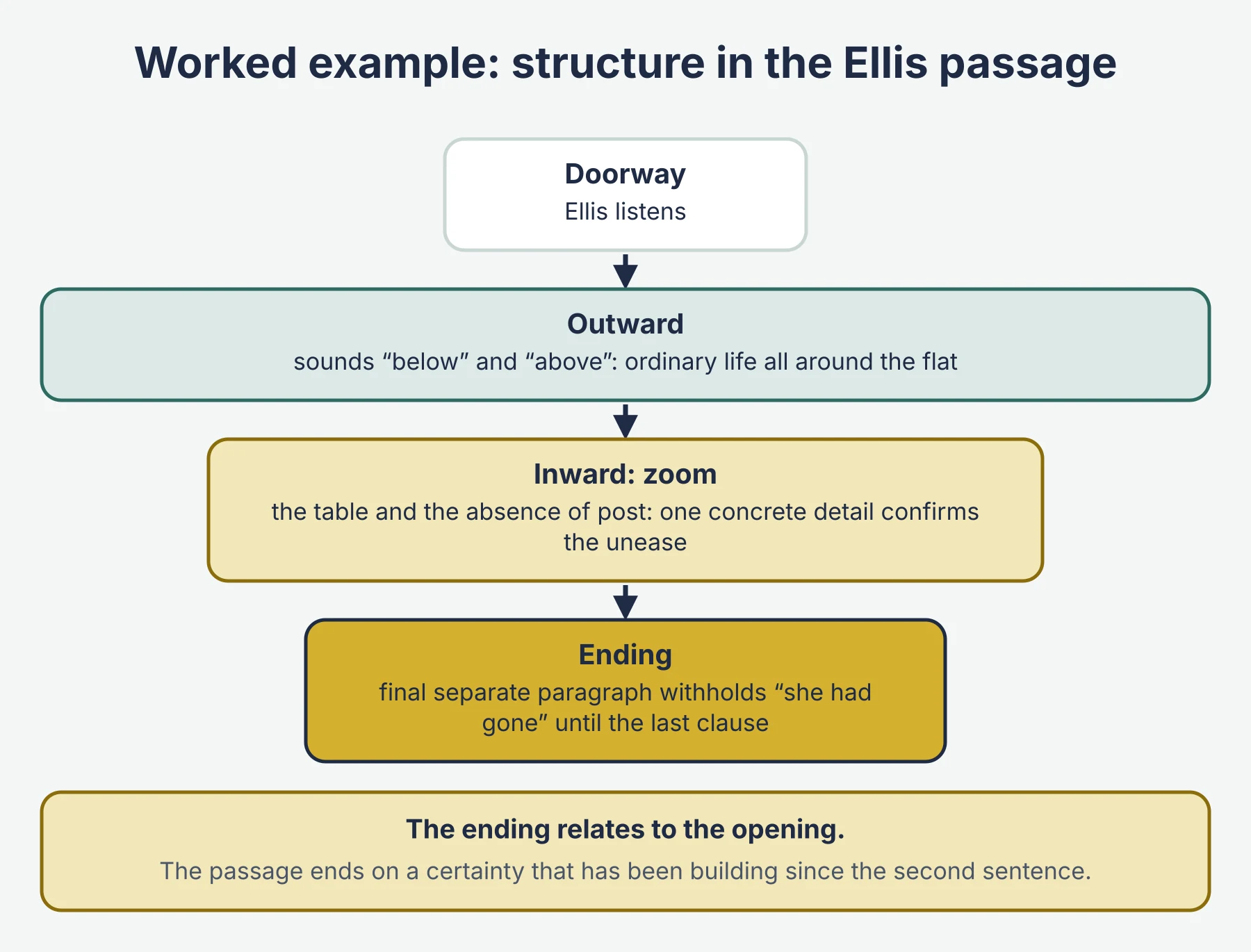
The writer moves the focus outward and then sharply inward. After the doorway, attention travels to sounds “below” and “above”, the balanced pairing placing ordinary life all around the flat [shift in focus]. The focus then narrows to the table and the absence of post, a single concrete detail that confirms the unease [zoom]. The final, separate paragraph withholds the explanation until the last clause, “she had gone”, so the passage ends on certainty that has been building since the second sentence [ending, and how it relates to the opening].
Common mistakes
- Feature-spotting: listing techniques with no effect explained.
- Generic effects: “it makes the reader want to read on” could be said of any text.
- Mixing up language and structure: analysing a metaphor in a structure question.
- Ignoring grammar: sentence forms and tense are often the most precise evidence available.
- Long quotations: a whole sentence makes it hard to analyse any single choice in detail.
- Explaining but never evaluating in the questions that ask how successful the writing is.
- Inaccurate terminology, which undermines the precision the mark scheme rewards.
Exam technique by command word
- How does the writer use language to…? Choose a few rich details from the lines given; for each, give a short quotation, an accurate term where helpful, and a developed effect linked to the focus of the question.
- How has the writer structured the text to interest you as a reader? Track the whole extract from beginning to end; use words such as “initially”, “then shifts”, “by the end”.
- To what extent do you agree? Use language and structure as evidence for a judgement, not as a separate list.
Related: Paper 1 study guide | Paper 1 revision notes | critical reading study guide
Official syllabus
AQA GCSE English Language (8700) specification, for GCSE exams June 2017 onwards: 3.1.1 Critical reading and comprehension (evaluation of a writer’s choice of vocabulary, form, grammatical and structural features), assessment objectives AO2 and AO4.
Related resources
-
Practice questions
AQA GCSE English Language (8700): Evaluating a Writer's Choice of Vocabulary, Form, Grammar and Structure – Practice Questions
Original AQA GCSE English Language 8700 practice on analysing vocabulary, grammar, form and structure in short invented passages, with full answers.
English · AQA · GCSE
Try questions -
Revision notes
AQA GCSE English Language (8700): Evaluating a Writer's Choice of Vocabulary, Form, Grammar and Structure – Revision Notes
AQA GCSE English Language 8700 recall notes on analysing vocabulary, grammar, form and structure: AO2 terms, effects, exam traps and a self-test.
English · AQA · GCSE
Revise topic -
Practice questions
AQA GCSE English Language (8700): Summary and Synthesis – Practice Questions
Original AQA GCSE English Language 8700 summary and synthesis practice: themes, compressing a text, true statements and synthesised paragraphs with answers.
English · AQA · GCSE
Try questions
Get free revision emails (optional)
Occasional emails with practice questions, worked explanations and links to free resources for the qualification and subjects you choose. No spam, and you can unsubscribe from any email. The free tools on this site never need an email.