
Revision Notes
AQA GCSE English Language (8700): Evaluating a Writer's Choice of Vocabulary, Form, Grammar and Structure – Revision Notes
AQA GCSE English Language 8700 recall notes on analysing vocabulary, grammar, form and structure: AO2 terms, effects, exam traps and a self-test.
- Subject
- English
- Level
- GCSE
- Topic
- Topic 1: Critical reading and comprehension
- Author
- Marlbridge Academic Team
- Updated
- Reviewed by
- Ammar Bilal (what this means)
Aligned to AQA GCSE English (8700), For first teaching 2015. Official specification .
Syllabus page (what it covers and how it is assessed): AQA GCSE English Language.
Found an error? Report a correction.
Need help with this topic? Request a free trial class for GCSE English Language (8700).
These notes condense the strand of 3.1.1 on evaluating “a writer’s choice of vocabulary, form, grammatical and structural features” in AQA GCSE English Language (8700). It is assessed mainly by AO2 (analyse how writers use language and structure to achieve effects and influence readers, using relevant subject terminology), and it feeds the evaluation required by AO4.
Related: study guide on evaluating a writer’s choices | practice questions on evaluating a writer’s choices | Paper 1 revision notes
The strand in one paragraph
Pick a precise detail, name it accurately, explain what it does to the reader and judge how well it serves the writer’s purpose. Language points work at the level of words and sentences; structure points work at the level of the whole text and its sequence. Form is the type of text and the conventions it uses or breaks.
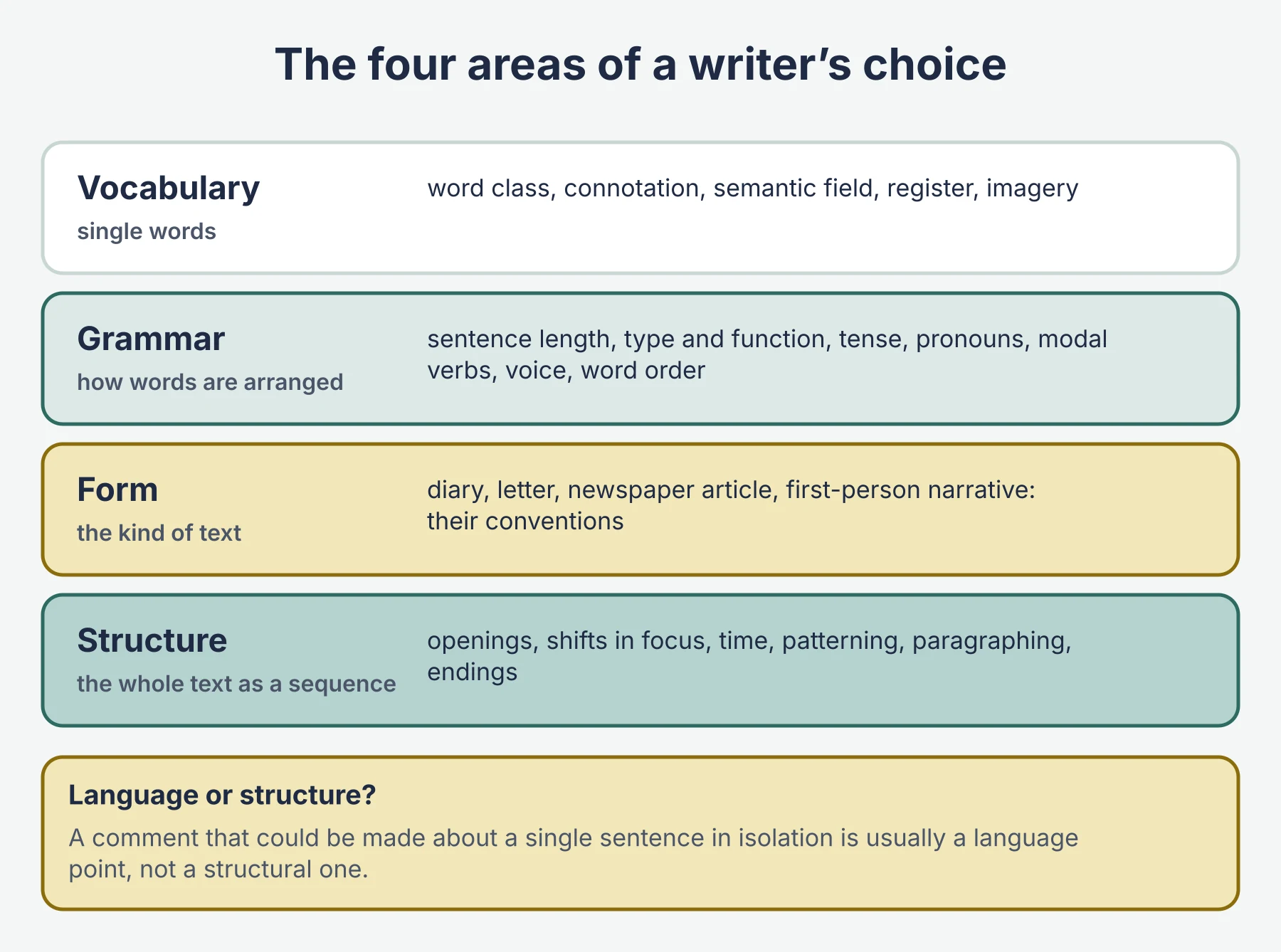
Where it is tested
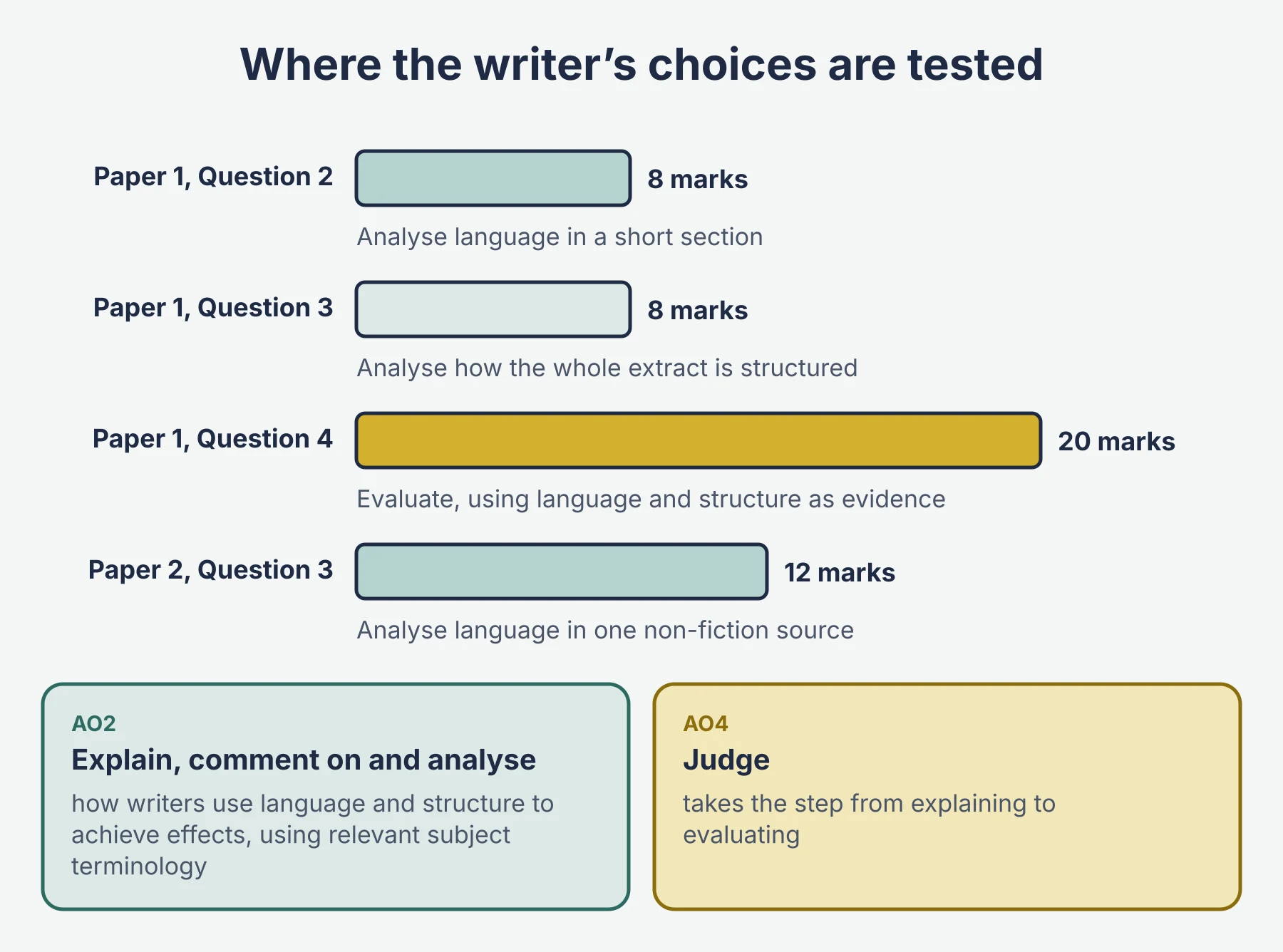
| Question | Marks | Focus |
|---|---|---|
| Paper 1, Question 2 | 8 | Language in a short section of fiction |
| Paper 1, Question 3 | 8 | Structure of the whole fiction extract |
| Paper 1, Question 4 | 20 | Evaluation, using methods as evidence |
| Paper 2, Question 3 | 12 | Language in one non-fiction source |
Key terms: vocabulary
| Term | Meaning | Ask yourself |
|---|---|---|
| Connotation | Associations a word carries | What else does this word bring to mind? |
| Semantic field | A group of words from one area | What idea builds across the passage? |
| Register | Level of formality | What relationship with the reader does it create? |
| Metaphor / simile | Comparison without / with “like” or “as” | Why this comparison, not another? |
| Personification | Human qualities given to a thing | What attitude does it suggest? |
| Juxtaposition | Contrasting items placed together | What does the contrast reveal? |
Key terms: grammar
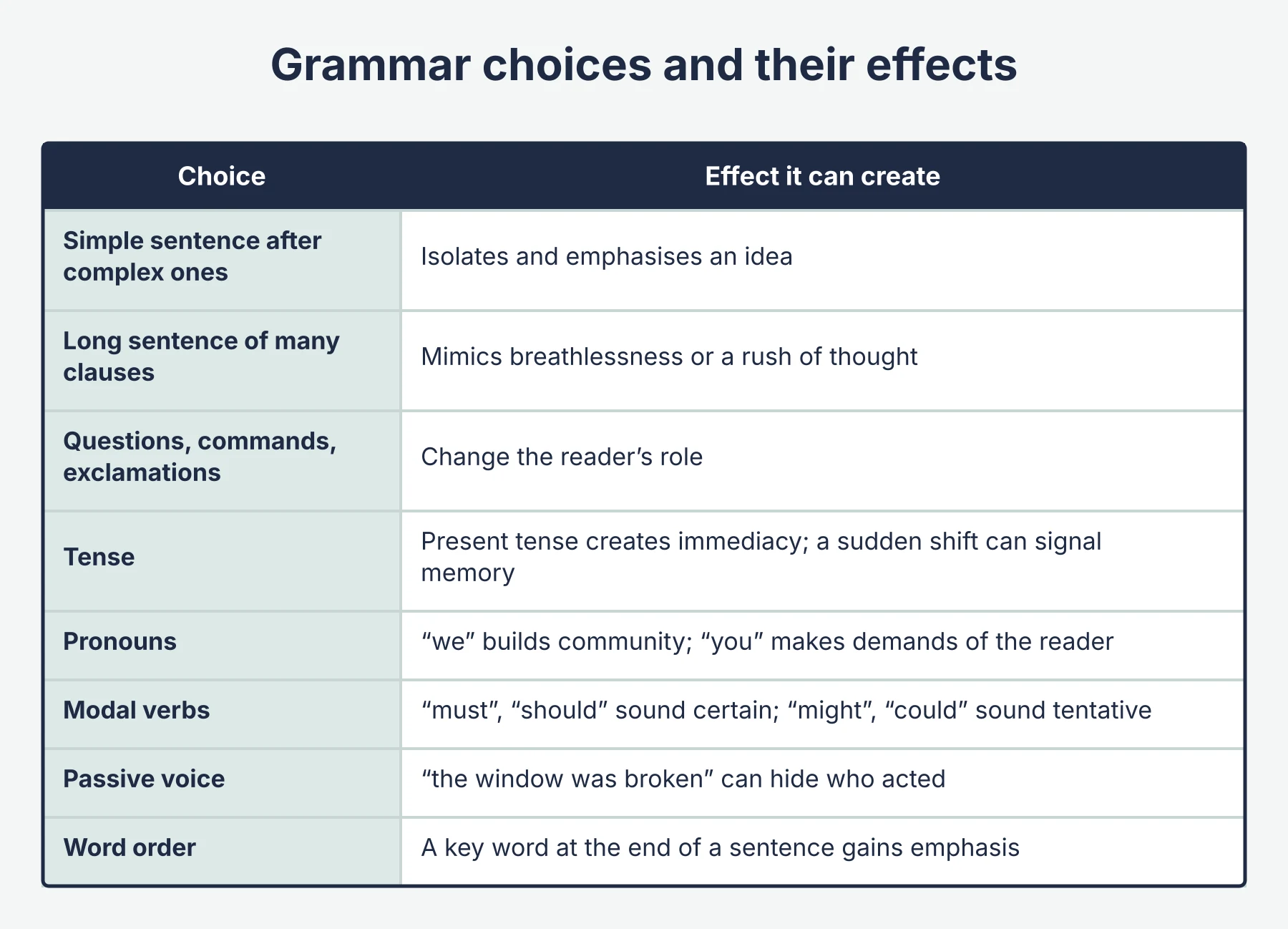
| Term | Meaning | Typical effect to test |
|---|---|---|
| Simple sentence | One main clause | Emphasis, bluntness, finality |
| Complex sentence | Main clause plus subordinate clause | Builds detail, delays the key idea |
| Minor sentence | A fragment with no main verb | Sharp focus, shock, a pause |
| Interrogative / imperative | Question / command | Involves or directs the reader |
| Modal verb | must, should, might, could | Certainty or doubt |
| Passive voice | Subject receives the action | Hides who acted |
| Tense shift | Change, for example past to present | Immediacy or memory |
| End focus | Key word placed last | Emphasis at the close of a sentence |
Key terms: form and structure
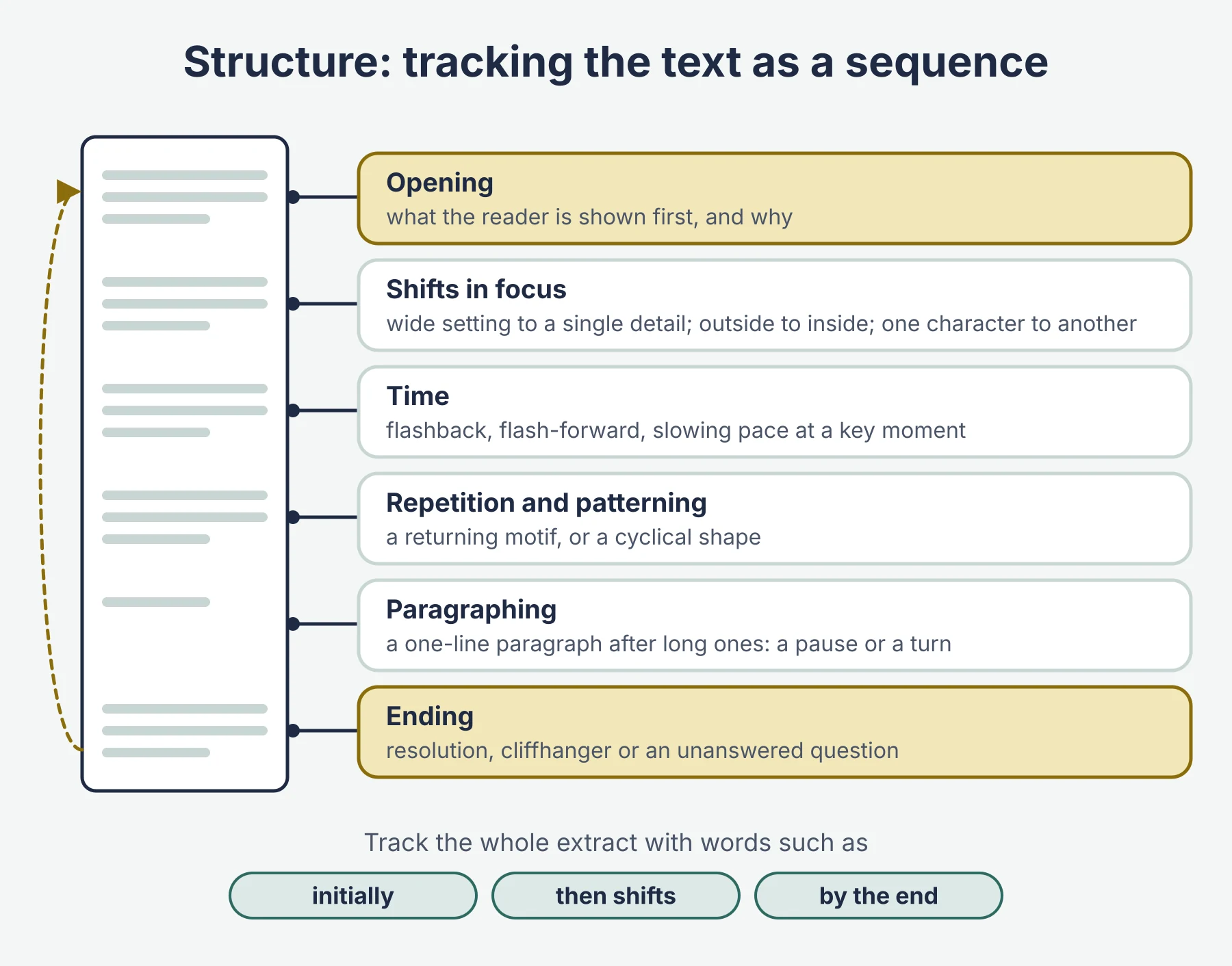
| Term | Meaning |
|---|---|
| Form | Text type and its conventions: diary, letter, article, speech, short story |
| Narrative perspective | Who tells the story: first person, third person, limited or wide knowledge |
| Shift in focus | Movement from one place, person or time to another |
| Zoom | Narrowing from a wide view to a single detail, or widening out |
| Flashback | A move back in time |
| Cyclical structure | Ending returns to the opening |
| Motif | A detail that recurs and gathers meaning |
| Withholding | Delaying information to build tension |
Language or structure? Quick sort
- A single metaphor: language.
- A short sentence analysed for its own force: language.
- A short paragraph analysed for where it falls and what it turns: structure.
- A move from outside to inside a building: structure.
- A repeated image that changes meaning by the end: structure (and language if you analyse its words).
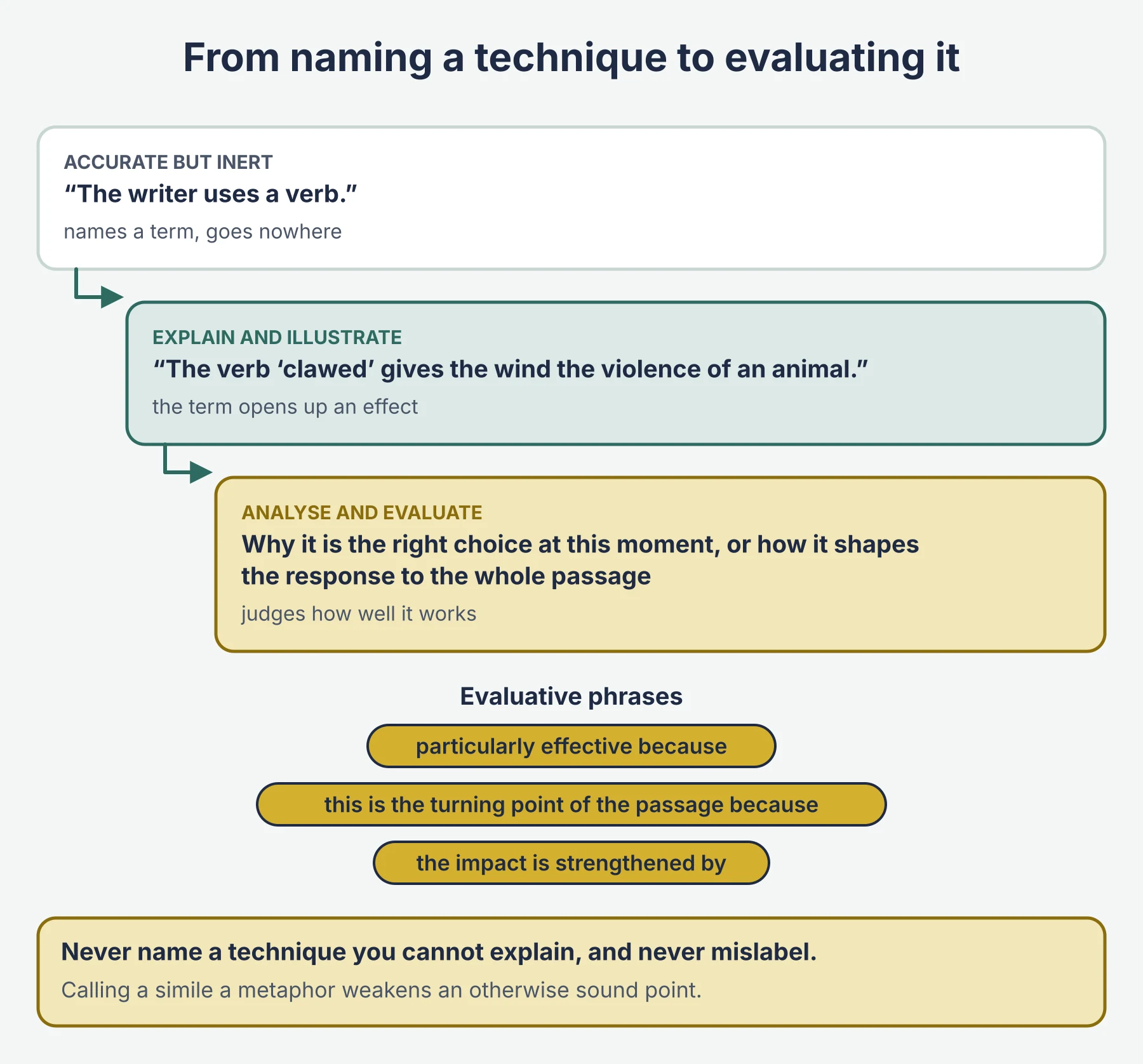
The analytical sentence
Short quotation -> accurate term -> effect on the reader -> link to the question's focus -> judgement of impactEvaluative phrases: “particularly effective because”, “the impact is strengthened by”, “this is the turning point because”, “less convincing, perhaps, is”.
Exam traps
- Naming a feature with no effect.
- Writing a generic effect (“creates tension”) that could apply to any text.
- Analysing a metaphor in a structure answer.
- Commenting on the whole text in a language question that names particular lines.
- Mislabelling a technique.
- Quoting a full sentence and analysing nothing in it.
- Forgetting form: a diary entry or a letter has conventions the writer is choosing to use.
Quick self-test
- Which assessment objective mainly covers this strand?
- What is the difference between connotation and denotation?
- What effect might a minor sentence create after several long sentences?
- How can the passive voice affect a reader’s view of an event?
- Name two structural features you could track across an opening.
- Is a single simile a language or structural point?
- What is end focus?
- Give one convention of a diary that a writer might use for effect.
- Why does “it makes the reader want to read on” earn little credit?
- Which Paper 1 question assesses structure, and how many marks is it worth?
- What turns an explanation into an evaluation?
- What might a cyclical structure suggest?
Answers
- AO2.
- Denotation is the literal meaning; connotation is the set of associations the word carries.
- Sharp emphasis, shock or a sudden pause that isolates an idea.
- It can hide who did something, shifting attention to the event or avoiding blame.
- Any two: opening focus, shift in focus, zoom, flashback, withholding, paragraph length, ending.
- Language.
- Placing the most important word or idea at the end of a sentence to give it emphasis.
- For example: first-person, dated entries and private tone, which create intimacy and immediacy.
- It is generic and could apply to any text; it does not explain how a specific choice works.
- Question 3, worth 8 marks.
- A judgement of how well the choice works and why it matters at that point.
- For example: that nothing has changed, a sense of being trapped, or closure.
Official syllabus
AQA GCSE English Language (8700) specification, for GCSE exams June 2017 onwards: 3.1.1 Critical reading and comprehension (evaluation of a writer’s choice of vocabulary, form, grammatical and structural features), assessment objectives AO2 and AO4.
Related resources
-
Practice questions
AQA GCSE English Language (8700): Summary and Synthesis – Practice Questions
Original AQA GCSE English Language 8700 summary and synthesis practice: themes, compressing a text, true statements and synthesised paragraphs with answers.
English · AQA · GCSE
Try questions -
Study guides
AQA GCSE English Language (8700): Comparing Texts
AQA GCSE English Language 8700 guide to comparing texts for AO3: perspectives, methods, comparing across centuries and an annotated comparison paragraph.
English · AQA · GCSE
Read guide -
Practice questions
AQA GCSE English Language (8700): Comparing Texts – Practice Questions
Original AQA GCSE English Language 8700 comparing texts practice on paired invented sources: perspectives, methods and comparative paragraphs, with answers.
English · AQA · GCSE
Try questions
Get free revision emails (optional)
Occasional emails with practice questions, worked explanations and links to free resources for the qualification and subjects you choose. No spam, and you can unsubscribe from any email. The free tools on this site never need an email.