
Study Guides
AQA GCSE English Language (8700): Comparing Texts
AQA GCSE English Language 8700 guide to comparing texts for AO3: perspectives, methods, comparing across centuries and an annotated comparison paragraph.
- Subject
- English
- Level
- GCSE
- Topic
- Topic 1: Critical reading and comprehension
- Author
- Marlbridge Academic Team
- Updated
- Reviewed by
- Ammar Bilal (what this means)
Aligned to AQA GCSE English (8700), For first teaching 2015. Official specification .
Syllabus page (what it covers and how it is assessed): AQA GCSE English Language.
Found an error? Report a correction.
Need help with this topic? Request a free trial class for GCSE English Language (8700).
The final strand of 3.1.1 in AQA GCSE English Language (8700) is short: “comparing two or more texts critically with respect to the above”. Those last three words matter. “The above” is everything else in critical reading: themes and ideas, inference, evaluation, and the writer’s choices of vocabulary, grammar, form and structure. Comparison is not a separate skill bolted on at the end; it is all of those skills applied to two texts at once. It is assessed by AO3: “compare writers’ ideas and perspectives, as well as how these are conveyed, across two or more texts”. For recall use the comparing texts revision notes, and to practise use the comparing texts practice questions.
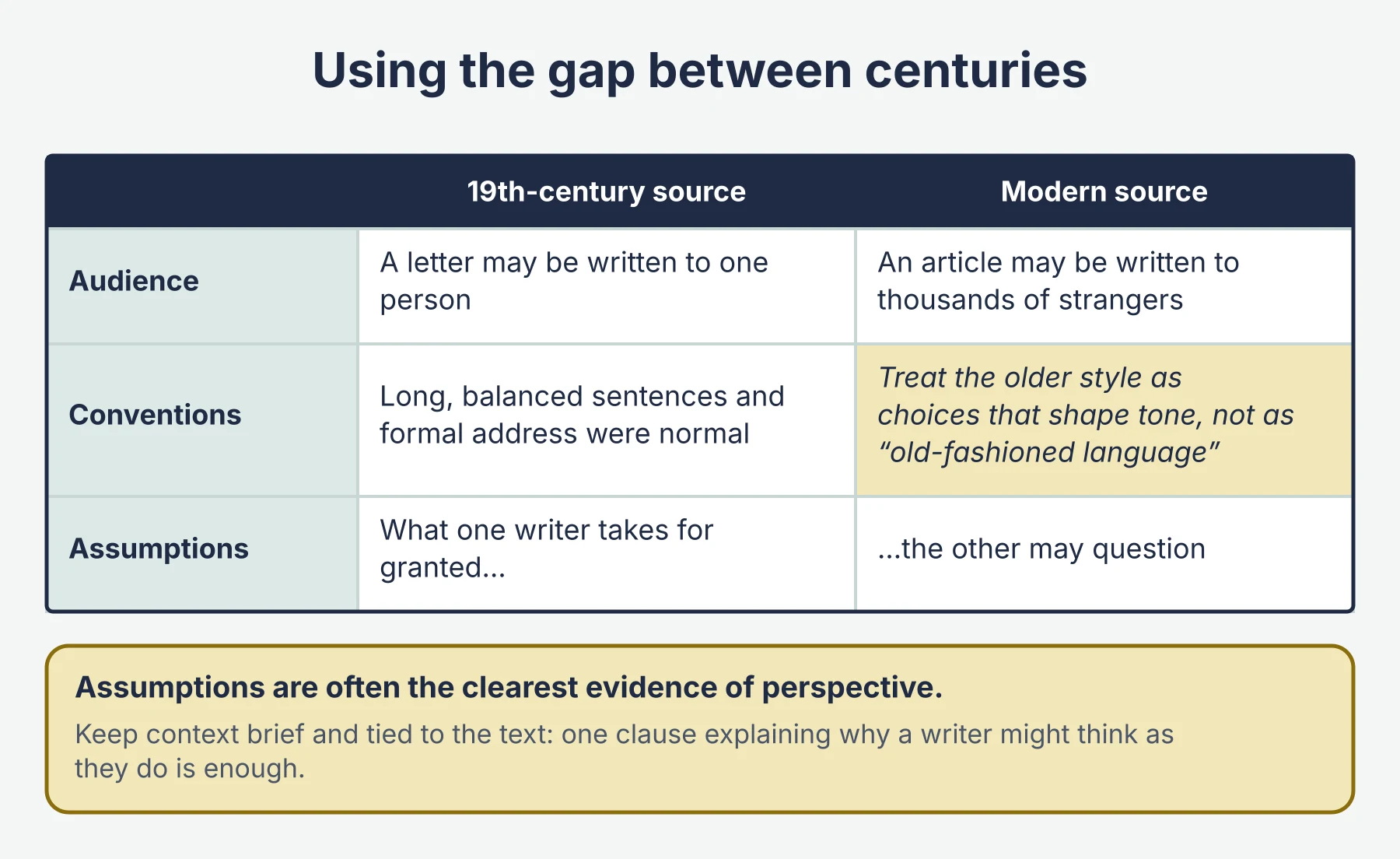
Where it is tested
AO3 belongs to Paper 2 only, where the specification gives it about 10% of the GCSE. Its main home is Question 4, the 16-mark question, which asks you to compare how the writers of the two sources convey their perspectives on a shared subject, using the whole of both texts. One source is from the 19th century and the other from the 20th or 21st century. Paper 1 has a single source and does not assess comparison.
| Question | What is compared | Assessment objective |
|---|---|---|
| Paper 2, Question 2 (8 marks) | What the sources show about a focus (content only) | AO1 |
| Paper 2, Question 4 (16 marks) | Writers’ perspectives and the methods that convey them | AO3 |
The difference is the key to both questions. Question 2 compares what. Question 4 compares what and how.
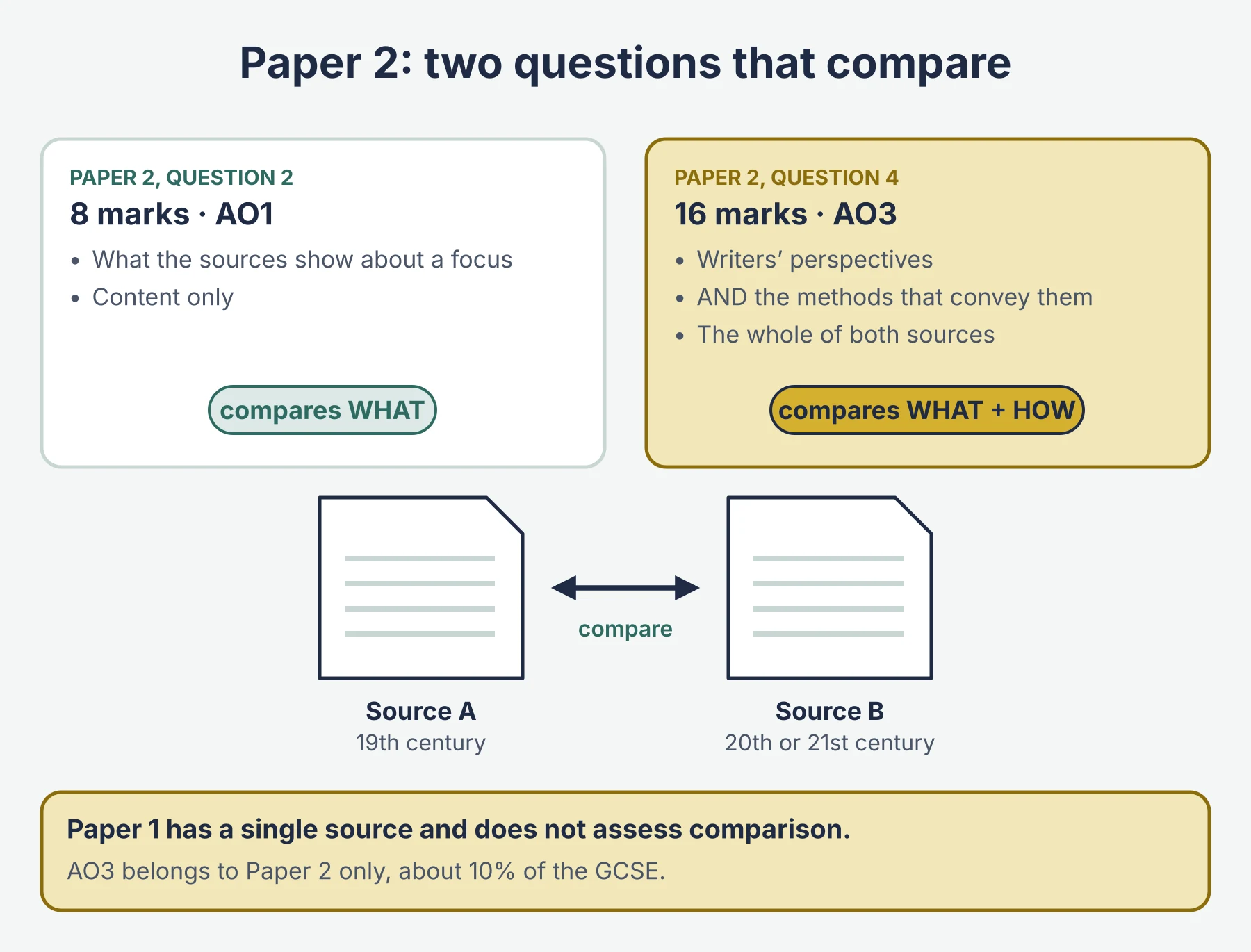
Perspective, viewpoint, attitude, tone
These words overlap, but separating them helps you write precisely:
- Viewpoint: the position a writer takes on an issue (“zoos should close”).
- Perspective: the wider way of seeing that produces the viewpoint, shaped by experience, time and values (“a scientist who has watched animals pace their cages”).
- Attitude: the writer’s feeling towards the subject (admiring, scornful, anxious).
- Tone: how that attitude sounds on the page (ironic, solemn, urgent, playful).
A strong comparison usually opens with perspectives and then shows how methods convey them. Two writers can share a viewpoint but differ in perspective: both might criticise a city’s poverty, one from pity and one from anger.
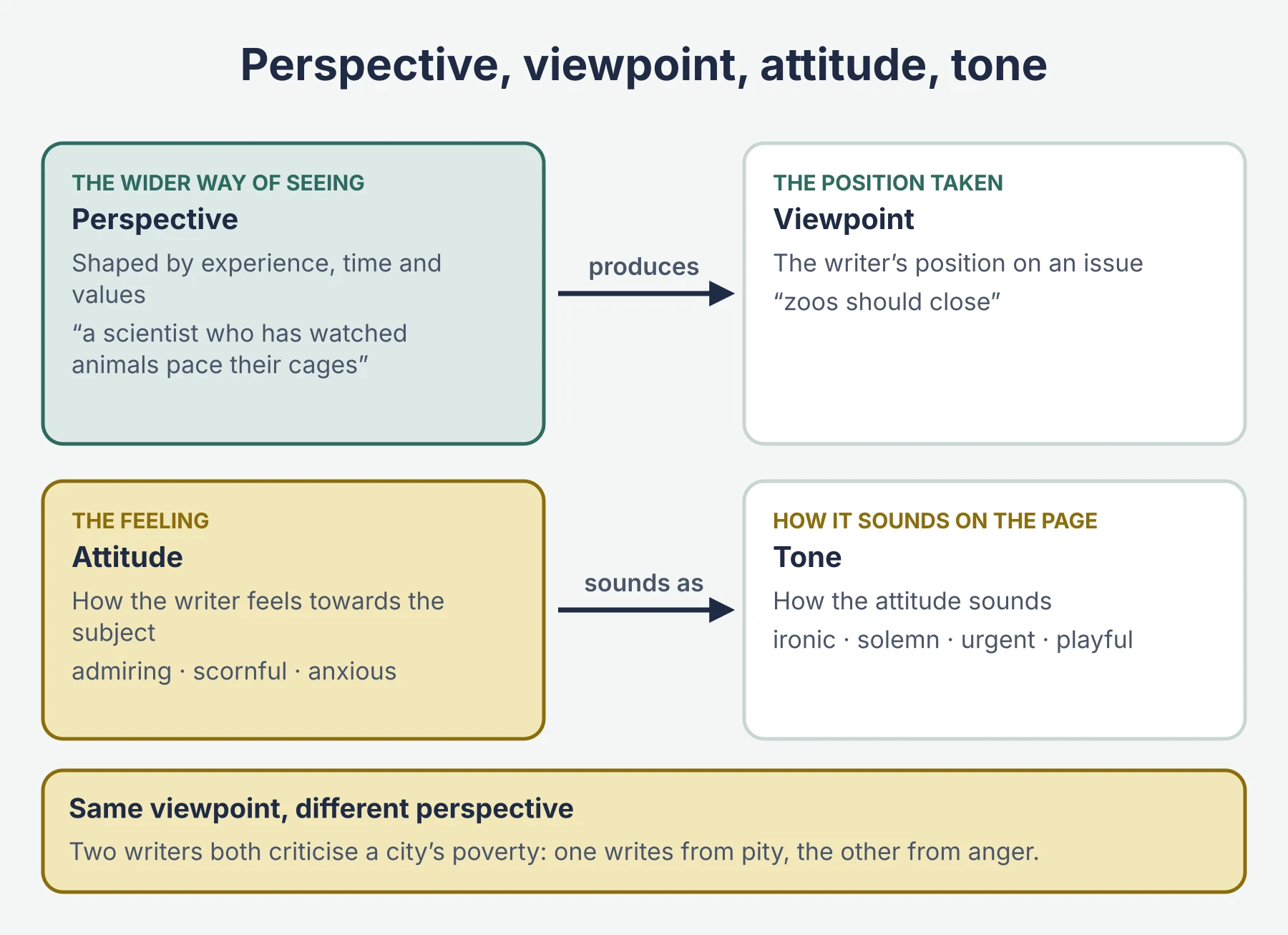
What “methods” can mean
Methods are the writer’s choices, the same categories you analyse for a single text:
- Vocabulary: emotive language, a semantic field, formal or informal register.
- Grammar: sentence lengths, questions, imperatives, pronouns such as “we” or “you”, modal verbs.
- Form: a letter, a diary, a newspaper column, a speech, travel writing, and the relationship each creates.
- Structure: how each text opens, where it turns, how it ends, how anecdote and argument are ordered.
- Evidence and voice: personal experience, statistics, expert opinion, humour, irony.
Compare like with like where you can: opening with opening, ending with ending, use of anecdote with use of anecdote. That makes a difference in method visible rather than asserted.
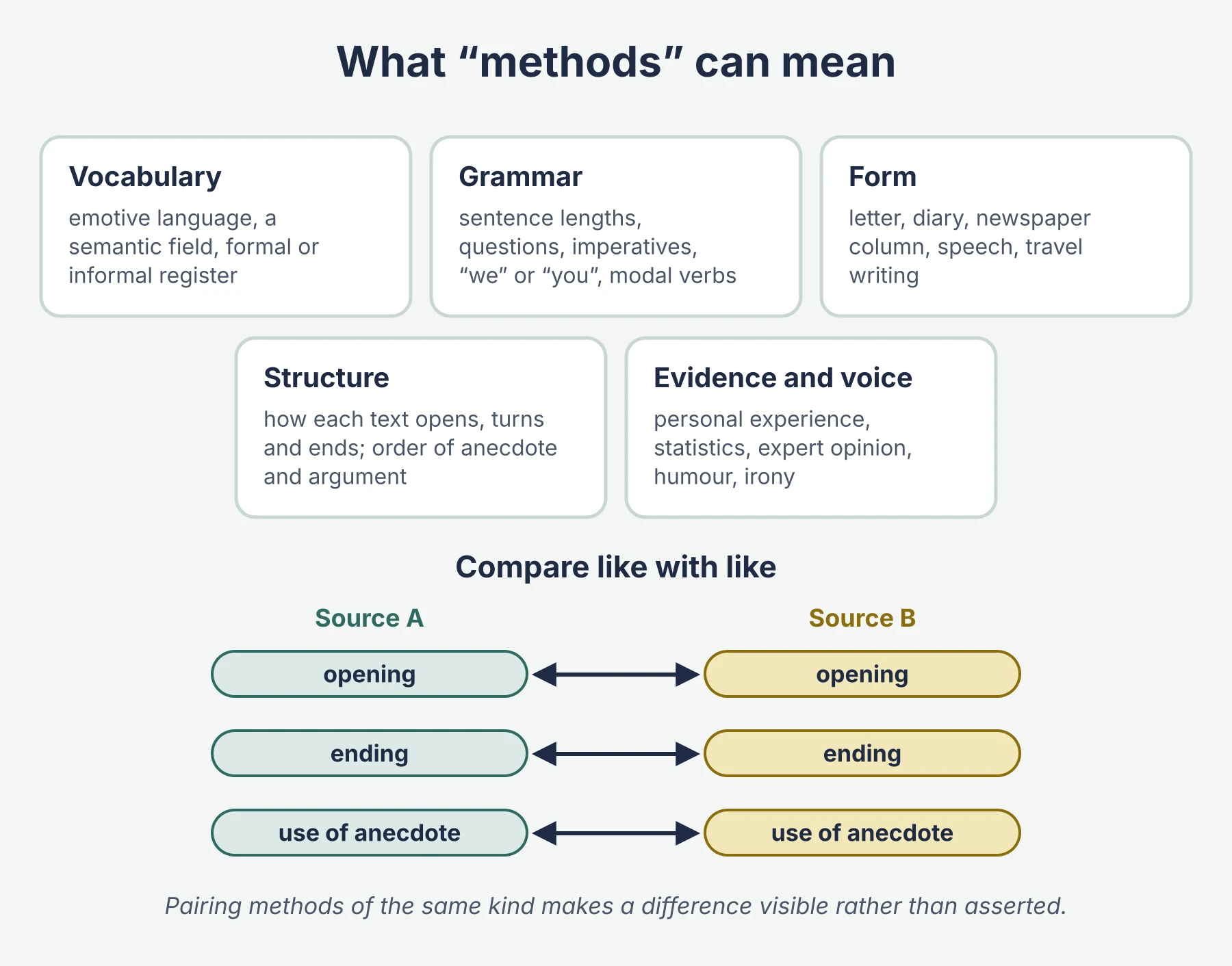
Comparing across time
The two sources are always from different periods. Use that difference critically rather than apologising for the older text:
- Audience: a 19th-century letter may be written to one person; a modern article to thousands of strangers.
- Conventions: long, balanced sentences and formal address were normal in much 19th-century prose. Treat them as choices that shape tone, not as “old-fashioned language”.
- Assumptions: what one writer takes for granted, the other may question. These unspoken assumptions are often the clearest evidence of perspective.
Keep context brief and tied to the text: one clause explaining why a writer might think as they do is enough.
Structuring a comparison
There are two broad approaches:
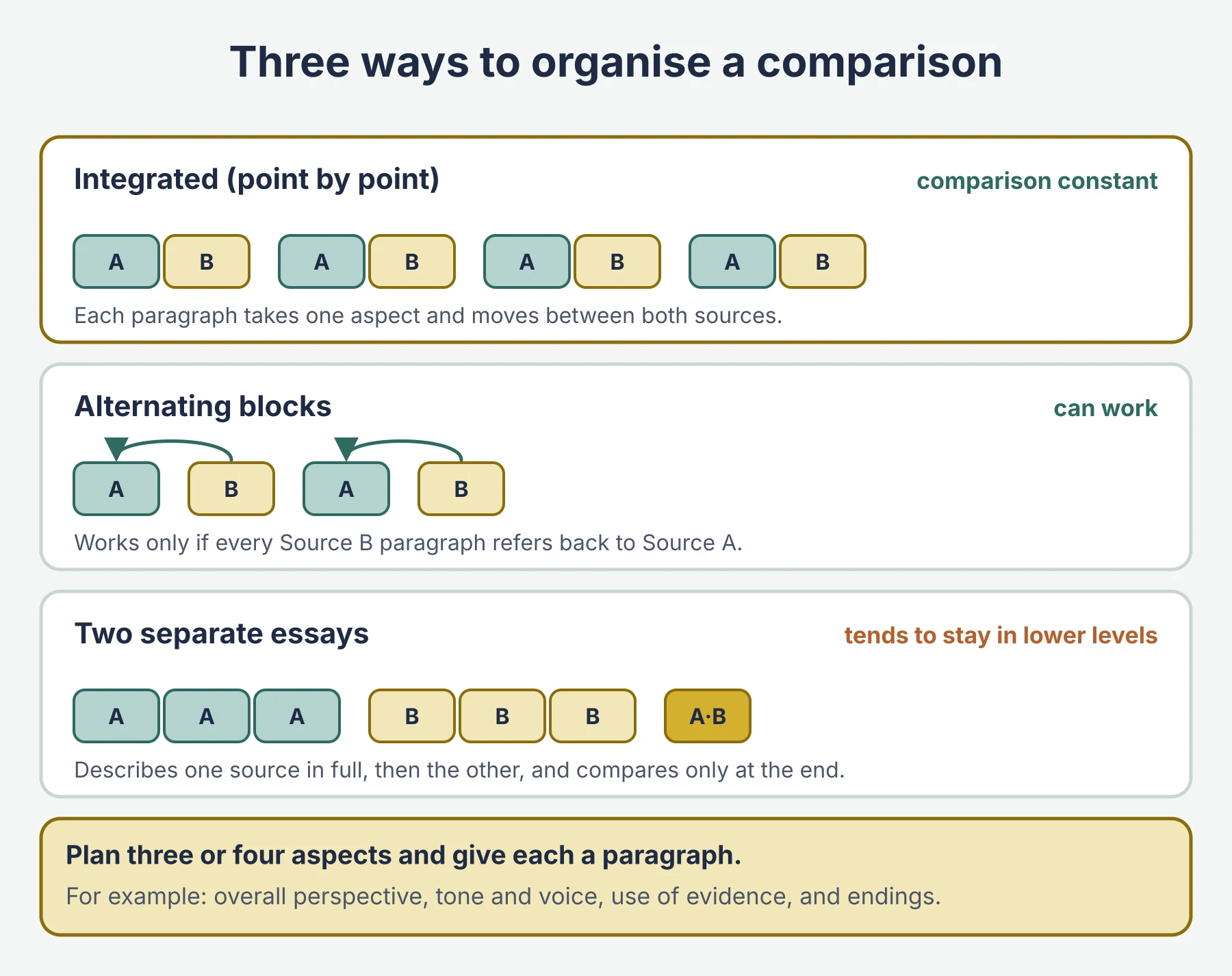
- Integrated (point by point): each paragraph takes one aspect and moves between both sources. This keeps comparison constant.
- Alternating blocks: a paragraph on Source A, then a paragraph on Source B, linked explicitly. This can work if every Source B paragraph refers back to Source A.
Answers that describe one source in full, then the other, and only compare in a final sentence tend to stay in the lower levels, because comparison is the skill being assessed. Plan three or four aspects, for example overall perspective, tone and voice, use of evidence, and endings, and give each a paragraph.
Worked example
The two extracts below are original, written for this guide.
Source A (letter in a 19th-century style): “We reached the summit at noon, and I confess I could not speak. The valleys lay below us like the folds of some vast garment, and the silence was so entire that I fancied I heard my own heart. I felt how small a thing a man is, and how great the hand that made these heights.”
Source B (modern column): “There was a queue at the summit. An actual queue, forty people long, each waiting to take the same photograph. Someone’s speaker was playing music. I looked down at the valley, beautiful and indifferent, and wondered what exactly we had all come up here to find.”
Annotated comparative paragraph:
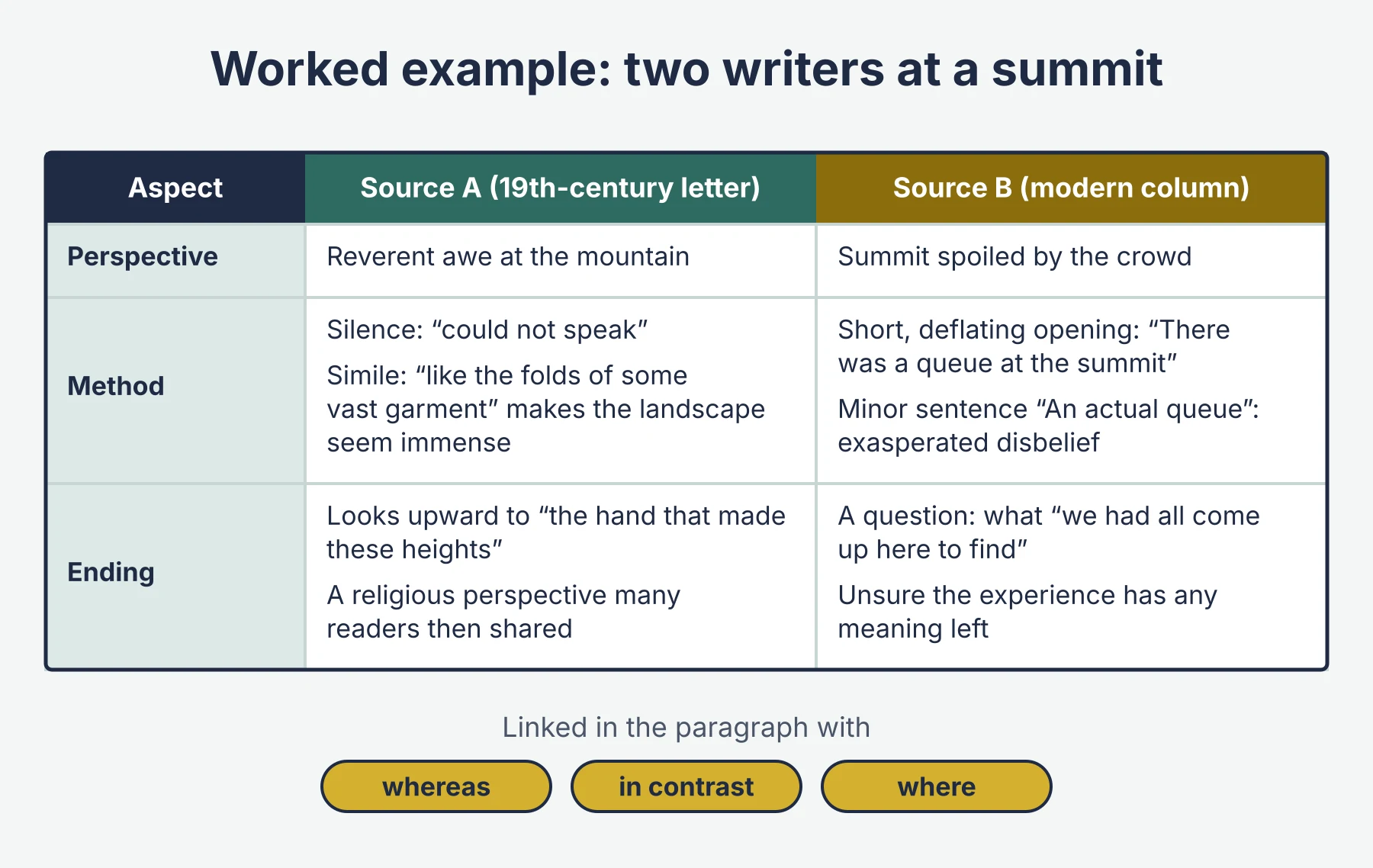
Both writers reach a summit, but their perspectives on the experience are almost opposite: for the writer of Source A the mountain inspires reverent awe, whereas the writer of Source B finds the summit spoiled by the crowd [comparison of perspectives in the first sentence]. The writer of Source A conveys awe through silence, admitting he “could not speak” and using an expansive simile, “like the folds of some vast garment”, which makes the landscape seem immense and carefully made [method, with effect]. The writer of Source B, in contrast, uses a short, deflating opening, “There was a queue at the summit”, followed by the minor sentence “An actual queue”, whose repetition conveys exasperated disbelief [method compared directly]. Where Source A ends by looking upward to “the hand that made these heights”, reflecting a religious perspective that many 19th-century readers would have shared, Source B ends with a question about what “we had all come up here to find”, which suggests a modern writer unsure whether the experience has any meaning left [endings compared; context used briefly].
Why it works: it compares in every sentence, it pairs methods of the same kind (silence with a flat opening, ending with ending), each method is linked to a perspective, and the context is one clause, not a history lesson.
Common mistakes
- Comparing content only, which turns the 16-mark question into a second summary.
- Comparing methods only, listing techniques without linking them to the writers’ perspectives.
- Two separate essays with a comparison sentence at the end.
- Using only part of each source when the question asks about the whole of both.
- Treating the older text’s style as a weakness rather than as a set of choices.
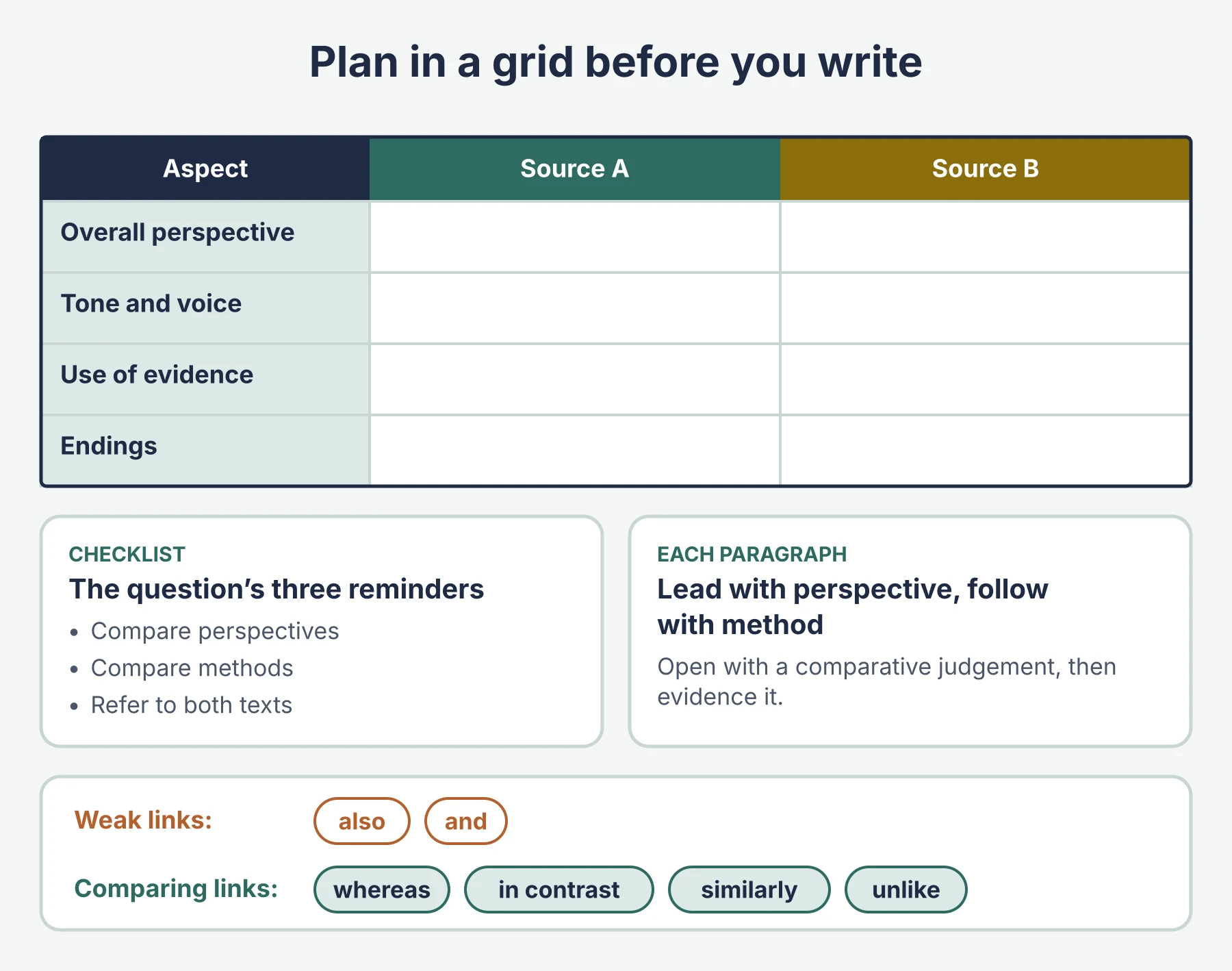
- Weak connectives: “also” and “and” do not compare; “whereas”, “in contrast”, “similarly”, “unlike” do.
Exam technique
- Compare how the writers convey…: the question typically reminds you to compare perspectives, compare methods, and support your answer with references to both texts. Use those three reminders as your checklist.
- Plan in a grid: aspects down the side, the two sources across the top. Fill it before writing.
- Lead with perspective, follow with method. Start each paragraph with a comparative judgement, then evidence it.
- Time: as the highest-tariff reading question on Paper 2, it deserves the most reading time on that paper.
Related: Paper 2 study guide | Paper 2 practice questions | summary and synthesis study guide
Official syllabus
AQA GCSE English Language (8700) specification, for GCSE exams June 2017 onwards: 3.1.1 Critical reading and comprehension (comparing texts), assessment objective AO3, and the Paper 2 scheme of assessment.
Related resources
-
Practice questions
AQA GCSE English Language (8700): Comparing Texts – Practice Questions
Original AQA GCSE English Language 8700 comparing texts practice on paired invented sources: perspectives, methods and comparative paragraphs, with answers.
English · AQA · GCSE
Try questions -
Revision notes
AQA GCSE English Language (8700): Comparing Texts – Revision Notes
AQA GCSE English Language 8700 comparing texts recall: AO3, perspective and method, comparing across centuries, planning grids, traps and a self-test.
English · AQA · GCSE
Revise topic -
Study guides
AQA GCSE English Language (8700): Critical Reading and Comprehension
AQA GCSE English Language 8700 guide to critical reading: inference, evidence, evaluating a statement, spotting bias and weighing different readings of a text.
English · AQA · GCSE
Read guide
Get free revision emails (optional)
Occasional emails with practice questions, worked explanations and links to free resources for the qualification and subjects you choose. No spam, and you can unsubscribe from any email. The free tools on this site never need an email.