
Revision Notes
AQA GCSE English Language (8700): Comparing Texts – Revision Notes
AQA GCSE English Language 8700 comparing texts recall: AO3, perspective and method, comparing across centuries, planning grids, traps and a self-test.
- Subject
- English
- Level
- GCSE
- Topic
- Topic 1: Critical reading and comprehension
- Author
- Marlbridge Academic Team
- Updated
- Reviewed by
- Ammar Bilal (what this means)
Aligned to AQA GCSE English (8700), For first teaching 2015. Official specification .
Syllabus page (what it covers and how it is assessed): AQA GCSE English Language.
Found an error? Report a correction.
Need help with this topic? Request a free trial class for GCSE English Language (8700).
These notes condense the comparing texts strand of 3.1.1 in AQA GCSE English Language (8700): “comparing two or more texts critically with respect to the above”. It is assessed by AO3: compare writers’ ideas and perspectives, as well as how these are conveyed, across two or more texts.
Related: comparing texts study guide | comparing texts practice questions | Paper 2 revision notes
The strand in one paragraph
Compare what each writer thinks and feels about the shared subject, and how their choices of language, structure, form and evidence convey it. Keep both sources in play in every paragraph, compare like with like, and use the gap in time between the sources to explain differences of perspective, briefly.
Where it is tested
| Question | Marks | Compares | AO |
|---|---|---|---|
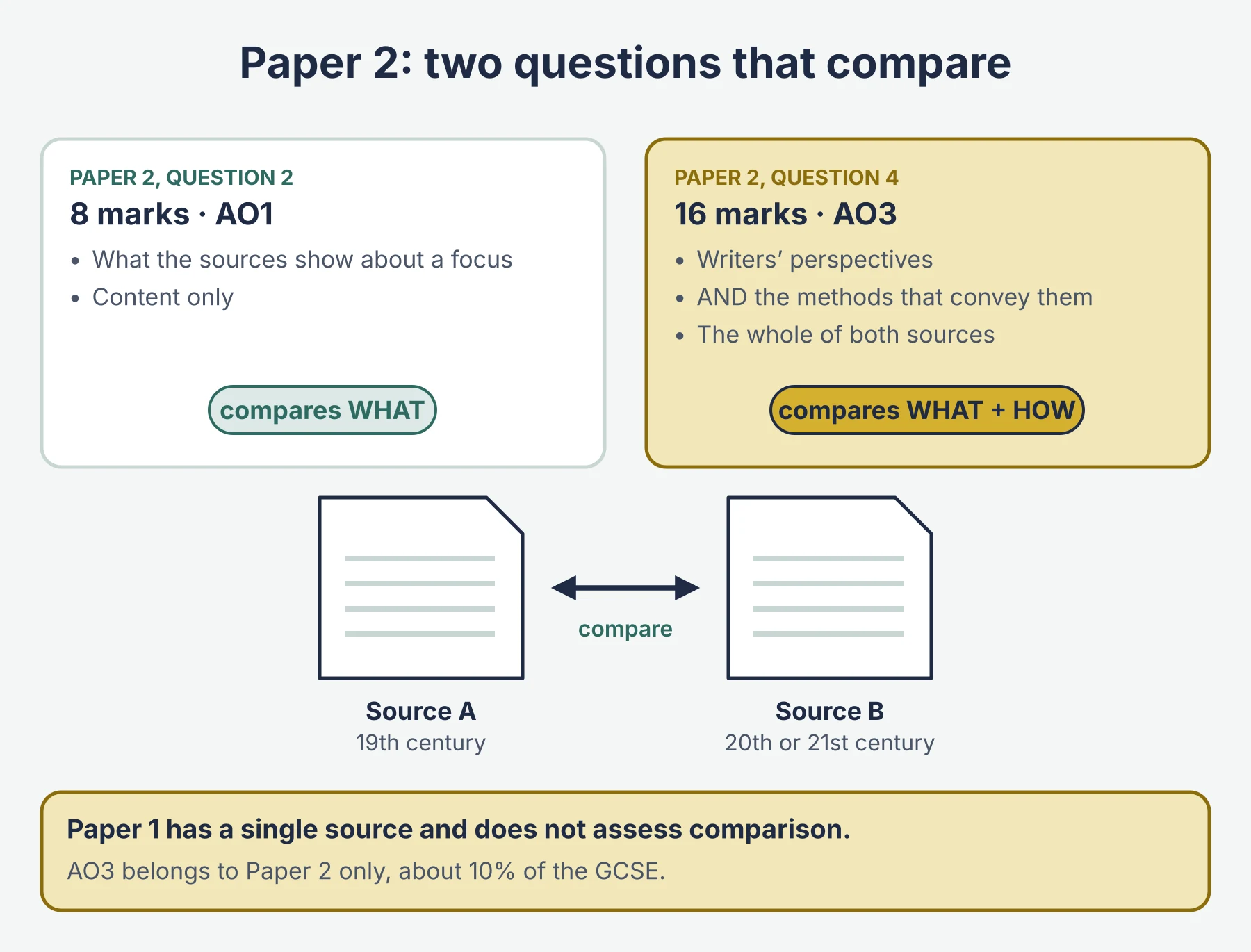
| Paper 2, Question 2 | 8 | Content: what the sources show about a focus | AO1 |
| Paper 2, Question 4 | 16 | Perspectives and methods, across the whole of both sources | AO3 |
- AO3 is Paper 2 only, about 10% of the GCSE.
- Paper 1 has one source, so it never asks you to compare.
- Sources: one 19th-century, one 20th- or 21st-century, non-fiction or literary non-fiction, on a linked subject.
Key terms
| Term | Meaning |
|---|---|
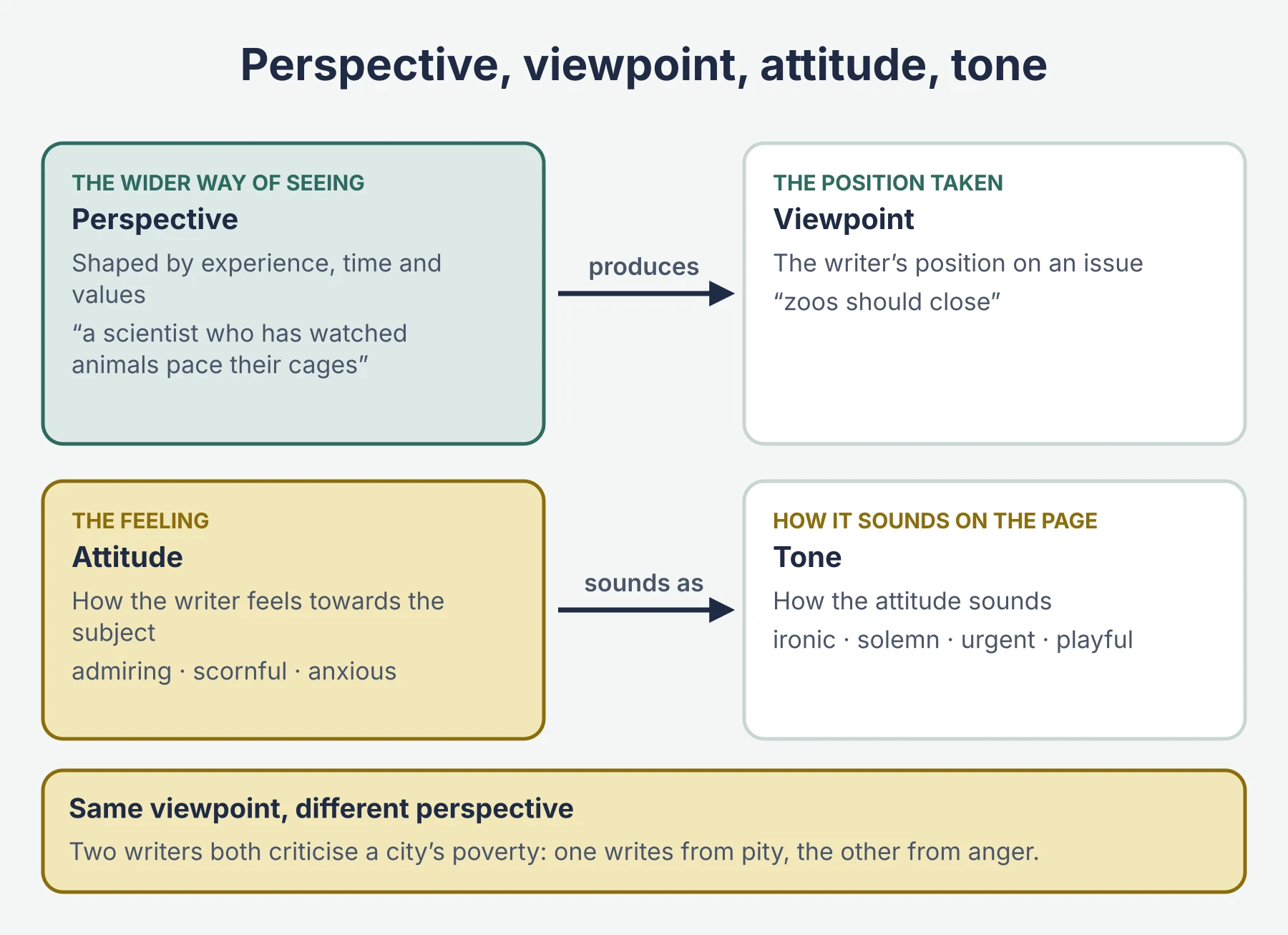
| Viewpoint | The position taken on an issue |
| Perspective | The wider way of seeing behind the viewpoint, shaped by experience, time and values |
| Attitude | The writer’s feeling towards the subject |
| Tone | How the attitude sounds: ironic, solemn, urgent, nostalgic |
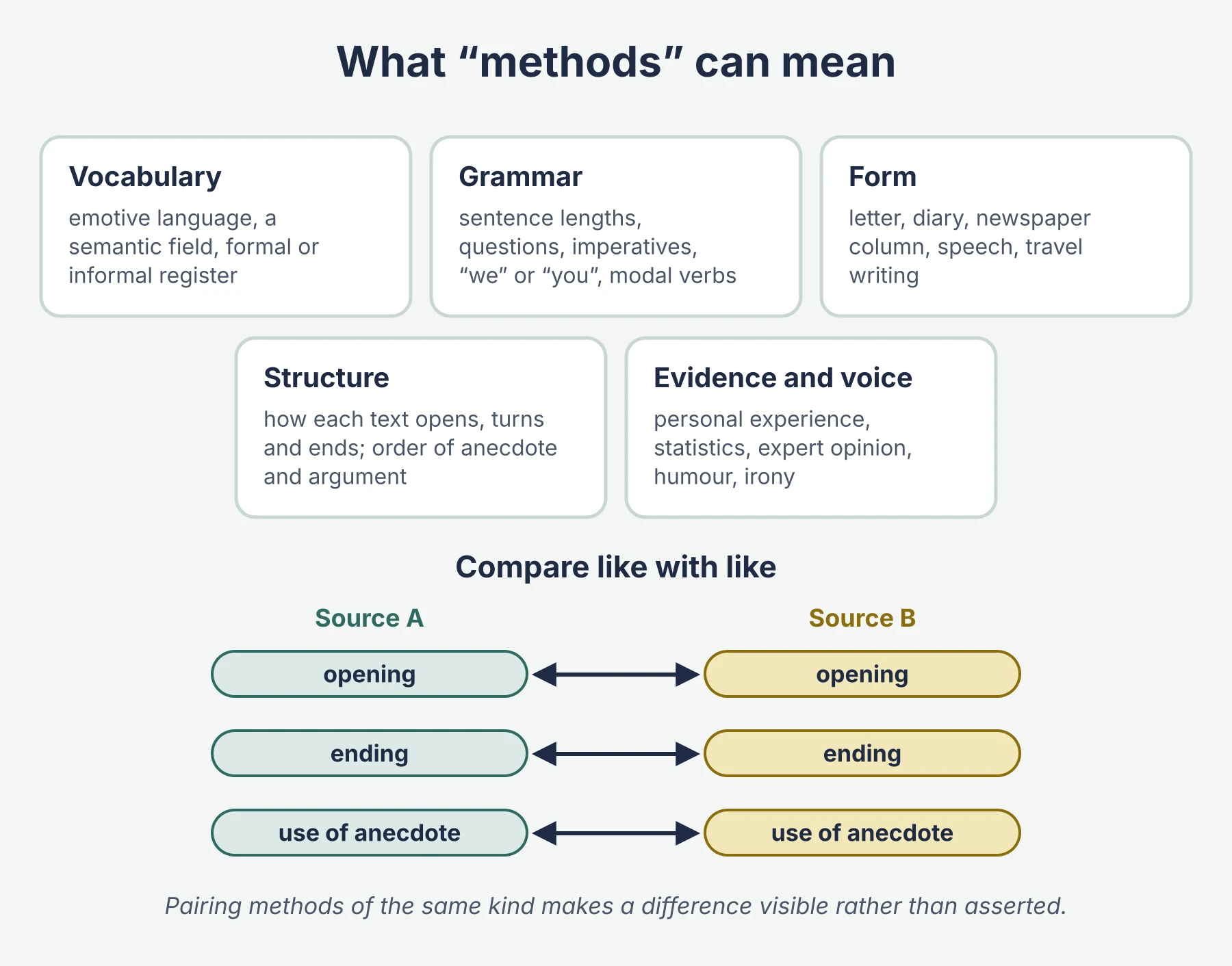
| Method | Any choice of vocabulary, grammar, form, structure or evidence |
| Integrated comparison | Each paragraph discusses both sources on one aspect |
| Comparative connective | A word that links and weighs two points |
| Assumption | Something a writer takes for granted, revealing perspective |
What to compare: the six-aspect grid
| Aspect | Source A | Source B |
|---|---|---|
| Overall perspective | ||
| Tone and voice | ||
| Opening | ||
| Key language method | ||
| Use of evidence (anecdote, fact, authority) | ||
| Ending |
Pick three or four rows with the sharpest contrasts or most interesting similarities. Each becomes a paragraph.
The comparative paragraph
Comparative judgement on perspective
 -> Source A method + quotation + effect
 -> connective
 -> Source B method + quotation + effect
 -> brief reason for the difference (purpose, audience or time)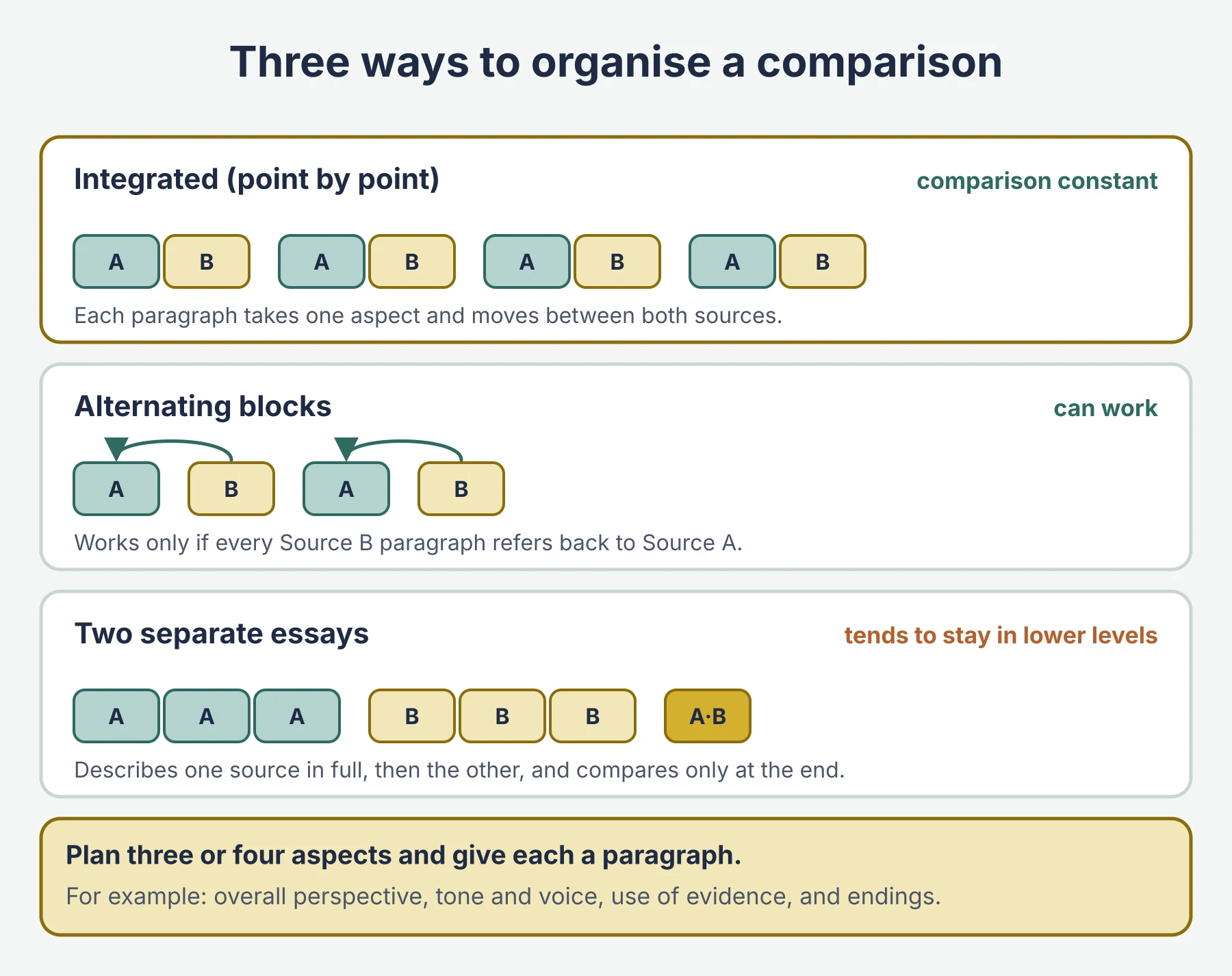
Comparative connectives
| Difference | Similarity | Degree |
|---|---|---|
| whereas, while, in contrast, unlike, conversely | similarly, likewise, both, equally, in the same way | more strongly, less directly, to a greater extent |
“And” and “also” join points without comparing them.
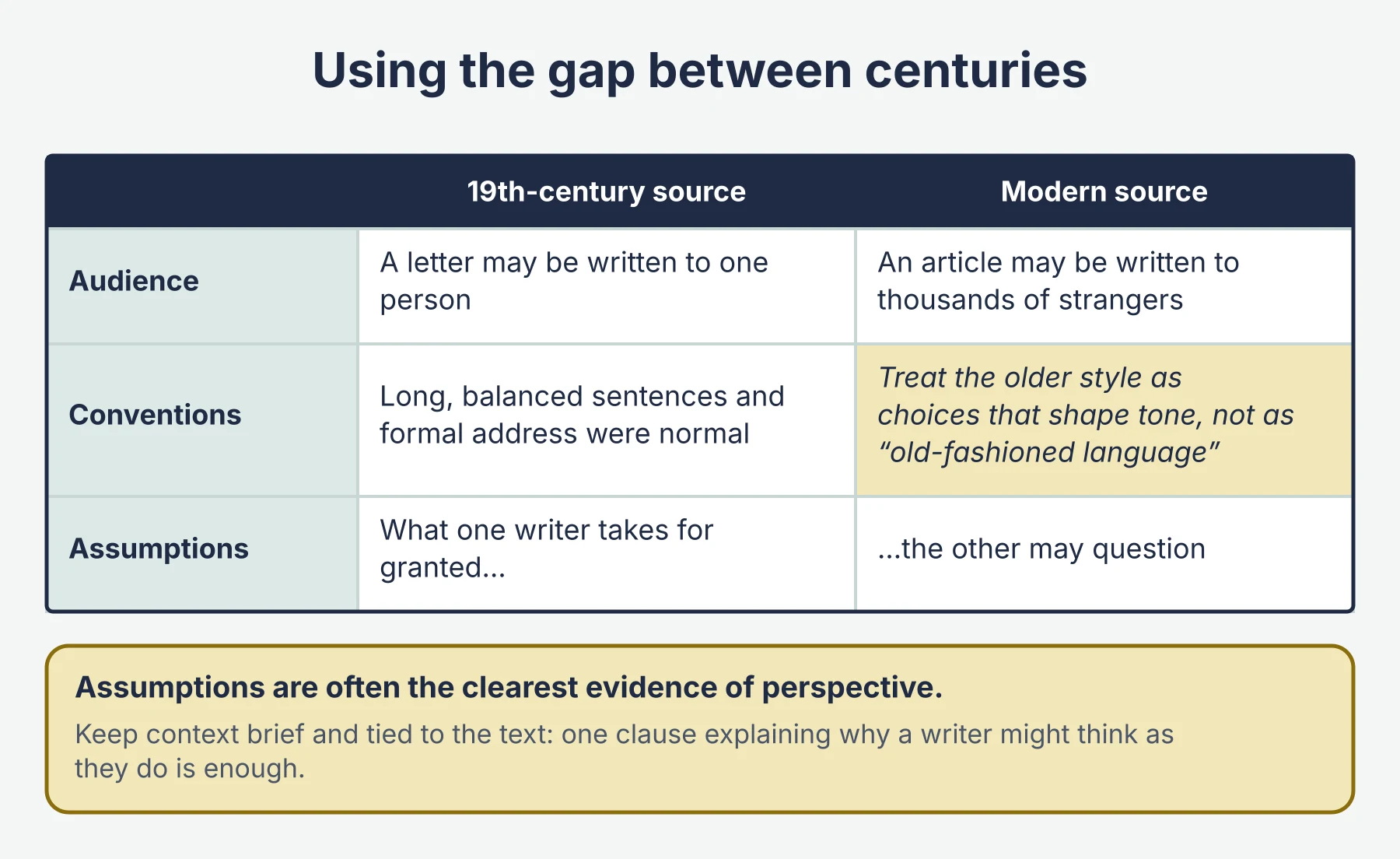
Comparing across centuries
- Audience: a single correspondent or a mass readership?
- Conventions: long balanced sentences and formal address are choices that shape tone.
- Assumptions: what does each writer never question?
- Context: one clause is enough, and only if it explains a difference.
From description to comparison
The examples below use two invented sources about a seaside town: a 19th-century visitor’s letter and a modern resident’s blog.
| Level | Example sentence |
|---|---|
| Description | “Source A describes the beach. Source B describes the beach too.” |
| Content comparison | “Source A enjoys the beach, whereas Source B finds it crowded.” |
| Method and perspective | “The letter writer’s long, admiring sentences suggest a visitor’s delight in novelty, whereas the blogger’s clipped complaints, ‘Litter. Again.’, reveal a resident’s weary perspective on the same shore.” |
Only the third sentence meets AO3 fully: it compares a perspective and the method that conveys it, in both sources, in one sentence.
Exam traps
- Comparing content only, turning AO3 into a second summary.
- Listing methods without linking them to perspectives.
- Writing about Source A, then Source B, with a final comparison sentence.
- Using only the opening of each source.
- Calling the 19th-century text “old-fashioned” instead of analysing its choices.
- Inventing differences when the writers genuinely agree.
- Long background paragraphs about history.
Quick self-test
- Which assessment objective is comparison, and on which paper is it assessed?
- What does “with respect to the above” refer to?
- How does Paper 2 Question 4 differ from Question 2?
- Define perspective, and say how it differs from viewpoint.
- Give three comparative connectives for differences.
- Why compare “like with like”?
- Give two ways the 19th-century date of a source might shape its perspective.
- What is an integrated comparison?
- Why do “and” and “also” weaken a comparison?
- Two writers both criticise a hotel. How could they still differ in perspective?
- How much context should you include?
- Why is the 16-mark question worth extra reading time?
Answers
- AO3, on Paper 2.
- The other parts of critical reading: themes, ideas, inference, evaluation, and the writer’s choices of vocabulary, grammar, form and structure.
- Question 2 compares content only (AO1); Question 4 compares perspectives and how methods convey them (AO3).
- Perspective is the wider way of seeing that produces a viewpoint; a viewpoint is the specific position taken.
- Any three: whereas, while, in contrast, unlike, conversely.
- Pairing the same kind of method makes the difference in approach visible rather than merely asserted.
- For example: a different audience, different conventions of formality, or assumptions about class, religion or gender that a modern writer would question.
- Each paragraph takes one aspect and discusses both sources together.
- They add points without weighing or linking them as similar or different.
- For example: one may be amused and ironic, the other genuinely angry; or one writes as a guest, the other as a worker.
- One clause, and only when it explains a difference.
- It is the highest-tariff reading question on Paper 2 and draws on the whole of both sources.
Official syllabus
AQA GCSE English Language (8700) specification, for GCSE exams June 2017 onwards: 3.1.1 Critical reading and comprehension (comparing texts), assessment objective AO3, and the Paper 2 scheme of assessment.
Related resources
-
Study guides
AQA GCSE English Language (8700): Critical Reading and Comprehension
AQA GCSE English Language 8700 guide to critical reading: inference, evidence, evaluating a statement, spotting bias and weighing different readings of a text.
English · AQA · GCSE
Read guide -
Practice questions
AQA GCSE English Language (8700): Critical Reading and Comprehension – Practice Questions
Original AQA GCSE English Language 8700 critical reading practice on short invented passages: inference, true statements, bias and evaluating a view.
English · AQA · GCSE
Try questions -
Revision notes
AQA GCSE English Language (8700): Critical Reading and Comprehension – Revision Notes
Condensed AQA GCSE English Language 8700 notes on critical reading: inference chains, AO1 and AO4, evaluating statements, bias and a 12-question self-test.
English · AQA · GCSE
Revise topic
Get free revision emails (optional)
Occasional emails with practice questions, worked explanations and links to free resources for the qualification and subjects you choose. No spam, and you can unsubscribe from any email. The free tools on this site never need an email.