
Revision Notes
AQA GCSE English Language (8700): Critical Reading and Comprehension – Revision Notes
Condensed AQA GCSE English Language 8700 notes on critical reading: inference chains, AO1 and AO4, evaluating statements, bias and a 12-question self-test.
- Subject
- English
- Level
- GCSE
- Topic
- Topic 1: Critical reading and comprehension
- Author
- Marlbridge Academic Team
- Updated
- Reviewed by
- Ammar Bilal (what this means)
Aligned to AQA GCSE English (8700), For first teaching 2015. Official specification .
Syllabus page (what it covers and how it is assessed): AQA GCSE English Language.
Found an error? Report a correction.
Need help with this topic? Request a free trial class for GCSE English Language (8700).
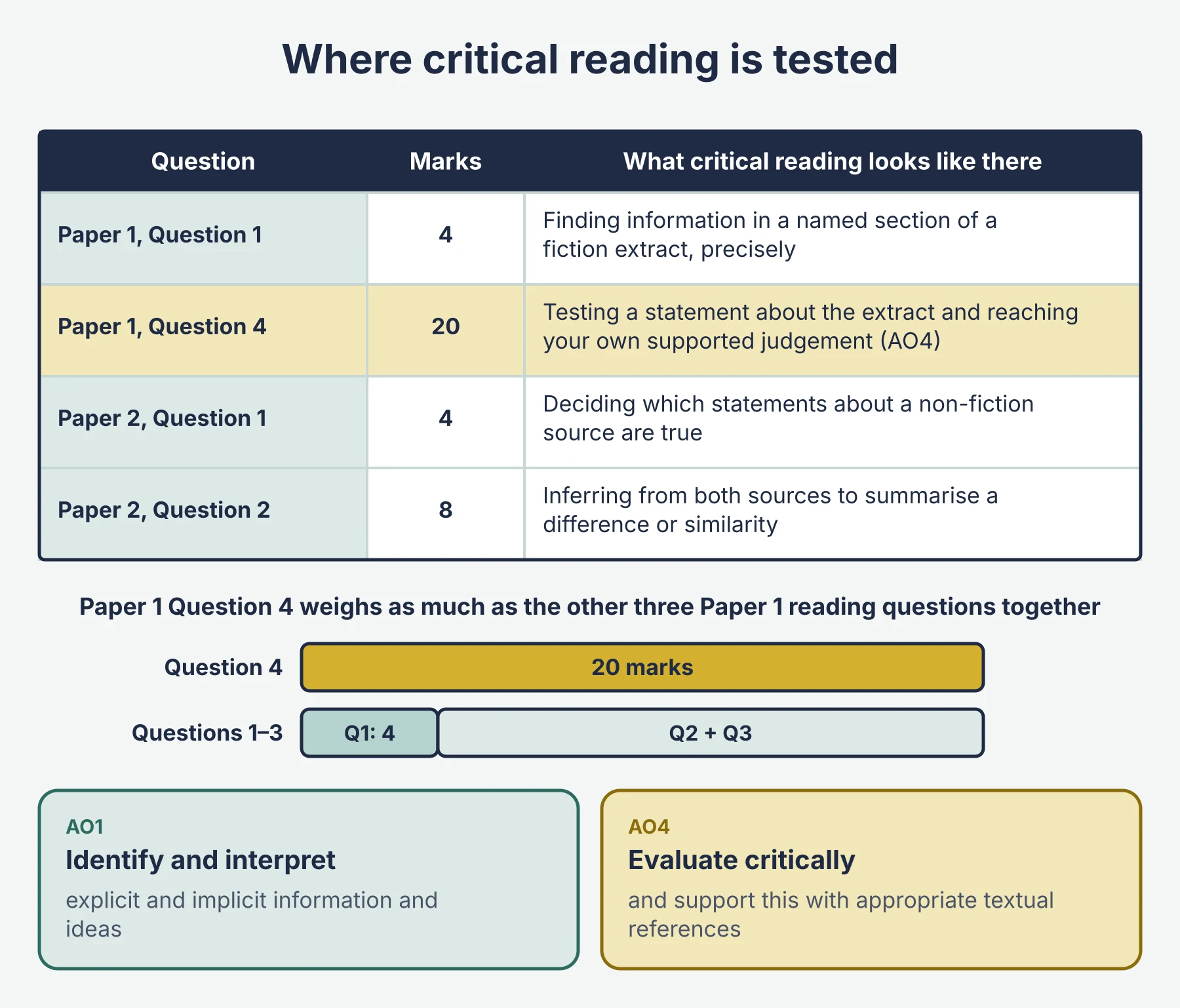
These notes condense the critical reading and comprehension strand of 3.1.1 in AQA GCSE English Language (8700). It is assessed mainly through AO1 (identify and interpret explicit and implicit information and ideas) and AO4 (evaluate texts critically and support this with appropriate textual references).
Related: critical reading study guide | critical reading practice questions | Paper 1 revision notes
The strand in one paragraph
Read for what is stated, then for what is implied, then for how far you trust it. Every interpretation must be tied to a short quotation. When asked to evaluate, judge how well the writer achieves something, test the wording of any statement you are given, and allow for a second reading before settling on your own.
The seven things the specification lists
- Identify and interpret themes, ideas and information.
- Read in different ways for different purposes; judge usefulness, relevance and presentation.
- Draw inferences and justify them with evidence.
- Support a point of view with reference to the text.
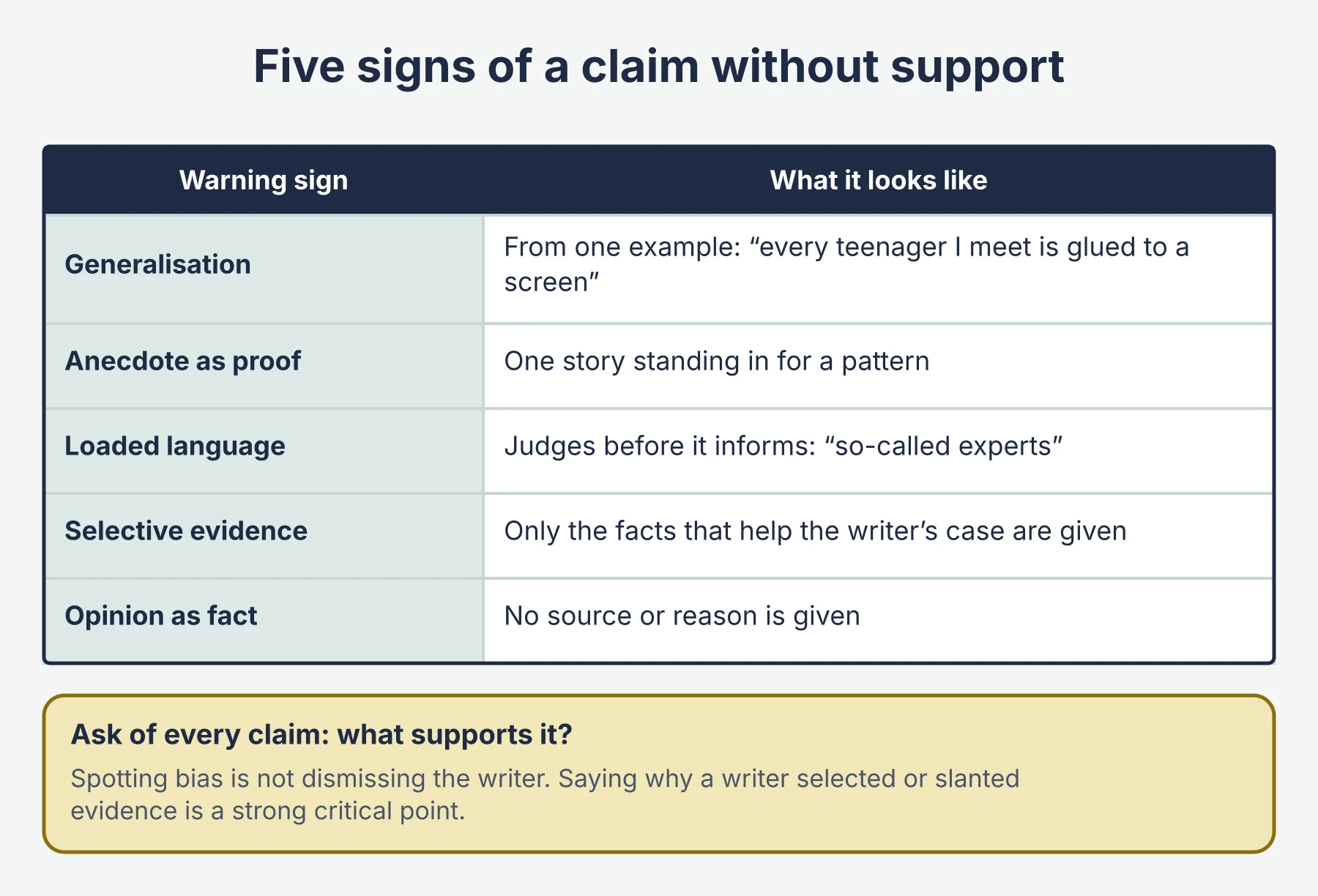
- Identify bias and misuse of evidence; separate supported from unsupported statements.
- Reflect critically, using the text’s context and wider reading.
- Recognise the possibility of different responses to a text.
Key terms
| Term | Meaning |
|---|---|
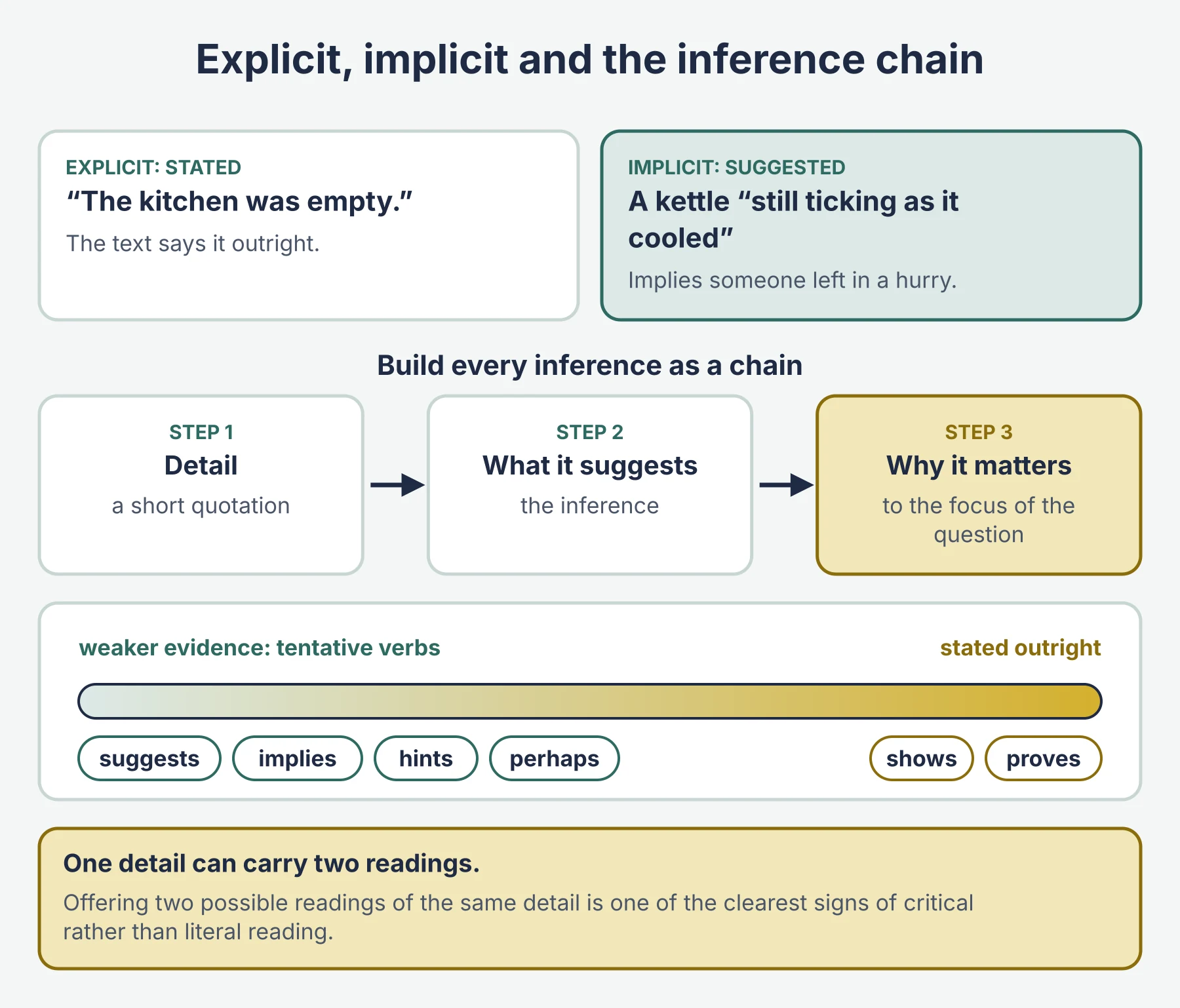
| Explicit | Stated directly on the page |
| Implicit | Suggested, not stated; recovered by inference |
| Inference | A reasoned conclusion drawn from a detail |
| Interpretation | Your account of what a detail or passage means |
| Evaluation | A judgement about how effectively a writer achieves an effect or purpose |
| Bias | A one-sided presentation that favours a view |
| Generalisation | A broad claim drawn from too few cases |
| Anecdote | A single personal story, sometimes used as if it were proof |
| Loaded language | Words that carry a judgement, steering the reader’s response |
| Context | The time, place, form and purpose in which a text was written |
| Alternative reading | A different but defensible interpretation of the same evidence |
Where it is tested
| Question | Marks | Focus |
|---|---|---|
| Paper 1, Question 1 | 4 | Information from a named section of the fiction extract |
| Paper 1, Question 4 | 20 | Evaluate a statement about part of the extract (AO4) |
| Paper 2, Question 1 | 4 | Identify true statements about one source |
| Paper 2, Question 2 | 8 | Infer from both sources to summarise (AO1) |
The inference chain
quotation (2-6 words) -> "this suggests..." -> link to the question's focus- Strong verbs for stated facts: shows, states.
- Tentative verbs for inferences: suggests, implies, perhaps, could indicate.
- Two inferences from one detail show interpretation, not just comprehension.
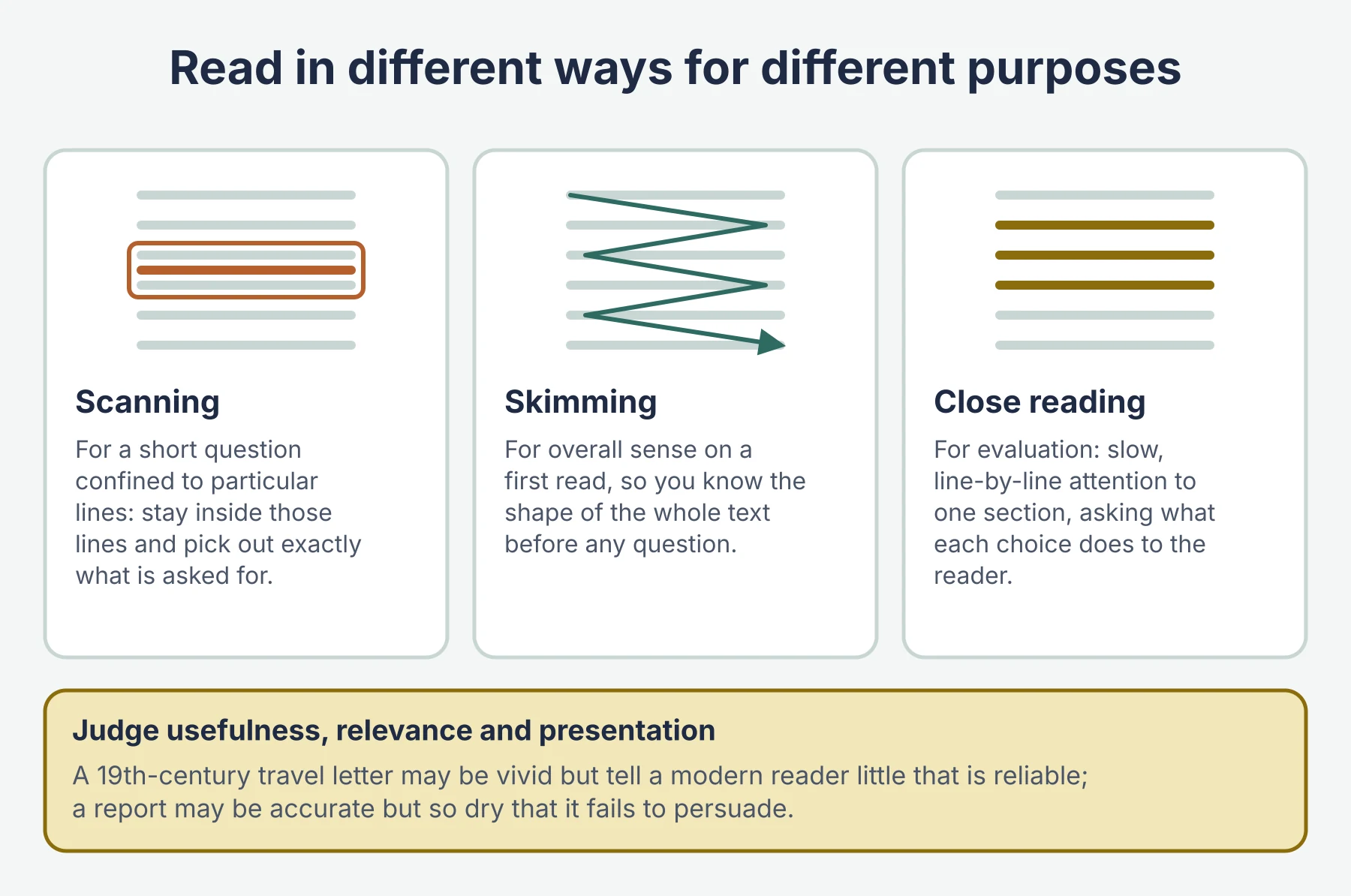
Three kinds of reading
| Kind | When | What you do |
|---|---|---|
| Skim | First read of any source | Get the gist and the overall shape |
| Scan | Short, line-limited questions | Find exactly the information asked for, inside the lines given |
| Close read | Evaluation | Weigh individual choices against the statement’s focus |
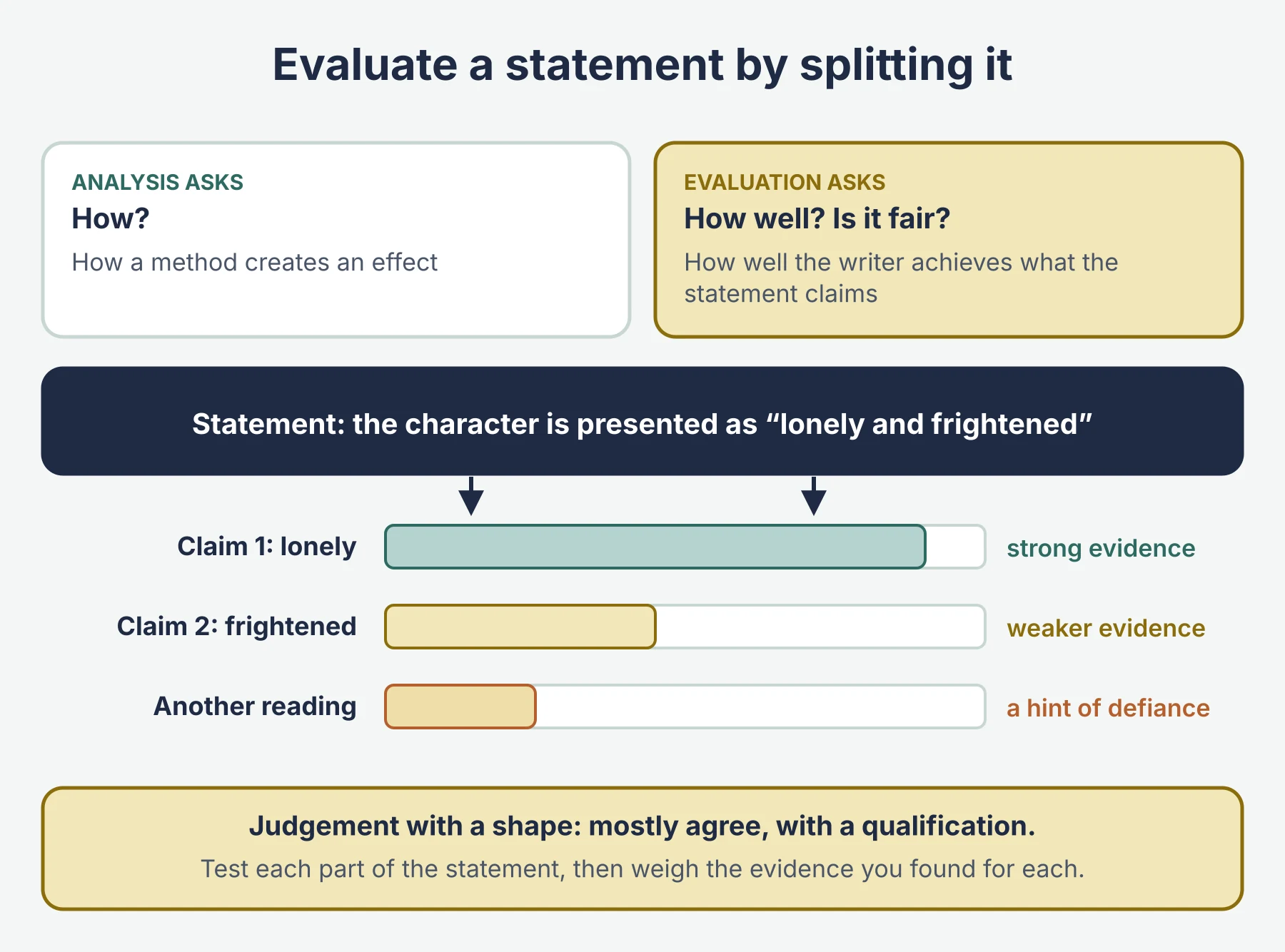
Evaluating a statement: five moves
- Judge first: say how far you agree in your opening sentence.
- Split the statement into its key words and test each one.
- Evidence each point with short, embedded quotations.
- Evaluate the method: how successfully does a choice create the effect named?
- Close with an earned judgement that may be qualified (“largely”, “only at first”).
Spotting misuse of evidence
| Warning sign | Example (original) | Critical comment |
|---|---|---|
| Generalisation | “All parents worry about this.” | No evidence that all do |
| Anecdote as proof | “My cousin’s school banned phones and grades soared.” | One case cannot show a pattern |
| Opinion as fact | “This is the worst policy in years.” | Unsupported value judgement |
| Selective evidence | Only benefits listed, no costs | The reader cannot weigh the case |
| Loaded words | “so-called experts” | Judges before informing |
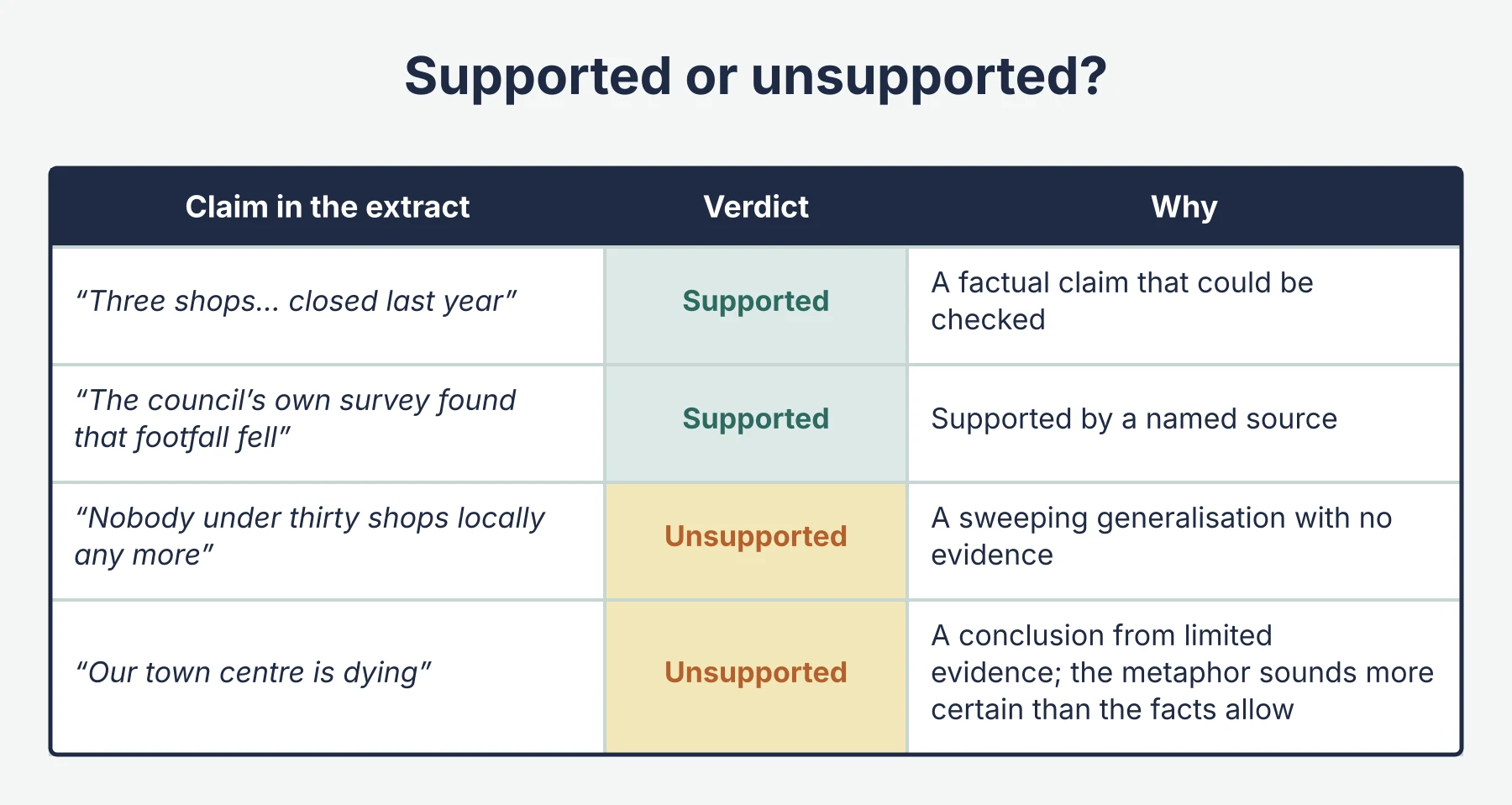
A supported statement names a source, gives a checkable fact or offers a reason. An unsupported statement asks the reader simply to trust the writer.
Using context well
- Use it when it changes or sharpens the reading of a detail.
- Keep it to a clause, not a paragraph of history.
- In a 19th-century source, treat assumptions the writer does not question as evidence of their perspective.
Exam traps
- Answering a line-limited question from the wrong section of the text.
- Copying a long quotation and calling it an inference.
- Agreeing completely with a statement, which pushes you towards description.
- Evaluating “the writer” in general rather than the part of the text named.
- Mistaking bias for weakness: a slanted text can still persuade powerfully.
- Inventing an inference with no traceable word in the text.
- Ignoring a possible second reading that the evidence clearly invites.
Quick self-test
- Which two assessment objectives carry most of this strand?
- What is the difference between explicit and implicit information?
- Give three tentative verbs for introducing an inference.
- Which Paper 1 question is the heaviest test of evaluation, and how many marks is it worth?
- Why should you split a statement into its key words?
- Name three signs that evidence may be misused.
- “Every shopper agrees the new car park is a disaster.” Is this supported? Why?
- What does “reading in different ways for different purposes” mean for a short, line-limited question?
- When is context worth including?
- Turn this into an inference: the boy “kept one hand on the door handle” while he talked.
- How do you show you recognise a different response to a text?
- What is the difference between analysis and evaluation?
Answers
- AO1 (identify and interpret information and ideas) and AO4 (evaluate texts critically with textual references).
- Explicit is stated directly; implicit is suggested and must be inferred.
- Any three: suggests, implies, hints, perhaps, could indicate.
- Paper 1 Question 4, worth 20 marks.
- Each key word is a separate claim; testing them one by one produces a qualified, evidenced judgement.
- Any three: generalisation, anecdote as proof, opinion stated as fact, selective evidence, loaded language.
- No: “every shopper” is a generalisation with no source, and “disaster” is an unsupported judgement.
- Scan only the lines named and select exactly the information asked for.
- When it changes or sharpens how a detail is read, kept brief.
- For example: he seems ready to leave at any moment, which suggests he feels uneasy or unwelcome.
- Offer the alternative reading with evidence, then explain which reading you find more convincing.
- Analysis explains how a method creates an effect; evaluation judges how successfully it achieves a purpose.
Official syllabus
AQA GCSE English Language (8700) specification, for GCSE exams June 2017 onwards: 3.1.1 Critical reading and comprehension, assessment objectives AO1 and AO4.
Related resources
-
Study guides
AQA GCSE English Language (8700): Evaluating a Writer's Choice of Vocabulary, Form, Grammar and Structure
AQA GCSE English Language 8700 guide to analysing and evaluating vocabulary, grammar, form and structure, with annotated language and structure paragraphs.
English · AQA · GCSE
Read guide -
Practice questions
AQA GCSE English Language (8700): Evaluating a Writer's Choice of Vocabulary, Form, Grammar and Structure – Practice Questions
Original AQA GCSE English Language 8700 practice on analysing vocabulary, grammar, form and structure in short invented passages, with full answers.
English · AQA · GCSE
Try questions -
Revision notes
AQA GCSE English Language (8700): Evaluating a Writer's Choice of Vocabulary, Form, Grammar and Structure – Revision Notes
AQA GCSE English Language 8700 recall notes on analysing vocabulary, grammar, form and structure: AO2 terms, effects, exam traps and a self-test.
English · AQA · GCSE
Revise topic
Get free revision emails (optional)
Occasional emails with practice questions, worked explanations and links to free resources for the qualification and subjects you choose. No spam, and you can unsubscribe from any email. The free tools on this site never need an email.