
Study Guides
AQA GCSE English Language (8700): Producing Clear and Coherent Text
AQA GCSE English Language 8700 guide to clear, coherent writing: purpose, audience and form, register, cohesion, consistent viewpoint and paragraph control.
- Subject
- English
- Level
- GCSE
- Topic
- Topic 2: Writing
- Author
- Marlbridge Academic Team
- Updated
- Reviewed by
- Ammar Bilal (what this means)
Aligned to AQA GCSE English (8700), For first teaching 2015. Official specification .
Syllabus page (what it covers and how it is assessed): AQA GCSE English Language.
Found an error? Report a correction.
Need help with this topic? Request a free trial class for GCSE English Language (8700).
Producing clear and coherent text is the first strand of 3.1.2 Writing in AQA GCSE English Language (8700). It is about control: choosing the right voice for a reader, organising ideas so that each follows from the last, and keeping the whole piece consistent from first line to last. It underpins Section B of both papers. For quick recall use the clear and coherent writing revision notes, and to practise use the clear and coherent writing practice questions.
What the specification includes
The strand lists:
- writing effectively for different purposes and audiences: to describe, narrate, explain, instruct, give and respond to information, and argue;
- selecting vocabulary, grammar, form, and structural and organisational features judiciously to reflect audience, purpose and context;
- using language imaginatively and creatively;
- using information provided by others to write in different forms;
- maintaining a consistent point of view;
- maintaining coherence and consistency across a text.
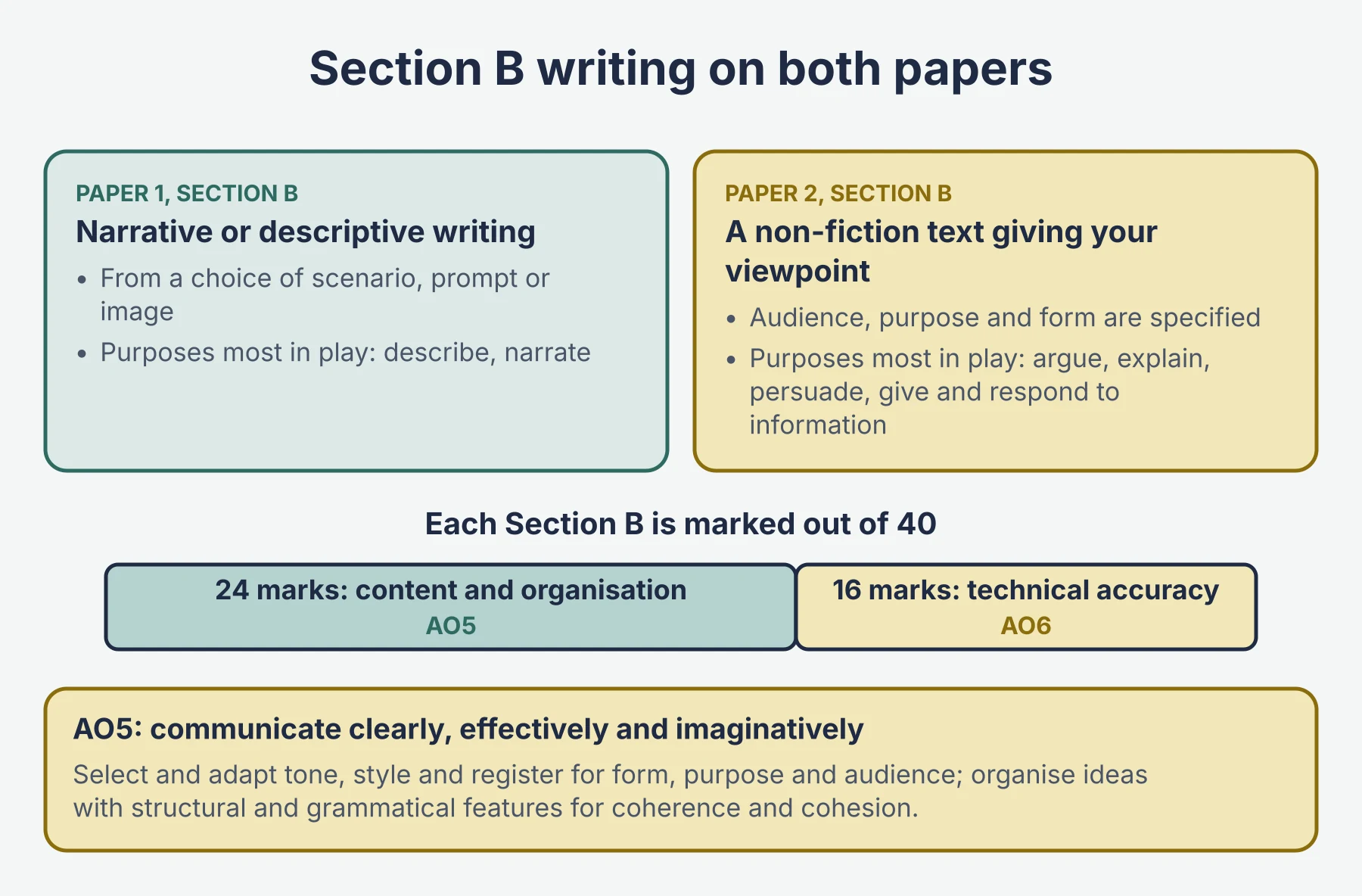
It is assessed by AO5: communicate clearly, effectively and imaginatively, selecting and adapting tone, style and register for different forms, purposes and audiences; organise information and ideas, using structural and grammatical features to support coherence and cohesion. AO6 (vocabulary, sentence structures, spelling and punctuation) is marked alongside it. In each paper’s Section B, 24 marks go to content and organisation and 16 to technical accuracy.
| Paper | Section B task | Purposes most often in play |
|---|---|---|
| Paper 1 | Narrative or descriptive writing from a choice of scenario, prompt or image | Describe, narrate |
| Paper 2 | A non-fiction text giving your viewpoint, with audience, purpose and form specified | Argue, explain, persuade, give and respond to information |
Purpose shapes everything
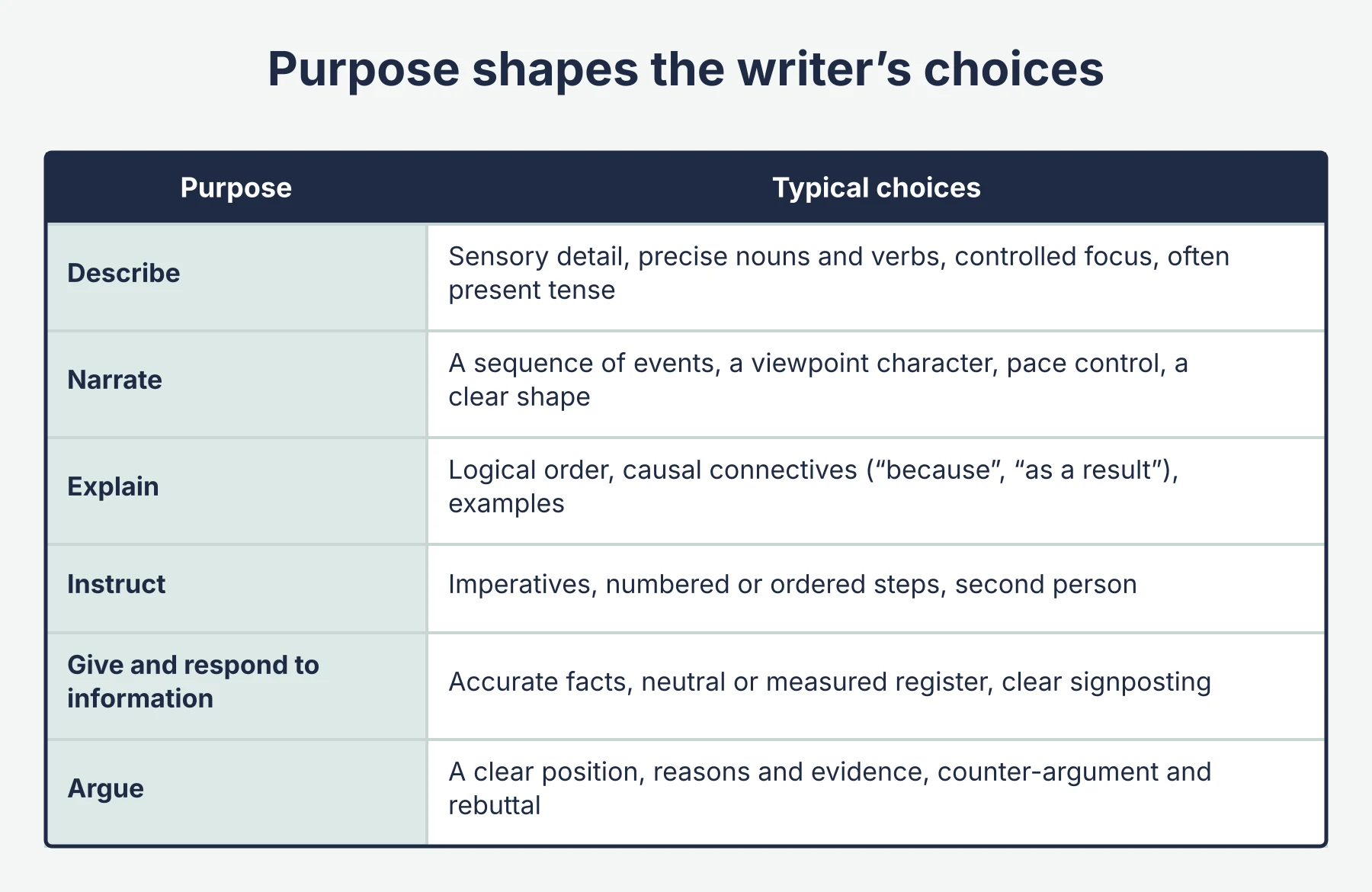
Each purpose pulls the writing towards different choices:
| Purpose | Typical choices |
|---|---|
| Describe | Sensory detail, precise nouns and verbs, controlled focus, often present tense |
| Narrate | A sequence of events, a viewpoint character, pace control, a clear shape |
| Explain | Logical order, causal connectives (“because”, “as a result”), examples |
| Instruct | Imperatives, numbered or ordered steps, second person |
| Give and respond to information | Accurate facts, neutral or measured register, clear signposting |
| Argue | A clear position, reasons and evidence, counter-argument and rebuttal |
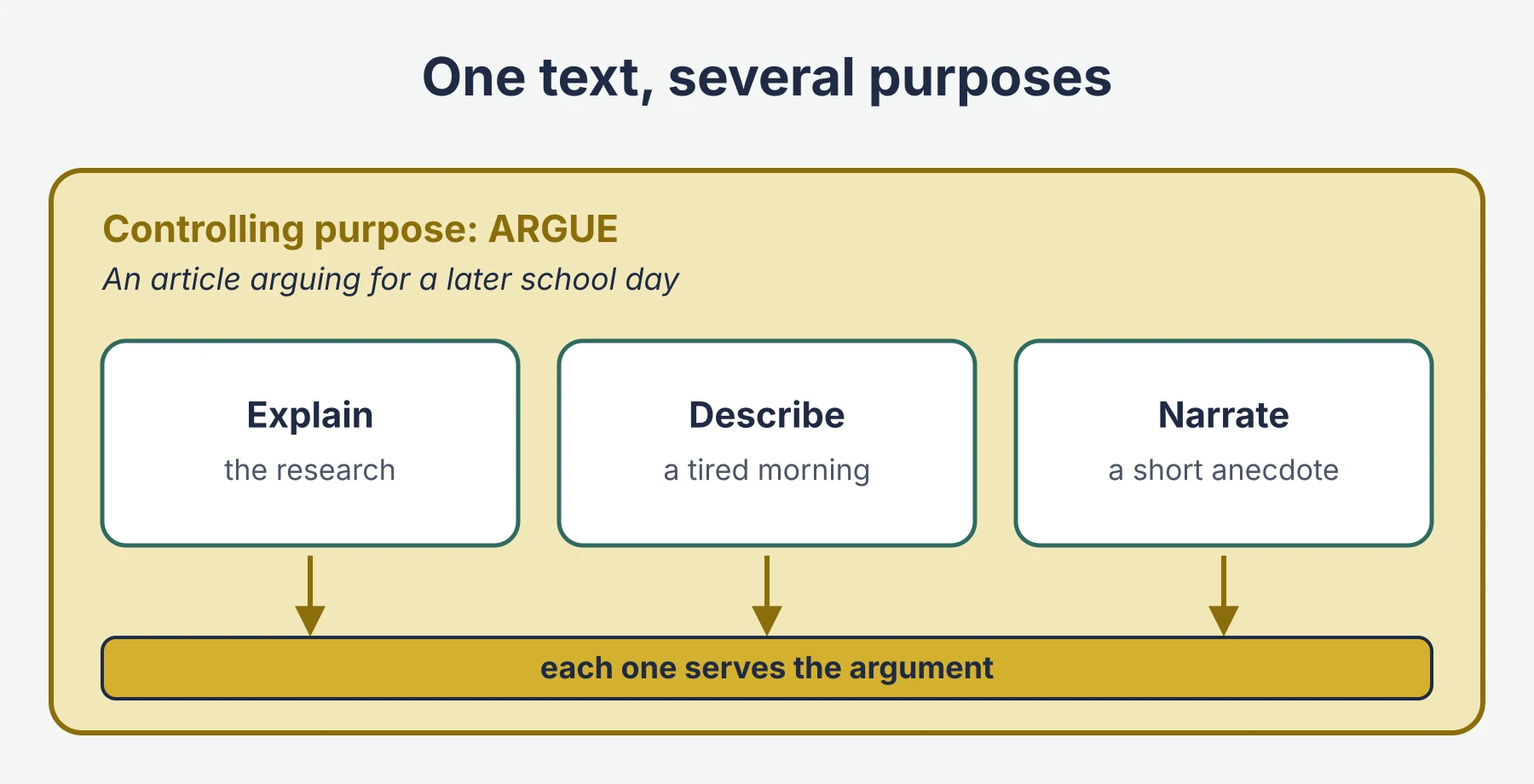
A single text can mix purposes. An article arguing for a later school day may explain research, describe a tired morning and narrate a short anecdote, but the controlling purpose stays argument.
Audience, form and register
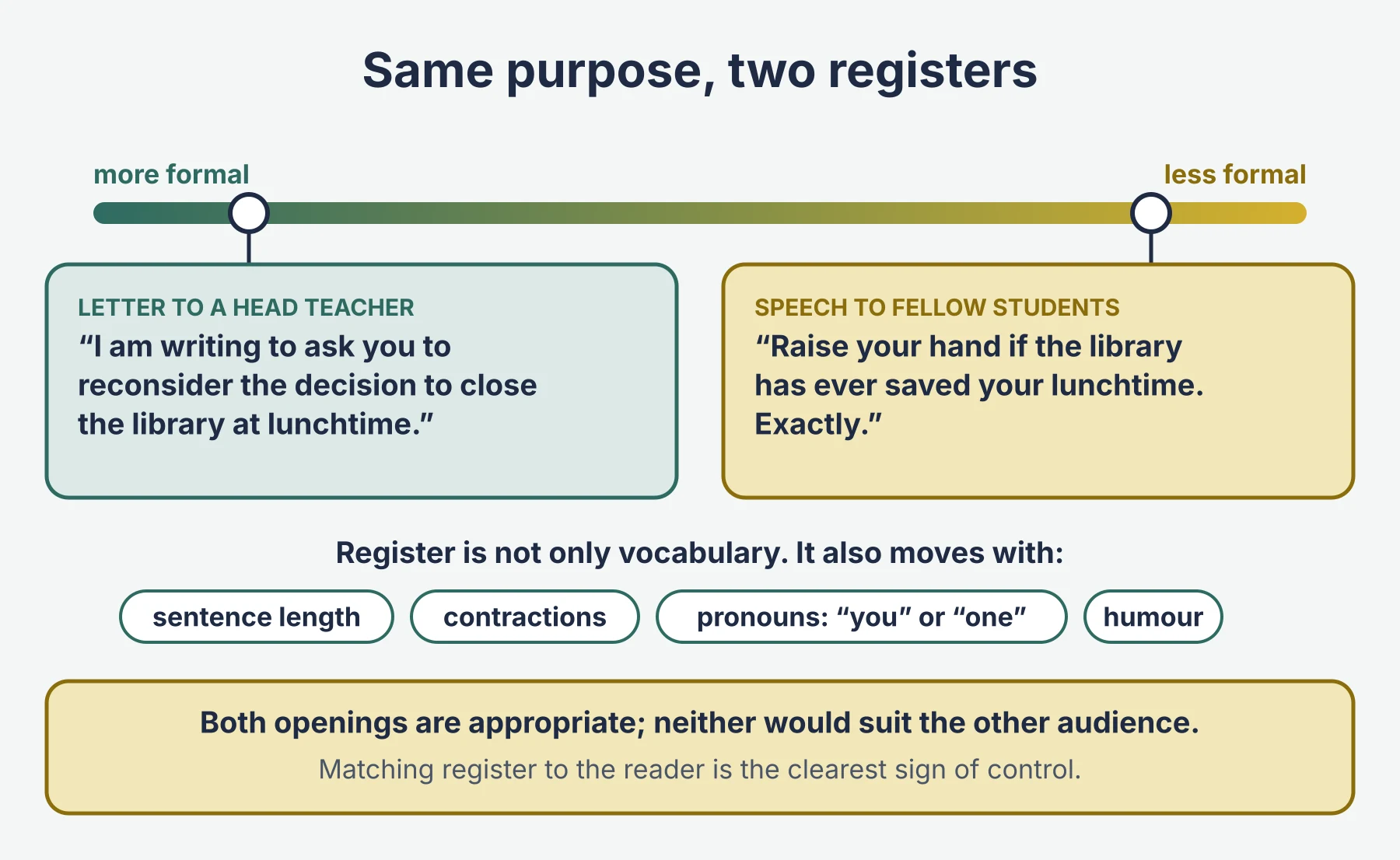
Register is the level of formality. Matching it to the reader is the clearest sign of control. Compare two openings with the same purpose:
- To a head teacher (letter): “I am writing to ask you to reconsider the decision to close the library at lunchtime.”
- To fellow students (speech): “Raise your hand if the library has ever saved your lunchtime. Exactly.”
Both are appropriate; neither would suit the other audience. Register is not only vocabulary: sentence length, contractions, pronouns (“you” or “one”) and humour all move it.
Form brings conventions. A letter needs an appropriate greeting and sign-off; an article benefits from a headline and perhaps a subheading; a speech addresses listeners directly and signals structure aloud; a leaflet may use subheadings. Use the conventions the form expects, but do not let layout replace content: a headline earns little if the article beneath it is disorganised.
Coherence and cohesion
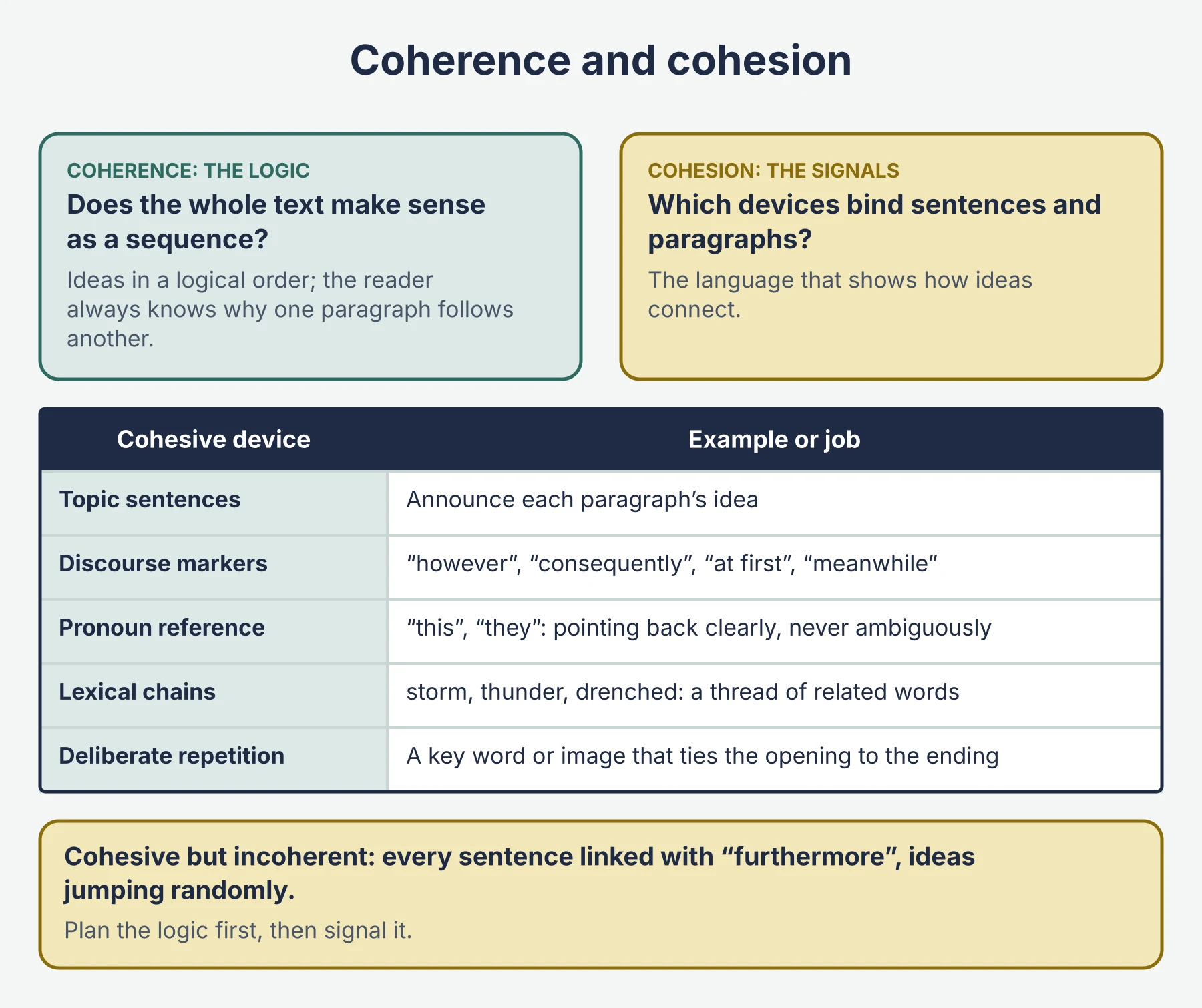
These two words are often confused.
- Coherence is whether the whole text makes sense as a sequence: the ideas are in a logical order and the reader always knows why one paragraph follows another.
- Cohesion is the set of linguistic devices that bind sentences and paragraphs together.
Cohesive devices include:
- topic sentences that announce each paragraph’s idea;
- discourse markers (“however”, “consequently”, “at first”, “meanwhile”) that signal the relationship between ideas;
- pronoun reference (“this”, “they”) that points back clearly, never ambiguously;
- lexical chains, where related words (storm, thunder, drenched) keep a thread running;
- deliberate repetition of a key word or image to tie the opening to the ending.
A text can be cohesive but incoherent: every sentence linked with “furthermore” while the ideas jump randomly. Aim for both: plan the logic first, then signal it.
Maintaining a consistent point of view
In narrative, consistency means keeping the same narrative person (first or third) and tense unless a change is deliberate and signalled. A story that slips from “I” to “she”, or from past to present in the middle of a paragraph, loses the reader’s trust.
In argument, consistency means keeping your stance. Acknowledging a counter-argument is a strength; drifting into agreeing with it is not. Signal concessions clearly: “Some argue that…, but this ignores…”.
Using information provided by others
The specification includes turning information from others into new forms. In practice, this might mean using facts from a briefing to write a leaflet, or drawing ideas from the Paper 2 reading sources into your own article. Select only what serves your purpose, rewrite it in your register, and integrate it rather than copying a list.
Worked example: improving coherence
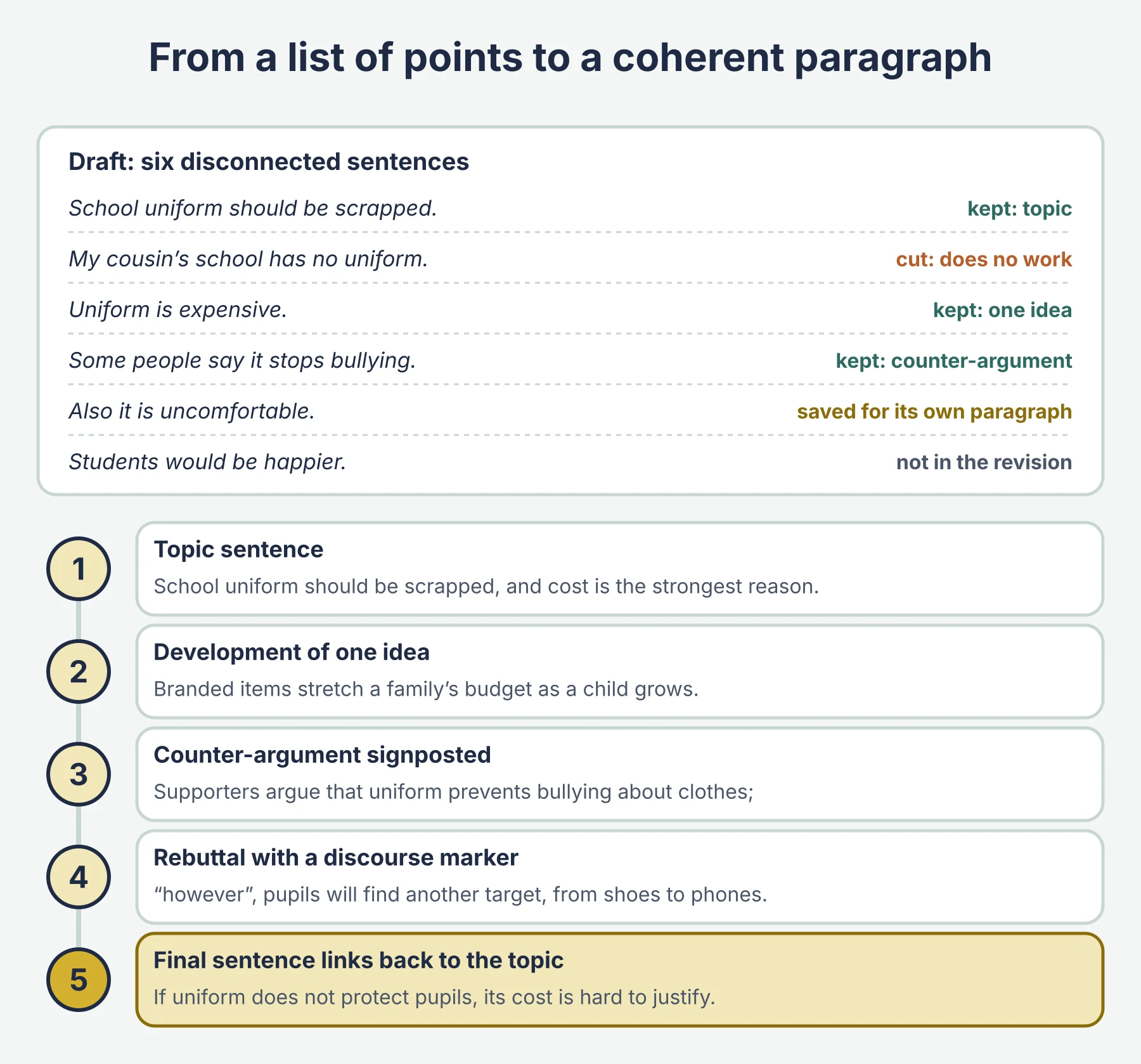
Draft paragraph (original):
School uniform should be scrapped. My cousin’s school has no uniform. Uniform is expensive. Some people say it stops bullying. Also it is uncomfortable. Students would be happier.
Revised paragraph (annotated):
School uniform should be scrapped, and cost is the strongest reason [topic sentence states the paragraph’s idea]. A full set of branded items can stretch a family’s budget, especially when a growing child needs new ones each year [development of one idea]. Supporters argue that uniform prevents bullying about clothes [counter- argument signposted]; however, pupils who want to single someone out will find another target, from shoes to phones [rebuttal with discourse marker]. If uniform does not protect pupils, it is hard to justify what it costs the families who pay for it [final sentence links back to the topic].
The revision removes the anecdote that did no work, groups the ideas, uses “however” to show the relationship between counter-argument and rebuttal, and ends where the topic sentence began. The comfort point has been saved for its own paragraph.
Common mistakes
- Ignoring the audience named in the task, so the register is wrong from the first line.
- Treating form as layout only, with a headline but no structure beneath it.
- Lists of points with no development or links.
- Overusing one discourse marker, especially “also” or “furthermore”.
- Slipping tense or person in narrative.
- Drifting stance in argument after a counter-argument.
- Copying information from a source rather than reshaping it.
Exam technique
- Underline the audience, purpose and form in the Paper 2 task before planning.
- Spend a few minutes planning a sequence of paragraphs, each with a one-line idea.
- Write the first and last lines of the plan first, so the ending can echo the opening.
- After writing, check three things: register matches the reader; tense and person are consistent; every paragraph connects to the one before.
Related: Paper 1 study guide | Paper 2 study guide | writing for impact study guide
Official syllabus
AQA GCSE English Language (8700) specification, for GCSE exams June 2017 onwards: 3.1.2 Writing (producing clear and coherent text), assessment objectives AO5 and AO6, and Section B of Papers 1 and 2.
Related resources
-
Practice questions
AQA GCSE English Language (8700): Producing Clear and Coherent Text – Practice Questions
Original AQA GCSE English Language 8700 writing practice on register, form, cohesion, consistent viewpoint and planning, with mark-scheme-style answers.
English · AQA · GCSE
Try questions -
Revision notes
AQA GCSE English Language (8700): Producing Clear and Coherent Text – Revision Notes
AQA GCSE English Language 8700 recall notes on clear, coherent writing: six purposes, register, form conventions, cohesion devices and a self-test.
English · AQA · GCSE
Revise topic -
Study guides
AQA GCSE English Language (8700): Writing for Impact
AQA GCSE English Language 8700 guide to writing for impact: emphasis, pertinent evidence, emotional impact, antithesis, parenthesis and other devices.
English · AQA · GCSE
Read guide
Get free revision emails (optional)
Occasional emails with practice questions, worked explanations and links to free resources for the qualification and subjects you choose. No spam, and you can unsubscribe from any email. The free tools on this site never need an email.