
Revision Notes
AQA GCSE English Language (8700): Producing Clear and Coherent Text – Revision Notes
AQA GCSE English Language 8700 recall notes on clear, coherent writing: six purposes, register, form conventions, cohesion devices and a self-test.
- Subject
- English
- Level
- GCSE
- Topic
- Topic 2: Writing
- Author
- Marlbridge Academic Team
- Updated
- Reviewed by
- Ammar Bilal (what this means)
Aligned to AQA GCSE English (8700), For first teaching 2015. Official specification .
Syllabus page (what it covers and how it is assessed): AQA GCSE English Language.
Found an error? Report a correction.
Need help with this topic? Request a free trial class for GCSE English Language (8700).
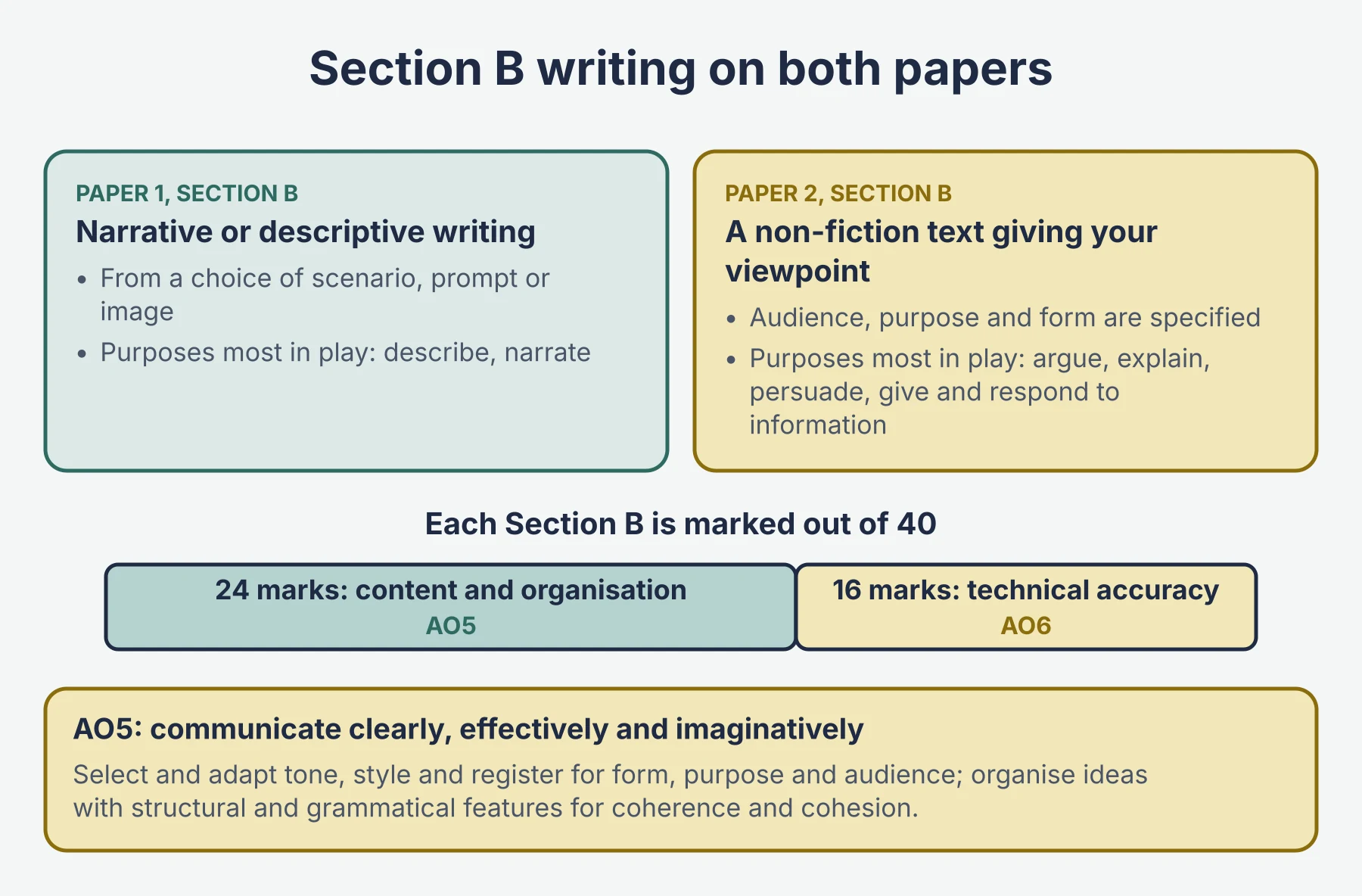
These notes condense producing clear and coherent text, the first strand of 3.1.2 Writing in AQA GCSE English Language (8700). It is assessed by AO5 (tone, style and register for form, purpose and audience; organisation for coherence and cohesion) alongside AO6 (vocabulary, sentence structures, spelling and punctuation).
Related: clear and coherent writing study guide | clear and coherent writing practice questions | Paper 2 revision notes
The strand in one paragraph
Know your reader, your purpose and your form before you write. Choose a register to match, organise ideas in a logical sequence, signal that sequence with cohesive devices, and keep the same point of view, tense and stance throughout.
Where it is assessed
| Paper | Section B | Marks |
|---|---|---|
| Paper 1 | Narrative or descriptive writing (choice of scenario, written prompt or visual image) | 40: 24 content and organisation, 16 technical accuracy |
| Paper 2 | Viewpoint writing to a specified audience, purpose and form | 40: 24 content and organisation, 16 technical accuracy |
The six purposes in the specification
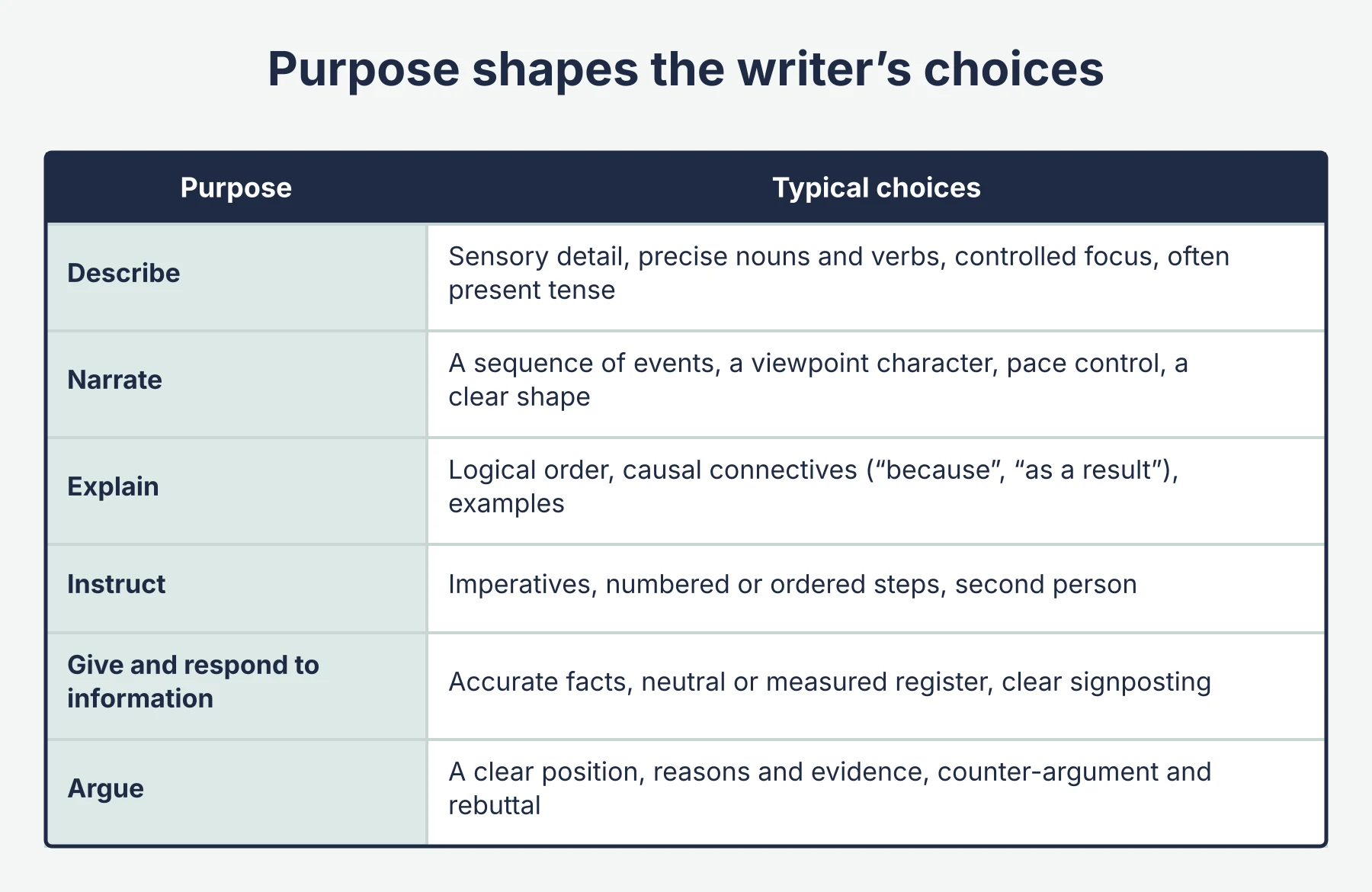
| Purpose | Key feature to show |
|---|---|
| Describe | Sensory, precise detail with a controlled focus |
| Narrate | A shaped sequence of events from a clear viewpoint |
| Explain | Logical, causal links and examples |
| Instruct | Ordered steps, imperatives |
| Give and respond to information | Accurate, clearly signposted content |
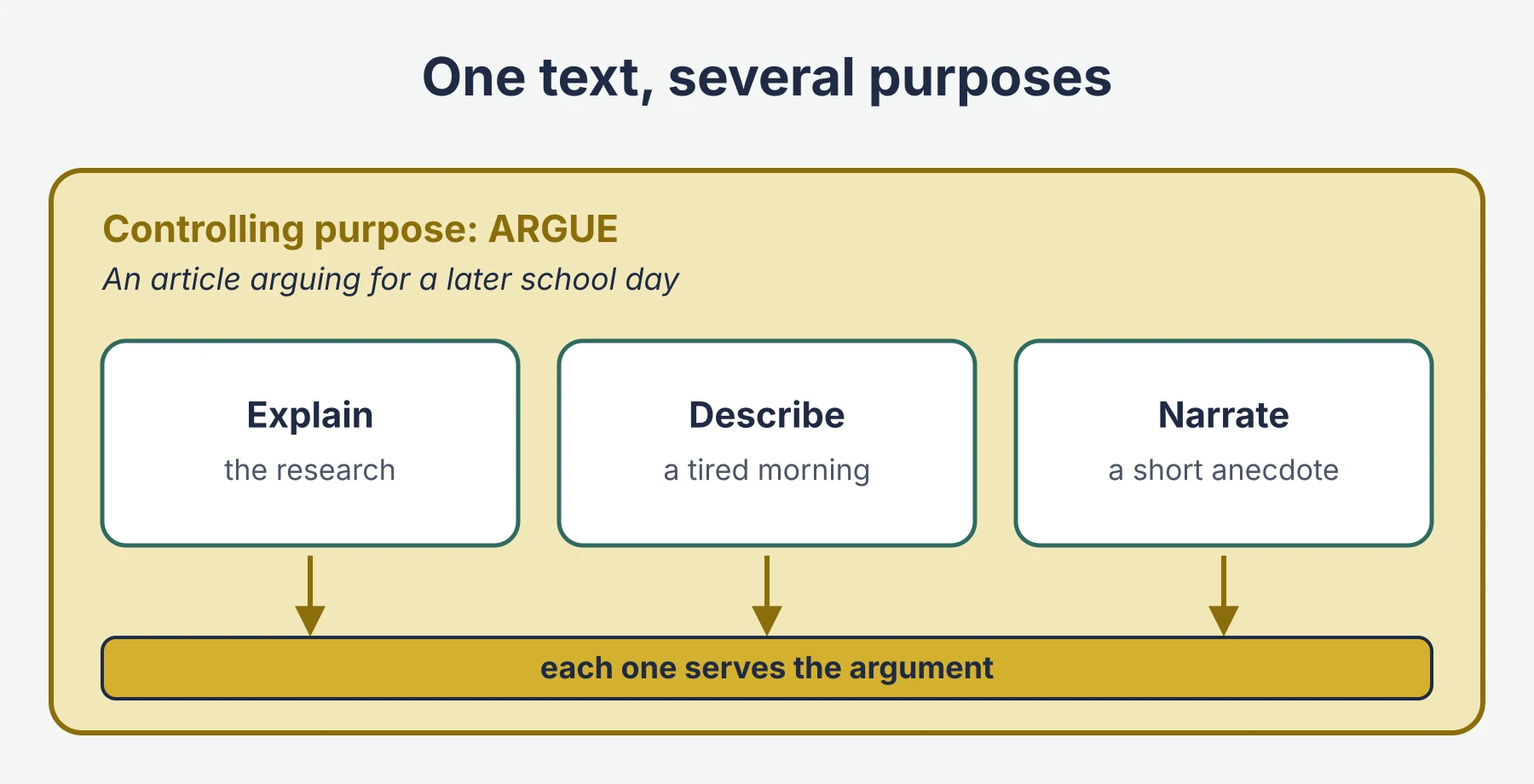
| Argue | Position, reasons, evidence, counter-argument and rebuttal |
Key terms
| Term | Meaning |
|---|---|
| Audience | The intended reader or listener |
| Purpose | What the text is meant to do |
| Form | The type of text and its conventions |
| Register | Level of formality |
| Tone | The attitude the voice conveys |
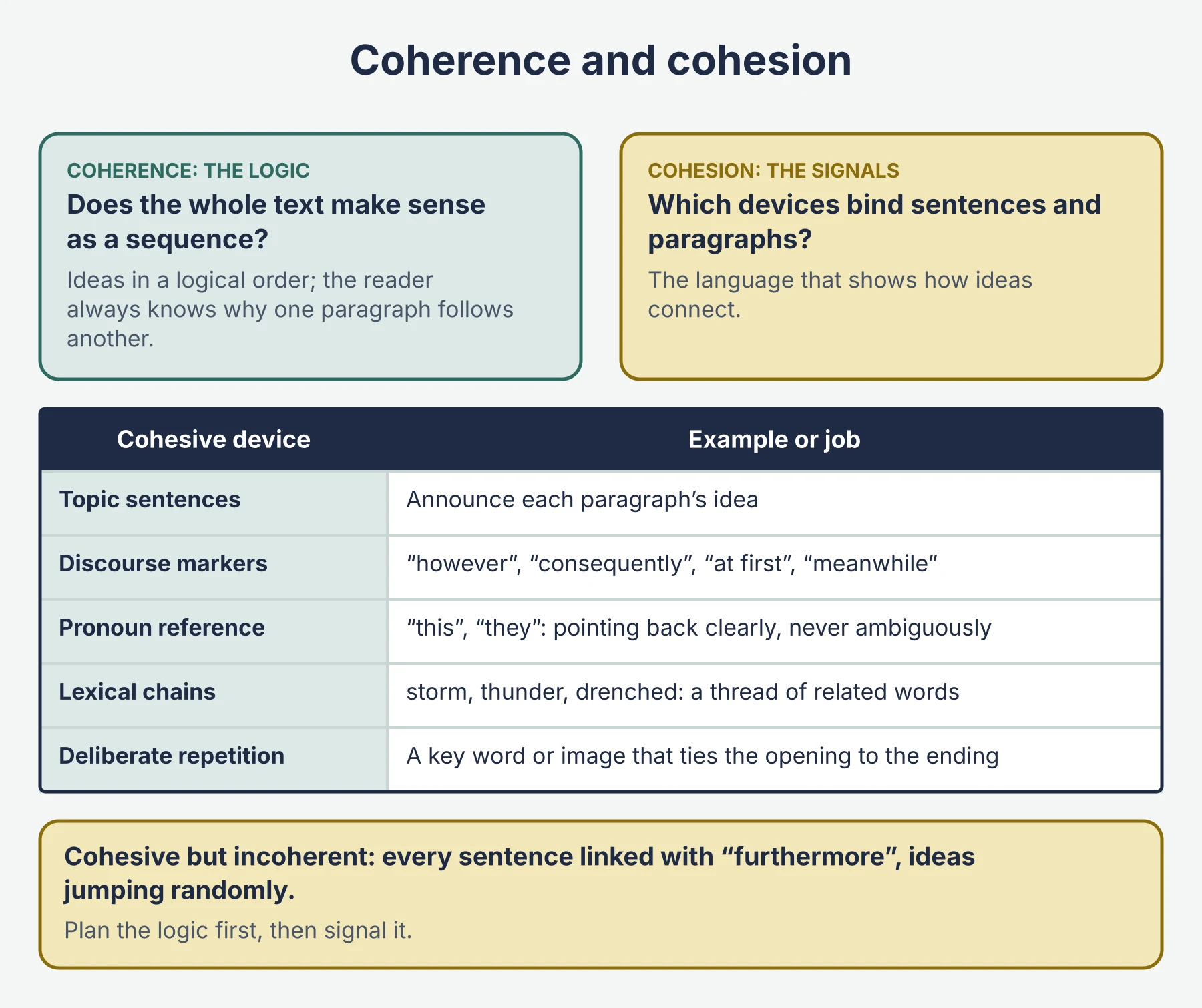
| Coherence | The whole text makes logical sense as a sequence |
| Cohesion | Devices that link sentences and paragraphs |
| Discourse marker | A word or phrase that signals how ideas relate |
| Topic sentence | A sentence announcing a paragraph’s main idea |
| Lexical chain | A run of related words that keeps a thread going |
| Point of view | Narrative person, or the writer’s stance in argument |
Form conventions
| Form | Conventions to use |
|---|---|
| Letter | Appropriate greeting and sign-off; clear reason for writing early on |
| Article | Headline; engaging opening; paragraphs that develop a line of thought |
| Speech | Direct address; signposting for listeners; memorable ending |
| Leaflet | Title; subheadings; direct, accessible advice |
| Essay | Introduction; developed, linked paragraphs; conclusion |
Layout features support content; they do not replace it.
Register: quick moves
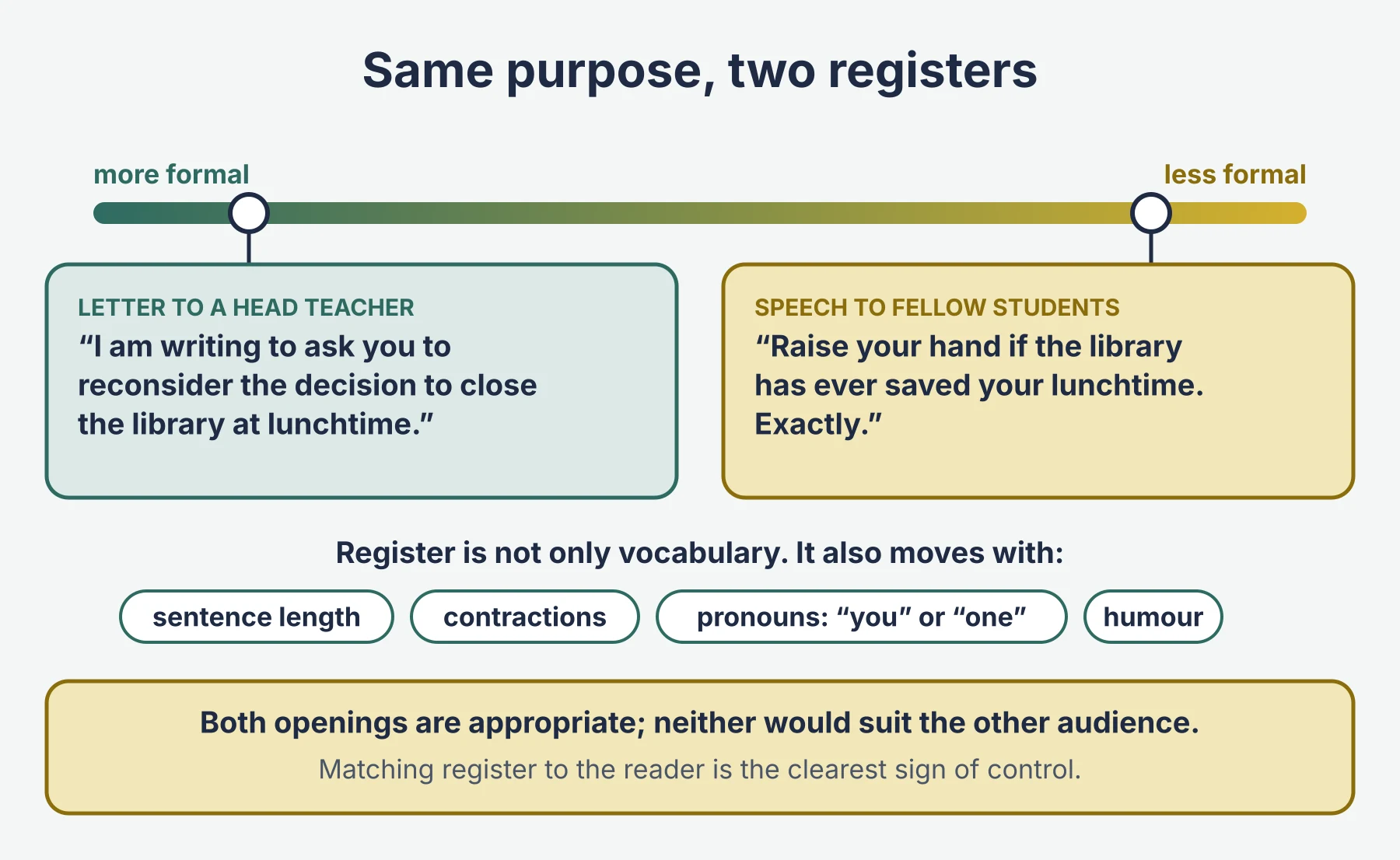
| More formal | Less formal |
|---|---|
| Full forms (“do not”) | Contractions (“don’t”) |
| “Many people believe” | “Loads of us reckon” |
| Third person, measured | Second person, direct |
| Longer, complex sentences | Shorter, punchier sentences |
Match the move to the reader the task names.
Cohesion toolkit
| Relationship | Discourse markers |
|---|---|
| Adding | furthermore, in addition, moreover |
| Contrasting | however, on the other hand, nevertheless |
| Cause and effect | consequently, as a result, therefore |
| Sequence | initially, subsequently, finally |
| Example | for instance, notably |
| Concession | admittedly, although, while it is true that |
Other devices: clear pronoun reference, lexical chains, repetition of a key image, an ending that echoes the opening.
Consistency checks
- Tense: past or present, kept unless a change is deliberate.
- Person: “I” or “she”, not both by accident.
- Stance: a concession must lead back to your position.
- Register: no slang in a letter to an official; no stiff formality in a talk to peers unless for effect.
A five-minute plan for Section B
- Underline audience, purpose and form (Paper 2), or choose the stimulus (Paper 1).
- Write a one-line idea for each paragraph, in order.
- Mark the discourse marker that will open each paragraph.
- Decide how the ending will echo or answer the opening.
Exam traps
- Missing the audience in the Paper 2 task.
- A headline or greeting with weak organisation underneath.
- Paragraphs that list rather than develop.
- “Also” at the start of every paragraph.
- Narrative that changes tense halfway through.
- Agreeing with the counter-argument by mistake.
- Copying facts from a source instead of shaping them.
Quick self-test
- Which assessment objective covers coherence and cohesion?
- List the six purposes named in the specification.
- What is the difference between coherence and cohesion?
- Give two conventions of a speech.
- Name a discourse marker for cause and effect and one for concession.
- Make this more formal: “Loads of kids don’t bother with breakfast.”
- What is a lexical chain?
- What does “maintaining a consistent point of view” mean in narrative writing?
- How should a concession be handled in argument writing?
- How many marks are given to content and organisation in Section B?
- What does “using information provided by others” involve?
- Can a text be cohesive but incoherent? Explain.
Answers
- AO5.
- Describe, narrate, explain, instruct, give and respond to information, argue.
- Coherence is overall logical sense; cohesion is the linguistic linking between sentences and paragraphs.
- Any two: direct address, signposting for listeners, rhetorical questions, a memorable ending.
- For example: “consequently”; “admittedly”.
- For example: “Many young people do not eat breakfast.”
- A sequence of related words that keeps an idea running through a text.
- Keeping the same narrative person and tense unless a change is deliberate.
- Acknowledge it clearly, then rebut it and return to your own position.
-
- Selecting information from another source, reshaping it in your own words and register for a new form.
- Yes: sentences can be linked by markers while the ideas themselves follow no logical order.
Official syllabus
AQA GCSE English Language (8700) specification, for GCSE exams June 2017 onwards: 3.1.2 Writing (producing clear and coherent text), assessment objectives AO5 and AO6.
Related resources
-
Study guides
AQA GCSE English Language (8700): Writing for Impact
AQA GCSE English Language 8700 guide to writing for impact: emphasis, pertinent evidence, emotional impact, antithesis, parenthesis and other devices.
English · AQA · GCSE
Read guide -
Practice questions
AQA GCSE English Language (8700): Writing for Impact – Practice Questions
Original AQA GCSE English Language 8700 writing for impact practice: rhetorical devices, emphasis, evidence and emotional impact, with full mark guidance.
English · AQA · GCSE
Try questions -
Revision notes
AQA GCSE English Language (8700): Writing for Impact – Revision Notes
AQA GCSE English Language 8700 writing for impact recall: emphasis, pertinent evidence, emotional impact, rhetorical devices, exam traps and a self-test.
English · AQA · GCSE
Revise topic
Get free revision emails (optional)
Occasional emails with practice questions, worked explanations and links to free resources for the qualification and subjects you choose. No spam, and you can unsubscribe from any email. The free tools on this site never need an email.