
Revision Notes
AQA GCSE English Language (8700): Writing for Impact – Revision Notes
AQA GCSE English Language 8700 writing for impact recall: emphasis, pertinent evidence, emotional impact, rhetorical devices, exam traps and a self-test.
- Subject
- English
- Level
- GCSE
- Topic
- Topic 2: Writing
- Author
- Marlbridge Academic Team
- Updated
- Reviewed by
- Ammar Bilal (what this means)
Aligned to AQA GCSE English (8700), For first teaching 2015. Official specification .
Syllabus page (what it covers and how it is assessed): AQA GCSE English Language.
Found an error? Report a correction.
Need help with this topic? Request a free trial class for GCSE English Language (8700).
These notes condense writing for impact, the second strand of 3.1.2 Writing in AQA GCSE English Language (8700): selecting, organising and emphasising ideas; citing evidence pertinently; creating emotional impact; and using language creatively and persuasively, including rhetorical devices such as rhetorical questions, antithesis and parenthesis. It is assessed by AO5 and AO6 in Section B of both papers.
Related: writing for impact study guide | writing for impact practice questions | Paper 1 revision notes
The strand in one paragraph
Choose fewer, stronger ideas; put the most important where the reader will feel it; support views with specific, relevant evidence; turn abstract issues into human detail; and use a small number of rhetorical devices, each for a reason.
The four parts of the strand
| Part | What it means in practice |
|---|---|
| Select, organise, emphasise | Strongest ideas only; deliberate order; weight through position and sentence length |
| Cite evidence pertinently | Specific examples, anecdote, expert view or quotation, each explained |
| Create emotional impact | Concrete human detail, precise emotive words, direct address, controlled tone |
| Use language creatively and persuasively | Fresh imagery, rhetorical devices, sentence variety for effect |
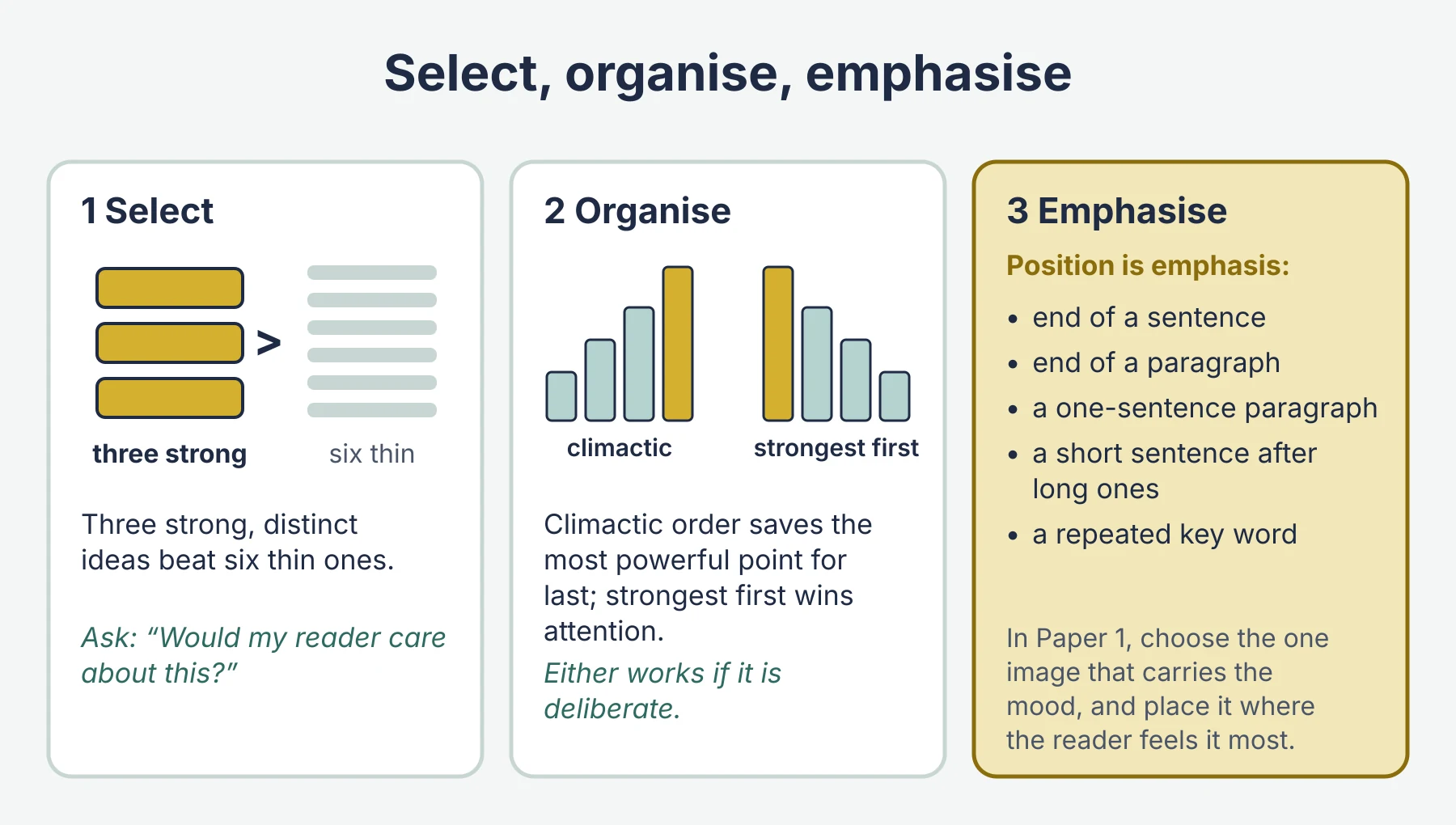
The three named devices
| Device | Definition | Example (original) |
|---|---|---|
| Rhetorical question | A question asked for effect, with an implied answer | “Who benefits from a park nobody can use?” |
| Antithesis | Contrasting ideas in a balanced structure | “Easy to close, impossible to replace.” |
| Parenthesis | An inserted word, phrase or clause marked by brackets, dashes or commas | “The plan, drawn up in secret, ignores residents.” |
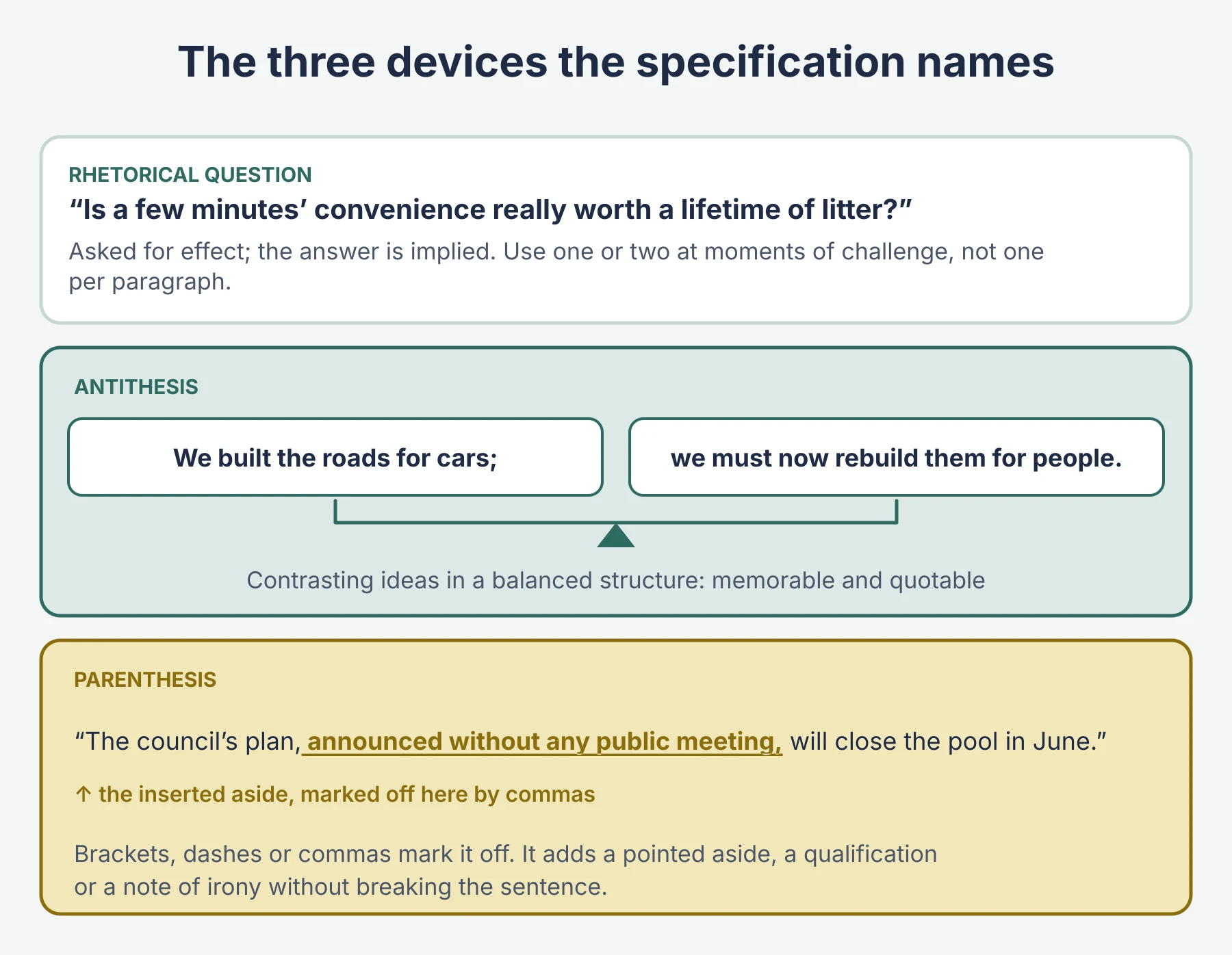
Other devices for impact
| Device | Use it to… |
|---|---|
| Tricolon | Build rhythm and a sense of completeness |
| Anaphora | Hammer home a key idea at the start of successive sentences |
| Hyperbole | Exaggerate for humour or emphasis (sparingly in formal tasks) |
| Irony | Expose a weakness in the opposing view |
| Imperative | Push the reader to act or imagine |
| Inclusive pronouns | Make the reader part of the cause |
| Short sentence | Land a key point after longer sentences |
| One-sentence paragraph | Isolate a turning point |
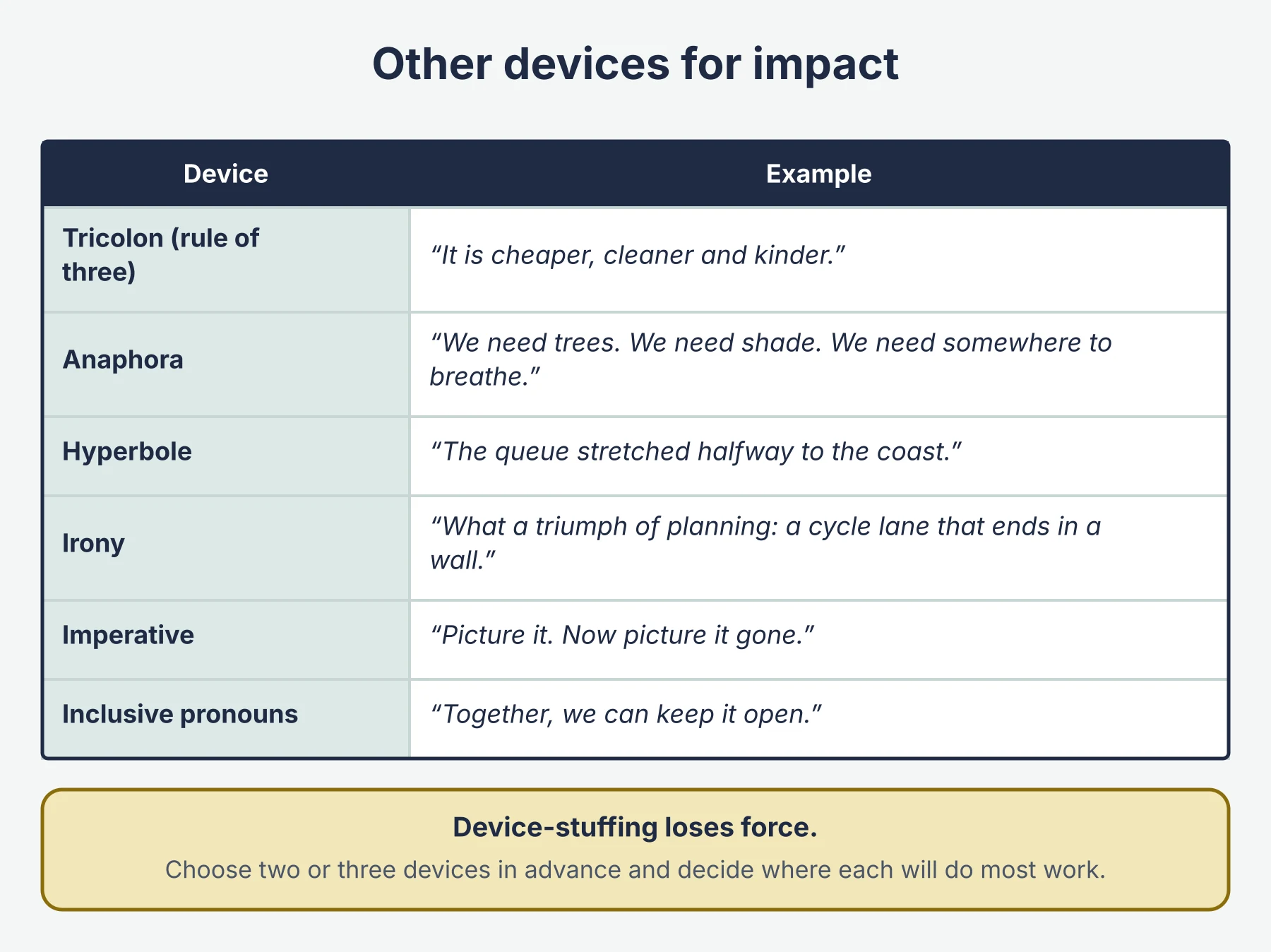
Where emphasis lives
- End of a sentence: end focus.
- End of a paragraph: the line the reader carries forward.
- Opening line: first impression.
- Final line: last impression.
- A one-sentence paragraph: a pause the reader cannot skip.
Ordering ideas
| Order | Effect | Use when |
|---|---|---|
| Strongest first | Wins attention immediately | Speeches, short articles |
| Climactic | Builds to the most powerful point | Arguments with a strong final appeal |
| Problem to solution | Makes the proposal feel necessary | Letters asking for change |
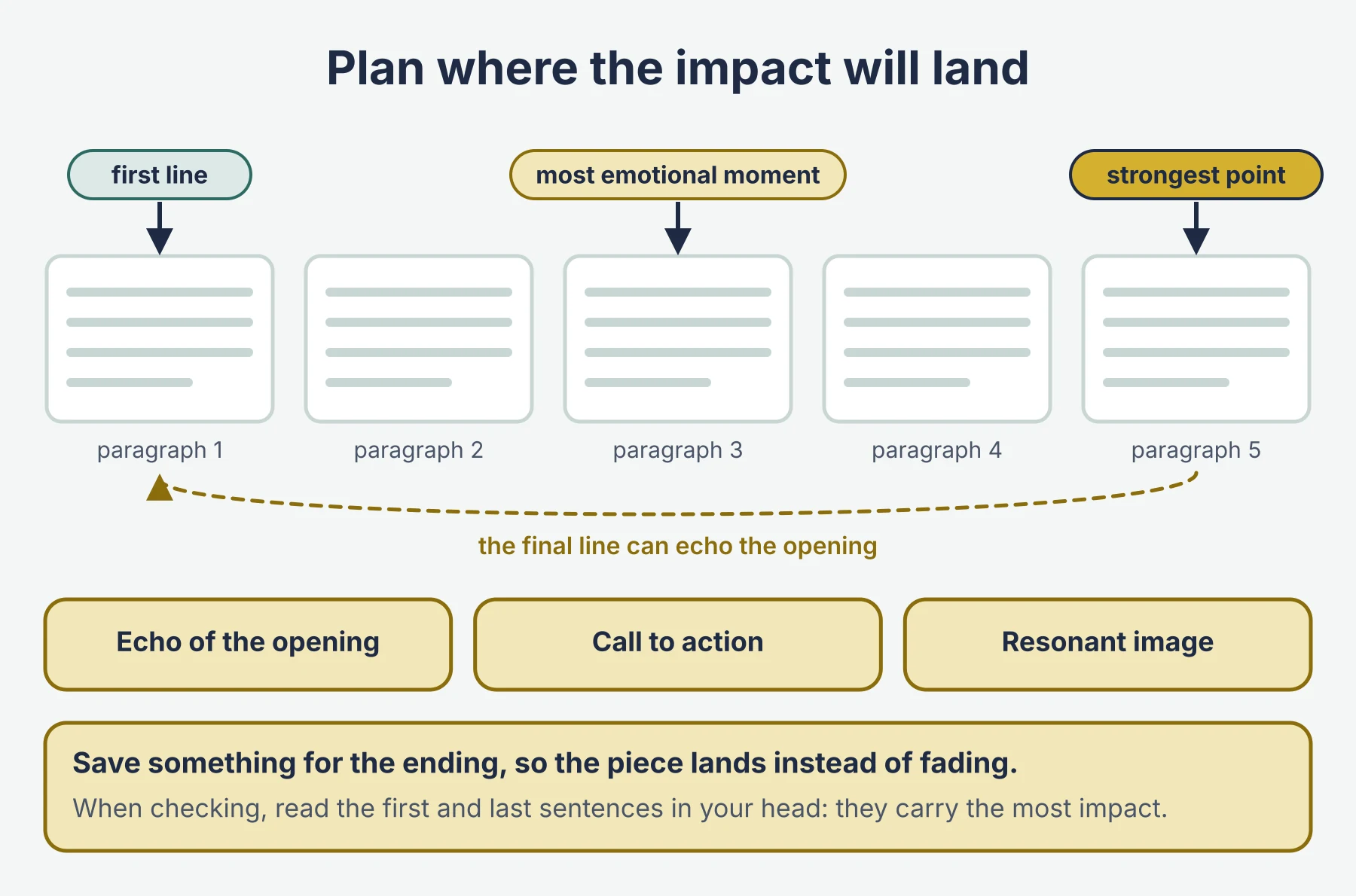
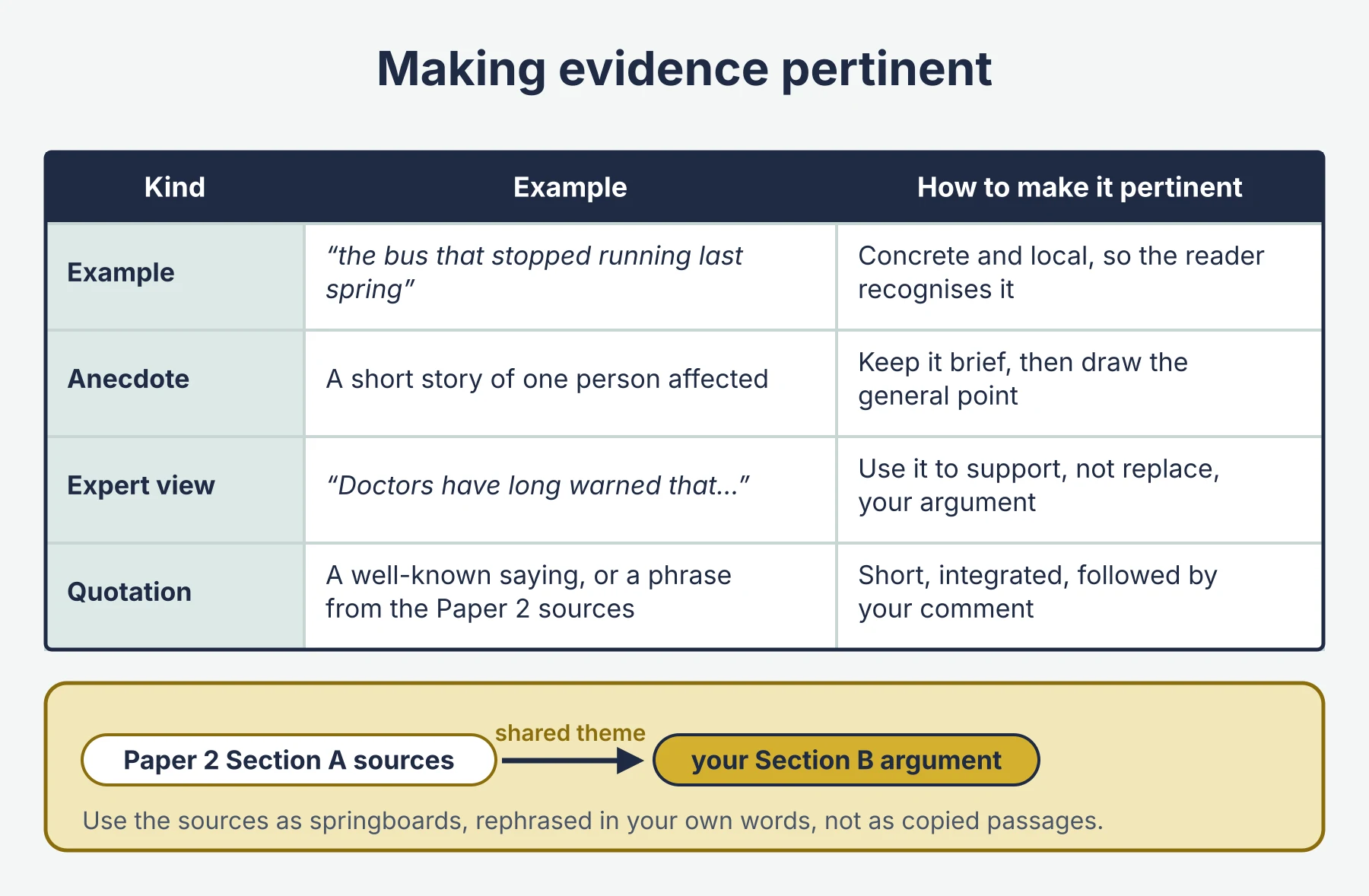
Evidence: pertinent or not?
| Weak | Pertinent |
|---|---|
| “Studies show it is bad.” | “Doctors have long warned that sitting still for hours harms the back, which is exactly what our timetable demands.” |
| A long anecdote with no point | A two-sentence anecdote followed by the general point it proves |
| A copied sentence from a source | A rephrased idea from the source, linked to your argument |
Emotional impact without melodrama
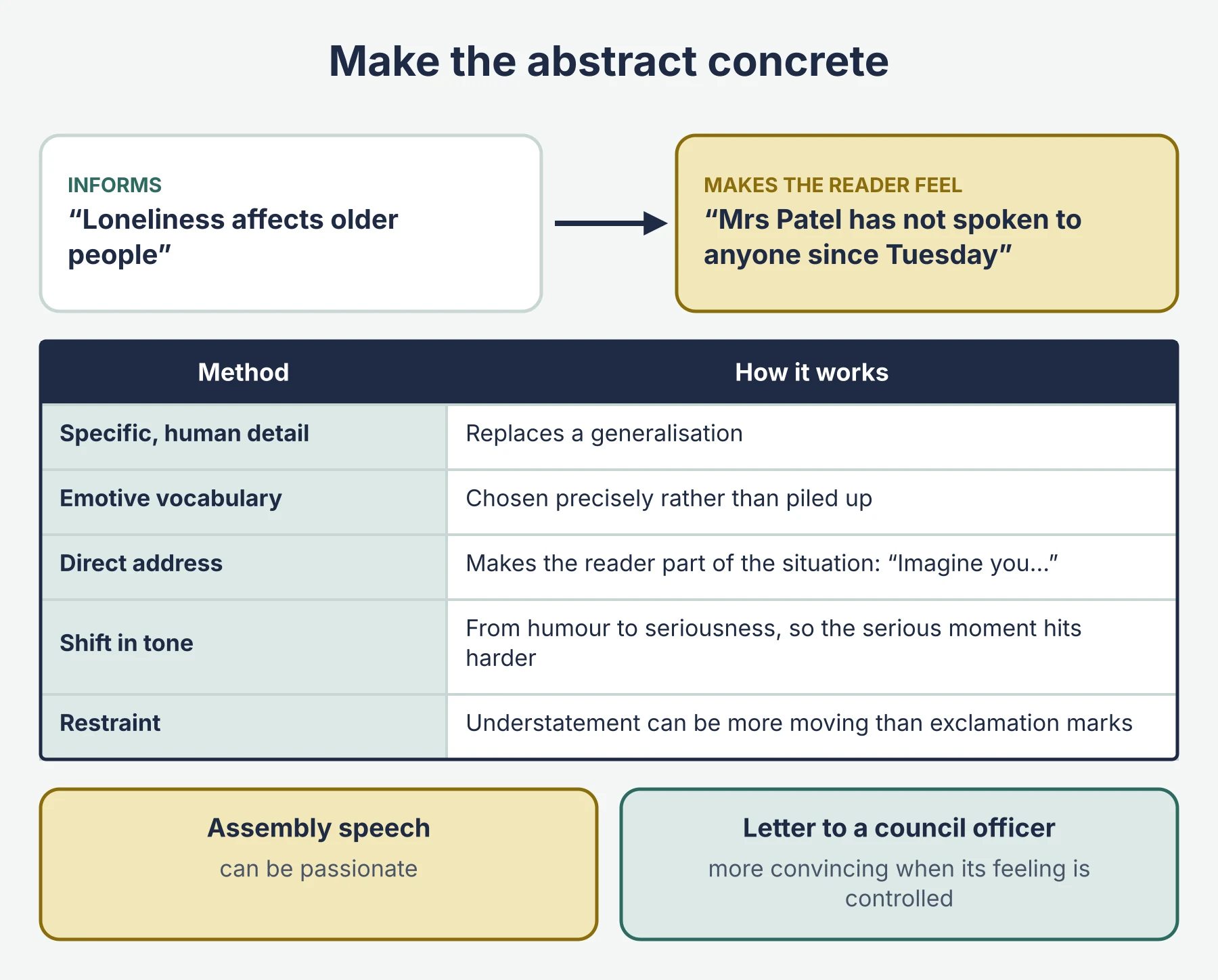
- Concrete detail beats adjectives: “her coat still on the hook” rather than “it was so, so sad”.
- One precise emotive word beats three vague ones.
- Understatement can move a reader more than exclamation marks.
- Match intensity to audience and form.
Impact in Paper 1 and Paper 2
| Paper 1 (narrative or descriptive) | Paper 2 (viewpoint) |
|---|---|
| One fresh, developed image carries the mood | A memorable line carries the argument |
| Emphasis through pace: a short sentence at the turning point | Emphasis through position: the strongest point first or last |
| Emotional impact through a character’s concrete detail | Emotional impact through a named, specific example |
| Ending that echoes an opening image | Ending with a call to action or a resonant claim |
Exam traps
- A rhetorical question in every paragraph.
- Devices with no purpose, used to “tick a box”.
- Evidence that is vague or unexplained.
- Over-the-top emotion in a formal letter.
- Unclosed dashes or brackets in parenthesis.
- A conclusion that repeats the introduction word for word instead of landing a final point.
- In Paper 1, piling up clichéd images rather than one fresh one.
Quick self-test
- Name the three rhetorical devices the specification lists.
- Define antithesis and write an original example.
- Which punctuation marks can show parenthesis?
- What does “pertinently” mean when citing evidence?
- Where in a sentence does end focus fall?
- What is a climactic order?
- Give two ways to create emotional impact without melodrama.
- Why might a rhetorical question lose force?
- Rewrite with parenthesis: “The new car park is ugly. It cost two million pounds.”
- What is anaphora?
- In Paper 2, how can ideas from the reading sources help your writing?
- Why is a fresh image worth more than several familiar ones?
Answers
- Rhetorical questions, antithesis, parenthesis.
- Contrasting ideas set in a balanced structure; for example, “We inherited clean rivers; we are handing on dirty ones.”
- Brackets, dashes or commas.
- Relevant and well-timed, chosen because it directly supports the point being made.
- At the end, where the key word or idea gains emphasis.
- An order that builds towards the most powerful point.
- Any two: a specific human detail, precise emotive vocabulary, direct address, understatement, a controlled shift in tone.
- Overuse makes it predictable, so the reader stops feeling challenged.
- For example: “The new car park (which cost two million pounds) is ugly.”
- Repetition of the same word or phrase at the start of successive sentences or clauses.
- The sections share a theme, so ideas from the sources can be rephrased and used as evidence or springboards.
- It surprises the reader and shows originality; familiar images are skimmed over.
Official syllabus
AQA GCSE English Language (8700) specification, for GCSE exams June 2017 onwards: 3.1.2 Writing (writing for impact), assessment objectives AO5 and AO6.
Related resources
-
Study guides
AQA GCSE English Language (8700): Producing Clear and Coherent Text
AQA GCSE English Language 8700 guide to clear, coherent writing: purpose, audience and form, register, cohesion, consistent viewpoint and paragraph control.
English · AQA · GCSE
Read guide -
Practice questions
AQA GCSE English Language (8700): Producing Clear and Coherent Text – Practice Questions
Original AQA GCSE English Language 8700 writing practice on register, form, cohesion, consistent viewpoint and planning, with mark-scheme-style answers.
English · AQA · GCSE
Try questions -
Revision notes
AQA GCSE English Language (8700): Producing Clear and Coherent Text – Revision Notes
AQA GCSE English Language 8700 recall notes on clear, coherent writing: six purposes, register, form conventions, cohesion devices and a self-test.
English · AQA · GCSE
Revise topic
Get free revision emails (optional)
Occasional emails with practice questions, worked explanations and links to free resources for the qualification and subjects you choose. No spam, and you can unsubscribe from any email. The free tools on this site never need an email.