
Study Guides
AQA GCSE English Language (8700): Writing for Impact
AQA GCSE English Language 8700 guide to writing for impact: emphasis, pertinent evidence, emotional impact, antithesis, parenthesis and other devices.
- Subject
- English
- Level
- GCSE
- Topic
- Topic 2: Writing
- Author
- Marlbridge Academic Team
- Updated
- Reviewed by
- Ammar Bilal (what this means)
Aligned to AQA GCSE English (8700), For first teaching 2015. Official specification .
Syllabus page (what it covers and how it is assessed): AQA GCSE English Language.
Found an error? Report a correction.
Need help with this topic? Request a free trial class for GCSE English Language (8700).
Writing for impact is the second strand of 3.1.2 Writing in AQA GCSE English Language (8700). Where clear and coherent writing is about control, writing for impact is about effect: making a reader feel, remember and agree. The specification lists four parts: “selecting, organising and emphasising facts, ideas and key points; citing evidence and quotation effectively and pertinently to support views; creating emotional impact; using language creatively, imaginatively and persuasively, including rhetorical devices (such as rhetorical questions, antithesis, parenthesis)”. It is assessed by AO5 with AO6 in Section B of both papers. For recall, use the writing for impact revision notes, and to practise, use the writing for impact practice questions.
Selecting, organising and emphasising
Impact starts before you write a sentence: it depends on what you choose to include and where you put it.
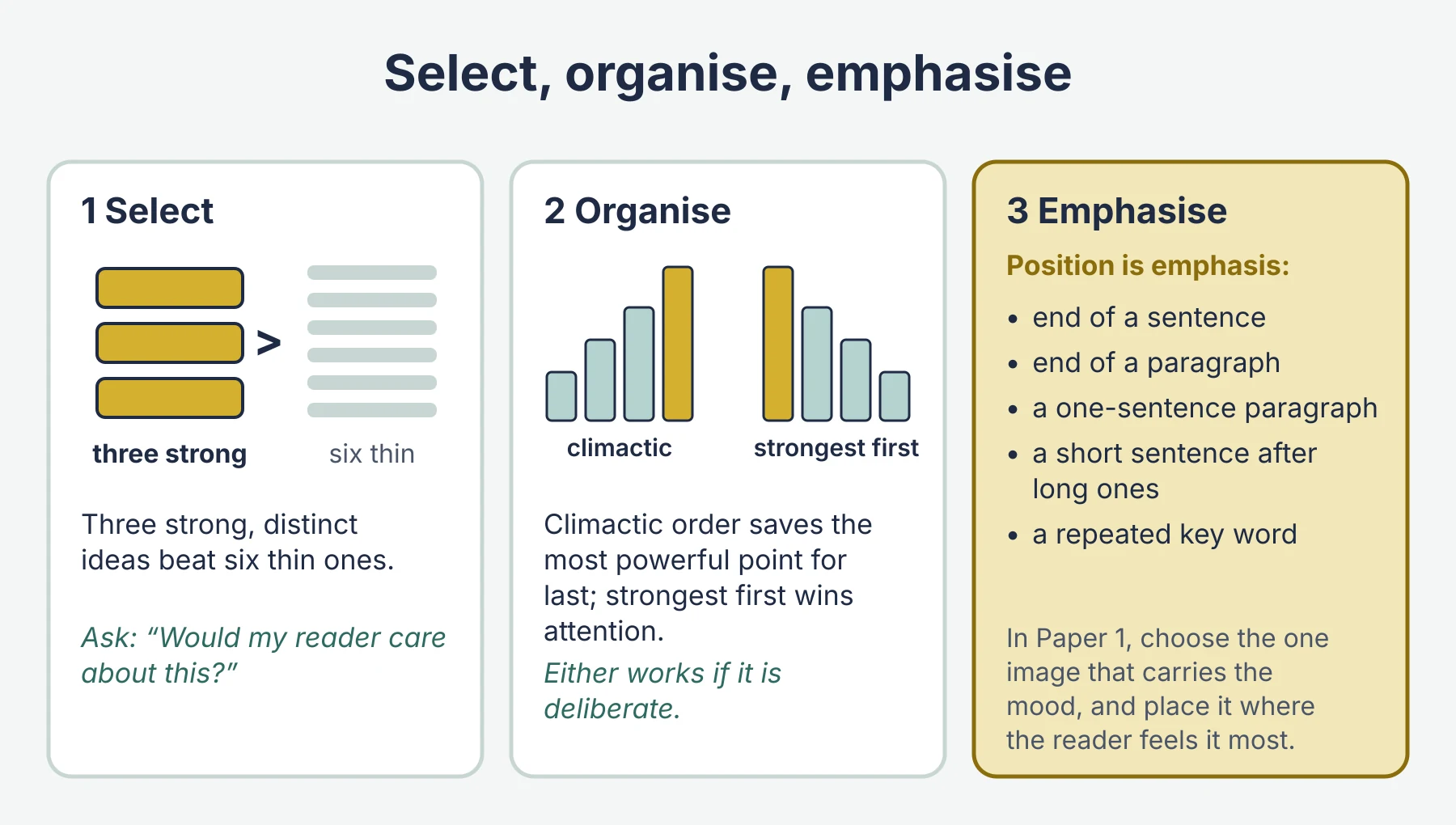
- Select: three strong, distinct ideas beat six thin ones. Ask of each point, “Would my reader care about this?”
- Organise: order points for effect. A climactic order saves the most powerful point for last; a strongest first order wins attention immediately. Either is defensible if it is deliberate.
- Emphasise: position is emphasis. The end of a sentence, the end of a paragraph and a one-sentence paragraph all give weight. A short sentence after long ones lands hard. Repetition of a key word can make it the idea the reader takes away.
In narrative and description (Paper 1), the same principle applies to detail: choose the one image that carries the mood, and place it where the reader will feel it most.
Citing evidence and quotation pertinently
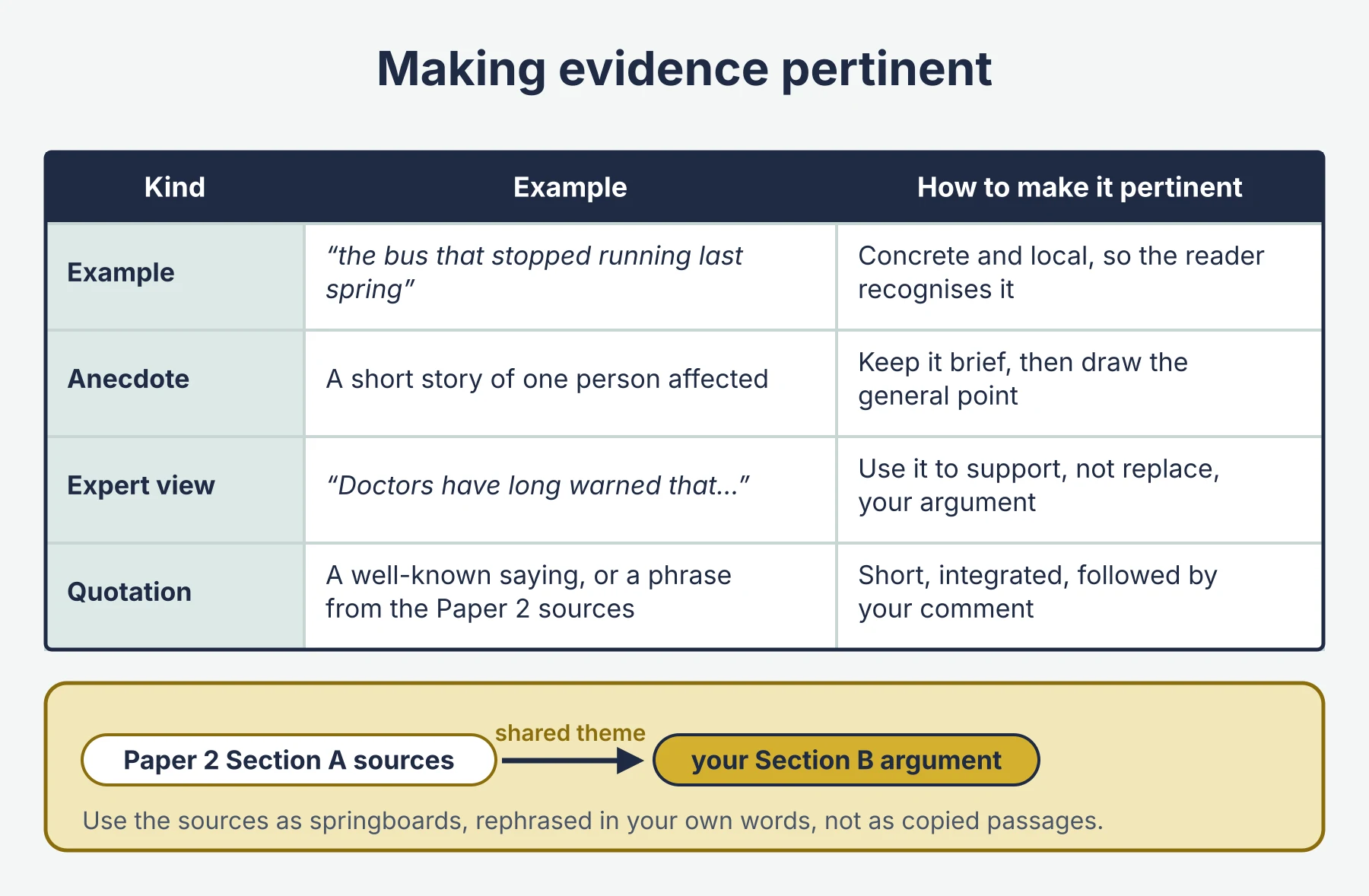
“Pertinently” means relevant and well-timed. Evidence persuades when it is specific and when the writer explains why it matters.
| Kind of evidence | Example (original) | How to make it pertinent |
|---|---|---|
| Example | “the bus that stopped running last spring” | Concrete and local, so the reader recognises it |
| Anecdote | A short story of one person affected | Keep it brief, then draw the general point |
| Expert view | “Doctors have long warned that…” | Use it to support, not replace, your argument |
| Quotation | A well-known saying, or a phrase from the Paper 2 sources | Short, integrated, followed by your comment |
On Paper 2, ideas and details from the Section A sources can feed your argument in Section B, because the two sections share a theme. Use them as springboards, rephrased in your own words, not as copied passages.
Creating emotional impact
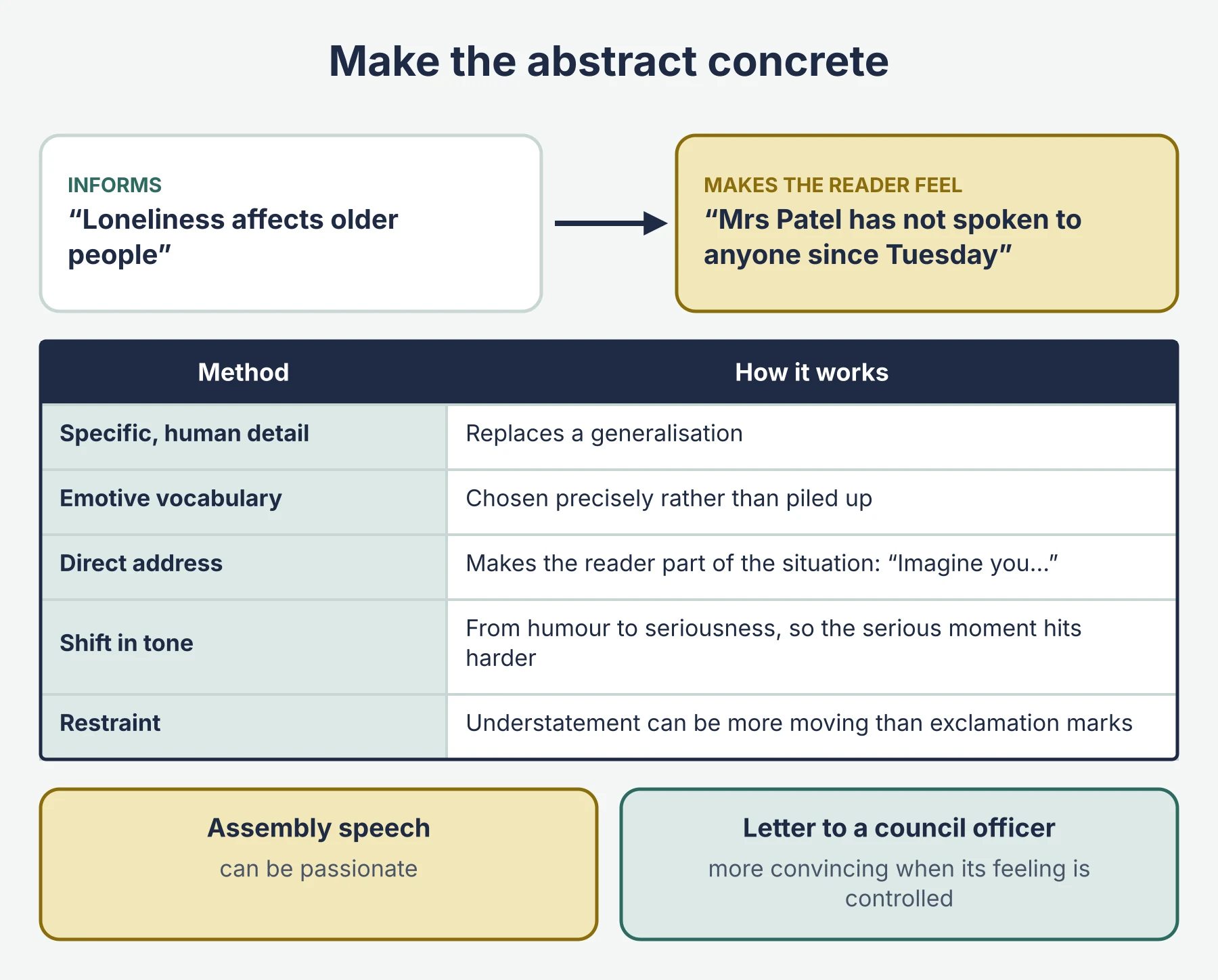
Emotional impact comes from making the abstract concrete. “Loneliness affects older people” informs; “Mrs Patel has not spoken to anyone since Tuesday” makes the reader feel. Useful methods:
- a specific, human detail in place of a generalisation;
- emotive vocabulary, chosen precisely rather than piled up;
- direct address, making the reader part of the situation (“Imagine you…”);
- a shift in tone, for example from humour to seriousness, which can make the serious moment hit harder;
- restraint: understatement can be more moving than exclamation marks.
Match the emotion to the task. An assembly speech can be passionate; a letter to a council officer is more convincing when its feeling is controlled.
Rhetorical devices
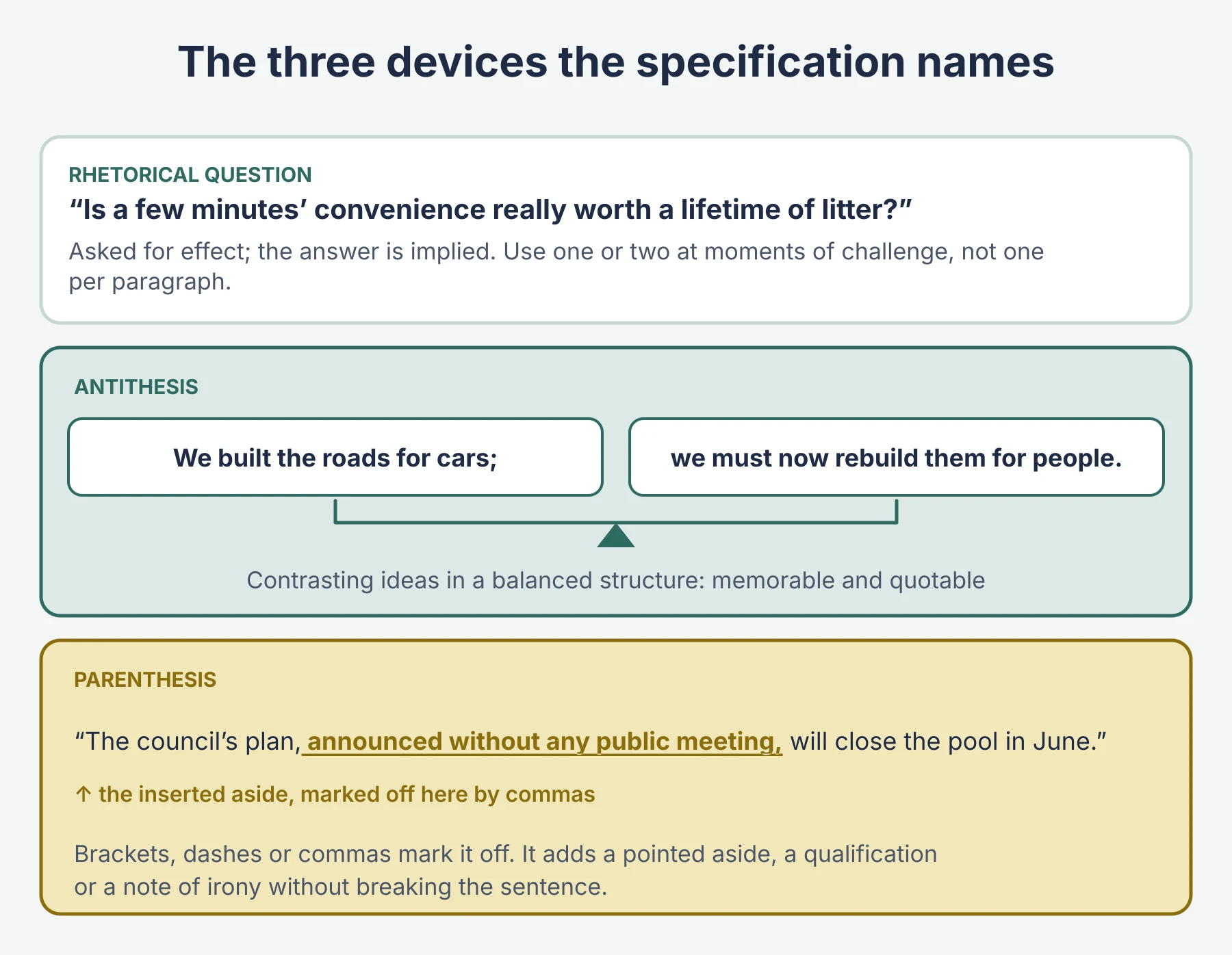
The specification names three devices. Know them precisely:
- Rhetorical question: a question asked for effect, where the answer is implied. “Is a few minutes’ convenience really worth a lifetime of litter?” Use one or two at moments of challenge, not one per paragraph.
- Antithesis: contrasting ideas placed in a balanced structure. “We built the roads for cars; we must now rebuild them for people.” The balance makes the contrast memorable and quotable.
- Parenthesis: an extra word, phrase or clause inserted into a sentence and marked off by brackets, dashes or commas. “The council’s plan, announced without any public meeting, will close the pool in June.” Parenthesis lets you add a pointed aside, a qualification or a note of irony without breaking the sentence.
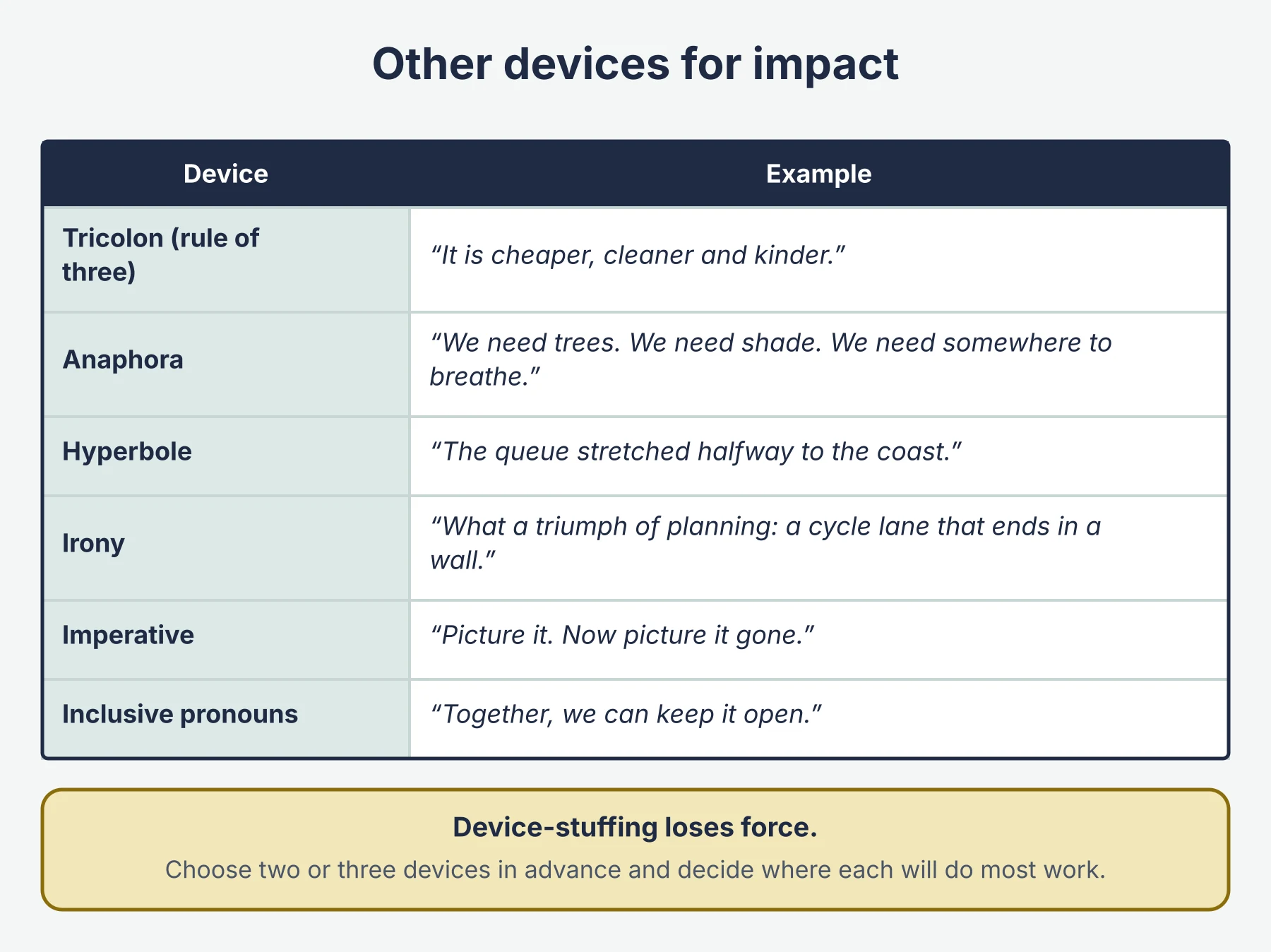
Other devices often used for impact:
| Device | Example (original) |
|---|---|
| Tricolon (rule of three) | “It is cheaper, cleaner and kinder.” |
| Anaphora | “We need trees. We need shade. We need somewhere to breathe.” |
| Hyperbole | “The queue stretched halfway to the coast.” |
| Irony | “What a triumph of planning: a cycle lane that ends in a wall.” |
| Imperative | “Picture it. Now picture it gone.” |
| Inclusive pronouns | “Together, we can keep it open.” |
Using language creatively and imaginatively
For Paper 1, impact comes from imaginative language and controlled structure: an extended metaphor that develops across a description, a motif that returns at the end, sentence variety that matches pace to action. Originality matters more than quantity: one fresh image (“the sky was the colour of a bruise healing”) is worth more than three familiar ones.
Worked example: from plain to powerful
Task (original): write the opening of an article arguing that the town’s library should stay open.
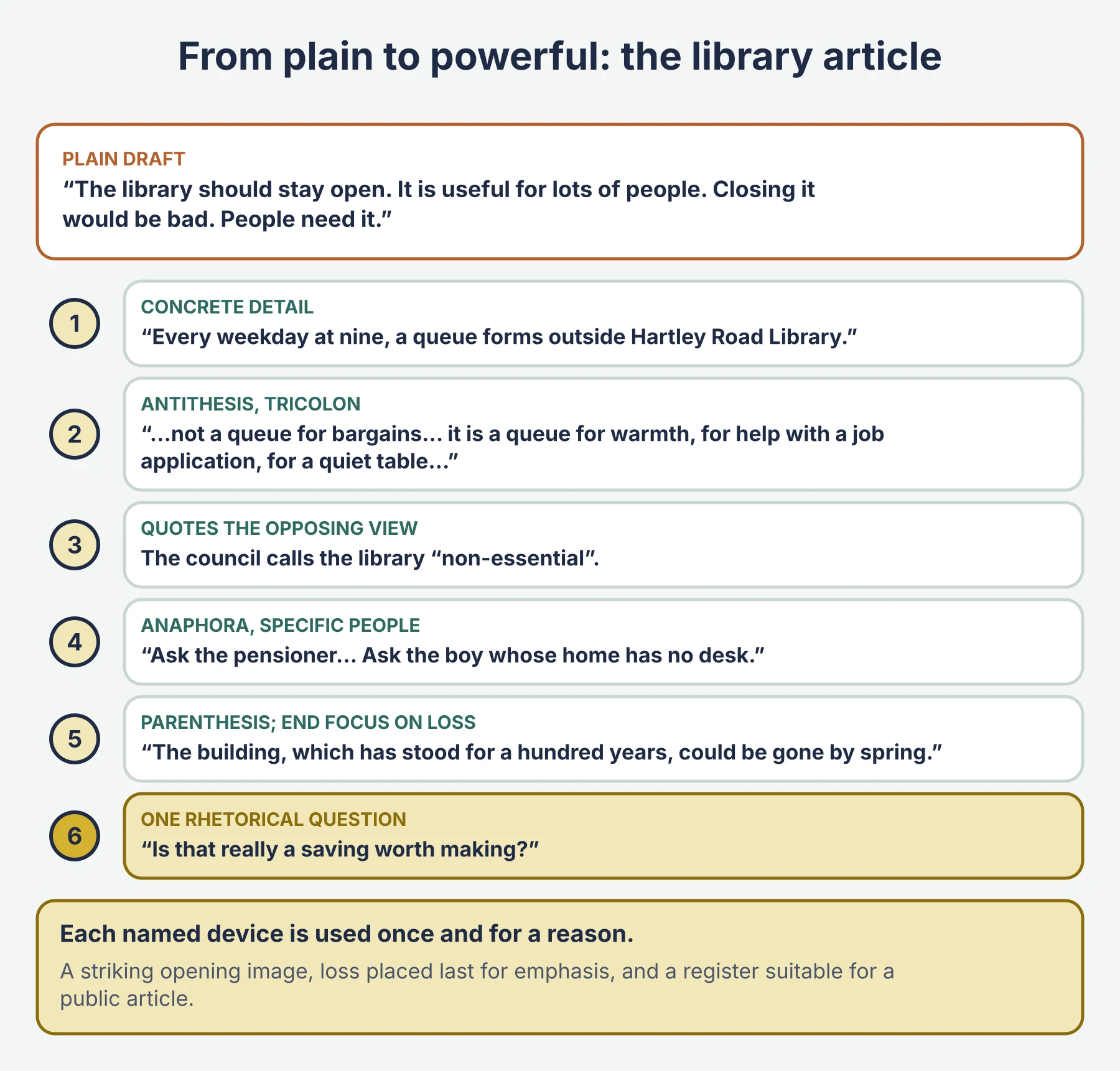
Plain draft:
The library should stay open. It is useful for lots of people. Closing it would be bad. People need it.
Revised opening (annotated):
Every weekday at nine, a queue forms outside Hartley Road Library [concrete detail, emotional impact]. It is not a queue for bargains or concert tickets; it is a queue for warmth, for help with a job application, for a quiet table to do homework [antithesis, tricolon]. The council calls the library “non-essential” [pertinent quotation of the opposing view]. Ask the pensioner who reads the paper there because she cannot afford her own. Ask the boy whose home has no desk [anaphora, specific people]. The building, which has stood for a hundred years, could be gone by spring [parenthesis adds weight; end focus on loss]. Is that really a saving worth making? [a single, well-placed rhetorical question]
The revision selects a striking opening image, emphasises loss by placing it last, uses each named device once and for a reason, and keeps the register suitable for a public article.
Common mistakes
- Device-stuffing: a rhetorical question in every paragraph loses force.
- Melodrama: exaggerated emotion that the topic or audience does not support.
- Vague evidence: “studies show” with no detail and no explanation of why it matters.
- Hyperbole that undermines credibility in a formal letter.
- Misusing parenthesis, for example opening a dash and never closing it, which damages AO6 too.
- Saving nothing for the ending, so the piece fades instead of landing.
Exam technique
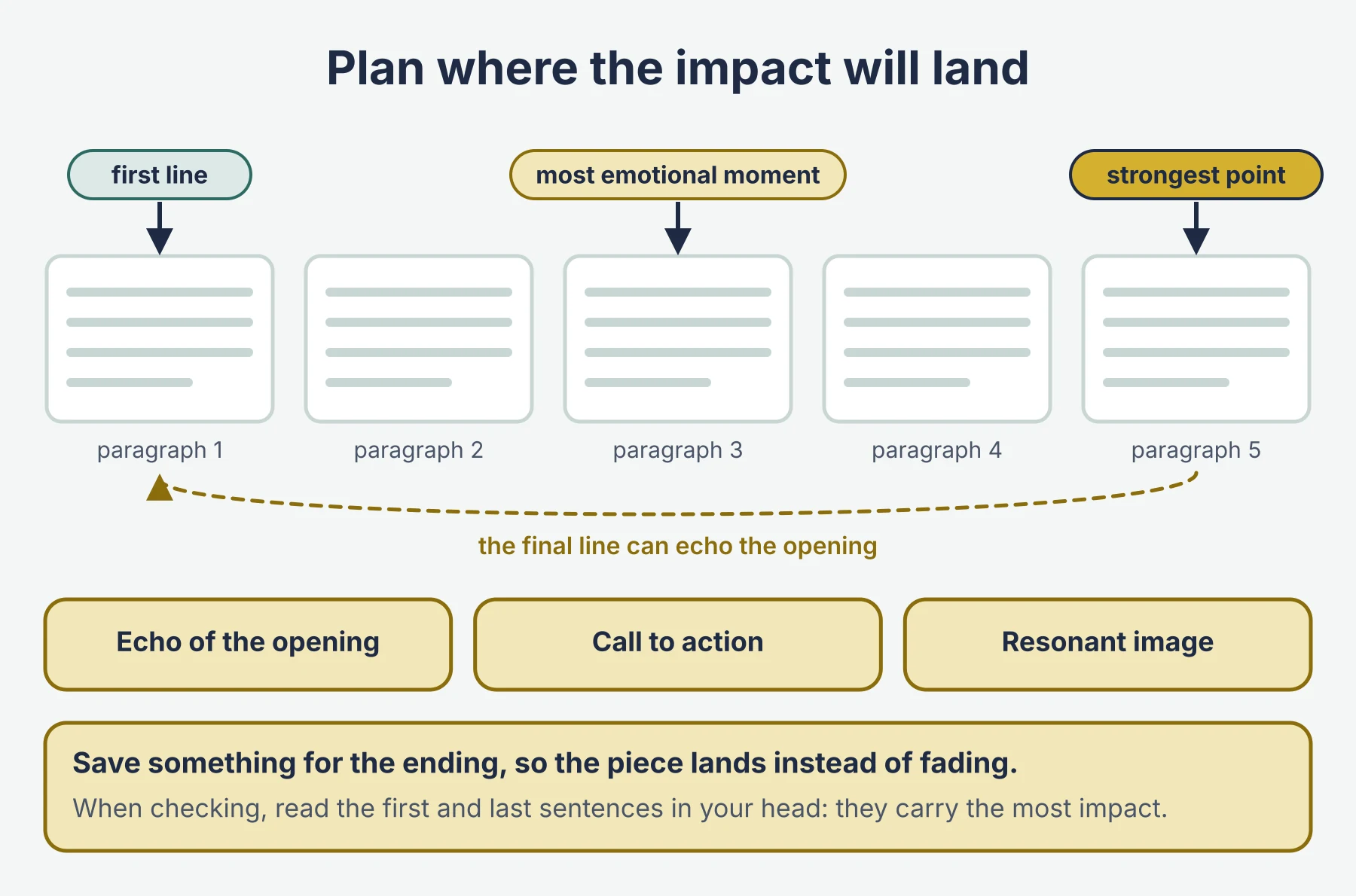
- In the plan, mark where your strongest point and your most emotional moment will go.
- Choose two or three devices in advance and decide where each will do most work.
- End with a deliberate final line: an echo of the opening, a call to action or a resonant image.
- When checking, read your first and last sentences aloud in your head: they carry the most impact.
Related: Paper 2 study guide | Paper 2 practice questions | clear and coherent writing study guide
Official syllabus
AQA GCSE English Language (8700) specification, for GCSE exams June 2017 onwards: 3.1.2 Writing (writing for impact), assessment objectives AO5 and AO6, and Section B of Papers 1 and 2.
Related resources
-
Practice questions
AQA GCSE English Language (8700): Writing for Impact – Practice Questions
Original AQA GCSE English Language 8700 writing for impact practice: rhetorical devices, emphasis, evidence and emotional impact, with full mark guidance.
English · AQA · GCSE
Try questions -
Revision notes
AQA GCSE English Language (8700): Writing for Impact – Revision Notes
AQA GCSE English Language 8700 writing for impact recall: emphasis, pertinent evidence, emotional impact, rhetorical devices, exam traps and a self-test.
English · AQA · GCSE
Revise topic -
Study guides
AQA GCSE English Language (8700): Producing Clear and Coherent Text
AQA GCSE English Language 8700 guide to clear, coherent writing: purpose, audience and form, register, cohesion, consistent viewpoint and paragraph control.
English · AQA · GCSE
Read guide
Get free revision emails (optional)
Occasional emails with practice questions, worked explanations and links to free resources for the qualification and subjects you choose. No spam, and you can unsubscribe from any email. The free tools on this site never need an email.