
Study Guides
AQA GCSE English Literature (8702): Reading Comprehension and Reading Critically
Reading skills in AQA GCSE English Literature 8702: inference, explicit and implied meaning, alternative readings, evaluation and comparing texts.
- Subject
- English Literature
- Level
- GCSE
- Topic
- Topic 3: Skills
- Author
- Marlbridge Academic Team
- Updated
- Reviewed by
- Ammar Bilal (what this means)
Aligned to AQA GCSE English Literature (8702), For first teaching 2015. Official specification .
Syllabus page (what it covers and how it is assessed): AQA GCSE English Literature.
Syllabus points this page covers
8702
- Reading comprehension and reading critically
Found an error? Report a correction.
Need help with this topic? Request a free trial class for GCSE English Literature (8702).
The specification lists a set of reading skills that students develop while studying the set texts. They sit behind every question on both papers, from the Shakespeare extract to the unseen poems. The Skills study guide introduces them alongside writing; this guide goes deeper into the reading skills alone, with methods for making inferences, weighing interpretations and evaluating a writer’s choices.
What the specification covers
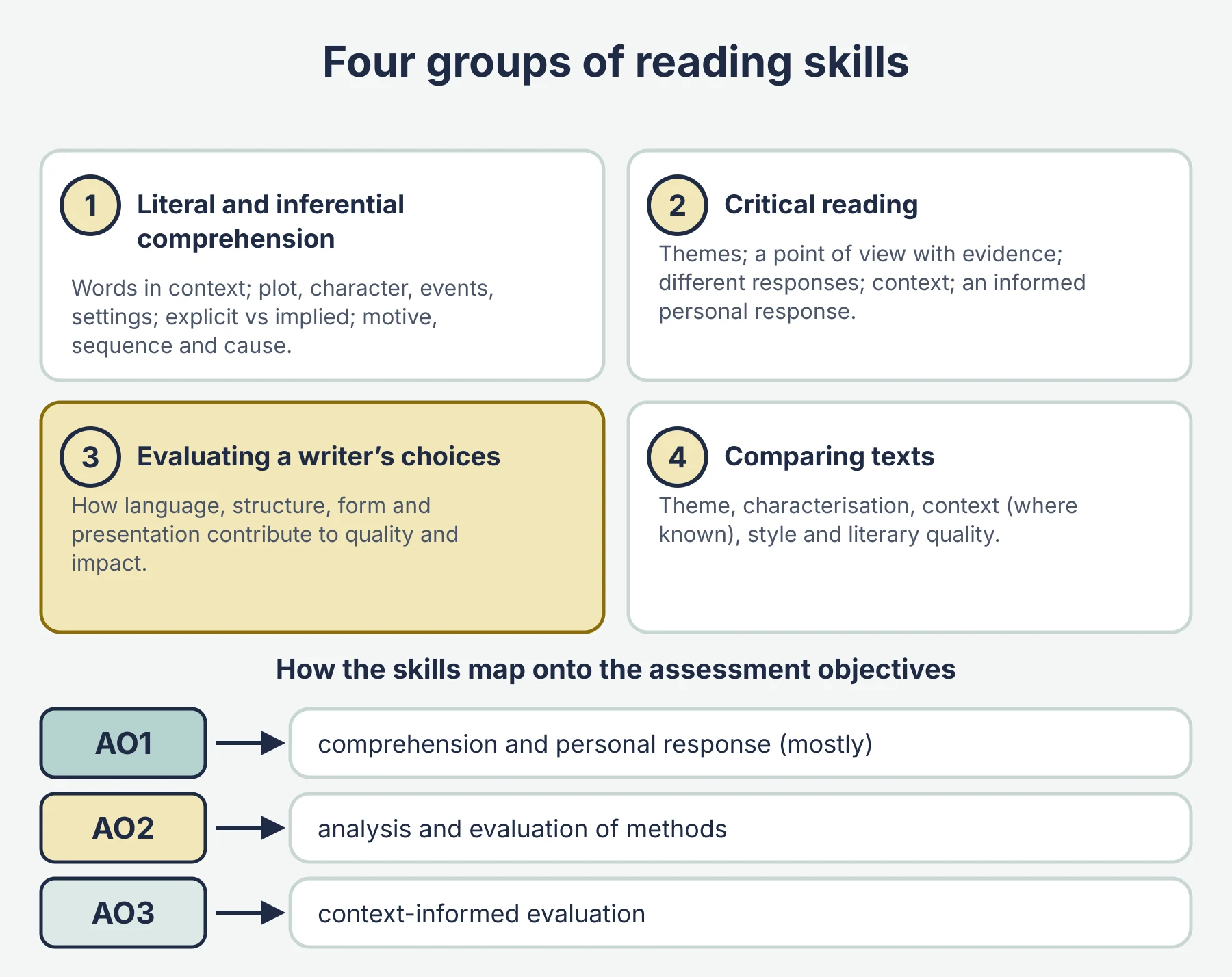
The reading skills fall into four groups:
- Literal and inferential comprehension – understanding a word, phrase or sentence in context; exploring plot, characterisation, events and settings; distinguishing between what is stated explicitly and what is implied; explaining motivation, the sequence of events, and the relationship between actions or events.
- Critical reading – identifying themes and distinguishing between them; supporting a point of view with evidence; recognising and evaluating different responses to a text; using understanding of writers’ social, historical and cultural contexts to inform evaluation; making an informed personal response that comes from analysis and evaluation.
- Evaluating a writer’s choices of vocabulary, grammatical and structural features – analysing and evaluating how language, structure, form and presentation contribute to quality and impact, using linguistic and literary terminology.
- Comparing texts – comparing and contrasting texts with reference to theme, characterisation, context (where known), style and literary quality.
These skills map onto the assessment objectives: comprehension and personal response mostly onto AO1, analysis and evaluation of methods onto AO2, and context-informed evaluation onto AO3.
Literal and inferential comprehension
Words in context
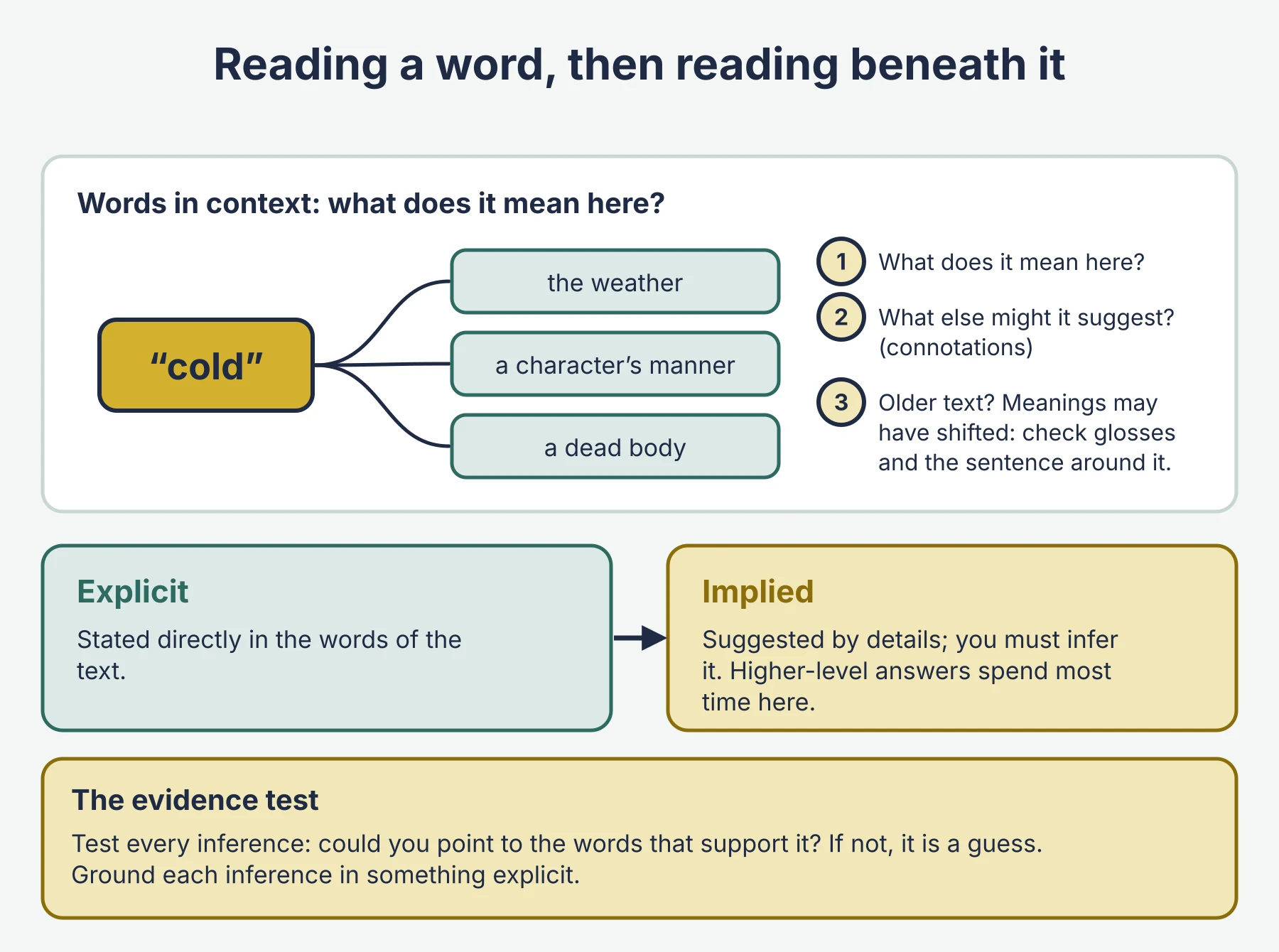
A word’s meaning depends on where it appears. “Cold” can describe weather, a character’s manner or a dead body. Before analysing, ask what the word means here, then what else it might suggest (connotations). Older texts add a further step: some words have shifted meaning since they were written, so check glosses and the surrounding sentence.
Explicit and implied
Explicit meaning is stated directly. Implied meaning is suggested and must be inferred from details. Higher-level answers spend most of their time on implication, but they ground every inference in something explicit. A useful test: could you point to the words that support your inference? If not, it is a guess.
The inference ladder
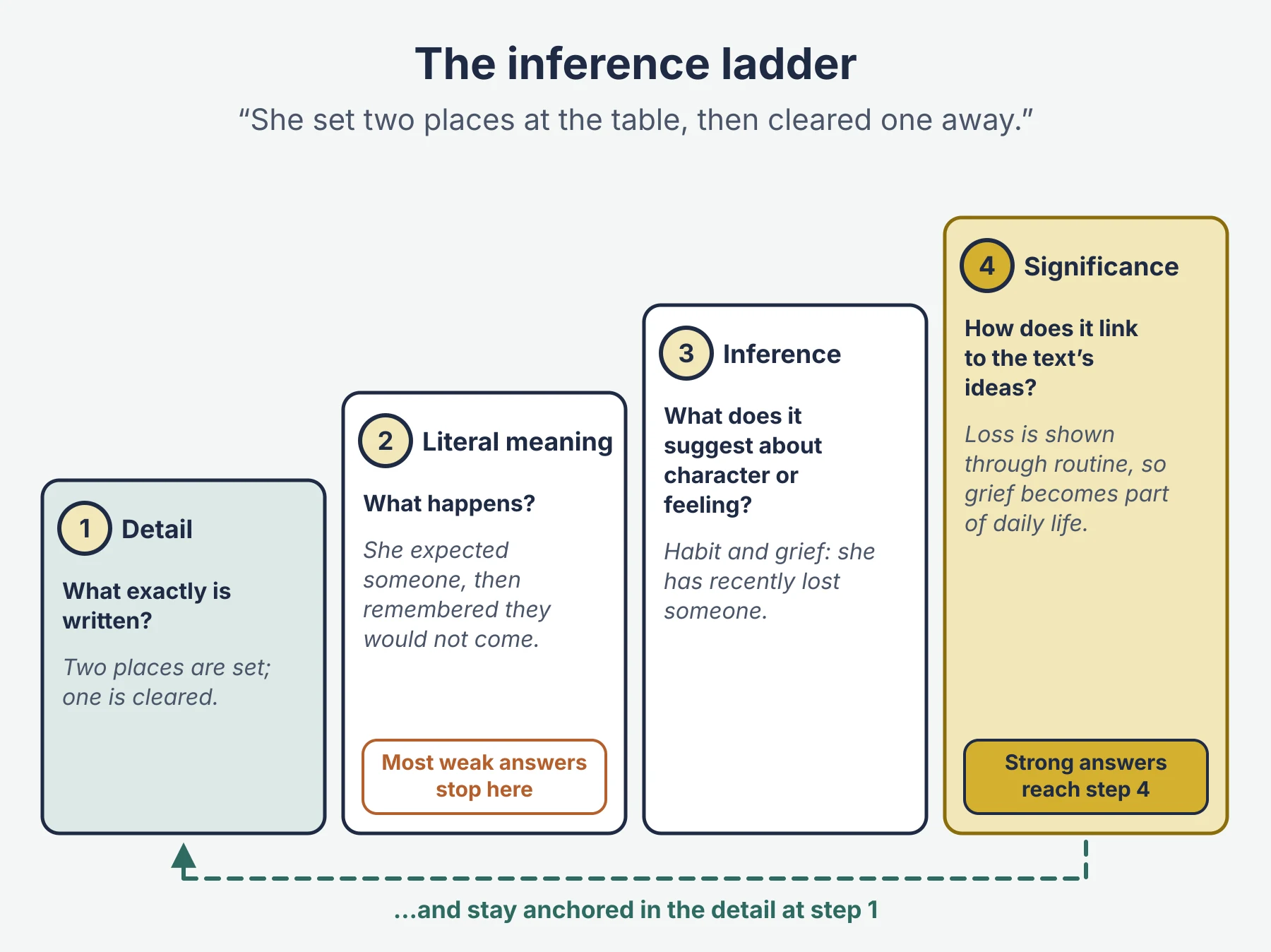
Climb from detail to significance in four steps:
| Step | Question | Example from an original sentence: “She set two places at the table, then cleared one away.” |
|---|---|---|
| Detail | What exactly is written? | Two places are set; one is cleared. |
| Literal meaning | What happens? | She expected someone, then remembered they would not come. |
| Inference | What does it suggest about character or feeling? | Habit and grief: she has recently lost someone. |
| Significance | How does it link to the text’s ideas? | Loss is shown through routine, so grief becomes part of daily life. |
Most weak answers stop at step two. Strong answers reach step four and stay anchored in step one.
Motivation, sequence and cause
Comprehension also means understanding why characters act and how events connect. Ask: what does the character want, fear or believe? What caused this event, and what does it cause? Writers often leave motives unstated, so explaining them is inference. Placing an extract in its sequence (“this follows directly after…”) shows whole-text understanding.
Critical reading
Themes, distinguished
A theme is an idea a text explores, such as power, guilt or belonging. Distinguishing between themes means seeing how they interact. A text about ambition might also be about loyalty, and a moment can show one theme undermining another. Name the relationship: “Here ambition overrides loyalty.”
Supporting a point of view
A point of view is an argument you can defend. It should be specific enough to be disagreed with: “The writer presents the father as cruel” is weaker than “The writer presents the father’s cruelty as a learned behaviour, inherited from the society around him.” Support it with evidence from more than one place.
Different responses
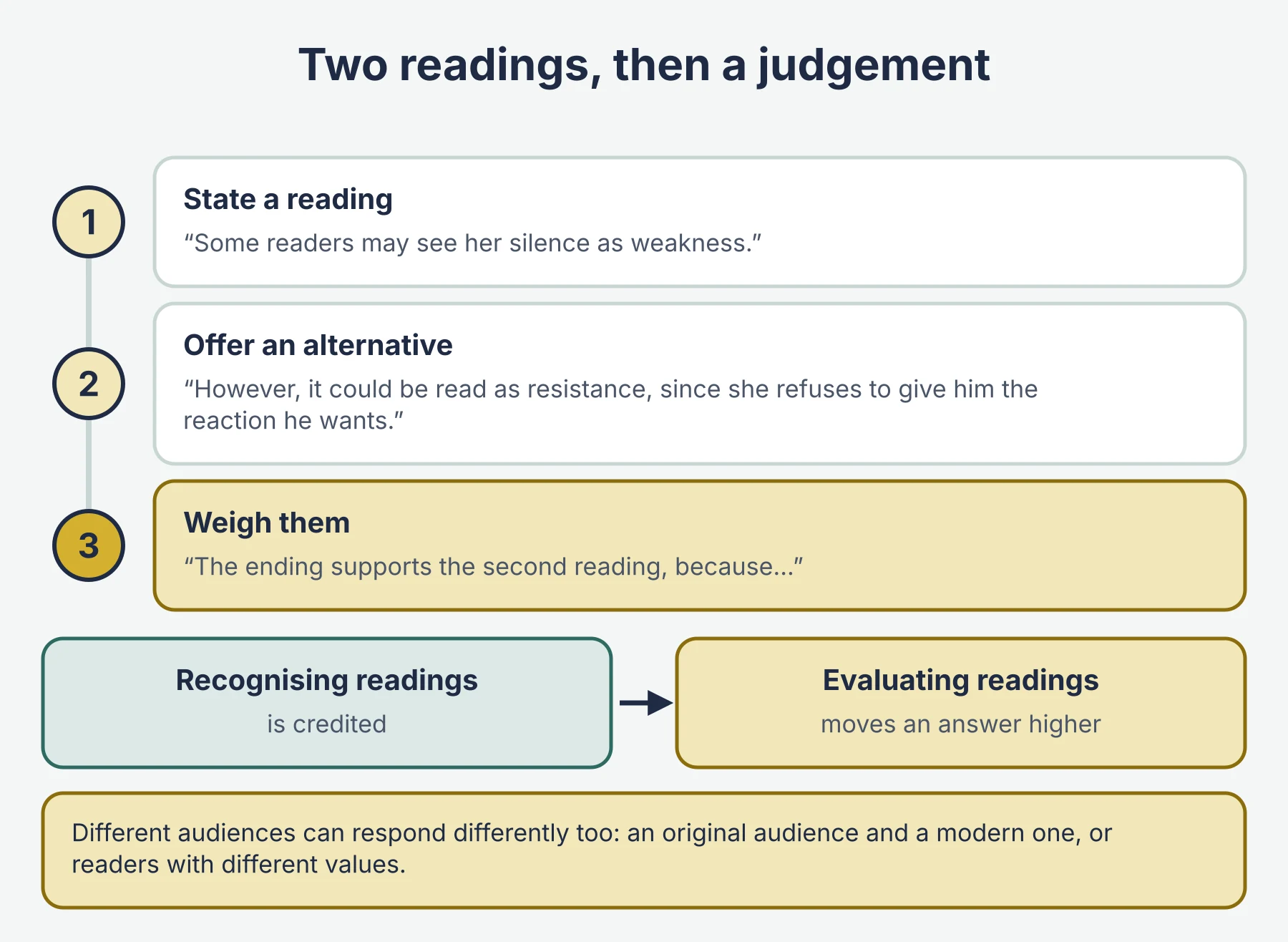
Texts allow more than one reading. Recognising this is credited, but evaluating readings is what moves an answer higher. Use a pattern:
- State a reading: “Some readers may see her silence as weakness.”
- Offer an alternative: “However, it could be read as resistance, since she refuses to give him the reaction he wants.”
- Weigh them: “The ending supports the second reading, because…”
Different audiences can also respond differently: an original audience and a modern one, or readers with different values.
Context to inform evaluation
Context should help you judge what a writer is doing. Knowing the attitudes of a text’s time lets you evaluate whether the writer reinforces or challenges them. Keep it specific and linked to a moment.
Informed personal response
“Informed” means your view comes from analysis and evaluation, not from liking or disliking a character. “I find this ending unsettling because the narrator never explains…” is a personal response; “I didn’t like it” is not.
Evaluating writers’ choices
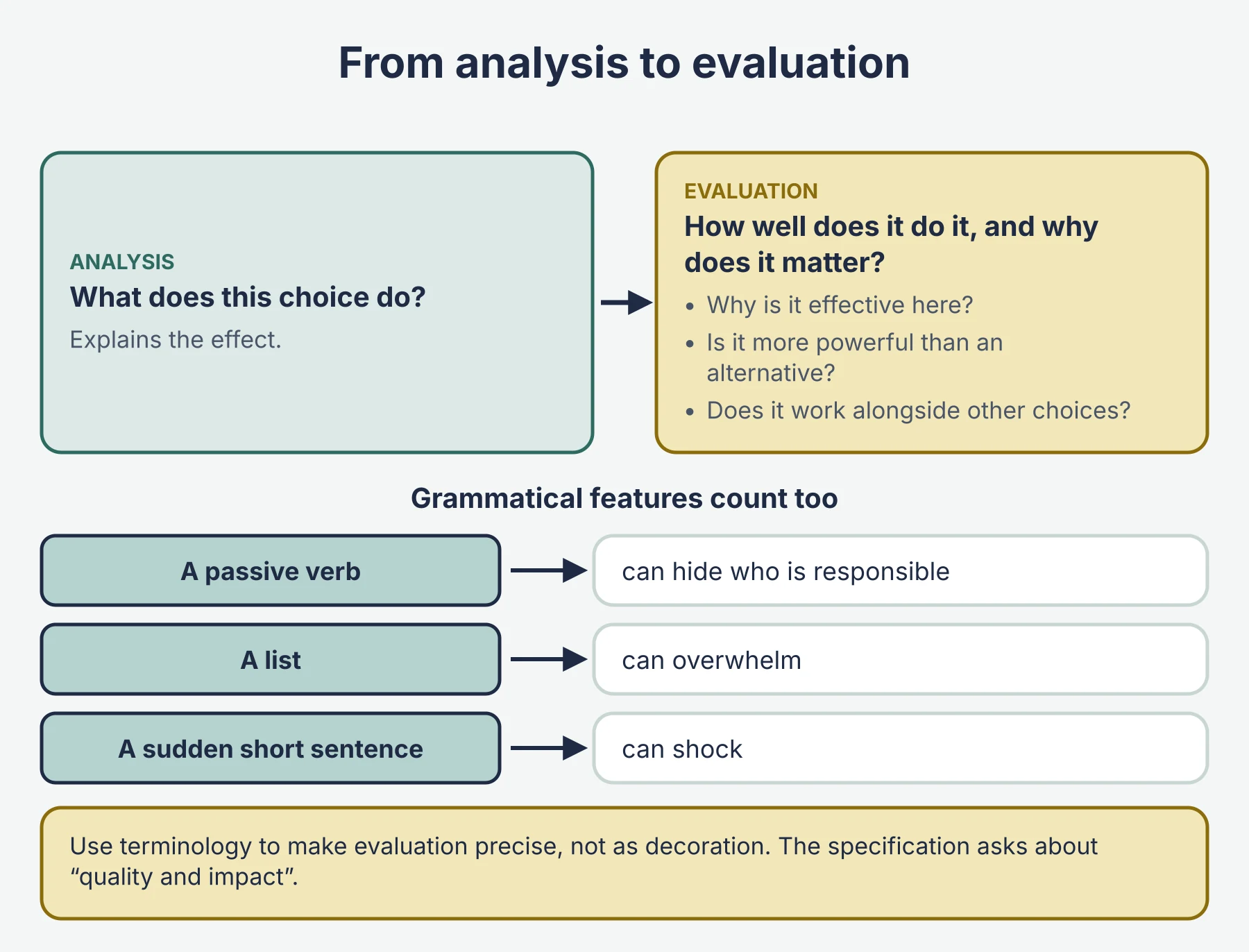
Analysis explains what a choice does. Evaluation judges how well it does it and why it matters. The specification uses the phrase “quality and impact”, so ask: why is this choice effective here? Is it more powerful than an alternative would have been? Does it work alongside other choices?
Use terminology to make evaluation precise, not as decoration. Grammatical features count too: a passive verb can hide who is responsible; a list can overwhelm; a sudden short sentence can shock.
Comparing texts
Comparison means holding two texts together and saying how they relate in theme, characterisation, context (where known), style and literary quality. On these papers it is tested directly in the poetry sections. Compare like with like: method against method, idea against idea, and judge which choice has more impact for the question being asked.
Worked example
The passage below is original, written for this resource.
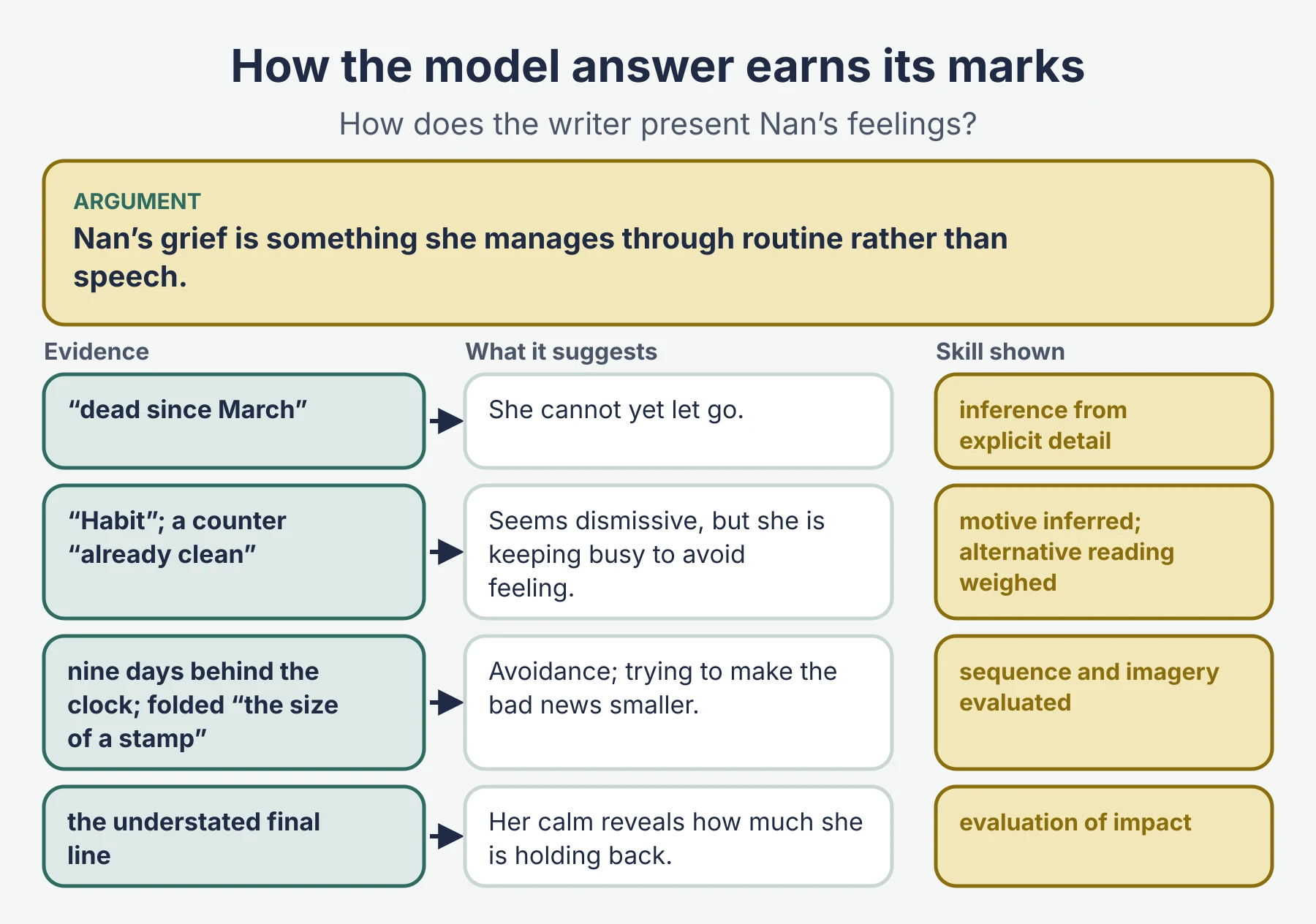
Original passage: When the letter came, Nan put it behind the clock without opening it. She made the tea as usual, two sugars for Grandad though he had been dead since March, and poured his cup down the sink when hers was finished. I asked her once why she still made it. “Habit,” she said, and wiped the counter that was already clean. The letter stayed behind the clock for nine days. On the tenth, she opened it at the kitchen table, read it twice, folded it into a square the size of a stamp, and said, “Well. That’s the house, then.”
Annotated response to “How does the writer present Nan’s feelings?”:
The writer presents Nan’s grief as something she manages through routine rather than speech. Explicitly, she makes tea for a husband “dead since March”; the implication is that she cannot yet let go [inference from explicit detail]. Her one-word answer, “Habit”, may seem dismissive, but wiping a counter “already clean” suggests she is keeping busy to avoid feeling [motive inferred; alternative reading weighed]. The structure delays the letter’s contents: nine days behind the clock show avoidance, so when she folds it “the size of a stamp”, the tiny shape suggests she is trying to make the bad news smaller [sequence and imagery evaluated]. The understated final line is more powerful than an outburst would be, because her calm reveals how much she is holding back [evaluation of impact].
Common mistakes
- Inferences without evidence: claims that cannot be traced to the words.
- Stopping at literal meaning: retelling what happens.
- Offering two readings without weighing them.
- Mistaking a topic for a theme: “family” is a topic; “family loyalty is shown as a trap” is a theme expressed as an idea.
- Analysis without evaluation: explaining an effect but never judging its impact.
Exam technique
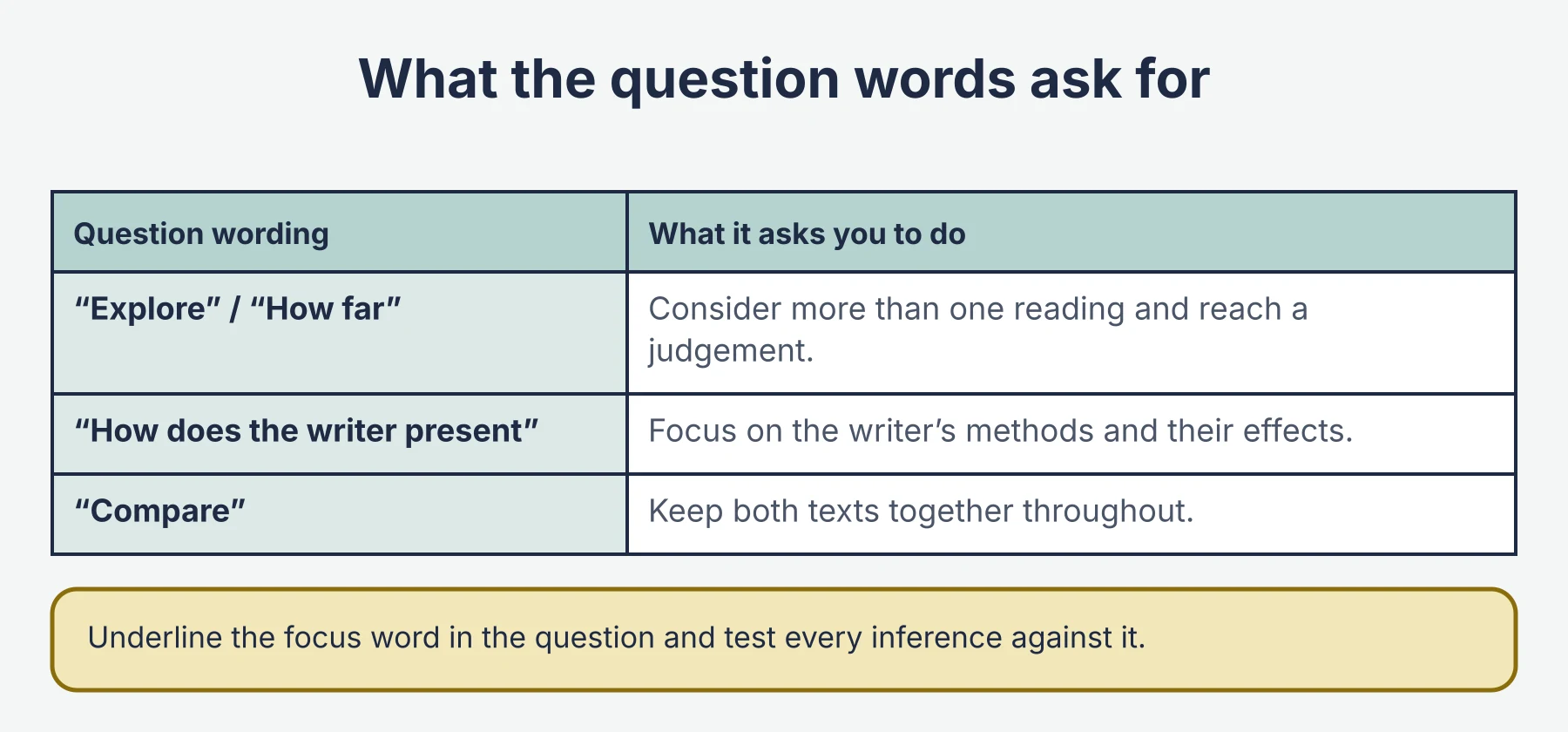
- “Explore” and “how far” invite you to consider more than one reading and reach a judgement.
- “How does the writer present” points you to methods and their effects.
- “Compare” requires both texts together throughout.
- Underline the focus word and test every inference against it.
More resources on this topic
Related resources
-
Practice questions
AQA GCSE English Literature (8702): Reading Comprehension and Reading Critically – Practice Questions
Original reading skills practice for AQA GCSE English Literature 8702: inference, alternative readings, evaluation and comparison, with answers.
English Literature · AQA · GCSE
Try questions -
Revision notes
AQA GCSE English Literature (8702): Reading Comprehension and Reading Critically – Revision Notes
Condensed notes on reading skills for AQA GCSE English Literature 8702: inference, explicit and implied meaning, weighing readings and a self-test.
English Literature · AQA · GCSE
Revise topic -
Study guides
AQA GCSE English Literature (8702): Writing
Writing about literature for AQA GCSE English Literature 8702: arguing a view, selecting evidence, embedding quotations and accurate Standard English for AO4.
English Literature · AQA · GCSE
Read guide
Get free revision emails (optional)
Occasional emails with practice questions, worked explanations and links to free resources for the qualification and subjects you choose. No spam, and you can unsubscribe from any email. The free tools on this site never need an email.