
Study Guides
AQA GCSE English Literature (8702): Writing
Writing about literature for AQA GCSE English Literature 8702: arguing a view, selecting evidence, embedding quotations and accurate Standard English for AO4.
- Subject
- English Literature
- Level
- GCSE
- Topic
- Topic 3: Skills
- Author
- Marlbridge Academic Team
- Updated
- Reviewed by
- Ammar Bilal (what this means)
Aligned to AQA GCSE English Literature (8702), For first teaching 2015. Official specification .
Syllabus page (what it covers and how it is assessed): AQA GCSE English Literature.
Syllabus points this page covers
8702
- Writing
Found an error? Report a correction.
Need help with this topic? Request a free trial class for GCSE English Literature (8702).
The specification’s writing skills are about writing about literature: producing clear, coherent essays and using accurate Standard English. Every answer on both papers depends on them, and two questions award separate marks for accuracy and range of expression (AO4). The Skills study guide introduces paragraph structure; this guide goes further into argument, quotation technique and the accuracy points that cost students marks.
What the specification covers
Producing clear and coherent text means writing effectively about literature for a range of purposes, such as to describe, explain, summarise, argue, analyse and evaluate; discussing and maintaining a point of view; selecting and emphasising key points; and using relevant quotation and detailed textual references.
Accurate Standard English means accurate spelling, punctuation and grammar.
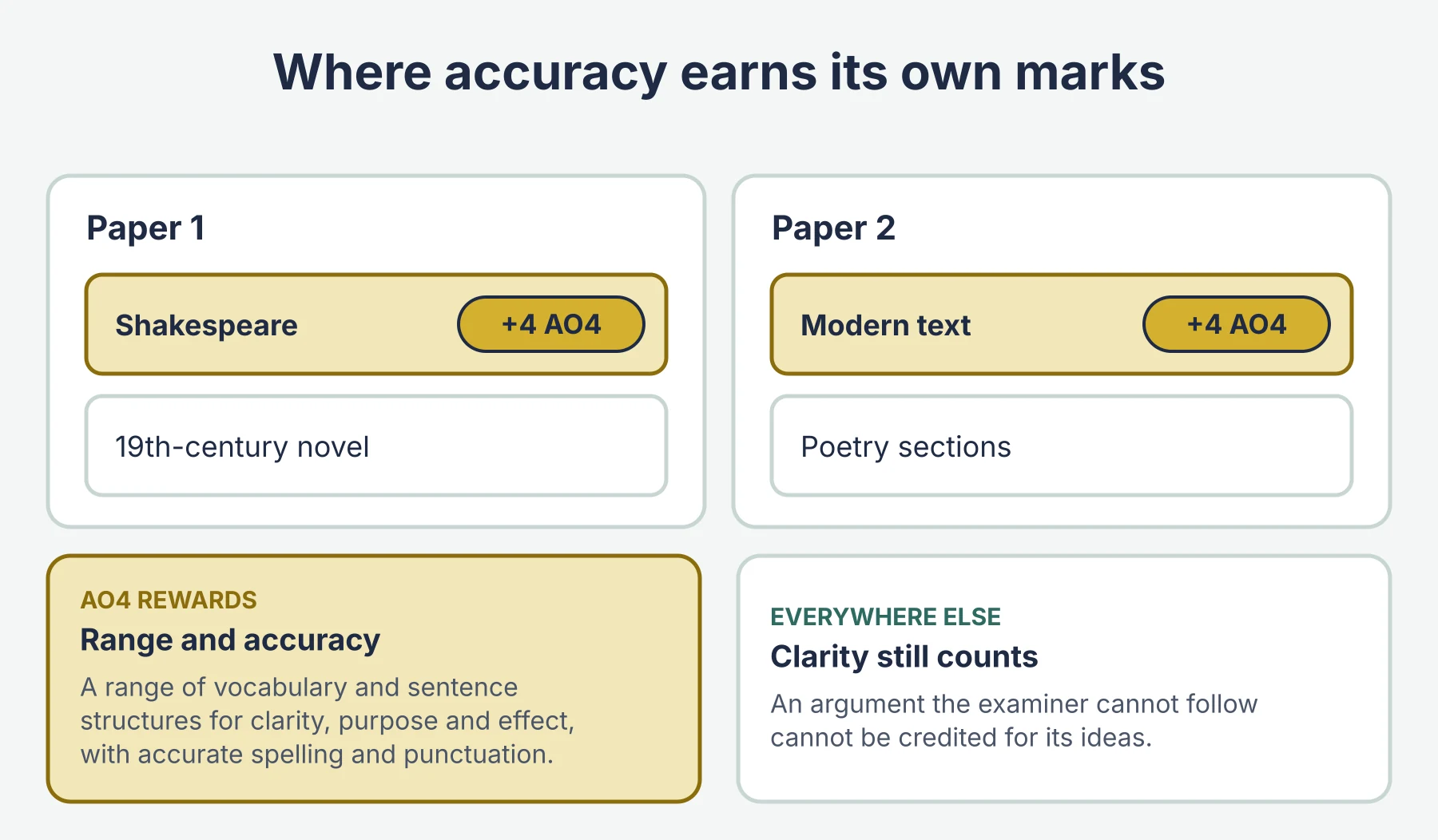
AO4 (a range of vocabulary and sentence structures for clarity, purpose and effect, with accurate spelling and punctuation) is assessed in two places: the Shakespeare question on Paper 1 and the modern text question on Paper 2, with 4 marks each. Clear writing still matters everywhere else, because an argument the examiner cannot follow cannot be credited for its ideas.
Writing for different purposes
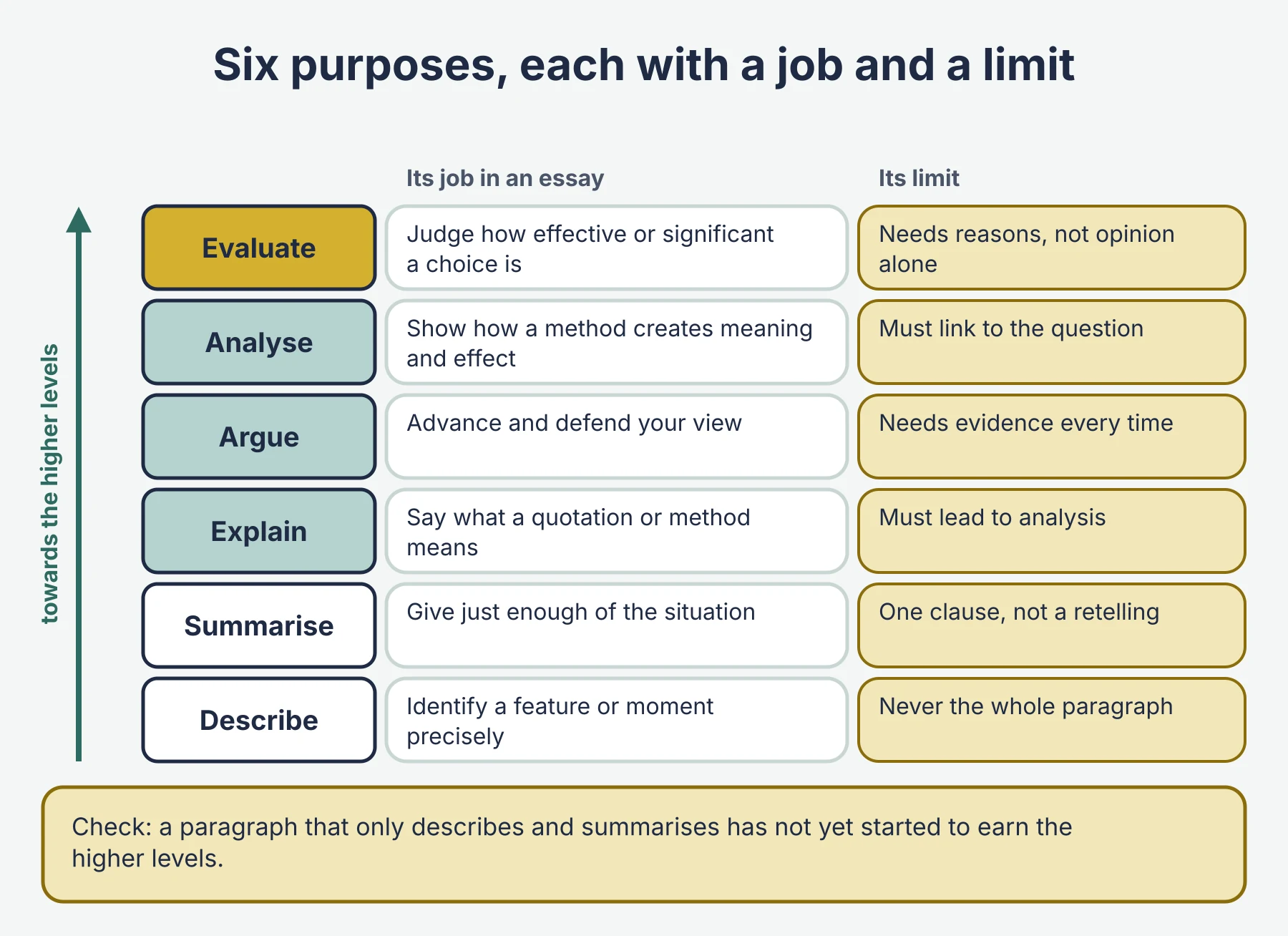
A literature essay blends purposes, but each has a job and a limit.
| Purpose | Its job in an essay | Its limit |
|---|---|---|
| Describe | Identify a feature or moment precisely | Never the whole paragraph |
| Summarise | Give the reader just enough of the situation | One clause, not a retelling |
| Explain | Say what a quotation or method means | Must lead to analysis |
| Argue | Advance and defend your view | Needs evidence every time |
| Analyse | Show how a method creates meaning and effect | Must link to the question |
| Evaluate | Judge how effective or significant a choice is | Needs reasons, not opinion alone |
A useful check: if a paragraph contains only describing and summarising, it has not yet started to earn the higher levels.
Discussing and maintaining a point of view
The thesis
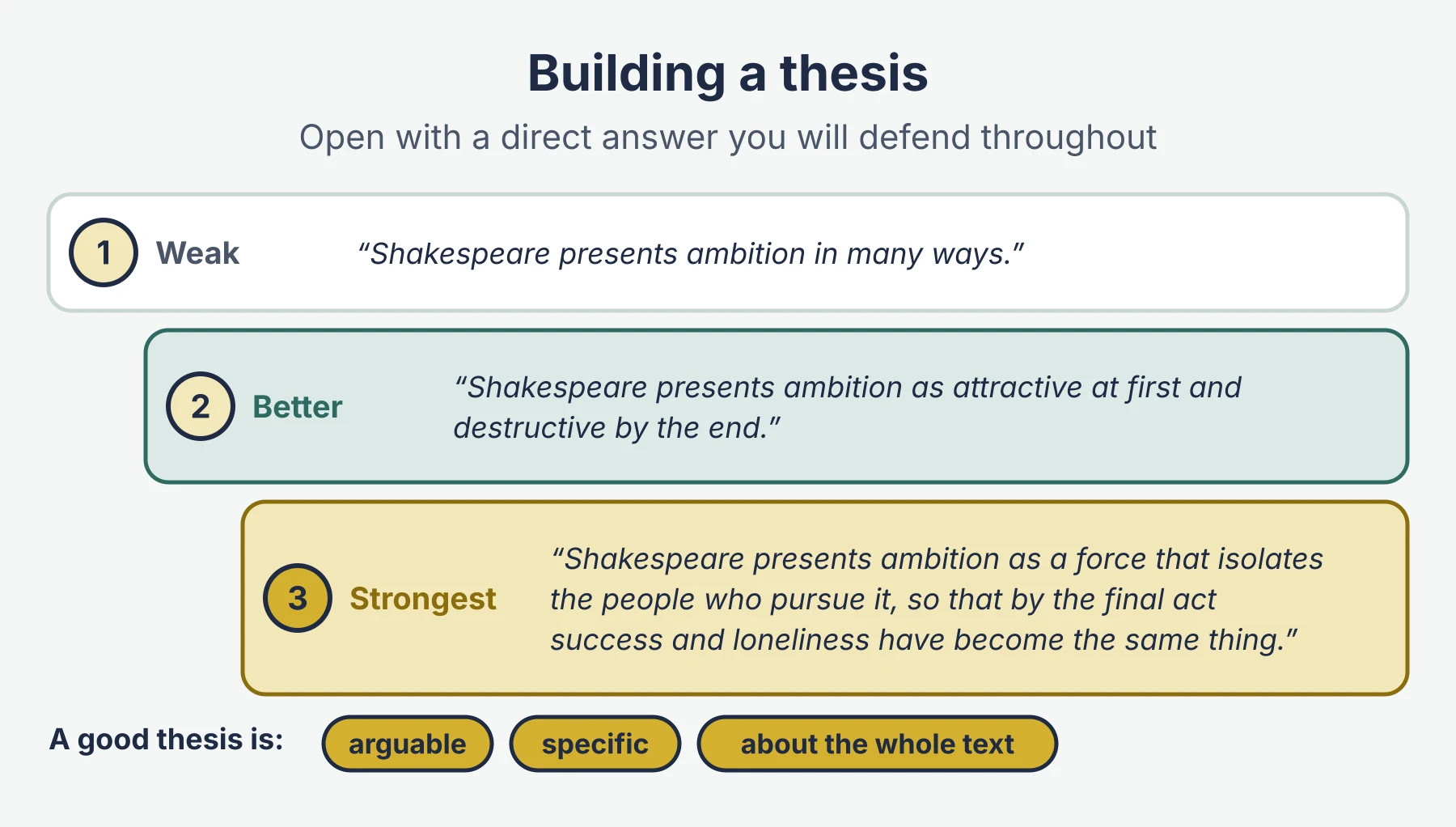
Open with a direct answer to the question that you will defend throughout. A good thesis is arguable, specific and covers the whole text:
- Weak: “Shakespeare presents ambition in many ways.”
- Better: “Shakespeare presents ambition as attractive at first and destructive by the end.”
- Strongest: “Shakespeare presents ambition as a force that isolates the people who pursue it, so that by the final act success and loneliness have become the same thing.”
Keeping the line of argument
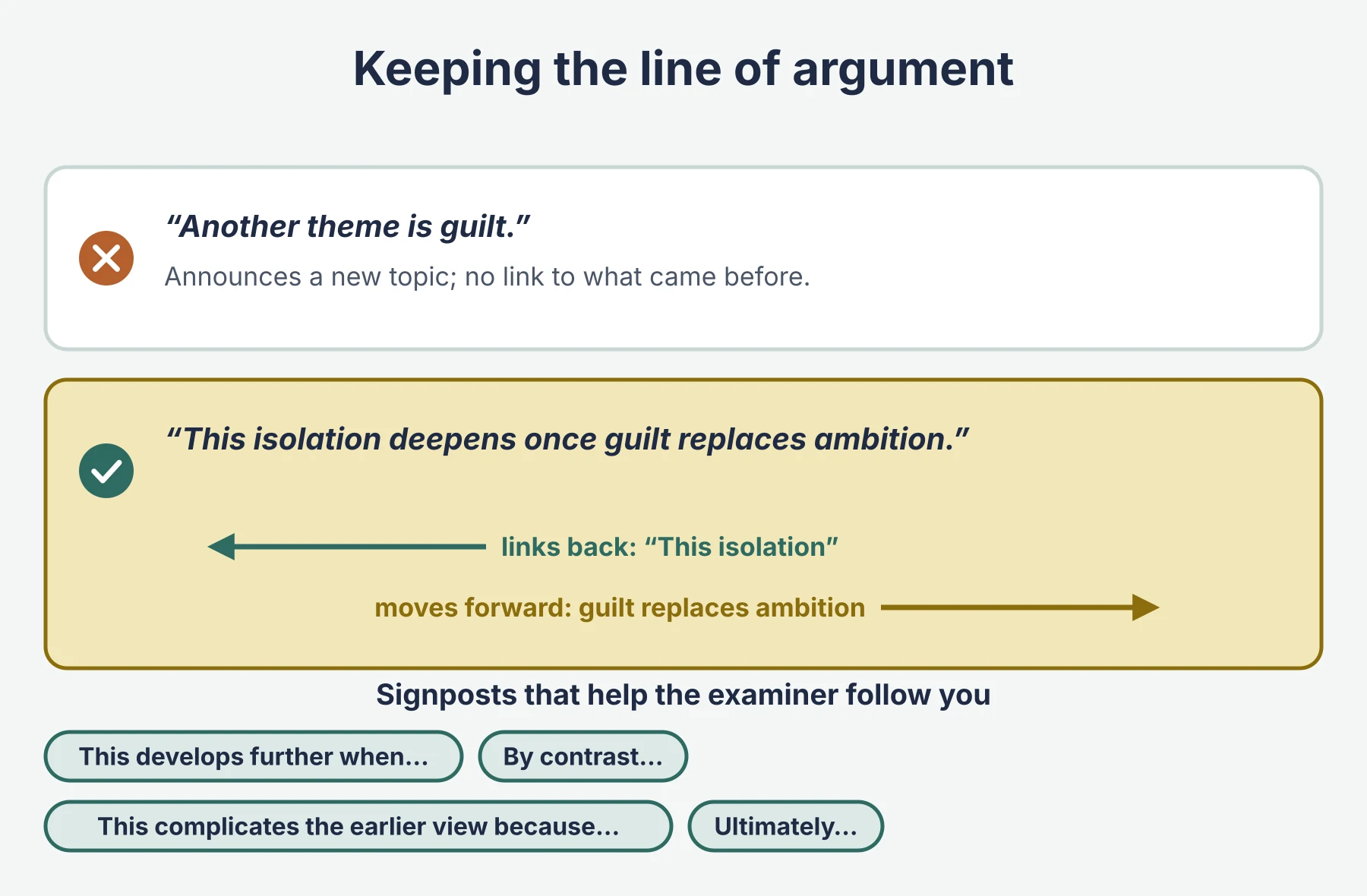
Each topic sentence should advance the thesis, not simply announce a new topic. Compare “Another theme is guilt” with “This isolation deepens once guilt replaces ambition.” The second links back and moves forward.
Signposting phrases help the examiner follow the argument: “This develops further when…”, “By contrast…”, “This complicates the earlier view because…”, “Ultimately…”.
Discussing other views
Maintaining a point of view does not mean ignoring others. Acknowledge a counter-reading, then show why your view holds, or refine it. This is discussion, and it strengthens rather than weakens your argument.
Selecting and emphasising key points
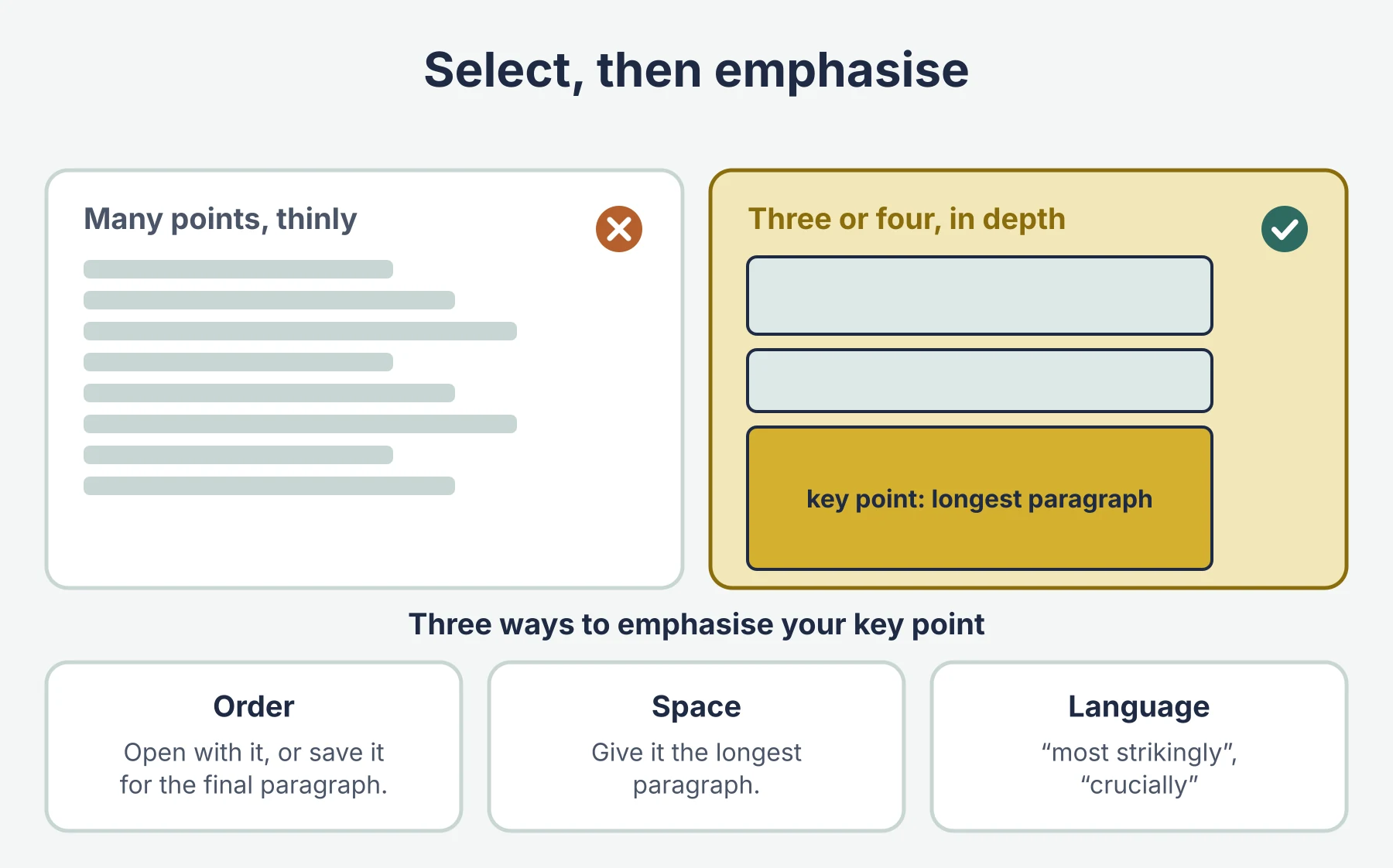
You cannot say everything. Choose the three or four points that best answer the question, and give each real depth rather than covering many points thinly. Emphasise by order (save your most significant point for the final paragraph or open with it), by space (give it the longest paragraph), and by language (“most strikingly”, “crucially”).
Using quotation and textual reference
Embedding
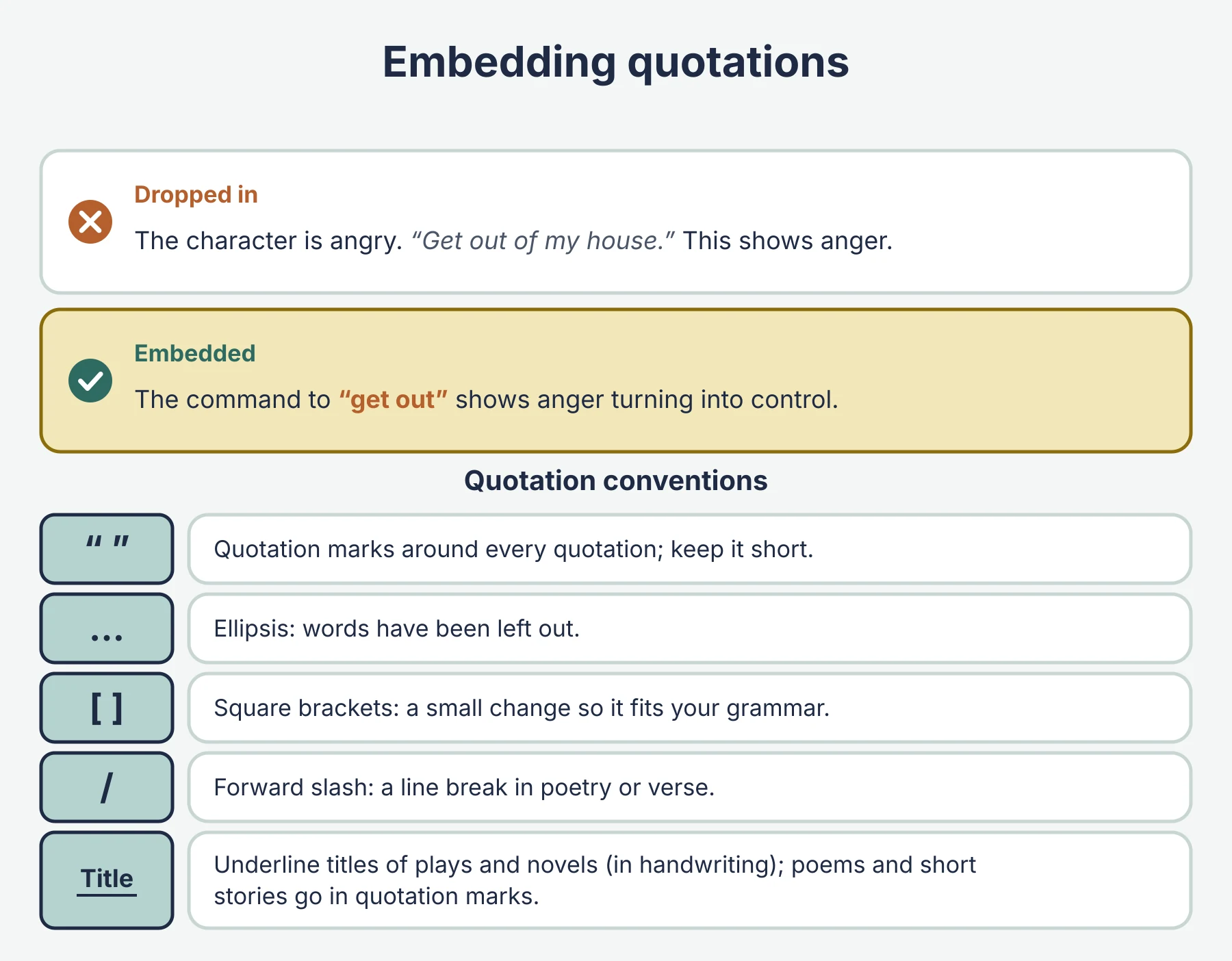
Integrate short quotations into your own sentences so that they read grammatically:
- Dropped in: The character is angry. “Get out of my house.” This shows anger.
- Embedded: The command to “get out” shows anger turning into control.
Conventions
- Use quotation marks around every quotation.
- Keep quotations short: a word or a phrase is often enough.
- Use an ellipsis (…) to show you have left words out.
- Use square brackets to make a small change so that a quotation fits your grammar, such as changing a pronoun.
- When quoting poetry or verse across a line break, mark the break with a forward slash.
- In handwriting, underline the titles of whole texts such as plays and novels; put the titles of poems and short stories in quotation marks.
Reference without quotation
A detailed reference to an event or moment is valid evidence: “when he tears up the letter in front of her” can support a point as well as a quotation. Use this when you cannot recall exact words, and never invent a quotation.
Accurate Standard English
Register
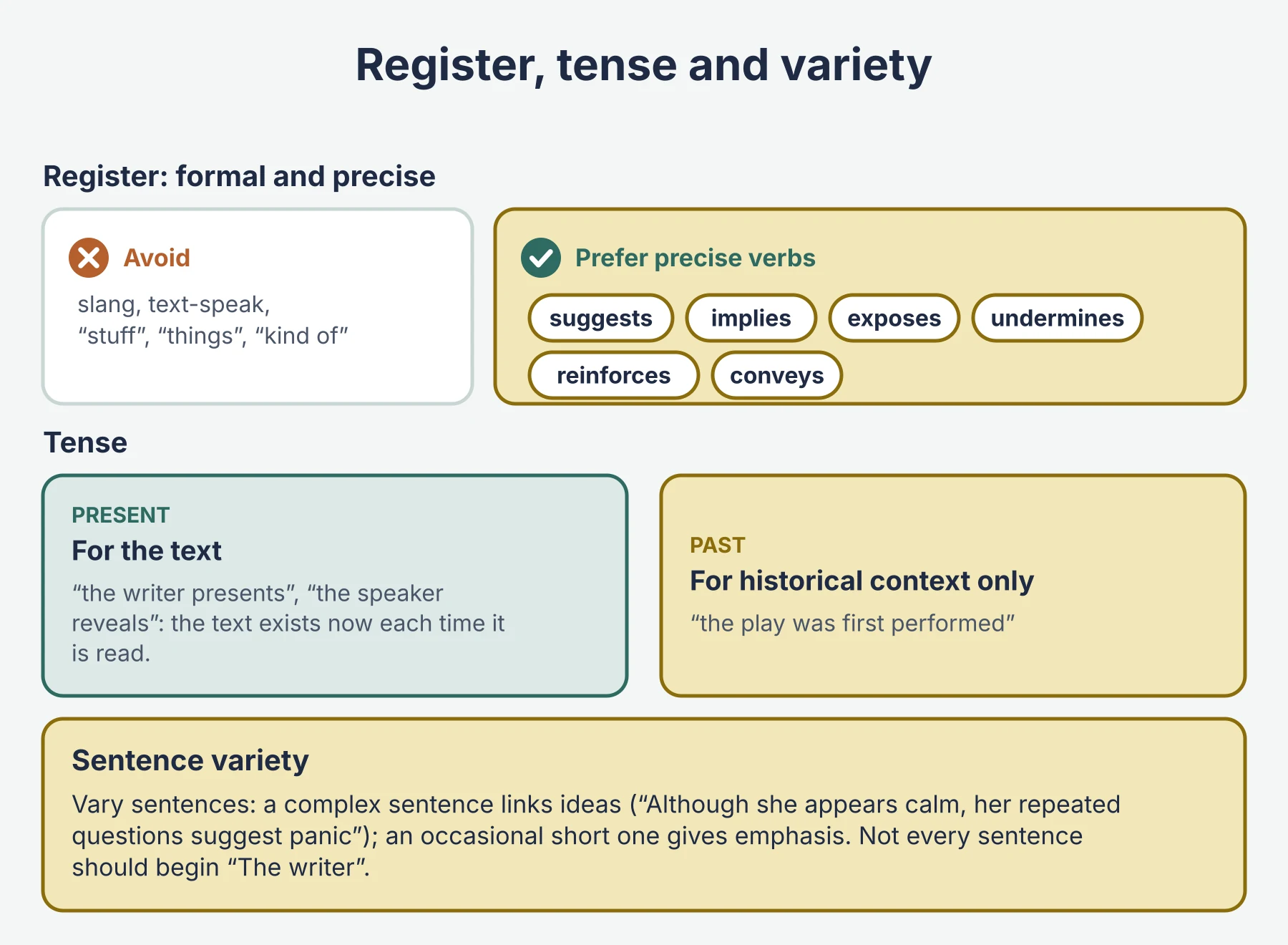
Write in a formal, analytical register. Avoid slang, text-speak and vague words such as “stuff” or “things”. Prefer precise verbs: “suggests”, “implies”, “exposes”, “undermines”, “reinforces”, “conveys”.
Tense
Write about the text in the present tense (“the writer presents”, “the speaker reveals”), because the text exists now each time it is read. Use the past tense only for historical context: “the play was first performed”.
Frequent errors
| Error | Correct use |
|---|---|
| its / it’s | “its” shows possession; “it’s” means “it is” |
| their / there / they’re | belonging; place; “they are” |
| affect / effect | “affect” is usually the verb; “effect” usually the noun |
| should of | should have |
| comma splice | Two sentences joined by a comma; use a full stop, semicolon or connective |
| who’s / whose | “who is”; belonging |
| Possessive names | One family member: Birling’s; the whole family: the Birlings’ |
Learn the spellings you will use in every answer: the writer’s name, characters’ names, and terms such as simile, metaphor, rhythm, soliloquy, onomatopoeia and juxtaposition.
Sentence variety
AO4 rewards a range of sentence structures. Use complex sentences to link ideas (“Although she appears calm, her repeated questions suggest panic”) and the occasional short sentence for emphasis. Vary sentence openings so that not every sentence begins with “The writer”.
Worked example
Original weaker paragraph:
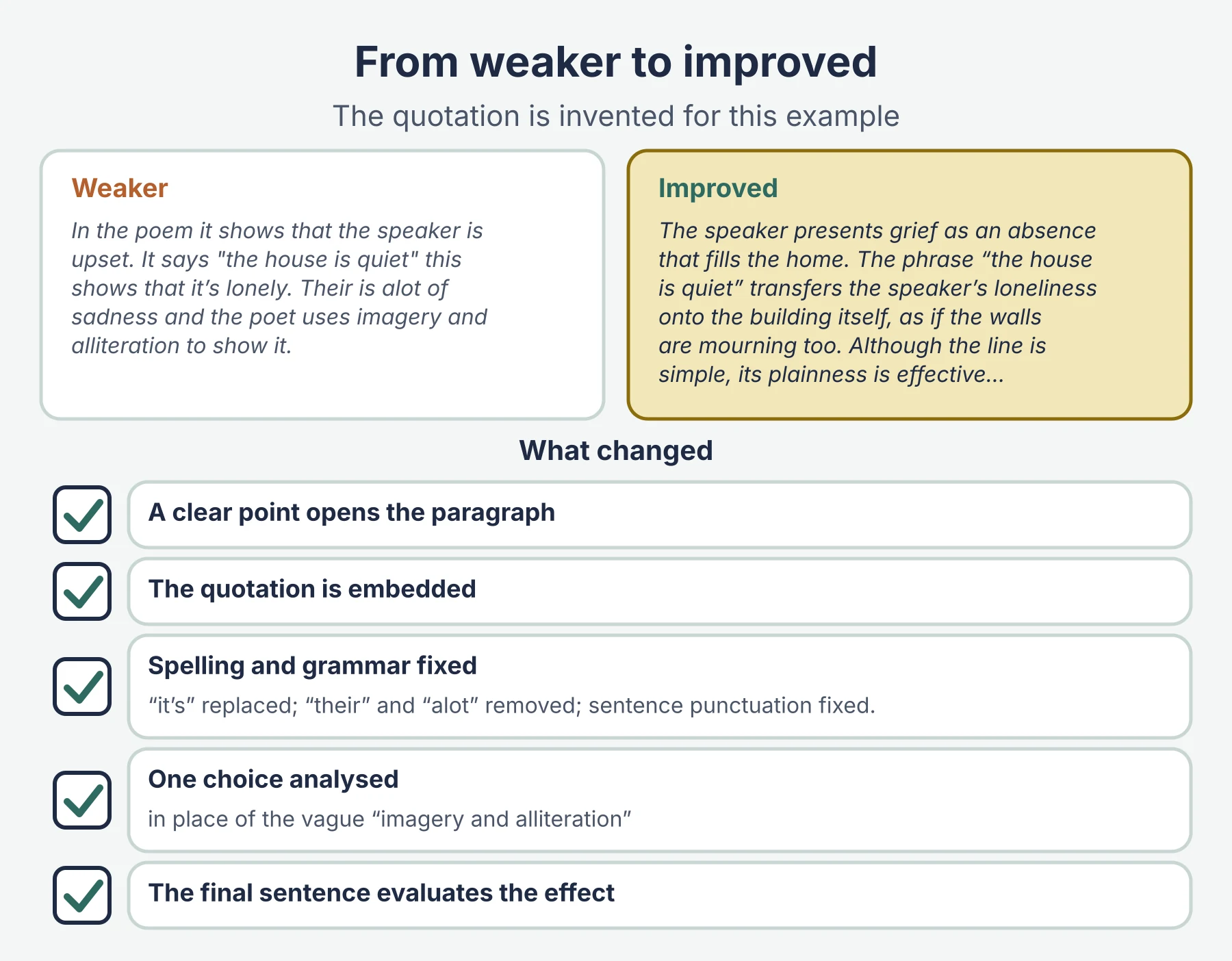
In the poem it shows that the speaker is upset. It says “the house is quiet” this shows that it’s lonely. Their is alot of sadness and the poet uses imagery and alliteration to show it.
Improved paragraph:
The speaker presents grief as an absence that fills the home. The phrase “the house is quiet” transfers the speaker’s loneliness onto the building itself, as if the walls are mourning too. Although the line is simple, its plainness is effective: the speaker does not dramatise the loss, which suggests a numb, exhausted sadness rather than open despair.
What changed: a clear point opens the paragraph; the quotation is embedded; “it’s” (meaning “it is”) is replaced, and “their” and “alot” are removed; a comma splice is fixed; the vague “imagery and alliteration” is replaced by analysis of one choice; and the final sentence evaluates the effect. (The quotation is invented for this example.)
Common mistakes
- No thesis, so paragraphs read as a list.
- Over-summarising before reaching analysis.
- Long quotations that crowd out commentary.
- Shifting tense between present and past.
- Misspelling names of writers and characters.
- Informal phrasing, such as “kind of” or “really bad”.
- Leaving no time to proofread the two questions that carry AO4.
Exam technique
- Write your thesis at the top of your plan, then check each paragraph against it.
- Leave two minutes after the Shakespeare and modern text answers to proofread.
- Correct errors with a single neat line through the mistake.
- If time runs short, write a one-sentence conclusion that answers the question.
More resources on this topic
Related resources
-
Practice questions
AQA GCSE English Literature (8702): Writing – Practice Questions
Original writing practice for AQA GCSE English Literature 8702: theses, embedding quotations, fixing errors and rewriting paragraphs for AO4.
English Literature · AQA · GCSE
Try questions -
Revision notes
AQA GCSE English Literature (8702): Writing – Revision Notes
Condensed notes on writing about literature for AQA GCSE English Literature 8702: thesis, quotation conventions, AO4 accuracy, common errors and a self-test.
English Literature · AQA · GCSE
Revise topic -
Practice questions
Skills (8702): Practice Questions
Original skills practice for AQA GCSE English Literature (8702): inference, critical reading, analysing writers' choices, comparison and writing, with answers.
English Literature · AQA · GCSE
Try questions
Get free revision emails (optional)
Occasional emails with practice questions, worked explanations and links to free resources for the qualification and subjects you choose. No spam, and you can unsubscribe from any email. The free tools on this site never need an email.