
Study Guides
AQA GCSE English Literature (8702): Shakespeare
How to analyse your Shakespeare play for AQA GCSE English Literature 8702 Paper 1 Section A: dramatic methods, context and the extract-to-whole-play essay.
- Subject
- English Literature
- Level
- GCSE
- Topic
- Paper 1 – Shakespeare and the 19th-century Novel
- Author
- Marlbridge Academic Team
- Updated
- Reviewed by
- Ammar Bilal (what this means)
Aligned to AQA GCSE English Literature (8702), For first teaching 2015. Official specification .
Syllabus page (what it covers and how it is assessed): AQA GCSE English Literature.
Syllabus points this page covers
8702
- 3.1.1 Shakespeare
Found an error? Report a correction.
Need help with this topic? Request a free trial class for GCSE English Literature (8702).
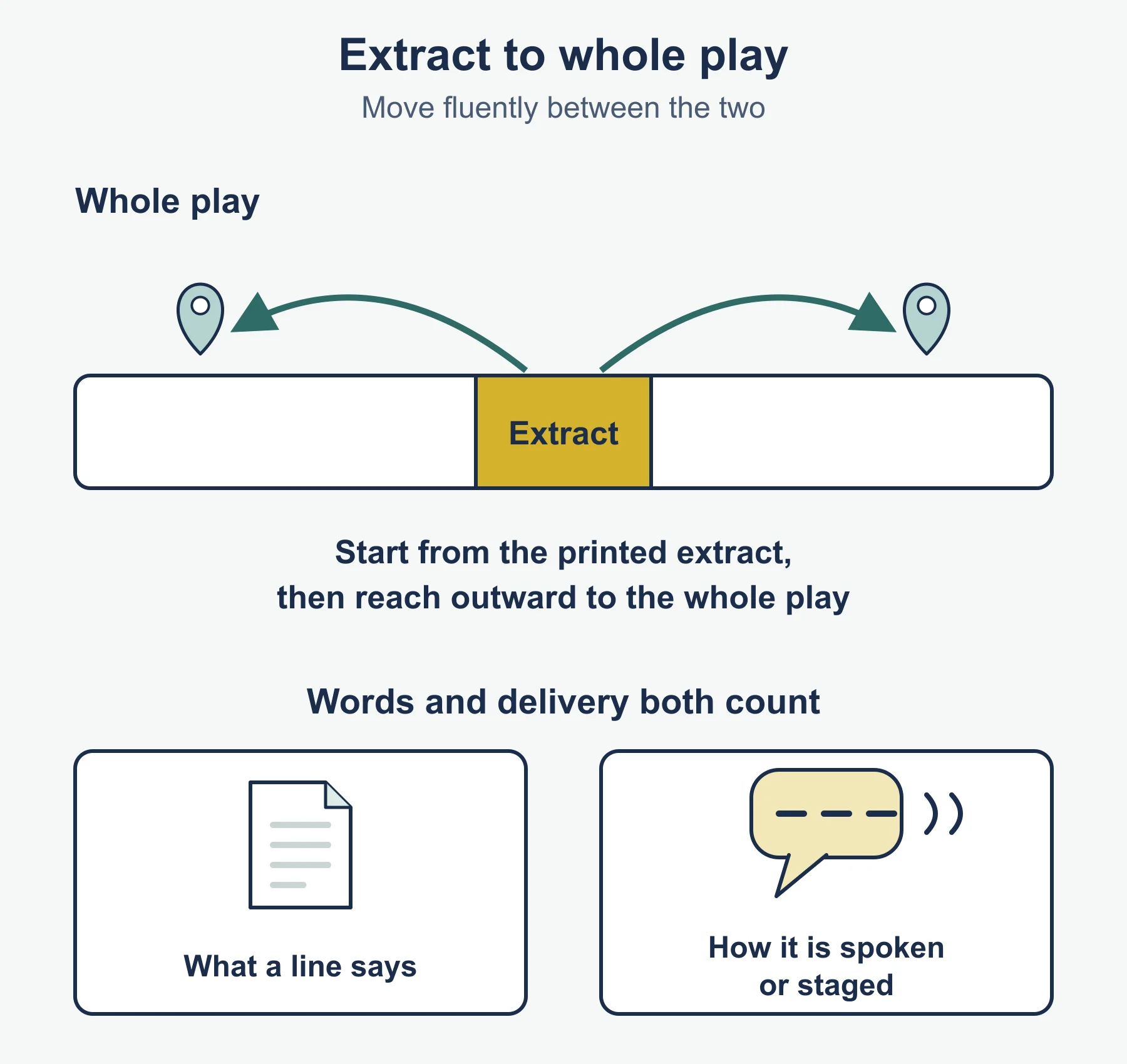
Section A of Paper 1 is the Shakespeare question. You study one play from the specification’s list of six, and you study the whole text. In the exam you answer one question on your play: it prints an extract, asks you to write in detail about that extract, and then asks you to write about the play as a whole. This guide goes beyond the Paper 1 overview to look closely at the methods a playwright uses, how to read Shakespeare’s verse and prose, and how to build a single argument that runs from the extract out across the play.
What the question rewards
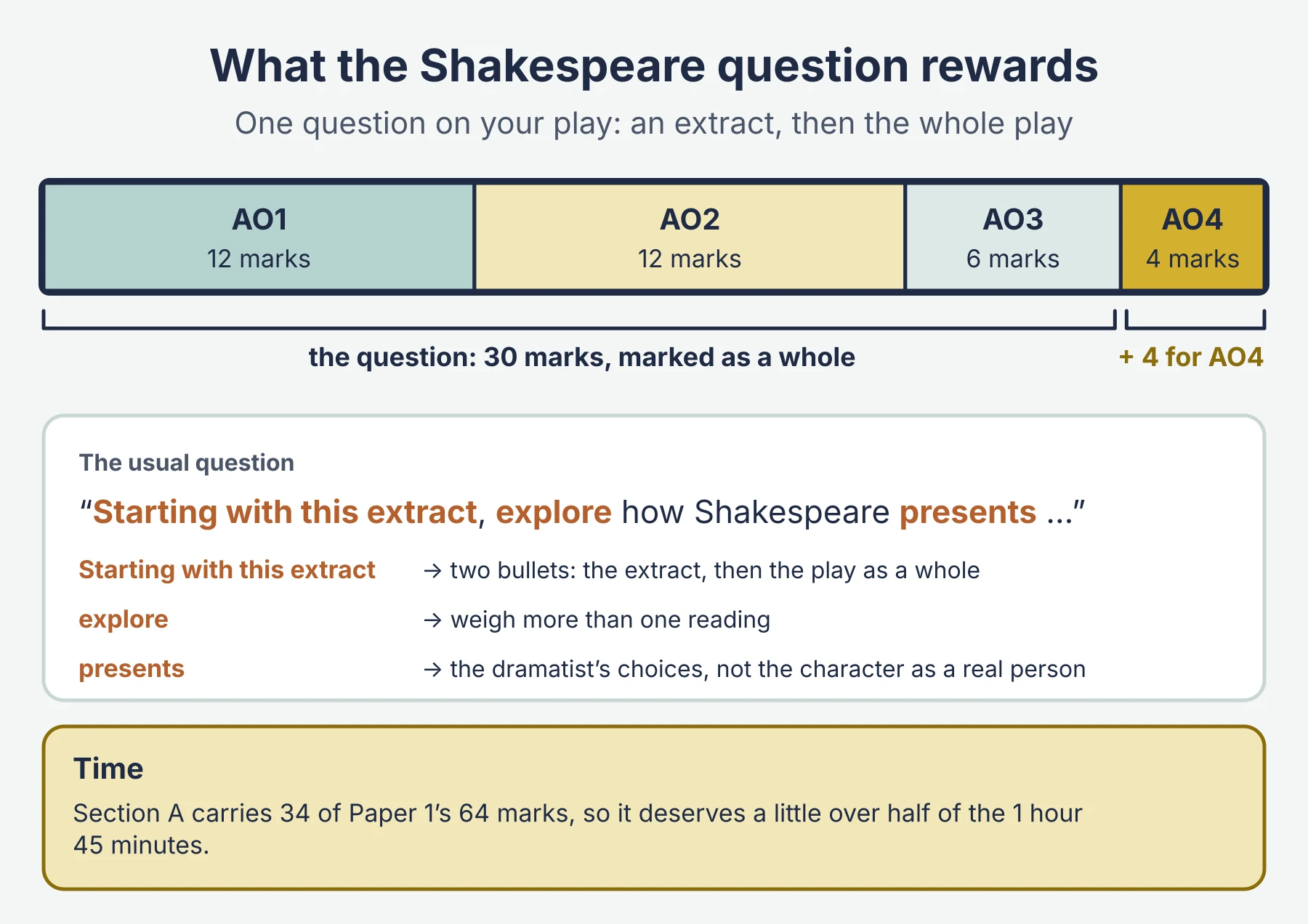
The question is worth 30 marks, plus 4 further marks for AO4: vocabulary, sentence structures, spelling and punctuation. AQA’s published mark schemes split the 30 as AO1 12, AO2 12 and AO3 6, but the examiner marks the answer as a whole against level descriptors rather than ticking off each objective separately.
- AO1 – an informed personal response with a critical style, supported by apt references, including quotation. The response must answer this question, not a remembered essay.
- AO2 – analysis of how Shakespeare uses language, form and structure to create meanings and effects, with subject terminology where it helps.
- AO3 – understanding of how the play relates to the context in which it was written.
- AO4 – accurate, varied and clear expression.
The question usually begins “Starting with this extract, explore how Shakespeare presents…” and gives two bullet points: one about the extract, one about the play as a whole. “Explore” invites you to weigh more than one reading; “presents” tells you to focus on the dramatist’s choices, not on the character as if they were a real person.
Reading a play as drama
Shakespeare wrote for performance. A script is a set of instructions for actors and an audience experience, so the strongest answers keep asking what an audience sees and hears.
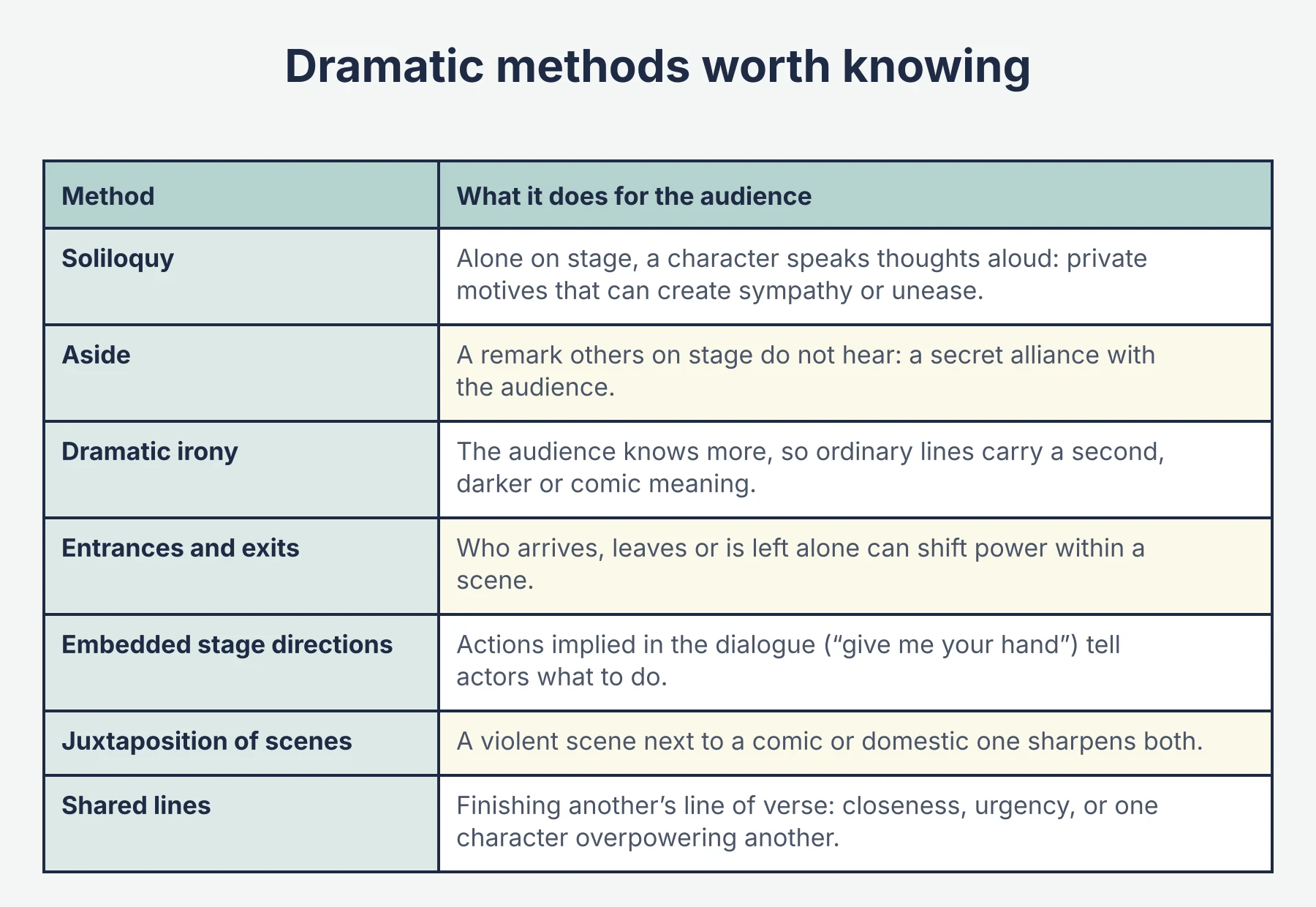
Dramatic methods worth knowing
| Method | What to say about it |
|---|---|
| Soliloquy | A character alone on stage speaks thoughts aloud. The audience hears private motives no other character knows, which can create sympathy or unease. |
| Aside | A brief remark to the audience or another character that others on stage do not hear. It builds a secret alliance with the audience. |
| Dramatic irony | The audience knows something a character does not, so ordinary lines carry a second, darker or comic meaning. |
| Entrances and exits | Who arrives or leaves at a key moment, and who is left alone, can shift power within a scene. |
| Embedded stage directions | Shakespeare’s texts contain few stage directions; actions are often implied in the dialogue (“give me your hand”), so the words tell actors what to do. |
| Juxtaposition of scenes | A violent scene followed by a comic or domestic one sharpens both through contrast. |
| Shared lines | When one character finishes another’s line of verse, it can suggest closeness, urgency or one character overpowering another. |
Verse, prose and rhyme
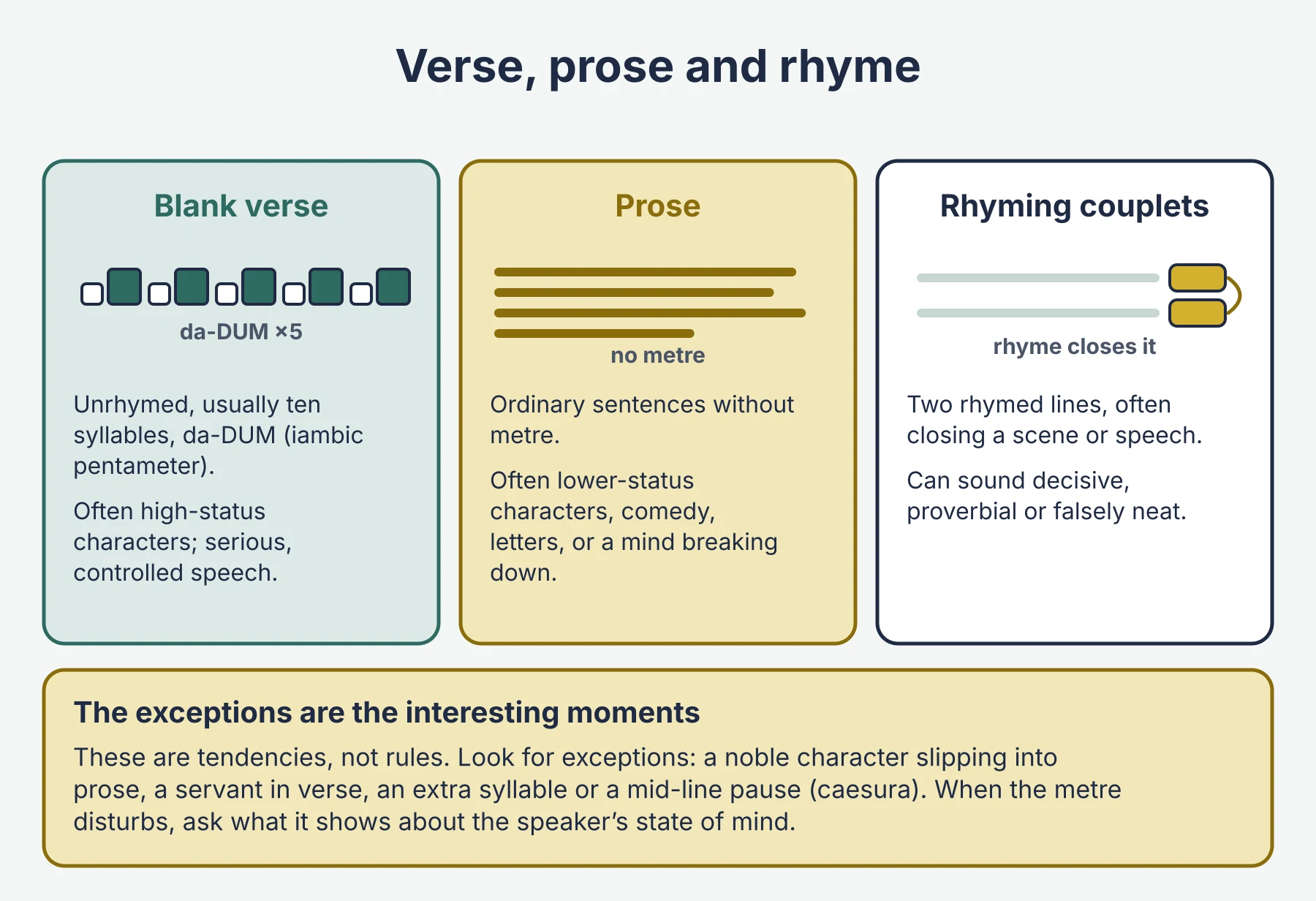
Shakespeare moves between three modes, and the movement itself is meaningful.
- Blank verse – unrhymed lines usually of ten syllables in a da-DUM pattern (iambic pentameter). It is often used by high-status characters or for serious, controlled speech.
- Prose – ordinary sentences without metre. It is often used by lower-status characters, for comedy, for letters, or for a character whose mind is breaking down.
- Rhyming couplets – two rhymed lines, often closing a scene or speech. They can sound decisive, proverbial or falsely neat.
These are tendencies, not rules. The interesting moments are the exceptions: a noble character slipping into prose, a servant speaking in verse, a regular rhythm breaking with an extra syllable or a mid-line pause (caesura). When the metre disturbs, ask what it shows about the speaker’s state of mind.
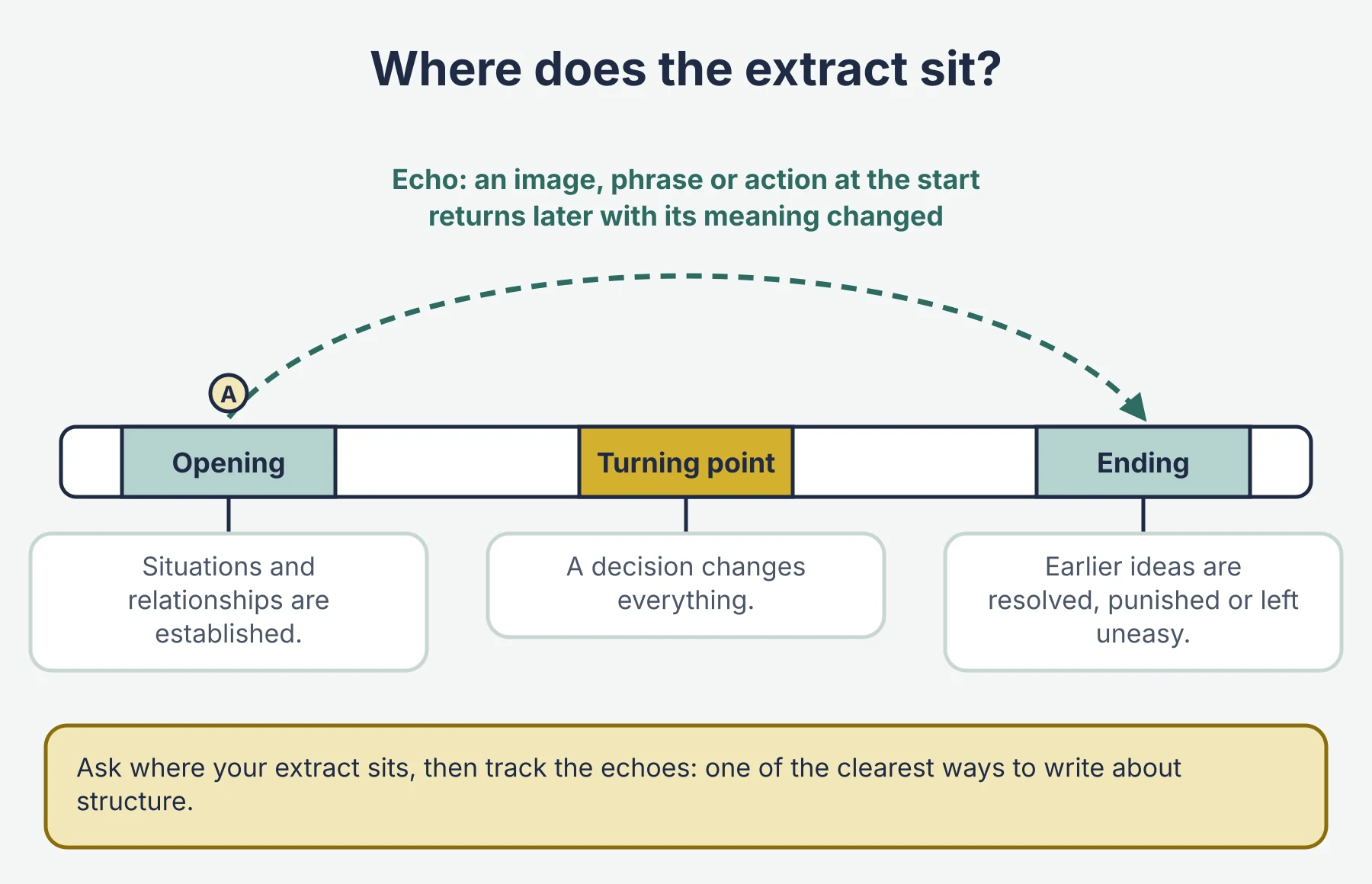
Structure across the play
Think about where your extract sits. Is it near the opening, where situations and relationships are established? Is it a turning point, where a decision changes everything? Is it close to the ending, where earlier ideas are resolved, punished or left uneasy? Plays often echo themselves: an image, phrase or action at the start returns later with its meaning changed. Tracking those echoes is one of the clearest ways to write about structure.
Context that earns credit
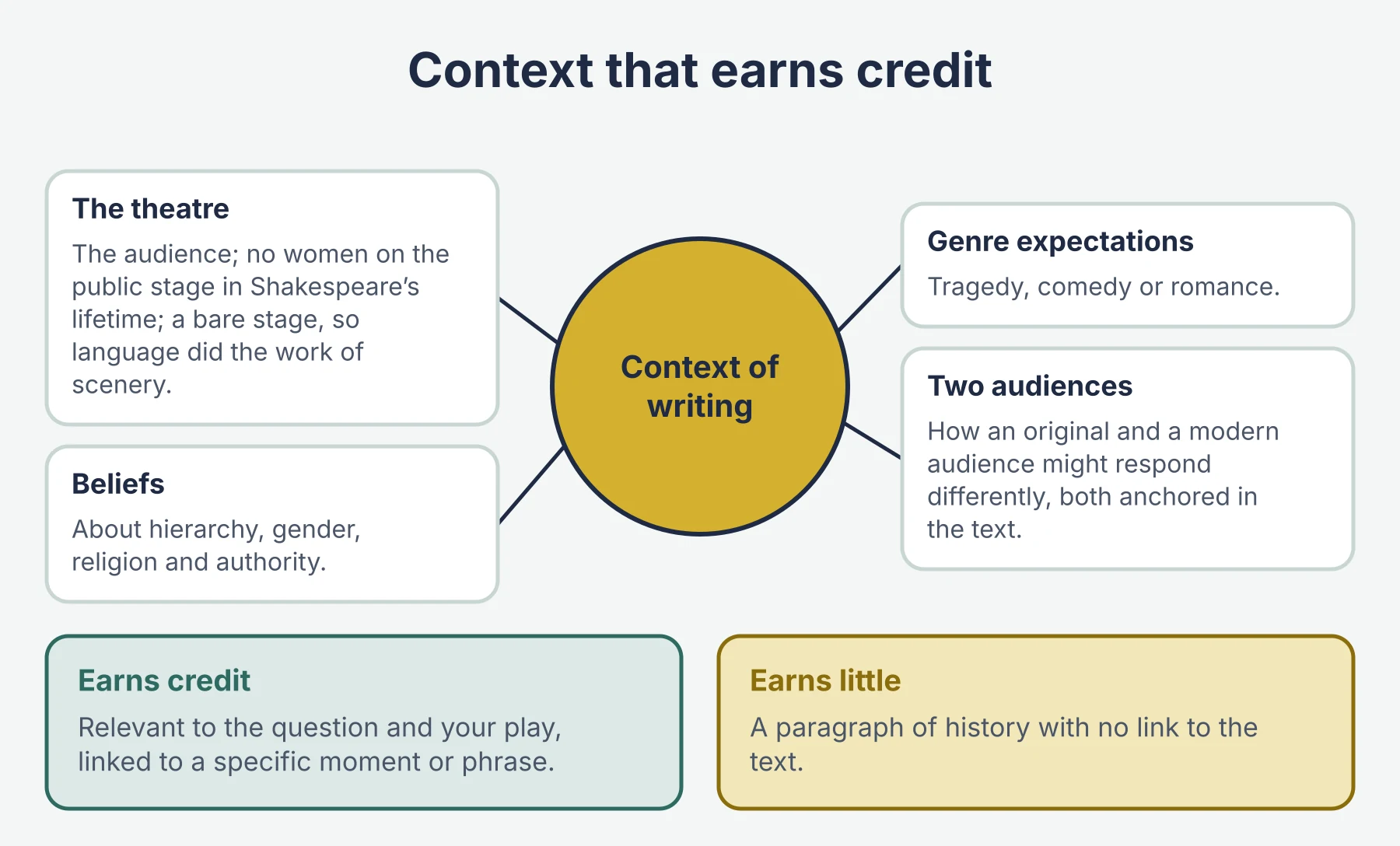
AO3 is about the relationship between the play and the context in which it was written. Useful contexts include the theatre itself (the audience, the absence of women on the public stage in Shakespeare’s lifetime, the bare stage that made language do the work of scenery), beliefs about hierarchy, gender, religion and authority, and the expectations of the genre (tragedy, comedy or romance). Use only what is relevant to the question and to your play, and link it to a specific moment. A paragraph of history with no link to the text earns little.
A strong move is to show how a modern audience and an original audience might respond differently, as long as you anchor both in what the text does.
Worked example
The passage below is original, written in the style of a Shakespeare soliloquy to model the method. It is not from a set play. A nobleman, Aldric, has just been offered his brother’s lands if he betrays him.
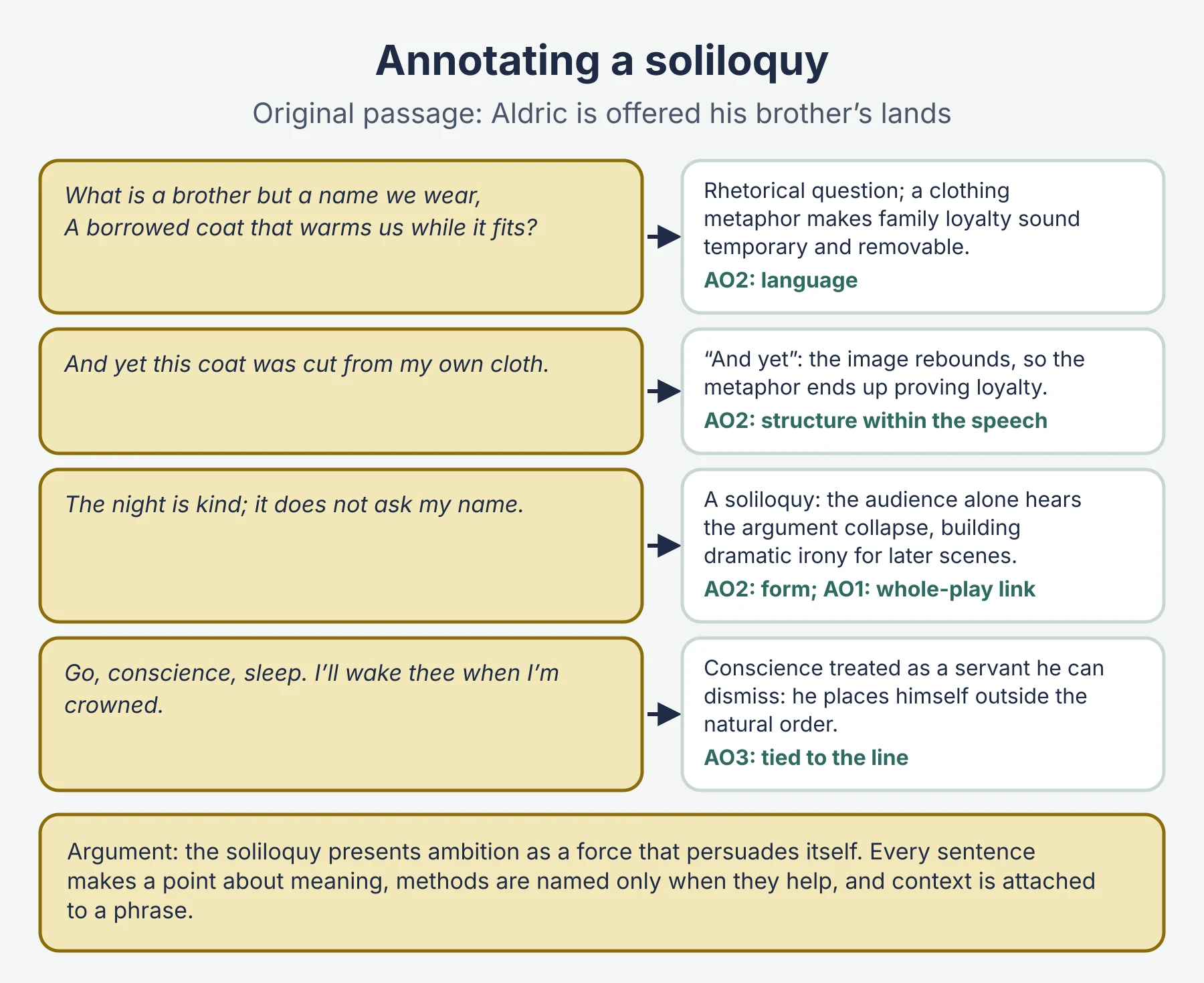
Original passage: What is a brother but a name we wear, A borrowed coat that warms us while it fits? And yet this coat was cut from my own cloth. The night is kind; it does not ask my name. Go, conscience, sleep. I’ll wake thee when I’m crowned.
Annotated model paragraph:
Aldric’s soliloquy presents ambition as a force that persuades itself. His opening rhetorical question reduces “brother” to a “name we wear”, a clothing metaphor that makes family loyalty sound temporary and removable [AO2: language]. Yet the third line turns on “And yet”, and the image rebounds on him: the coat was “cut from my own cloth”, so the metaphor he chose to dismiss loyalty ends up proving it [AO2: structure within the speech]. Because this is a soliloquy, the audience alone hears the argument collapse, which makes us complicit in his choice and builds dramatic irony for every later scene in which he greets his brother warmly [AO2: form; AO1: whole-play link]. His final command, “Go, conscience, sleep”, treats conscience as a servant he can dismiss, and an audience who believed betrayal of kin to be a sin against natural order might hear this as the moment he places himself outside that order [AO3, tied to the line].
Notice that every sentence makes a point about meaning, the method is named only when it helps, the context is attached to a specific phrase, and there is already a signal of where the argument goes next in the play.
Building the extract-to-whole-play argument
The extract is a starting point, not the whole answer. A reliable plan:
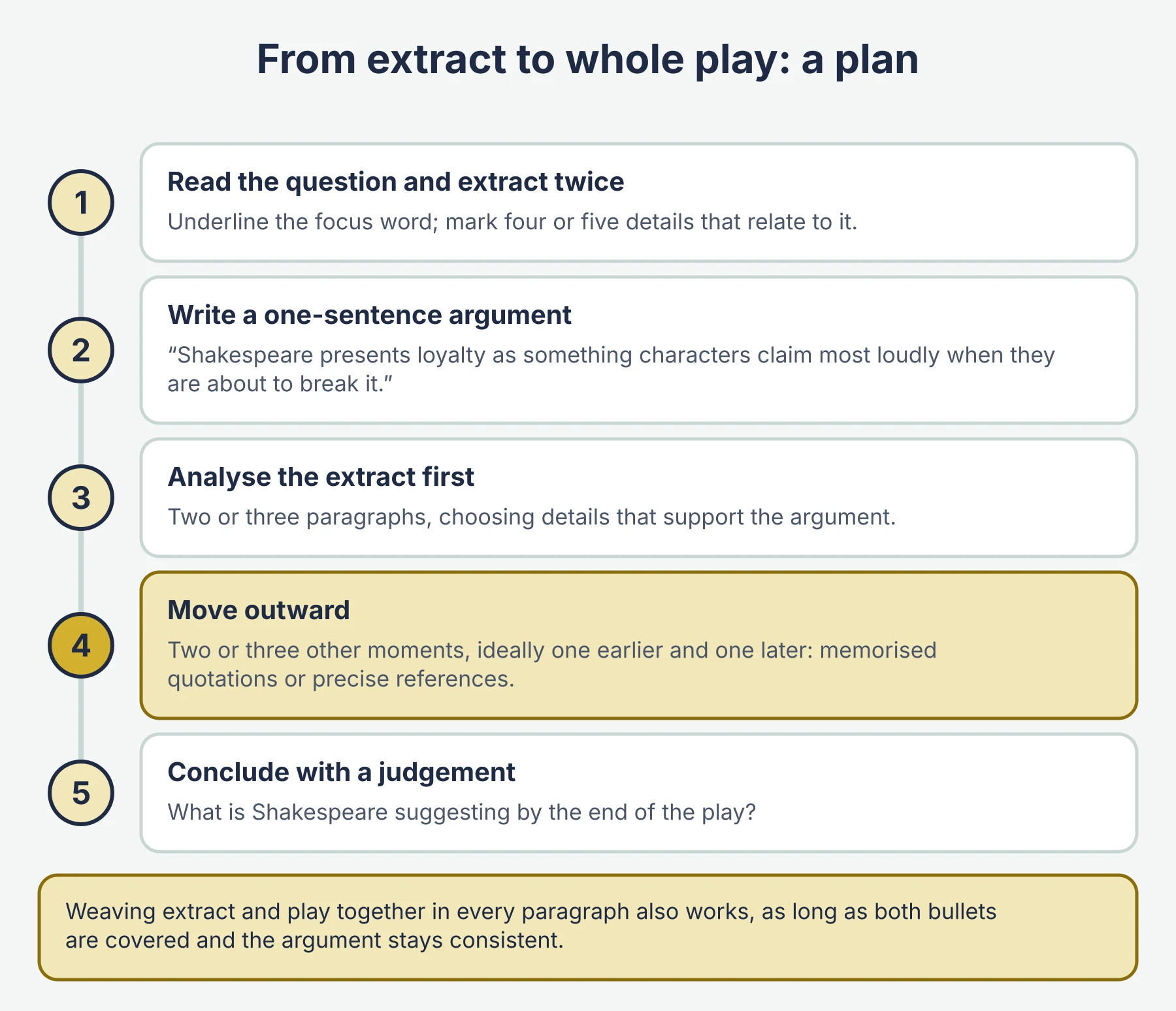
- Read the question and the extract twice. Underline the focus word (for example, “loyalty” or “fear”) and mark four or five details in the extract that relate to it.
- Write a one-sentence argument that answers the question across the play: “Shakespeare presents loyalty as something characters claim most loudly when they are about to break it.”
- Analyse the extract first, in two or three paragraphs, choosing details that support your argument.
- Move outward to two or three other moments, ideally one earlier and one later, using memorised quotations or precise references to events.
- Conclude with a judgement about what Shakespeare is suggesting by the end of the play.
Some candidates prefer to weave the extract and the wider play together in every paragraph. Either approach can reach the top levels as long as both bullet points are covered and the argument is consistent.
Common mistakes
- Treating characters as real people. Write “Shakespeare presents Aldric as…” rather than “Aldric is…”. The marks are for analysing choices.
- Spending the whole answer on the extract, or ignoring it after one paragraph.
- Feature-spotting: “There is iambic pentameter here.” Say what the rhythm, or the break in it, does.
- Plot summary of the wider play instead of analysis of selected moments.
- Bolt-on context, especially generic history unrelated to the question.
- Misquoting under pressure. A precise reference to an event is better than an invented quotation.
- Neglecting AO4. Four marks reward clear, accurate writing; spell the characters’ names and Shakespeare’s name correctly.
Exam technique
- Allow time for the question roughly in proportion to its marks: Section A carries 34 of the paper’s 64 marks, so it deserves a little over half of the 1 hour 45 minutes.
- Spend about five minutes planning; a clear line of argument raises AO1.
- Quote briefly. Single words and short phrases are easier to analyse and remember.
- Use tentative language for interpretation (“perhaps”, “may suggest”) and confident language for your overall argument.
- Refer to the audience at least once in a way that shows you are thinking about performance.
- Finish with a sentence that answers the question directly.
Revising your play
Because the exam is closed book, build revision around retrieval rather than rereading. Make a timeline of the play’s key scenes with one short quotation for each. For every major character and theme, note how they appear at the start, middle and end. Practise with random extracts: open the play at any scene, give yourself ten minutes, and plan how that extract links to the rest of the play.
More resources on this topic
- Shakespeare revision notes
- Shakespeare practice questions
- The 19th-century novel study guide
- Writing skills for literature essays
The set plays are chosen by your school from the specification’s list, which AQA can revise, so check your own text with your teacher.
Related resources
-
Practice questions
AQA GCSE English Literature (8702): Shakespeare – Practice Questions
Original Shakespeare practice for AQA GCSE English Literature 8702 Paper 1 Section A: dramatic terms, an original verse scene and full essay tasks with answers.
English Literature · AQA · GCSE
Try questions -
Revision notes
AQA GCSE English Literature (8702): Shakespeare – Revision Notes
Condensed notes on Paper 1 Section A Shakespeare for AQA GCSE English Literature 8702: dramatic terms, verse and prose, AO weighting, traps and a self-test.
English Literature · AQA · GCSE
Revise topic -
Study guides
AQA GCSE English Literature (8702): The 19th-century Novel
How to write about your 19th-century novel for AQA GCSE English Literature 8702 Paper 1 Section B: narrative methods, context and the extract essay.
English Literature · AQA · GCSE
Read guide
Get free revision emails (optional)
Occasional emails with practice questions, worked explanations and links to free resources for the qualification and subjects you choose. No spam, and you can unsubscribe from any email. The free tools on this site never need an email.