
Study Guides
AQA GCSE English Literature (8702): The 19th-century Novel
How to write about your 19th-century novel for AQA GCSE English Literature 8702 Paper 1 Section B: narrative methods, context and the extract essay.
- Subject
- English Literature
- Level
- GCSE
- Topic
- Paper 1 – Shakespeare and the 19th-century Novel
- Author
- Marlbridge Academic Team
- Updated
- Reviewed by
- Ammar Bilal (what this means)
Aligned to AQA GCSE English Literature (8702), For first teaching 2015. Official specification .
Syllabus page (what it covers and how it is assessed): AQA GCSE English Literature.
Syllabus points this page covers
8702
- 3.1.2 The 19th-century novel
Found an error? Report a correction.
Need help with this topic? Request a free trial class for GCSE English Literature (8702).
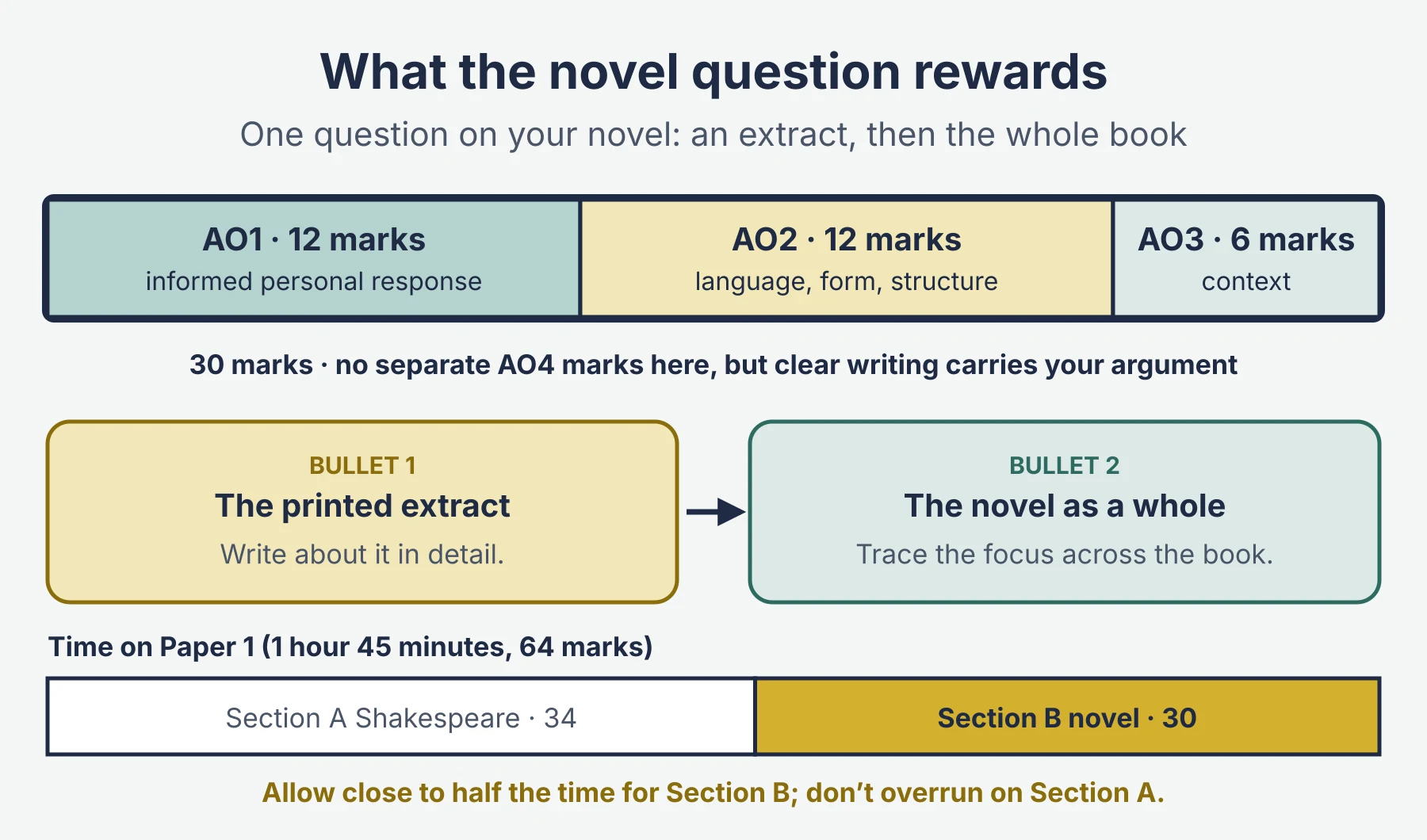
Section B of Paper 1 is the 19th-century novel question. You study one novel from the specification’s list of seven, and you study the whole text. In the exam you answer one question on your novel: an extract is printed, and you write in detail about it before writing about the novel as a whole. This guide focuses on what makes prose fiction different from drama, the narrative methods examiners expect you to analyse, and how to turn a single extract into an argument about the whole book. For the shape of the paper, see the Paper 1 overview.
What the question rewards
The question is worth 30 marks. AQA’s published mark schemes split these as AO1 12, AO2 12 and AO3 6. Unlike the Shakespeare question, there are no separate AO4 marks here, but clear writing still matters because it carries your argument.
- AO1 – a critical, informed personal response that answers the question, with apt references.
- AO2 – analysis of the writer’s language, form and structure, using terminology where it helps.
- AO3 – understanding of the relationship between the novel and the context in which it was written.
The wording follows the Shakespeare pattern: “Starting with this extract, explore how [the writer] presents…” with one bullet for the extract and one for the novel as a whole. Use the writer’s name throughout.
What makes a novel different
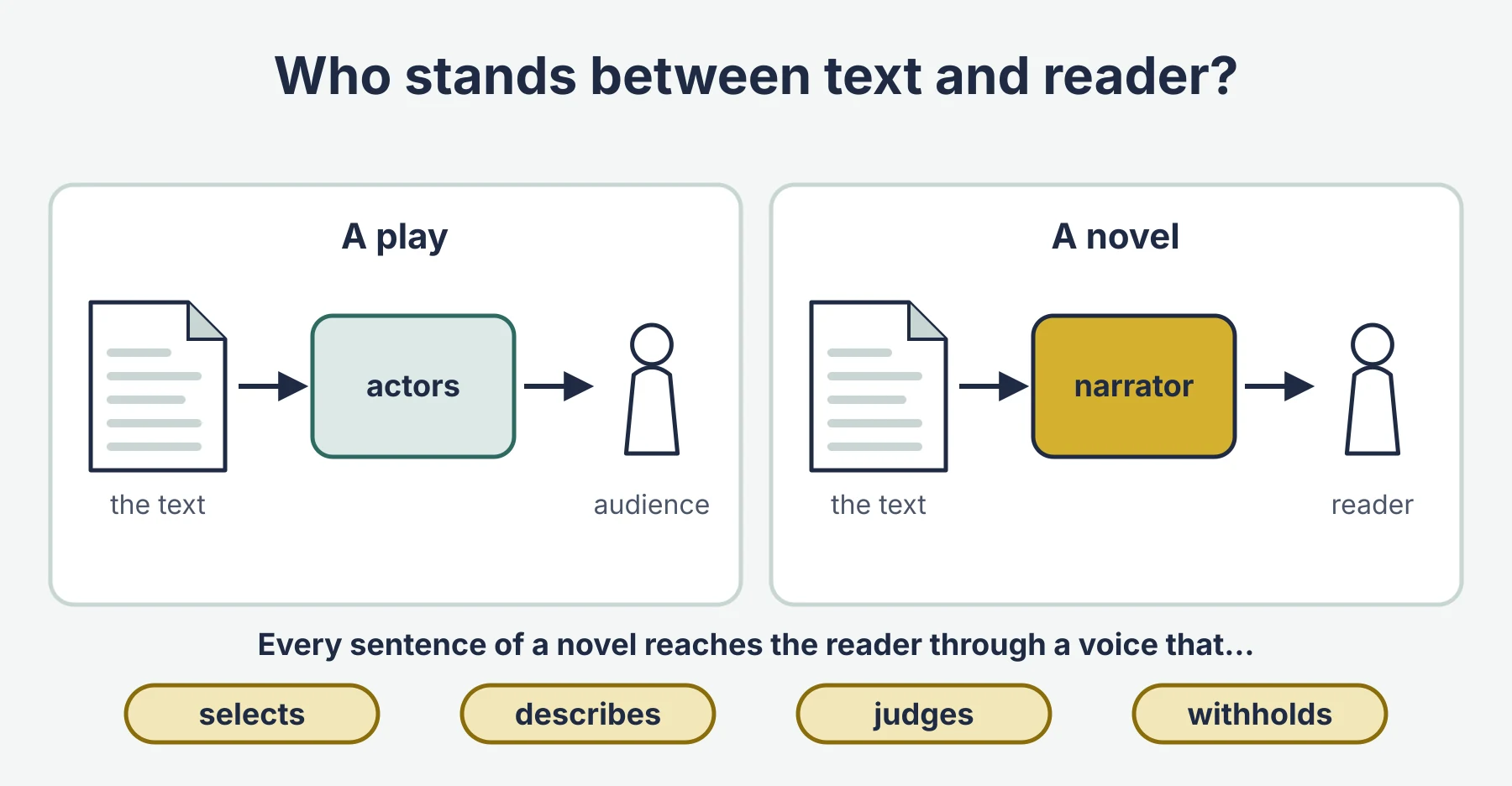
A play is mediated by actors; a novel is mediated by a narrator. Every sentence reaches the reader through a voice that selects, describes, judges and withholds. That gives you methods to analyse that do not exist in the same way in drama.
Narrative voice and viewpoint
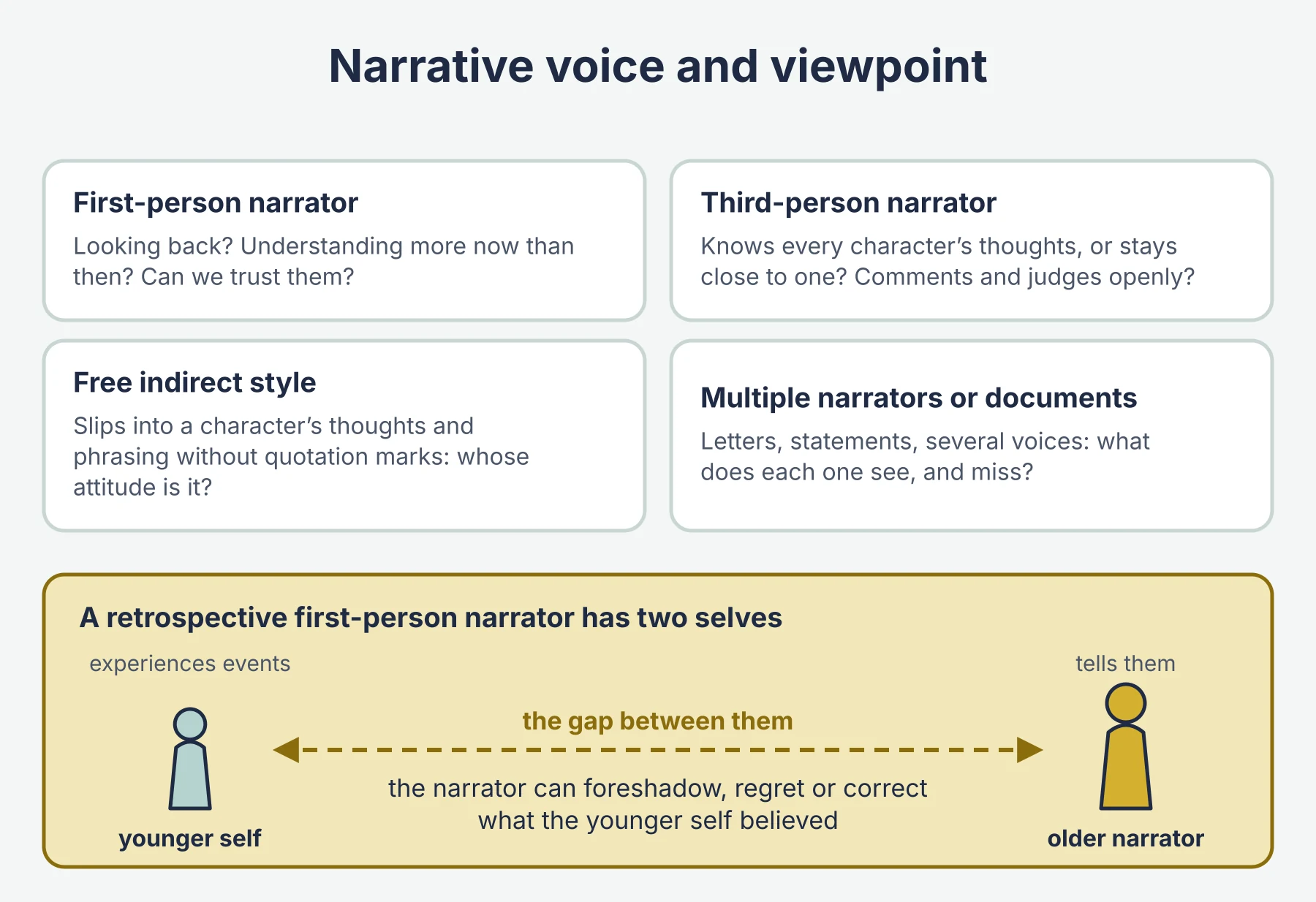
| Method | Questions to ask |
|---|---|
| First-person narrator | Is the narrator looking back on events? Do they understand more now than they did then? Can we trust them? |
| Third-person narrator | Does the narrator know every character’s thoughts, or stay close to one? Do they comment and judge openly? |
| Free indirect style | Does the narrative slip into a character’s own thoughts and phrasing without quotation marks? Whose attitude is the sentence really expressing? |
| Multiple narrators or documents | Does the story come through letters, statements or several voices? What does each one see, and what does each miss? |
A retrospective first-person narrator creates two selves: the younger character experiencing events and the older narrator telling them. Gaps between the two are rich for analysis, because the narrator can foreshadow, regret or correct what the younger self believed.
Language at sentence level
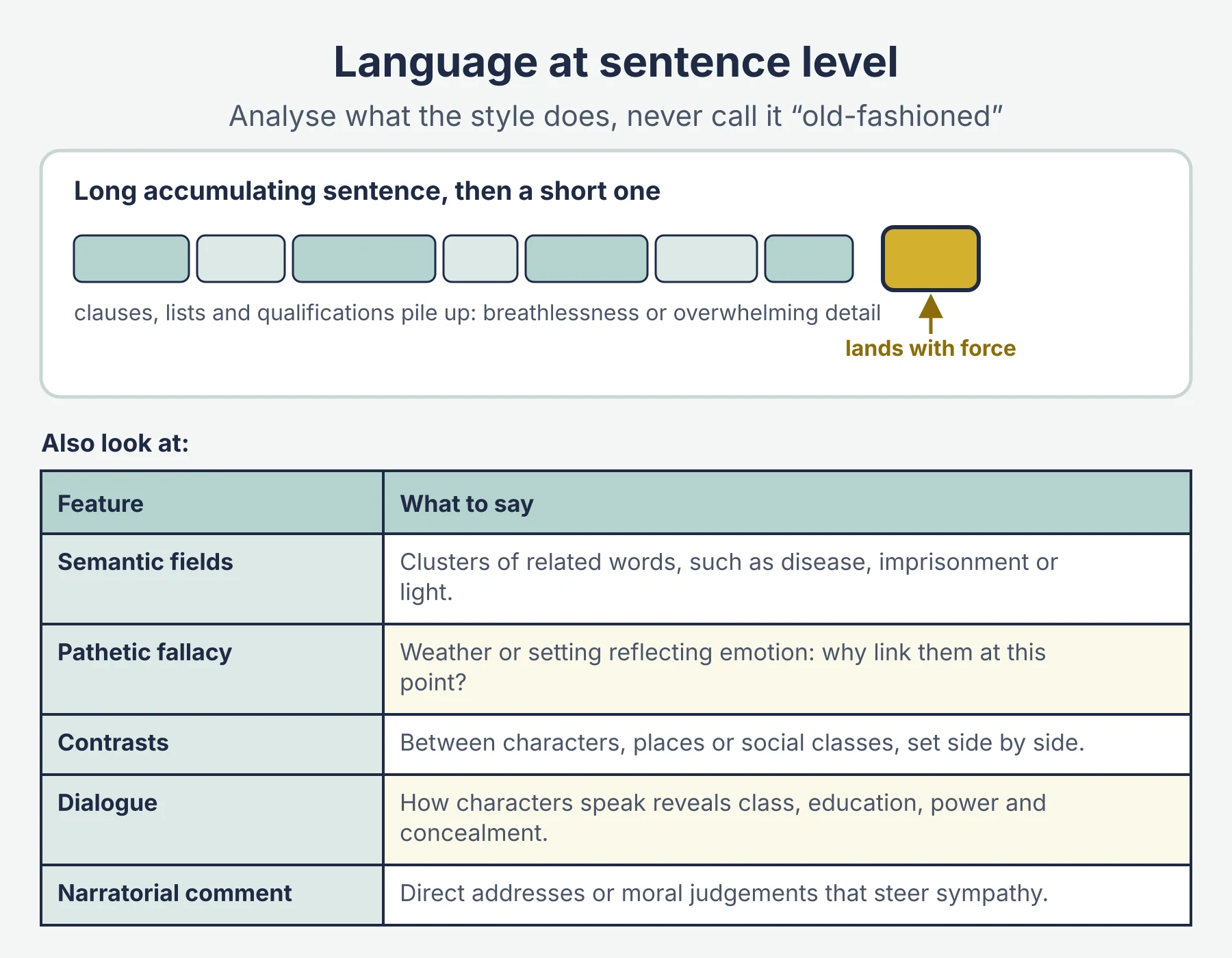
Nineteenth-century prose often uses long sentences built from clauses, lists and qualifications. Rather than calling the style “old-fashioned”, analyse what it does. A long, accumulating sentence can create breathlessness or overwhelming detail; a sudden short sentence after it lands with force. Look at:
- Semantic fields – clusters of related words, such as disease, imprisonment or light.
- Pathetic fallacy – weather or setting reflecting emotion. Say why the writer links them at this point.
- Contrasts – between characters, places or social classes, often set side by side.
- Dialogue – how characters speak reveals class, education, power and concealment.
- Narratorial comment – direct addresses to the reader or moral judgements, which steer the reader’s sympathy.
Structure across the novel
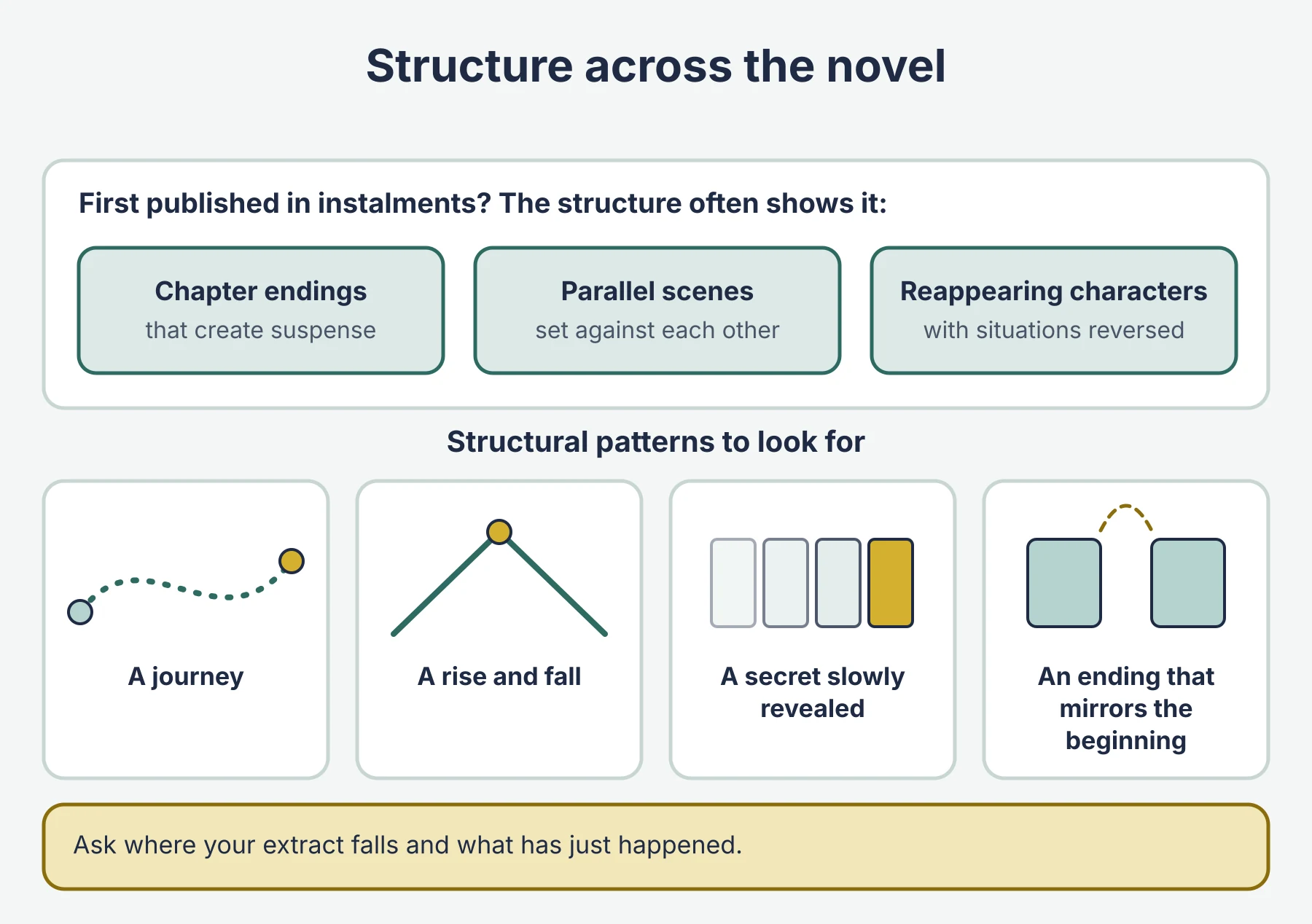
Many Victorian novels were first published in instalments, and their structure often shows it: chapter endings that create suspense, parallel scenes, and characters who reappear with their situations reversed. Ask where your extract falls and what has just happened. Look for the novel’s structural patterns: a journey, a rise and fall, a secret slowly revealed, a beginning that the ending mirrors.
Context that earns credit
The nineteenth century spans the Regency and the Victorian periods, so the relevant context depends on when your novel was written. Possible areas include class and money, the position of women and marriage, childhood and education, poverty and the industrial city, religion and science, and attitudes to respectability and reputation. Context earns marks when it explains a choice the writer made. Ask: what might the novel’s first readers have expected, and how does the writer meet, exploit or challenge that expectation?
Worked example
The passage below is original, written in a 19th-century style to model the method. It is not from a set novel.
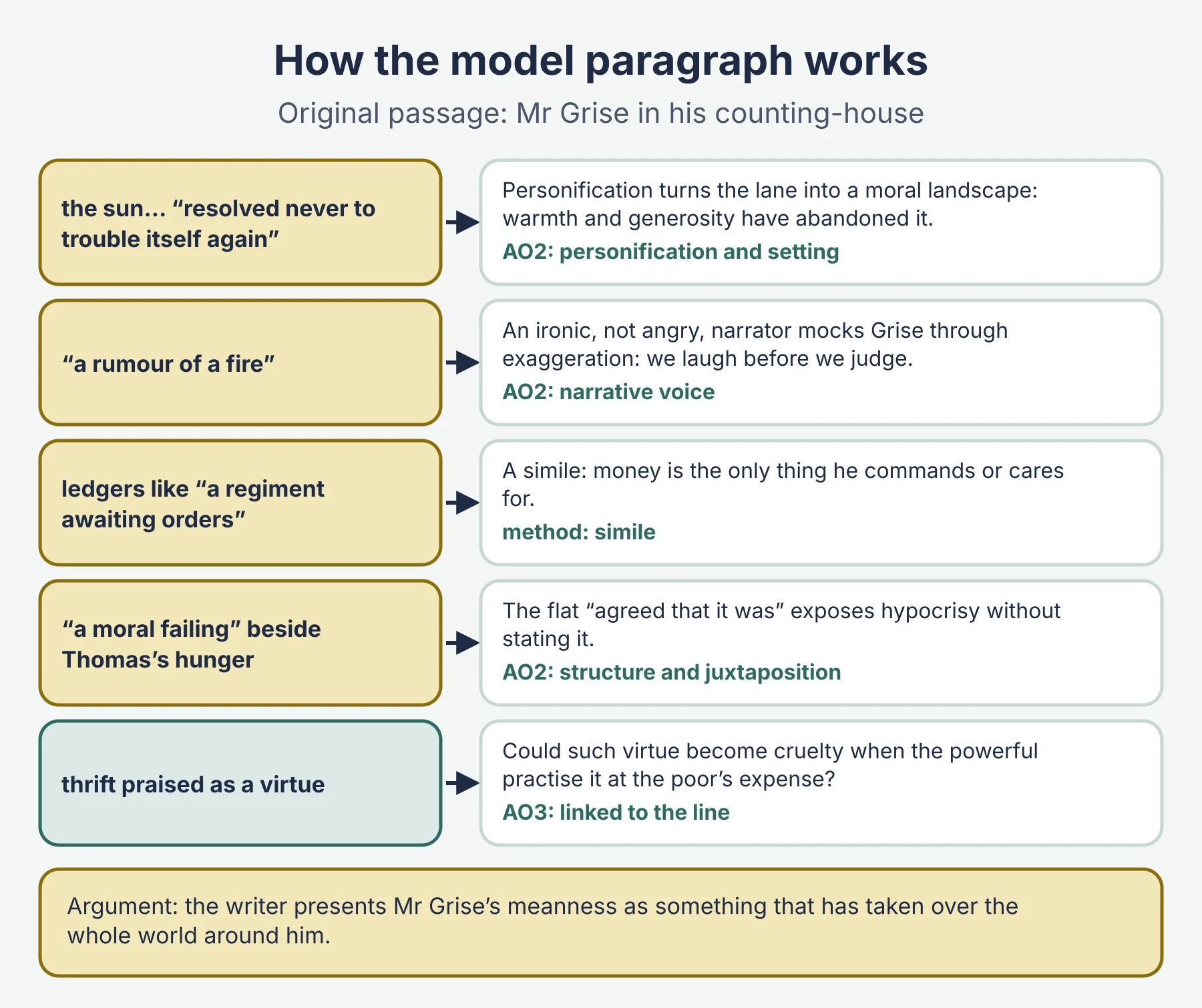
Original passage: The counting-house stood at the bottom of a lane so narrow that the sun, having once looked down it, seemed resolved never to trouble itself again. Within, Mr Grise sat as he had sat for thirty years, with his ledgers ranged before him like a regiment awaiting orders, and his fire kept so small that it might have been a rumour of a fire rather than the thing itself. “Waste,” he observed to his clerk, who was attempting to warm his fingers upon his own breath, “is a moral failing, Thomas.” Thomas, who had not eaten since morning, agreed that it was.
Annotated model paragraph:
The writer presents Mr Grise’s meanness as something that has taken over the whole world around him. Even the sun is personified as having “resolved never to trouble itself again”, which turns the dark lane into a moral landscape: warmth and generosity have abandoned the place where he works [AO2: personification and setting]. The narrator’s tone is ironic rather than angry; describing the fire as “a rumour of a fire” mocks Grise through exaggeration, inviting the reader to laugh at him before judging him [AO2: narrative voice]. The simile comparing his ledgers to “a regiment awaiting orders” suggests that money is the only thing he commands or cares for. The final sentence places Grise’s pious claim that waste is “a moral failing” directly beside Thomas’s hunger, and the narrator’s flat “agreed that it was” exposes the hypocrisy without stating it [AO2: structure and juxtaposition]. For readers in an age when respectable thrift was often praised as a virtue, this contrast questions whether such virtue could become cruelty when the powerful practised it at the expense of the poor [AO3, linked to the line].
Building the extract-to-whole-novel argument
- Read the extract with the question in mind. Mark details that link to the focus and note where the extract sits in the novel.
- Decide your argument across the whole novel, for example “[The writer] presents ambition as a force that isolates characters, until…” Your sentence should promise development, not just a label.
- Analyse the extract closely, narrating less and interpreting more.
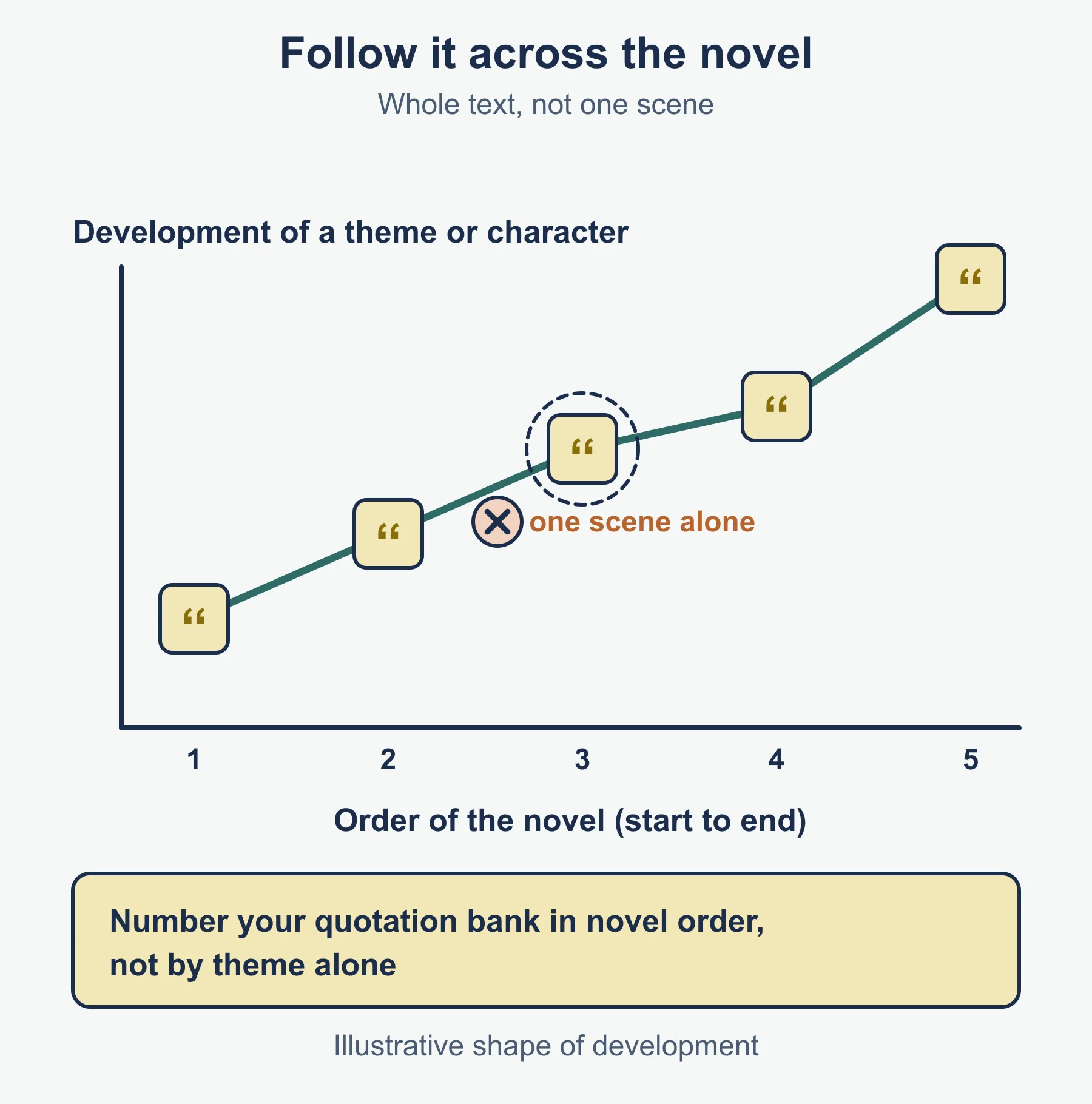
- Trace the focus through the novel at two or three other points. A chronological bank of short quotations makes this possible from memory.
- End with what the writer is suggesting by the ending of the novel.
Common mistakes
- Summarising the extract line by line instead of selecting details.
- Ignoring the narrator. “The writer describes” misses who is speaking and how they shape our view.
- Calling the style “old-fashioned” instead of analysing a specific sentence.
- Treating context as a history lesson rather than an explanation of a choice.
- Covering only one moment of the novel, so there is no sense of development.
- Spending too long on Section A and arriving at Section B with too little time for 30 marks.
Exam technique
- Section B carries 30 of the paper’s 64 marks, so allow close to half of the 1 hour 45 minutes.
- Read the extract’s introduction line, which usually tells you where it falls in the novel.
- Quote short phrases from the extract; for the wider novel, precise references to events are acceptable if you cannot remember exact words.
- Use the narrator in your analysis at least once: “The narrator’s ironic tone…”
- Keep returning to the question’s key word so the argument stays on focus.
- Finish with a clear judgement about the writer’s purpose.
Revising your novel
Build a chronological quotation bank: for each chapter group, one short quotation linked to a theme and a character. Practise “zooming out”: choose any page, then name one earlier and one later moment that it echoes or contrasts with. Summarise each main character’s arc in one sentence, and note where the narrator’s attitude to them is clearest.
More resources on this topic
- The 19th-century novel revision notes
- The 19th-century novel practice questions
- Shakespeare study guide
- Reading comprehension and reading critically
Your school chooses the set novel from the specification’s list, which AQA can change, so check your own text with your teacher.
Related resources
-
Practice questions
AQA GCSE English Literature (8702): The 19th-century Novel – Practice Questions
Original 19th-century novel practice for AQA GCSE English Literature 8702 Paper 1 Section B: an original extract and essay tasks with answers.
English Literature · AQA · GCSE
Try questions -
Revision notes
AQA GCSE English Literature (8702): The 19th-century Novel – Revision Notes
Condensed notes on the 19th-century novel question in AQA GCSE English Literature 8702 Paper 1: narrative terms, marks, context prompts, traps and a self-test.
English Literature · AQA · GCSE
Revise topic -
Study guides
AQA GCSE English Literature: Shakespeare and the 19th-Century Novel (8702)
Shakespeare and the 19th-century novel – the full paper structure of Paper 1 for AQA GCSE English Literature (8702), an untiered, closed-book qualification.
English Literature · AQA · GCSE
Read guide
Get free revision emails (optional)
Occasional emails with practice questions, worked explanations and links to free resources for the qualification and subjects you choose. No spam, and you can unsubscribe from any email. The free tools on this site never need an email.