
Revision Notes
AQA GCSE English Literature (8702): Shakespeare – Revision Notes
Condensed notes on Paper 1 Section A Shakespeare for AQA GCSE English Literature 8702: dramatic terms, verse and prose, AO weighting, traps and a self-test.
- Subject
- English Literature
- Level
- GCSE
- Topic
- Paper 1 – Shakespeare and the 19th-century Novel
- Author
- Marlbridge Academic Team
- Updated
- Reviewed by
- Ammar Bilal (what this means)
Aligned to AQA GCSE English Literature (8702), For first teaching 2015. Official specification .
Syllabus page (what it covers and how it is assessed): AQA GCSE English Literature.
Syllabus points this page covers
8702
- 3.1.1 Shakespeare
Found an error? Report a correction.
Need help with this topic? Request a free trial class for GCSE English Literature (8702).
Quick-recall notes for the Shakespeare question. For the full method with a worked paragraph, use the Shakespeare study guide.
The task in one view
| Feature | Detail |
|---|---|
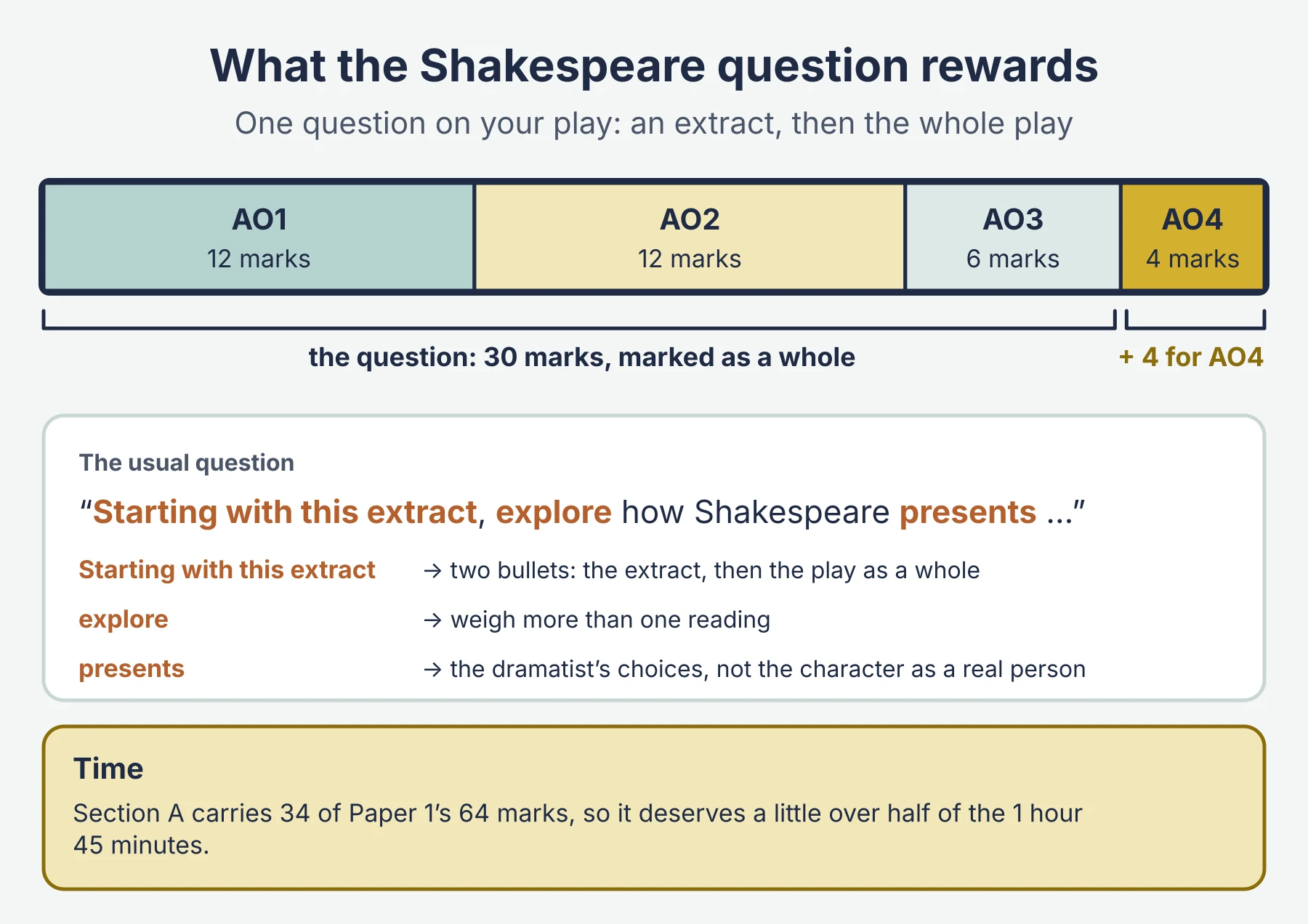
| Text | One play from the specification’s list of six, studied as a whole |
| Question | One question on your play; an extract is printed |
| What you do | Write in detail about the extract, then about the play as a whole |
| Marks | 30, plus 4 for AO4 (34 of Paper 1’s 64) |
| Split in AQA mark schemes | AO1 12, AO2 12, AO3 6, then AO4 4 |
| Book | Closed: quotations from the wider play come from memory |
Core recall
- “Presents” means focus on Shakespeare’s choices. Name the dramatist as the agent of every effect.
- “Explore” rewards more than one possible reading and a developing argument.
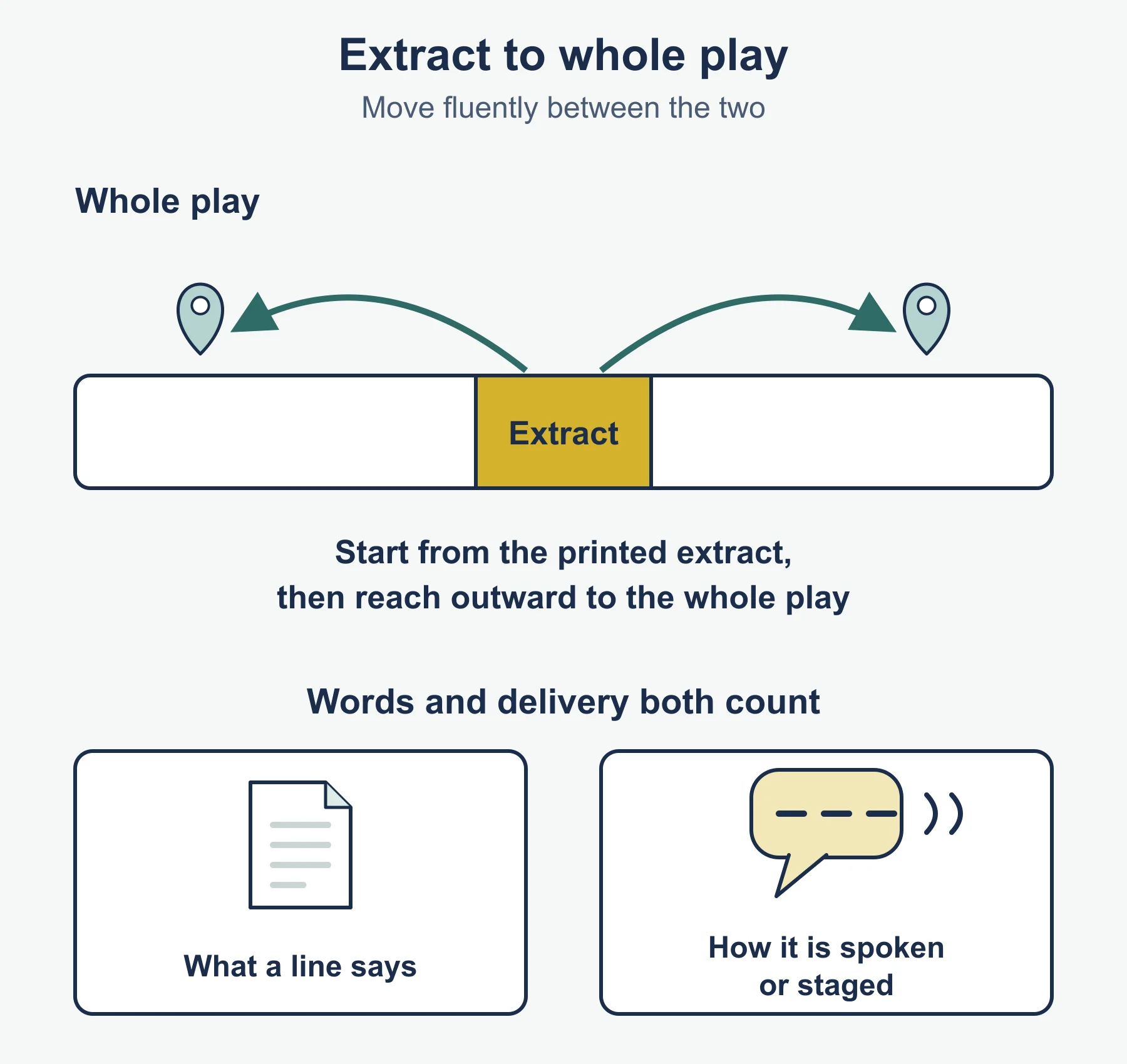
- The extract shows close analysis; the whole play shows development. Both bullets must be answered.
- Drama, not novel. Think about what an audience sees and hears: who is on stage, who speaks, who stays silent, who exits.
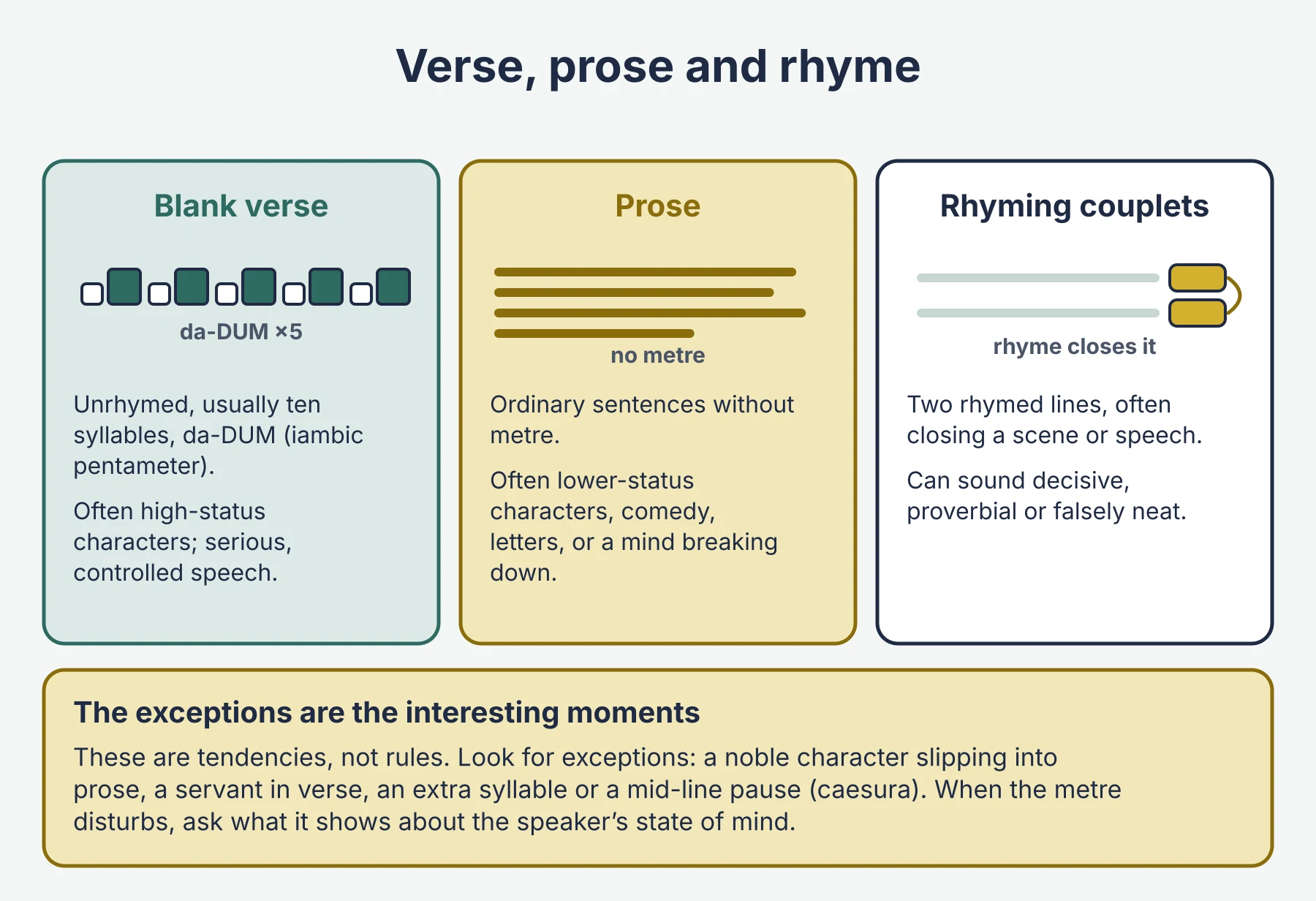
- Metre carries meaning. Iambic pentameter is a ten-syllable da-DUM line. A broken, shared or irregular line often marks tension, interruption or loss of control.
- Mode switches matter. Verse for formal or high-status speech, prose for comedy, low status, letters or madness, couplets to close a scene. A switch is often the most analysable moment in an extract.
- Context belongs inside analysis. Attach a contextual point to a specific line, and only if it explains why that line matters.
Key terms
| Term | Meaning | Why it matters in an answer |
|---|---|---|
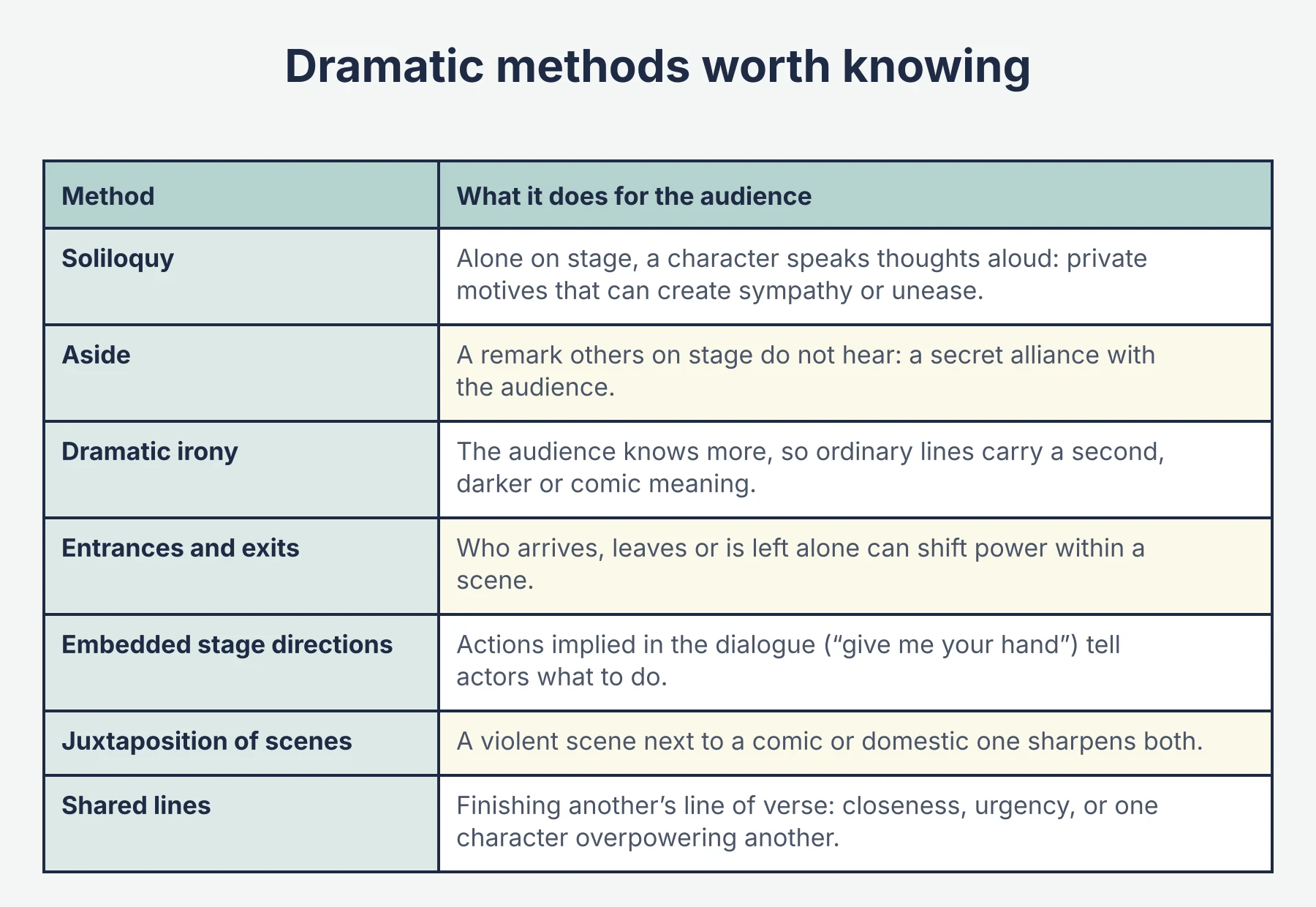
| Soliloquy | Speech by a character alone on stage | Private motive revealed to the audience only |
| Aside | Remark unheard by other characters | Audience becomes a confidant; creates irony |
| Dramatic irony | Audience knows more than a character | Lines gain a second meaning |
| Blank verse | Unrhymed iambic pentameter | Control, status, seriousness |
| Caesura | Pause in the middle of a line | Hesitation, shock, a turn in thought |
| Enjambment | Sense runs over the line ending | Urgency, overflowing feeling |
| Stichomythia | Rapid exchange of single lines | Conflict, wit, rising tension |
| Hamartia | A fatal flaw or error in a tragic hero | Responsibility and downfall |
| Foil | Character who contrasts with another | Highlights the other’s qualities |
| Foreshadowing | Hint of later events | Structure; tension; inevitability |
| Motif | Repeated image or idea | Tracks a theme across the whole play |
| Embedded stage direction | Action implied in dialogue | Shows awareness of performance |
Planning in five minutes
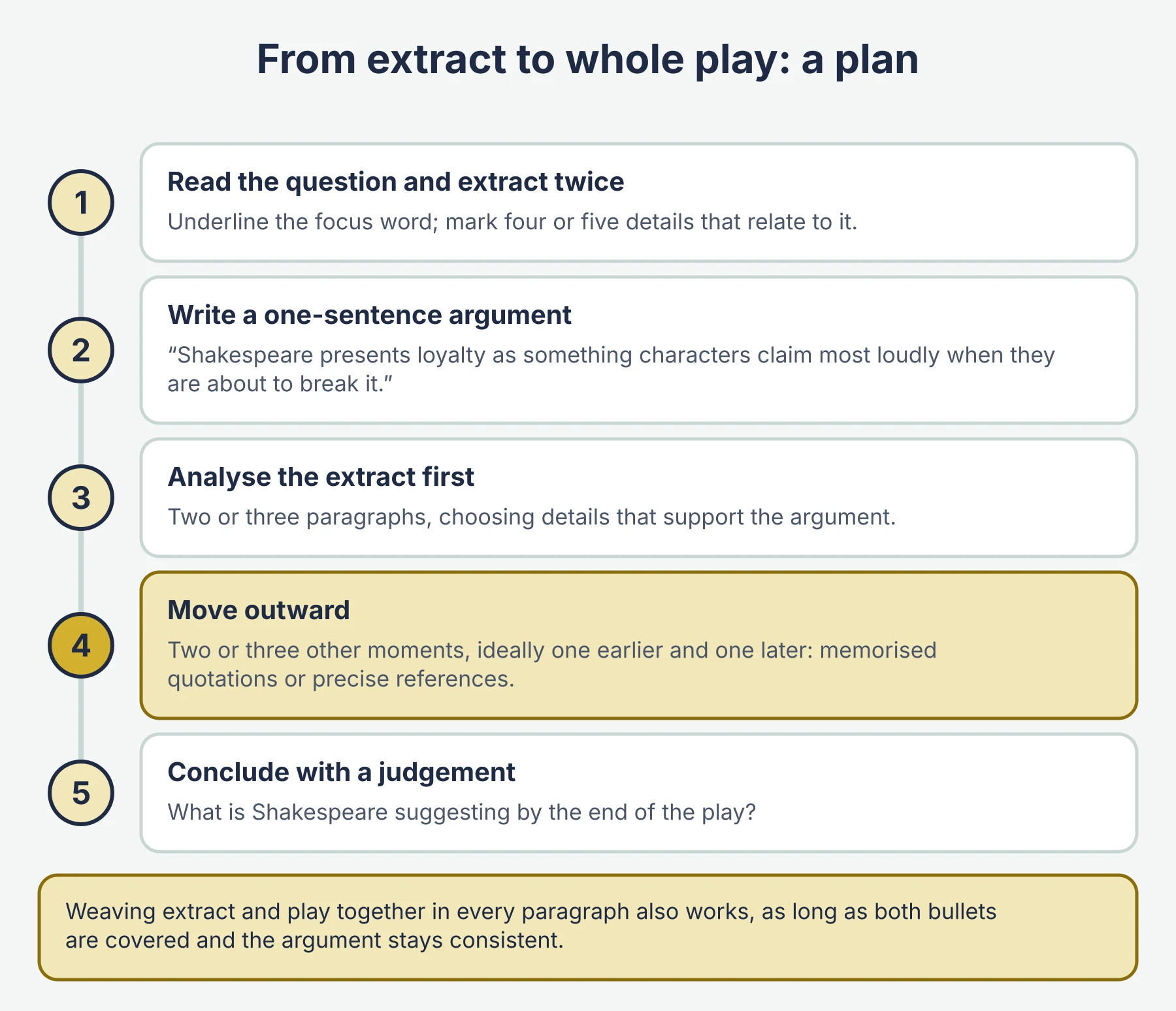
- Circle the focus word in the question.
- Annotate four or five details in the extract linked to it.
- Write a one-line argument covering the whole play.
- List two or three other moments, ideally one earlier and one later, each with a short quotation or precise event.
- Choose one context point that fits a specific moment.
Paragraph checklist
- Topic sentence that answers the question.
- Short embedded quotation, or a precise reference to an event.
- Analysis of a method: a word, an image, the metre, the scene’s structure, a stage action.
- Effect on the audience, with a second reading if one exists.
- Link to the play as a whole or to context, where relevant.
Exam traps
- Writing about the extract alone. The question has two bullets, and an answer that covers only one cannot show the whole-text knowledge the task asks for.
- Writing about the play alone. Starting outside the extract ignores the first bullet.
- Character as a real person. “She feels guilty” is weaker than “Shakespeare presents her guilt through…”.
- Naming techniques without effects. “Shakespeare uses a metaphor” earns little on its own.
- Long quotations. Copying several lines wastes time and shows less analysis than two well-chosen words.
- Generic history. A paragraph about the period that does not explain the line in front of you.
- Forgetting AO4. Spelling, punctuation and sentence variety earn 4 marks here and nowhere else on Paper 1.
- Overrunning. This question carries just over half the paper’s marks; leave enough time for the novel in Section B.
Context prompts
Use whichever fits your play and question:
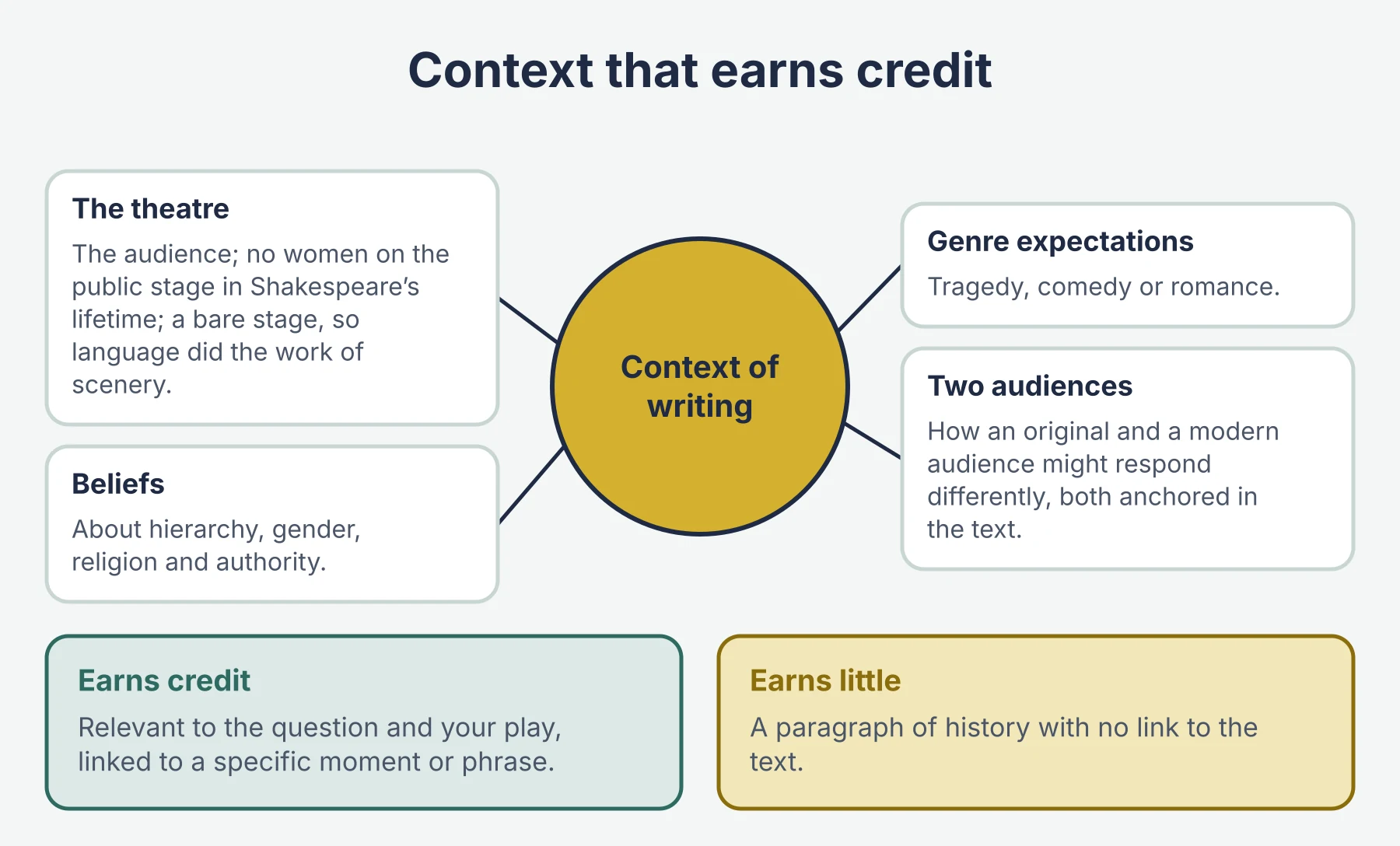
- The original audience: mixed classes standing and seated, used to listening closely to language because the stage had little scenery.
- Female roles played by boys or young men, since women did not act on the public stage in Shakespeare’s lifetime.
- Beliefs about order: monarch and subject, parent and child, husband and wife.
- Religion and the supernatural, where the play uses them.
- Genre expectations: a tragedy moves towards death and loss; a comedy towards marriage and reconciliation, often with darker undertones.
Self-test
- What two things does the Shakespeare question ask you to write about?
- How many marks are available, including AO4?
- What is the difference between a soliloquy and an aside?
- What is iambic pentameter?
- Give two reasons a character might speak in prose.
- What might a rhyming couplet at the end of a scene suggest?
- What does a caesura in the middle of a line often show?
- Why should you write “Shakespeare presents…” rather than describe a character directly?
- Name two kinds of context that could be relevant to a Shakespeare play.
- How should you divide your time between the extract and the rest of the play?
- Which assessment objective covers spelling and punctuation, and is it assessed in Section B?
- What is dramatic irony and why is it useful in an answer?
Answers
- The extract in detail, and the play as a whole.
- 30 marks plus 4 for AO4, making 34.
- A soliloquy is spoken by a character alone on stage; an aside is a brief remark that other characters present on stage do not hear.
- A line of verse with ten syllables in five unstressed-stressed pairs (da-DUM).
- Any two of: lower social status, comedy, letters or documents, a breakdown in the character’s mind, informal or intimate conversation.
- Closure, a decisive or proverbial conclusion, or a neatness that the audience may distrust.
- Hesitation, shock, a change of direction in thought, or emotion interrupting speech.
- Because the marks are for analysing the writer’s choices, not for treating characters as real people.
- Any two of: the theatre and its audience, all-male casting, beliefs about hierarchy, gender, religion or the supernatural, genre expectations.
- Give both real weight; roughly balanced, with enough on the extract to analyse closely and enough on the wider play to show development.
- AO4. No: on Paper 1 it is assessed only in Section A, the Shakespeare question.
- The audience knows something a character does not, so lines carry a second meaning; it lets you discuss audience response and structure together.
More resources on this topic
Related resources
-
Study guides
AQA GCSE English Literature (8702): The 19th-century Novel
How to write about your 19th-century novel for AQA GCSE English Literature 8702 Paper 1 Section B: narrative methods, context and the extract essay.
English Literature · AQA · GCSE
Read guide -
Practice questions
AQA GCSE English Literature (8702): The 19th-century Novel – Practice Questions
Original 19th-century novel practice for AQA GCSE English Literature 8702 Paper 1 Section B: an original extract and essay tasks with answers.
English Literature · AQA · GCSE
Try questions -
Revision notes
AQA GCSE English Literature (8702): The 19th-century Novel – Revision Notes
Condensed notes on the 19th-century novel question in AQA GCSE English Literature 8702 Paper 1: narrative terms, marks, context prompts, traps and a self-test.
English Literature · AQA · GCSE
Revise topic
Get free revision emails (optional)
Occasional emails with practice questions, worked explanations and links to free resources for the qualification and subjects you choose. No spam, and you can unsubscribe from any email. The free tools on this site never need an email.