
Revision Notes
AQA GCSE English Literature (8702): The 19th-century Novel – Revision Notes
Condensed notes on the 19th-century novel question in AQA GCSE English Literature 8702 Paper 1: narrative terms, marks, context prompts, traps and a self-test.
- Subject
- English Literature
- Level
- GCSE
- Topic
- Paper 1 – Shakespeare and the 19th-century Novel
- Author
- Marlbridge Academic Team
- Updated
- Reviewed by
- Ammar Bilal (what this means)
Aligned to AQA GCSE English Literature (8702), For first teaching 2015. Official specification .
Syllabus page (what it covers and how it is assessed): AQA GCSE English Literature.
Syllabus points this page covers
8702
- 3.1.2 The 19th-century novel
Found an error? Report a correction.
Need help with this topic? Request a free trial class for GCSE English Literature (8702).
Quick-recall notes for Section B of Paper 1. The full method, with an annotated model paragraph, is in the 19th-century novel study guide.
The task in one view
| Feature | Detail |
|---|---|
| Text | One novel from the specification’s list of seven, studied as a whole |
| Question | One question on your novel; an extract is printed |
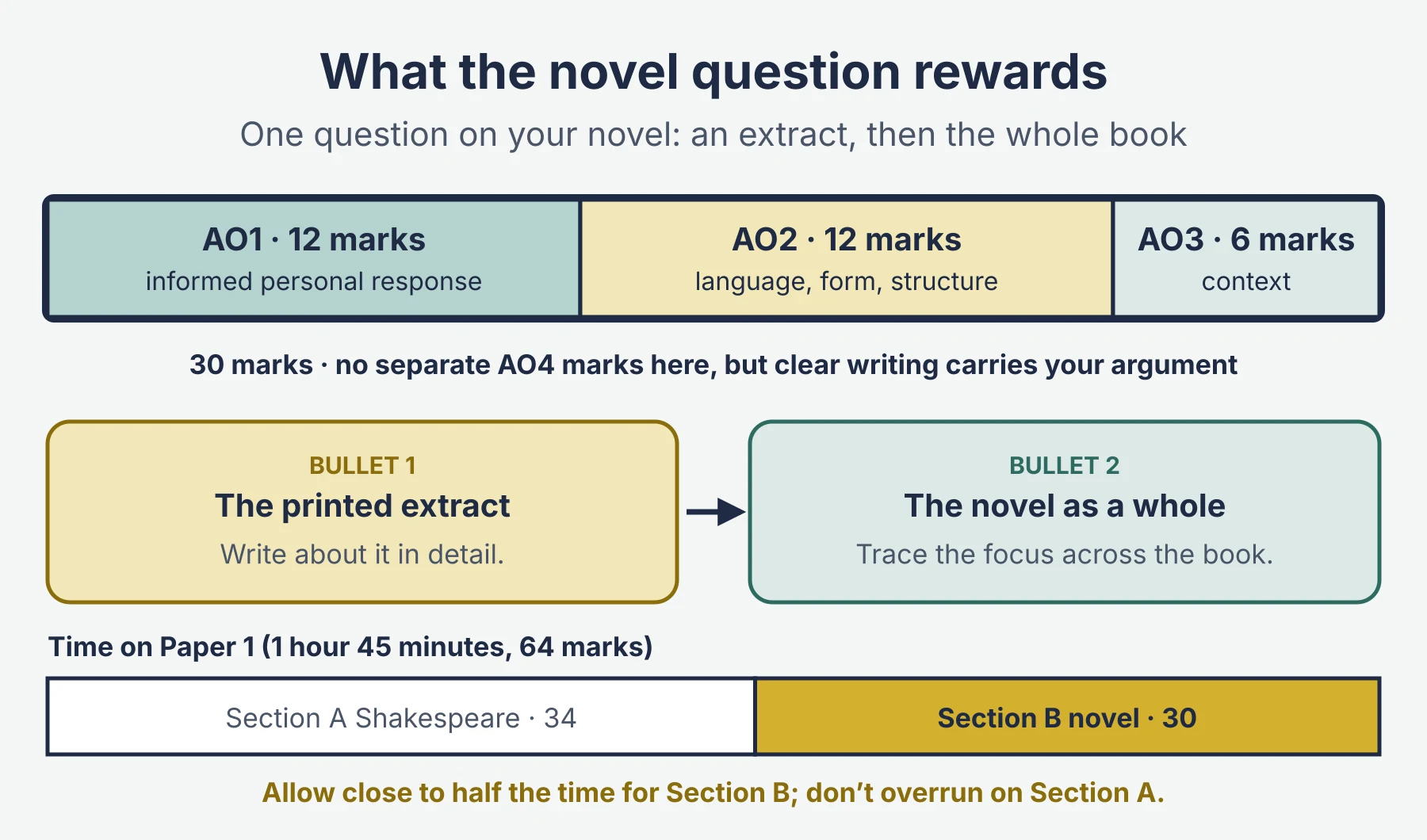
| What you do | Write in detail about the extract, then about the novel as a whole |
| Marks | 30 (no separate AO4 marks in this section) |
| Split in AQA mark schemes | AO1 12, AO2 12, AO3 6 |
| Book | Closed: references to the rest of the novel come from memory |
Core recall
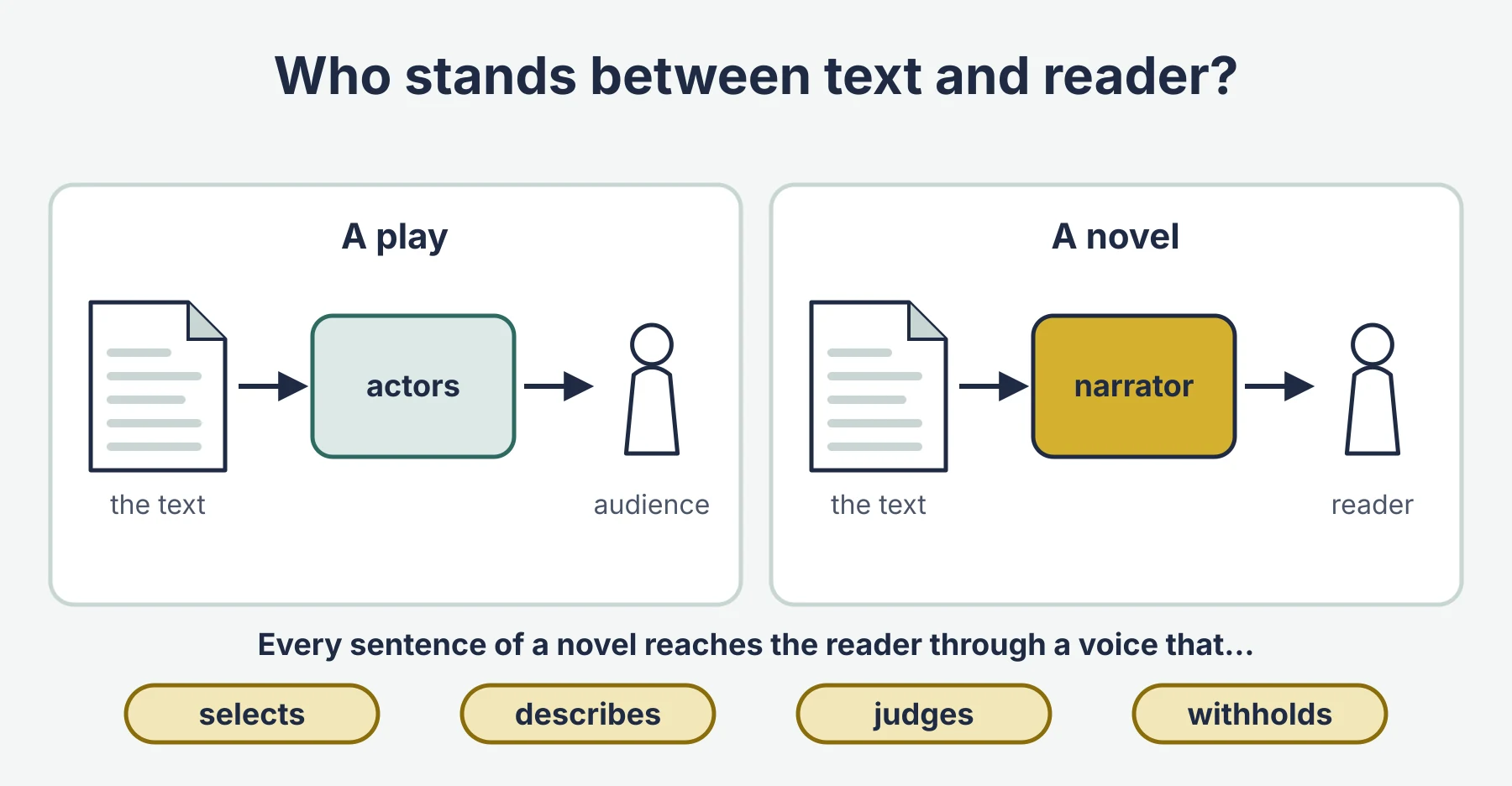
- Narrator first. Every sentence in a novel comes through a voice. Identify who narrates, how much they know, and whether they judge.
- Extract and whole novel. The extract shows close reading; the wider novel shows development. Cover both bullets.
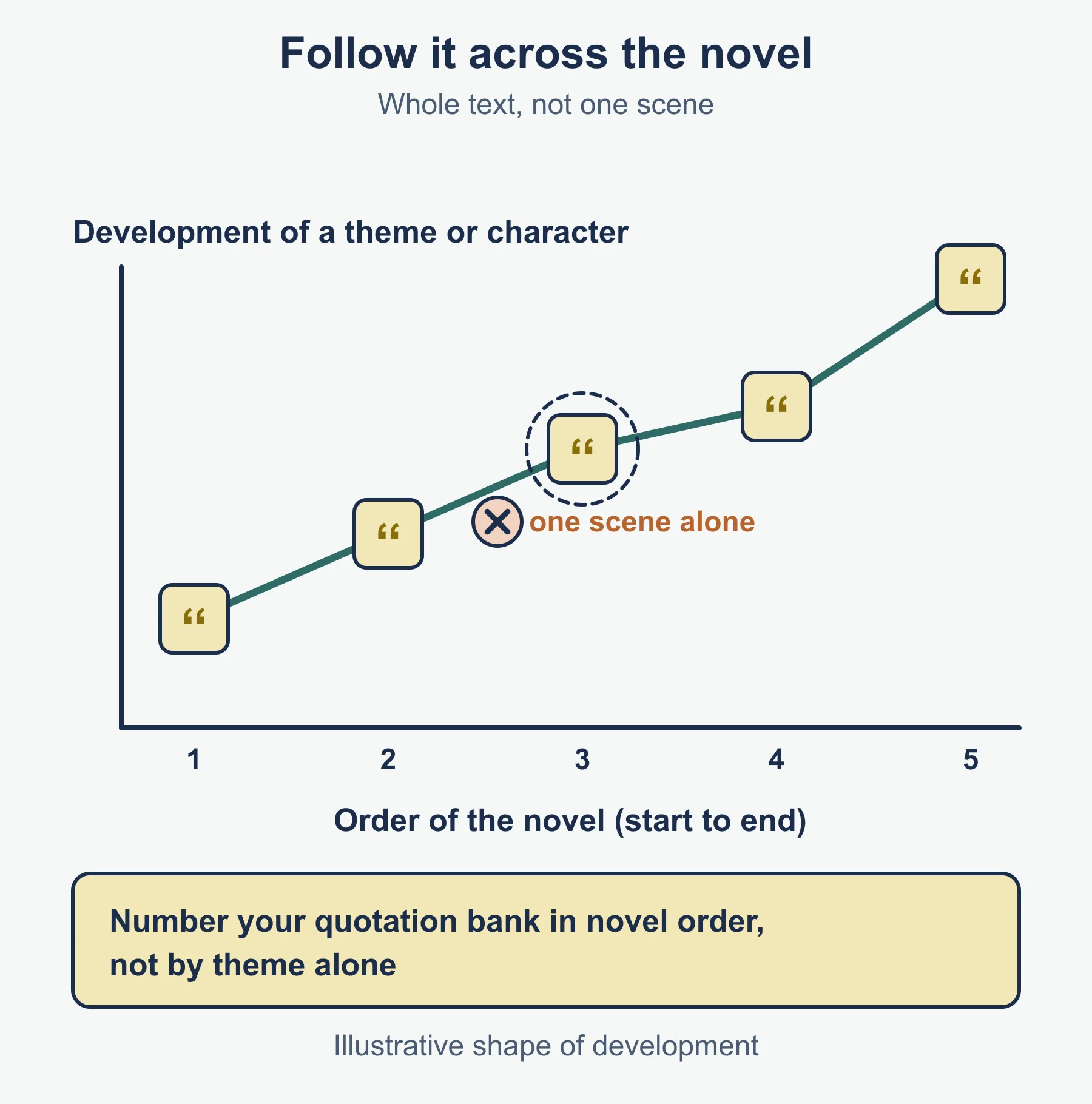
- Development is the key idea. Characters change, relationships shift, themes deepen. Track the focus from beginning to end.
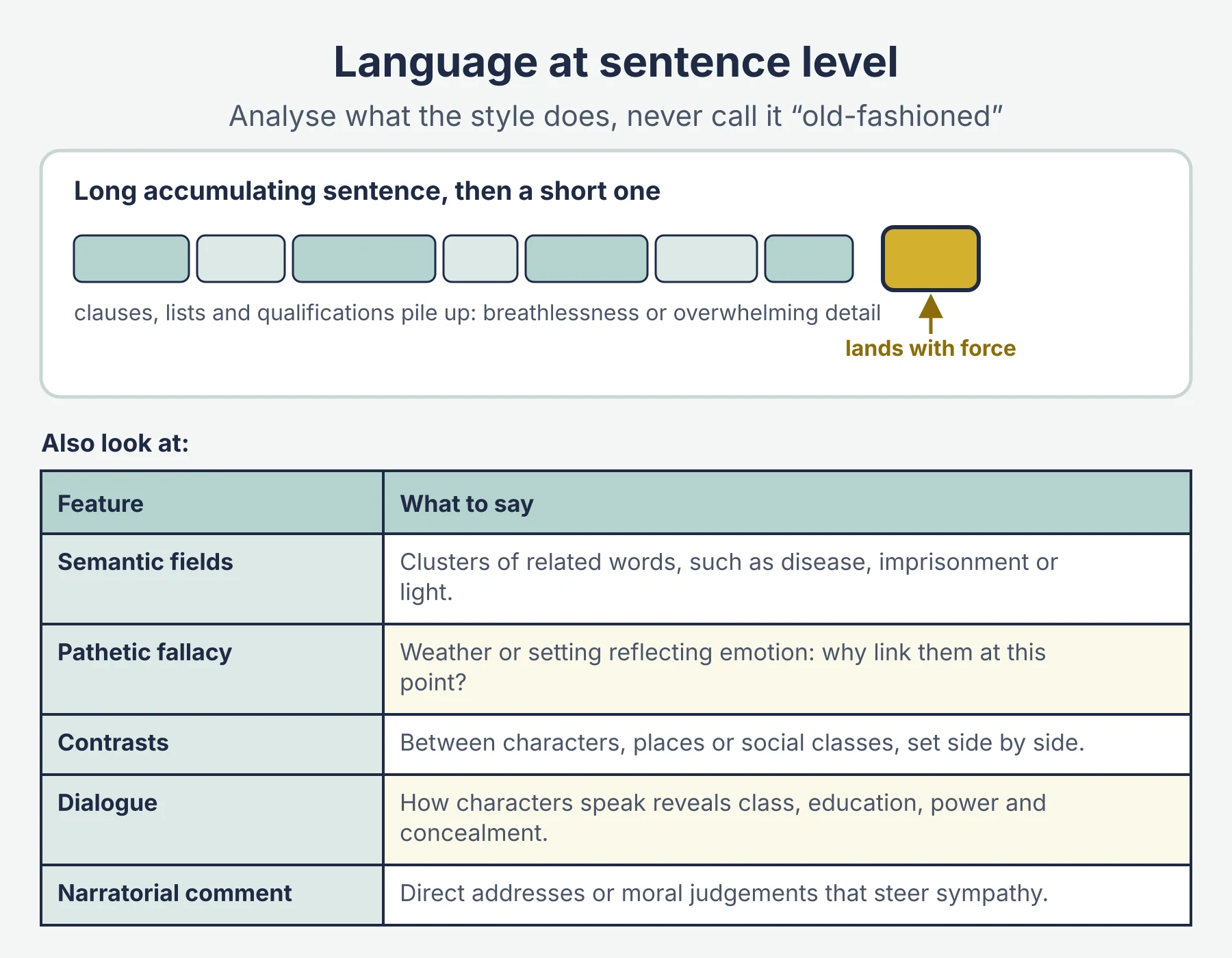
- Sentence-level analysis. Long, layered sentences, lists and clause build-up are methods; analyse their effect instead of calling the style old.
- Context explains choices. Link a contextual point to a specific moment and say how it shapes meaning for the novel’s first readers or for us.
- Name the writer. Write “the writer presents…” or use the author’s surname, not “the book says”.
Key terms
| Term | Meaning | Typical use in an answer |
|---|---|---|
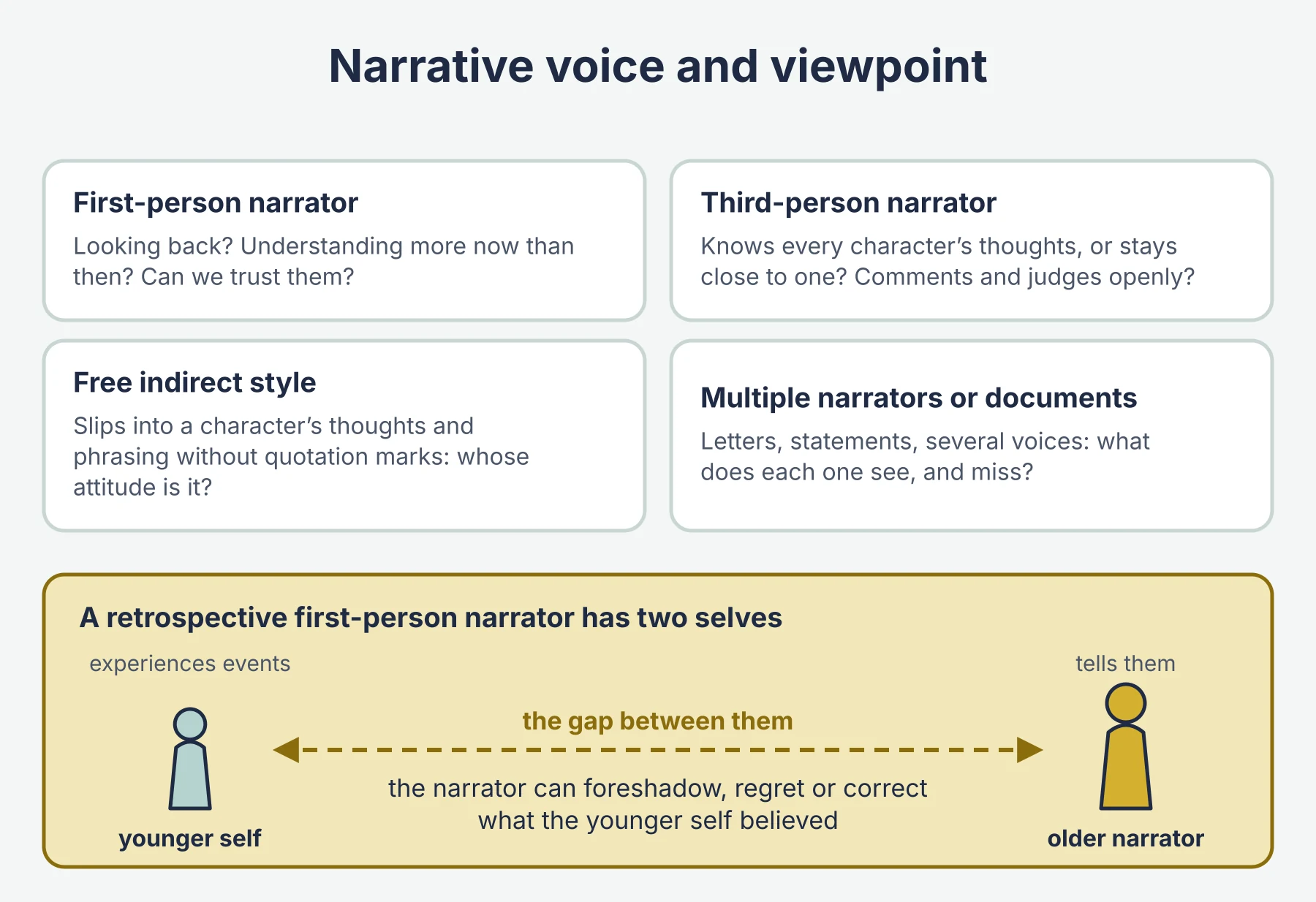
| First-person narrator | Story told by “I”, a character | Limited view, possible unreliability |
| Retrospective narration | Older narrator recalling earlier events | Gap between past and present self |
| Third-person omniscient | Narrator knows all characters’ thoughts | Overview, moral commentary |
| Free indirect style | Narration that adopts a character’s own thoughts | Irony, closeness to a character |
| Unreliable narrator | A narrator whose account may be biased or mistaken | Reader must judge beyond the narrator |
| Pathetic fallacy | Setting or weather reflecting feeling | Mood, foreshadowing |
| Semantic field | Group of words from one area of meaning | Building a theme through vocabulary |
| Juxtaposition | Placing contrasting things side by side | Exposing hypocrisy or difference |
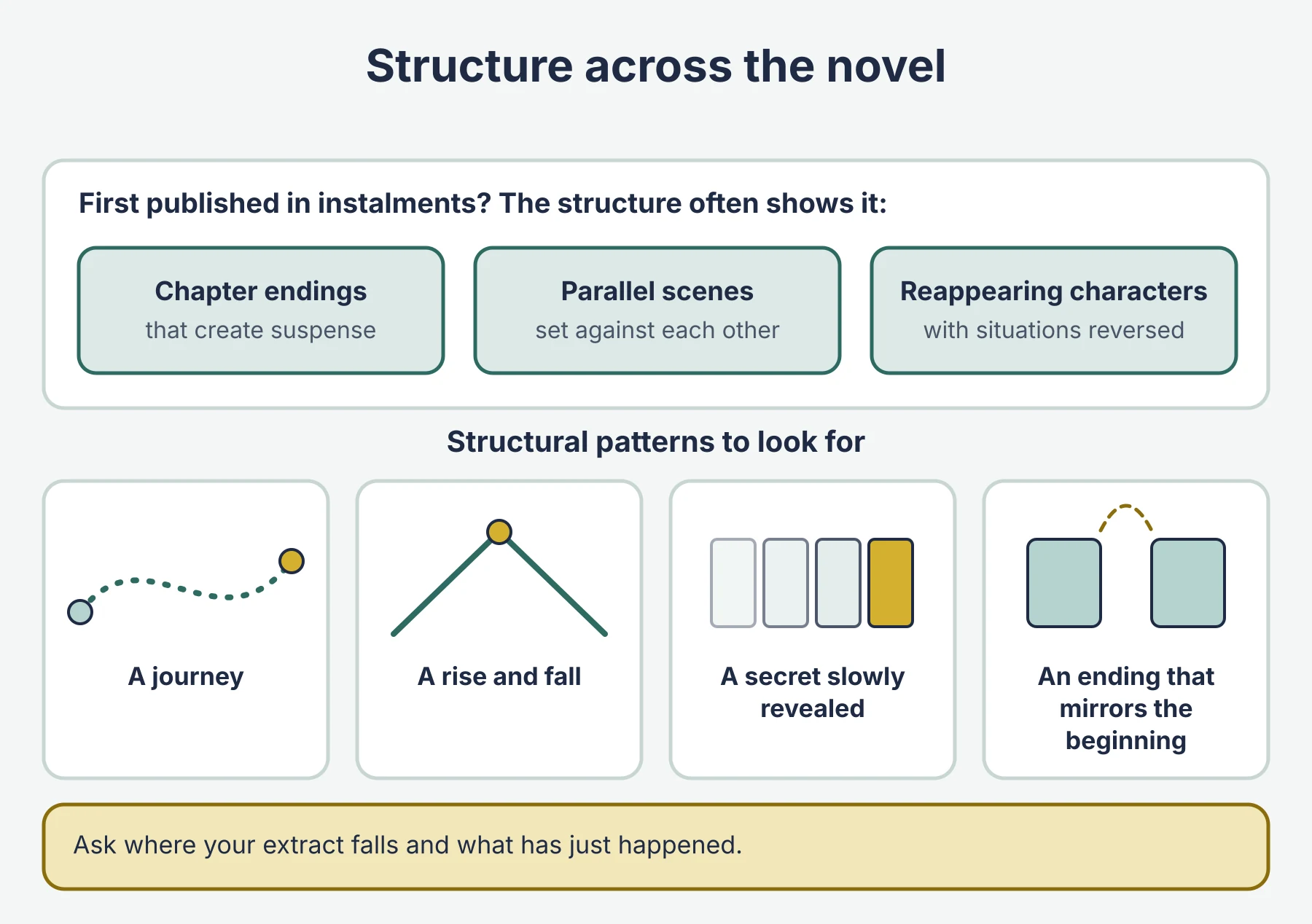
| Bildungsroman | Novel tracing a character’s growth from youth | Structure of development |
| Gothic | Genre of mystery, terror and the supernatural | Setting, suspense, the hidden |
| Serialisation | Publication in instalments | Cliffhangers, episodic structure |
| Epistolary | Told through letters or documents | Multiple viewpoints, gaps in knowledge |
Planning in five minutes
- Underline the focus word in the question and read the extract’s introductory line.
- Mark four or five extract details linked to the focus, at least one about narrative voice.
- Write a one-sentence argument that promises development across the novel.
- Pick two or three other moments: beginning, turning point, ending.
- Choose one context point that explains a specific choice.
Paragraph checklist
- A point that answers the question.
- A short quotation or precise event.
- Analysis of a method: narrative voice, word choice, imagery, sentence shape, structure.
- The effect on the reader, with an alternative reading if one is credible.
- Development: how this moment connects to another point in the novel.
Exam traps
- Paraphrasing the extract in order from top to bottom.
- One-moment answers that never leave the extract, or that leave it after one sentence.
- Narrator blindness: analysing descriptions as if they came from nowhere.
- Generic Victorian history, such as long accounts of the workhouse or the factory, that do not connect to the line under discussion.
- Misplacing the extract in the plot; read the introduction line on the paper.
- Time squeeze. Section A comes first and carries more marks, but Section B is still 30 of the paper’s 64. Protect close to half the time for it.
Context prompts
Choose those that fit your novel:
- Social class, money, inheritance and the gap between rich and poor.
- Expectations of women, marriage and reputation.
- Childhood, education and the treatment of the vulnerable.
- The growing industrial city, crime and public health.
- Religion, science and changing ideas about human nature.
- The reading public: many novels reached readers in parts, which encouraged suspense.
Self-test
- What two parts does the novel question ask you to cover?
- How many marks is the question worth, and are AO4 marks awarded?
- What is a retrospective first-person narrator?
- Define free indirect style.
- Give one effect of an unreliable narrator.
- What is a semantic field? Give an example of one that might build a theme.
- Why is “the writer uses old-fashioned language” a weak comment?
- Name two context areas relevant to many 19th-century novels.
- What is juxtaposition and how might a writer use it to criticise a character?
- How can serial publication affect a novel’s structure?
- How should you organise a quotation bank for the whole novel?
- Roughly what share of the paper’s time should Section B receive?
Answers
- The extract in detail, and the novel as a whole.
- 30 marks; no, AO4 marks are not awarded in Section B.
- A narrator who tells their own story looking back from a later point, so there are two selves: the one who experienced events and the one telling them.
- Third-person narration that takes on a character’s own thoughts and phrasing without quotation marks.
- The reader has to judge beyond what the narrator says, creating irony, suspense or doubt.
- A cluster of words from one area of meaning; for example, words of illness or decay could build a theme of moral corruption.
- It names no method and explains no effect; analysis needs a specific sentence feature and its impact.
- Any two of: class and money, women and marriage, childhood and education, the industrial city, religion and science, reputation and respectability.
- Placing contrasting things side by side; for example, setting a character’s pious words next to their cruel action exposes hypocrisy.
- It encourages instalment endings with suspense, episodes, and characters or plot lines that return later.
- Chronologically, with short quotations from the beginning, middle and end linked to themes and characters, so development can be traced.
- Close to half: 30 of 64 marks.
More resources on this topic
Related resources
-
Study guides
AQA GCSE English Literature: Shakespeare and the 19th-Century Novel (8702)
Shakespeare and the 19th-century novel – the full paper structure of Paper 1 for AQA GCSE English Literature (8702), an untiered, closed-book qualification.
English Literature · AQA · GCSE
Read guide -
Practice questions
Shakespeare and the 19th-Century Novel (8702): Practice Questions
Original practice with full worked answers on Paper 1 Shakespeare and the 19th-century novel of AQA GCSE English Literature 8702, for any set texts studied.
English Literature · AQA · GCSE
Try questions -
Revision notes
Shakespeare and the 19th-Century Novel (8702): Revision Notes
Condensed notes on AQA GCSE English Literature 8702 Paper 1: the closed-book Shakespeare and 19th-century novel sections, the AOs and how to answer.
English Literature · AQA · GCSE
Revise topic
Get free revision emails (optional)
Occasional emails with practice questions, worked explanations and links to free resources for the qualification and subjects you choose. No spam, and you can unsubscribe from any email. The free tools on this site never need an email.