
Revision Notes
AQA GCSE English Literature (8702): Writing – Revision Notes
Condensed notes on writing about literature for AQA GCSE English Literature 8702: thesis, quotation conventions, AO4 accuracy, common errors and a self-test.
- Subject
- English Literature
- Level
- GCSE
- Topic
- Topic 3: Skills
- Author
- Marlbridge Academic Team
- Updated
- Reviewed by
- Ammar Bilal (what this means)
Aligned to AQA GCSE English Literature (8702), For first teaching 2015. Official specification .
Syllabus page (what it covers and how it is assessed): AQA GCSE English Literature.
Syllabus points this page covers
8702
- Writing
Found an error? Report a correction.
Need help with this topic? Request a free trial class for GCSE English Literature (8702).
Quick-recall notes on the writing skills in the specification. The full explanation, with a worked before-and-after paragraph, is in the Writing study guide.
What the specification asks for
| Skill | In practice |
|---|---|
| Writing for purposes | Describe, explain, summarise, argue, analyse and evaluate, each in proportion |
| Discussing and maintaining a point of view | A clear thesis sustained across the essay, with other views discussed |
| Selecting and emphasising key points | Three or four strong points in depth, ordered for impact |
| Relevant quotation and detailed reference | Short embedded quotations; precise references to events |
| Accurate Standard English | Correct spelling, punctuation and grammar |
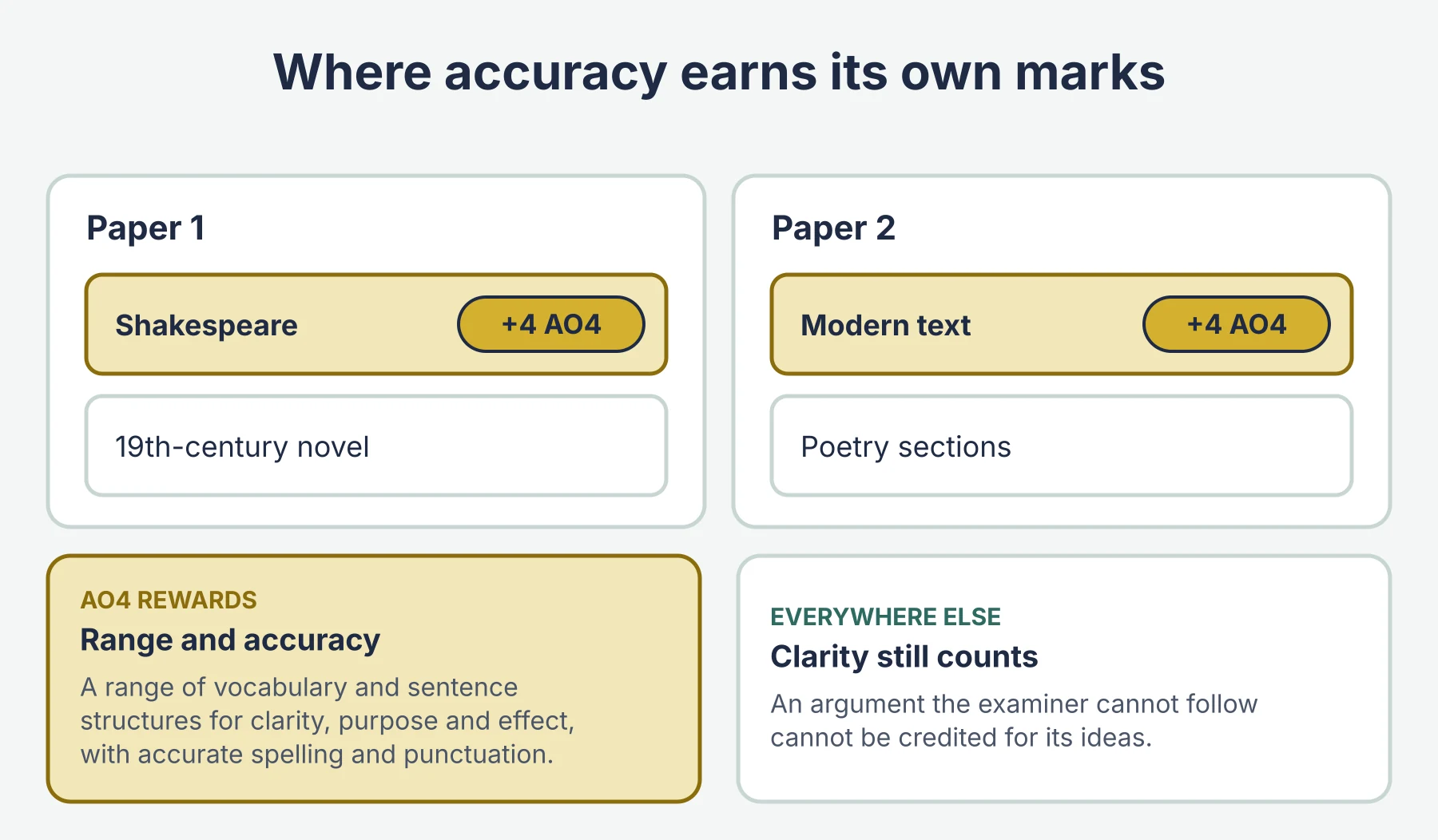
AO4 is assessed on the Shakespeare question (Paper 1) and the modern text question (Paper 2), 4 marks each, for a range of vocabulary and sentence structures with accurate spelling and punctuation.
Core recall
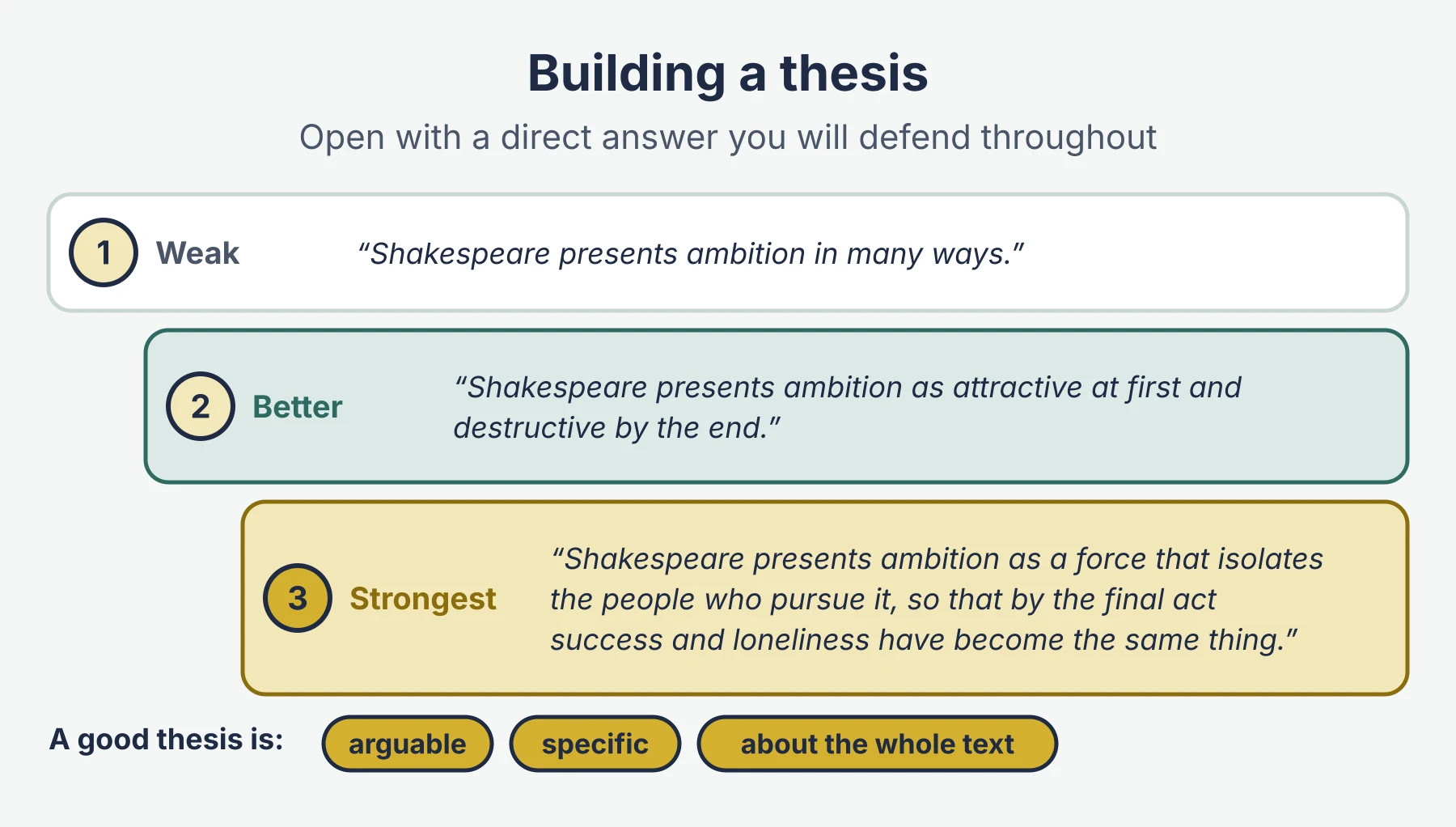
- Thesis first: arguable, specific, covering the whole text.
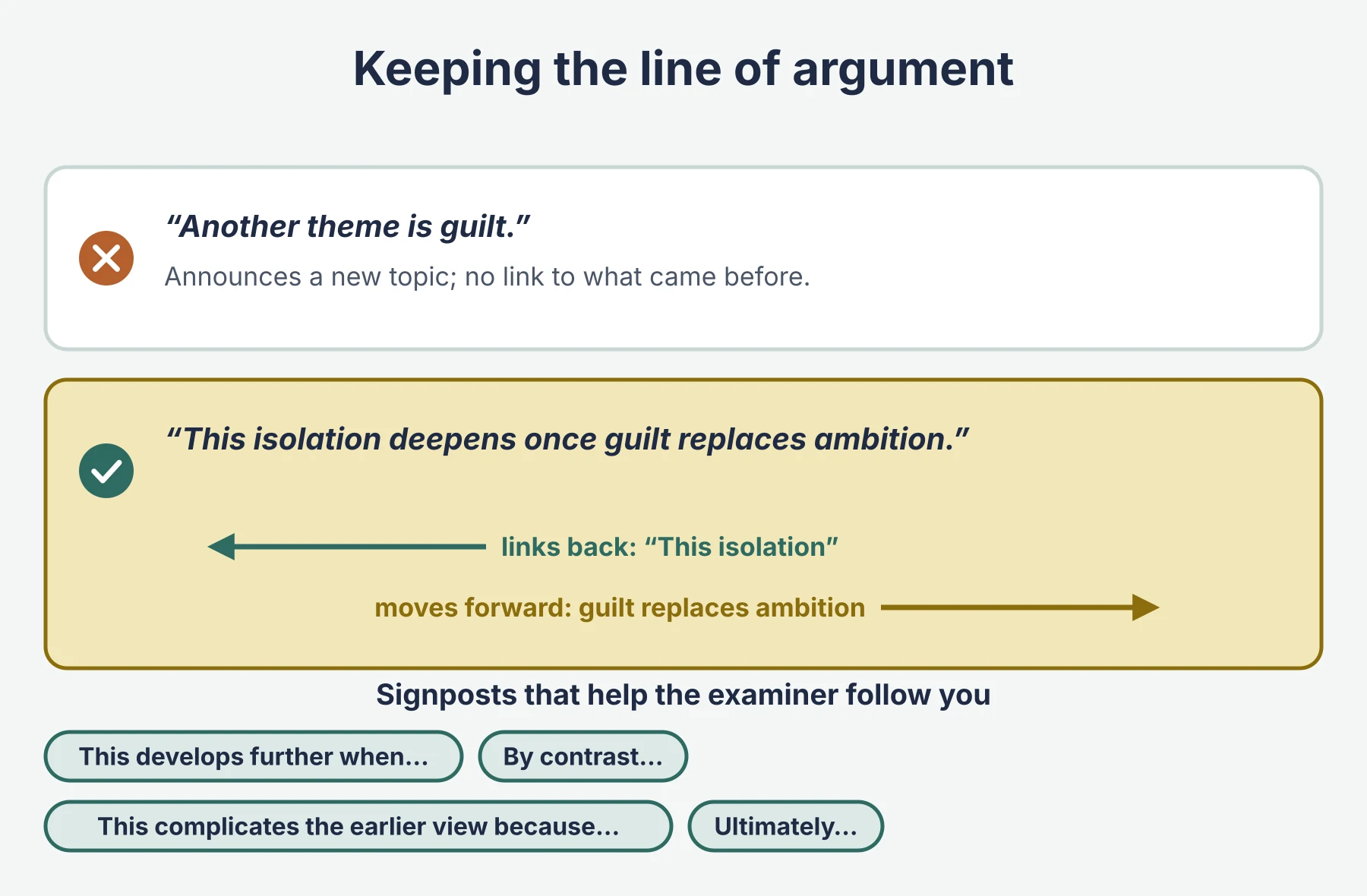
- Topic sentences advance the argument; they do not just name a new topic.
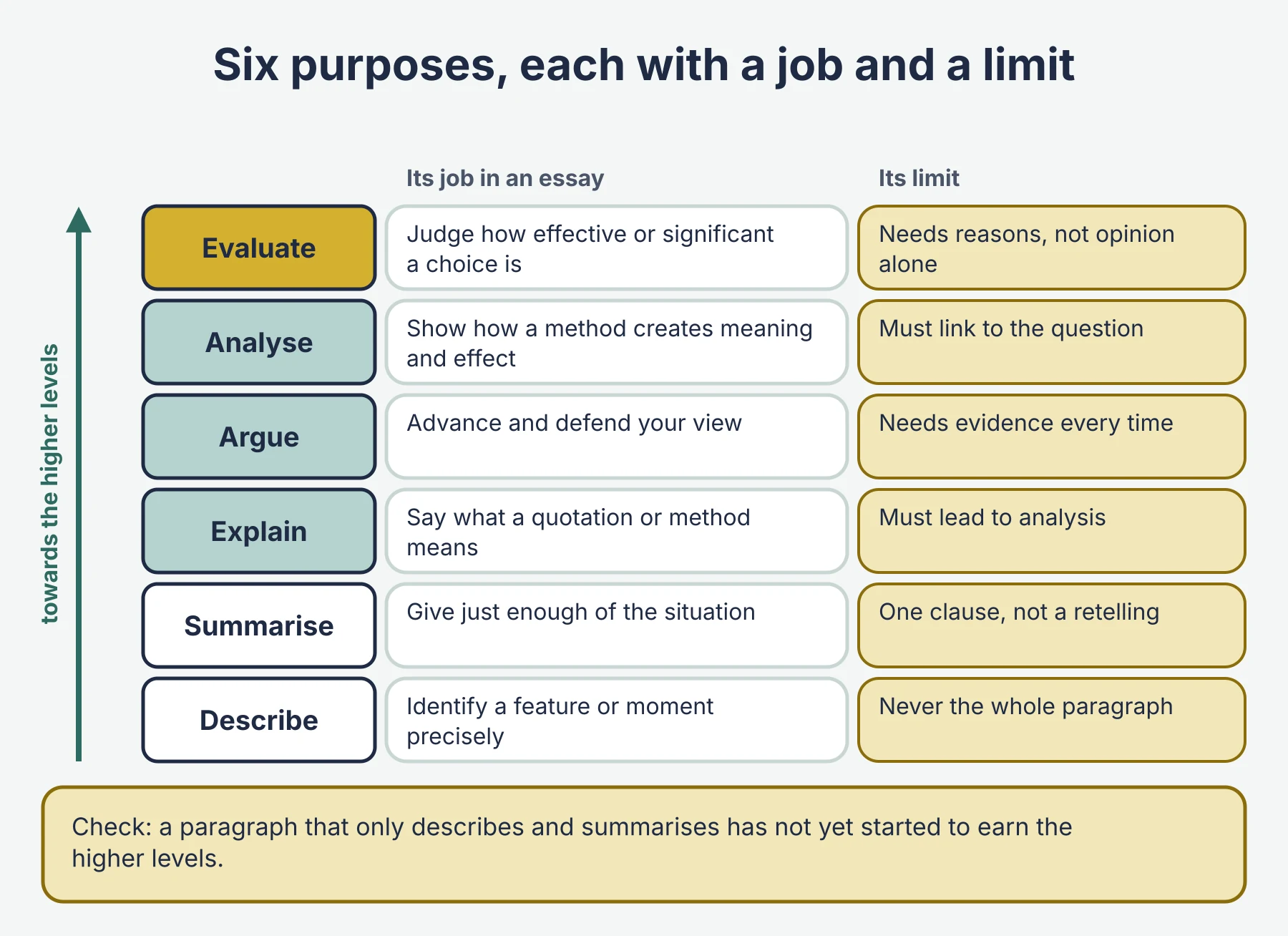
- Summary in one clause, then analysis.
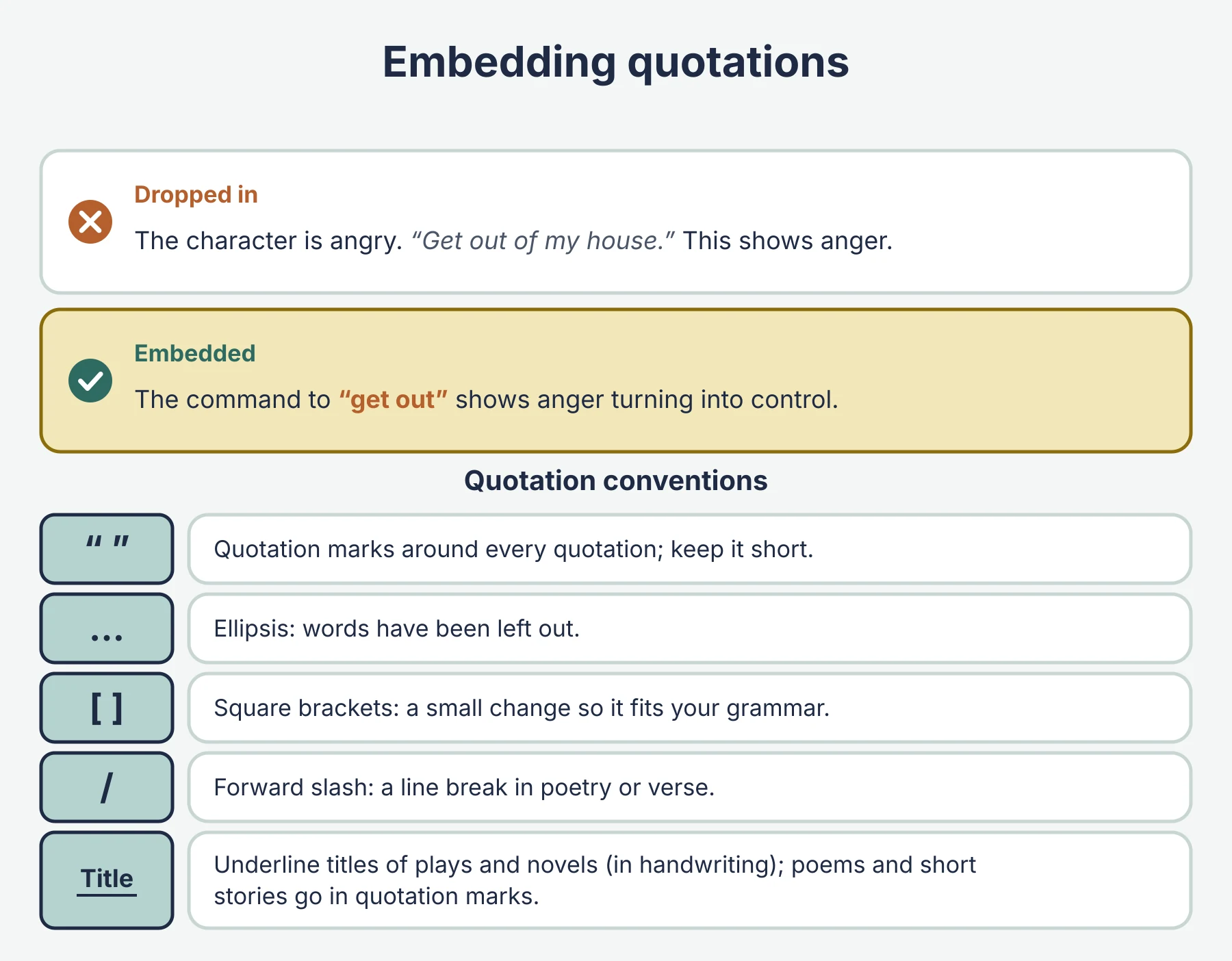
- Embed quotations so that sentences read grammatically.
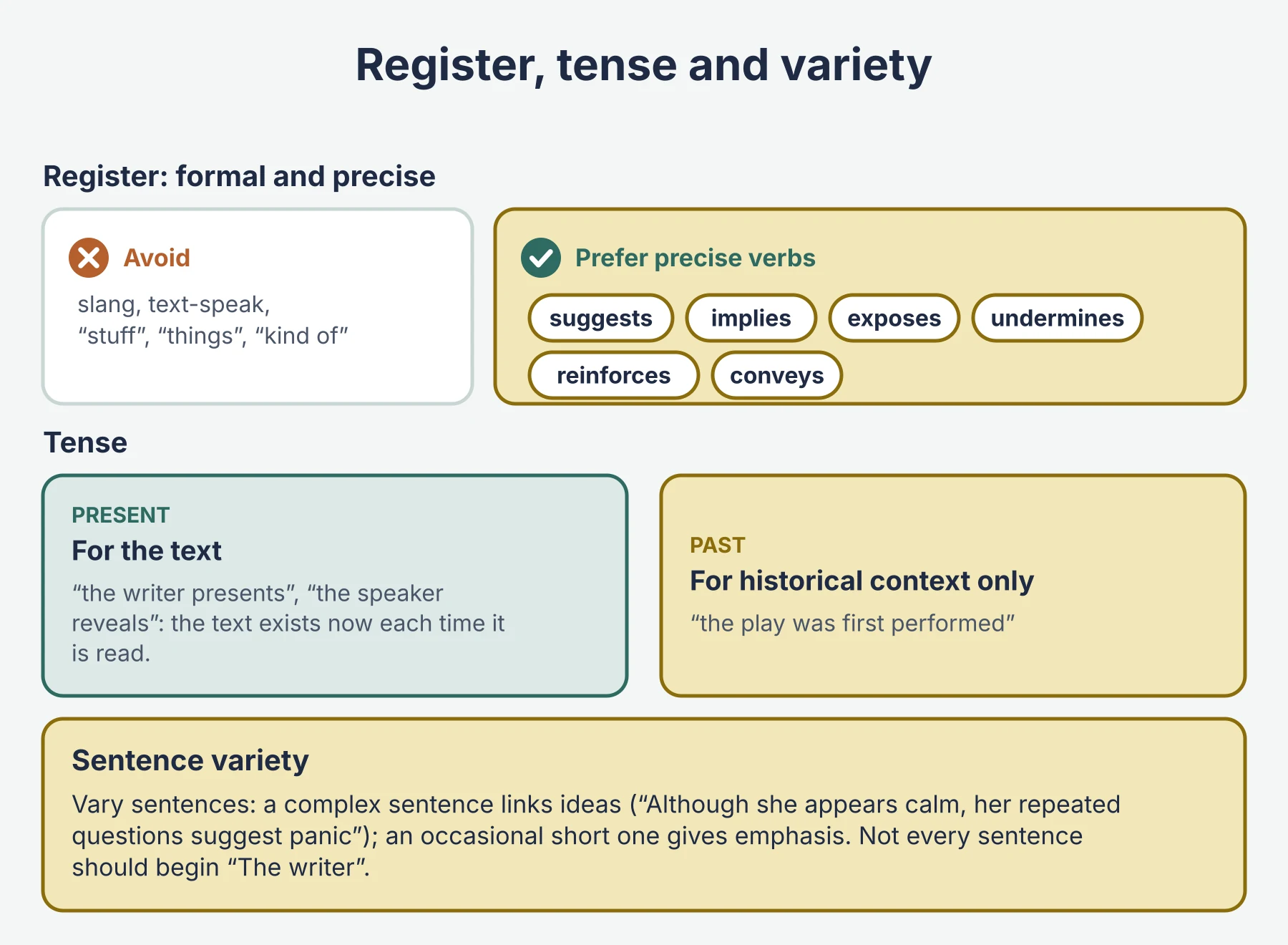
- Present tense for the text; past tense only for historical context.
- Formal register with precise analytical verbs.
- Proofread the two AO4 questions.
Thesis ladder
| Level | Example for “How does the writer present loyalty?” |
|---|---|
| Topic only | The writer presents loyalty in different ways. |
| A view | The writer presents loyalty as fragile. |
| Arguable, specific, whole text | The writer presents loyalty as fragile because it depends on self-interest, so each betrayal in the text grows from a character protecting themselves. |
Aim for the third level: a reader could disagree with it, and it gives the essay a direction.
Purposes in proportion
| Purpose | Rough share of a paragraph |
|---|---|
| Summarise or describe | A clause to set up the moment |
| Explain | A sentence on what the evidence means |
| Analyse | The core: how the method creates meaning |
| Evaluate | A sentence judging impact or significance |
| Argue | Topic sentence and closing link to the thesis |
Linking paragraphs
Each new paragraph should pick up the last one’s idea and move it on:
- “This control begins to slip when…”
- “A darker version of this appears in…”
- “By contrast, the ending suggests…”
- “This complicates the earlier view, because…”
Analytical verbs
| Instead of | Try |
|---|---|
| shows | suggests, conveys, reveals, exposes, emphasises |
| says | asserts, claims, insists, admits, implies |
| makes the reader feel | evokes, provokes, unsettles, invites sympathy |
| is about | explores, examines, questions, challenges |
| uses | employs, deploys, crafts, constructs |
Quotation conventions
| Convention | Use |
|---|---|
| Quotation marks | Around every quoted word or phrase |
| Ellipsis (…) | Shows words left out |
| Square brackets [ ] | Small changes to fit your grammar |
| Forward slash ( / ) | Marks a line break when quoting verse |
| Underlining (handwriting) | Titles of plays, novels and other whole texts |
| Quotation marks for titles | Poems and short stories |
Accuracy checklist
| Watch for | Rule |
|---|---|
| its / it’s | possession / “it is” |
| their / there / they’re | belonging / place / “they are” |
| affect / effect | usually verb / usually noun |
| should of | should have |
| alot | a lot |
| comma splice | join with a full stop, semicolon or connective |
| possessive names | Sheila’s (one person); the Birlings’ (the family) |
| capital letters | names, titles, the start of sentences, “I” |
Sentence variety
- Complex: “Although X, Y” links contrasting ideas.
- Short: a brief sentence for emphasis after a long one.
- Varied openings: start with a subordinate clause, an adverb or a quotation, not always “The writer”.
- Semicolon: joins two closely related complete sentences.
- Colon: introduces an explanation or example.
Exam traps
- No argument: paragraphs that list features or events.
- Retelling: long summaries that crowd out analysis.
- Dropped quotations left as separate sentences without comment.
- Invented quotations under pressure; use a precise reference instead.
- Tense drift from present to past.
- Misspelled names and terms repeated throughout an answer.
- No time to check the questions carrying AO4.
Self-test
- Which questions carry AO4 marks, and how many marks each?
- What three qualities make a strong thesis?
- What is the difference between a topic sentence that announces and one that advances?
- Why should summary be kept to a clause?
- What does an ellipsis show in a quotation?
- How do you mark a line break when quoting poetry?
- Which tense should you use to discuss the events of a text?
- Correct this: “Its clear that there anger effects them.”
- What is a comma splice, and how do you fix one?
- Give two analytical verbs to replace “shows”.
- How should you set out the title of a poem in a handwritten essay?
- What should you do if you cannot remember an exact quotation?
Answers
- The Shakespeare question on Paper 1 and the modern text question on Paper 2; 4 marks each.
- It is arguable, specific and covers the whole text.
- An announcing sentence names a new topic (“Another theme is guilt”); an advancing sentence links to the argument and develops it (“This isolation deepens once guilt replaces ambition”).
- Because summary earns little credit; analysis and argument earn the marks.
- That words have been left out.
- With a forward slash.
- The present tense.
- “It’s clear that their anger affects them.”
- Two complete sentences joined only by a comma; fix it with a full stop, a semicolon or a connective.
- Any two of: suggests, conveys, reveals, exposes, emphasises.
- In quotation marks.
- Refer precisely to the event or moment instead; never invent a quotation.
More resources on this topic
Related resources
-
Practice questions
Skills (8702): Practice Questions
Original skills practice for AQA GCSE English Literature (8702): inference, critical reading, analysing writers' choices, comparison and writing, with answers.
English Literature · AQA · GCSE
Try questions -
Revision notes
Skills (8702): Revision Notes
Revision notes on 3.3 Skills in AQA GCSE English Literature (8702): comprehension, critical reading, writers' choices, comparison, writing and AO1–AO4.
English Literature · AQA · GCSE
Revise topic -
Study guides
AQA GCSE English Literature (8702): Skills – Study Guide
The reading and writing skills behind AQA GCSE English Literature 8702: understanding texts, analysing language and structure, context and accurate essays.
English Literature · AQA · GCSE
Read guide
Get free revision emails (optional)
Occasional emails with practice questions, worked explanations and links to free resources for the qualification and subjects you choose. No spam, and you can unsubscribe from any email. The free tools on this site never need an email.