
Revision Notes
AQA GCSE English Literature (8702): Reading Comprehension and Reading Critically – Revision Notes
Condensed notes on reading skills for AQA GCSE English Literature 8702: inference, explicit and implied meaning, weighing readings and a self-test.
- Subject
- English Literature
- Level
- GCSE
- Topic
- Topic 3: Skills
- Author
- Marlbridge Academic Team
- Updated
- Reviewed by
- Ammar Bilal (what this means)
Aligned to AQA GCSE English Literature (8702), For first teaching 2015. Official specification .
Syllabus page (what it covers and how it is assessed): AQA GCSE English Literature.
Syllabus points this page covers
8702
- Reading comprehension and reading critically
Found an error? Report a correction.
Need help with this topic? Request a free trial class for GCSE English Literature (8702).
Quick-recall notes on the reading skills in the specification. The full explanation, with an annotated response to an original passage, is in the Reading comprehension and reading critically study guide.
The four skill groups
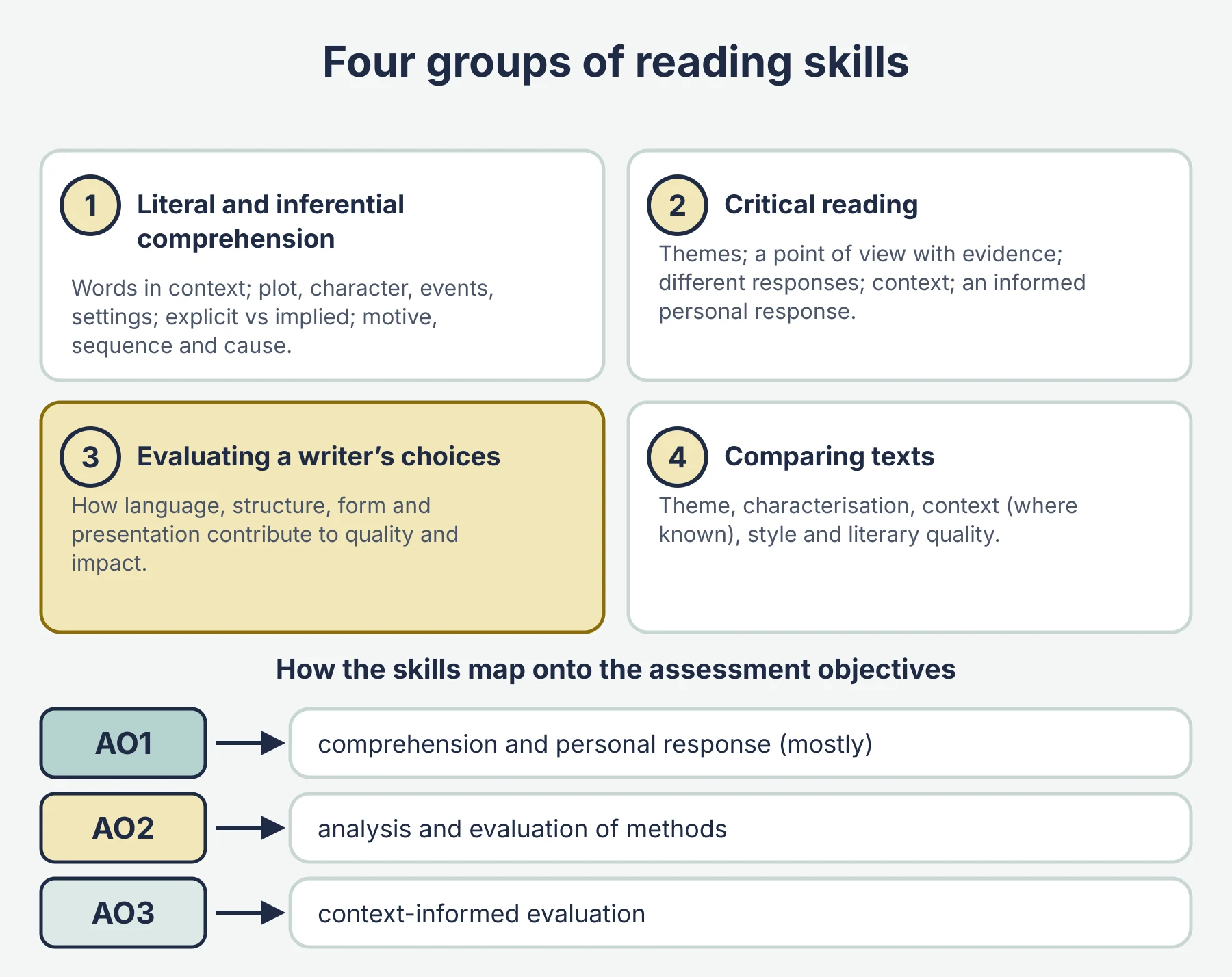
| Group | What it asks you to do | Main objective |
|---|---|---|
| Literal and inferential comprehension | Understand words in context, plot, character, setting; separate stated from implied; explain motives, sequence and links between events | AO1 |
| Critical reading | Identify and distinguish themes; support a view with evidence; recognise and evaluate different responses; use context to inform evaluation; give an informed personal response | AO1, AO3 |
| Evaluating writers’ choices | Analyse and evaluate how language, structure, form and presentation contribute to quality and impact, with terminology | AO2 |
| Comparing texts | Compare theme, characterisation, context (where known), style and literary quality | AO1, AO2, AO3 |
Core recall
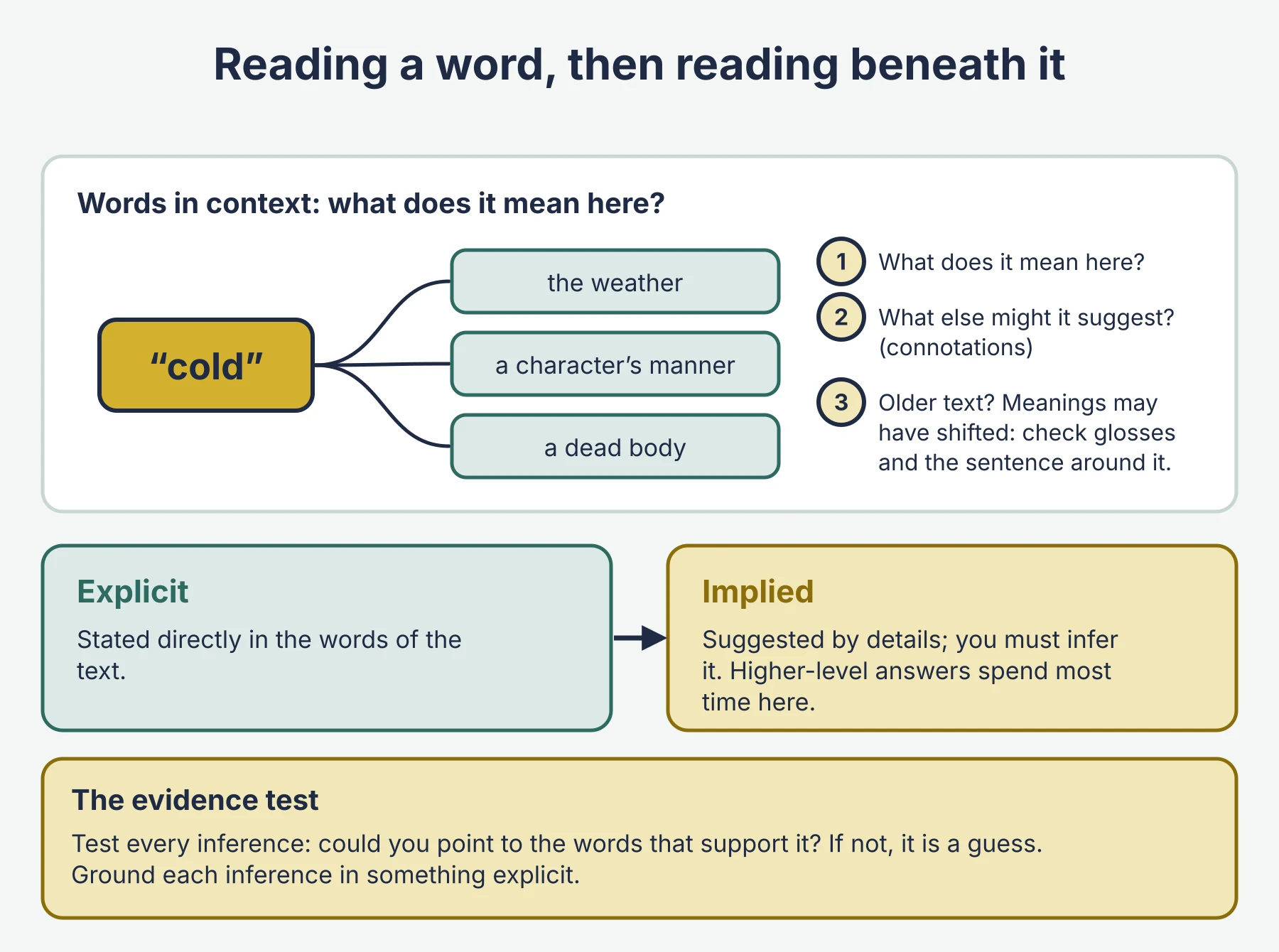
- Explicit = stated. Implied = suggested by details. Inference must always be traceable to explicit words.
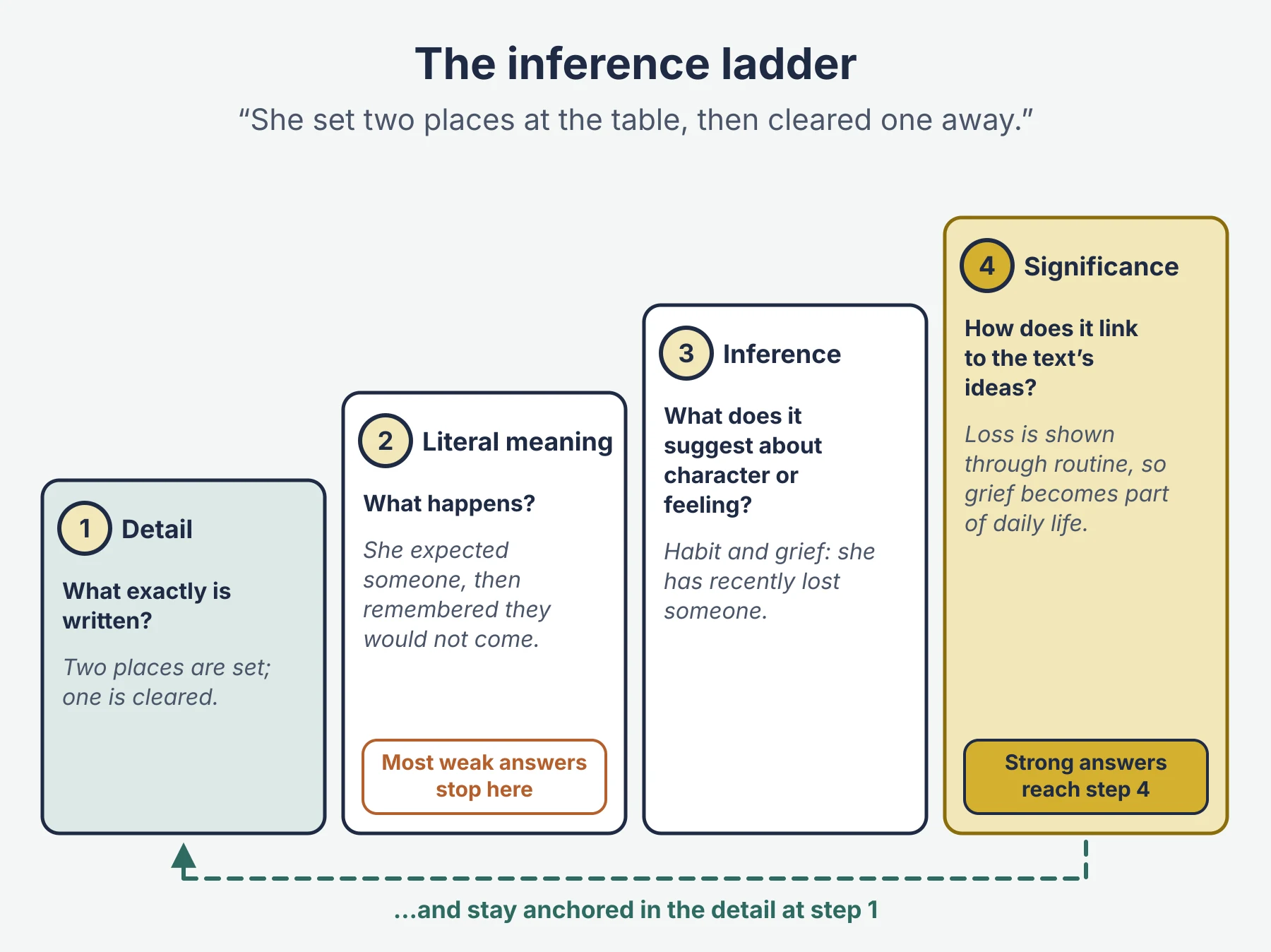
- The inference ladder: detail → literal meaning → inference → significance. Climb all four steps.
- Motive is usually unstated; explaining it is inference.
- Sequence matters: placing a moment before or after another shows whole-text understanding.
- A theme is an idea, not a topic. “Power” is a topic; “power corrupts those who seek it” is a theme stated as an idea.
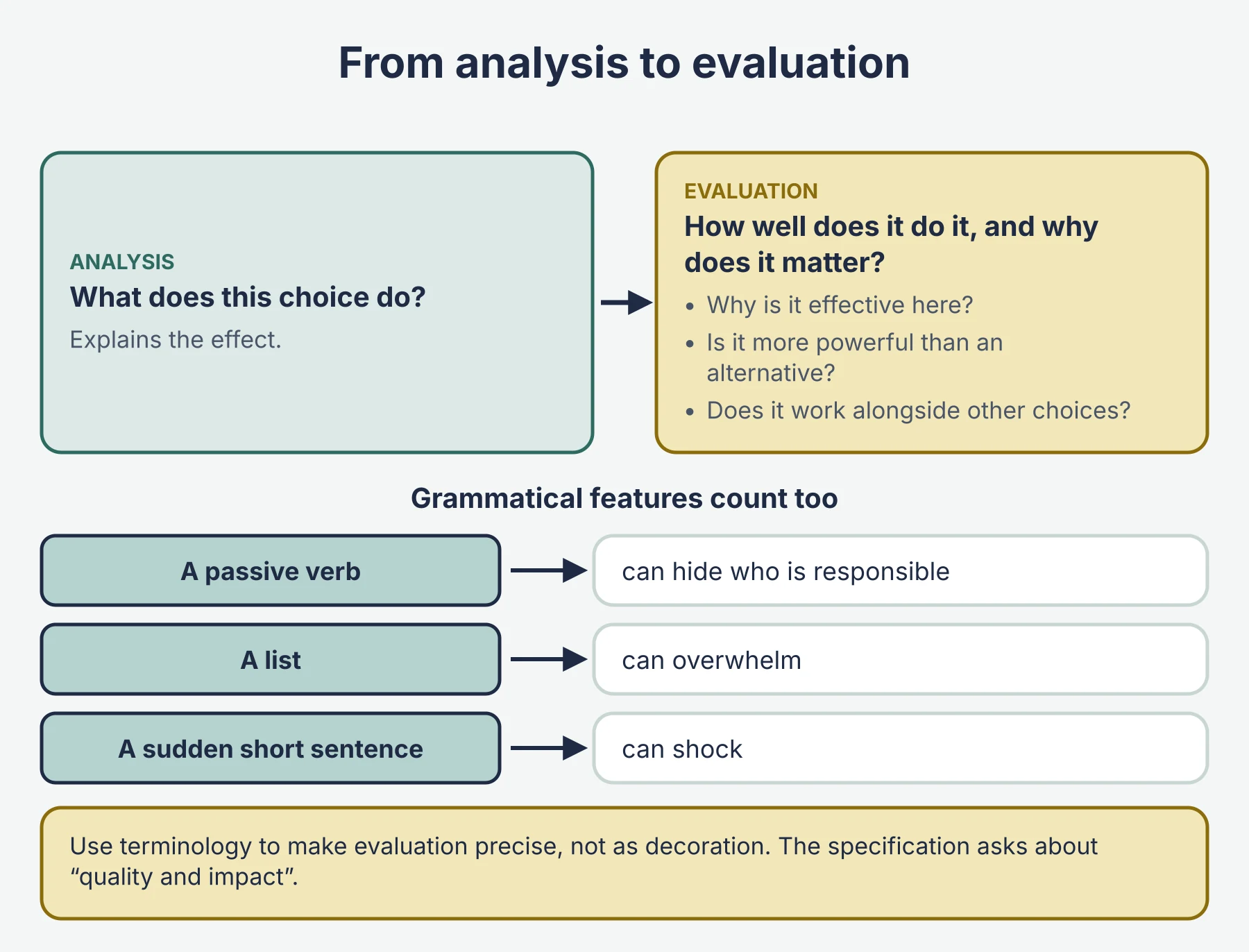
- Evaluation judges effectiveness and impact, not just effect.
- Personal response must be informed by analysis, not taste.
Key terms
| Term | Meaning |
|---|---|
| Inference | A conclusion drawn from evidence in the text |
| Connotation | An association a word carries beyond its literal meaning |
| Denotation | The literal dictionary meaning of a word |
| Subtext | Meaning beneath what is said, especially in dialogue |
| Ambiguity | Openness to more than one meaning |
| Interpretation | A reasoned reading of what a text or detail means |
| Alternative reading | A different credible interpretation of the same evidence |
| Evaluation | A judgement about how effective or significant a choice is |
| Perspective | The viewpoint from which something is presented |
| Characterisation | The methods a writer uses to create a character |
| Motif | A recurring image, object or idea |
| Literary quality | How skilfully a text achieves its effects |
Inference ladder: a quick model
Original sentence: “He laughed at the joke a moment after everyone else.”
| Step | Note |
|---|---|
| Detail | He laughs, but late. |
| Literal meaning | He did not understand the joke at first, or was not listening. |
| Inference | He may be distracted, an outsider, or laughing to fit in. |
| Significance | The writer could be presenting isolation within a group, shown through timing rather than statement. |
Notice that the inference offers more than one possibility. The rest of the text decides which is most convincing.
Comparing texts: a checklist
- Theme: what idea do both explore, and do they reach the same view?
- Characterisation: how are similar figures created and judged?
- Context (where known): does the time of writing explain a difference?
- Style: voice, form, structure, imagery, sentence shape.
- Literary quality: which text achieves its effect more powerfully for this question, and why?
Phrases for weighing readings
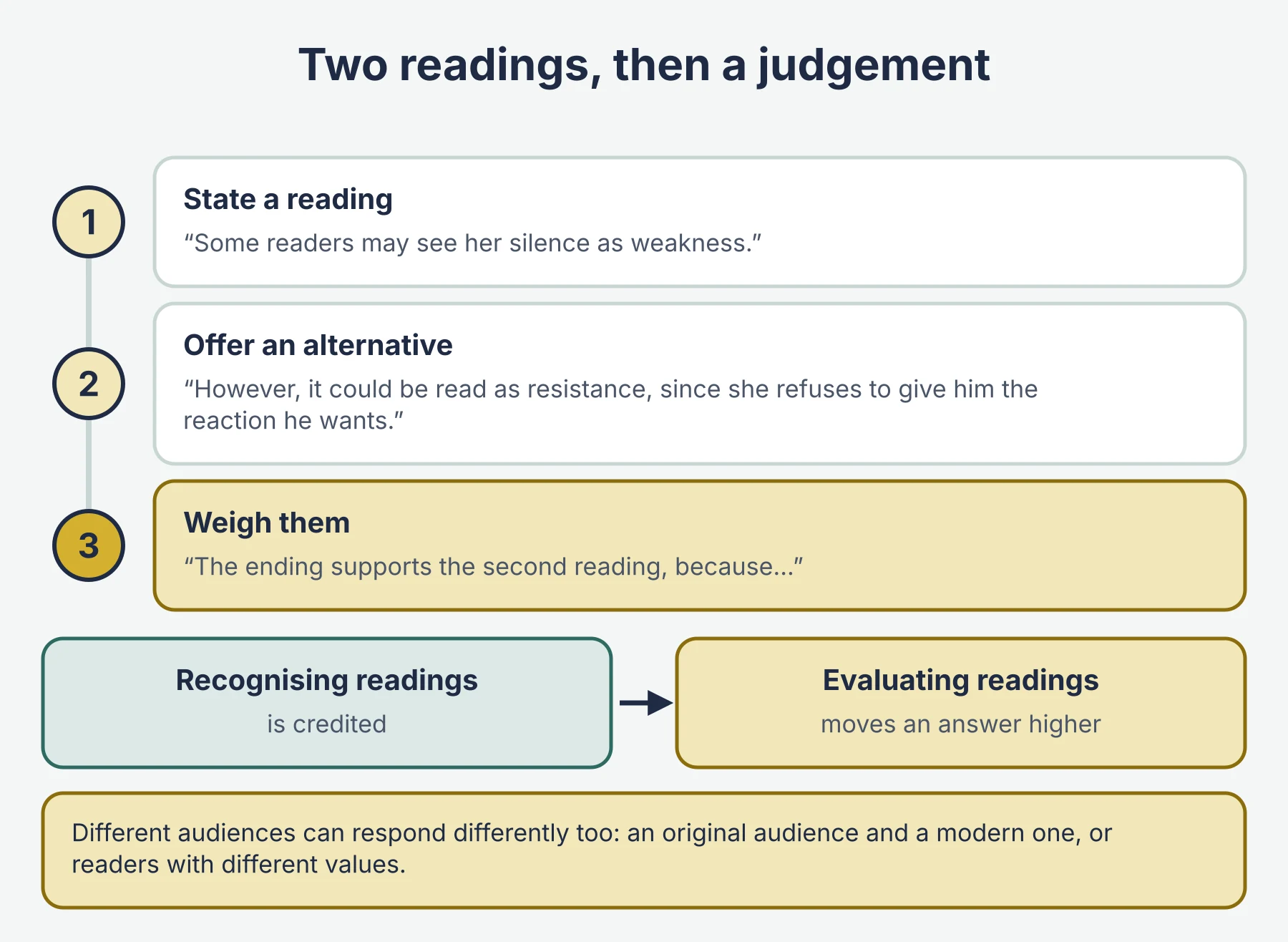
| Offer | Alternative | Weigh |
|---|---|---|
| This suggests… | However, it could also… | The ending supports… |
| Some readers may see… | Others might argue… | This reading is more convincing because… |
| On the surface… | Beneath this… | Ultimately, the writer seems to… |
Evaluation prompts
- Why is this choice effective at this point?
- What would be lost if the writer had chosen differently?
- How does this choice work with others nearby?
- Which choice in the passage has the greatest impact, and why?
Exam traps
- Unsupported inference: a claim no words in the text can back up.
- Literal paraphrase dressed as analysis.
- Listing readings without choosing or weighing.
- Topic labels instead of themes stated as ideas.
- Context as decoration, not used to judge what the writer is doing.
- Effect without impact: explaining what a choice does but never why it matters.
- Comparing subject only, ignoring style and method.
Self-test
- What is the difference between explicit and implied meaning?
- Name the four steps of the inference ladder.
- Why must an inference be traceable to explicit words?
- What is a connotation?
- How is a theme different from a topic?
- What does “evaluating different responses” require beyond listing them?
- How can context inform evaluation?
- What makes a personal response “informed”?
- What is the difference between analysis and evaluation?
- Name the five aspects the specification lists for comparing texts.
- What is subtext?
- Give one grammatical feature you could evaluate and its possible effect.
Answers
- Explicit meaning is stated directly; implied meaning is suggested and must be inferred from details.
- Detail, literal meaning, inference, significance.
- Otherwise it is a guess rather than a reading of the text, and cannot be supported with evidence.
- An association a word carries beyond its literal meaning.
- A topic is a subject; a theme is an idea about that subject, such as what the text suggests about it.
- Weighing them against the evidence and judging which is more convincing, or how they coexist.
- By helping you judge whether the writer reinforces or challenges the attitudes of the time, linked to a specific moment.
- It comes from analysis and evaluation of the text, with evidence, not from simple liking or disliking.
- Analysis explains what a choice does; evaluation judges how effective or significant it is.
- Theme, characterisation, context (where known), style and literary quality.
- The meaning beneath what is said, especially in dialogue.
- For example, a passive verb can hide who is responsible; a short sentence can create shock; a list can overwhelm.
More resources on this topic
Related resources
-
Study guides
AQA GCSE English Literature (8702): Writing
Writing about literature for AQA GCSE English Literature 8702: arguing a view, selecting evidence, embedding quotations and accurate Standard English for AO4.
English Literature · AQA · GCSE
Read guide -
Practice questions
AQA GCSE English Literature (8702): Writing – Practice Questions
Original writing practice for AQA GCSE English Literature 8702: theses, embedding quotations, fixing errors and rewriting paragraphs for AO4.
English Literature · AQA · GCSE
Try questions -
Revision notes
AQA GCSE English Literature (8702): Writing – Revision Notes
Condensed notes on writing about literature for AQA GCSE English Literature 8702: thesis, quotation conventions, AO4 accuracy, common errors and a self-test.
English Literature · AQA · GCSE
Revise topic
Get free revision emails (optional)
Occasional emails with practice questions, worked explanations and links to free resources for the qualification and subjects you choose. No spam, and you can unsubscribe from any email. The free tools on this site never need an email.