
Revision Notes
AQA GCSE English Literature (8702): Poetry – Revision Notes
Condensed notes on the anthology poetry comparison in AQA GCSE English Literature 8702 Paper 2 Section B: poetic terms, comparison grid, traps and a self-test.
- Subject
- English Literature
- Level
- GCSE
- Topic
- Paper 2 – Modern Texts and Poetry
- Author
- Marlbridge Academic Team
- Updated
- Reviewed by
- Ammar Bilal (what this means)
Aligned to AQA GCSE English Literature (8702), For first teaching 2015. Official specification .
Syllabus page (what it covers and how it is assessed): AQA GCSE English Literature.
Syllabus points this page covers
8702
- 3.2.2 Poetry
Found an error? Report a correction.
Need help with this topic? Request a free trial class for GCSE English Literature (8702).
Quick-recall notes for the anthology comparison. The full method, with two original poems and a model comparative paragraph, is in the Poetry study guide.
The task in one view
| Feature | Detail |
|---|---|
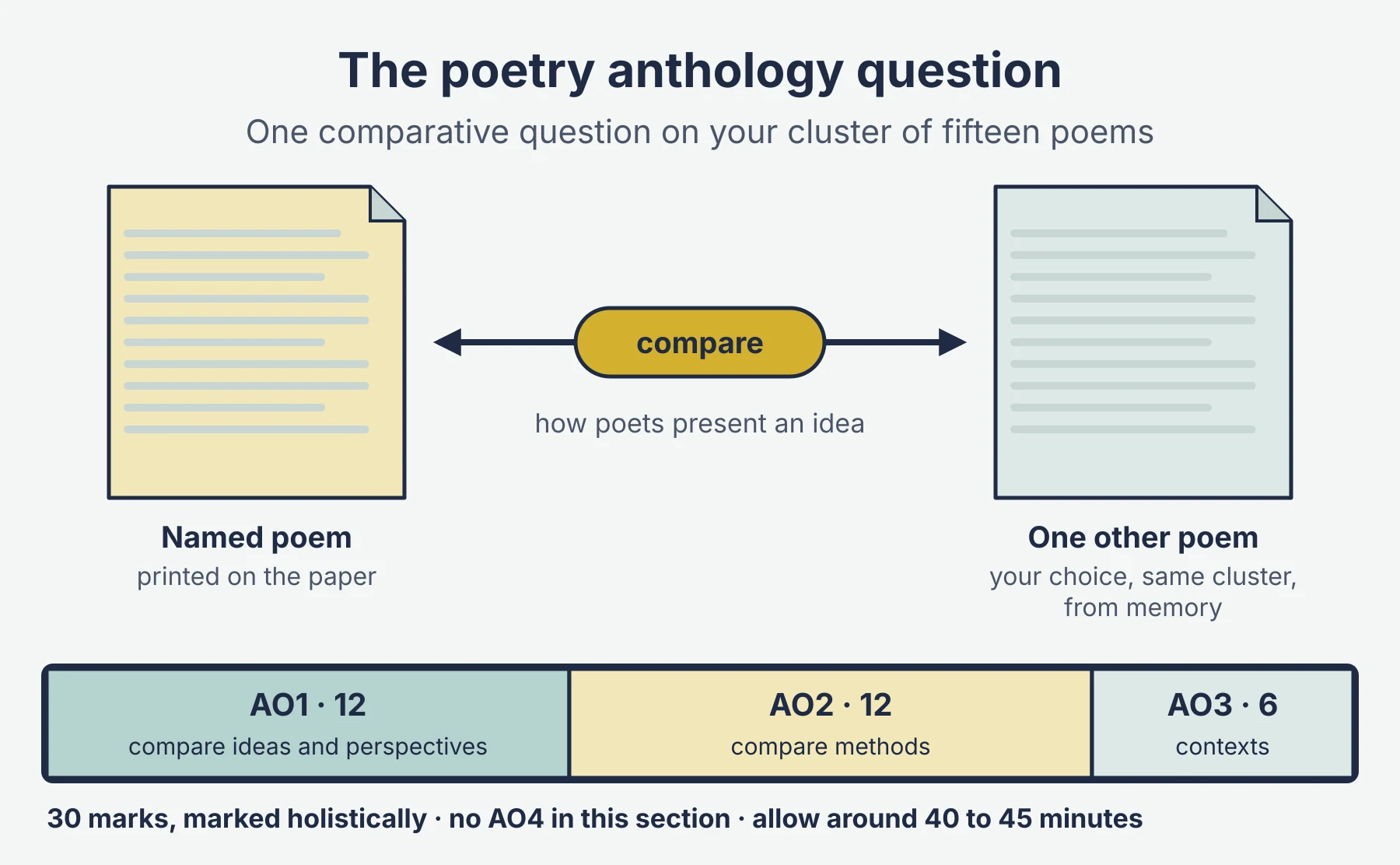
| Texts | One cluster of 15 poems from Poems Past and Present, all studied |
| Clusters | Love and Relationships; Power and Conflict; Worlds and Lives |
| Question | One comparative question |
| Printed | One named poem only |
| From memory | The second poem, chosen by you from the same cluster |
| Marks | 30 (no AO4) |
| Split in AQA mark schemes | AO1 12, AO2 12, AO3 6 |
Core recall
- Compare from the first sentence. The question is comparative; separate essays score lower.
- Method, not just meaning. Compare how poets present the idea: voice, form, structure, language.
- Choose the second poem for contrast or connection, and for quotations you can recall.
- All fifteen poems must be revised; any can be named.
- Context is the smallest share of the marks; keep it brief and linked to a method or idea.
- Balance the two poems, even though only one is printed.
Key terms
| Term | Meaning | Typical effect |
|---|---|---|
| Speaker / persona | The voice of the poem, not necessarily the poet | Perspective, irony |
| Dramatic monologue | One character speaks to a silent listener | Reveals more than the speaker intends |
| Sonnet | Fourteen-line poem, often with a turn (volta) | Argument, love, compression |
| Free verse | No regular metre or rhyme | Natural speech, freedom or disorder |
| Ballad | Narrative poem with regular stanzas and rhyme | Story, tradition, inevitability |
| Volta | Turn in thought or tone | Change of attitude |
| Enjambment | Sentence runs over the line end | Flow, urgency, overflow of feeling |
| Caesura | Pause within a line | Interruption, hesitation, emphasis |
| End-stopping | Line ending with punctuation | Control, finality |
| Half rhyme | Near rhyme with mismatched sounds | Unease, incompleteness |
| Sibilance | Repeated “s” sounds | Softness, menace, whispering |
| Extended metaphor | Metaphor developed across lines | Builds a theme through one image |
| Cyclical structure | Ending returns to opening | Entrapment, continuity |
| Juxtaposition | Contrasting images side by side | Highlights difference |
Comparison grid
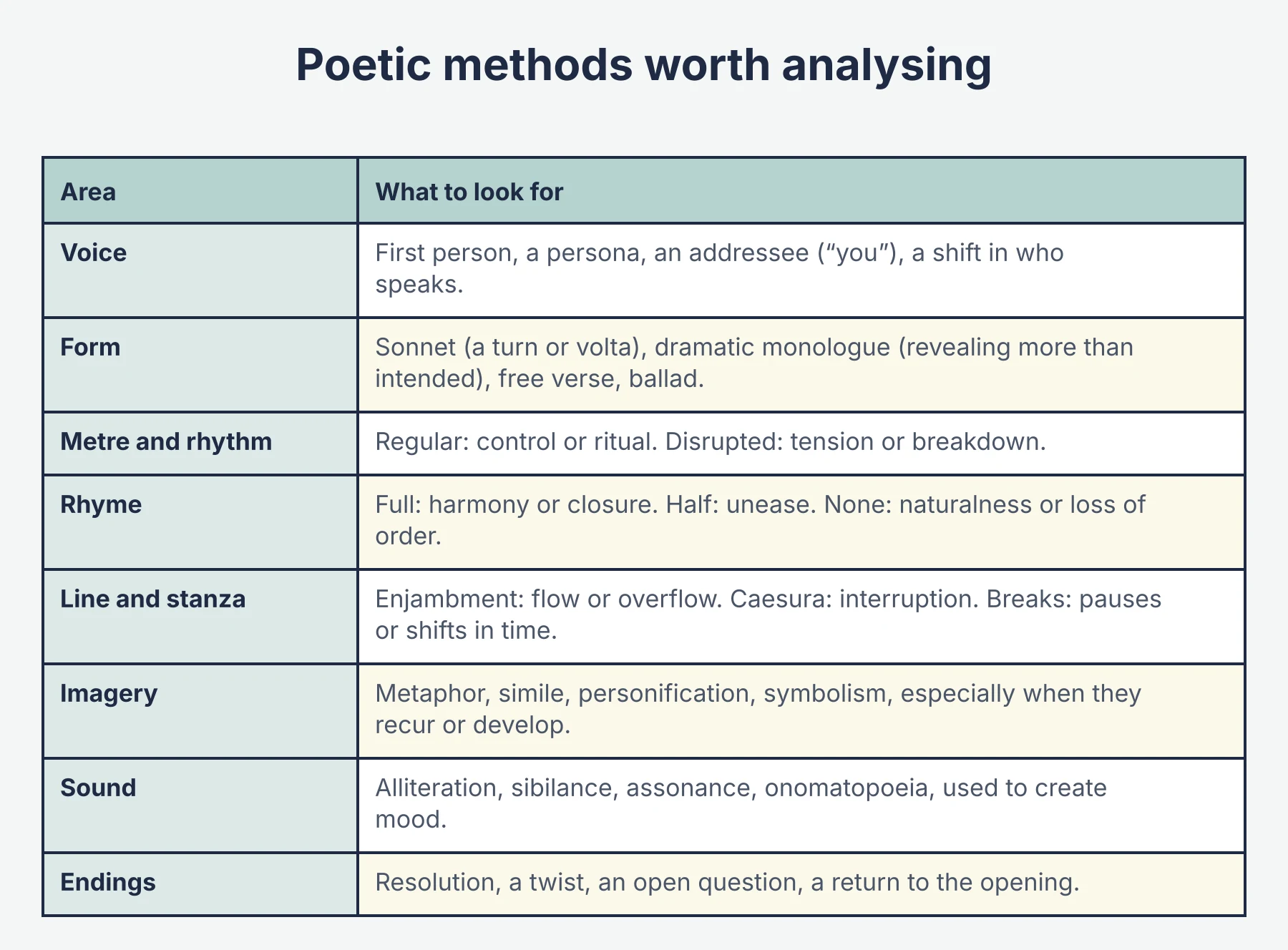
Draw a table with the fifteen poems down the side and recurring ideas across the top. For each tick, add one quotation and one method. On the day, a named poem plus the question’s idea points you to two or three candidate partners.
One revision card per poem
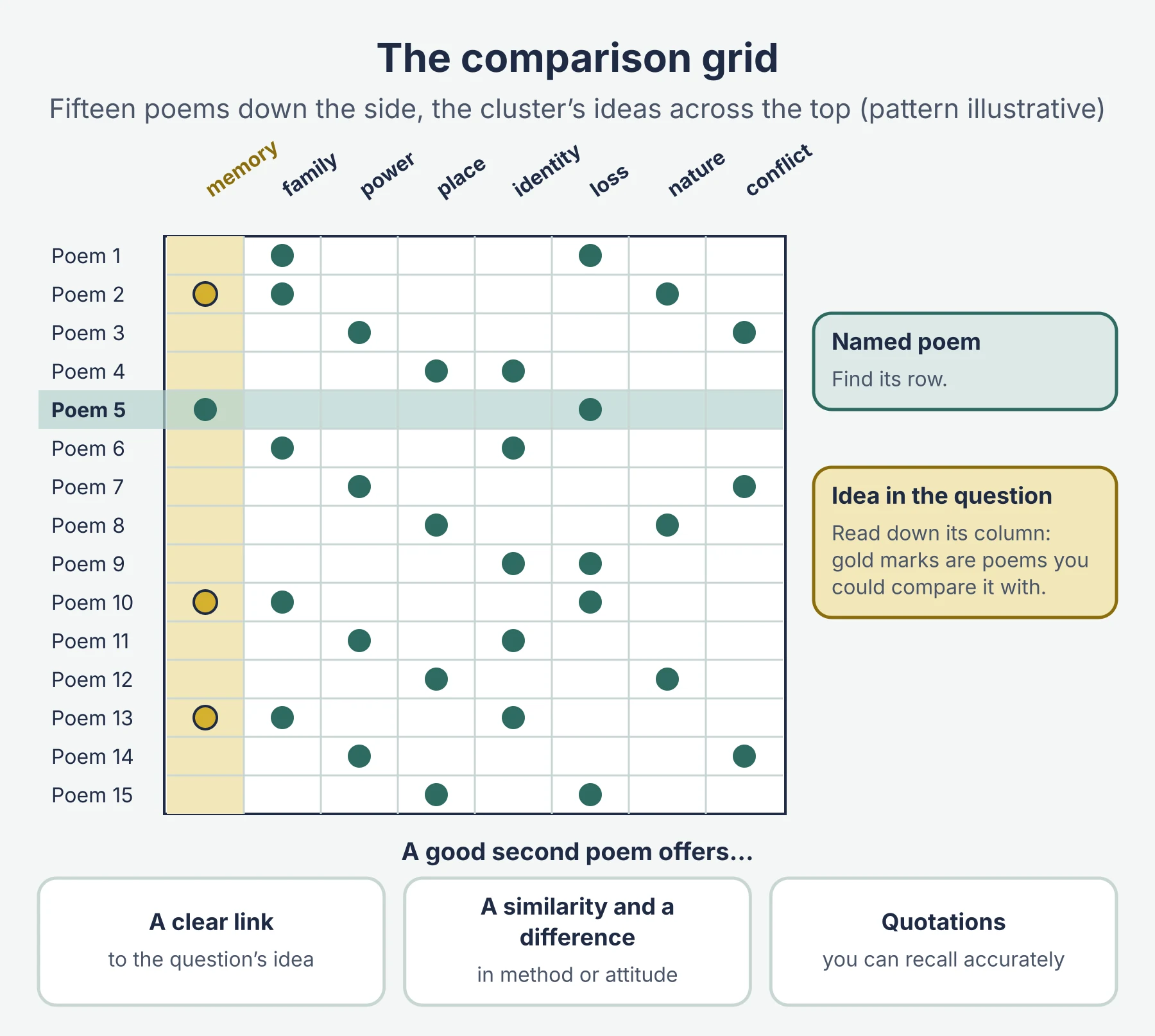
For each of the fifteen poems, fill one card:
- Speaker and situation in one line.
- Central idea and whether the attitude shifts.
- Form and one reason the poet might have chosen it.
- Structure: one feature of shape and one of the ending.
- Three short quotations, each with a method.
- One context point that explains a choice.
- Two partner poems with a similarity and a difference noted.
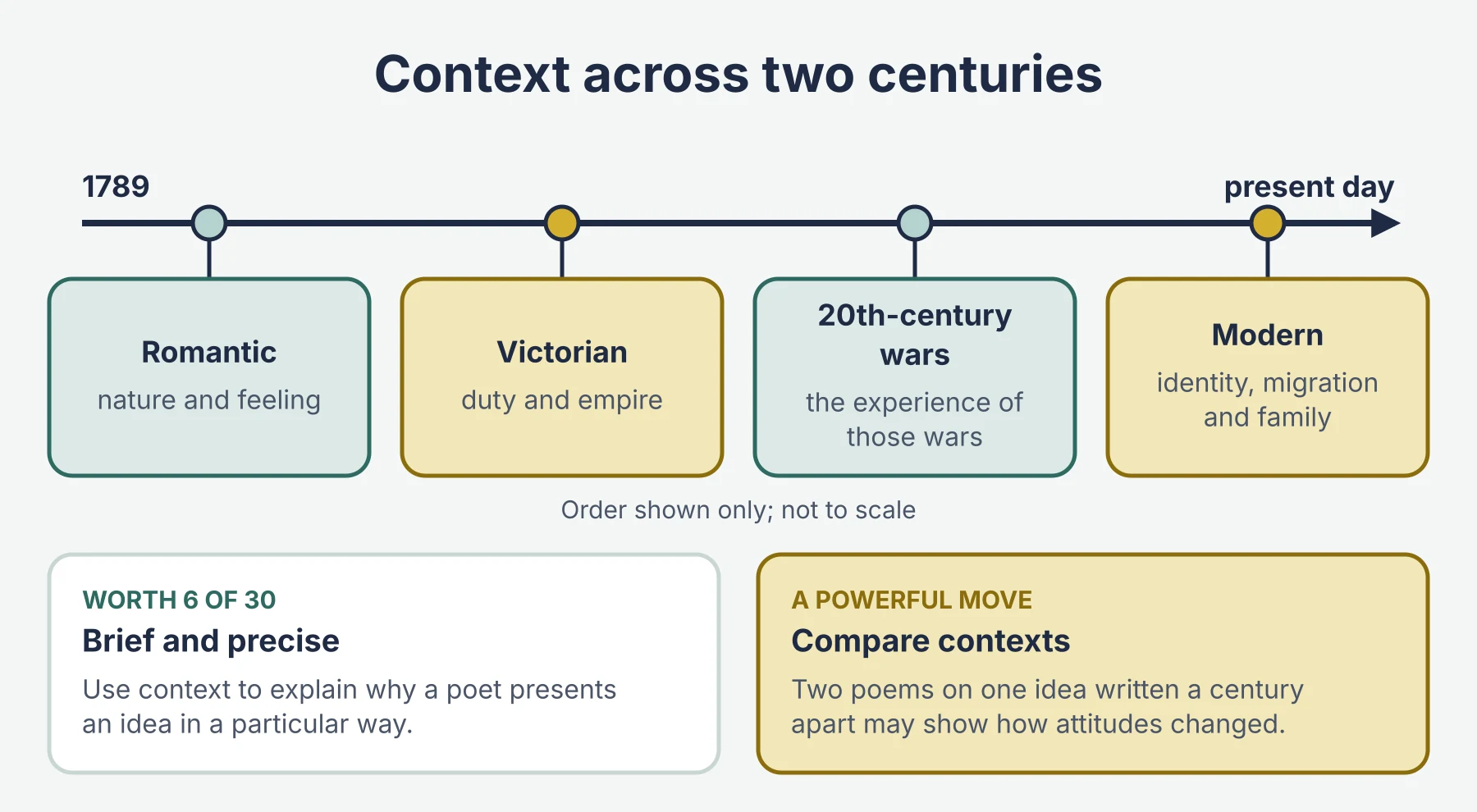
Context by period, briefly
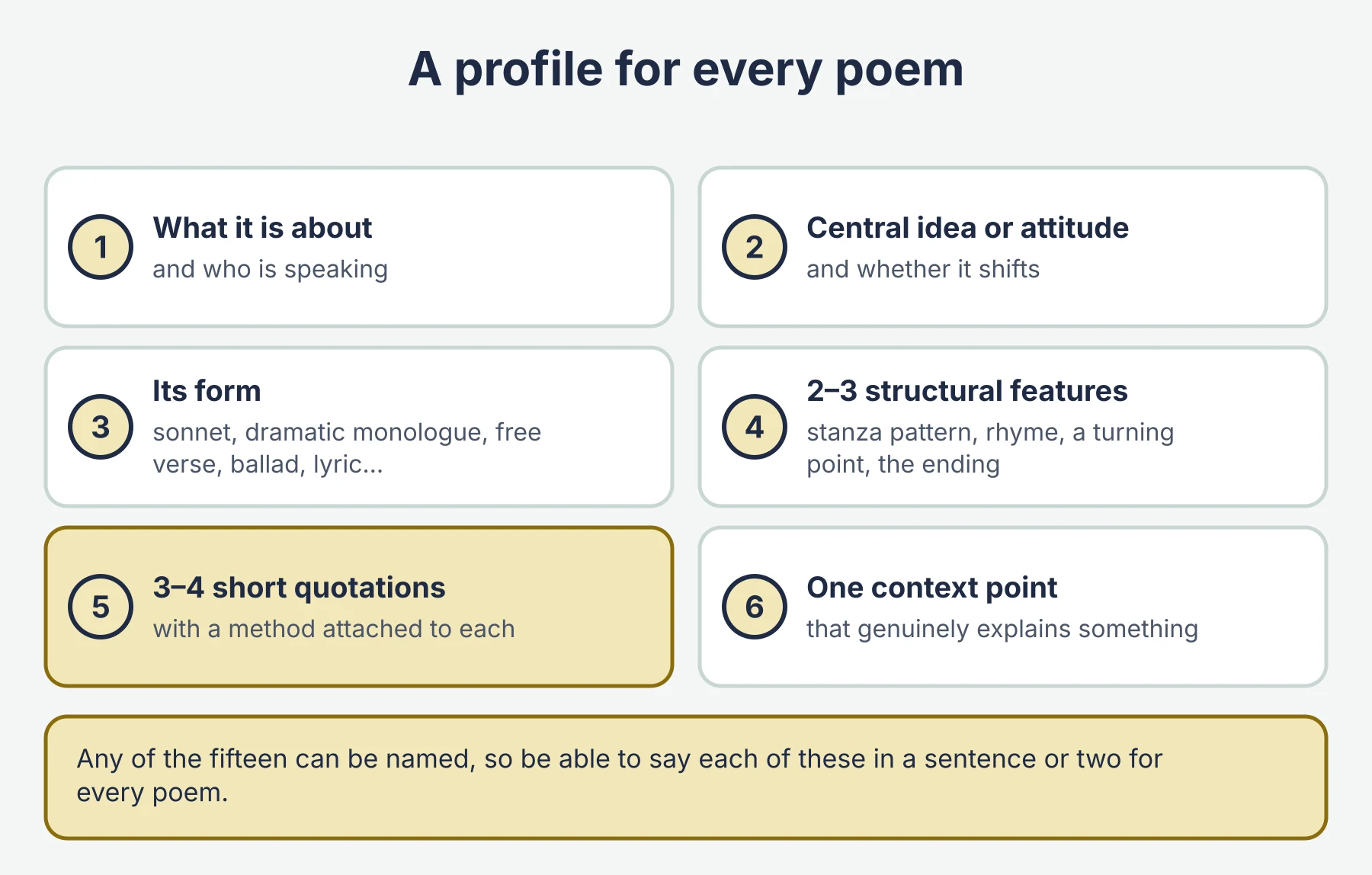
| Period | Ideas that may be relevant |
|---|---|
| Romantic era | Nature, feeling, imagination, the individual |
| Victorian era | Duty, faith and doubt, empire, social change |
| Twentieth-century wars | Patriotism questioned, trauma, loss |
| Recent decades | Identity, migration, family, place, voice |
Use these only where they fit the poem in front of you.
Comparative connectives
| Similarity | Difference | Weighing |
|---|---|---|
| Similarly | In contrast | More strikingly |
| Likewise | Whereas | Even more |
| Both poets | However | Less directly |
| In the same way | On the other hand | Ultimately |
Paragraph shape
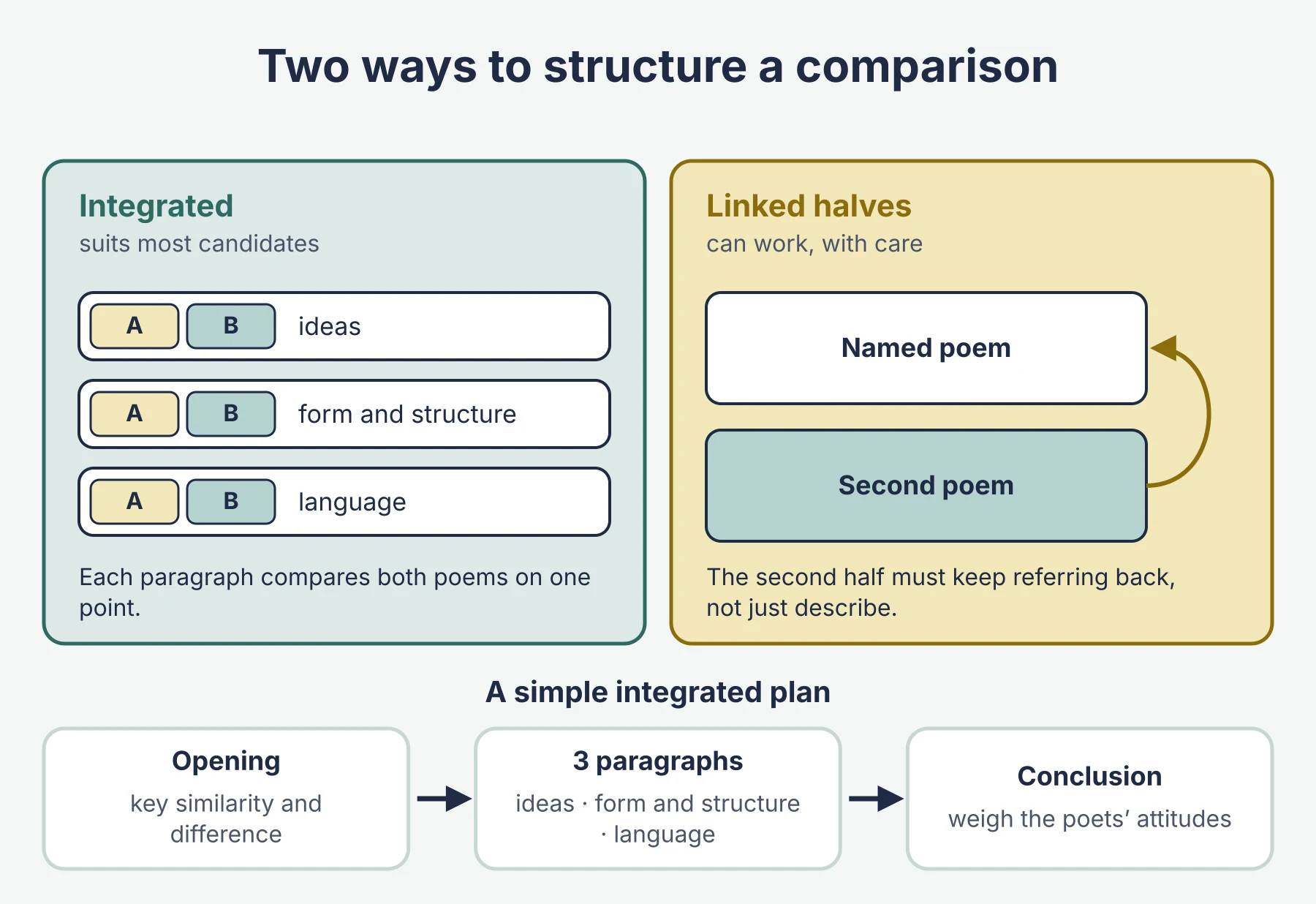
- Comparative point that covers both poems.
- Evidence and method from the named poem.
- Evidence and method from the second poem.
- Comparison of effects, ending with a judgement.
- Context only if it explains a difference or similarity.
Exam traps
- Two halves, one link. Writing separately about each poem with a comparison only at the end.
- Theme-only comparison. “Both are about conflict” gives nothing to analyse.
- Unbalanced coverage of the printed poem at the expense of the remembered one.
- Inventing quotations for the second poem; refer precisely to images or moments instead.
- Spending too long and leaving too little time for Section C.
- Biography instead of analysis. A poet’s life matters only where it explains a choice.
- Confusing poet and speaker, especially in dramatic monologues.
Self-test
- How many poems are in a cluster, and how many must you study?
- Which poem is printed on the paper?
- How many marks is the question worth, and is AO4 assessed?
- Which objective carries the smallest share of this question’s marks?
- What is a dramatic monologue?
- What is a volta, and where is it often found?
- Give one effect of half rhyme.
- What is the difference between enjambment and end-stopping?
- Name two things that make a good second poem.
- What is an integrated comparison structure?
- Why should you distinguish the poet from the speaker?
- Give two comparative connectives for difference.
Answers
- Fifteen; you study all fifteen.
- The named poem in the question. The second poem must be recalled.
- 30 marks; no, AO4 is not assessed in this section.
- AO3, context (6 of the 30 in AQA’s mark schemes).
- A poem in which one character speaks to a silent listener, often revealing more than they intend.
- A turn in thought or tone, often found in sonnets.
- It can create unease, incompleteness or a sense that something is slightly wrong.
- Enjambment lets the sentence run on past the line end; end-stopping closes the line with punctuation.
- Any two of: a clear link to the question’s idea; a meaningful similarity and difference in method; quotations you can recall accurately.
- Each paragraph compares one point across both poems rather than treating them separately.
- Because the speaker may be a persona with views the poet does not share, especially in a dramatic monologue.
- Any two of: whereas, in contrast, however, on the other hand.
More resources on this topic
Related resources
-
Practice questions
AQA GCSE English Literature (8702): Unseen Poetry – Practice Questions
Original unseen poetry practice for AQA GCSE English Literature 8702 Paper 2 Section C: two original poems, the 24-mark and 8-mark tasks, with answers.
English Literature · AQA · GCSE
Try questions -
Revision notes
AQA GCSE English Literature (8702): Unseen Poetry – Revision Notes
Condensed notes on unseen poetry in AQA GCSE English Literature 8702 Paper 2 Section C: the 24-mark and 8-mark tasks, key terms, traps and a self-test.
English Literature · AQA · GCSE
Revise topic -
Study guides
AQA GCSE English Literature: Modern Texts and Poetry (8702)
AQA GCSE English Literature 8702 Paper 2 Modern Texts and Poetry: the modern prose or drama text, the anthology cluster, unseen poetry and the paper's format.
English Literature · AQA · GCSE
Read guide
Get free revision emails (optional)
Occasional emails with practice questions, worked explanations and links to free resources for the qualification and subjects you choose. No spam, and you can unsubscribe from any email. The free tools on this site never need an email.