
Study Guides
AQA GCSE English Literature (8702): Poetry
How to compare poems from your anthology cluster for AQA GCSE English Literature 8702 Paper 2 Section B: poetic methods, context and comparison structure.
- Subject
- English Literature
- Level
- GCSE
- Topic
- Paper 2 – Modern Texts and Poetry
- Author
- Marlbridge Academic Team
- Updated
- Reviewed by
- Ammar Bilal (what this means)
Aligned to AQA GCSE English Literature (8702), For first teaching 2015. Official specification .
Syllabus page (what it covers and how it is assessed): AQA GCSE English Literature.
Syllabus points this page covers
8702
- 3.2.2 Poetry
Found an error? Report a correction.
Need help with this topic? Request a free trial class for GCSE English Literature (8702).
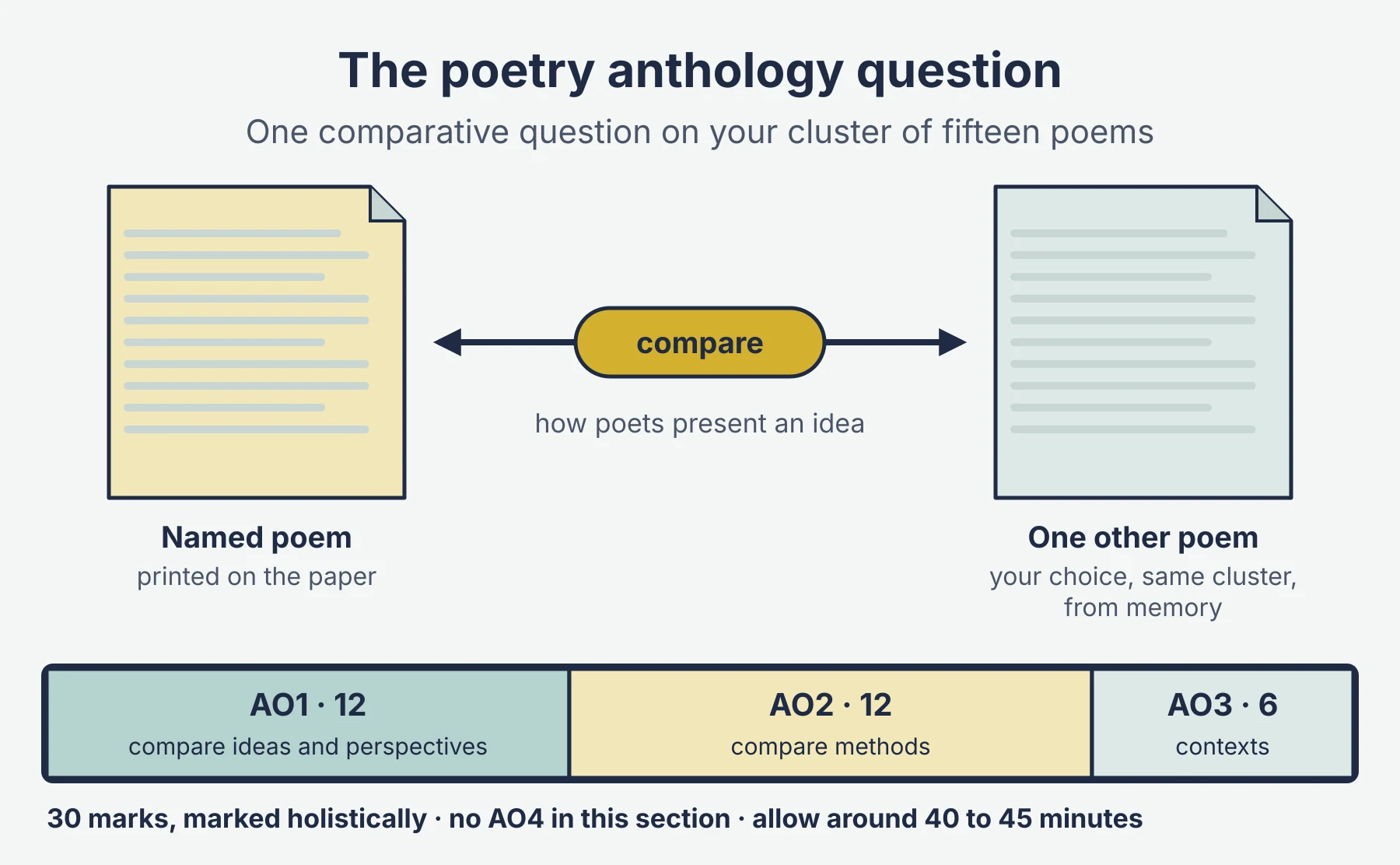
Section B of Paper 2 is the poetry anthology question. You study one cluster of fifteen poems from the AQA anthology Poems Past and Present: Love and Relationships, Power and Conflict, or Worlds and Lives. The poems in each cluster are thematically linked and were written between 1789 and the present day. You must study all fifteen and be ready to write about any of them. In the exam there is one comparative question: one named poem is printed on the paper, and you compare it with one other poem of your choice from the same cluster, which you must recall from memory. For the shape of the paper, see the Paper 2 overview.
What the question rewards
The question is worth 30 marks, split in AQA’s published mark schemes as AO1 12, AO2 12 and AO3 6. There are no AO4 marks in this section. Marking is holistic, and the comparison runs through all three objectives: you compare ideas and perspectives (AO1), methods (AO2) and, where relevant, contexts (AO3).
The question is usually phrased “Compare how poets present [an idea] in [the named poem] and in one other poem from [your cluster].” The key words are compare, how and present: the task is about the poets’ methods for presenting an idea, examined side by side.
Knowing fifteen poems
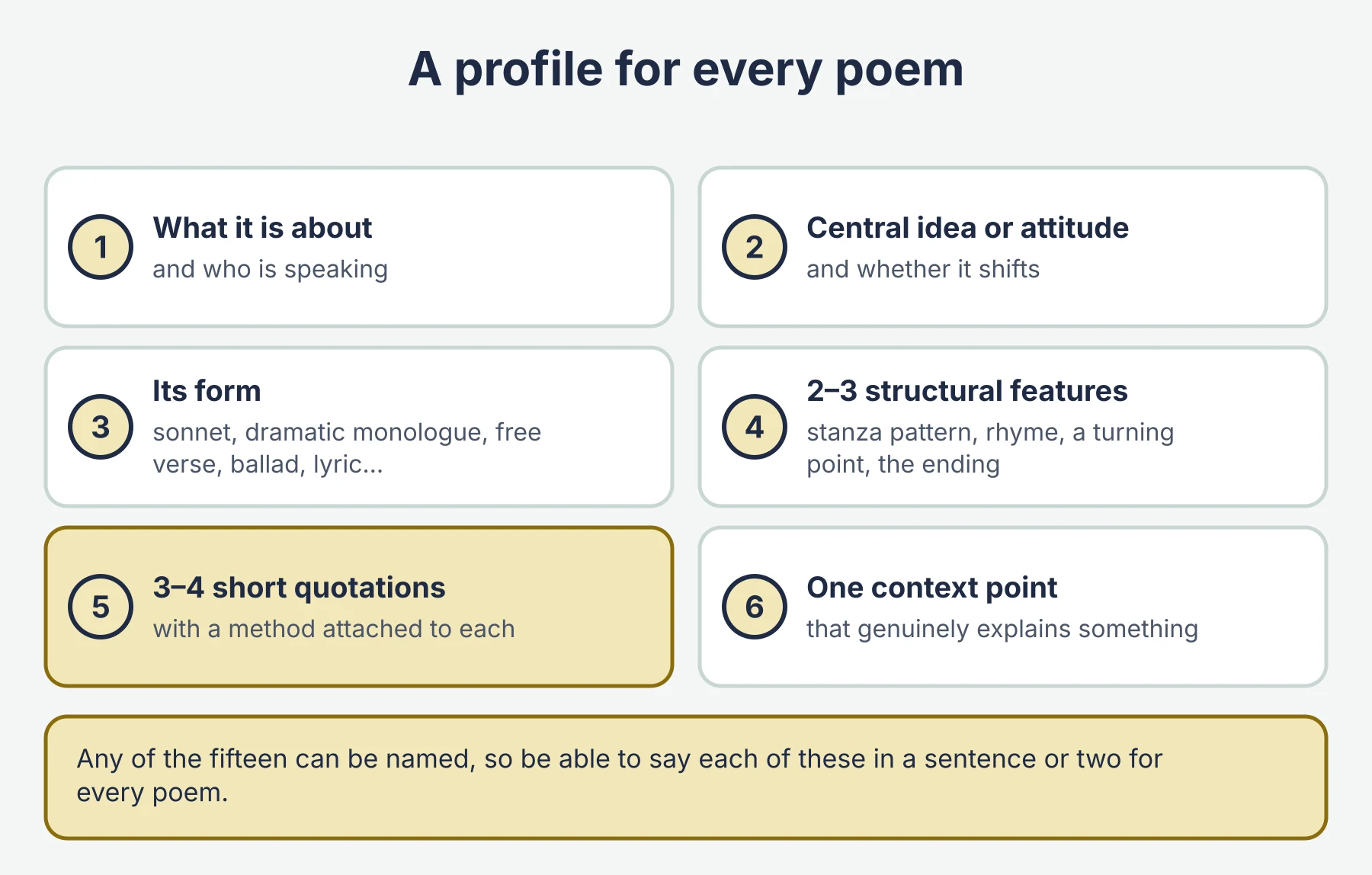
Because any poem can be named, revision must be broad. For each poem, be able to state in a sentence or two:
- What it is about and who is speaking.
- Its central idea or attitude, and whether it shifts.
- Its form: sonnet, dramatic monologue, free verse, ballad, lyric, or something else.
- Two or three structural features: stanza pattern, rhyme or its absence, a turning point, the ending.
- Three or four short quotations with a method attached to each.
- One context point that genuinely explains something in the poem.
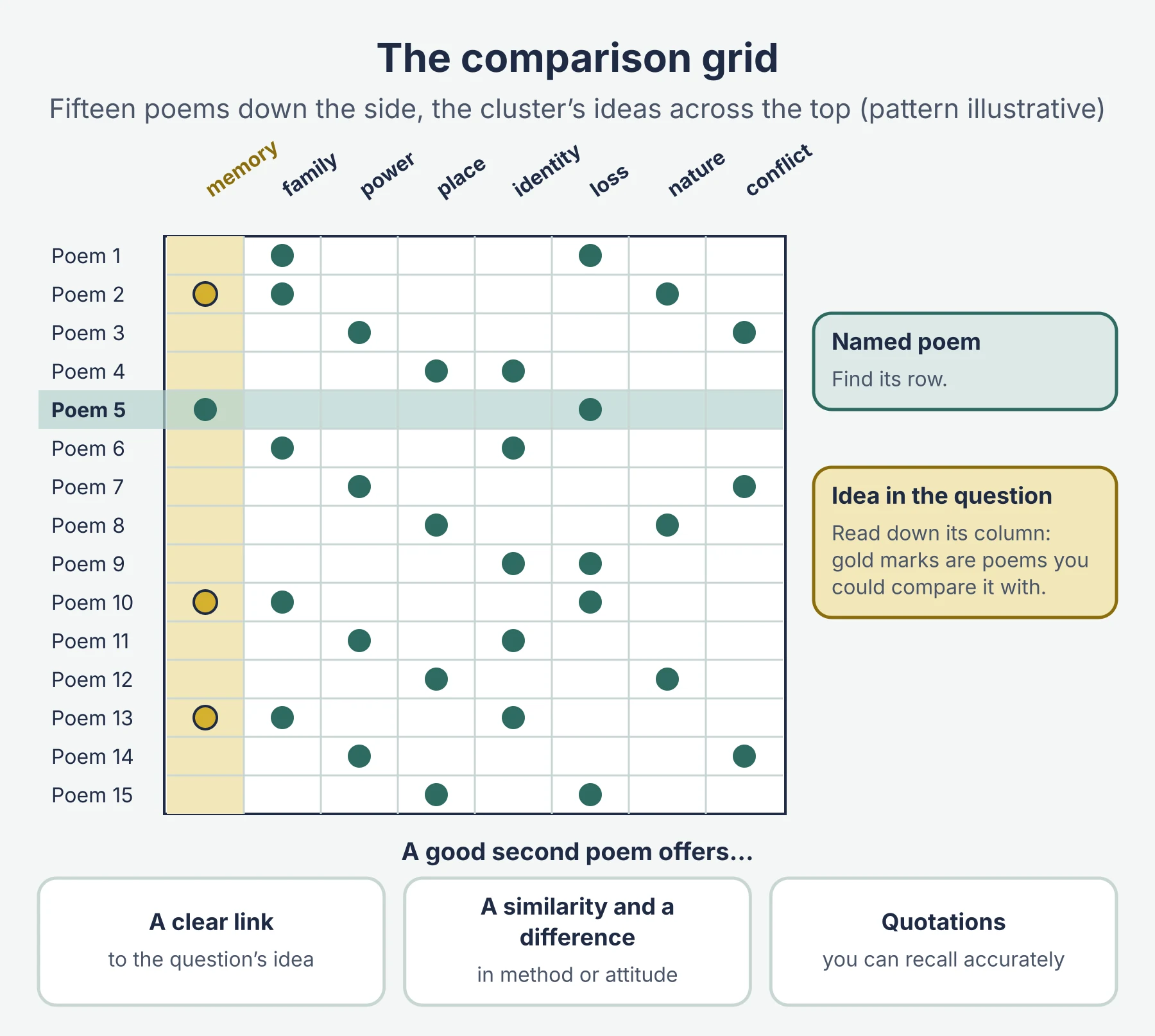
Then build a comparison grid: list the fifteen poems down the side and the cluster’s recurring ideas across the top (for example memory, family, power, place, identity, loss, nature, conflict). Tick where a poem fits. When a poem is named on the paper, the grid tells you which two or three poems you could compare it with for the idea in the question.
Choosing the second poem
Choose the poem that gives you the most to compare, not simply your favourite. Good choices offer:
- A clear link to the question’s idea.
- A meaningful similarity and a meaningful difference in method or attitude.
- Quotations you can recall accurately under pressure.
Prepare two or three “go-to” poems that connect with many others, but always check that your choice fits the specific idea in the question.
Poetic methods worth analysing
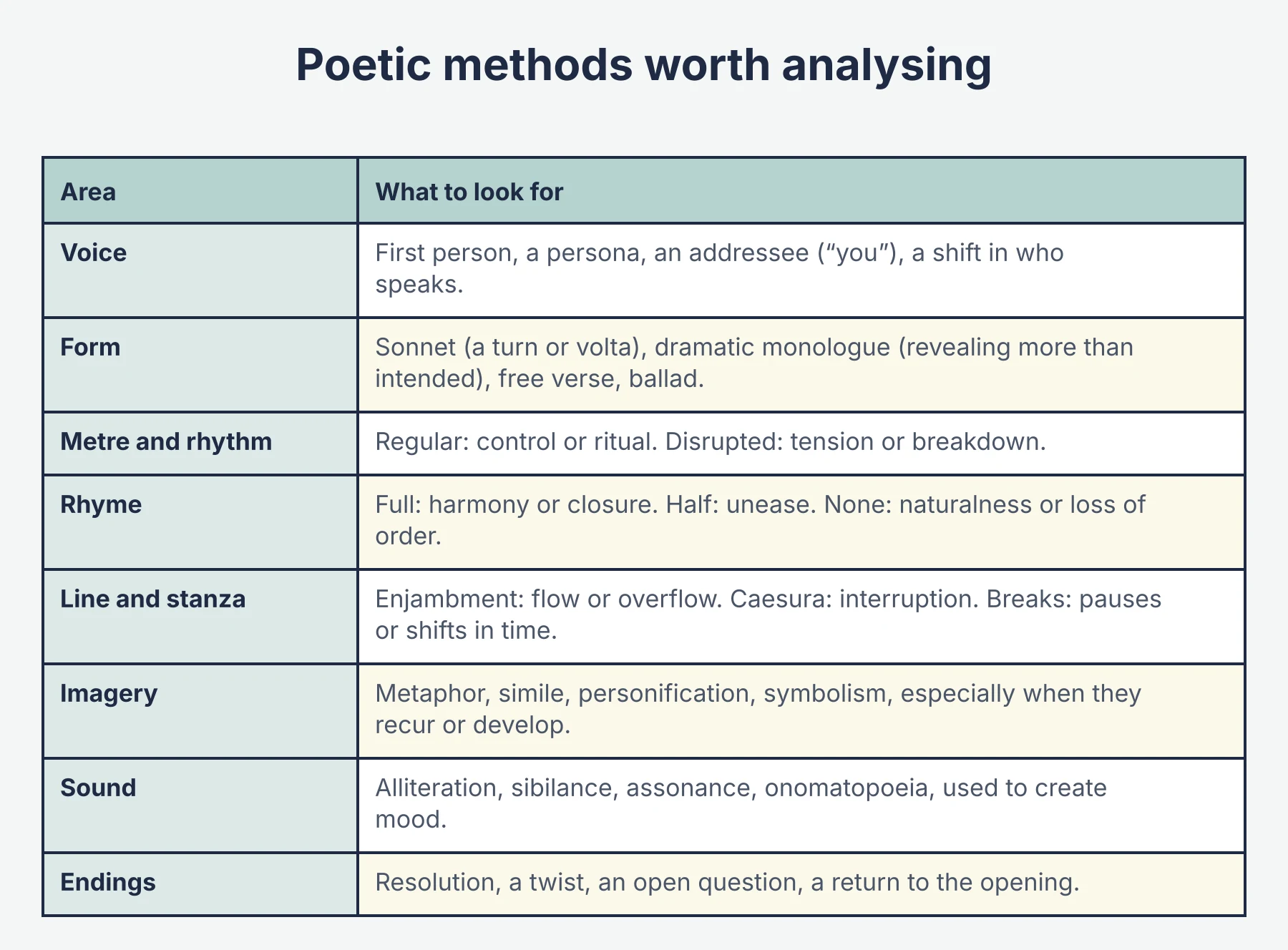
| Area | What to look for |
|---|---|
| Voice | First person, a persona, an addressee (“you”), a shift in who speaks |
| Form | Sonnet (often love or argument, with a turn or volta), dramatic monologue (a character revealing more than they intend), free verse (freedom or disorder), ballad (story, song, tradition) |
| Metre and rhythm | Regular rhythm can suggest control or ritual; disrupted rhythm can suggest tension or breakdown |
| Rhyme | Full rhyme for harmony or closure; half rhyme for unease; absence of rhyme for naturalness or loss of order |
| Line and stanza | Enjambment for flow or overflow; caesura for interruption; stanza breaks as pauses or shifts in time |
| Imagery | Metaphor, simile, personification and symbolism, especially when they recur or develop |
| Sound | Alliteration, sibilance, assonance, onomatopoeia, used to create mood |
| Endings | Resolution, a twist, an open question, a return to the opening |
Context across two centuries
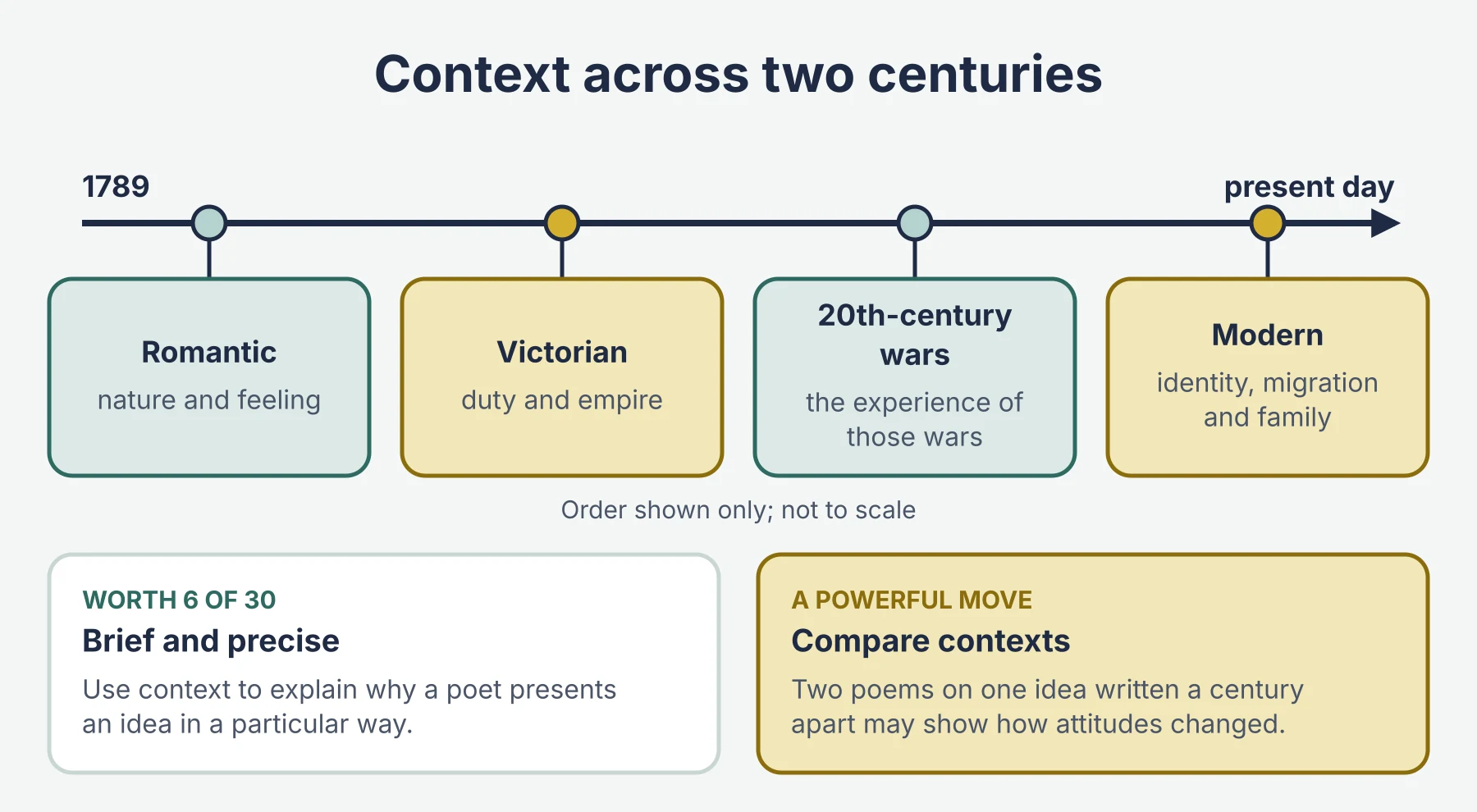
Because the cluster spans more than two hundred years, contexts differ widely: the Romantic interest in nature and feeling, Victorian ideas about duty and empire, the experience of twentieth-century wars, and modern writing about identity, migration and family. Context is worth only 6 of the 30 marks, so use it briefly and precisely to explain why a poet presents an idea in a particular way. Comparing contexts can be powerful: two poems on the same idea written a century apart may show how attitudes changed.
Worked example
The two poems below are original, written for this resource to model the method. They are not anthology poems.
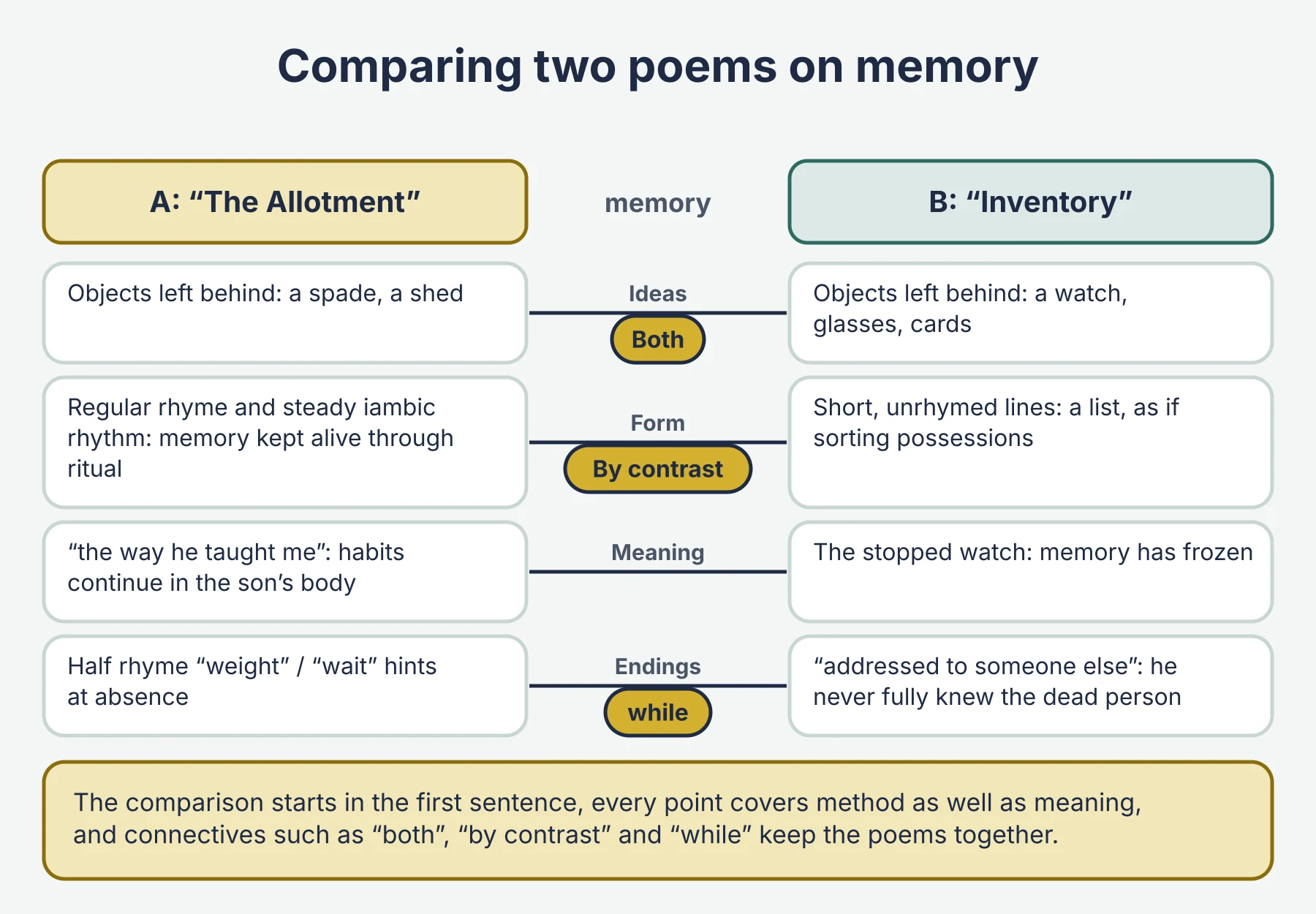
Original poem A, “The Allotment” My father’s spade still leans against the shed, its handle polished by a different hand, the blade gone orange where the rain has fed on what he left unfinished in the land. I dig the way he taught me, foot then weight, and turn the soil he turned for forty years; the robin that he fed comes down to wait, as if it knows the gardener disappears.
Original poem B, “Inventory” One watch, stopped. Two pairs of glasses, both for reading. A shoebox of birthday cards, every one addressed to someone else.
Question focus: compare how the poets present memory.
Annotated comparative paragraph:
Both poets present memory through objects left behind, but they use form to create opposite effects. In “The Allotment”, the regular rhyme scheme and steady iambic rhythm suggest that the speaker keeps memory alive through ritual, digging “the way he taught me” so that the father’s habits continue in the son’s body [AO2: form and rhythm; AO1: comparison of ideas]. By contrast, “Inventory” lists its objects in short, unrhymed lines, as if the speaker is sorting possessions rather than recalling a person; the stopped watch suggests that memory has frozen rather than continued [AO2: structure]. The endings sharpen the difference. Poem A closes on the half rhyme of “weight” and “wait”, a slight mismatch that hints at the absence the robin seems to sense, while Poem B’s final line reveals that the cards were “addressed to someone else”, turning the list into a discovery that the speaker never fully knew the dead person [AO2: endings; AO1: interpretation].
Notice that the comparison starts in the first sentence, that every point is about method as well as meaning, and that connectives such as “both”, “by contrast” and “while” keep the poems together.
Structuring a comparison
Two structures work well:
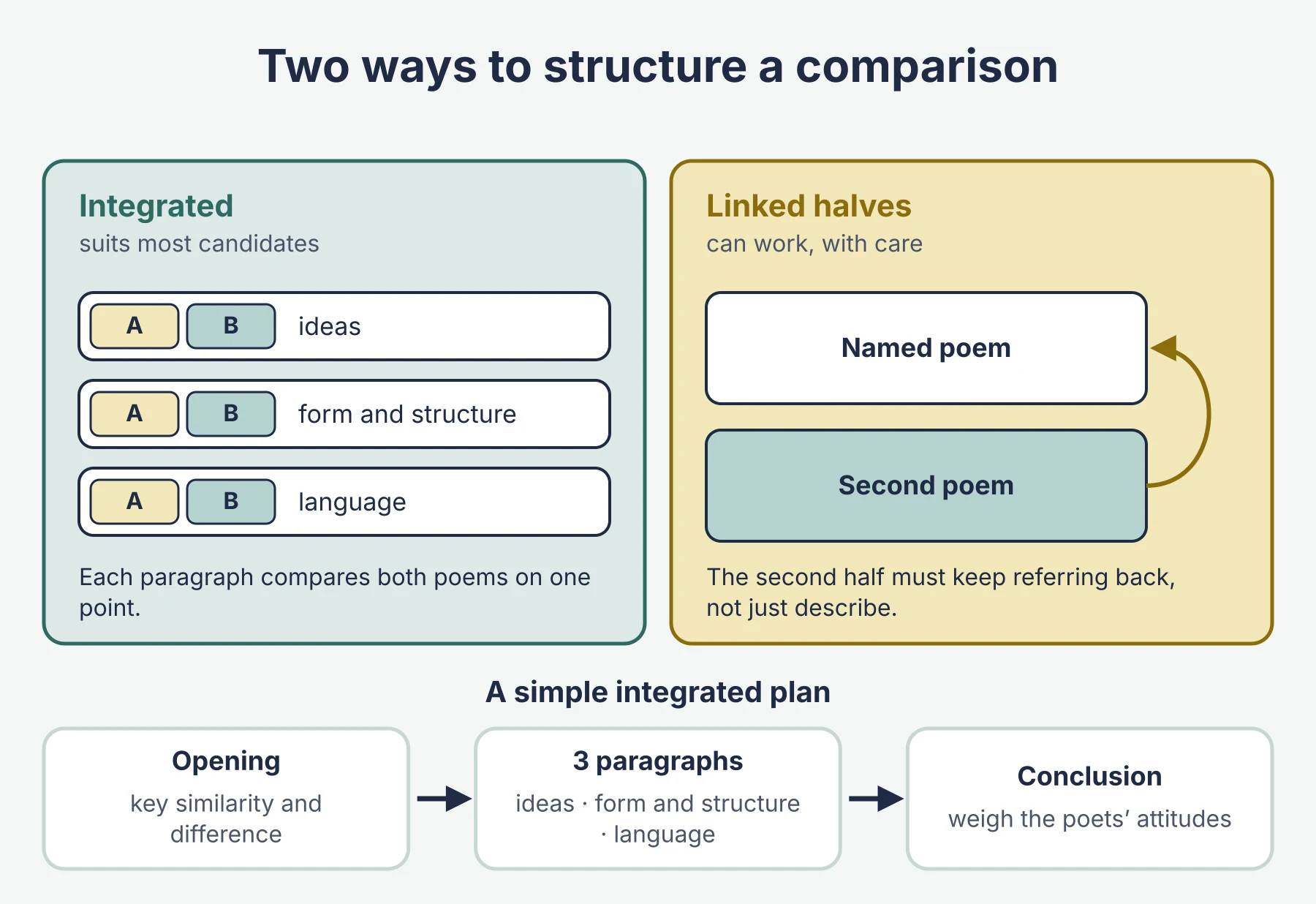
- Integrated: each paragraph covers one point of comparison across both poems. This keeps the comparison active throughout and suits most candidates.
- Linked halves: write about the named poem first, then the second poem, constantly referring back to the first. This can work, but only if the second half compares rather than describes.
A simple plan for integrated paragraphs: an opening that states the key similarity and difference; three paragraphs on ideas, form and structure, and language, each comparing both poems; a brief conclusion that weighs the poets’ attitudes.
Common mistakes
- Writing two separate essays with a single comparative sentence at the end.
- Comparing only subject matter: “Both poems are about war.”
- Choosing the second poem for convenience rather than connection.
- Neglecting the second poem because it is not printed; aim for balanced coverage.
- Misremembering quotations from the second poem; brief, precise references are safer.
- Overloading context, which carries fewer marks than AO1 and AO2.
- Feature-spotting: naming enjambment or alliteration without explaining its effect.
Exam technique
- Spend about five minutes choosing the second poem and planning three comparative points.
- Annotate the printed poem quickly for methods linked to the question.
- Write the second poem’s key quotations at the top of your plan before you start, while they are fresh.
- Keep both poems in every paragraph where you can, using comparative connectives.
- Allow around 40 to 45 minutes for 30 marks, leaving enough time for Section C.
More resources on this topic
The anthology clusters are set by AQA and can change, so check which cluster and edition your school uses.
Related resources
-
Practice questions
AQA GCSE English Literature (8702): Poetry – Practice Questions
Original poetry comparison practice for AQA GCSE English Literature 8702 Paper 2 Section B: two original poems and cluster essays with answers.
English Literature · AQA · GCSE
Try questions -
Revision notes
AQA GCSE English Literature (8702): Poetry – Revision Notes
Condensed notes on the anthology poetry comparison in AQA GCSE English Literature 8702 Paper 2 Section B: poetic terms, comparison grid, traps and a self-test.
English Literature · AQA · GCSE
Revise topic -
Practice questions
AQA GCSE English Literature (8702): Unseen Poetry – Practice Questions
Original unseen poetry practice for AQA GCSE English Literature 8702 Paper 2 Section C: two original poems, the 24-mark and 8-mark tasks, with answers.
English Literature · AQA · GCSE
Try questions
Get free revision emails (optional)
Occasional emails with practice questions, worked explanations and links to free resources for the qualification and subjects you choose. No spam, and you can unsubscribe from any email. The free tools on this site never need an email.