
Revision Notes
AQA GCSE English Literature (8702): Modern Texts – Revision Notes
Condensed notes on Paper 2 Section A modern texts for AQA GCSE English Literature 8702: choosing a question, key terms, context, traps and a self-test.
- Subject
- English Literature
- Level
- GCSE
- Topic
- Paper 2 – Modern Texts and Poetry
- Author
- Marlbridge Academic Team
- Updated
- Reviewed by
- Ammar Bilal (what this means)
Aligned to AQA GCSE English Literature (8702), For first teaching 2015. Official specification .
Syllabus page (what it covers and how it is assessed): AQA GCSE English Literature.
Syllabus points this page covers
8702
- 3.2.1 Modern texts
Found an error? Report a correction.
Need help with this topic? Request a free trial class for GCSE English Literature (8702).
Quick-recall notes for the modern prose or drama question. The full method, including a worked plan, is in the Modern texts study guide.
The task in one view
| Feature | Detail |
|---|---|
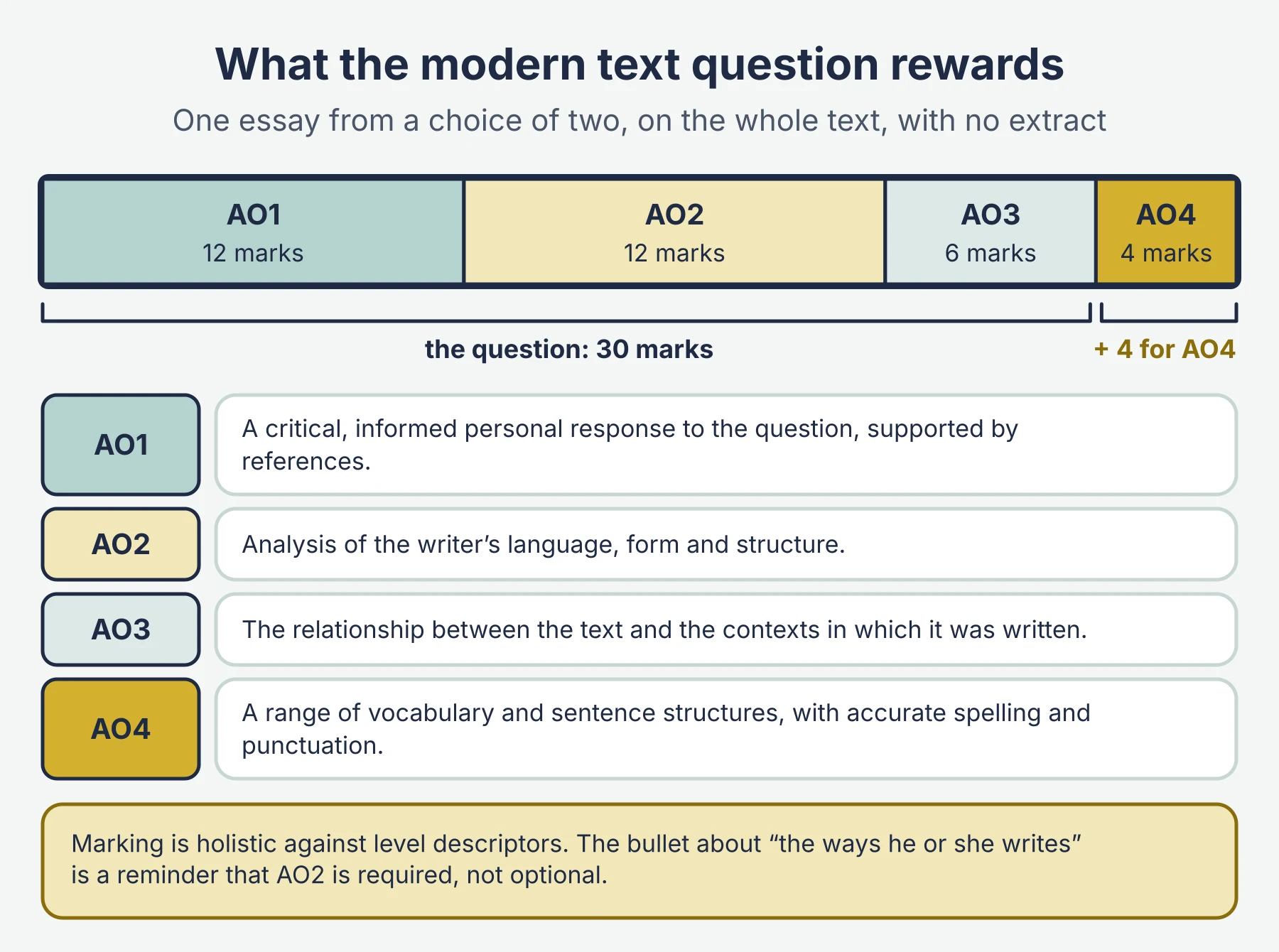
| Text | One post-1914 prose or drama text from the specification’s list of twelve |
| Question | One essay from a choice of two on your text |
| Extract | None: the whole answer comes from memory |
| Marks | 30, plus 4 for AO4 (34 of Paper 2’s 96) |
| Split in AQA mark schemes | AO1 12, AO2 12, AO3 6, then AO4 4 |
| Book | Closed |
Core recall
- No extract means your evidence must be memorised and portable: short quotations and precise references to events.
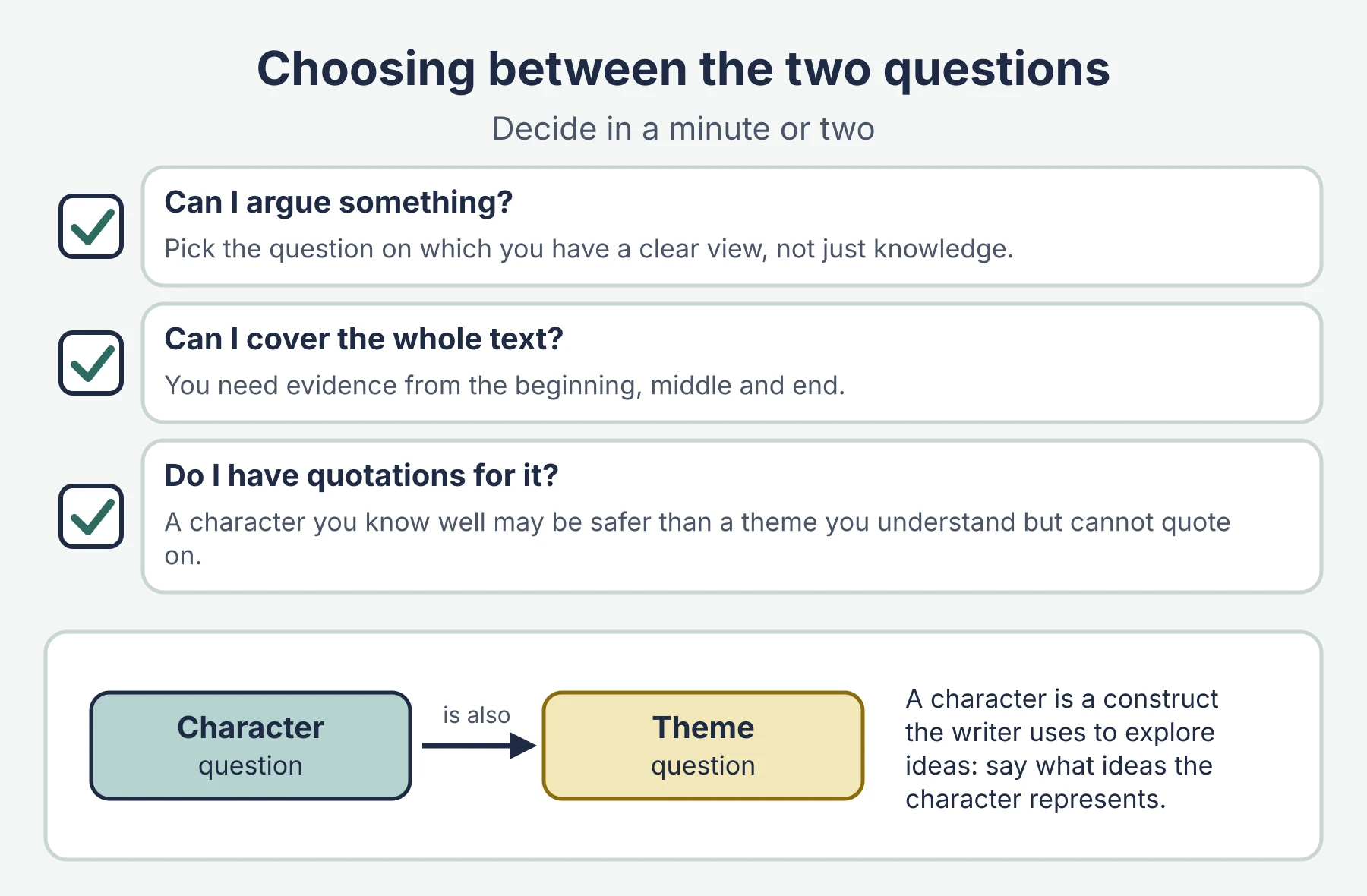
- Choose by argument, not by topic you like: which question can you answer with a clear view across the whole text?
- Characters are constructs. Say what ideas a character helps the writer explore.
- The methods bullet (“by the ways he or she writes”) is an AO2 reminder. Every paragraph needs a method.
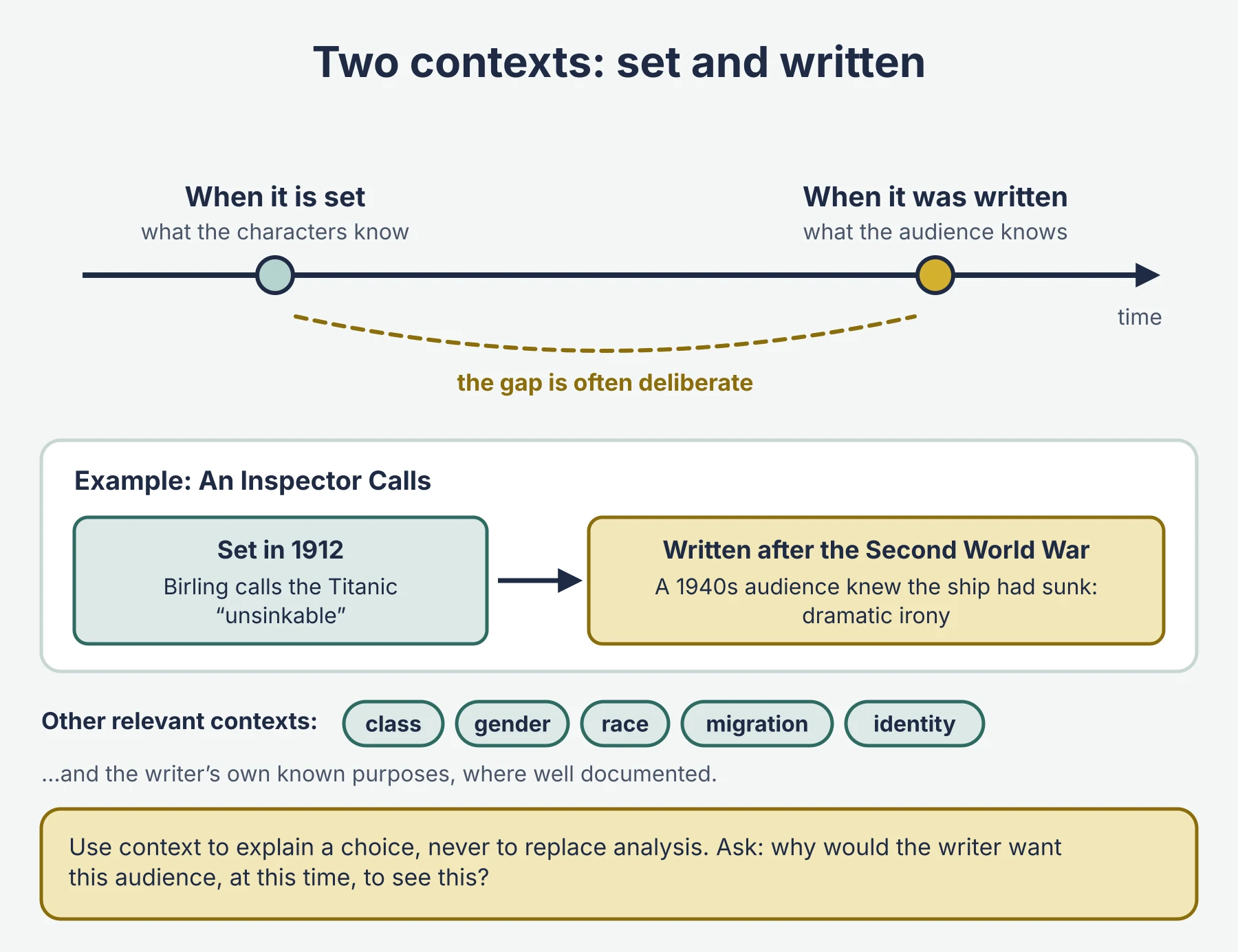
- Two contexts: when the text is set and when it was written. The gap often creates dramatic irony or a message for the audience.
- AO4 counts here. Spell names correctly, capitalise and mark titles, and vary sentences.
Key terms for drama
| Term | Meaning | Use in an answer |
|---|---|---|
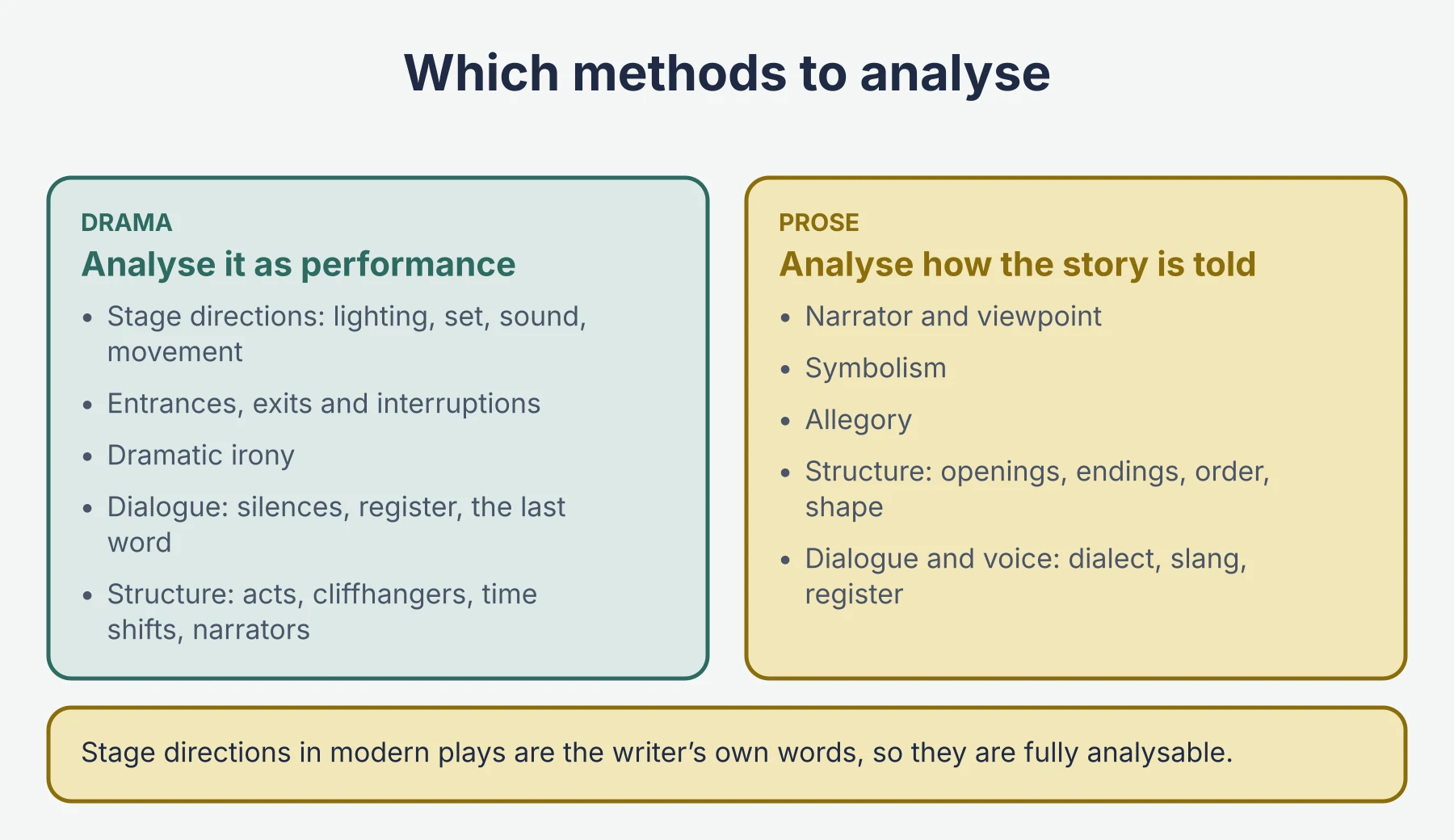
| Stage directions | Writer’s instructions for set, light, sound, movement | Analyse as the writer’s own language |
| Dramatic irony | Audience knows more than characters | Exposes characters’ blindness |
| Monologue | Long speech by one character | Reveals viewpoint, may address audience |
| Narrator or choric figure | Character who comments on action to the audience | Guides judgement, foreshadows |
| Cliffhanger | Tense end to an act or scene | Structure, suspense |
| Register | Level of formality in speech | Class, power, change in a character |
| Proxemics | How characters are positioned on stage | Distance, power, closeness |
Key terms for prose
| Term | Meaning | Use in an answer |
|---|---|---|
| Allegory | Story whose events stand for real events or ideas | Writer’s political or moral purpose |
| Symbolism | Object or place carrying wider meaning | Track how the symbol changes |
| Microcosm | Small world representing a larger society | Island, farm or street as society |
| Dialect | Regional or social variety of speech | Identity, belonging, voice |
| Child narrator | Story seen through a young viewpoint | Innocence, irony, limited understanding |
| Cyclical structure | Ending that returns to the beginning | Nothing has changed, or lesson repeated |
Memory bank template
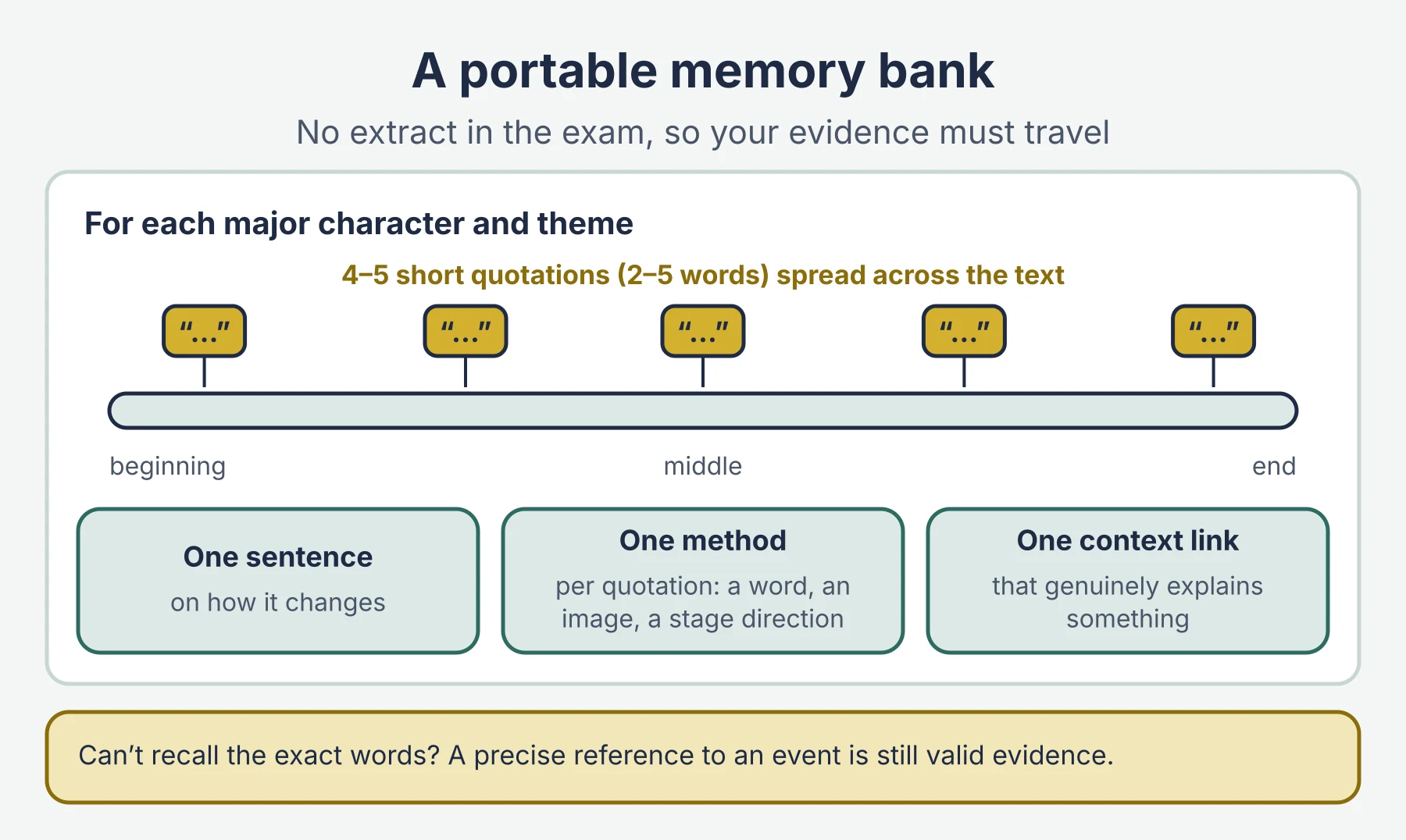
For each character and theme:
- Four or five short quotations from beginning, middle and end.
- One method per quotation that you can analyse.
- One sentence on how the character or theme changes.
- One context link that explains the writer’s purpose.
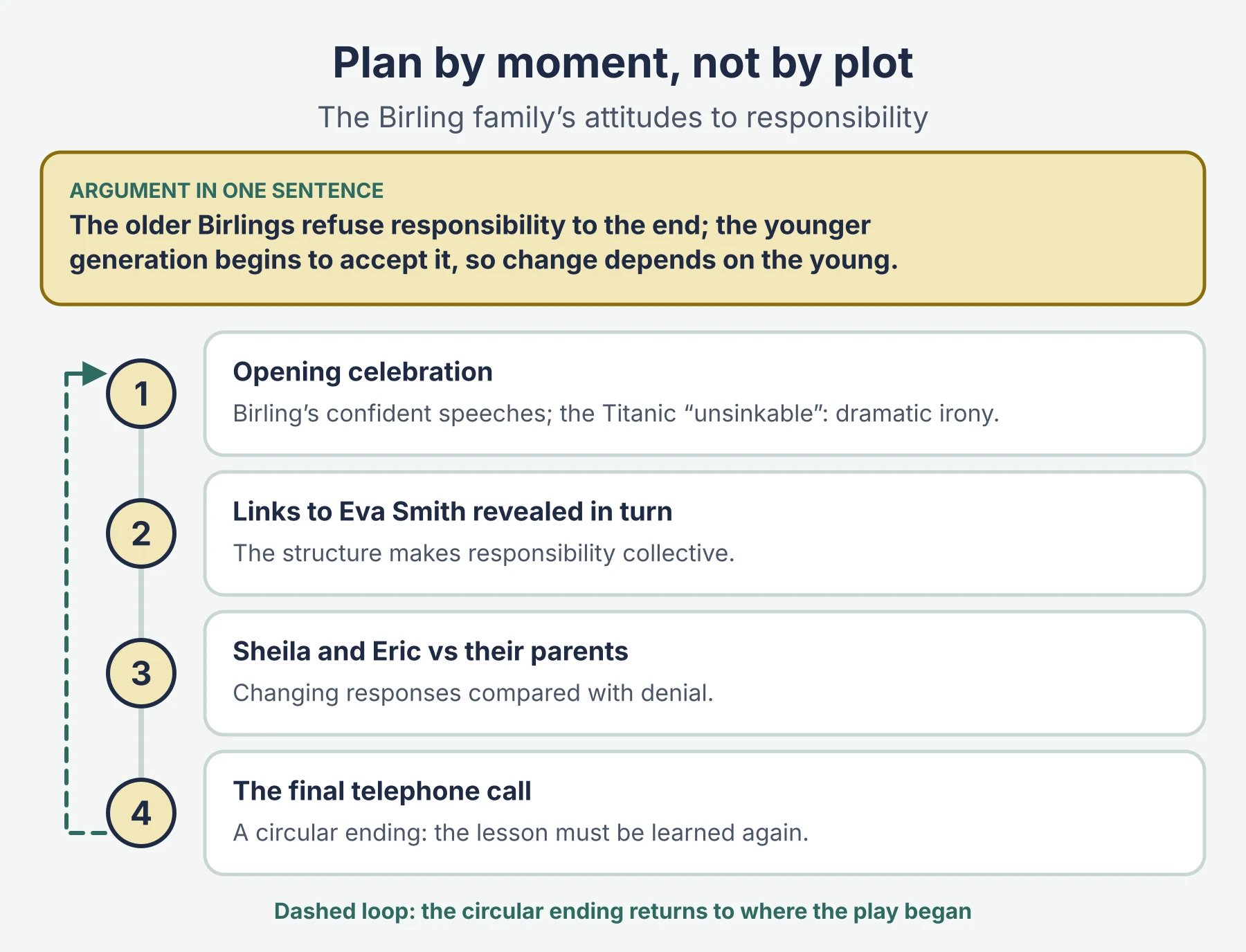
Planning in five minutes
- Underline the focus and any bullet points.
- Write a one-sentence argument that includes change or a judgement.
- Choose four moments spread across the text.
- Note a method and a quotation or event for each.
- Add one context link where it explains a choice.
Exam traps
- Plot retelling. Chronological order is fine only if each paragraph argues something.
- One-end answers. Writing only about the opening or only the ending misses development.
- No methods. An answer about what a character does, with nothing on how the writer presents it, stays low on AO2.
- Background context. “The play was written in 1945” earns nothing unless it explains a choice.
- Misnamed texts and characters. These cost AO4 marks and credibility.
- Over-long quotations. Two to five words is usually enough.
- Starting both questions. Pick one and commit.
Context prompts
Choose what fits your text:
- Class and inequality, and attitudes to responsibility for others.
- War and its aftermath, including what people are capable of when order collapses.
- Political systems and power, including revolution and dictatorship.
- Gender expectations and how they are challenged.
- Race, migration, identity and belonging.
- Youth, family and growing up in a particular place and time.
Self-test
- How many questions are you offered on your modern text, and how many do you answer?
- Is there an extract in Paper 2 Section A?
- How many marks are available, including AO4?
- What two contexts should you consider for many modern texts?
- What does the “by the ways he or she writes” bullet remind you to do?
- Why should you treat a character as a construct?
- What is an allegory?
- What is a microcosm, and how might a writer use one?
- Why are stage directions useful evidence in a drama answer?
- How long should your quotations usually be, and why?
- What should you do if you cannot remember a quotation exactly?
- Name two quick ways to protect AO4 marks.
Answers
- Two questions; you answer one.
- No. The answer is built entirely from memory.
- 30 marks plus 4 for AO4, making 34.
- When the text is set and when it was written.
- Analyse the writer’s methods (AO2), not only what happens.
- Because the marks are for how the writer uses a character to explore ideas, not for judging the character as a real person.
- A story in which characters and events stand for real people, events or ideas.
- A small, contained world that represents a larger society, such as an island or a farm, used to show how a whole society might behave.
- They are the playwright’s own words, so they show deliberate choices about how a scene looks and sounds.
- Usually two to five words: easier to remember and to analyse closely.
- Refer precisely to the event or moment instead; precise reference is valid evidence.
- Any two of: spell characters’ and writers’ names correctly; mark titles correctly; vary sentence structures; leave two minutes to proofread.
More resources on this topic
Related resources
-
Study guides
AQA GCSE English Literature (8702): Poetry
How to compare poems from your anthology cluster for AQA GCSE English Literature 8702 Paper 2 Section B: poetic methods, context and comparison structure.
English Literature · AQA · GCSE
Read guide -
Practice questions
AQA GCSE English Literature (8702): Poetry – Practice Questions
Original poetry comparison practice for AQA GCSE English Literature 8702 Paper 2 Section B: two original poems and cluster essays with answers.
English Literature · AQA · GCSE
Try questions -
Revision notes
AQA GCSE English Literature (8702): Poetry – Revision Notes
Condensed notes on the anthology poetry comparison in AQA GCSE English Literature 8702 Paper 2 Section B: poetic terms, comparison grid, traps and a self-test.
English Literature · AQA · GCSE
Revise topic
Get free revision emails (optional)
Occasional emails with practice questions, worked explanations and links to free resources for the qualification and subjects you choose. No spam, and you can unsubscribe from any email. The free tools on this site never need an email.