
Study Guides
AQA GCSE English Literature (8702): Modern Texts
How to write the whole-text essay on your modern prose or drama text for AQA GCSE English Literature 8702 Paper 2 Section A, with no extract to lean on.
- Subject
- English Literature
- Level
- GCSE
- Topic
- Paper 2 – Modern Texts and Poetry
- Author
- Marlbridge Academic Team
- Updated
- Reviewed by
- Ammar Bilal (what this means)
Aligned to AQA GCSE English Literature (8702), For first teaching 2015. Official specification .
Syllabus page (what it covers and how it is assessed): AQA GCSE English Literature.
Syllabus points this page covers
8702
- 3.2.1 Modern texts
Found an error? Report a correction.
Need help with this topic? Request a free trial class for GCSE English Literature (8702).
Section A of Paper 2 asks about a modern prose or drama text. You study one text from the specification’s list of twelve post-1914 texts, and you study the whole text. In the exam you answer one essay question from a choice of two on your text. There is no printed extract, so the whole answer is built from what you remember. This guide covers how that changes your planning, which methods to analyse in drama and in prose, and how to handle context in a modern text. For the shape of the whole paper, see the Paper 2 overview.
What the question rewards
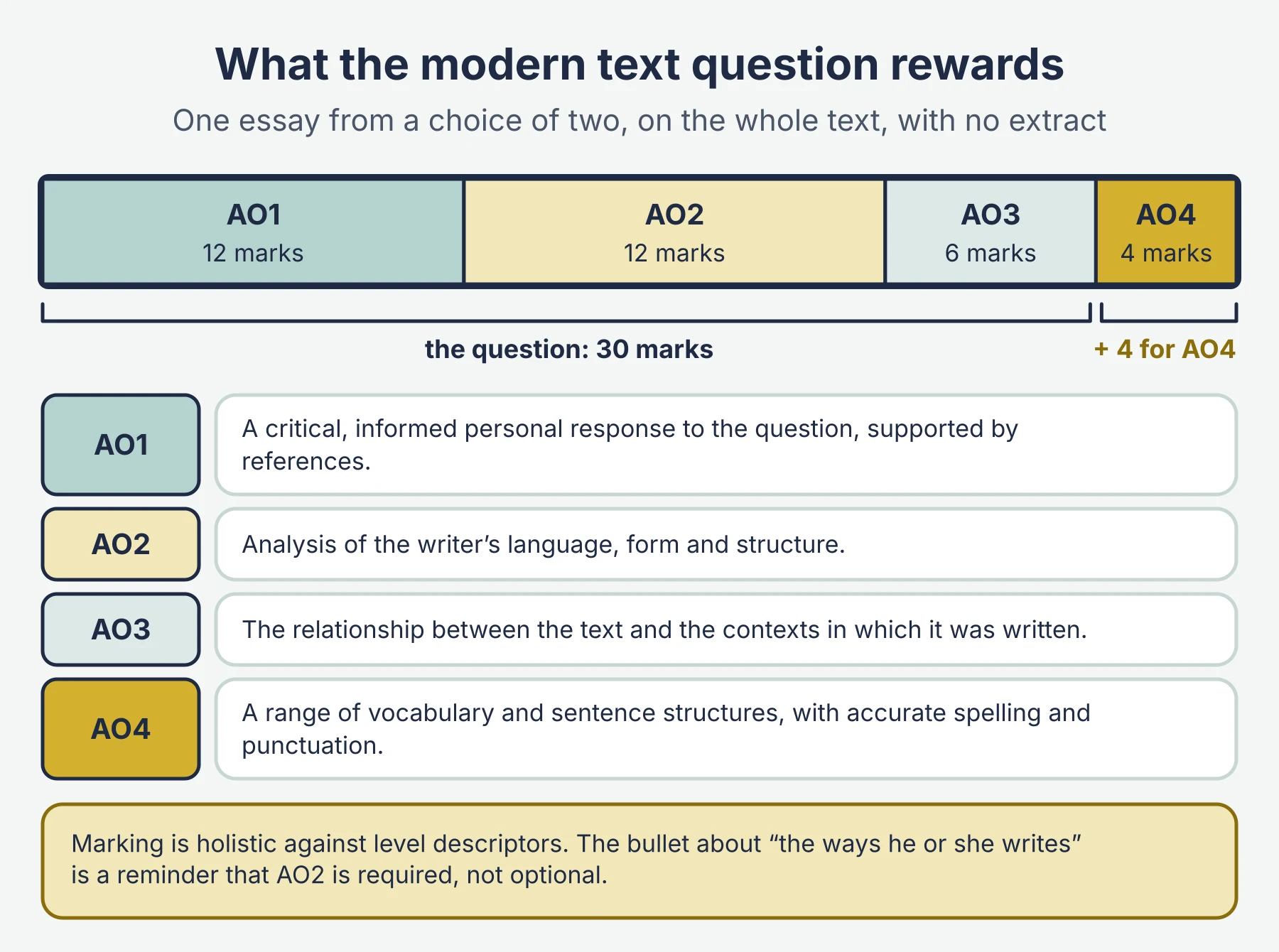
The question is worth 30 marks, plus 4 marks for AO4. AQA’s published mark schemes split the 30 as AO1 12, AO2 12 and AO3 6, but marking is holistic against level descriptors.
- AO1 – a critical, informed personal response to the question, supported by references.
- AO2 – analysis of the writer’s language, form and structure.
- AO3 – the relationship between the text and the contexts in which it was written.
- AO4 – a range of vocabulary and sentence structures, with accurate spelling and punctuation.
Questions usually take the form “How does [the writer] present…” or “How far does [the writer] present…”, often with bullet points such as “what [a character] says and does” and “how [the writer] presents [the focus] by the ways he or she writes”. That last bullet is a reminder that AO2 is required, not optional.
Choosing between the two questions
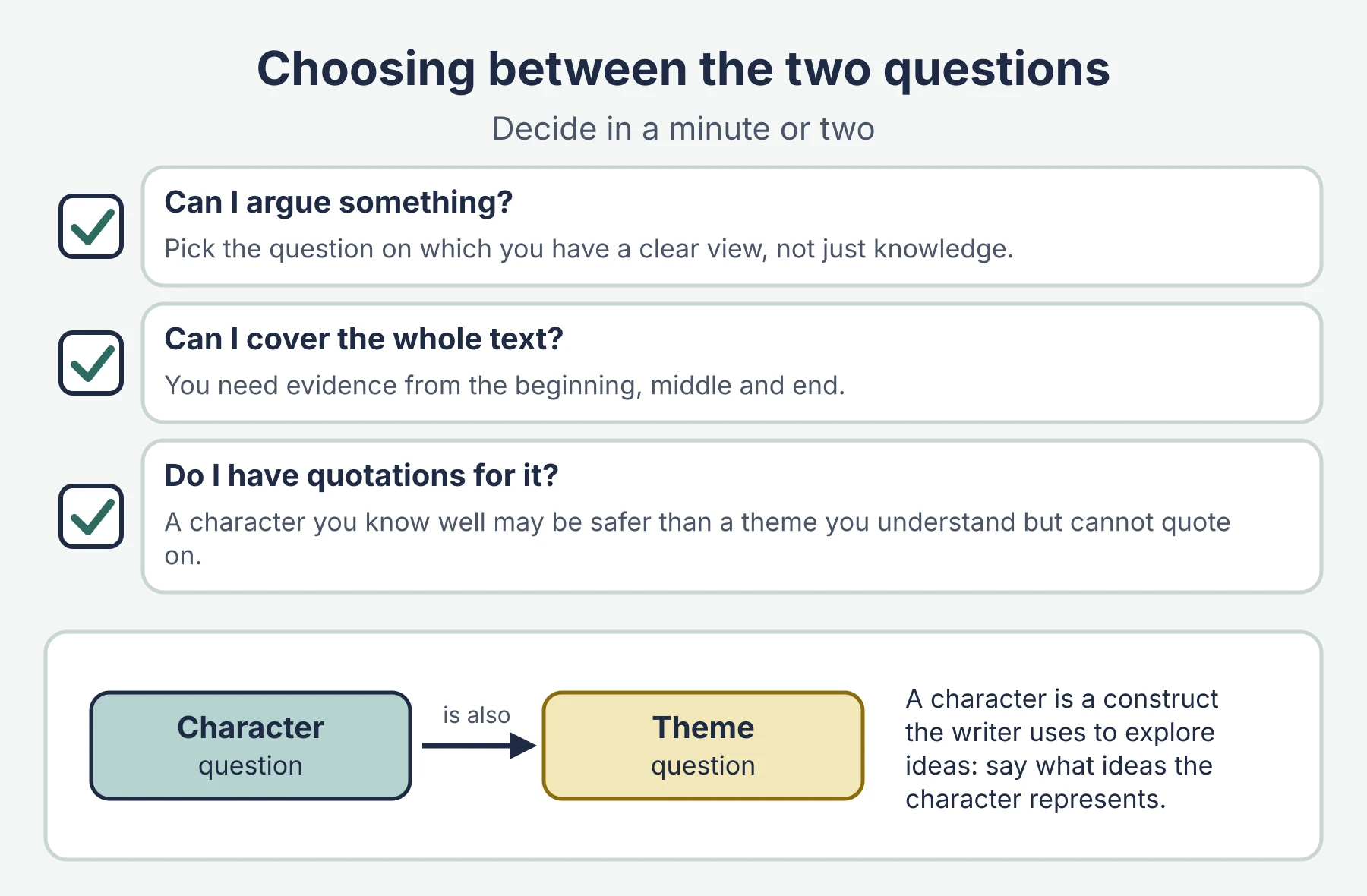
You have a minute or two to choose, so decide by asking three things:
- Can I argue something? Pick the question on which you have a clear view, not just knowledge.
- Can I cover the whole text? You need evidence from the beginning, middle and end.
- Do I have quotations for it? A question on a character you know well may be safer than a theme you understand but cannot quote on.
One question is often about a character and the other about a theme. Every character question is also a theme question in disguise: a character is a construct the writer uses to explore ideas, so say what ideas the character represents.
Methods in drama
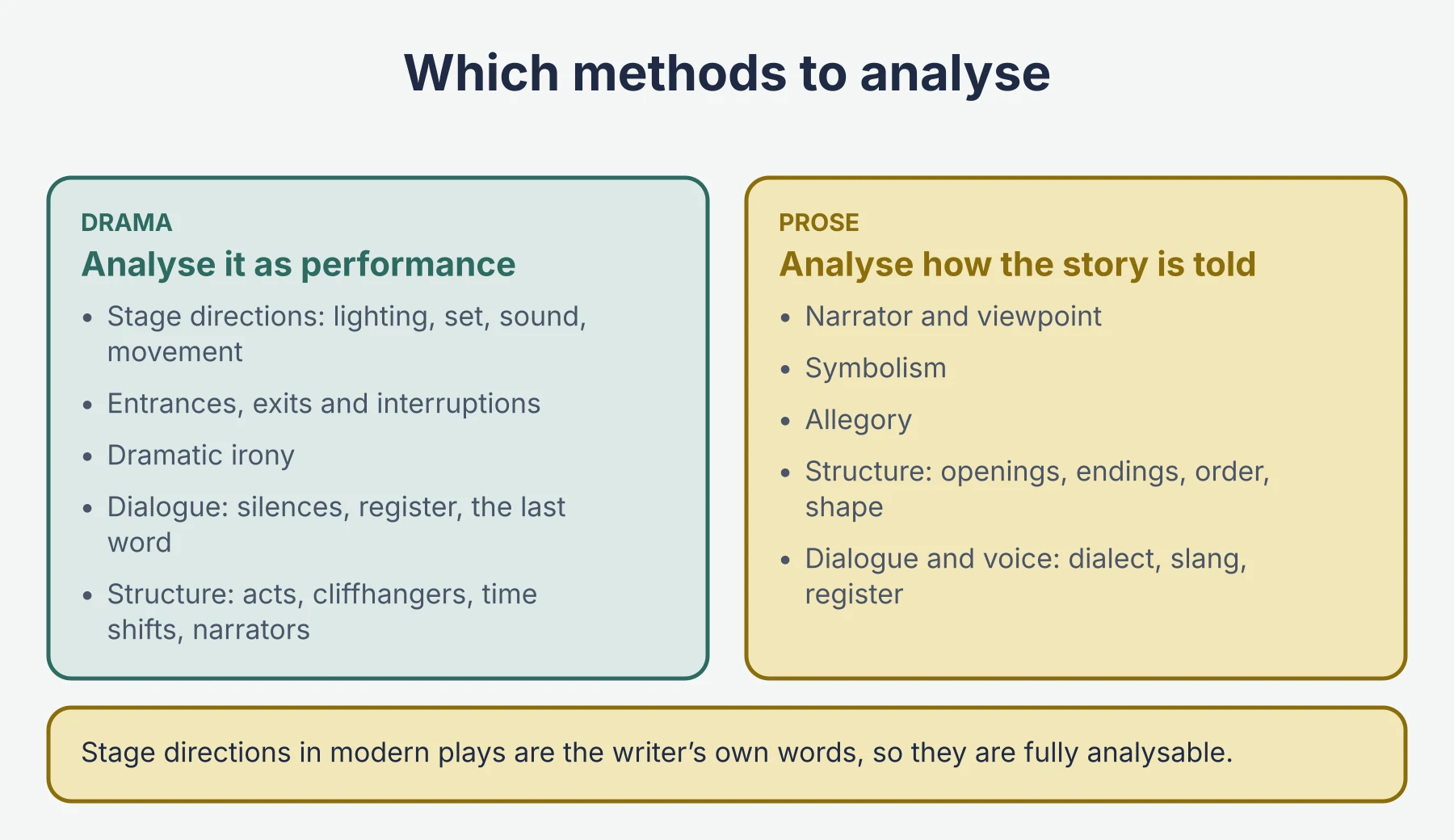
If your text is a play, analyse it as performance.
- Stage directions – modern playwrights often write detailed directions about lighting, set, sound and movement. These are the writer’s own words and are fully analysable.
- Entrances, exits and interruptions – who controls the stage, and when?
- Dramatic irony – the audience knows more than characters, especially where a play is set earlier than it was written.
- Dialogue – interruptions, silences, changes in register or dialect, and who gets the last word.
- Structural devices – acts and scenes, cliffhangers at the end of an act, time shifts, and narrators or choric figures who address the audience directly.
Methods in prose
If your text is a novel or short stories, analyse how the story is told.
- Narrator and viewpoint – first person or third, child or adult, reliable or not.
- Symbolism – objects, places or animals that gather meaning across the text.
- Allegory – a story whose characters and events stand for real people, ideas or events.
- Structure – chapter openings and endings, the order of events, a circular or a linear shape.
- Dialogue and voice – dialect, slang and register can mark identity, belonging or exclusion.
Context in a modern text
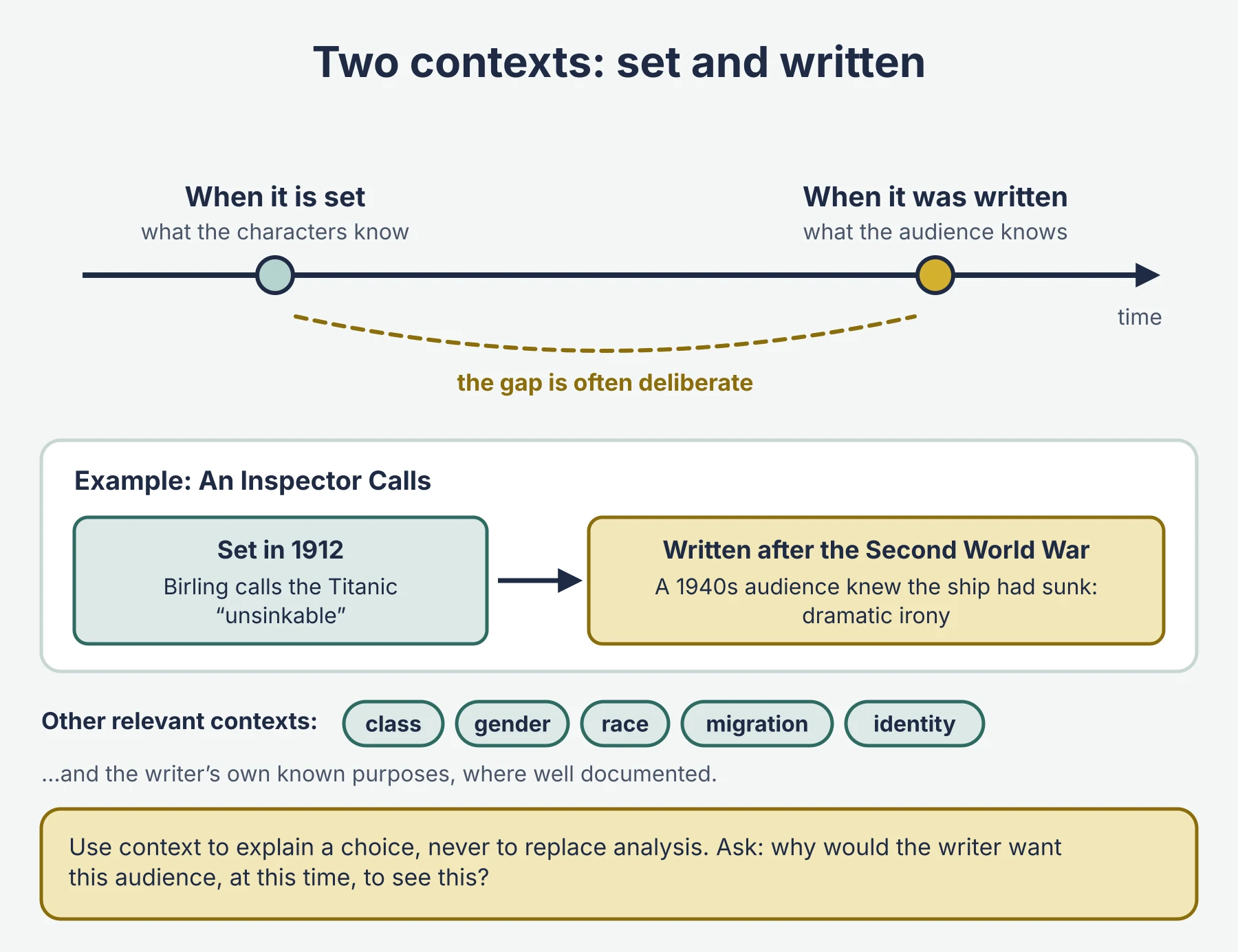
Many modern texts have two contexts: when they are set and when they were written. The gap is often deliberate. A play set before a war but written after it can give the audience knowledge that the characters lack. A novel published soon after a war may explore what people are capable of when order breaks down. Other relevant contexts include class, gender, race, migration and identity, and the writer’s own known purposes, where these are well documented.
Use context to explain a choice, never to replace analysis. Ask: why would the writer want this audience, at this time, to see this?
Worked example
Suppose the question is: How does Priestley present the Birling family’s attitudes to responsibility in An Inspector Calls*?* (The set list changes from time to time; check yours with your teacher.)
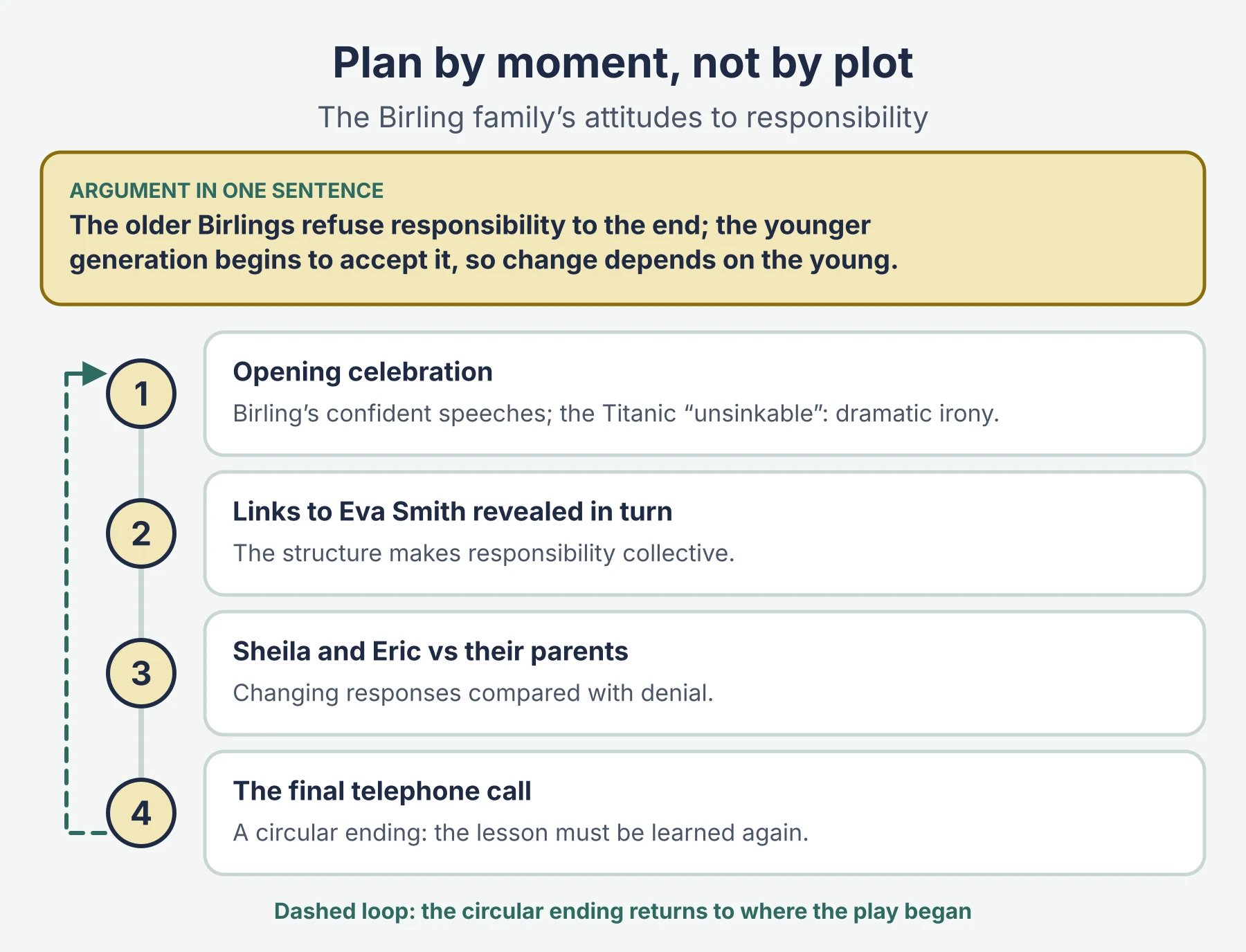
Argument in one sentence: Priestley presents the older Birlings as refusing responsibility to the end, while the younger generation begins to accept it, so the play argues that change depends on the young.
Plan by moment, not by plot:
- Opening celebration: Mr Birling’s confident speeches, including calling the Titanic “unsinkable”, create dramatic irony for an audience who knew what followed.
- Each family member’s link to Eva Smith revealed in turn: Priestley’s structure makes responsibility collective.
- Sheila’s and Eric’s changing responses compared with their parents’ denial.
- The final telephone call: the play’s circular ending suggests the lesson must be learned again.
Annotated model paragraph:
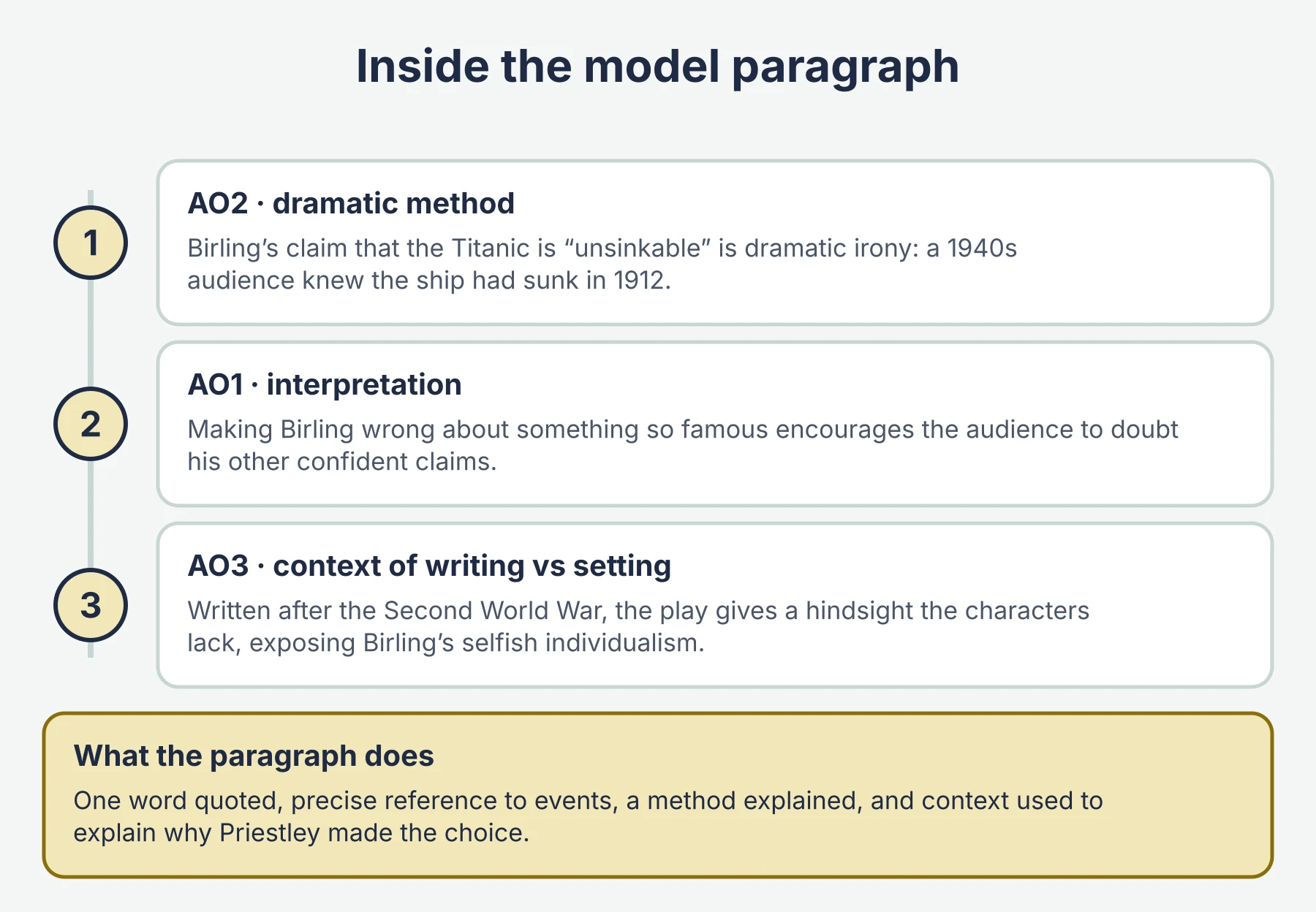
Priestley undermines Mr Birling’s authority before the Inspector even arrives. Birling’s claim that the Titanic is “unsinkable” is an example of dramatic irony, because an audience in the 1940s knew the ship had sunk in 1912 [AO2: dramatic method]. By making Birling wrong about something so famous, Priestley encourages the audience to doubt his other confident claims, including his view that a man need only look after himself and his family [AO1: interpretation]. Setting the play in 1912 but writing it after the Second World War gives the audience a hindsight the characters lack, so Birling’s selfish individualism is exposed as the kind of thinking the audience has already seen fail [AO3: context of writing versus setting].
Notice that the paragraph quotes one word, refers precisely to events, explains a method, and uses context to explain why Priestley made the choice.
Building a memory bank for a whole text
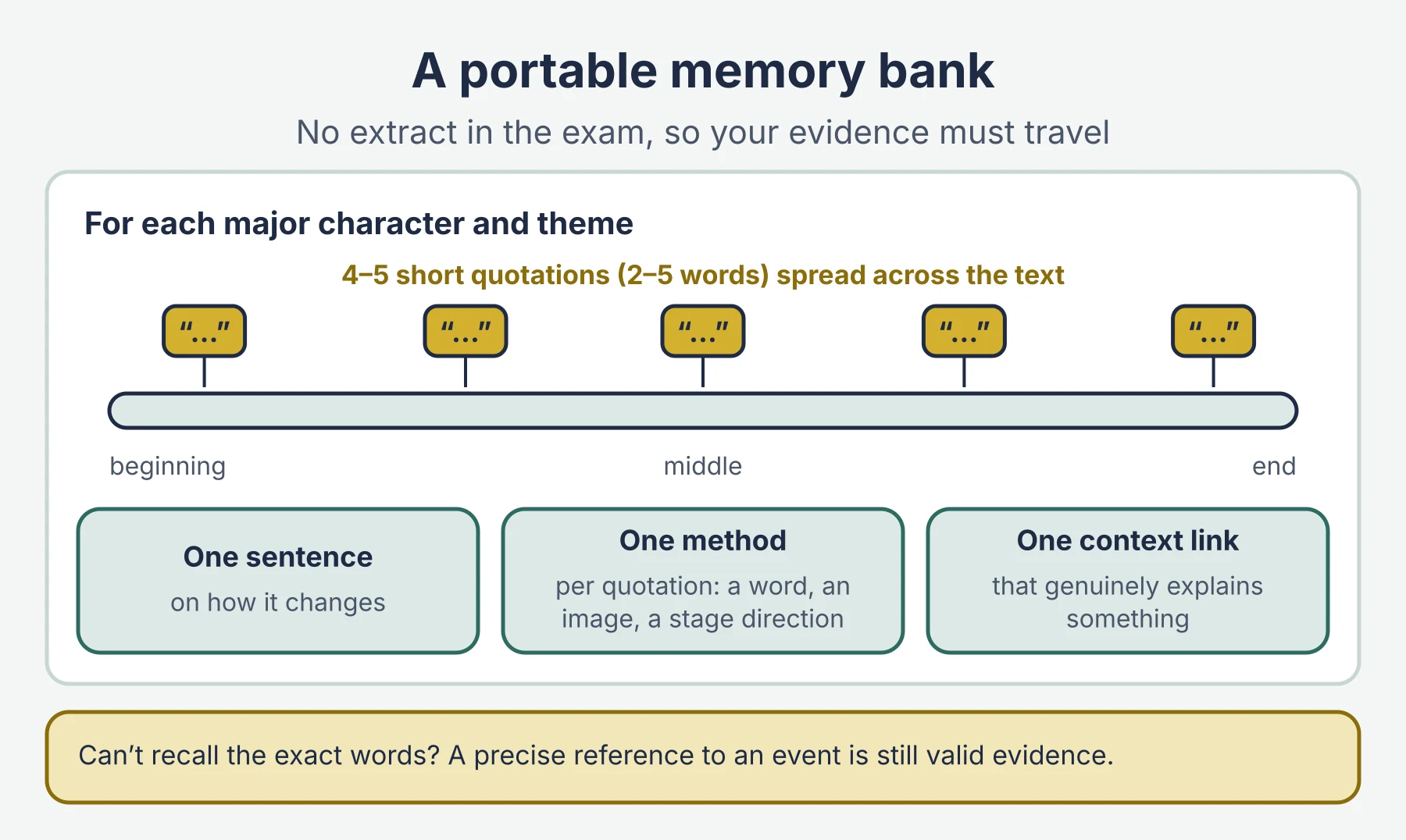
Without an extract, your evidence must be portable. For each major character and theme, prepare:
- Four or five short quotations spread across the text.
- One sentence on how the character or theme changes.
- One method per quotation that you can analyse (a word, an image, a stage direction).
- One context link that genuinely explains something.
Short quotations of two to five words are easier to remember and easier to analyse than long ones. Where you cannot recall exact words, a precise reference to an event is still valid evidence.
Common mistakes
- Retelling the plot in order instead of choosing moments that answer the question.
- Writing about only the opening or the ending and missing development.
- Ignoring the bullet about methods, so the answer becomes all character and no writer.
- Treating context as background instead of linking it to the writer’s purpose.
- Losing AO4 marks through careless spelling of names, missing capital letters for titles, or unclear sentences.
- Answering both questions, or switching question half way through.
Exam technique
- Spend no more than two minutes choosing and five minutes planning.
- Open with a direct answer to the question, not background about the writer.
- Organise paragraphs by ideas that build an argument; chronological order is fine if each paragraph still argues.
- Keep the writer’s name active: “Priestley presents”, “Golding uses”, “Orwell shows”.
- Leave two minutes to check spelling and punctuation for AO4.
More resources on this topic
- Modern texts revision notes
- Modern texts practice questions
- Poetry anthology study guide
- Writing skills for literature essays
Your school chooses the modern text from the specification’s list, which AQA can revise.
Related resources
-
Practice questions
AQA GCSE English Literature (8702): Modern Texts – Practice Questions
Original modern text practice for AQA GCSE English Literature 8702 Paper 2 Section A: drama and prose methods and whole-text essays with answers.
English Literature · AQA · GCSE
Try questions -
Revision notes
AQA GCSE English Literature (8702): Modern Texts – Revision Notes
Condensed notes on Paper 2 Section A modern texts for AQA GCSE English Literature 8702: choosing a question, key terms, context, traps and a self-test.
English Literature · AQA · GCSE
Revise topic -
Study guides
AQA GCSE English Literature (8702): Poetry
How to compare poems from your anthology cluster for AQA GCSE English Literature 8702 Paper 2 Section B: poetic methods, context and comparison structure.
English Literature · AQA · GCSE
Read guide
Get free revision emails (optional)
Occasional emails with practice questions, worked explanations and links to free resources for the qualification and subjects you choose. No spam, and you can unsubscribe from any email. The free tools on this site never need an email.