
Revision Notes
AQA GCSE Sociology (8192): Criminal and deviant behaviour – Revision Notes
Condensed AQA GCSE Sociology 8192 notes on 3.5.3: class, gender, ethnicity and age, five public debates, Albert Cohen, Carlen, perspectives and a self-test.
- Subject
- Sociology
- Level
- GCSE
- Topic
- Crime and deviance
- Author
- Marlbridge Academic Team
- Updated
- Reviewed by
- Naqiya Yousaf (what this means)
Aligned to AQA GCSE Sociology (8192), first teaching 2017. Official specification .
Syllabus page (what it covers and how it is assessed): AQA GCSE Sociology.
Syllabus points this page covers
8192
- 3.5.3 Criminal and deviant behaviour
Found an error? Report a correction.
Need help with this topic? Request a free trial class for GCSE Sociology (8192).
These notes condense 3.5.3 Criminal and deviant behaviour, from the AQA GCSE Sociology (8192) specification, assessed in Paper 2. You must explain social class, gender, ethnicity and age as factors; describe public debates over violent crime, sentencing, the treatment of young offenders, the prison system and media coverage of crime; compare interactionist, functionalist, feminist and Marxist perspectives; and describe the key ideas of Albert Cohen and Carlen.
For full explanations, read the criminal and deviant behaviour study guide. For the whole topic, see the Crime and deviance revision notes. Then try the criminal and deviant behaviour practice questions.
The question to ask of every pattern
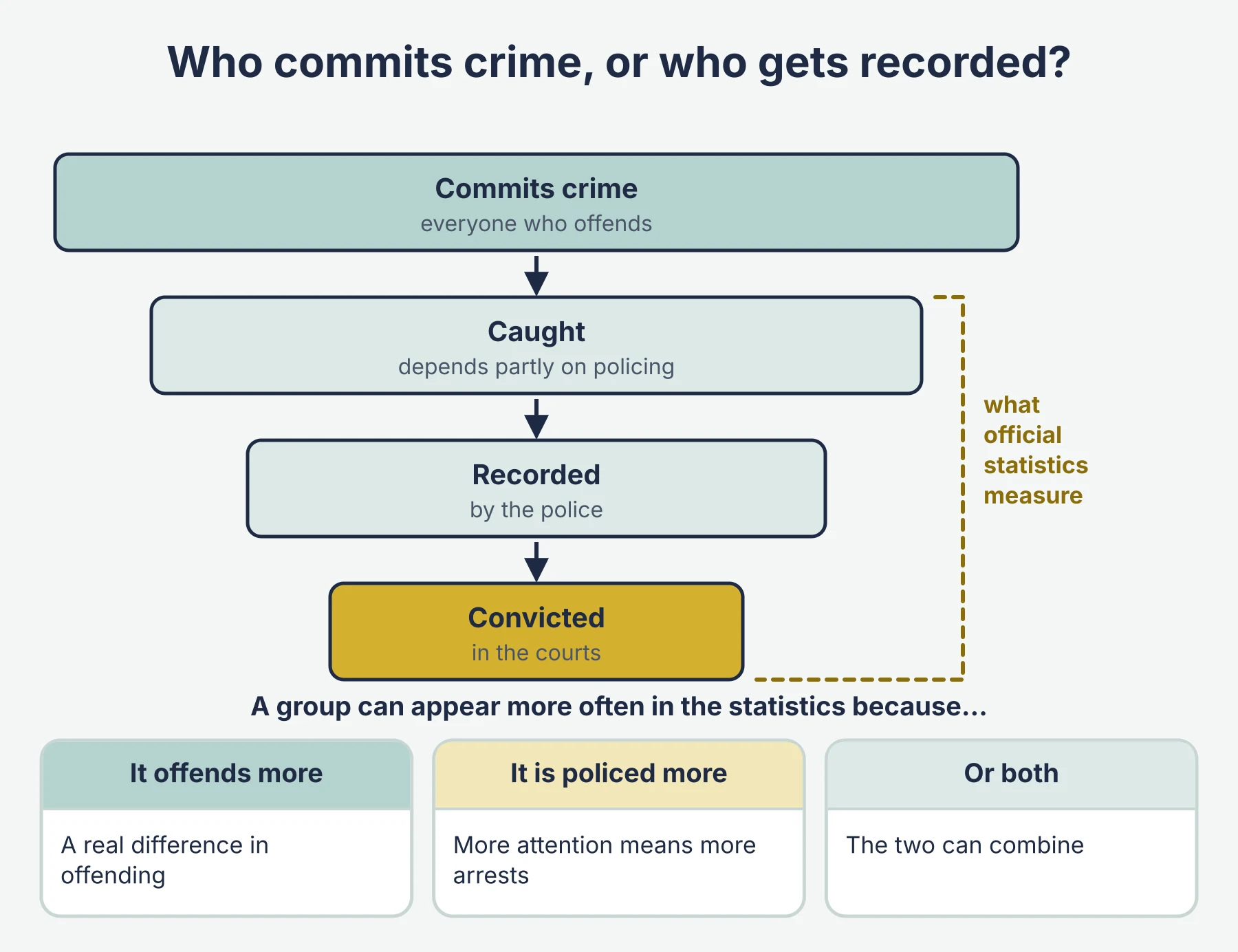
Does it show who commits crime, or who is policed, recorded and convicted? Official statistics show the second.
Key terms
| Term | Meaning |
|---|---|
| Delinquency | Antisocial or criminal behaviour, especially by young people |
| Status frustration | Frustration at being unable to gain status by legitimate means (Albert Cohen) |
| Delinquent (criminal) subculture | A group whose values reward crime, such as stealing and vandalism |
| Cultural deprivation | Cohen’s explanation of working-class boys’ educational failure |
| Control theory | People choose crime when its advantages outweigh its disadvantages |
| Class deal | Consumer goods offered to working-class women in return for their wage (Carlen) |
| Gender deal | Rewards from a male breadwinner in return for love and domestic labour (Carlen) |
| Chivalry thesis | The claim that women are treated more leniently by a male-dominated justice system |
| White collar crime | Crime by people in higher-status jobs, often at work |
| Corporate crime | Crime committed by or for a company |
| Institutional racism | Policies and practices that disadvantage ethnic groups, intended or not |
| Youth crime | Offending by young people |
| Moral panic | Exaggerated public concern about a group seen as a threat |
| Folk devils | The group blamed in a moral panic |
| Deviancy amplification | Reaction to deviance that increases it, or the amount recorded |
Factors at a glance
| Factor | Pattern in official figures | Explanations | Counter-argument |
|---|---|---|---|
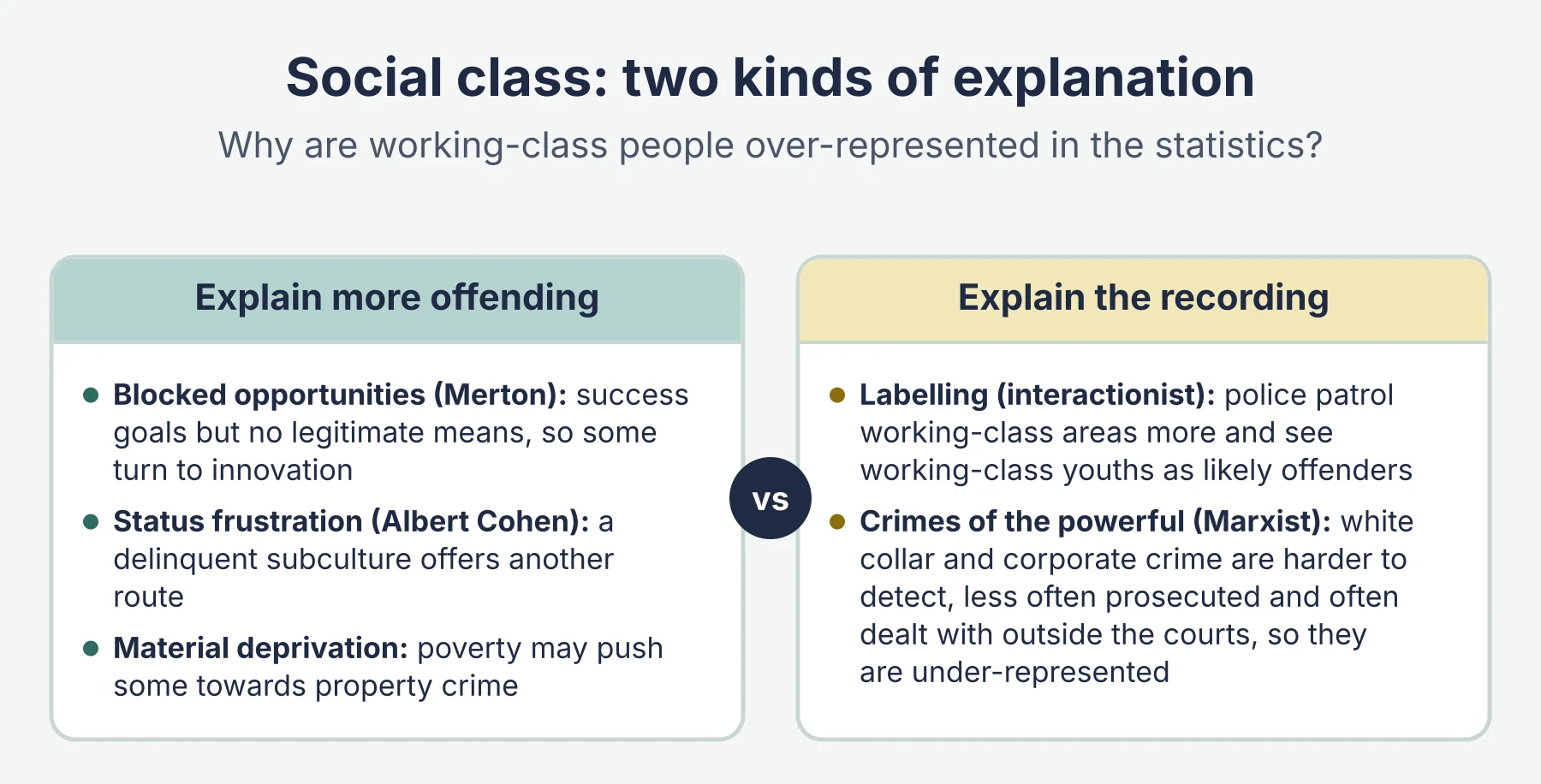
| Class | Working class over-represented | Merton’s blocked means; Cohen’s status frustration; deprivation | Labelling and policing; crimes of the powerful under-recorded (Marxist) |
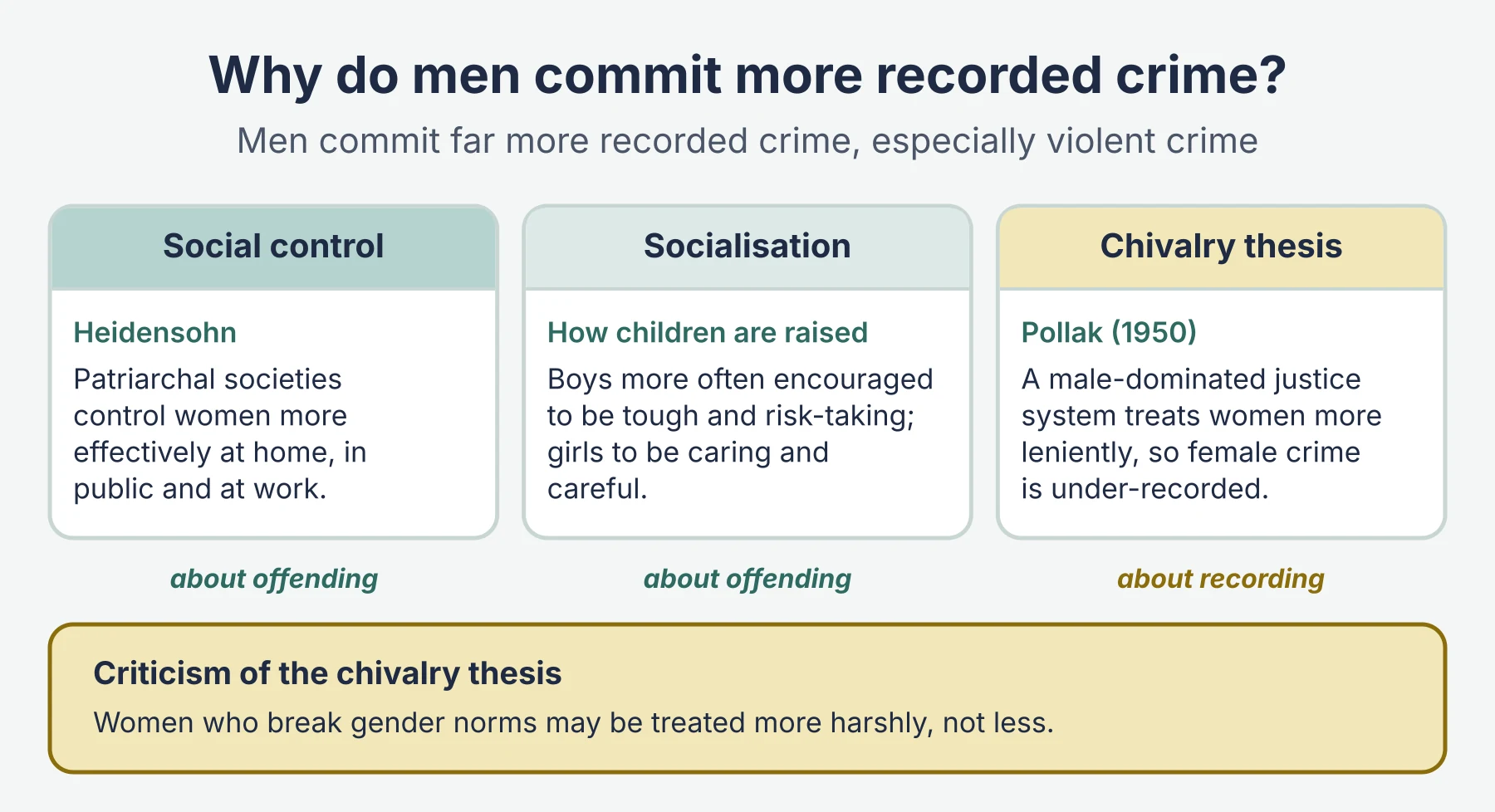
| Gender | Men commit far more recorded crime | Heidensohn’s control; socialisation | Chivalry thesis says female crime under-recorded |
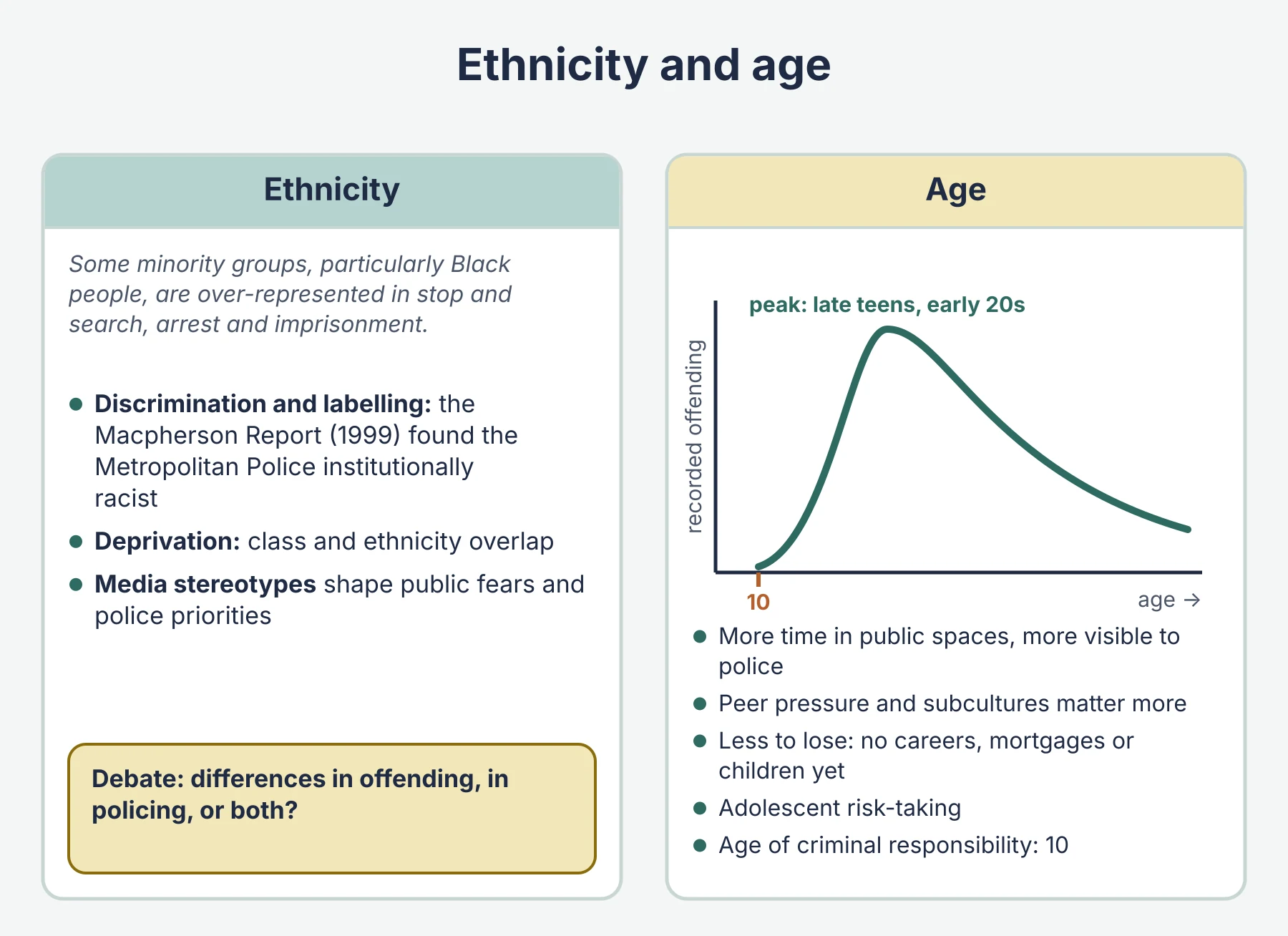
| Ethnicity | Black people over-represented in stop and search and prison | Deprivation; area effects | Macpherson Report (1999): institutional racism in the Metropolitan Police; labelling; media stereotypes |
| Age | Peaks in late teens and early twenties | Visibility; peers; less to lose; risk-taking | Young people more visible to police, so more likely to be recorded |
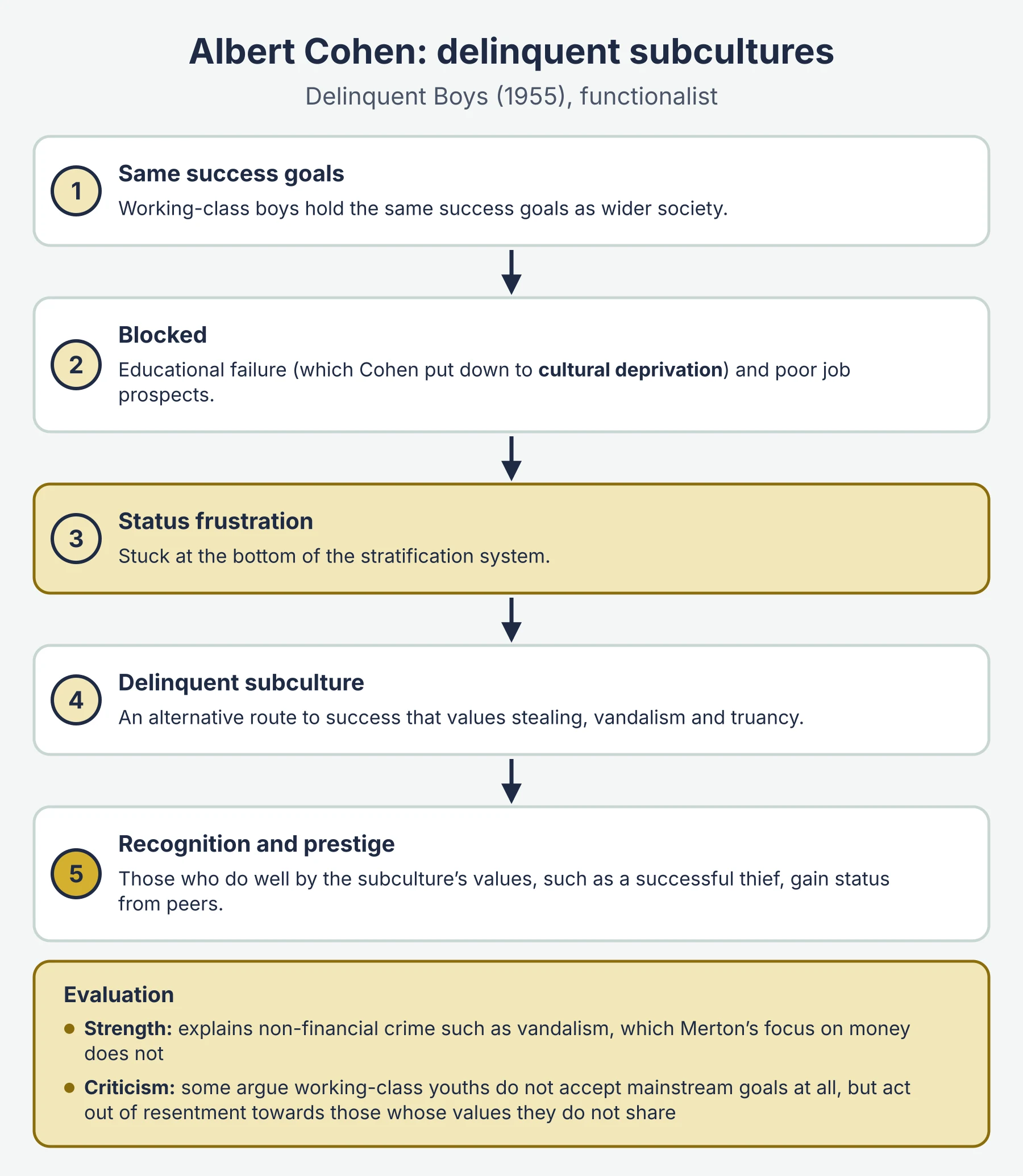
Albert Cohen (Delinquent Boys, 1955): the chain
Functionalist. Working-class boys share mainstream goals → educational failure (cultural deprivation) and poor job prospects → stuck at the bottom → status frustration → delinquent subculture valuing stealing, vandalism, truancy → prestige from peers for success by the subculture’s values.
Criticism: youths may reject mainstream goals and act from resentment towards those whose values they do not share, such as teachers and middle-class pupils.
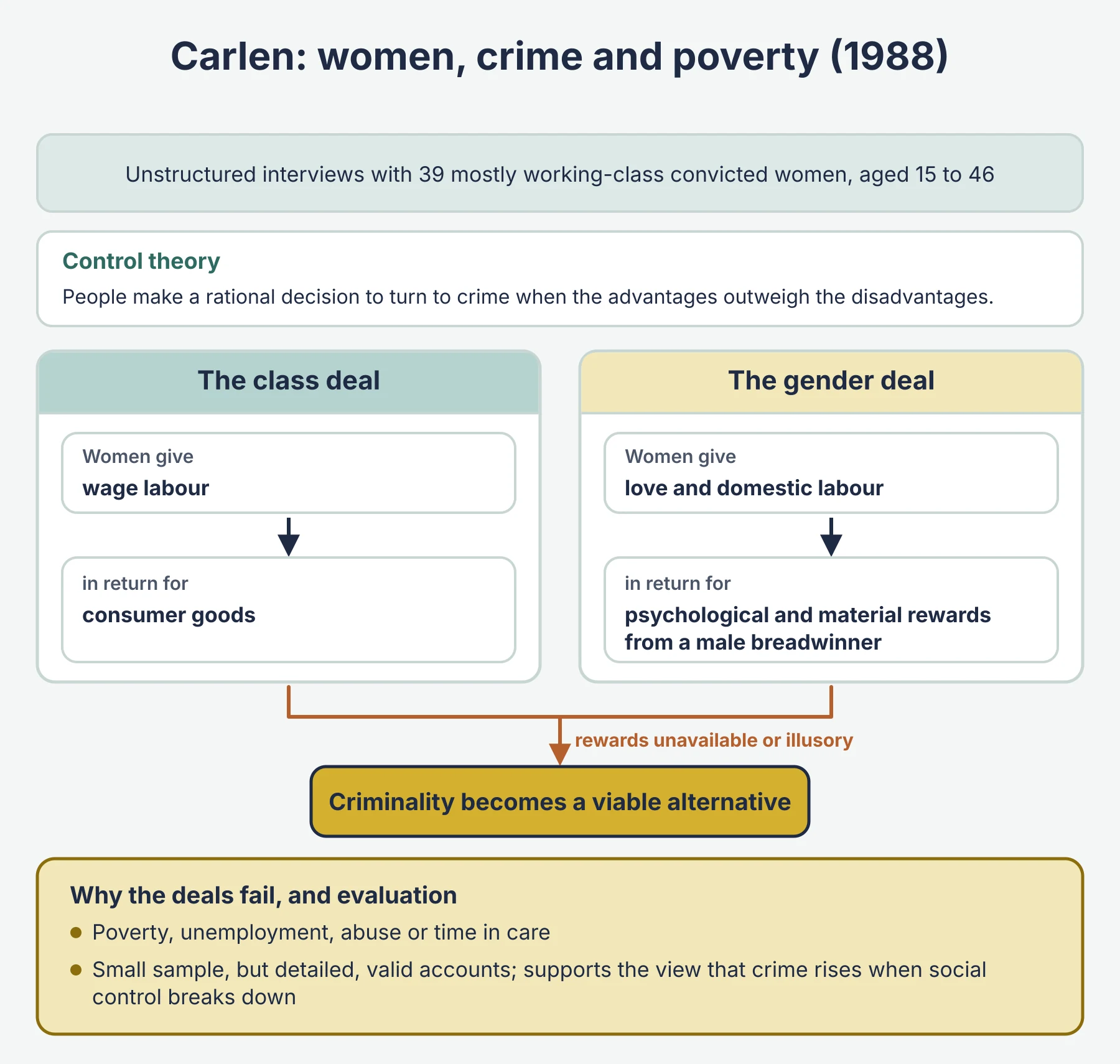
Carlen (Women, Crime and Poverty, 1988): the deals
Feminist; unstructured interviews with 39 mostly working-class women aged 15 to 46, convicted of crimes, some in prison or youth custody; uses control theory.
- Class deal: consumer goods in return for wage labour.
- Gender deal: material and psychological rewards from a male breadwinner in return for love and domestic labour.
- When the rewards are unavailable or illusory → crime becomes a viable alternative.
Evaluation: small sample, but supports the view that crime rises when social control breaks down.
The five public debates
| Debate | Core question |
|---|---|
| Violent crime | Is it rising, what causes it and how can it be prevented? |
| Sentencing | Too lenient or too harsh? Consistent? Does it deter? |
| Young offenders | Punishment or rehabilitation? Does contact with the system label them? |
| Prison system | Does prison reduce reoffending or act as a “school for crime”? |
| Media coverage | Do news values exaggerate crime, create fear and produce moral panics? |
Perspectives in one line each
- Functionalist: strain and subcultures (Merton, Cohen).
- Marxist: class inequality and selective enforcement; crimes of the powerful under-recorded.
- Feminist: patriarchal control (Heidensohn) and its breakdown (Carlen).
- Interactionist: labelling by police and courts shapes who is recorded.
Exam traps
- Albert Cohen (subcultures, named) is not Stanley Cohen (moral panics, not named).
- Carlen needs the deals failing, not just the deals.
- Never say ethnicity “causes” crime; explain competing explanations.
- Debates need the two sides of the argument, not just the topic name.
- England and Wales: the age of criminal responsibility is 10.
Self-test
- Which perspective did Albert Cohen write from?
- What did Cohen say caused working-class boys’ educational failure?
- Define status frustration.
- Name two activities valued by Cohen’s delinquent subculture.
- How many women did Carlen interview, and with what method?
- Describe Carlen’s gender deal.
- What happens, according to Carlen, when the deals fail?
- What is the chivalry thesis?
- What did the Macpherson Report (1999) conclude?
- Give two reasons why offending peaks among young people.
- Name the five public debates in the specification.
- How do Marxists explain the low recorded rate of middle-class crime?
Answers
- Functionalist.
- Cultural deprivation.
- Frustration at being unable to gain status through legitimate means.
- Any two: stealing, vandalism, truancy.
- 39, using in-depth unstructured interviews.
- Women receive material and psychological rewards from a male breadwinner in return for love and domestic labour.
- Crime becomes a viable alternative.
- The claim that a male-dominated criminal justice system treats women more leniently, so their crime is under-recorded.
- That the Metropolitan Police was institutionally racist.
- Any two: more time in public and visible to police; peer pressure; less to lose; risk-taking.
- Violent crime, sentencing, the treatment of young offenders, the prison system, media coverage of crime.
- White collar and corporate crimes are harder to detect, less often prosecuted and often dealt with outside the criminal courts, because the powerful influence how laws are enforced.
Official syllabus
AQA GCSE Sociology (8192) specification, Version 1.2 (June 2026), for GCSE exams 2019 onwards: section 3.5.3 Criminal and deviant behaviour, with Appendix B summaries.
Related resources
-
Study guides
AQA GCSE Sociology (8192): Data on crime
In-depth AQA GCSE Sociology 8192 guide to 3.5.4: police recorded crime, victim surveys, self-report studies, trends, the dark figure and three perspectives.
Sociology · AQA · GCSE
Read guide -
Practice questions
AQA GCSE Sociology (8192): Data on crime – Practice Questions
Original AQA GCSE Sociology 8192 practice on 3.5.4 with marked answers: official statistics, victim surveys, self-report studies, the dark figure and trends.
Sociology · AQA · GCSE
Try questions -
Revision notes
AQA GCSE Sociology (8192): Data on crime – Revision Notes
Condensed AQA GCSE Sociology 8192 notes on 3.5.4: three sources of crime data, the dark figure's two filters, trends, three perspectives and a self-test.
Sociology · AQA · GCSE
Revise topic
Related articles
Get free revision emails (optional)
Occasional emails with practice questions, worked explanations and links to free resources for the qualification and subjects you choose. No spam, and you can unsubscribe from any email. The free tools on this site never need an email.