
Study Guides
AQA GCSE Sociology (8192): Criminal and deviant behaviour
In-depth AQA GCSE Sociology 8192 guide to 3.5.3: class, gender, ethnicity and age in crime, the five public debates, Albert Cohen and Carlen.
- Subject
- Sociology
- Level
- GCSE
- Topic
- Crime and deviance
- Author
- Marlbridge Academic Team
- Updated
- Reviewed by
- Naqiya Yousaf (what this means)
Aligned to AQA GCSE Sociology (8192), first teaching 2017. Official specification .
Syllabus page (what it covers and how it is assessed): AQA GCSE Sociology.
Syllabus points this page covers
8192
- 3.5.3 Criminal and deviant behaviour
Found an error? Report a correction.
Need help with this topic? Request a free trial class for GCSE Sociology (8192).
This guide goes deep on one sub-section of the AQA GCSE Sociology (8192) specification: 3.5.3 Criminal and deviant behaviour, assessed in Paper 2: The sociology of crime and deviance and social stratification. The content is “factors affecting criminal and deviant behaviour and ways in which criminal and deviant behaviour have generated public debate”, with “the work of Albert Cohen on delinquent subcultures and Carlen on women, crime and poverty”. You must explain social class, gender, ethnicity and age as factors; describe public debates over “violent crime, sentencing, the treatment of young offenders, the prison system and media coverage of crime”; and compare interactionist, functionalist, feminist and Marxist perspectives.
For the whole topic, start with the Crime and deviance study guide. To revise this sub-section, use the criminal and deviant behaviour revision notes, then test yourself with the criminal and deviant behaviour practice questions.
A key distinction: committing crime versus being recorded
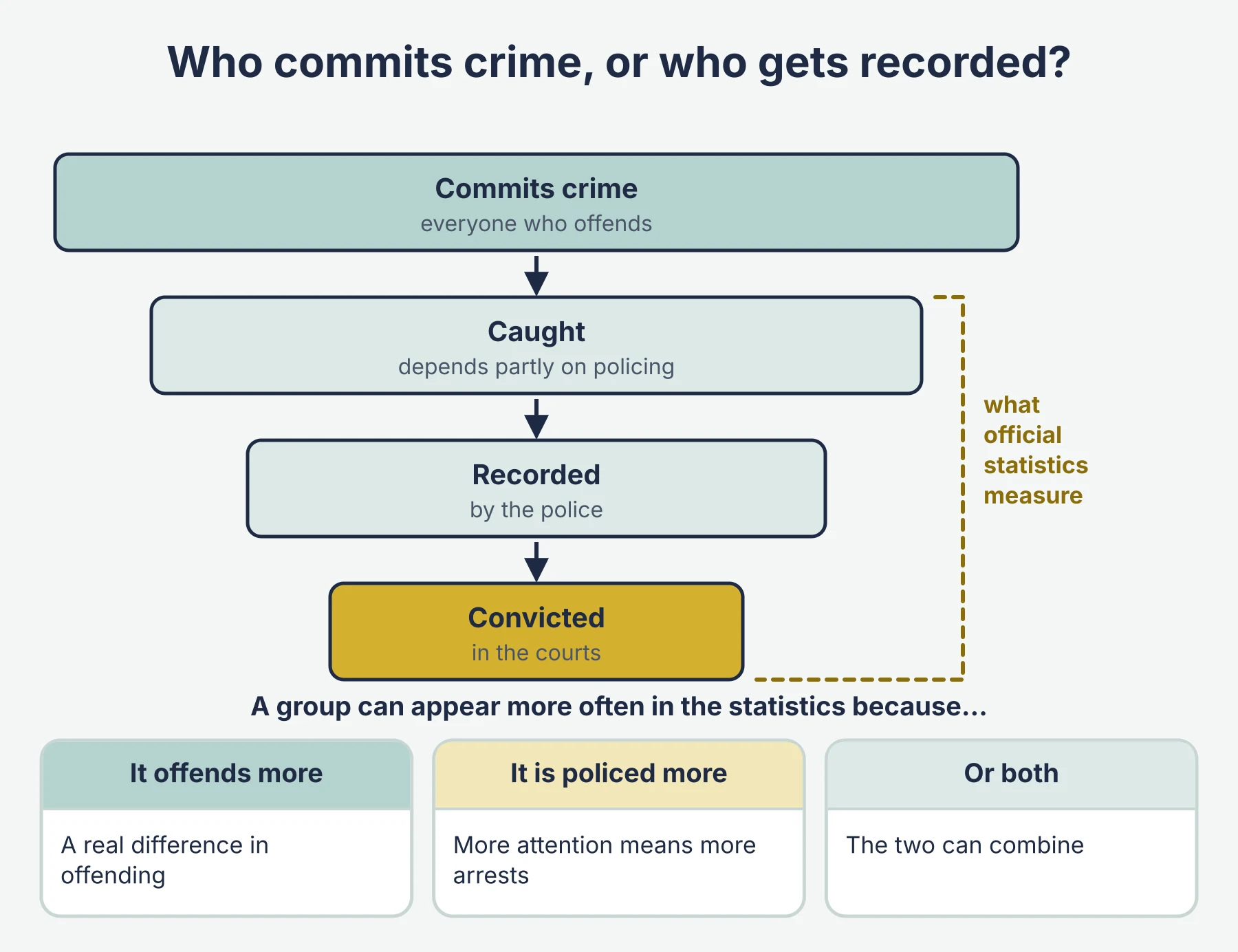
Before explaining any pattern, ask whether it shows who commits crime or who is caught, recorded and convicted. Official statistics measure the second. A group can appear in the statistics more often because it offends more, because it is policed more, or both. Every factor below needs this question applied to it.
Social class
Pattern: working-class people, especially young working-class men, are over-represented in official statistics for crimes such as theft, burglary and criminal damage.
Explanations:
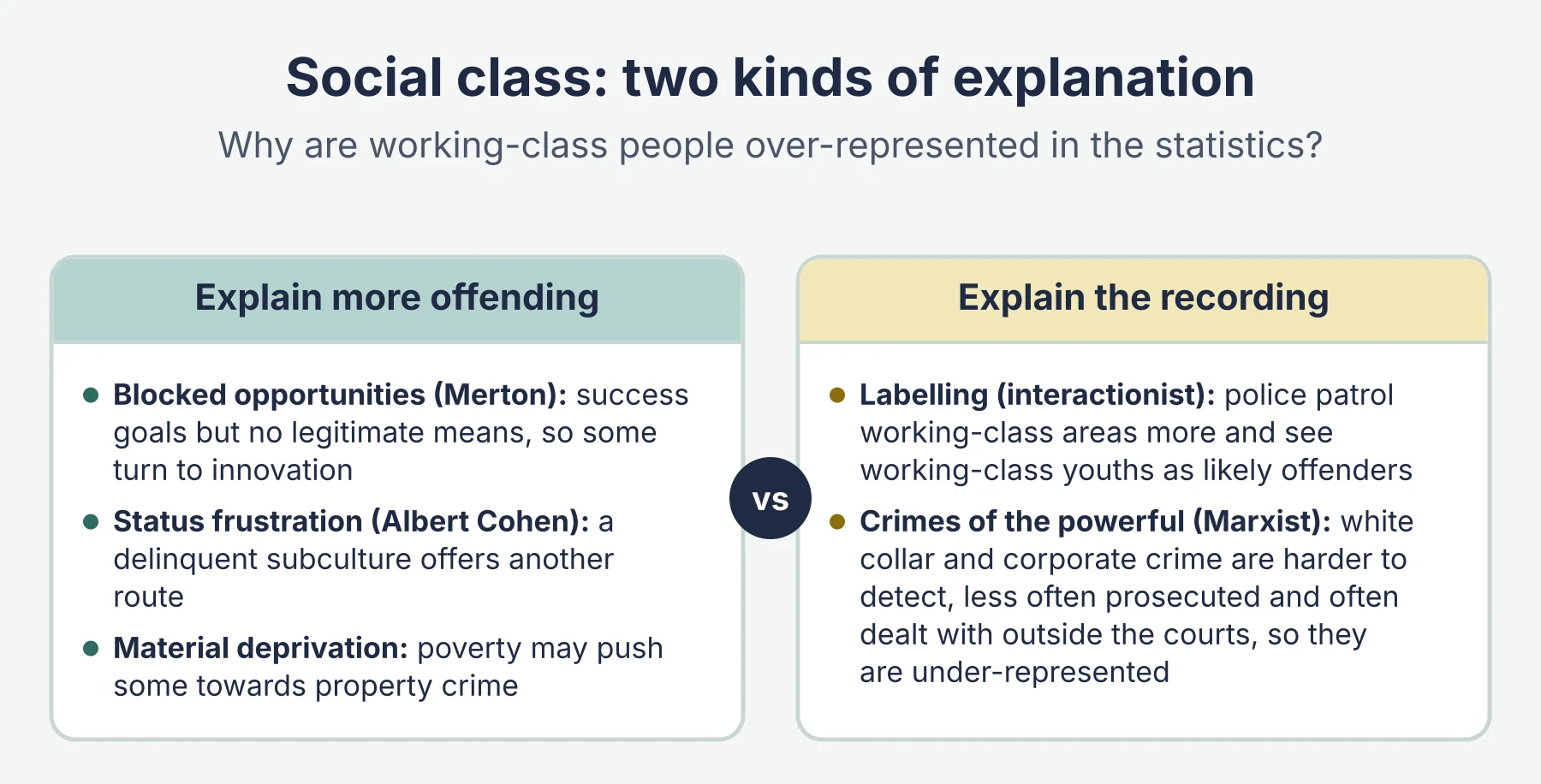
- Blocked opportunities (Merton): working-class people share success goals but lack legitimate means, so some turn to innovation.
- Status frustration and subculture (Albert Cohen): see below.
- Material deprivation: poverty may push some people towards property crime.
- Labelling (interactionist): police may patrol working-class areas more and see working-class youths as likely offenders, producing more arrests.
- Crimes of the powerful (Marxist): middle-class white collar crime and corporate crime, such as fraud or breaking safety laws, are harder to detect, less often prosecuted and often dealt with outside the criminal courts, so they are under-represented.
Albert Cohen on delinquent subcultures
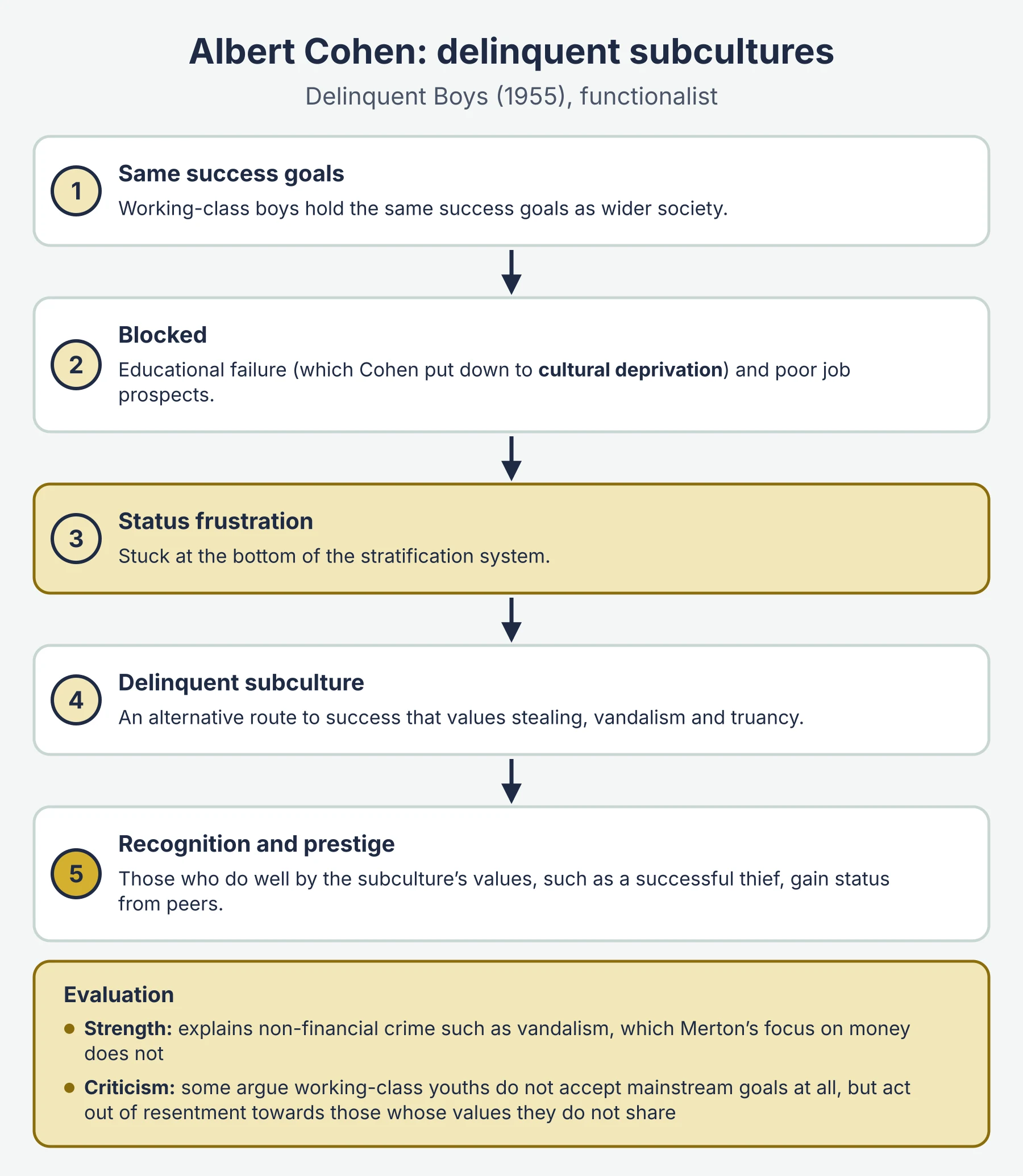
Albert Cohen (Delinquent Boys, 1955), writing from a functionalist perspective, argued that:
- Working-class boys hold the same success goals as wider society.
- Because of educational failure and poor employment prospects, they have little opportunity to reach those goals. Cohen held that cultural deprivation accounts for their lack of educational success.
- Stuck at the bottom of the stratification system, they suffer status frustration.
- They turn to crime as an alternative route to success, joining a delinquent subculture that values stealing, vandalism and truancy.
- Those who do well by the subculture’s values, such as a successful thief, gain recognition and prestige from peers.
Cohen explains non-financial crime such as vandalism, which Merton’s focus on money does not. Criticism: some argue working-class youths do not accept mainstream goals at all, but act out of resentment towards those whose values they do not share, such as teachers and successful middle-class pupils.
Gender
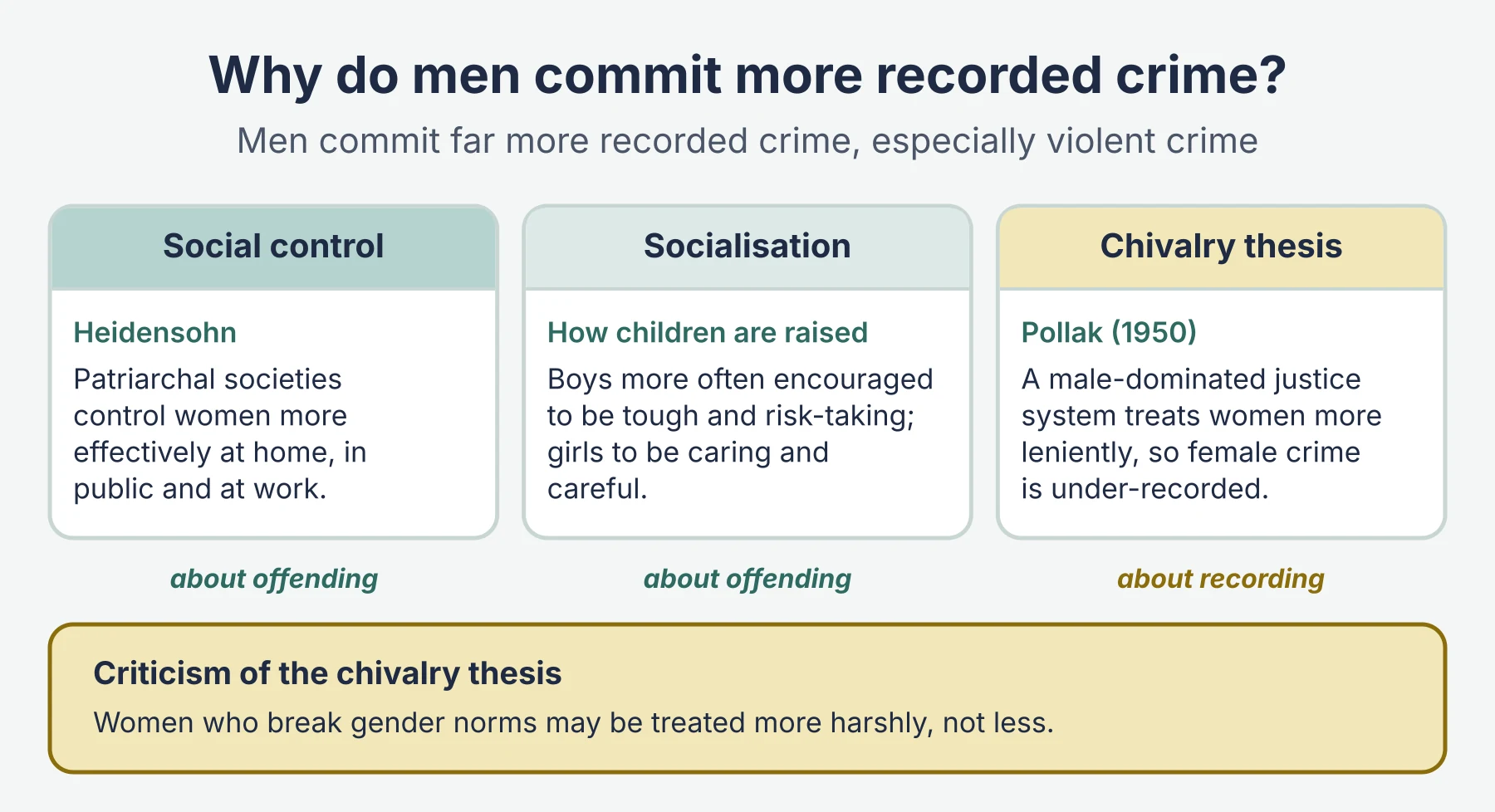
Pattern: men commit far more recorded crime than women, especially violent crime, and make up the large majority of the prison population.
Explanations:
- Social control (Heidensohn, 3.5.2): patriarchal societies control women more effectively at home, in public and at work.
- Socialisation: boys are more often encouraged to be tough and risk-taking; girls to be caring and careful.
- The chivalry thesis: the argument, associated with Otto Pollak (1950), that a male-dominated criminal justice system treats women more leniently, so female crime is under-recorded. Critics argue women who break gender norms may be treated more harshly, not less.
Carlen on women, crime and poverty
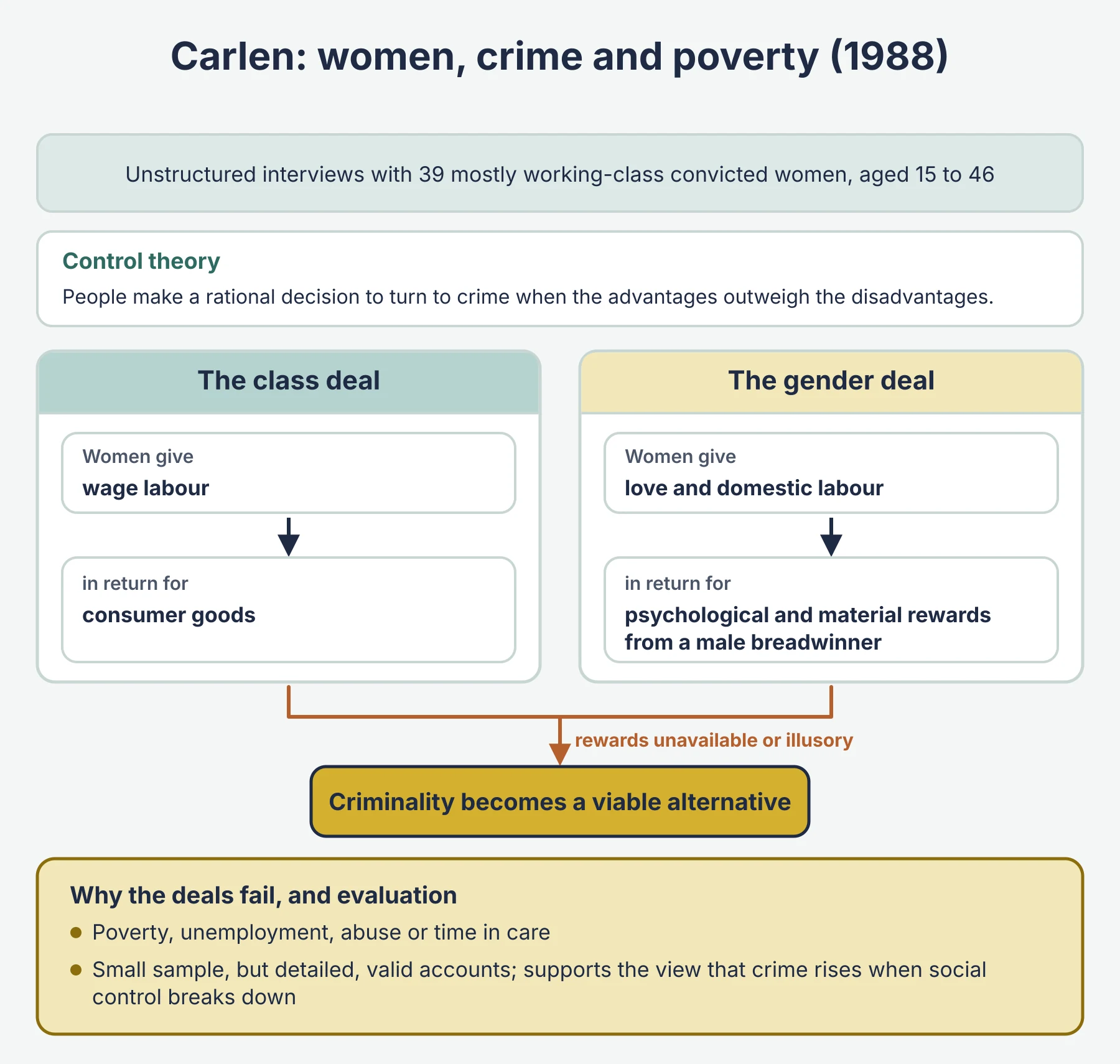
Pat Carlen (Women, Crime and Poverty, 1988), writing from a feminist perspective, carried out in-depth, unstructured interviews with 39 mostly working-class women aged 15 to 46 who had been convicted of one or more crimes; a number were in prison or youth custody at the time.
- She used control theory: people are neither naturally good nor bad, but make a rational decision to turn to crime when the advantages outweigh the disadvantages.
- Working-class women are controlled through the promise of rewards:
- the class deal: respectable working-class women are offered consumer goods in return for their wage labour;
- the gender deal: psychological and material rewards from a male breadwinner in return for love and domestic labour.
- When these rewards are not available or prove to be illusory, for example through poverty, unemployment, abuse or time in care, criminality becomes a viable alternative.
Evaluation: the sample was relatively small (39 women), but the study supports the view that crime becomes more likely when social control breaks down. Unstructured interviews give detailed, valid insight into the women’s own accounts.
Ethnicity
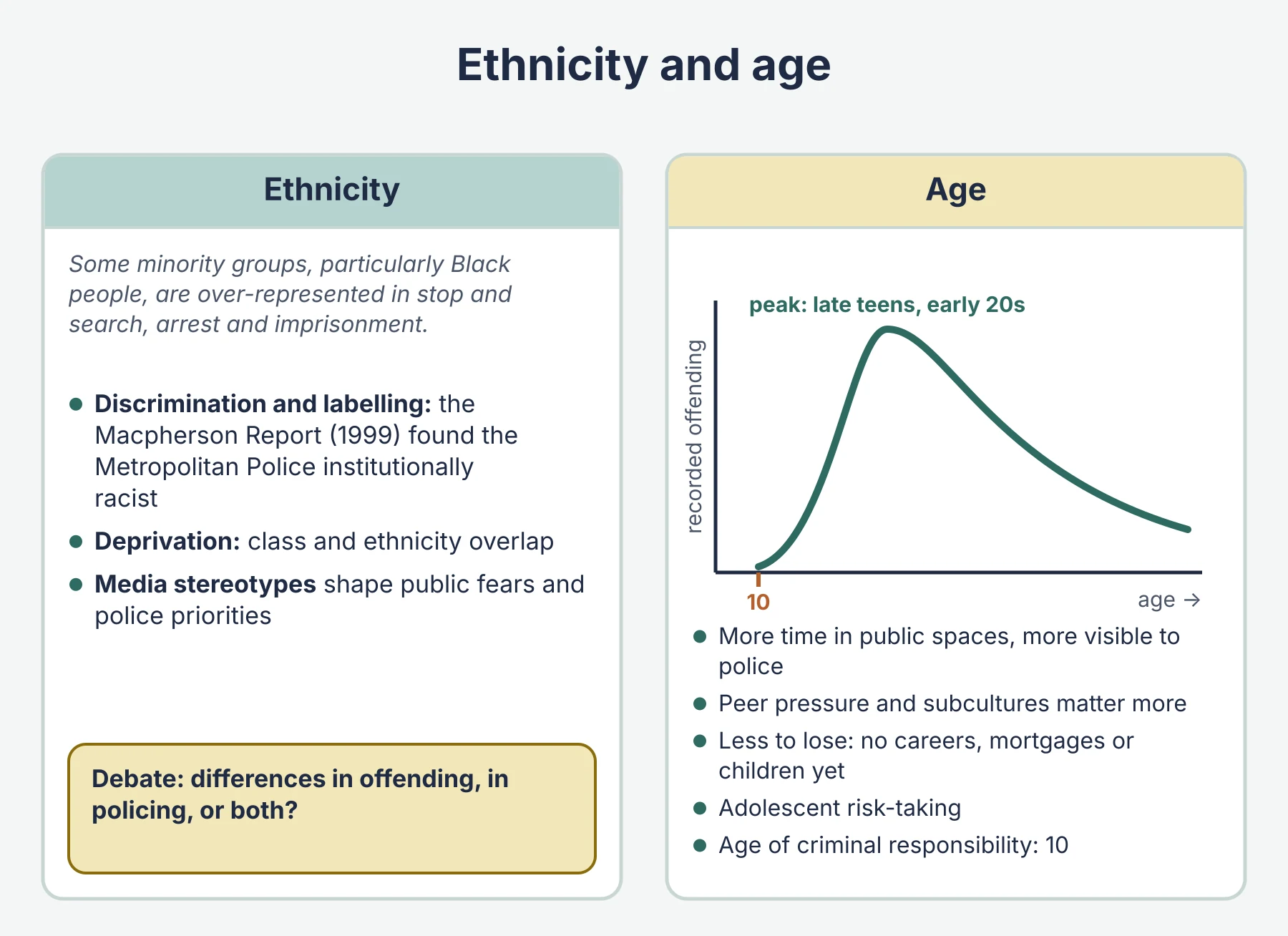
Pattern: some ethnic minority groups, particularly Black people, are over-represented in official figures for stop and search, arrest and imprisonment in England and Wales.
Explanations:
- Discrimination and labelling: the Macpherson Report (1999), following the inquiry into the murder of Stephen Lawrence, concluded that the Metropolitan Police was institutionally racist. Interactionists argue stereotypes shape whom police stop.
- Deprivation: some minority groups are more likely to live in poverty and in areas with high crime, so class and ethnicity overlap.
- Media stereotypes may link particular groups with crime, influencing public fears and police priorities.
The debate is whether the statistics reflect differences in offending, differences in policing, or both.
Age
Pattern: recorded offending peaks in the late teenage years and early twenties, then falls with age.
Explanations: young people spend more time in public spaces where they are more visible to police; peer group pressure and subcultures matter more; they have less to lose, as most do not yet have careers, mortgages or children; and adolescence involves risk-taking. In England and Wales the age of criminal responsibility is 10, so children from 10 can be prosecuted.
Public debates over crime
| Debate | What the argument is about |
|---|---|
| Violent crime | Whether violence, such as knife crime, is rising or falling, what causes it and how best to prevent it |
| Sentencing | Whether sentences are too lenient or too harsh, consistent between courts, and effective in deterring crime |
| Treatment of young offenders | Whether young people should be punished or rehabilitated, and whether contact with the system labels them |
| The prison system | Whether prison reduces reoffending or acts as a “school for crime”, and the effects of overcrowding |
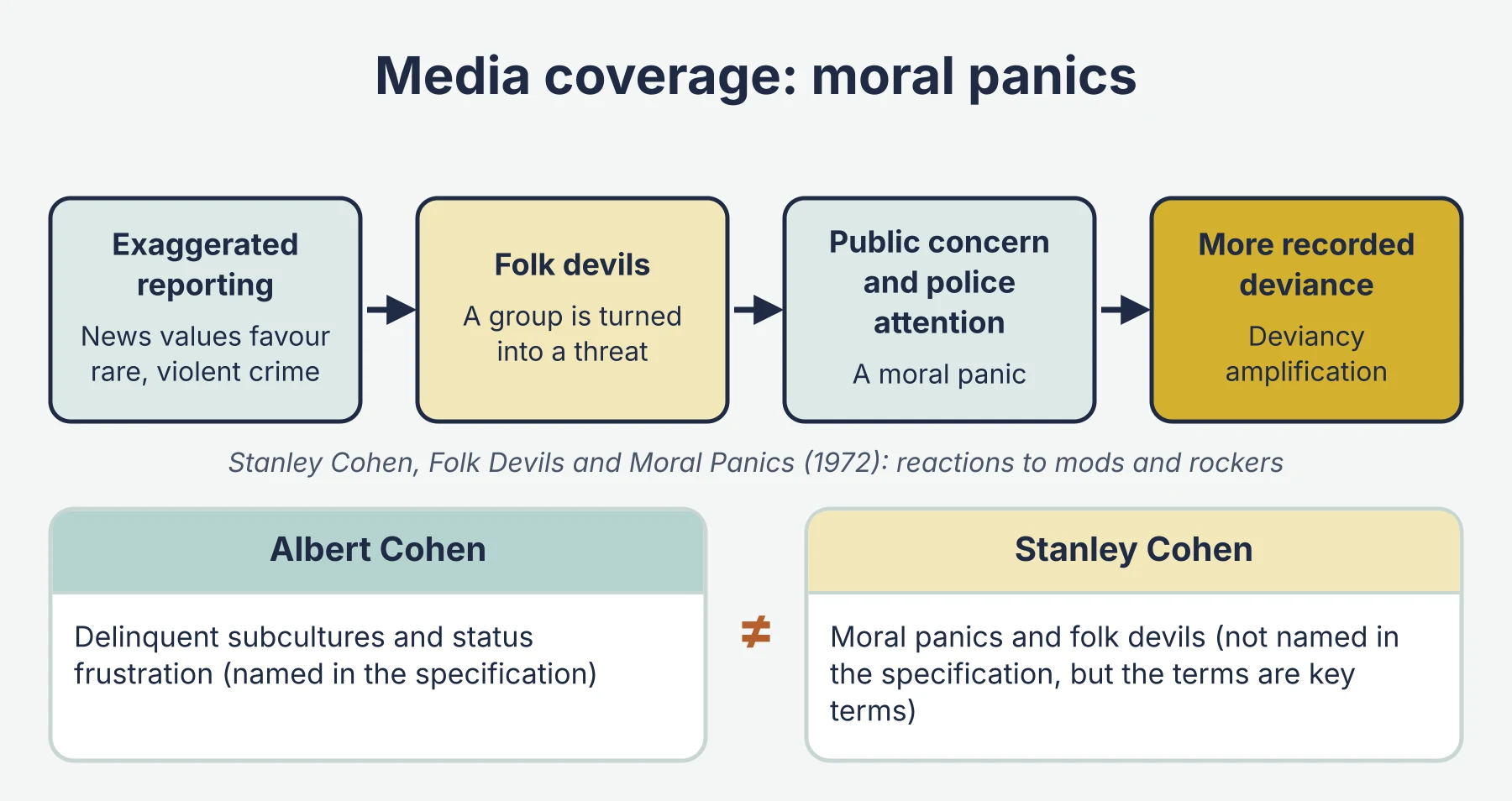
| Media coverage of crime | Whether news values exaggerate rare, violent crime, create fear and produce moral panics |
On media coverage, Stanley Cohen’s Folk Devils and Moral Panics (1972), about reactions to mods and rockers, described how exaggerated reporting can turn a group into folk devils and produce deviancy amplification: more police attention and public concern lead to more recorded deviance. Stanley Cohen is not named in the specification, but the terms are in its key terms list. Do not confuse him with Albert Cohen.
Perspectives compared
| Perspective | Main factor stressed | Example |
|---|---|---|
| Functionalist | Strain and blocked opportunity; subcultures | Merton; Albert Cohen |
| Marxist | Class inequality and selective law enforcement | Crimes of the powerful under-recorded |
| Feminist | Patriarchal control and its breakdown | Heidensohn; Carlen |
| Interactionist | Labelling by agents of social control | Policing of young, working-class and Black people |
Worked example: an annotated 4-mark answer
Question (practice): Identify and explain one reason, according to Carlen, why some working-class women commit crime. [4]
Some working-class women commit crime when the class deal fails [identifies: 1]. The class deal promises respectable working-class women consumer goods in return for their wage labour [explains the deal: 1]. If a woman is unemployed or on a very low income, these rewards are not available [shows the deal failing: 1]. Using control theory, Carlen argues that when the advantages of conformity disappear, crime becomes a rational and viable alternative [links to the theory: 1].
Common mistakes
- Confusing Albert Cohen (delinquent subcultures) with Stanley Cohen (moral panics).
- Treating official statistics as proof of who commits crime, without mentioning policing and the dark figure (3.5.4).
- Describing Carlen’s deals without explaining what happens when they fail.
- Listing the five public debates without describing what the disagreement is.
- Writing that ethnicity “causes” crime. Explain the competing explanations.
Exam technique for the command words
- Identify: name a factor or debate.
- Describe: give the pattern or the features of a study.
- Explain: show the link from factor to offending, or to being recorded as offending.
- Discuss how far: set explanations of offending against explanations of policing and recording, and reach a judgement.
Official syllabus
AQA GCSE Sociology (8192) specification, Version 1.2 (June 2026), for GCSE exams 2019 onwards: section 3.5.3 Criminal and deviant behaviour, and the summaries of Albert Cohen and Carlen in Appendix B.
Related resources
-
Practice questions
AQA GCSE Sociology (8192): Criminal and deviant behaviour – Practice Questions
Original AQA GCSE Sociology 8192 practice on 3.5.3 with marked answers: class, gender, ethnicity and age, public debates, Albert Cohen and Carlen.
Sociology · AQA · GCSE
Try questions -
Revision notes
AQA GCSE Sociology (8192): Criminal and deviant behaviour – Revision Notes
Condensed AQA GCSE Sociology 8192 notes on 3.5.3: class, gender, ethnicity and age, five public debates, Albert Cohen, Carlen, perspectives and a self-test.
Sociology · AQA · GCSE
Revise topic -
Study guides
AQA GCSE Sociology (8192): Data on crime
In-depth AQA GCSE Sociology 8192 guide to 3.5.4: police recorded crime, victim surveys, self-report studies, trends, the dark figure and three perspectives.
Sociology · AQA · GCSE
Read guide
Related articles
Get free revision emails (optional)
Occasional emails with practice questions, worked explanations and links to free resources for the qualification and subjects you choose. No spam, and you can unsubscribe from any email. The free tools on this site never need an email.