
Revision Notes
AQA GCSE Sociology (8192): Social control – Revision Notes
Condensed AQA GCSE Sociology 8192 notes on 3.5.2: formal and informal control, the sanctions grid, four perspectives, Heidensohn and a self-test.
- Subject
- Sociology
- Level
- GCSE
- Topic
- Crime and deviance
- Author
- Marlbridge Academic Team
- Updated
- Reviewed by
- Naqiya Yousaf (what this means)
Aligned to AQA GCSE Sociology (8192), first teaching 2017. Official specification .
Syllabus page (what it covers and how it is assessed): AQA GCSE Sociology.
Syllabus points this page covers
8192
- 3.5.2 Social control
Found an error? Report a correction.
Need help with this topic? Request a free trial class for GCSE Sociology (8192).
These notes condense 3.5.2 Social control, from the AQA GCSE Sociology (8192) specification, assessed in Paper 2. You must explain “formal and informal methods of social control including unwritten rules and sanctions”, compare interactionist, functionalist, feminist and Marxist perspectives, and describe the key ideas of Heidensohn on female conformity.
For full explanations, read the social control study guide. For the whole topic, see the Crime and deviance revision notes. Then try the social control practice questions.
Key terms
| Term | Meaning |
|---|---|
| Social control | The ways a society encourages conformity and discourages deviance |
| Formal social control | Control based on written rules, enforced by official agents |
| Informal social control | Control based on unwritten rules, applied through everyday relationships |
| Unwritten rules | Norms everyone knows but that are not written down |
| Agent of social control | A person or institution that enforces rules, such as police, courts, family or peers |
| Sanctions | Rewards (positive) or punishments (negative) that encourage conformity |
| Internalisation | Accepting norms as your own through socialisation |
| Criminal justice system | Police, courts, prisons and probation |
| Surveillance | Watching people’s behaviour, for example through CCTV |
| Control theory | People make a rational choice to offend when the advantages outweigh the disadvantages |
| Patriarchy | A society dominated by men |
| Separate spheres | The idea that women belong in the home and men in public life |
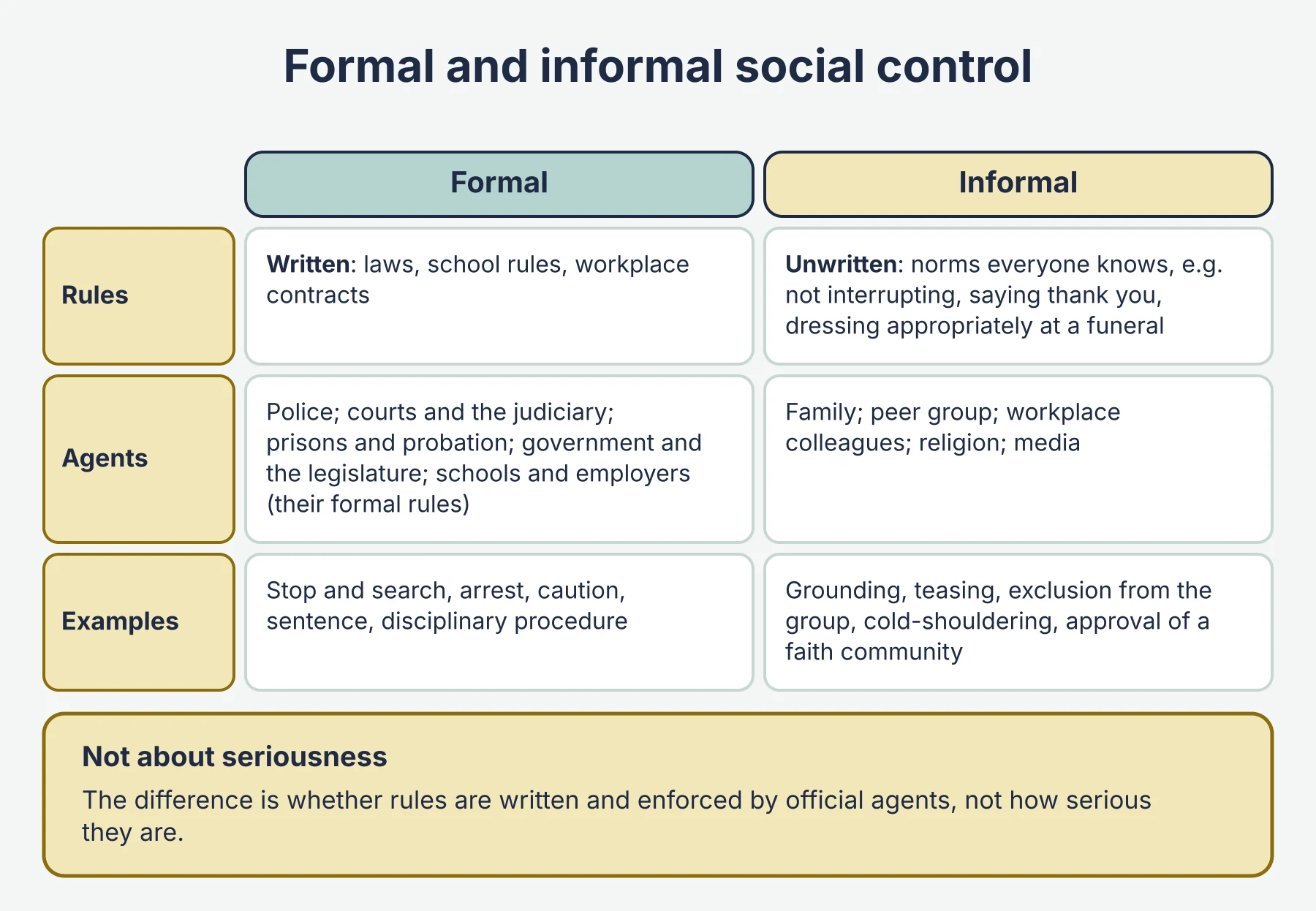
Formal versus informal
| Formal | Informal | |
|---|---|---|
| Rules | Written: laws, school rules, contracts | Unwritten: norms and expectations |
| Agents | Police, courts, prisons, probation, government, schools and employers through official procedures | Family, peers, colleagues, religion, media |
| Typical sanctions | Arrest, fine, prison, caution, exclusion | Praise, disapproval, gossip, ridicule, being ignored |
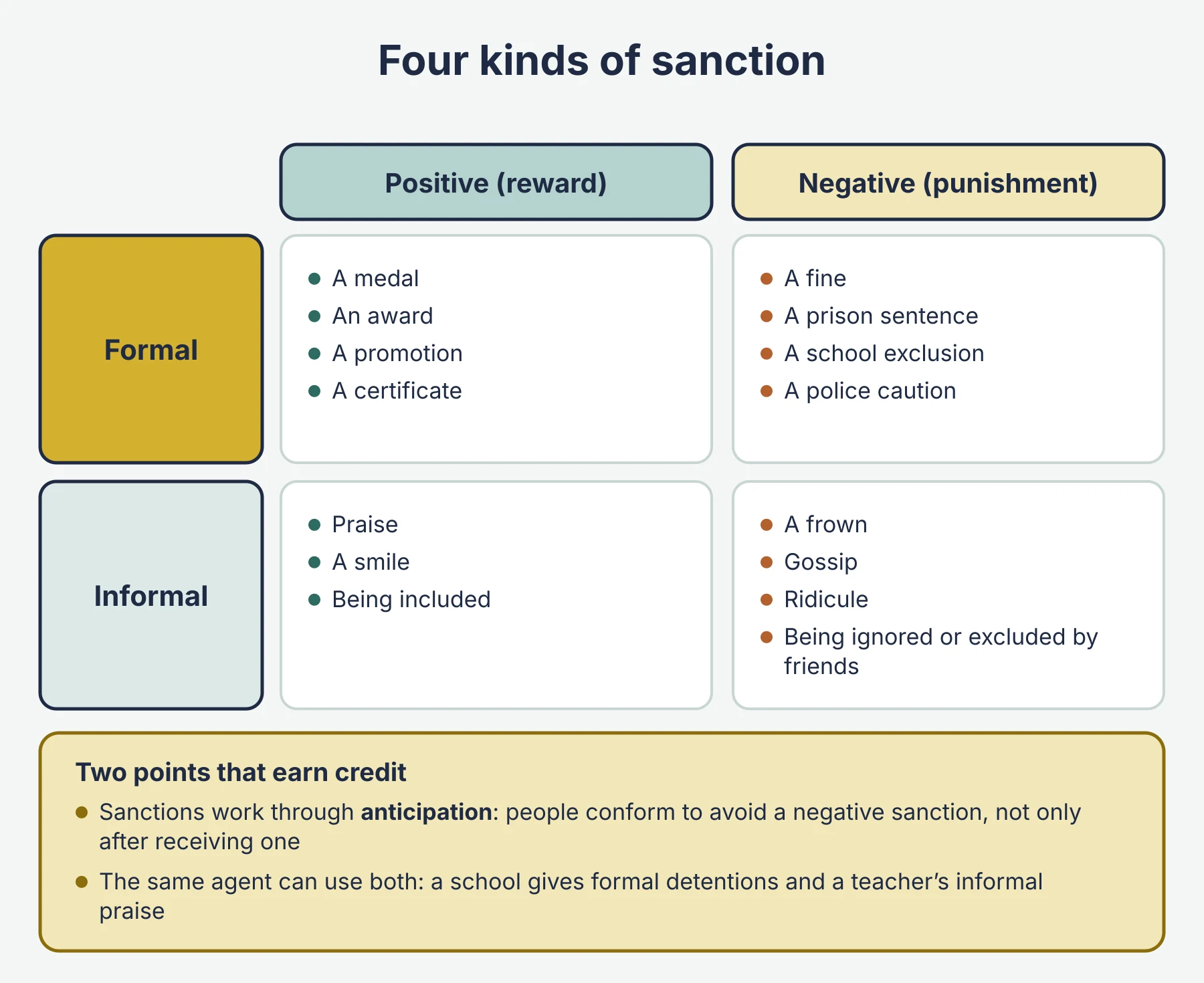
The sanctions grid
| Positive | Negative | |
|---|---|---|
| Formal | Award, medal, promotion, certificate | Fine, prison, exclusion, caution |
| Informal | Praise, smile, inclusion | Frown, gossip, ridicule, exclusion from a group |
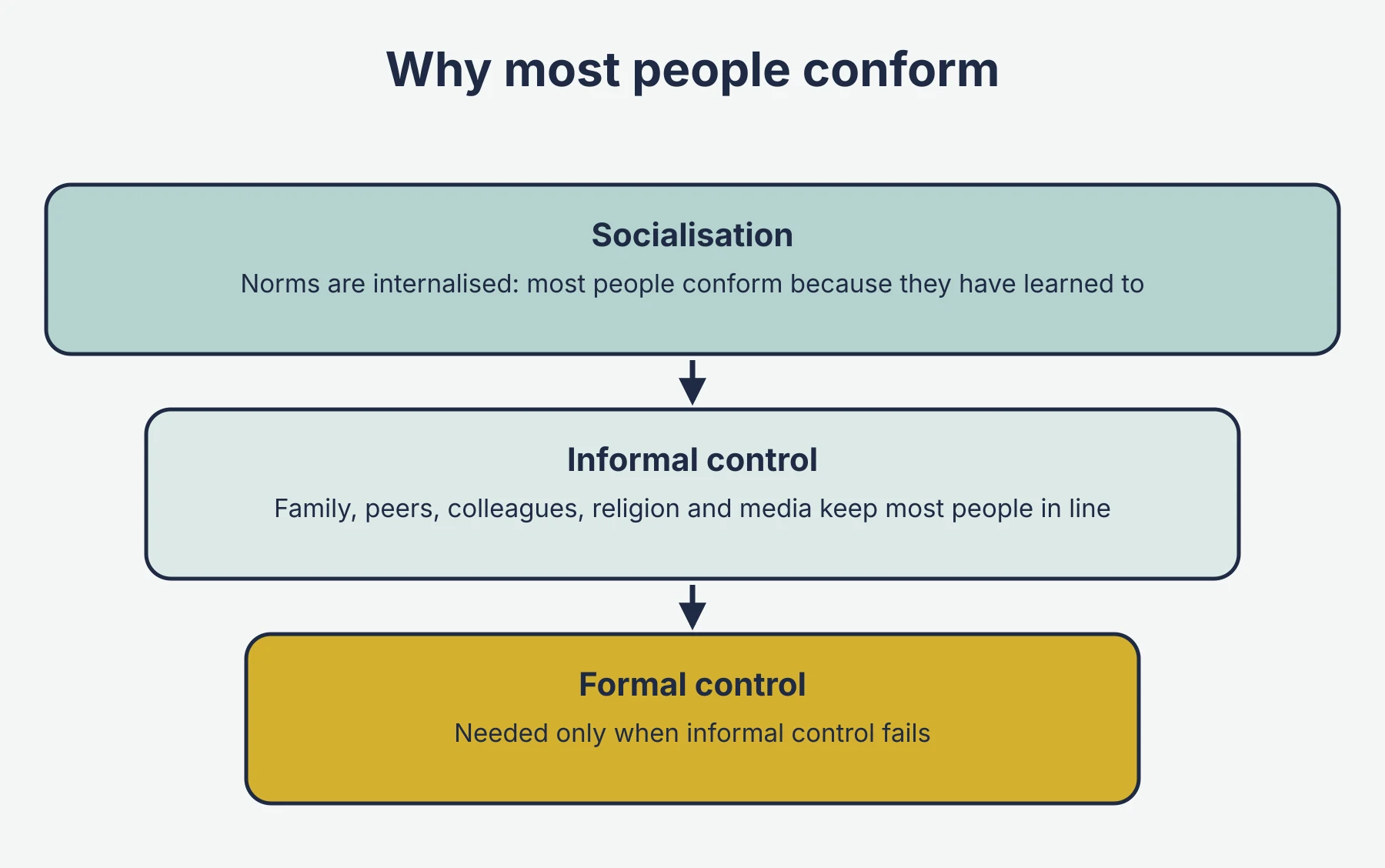
Remember: sanctions work by anticipation as well as after the event; most conformity comes from internalised norms and informal control.
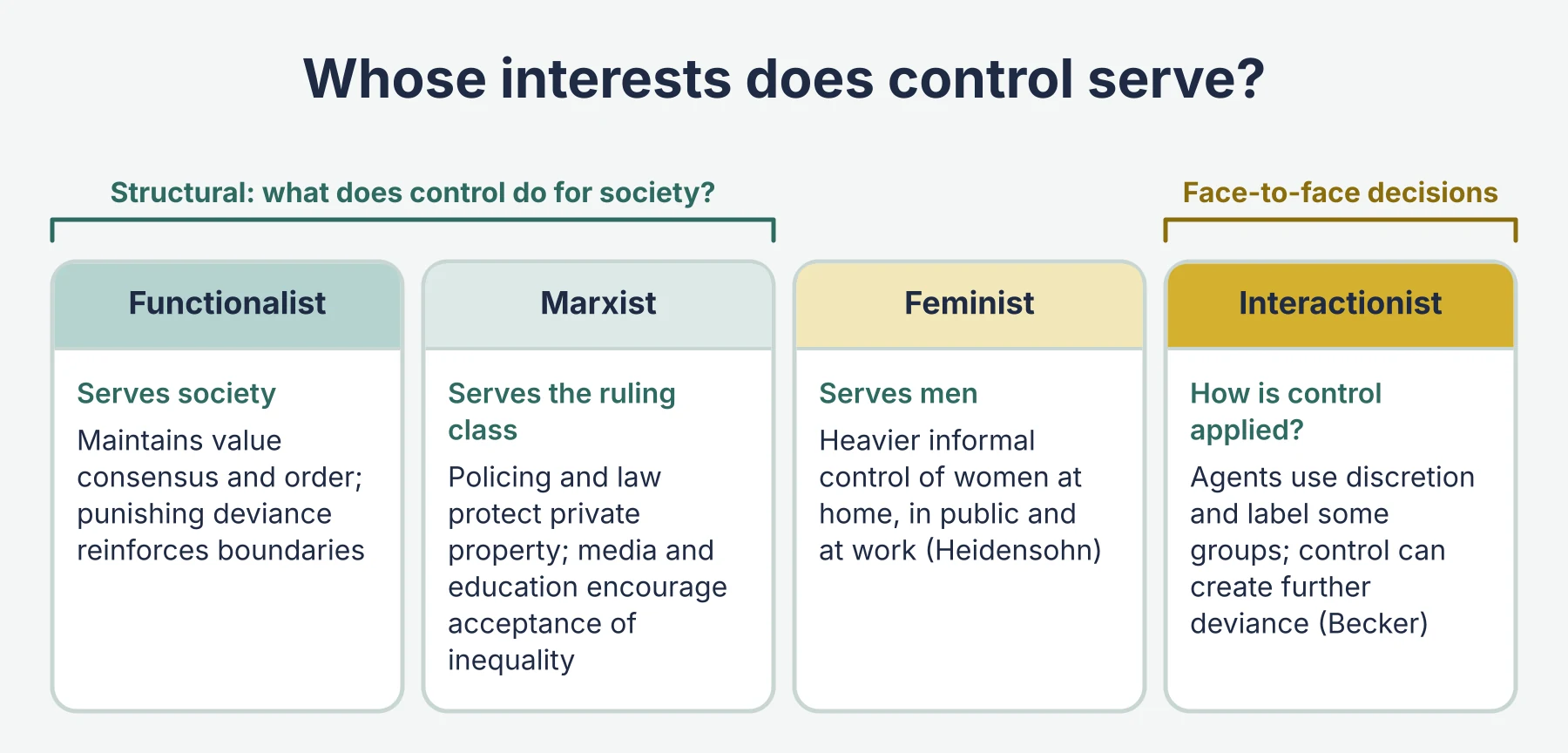
Perspectives in one line each
- Functionalist: control maintains value consensus and social order for the benefit of all.
- Marxist: formal control protects ruling-class property; informal control through media and education encourages acceptance of inequality.
- Feminist: patriarchal societies control women more than men (Heidensohn).
- Interactionist: agents of control use discretion and label some groups more than others, which can create further deviance.
Heidensohn (Women and Crime, 1985)
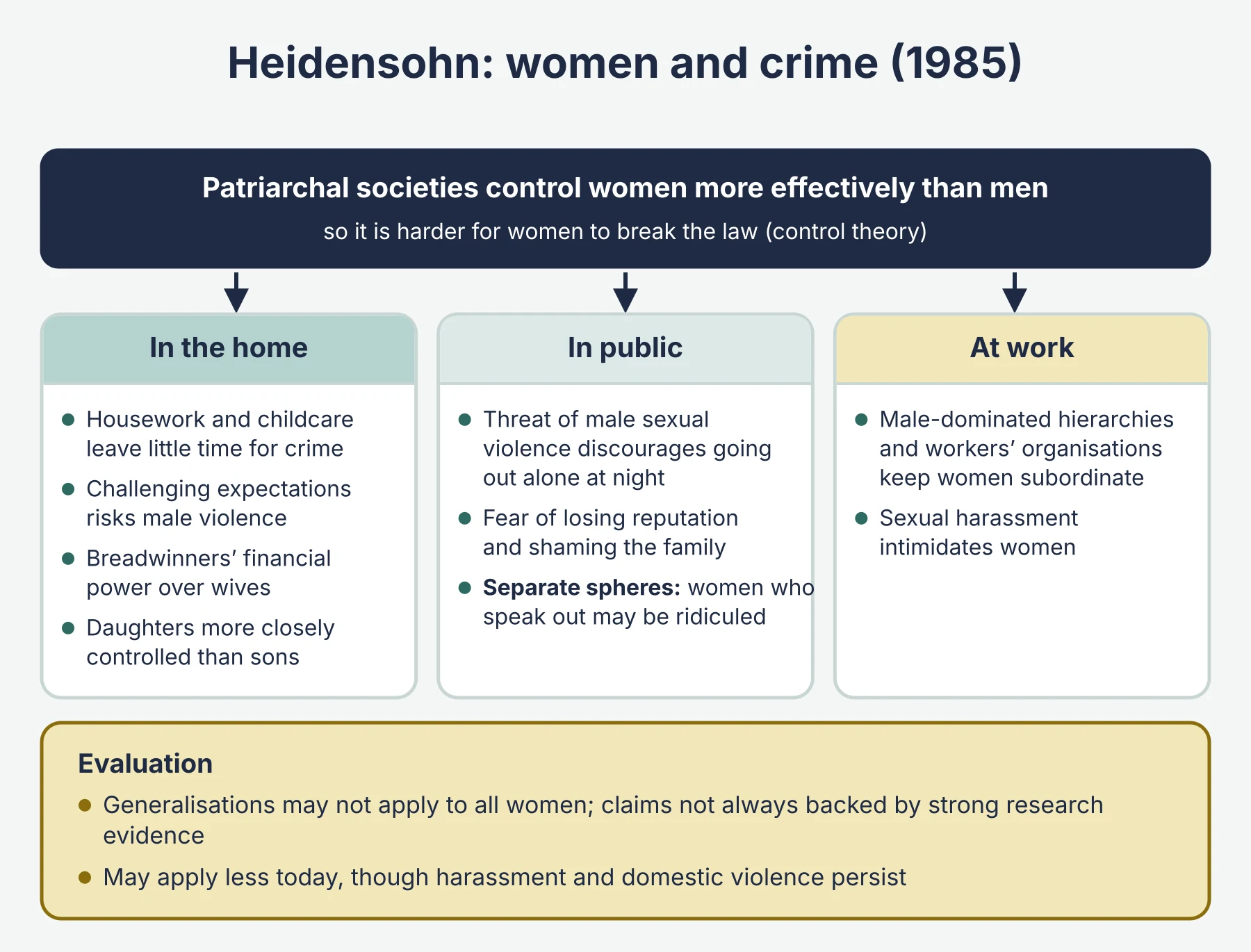
Feminist; uses control theory to explain why women commit fewer crimes than men: patriarchal societies control women more effectively than men.
| Setting | How women are controlled |
|---|---|
| Home | Housework and childcare take most of their time; risk of male violence if they challenge this; men’s financial power as breadwinners; daughters more closely controlled than sons |
| Public | Threat of male sexual violence; fear of losing reputation and bringing shame on the family; separate spheres, with ridicule for women raising concerns in public |
| Work | Male-dominated hierarchies and workers’ organisations; sexual harassment |
Evaluation: generalises to all women; claims not always backed by strong research evidence; gender roles have changed since the 1980s, though harassment and domestic violence persist.
Contrast with Carlen (3.5.3): both use control theory; Heidensohn explains women’s conformity, Carlen explains why control breaks down for some working-class women.
Must-know distinctions
- Formal vs informal: written rules and official agents versus unwritten rules and everyday relationships.
- Positive vs negative sanctions: rewards versus punishments.
- Structural vs interactionist views: what control does for society or the ruling class versus how individual agents apply it.
- Heidensohn vs Carlen: why women conform versus why some women offend.
Exam traps
- Every example needs the agent and the sanction: “a parent grounds a teenager” beats “the family”.
- Schools and employers can use both formal and informal control.
- Heidensohn’s argument is about control, not women’s nature.
- The specification lists four perspectives for 3.5.2, including interactionist.
- In “discuss how far” questions, ask whose interests control serves.
Self-test
- Define informal social control.
- Give one example of an unwritten rule.
- Name two formal agents of social control.
- Give one example of a positive informal sanction.
- Give one example of a negative formal sanction.
- Why do most people conform without formal control?
- How do Marxists see the role of the police and the law?
- How do interactionists view the work of agents of social control?
- Which theory does Heidensohn use?
- Give two ways women are controlled in the home, according to Heidensohn.
- What is meant by “separate spheres”?
- Give one criticism of Heidensohn.
Answers
- Control through unwritten rules and everyday relationships, such as family and peers, using sanctions like praise or disapproval.
- For example, not interrupting someone who is speaking.
- Any two: police, courts, prisons, probation, government.
- For example, praise from a parent or friend.
- For example, a fine or a prison sentence.
- They have internalised norms through socialisation and want to avoid informal sanctions.
- As protecting the property and interests of the ruling class and the capitalist system.
- They use discretion and label some groups more readily, which can create further deviance.
- Control theory.
- Any two: expected to spend most time on housework and childcare; risk of male violence; men’s financial power; daughters more closely controlled than sons.
- The idea that women’s place is in the home and men’s is in public life.
- She generalises to all women, or does not always support claims with strong research evidence.
Official syllabus
AQA GCSE Sociology (8192) specification, Version 1.2 (June 2026), for GCSE exams 2019 onwards: section 3.5.2 Social control, with Appendix B summaries.
Related resources
-
Study guides
AQA GCSE Sociology (8192): The social construction of crime and deviance
In-depth AQA GCSE Sociology 8192 guide to 3.5.1: how crime and deviance are socially constructed, Merton's anomie, Becker's labelling and four perspectives.
Sociology · AQA · GCSE
Read guide -
Revision notes
AQA GCSE Sociology (8192): The social construction of crime and deviance – Revision Notes
Condensed AQA GCSE Sociology 8192 notes on 3.5.1: crime and deviance as social constructs, the five explanations, Merton, Becker, perspectives and a self-test.
Sociology · AQA · GCSE
Revise topic -
Study guides
AQA GCSE Sociology (8192): Crime and Deviance – Study Guide
Study guide to AQA GCSE Sociology 8192 Crime and deviance 3.5.1-3.5.4: Merton, Becker, Heidensohn, Albert Cohen, Carlen, social control and crime statistics.
Sociology · AQA · GCSE
Read guide
Related articles
Get free revision emails (optional)
Occasional emails with practice questions, worked explanations and links to free resources for the qualification and subjects you choose. No spam, and you can unsubscribe from any email. The free tools on this site never need an email.