
Revision Notes
AQA GCSE Sociology (8192): The social construction of crime and deviance – Revision Notes
Condensed AQA GCSE Sociology 8192 notes on 3.5.1: crime and deviance as social constructs, the five explanations, Merton, Becker, perspectives and a self-test.
- Subject
- Sociology
- Level
- GCSE
- Topic
- Crime and deviance
- Author
- Marlbridge Academic Team
- Updated
- Reviewed by
- Naqiya Yousaf (what this means)
Aligned to AQA GCSE Sociology (8192), first teaching 2017. Official specification .
Syllabus page (what it covers and how it is assessed): AQA GCSE Sociology.
Syllabus points this page covers
8192
- 3.5.1 The social construction of crime and deviance
Found an error? Report a correction.
Need help with this topic? Request a free trial class for GCSE Sociology (8192).
These notes condense 3.5.1 The social construction of crime and deviance, from the AQA GCSE Sociology (8192) specification, assessed in Paper 2. You must explain how concepts of crime and deviance are socially constructed; explain anomie, labelling, structural, subcultural and interactionist explanations; compare interactionist, functionalist, feminist and Marxist perspectives; and describe the key ideas of Merton and Becker on the causes of crime.
For full explanations, read the social construction of crime and deviance study guide. For the whole topic, see the Crime and deviance revision notes. Then try the social construction of crime practice questions.
Core idea in three lines
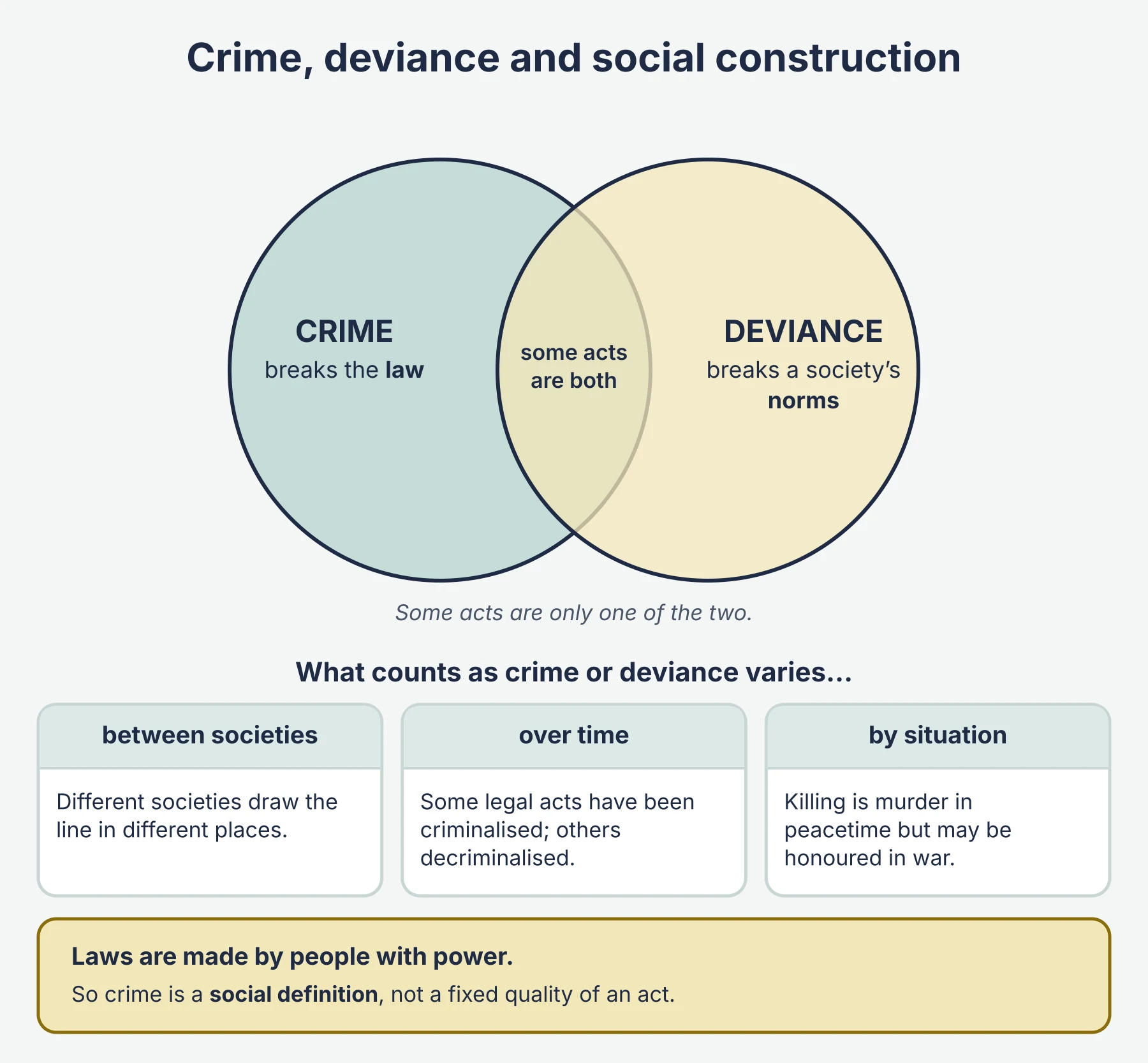
- No act is criminal or deviant in itself.
- Societies define acts as crime (through law) or deviance (through norms).
- Definitions vary over time, between societies and by situation, and reflect who has the power to define.
Key terms
| Term | Meaning |
|---|---|
| Crime | Behaviour that breaks the criminal law |
| Deviance | Behaviour that breaks a society’s norms, legal or not |
| Social construct | Something whose meaning is created by society, not fixed by nature |
| Norms | Unwritten expectations about how to behave in a situation |
| Value consensus | Broad agreement on society’s main values (functionalist) |
| Anomie | Normlessness: the usual rules are abandoned in pursuit of success (Merton) |
| Structural theories | Crime explained by how society is organised, such as unequal opportunity |
| Subcultural theories | Crime explained by groups with values different from the mainstream |
| Labelling | Defining a person or act as deviant |
| Master status | A label that overrides all other identities, such as “criminal” |
| Self-fulfilling prophecy | A person comes to act in line with a label |
| Deviant career | Progression into further deviance after labelling, ending in a deviant group |
| Agent of social control | An institution with power to enforce rules, such as the police or courts |
| White collar crime | Crime committed by people in higher-status jobs, often in the course of work |
| Corporate crime | Crime committed by or for a company |
Examples of social construction
| Type of variation | Example |
|---|---|
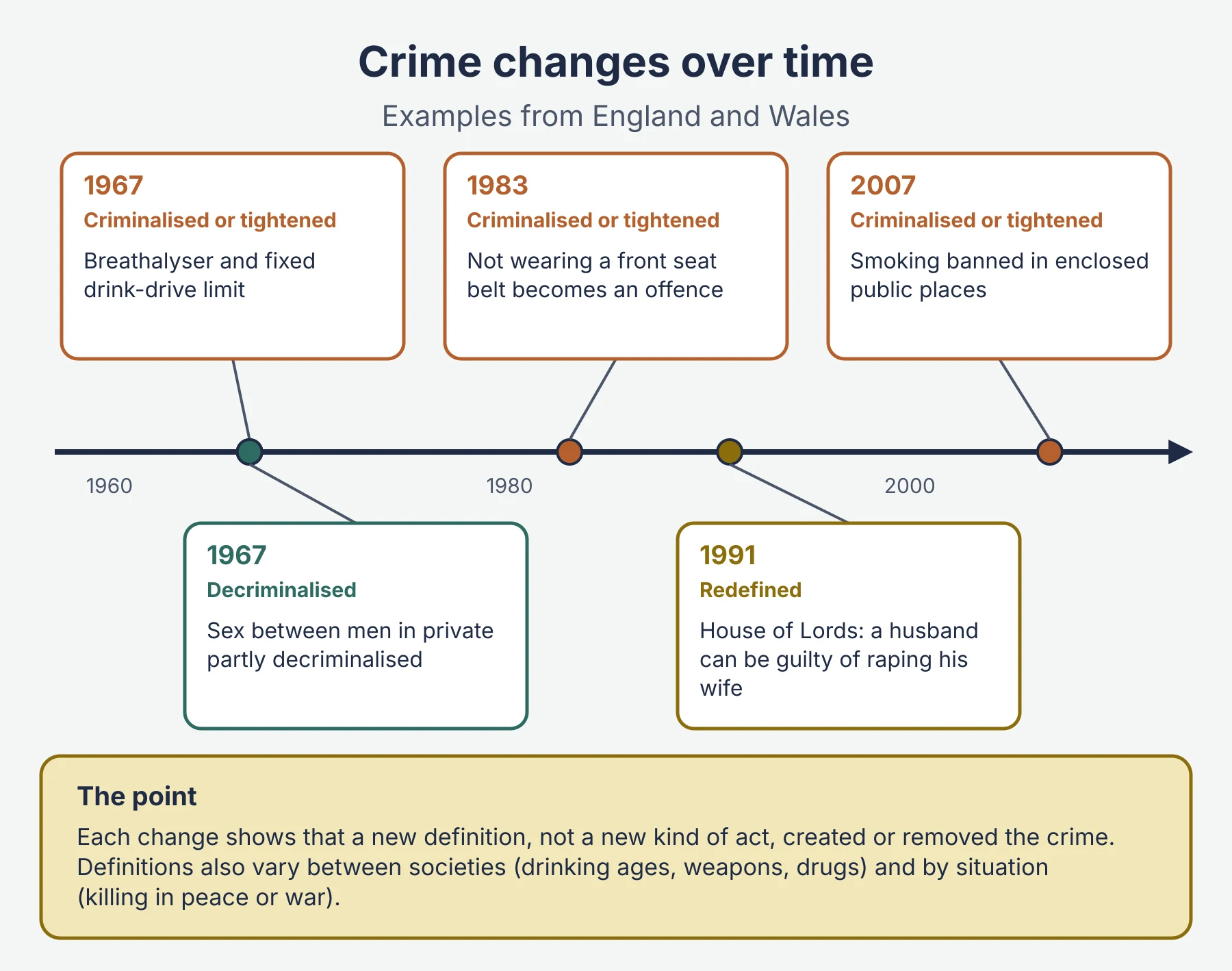
| Over time | Sexual Offences Act 1967 partly decriminalised sex between men in private in England and Wales; smoking in enclosed public places banned in England in 2007; rape in marriage recognised as a crime by the House of Lords in 1991 |
| Between societies | Different legal drinking ages and drug laws between countries |
| By situation | Killing in war versus peacetime; shouting at a football match versus in a library |
Merton (functionalist) in brief
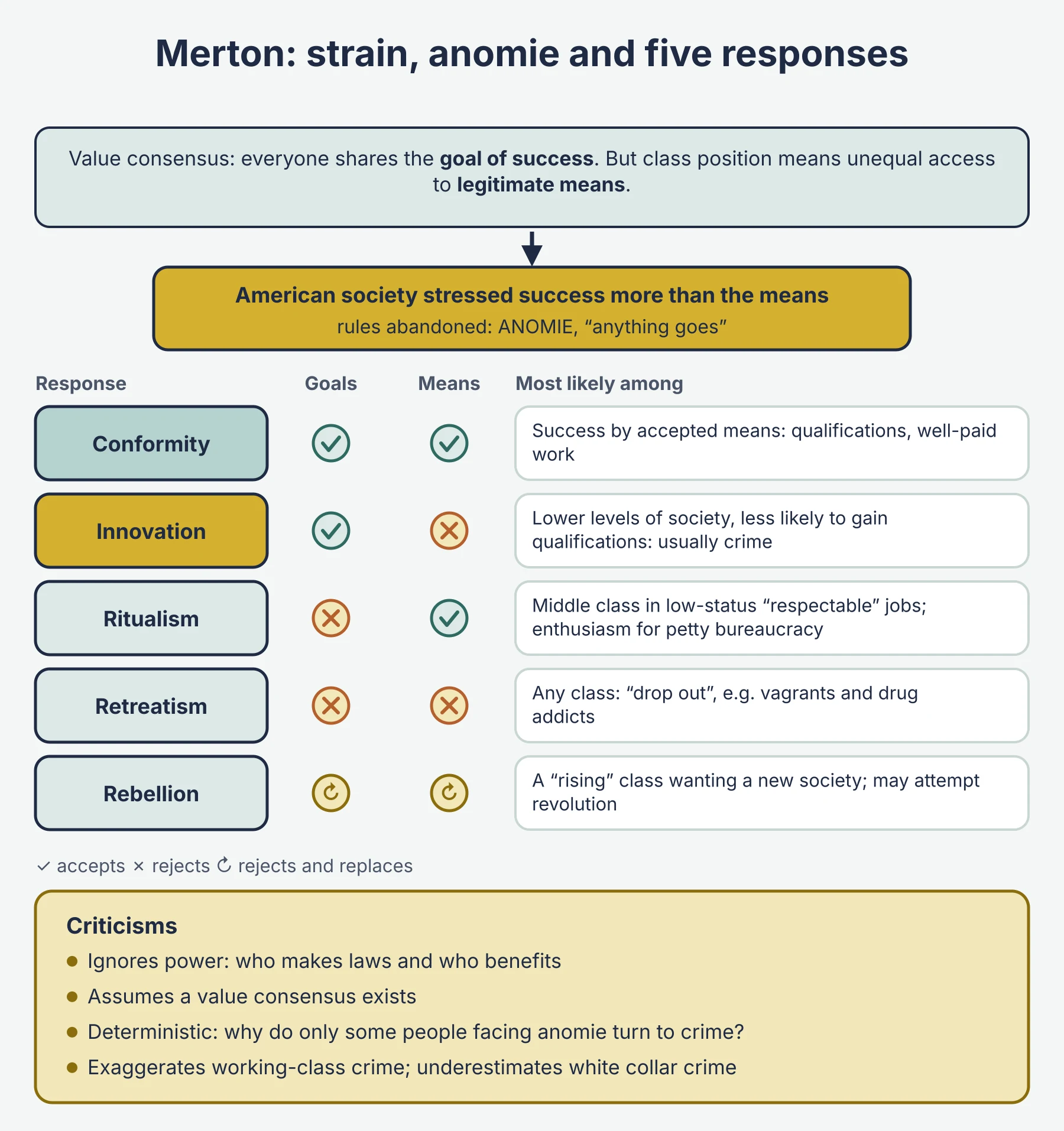
- Starts from value consensus: all share the goal of success.
- Unequal positions in the social structure mean unequal access to legitimate means.
- American society stressed success over means → anomie (“anything goes”).
| Adaptation | Goals | Means | Typical group (specification) |
|---|---|---|---|
| Conformity | Accept | Accept | Those using qualifications, talent, hard work |
| Innovation | Accept | Reject | Lower levels of society denied usual routes; usually crime |
| Ritualism | Reject | Accept | Middle-class people stuck in low-status “respectable” jobs |
| Retreatism | Reject | Reject | Any class; vagrants, drug addicts |
| Rebellion | Replace | Replace | A “rising” class seeking a new society |
Criticisms: ignores power and who makes laws; assumes consensus; deterministic; exaggerates working-class crime and underestimates white collar crime.
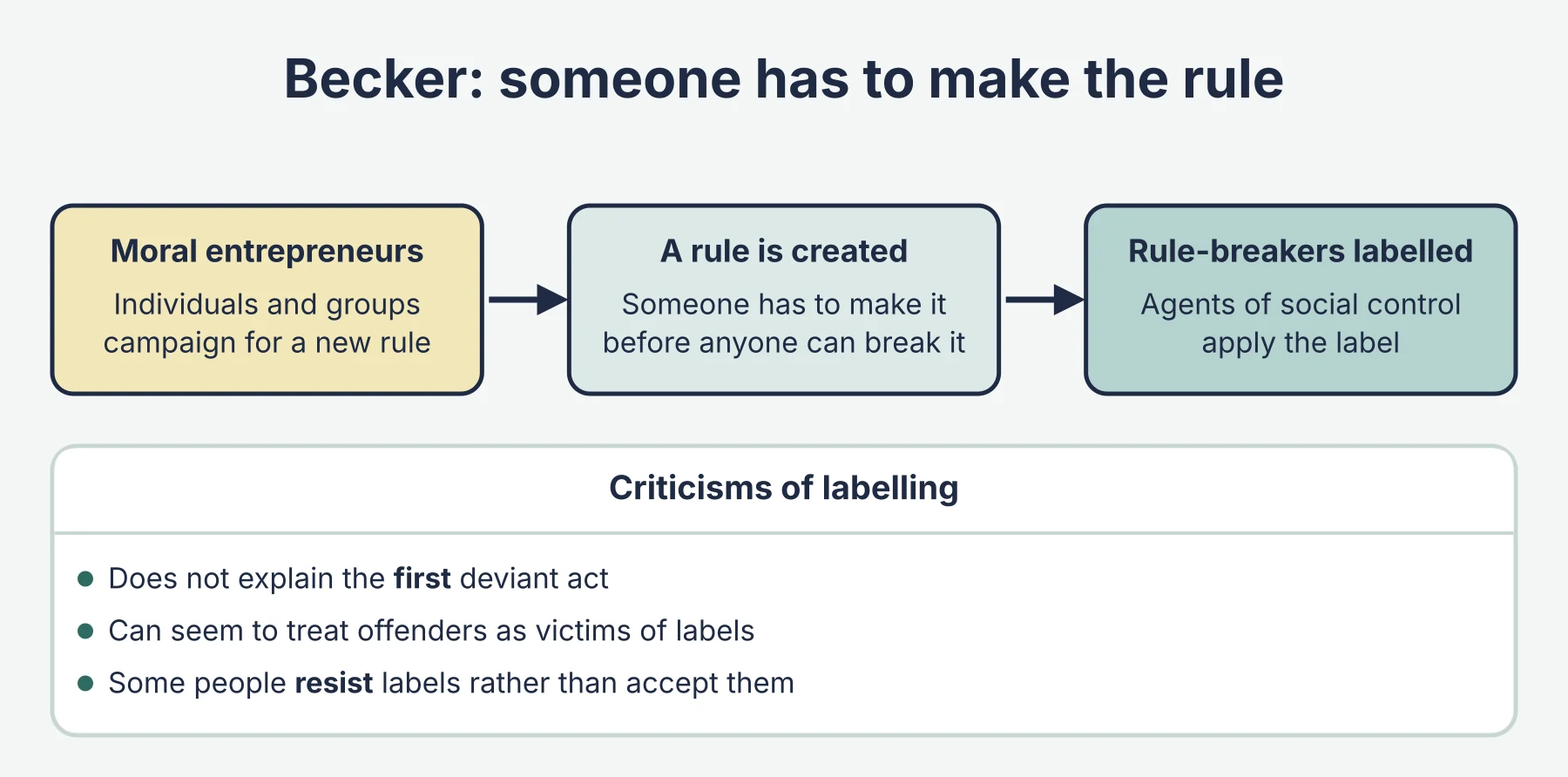
Becker (interactionist) in brief
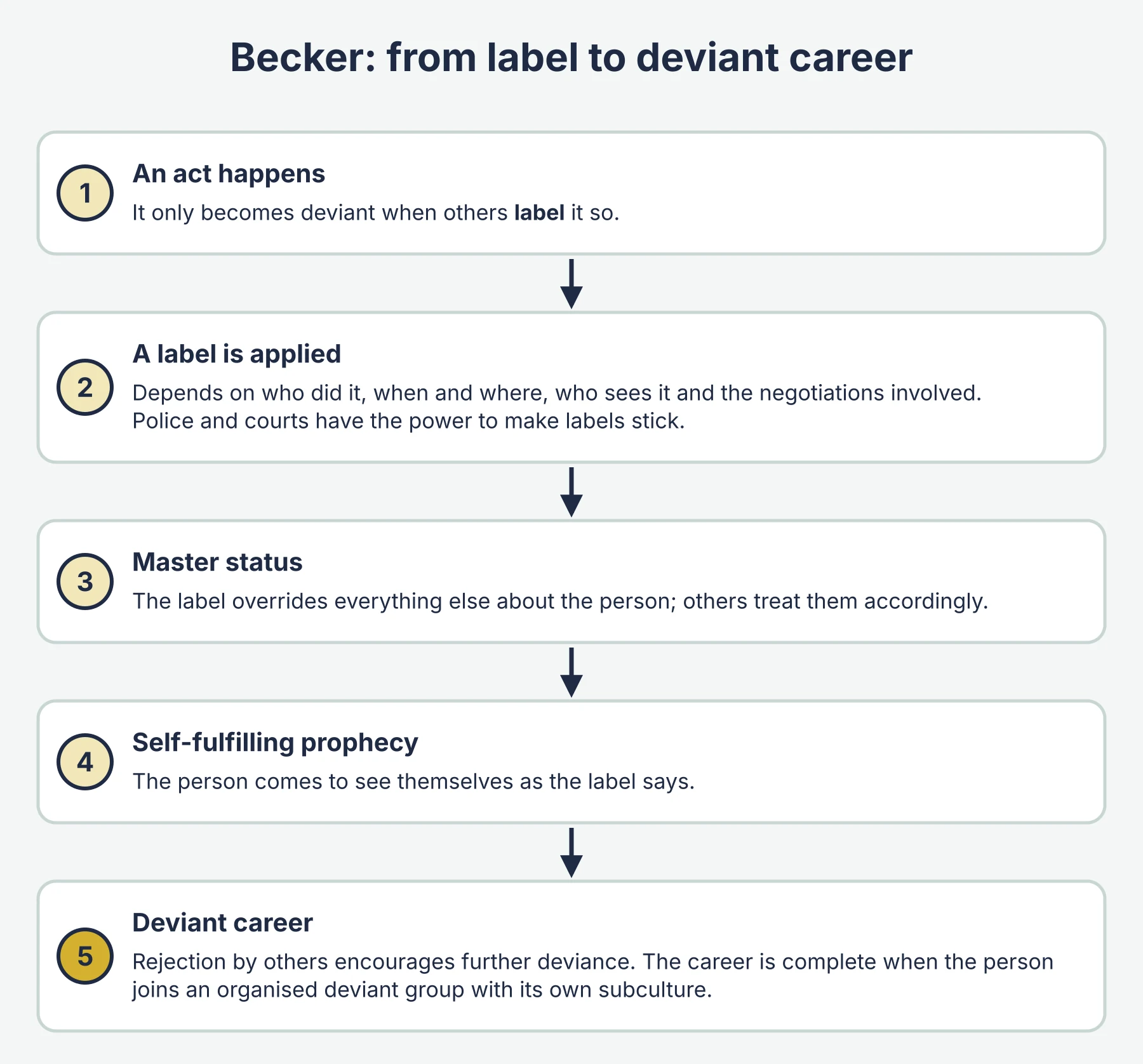
- An act becomes deviant only when others define it as deviant.
- Labelling depends on who, when, where, who observes, and negotiations.
- Police and courts have the power to make labels stick.
- Label → master status → assumptions by others → self-fulfilling prophecy → rejection → deviant career → joining an organised deviant group with a subculture.
- Moral entrepreneurs campaign for new rules.
Criticisms: does not explain the first act; may treat offenders as victims; ignores people who resist labels.
Perspectives in one line each
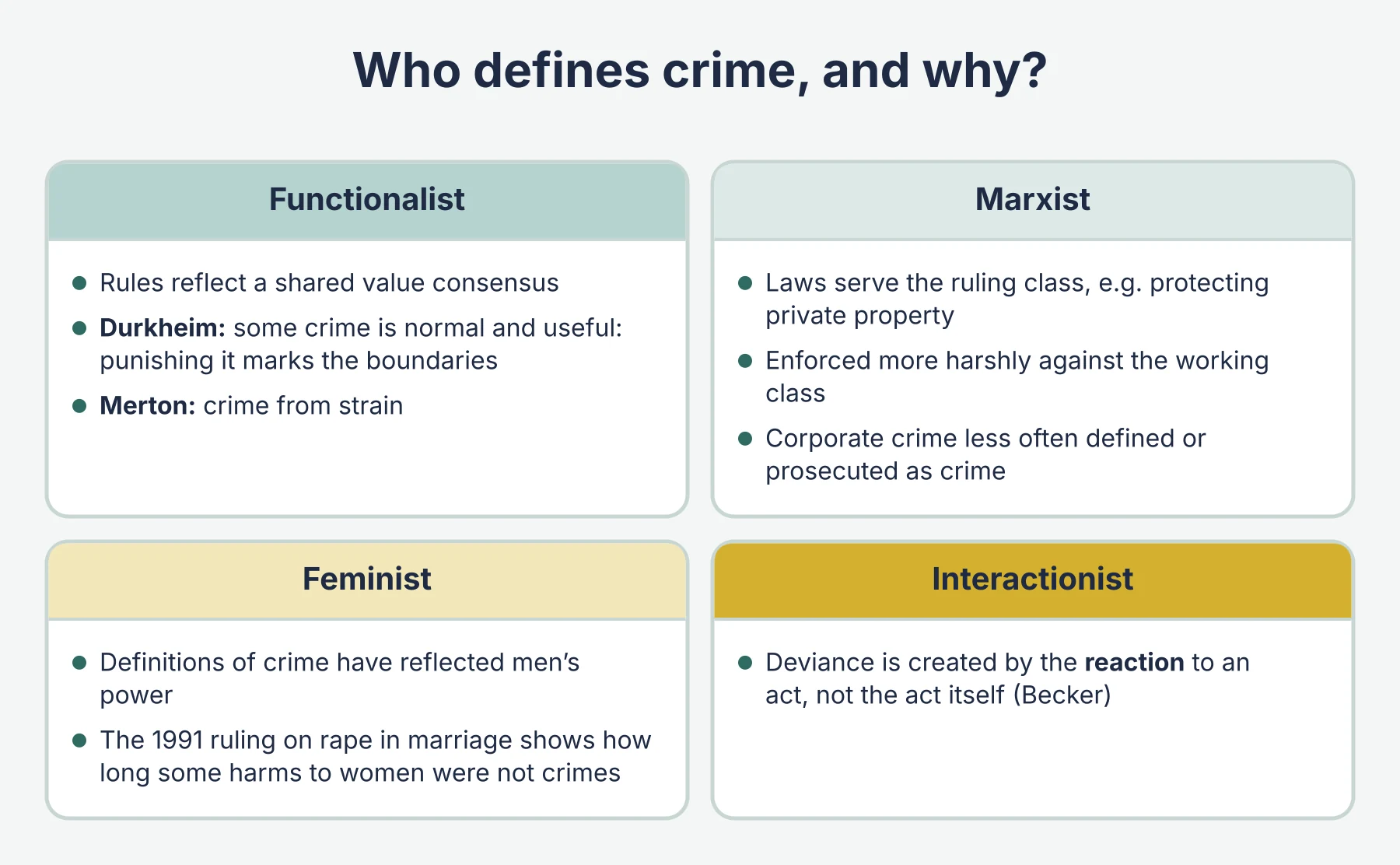
- Functionalist: rules reflect consensus; some crime is normal and reinforces boundaries (Durkheim); strain causes crime (Merton).
- Marxist: laws protect ruling-class interests; working-class crime is targeted; crimes of the powerful are under-defined.
- Feminist: definitions reflect male power; some harms to women were long not treated as crimes.
- Interactionist: deviance is created by reactions and labels (Becker).
Exam traps
- Always tie an example to time, place or situation.
- Merton is functionalist, even though he discusses class inequality.
- Innovation, not rebellion, is Merton’s main explanation of property crime.
- Becker explains the reaction to deviance, not the original motive.
- Do not confuse Albert Cohen (subcultures, 3.5.3) with Becker (labelling).
- In “discuss how far” questions, use at least three perspectives and give a judgement.
Self-test
- Define deviance and give an example that is deviant but not a crime.
- Give one example of an act whose legal status changed over time.
- What is anomie?
- Why did Merton think American society was “unbalanced”?
- Which of Merton’s adaptations accepts goals but rejects legitimate means?
- Which social group did Merton link to ritualism?
- Give two criticisms of Merton.
- What four things affect whether Becker’s label is applied?
- What is a master status?
- When is Becker’s deviant career completed?
- What did Durkheim argue about the function of some crime?
- How would a Marxist explain why some acts are defined as crimes?
Answers
- Behaviour that breaks a society’s norms; for example, pushing in a queue.
- For example, smoking in enclosed public places became illegal in England in 2007.
- A state of normlessness in which the usual rules are abandoned in the pursuit of success.
- It placed greater importance on success than on the legitimate ways of achieving it.
- Innovation.
- Middle-class people stuck in low-paid, low-status “respectable” jobs.
- Any two: ignores power and who makes laws; assumes value consensus; deterministic; exaggerates working-class crime and underestimates white collar crime.
- Who commits the act; when and where it is committed; who observes it; and the negotiations between those involved.
- A label that overrides a person’s other identities in how others see them.
- When the person joins an organised deviant group with its own subculture.
- Punishing it reminds society of its shared rules and reinforces the boundaries of acceptable behaviour.
- Laws are made in the interests of the ruling class, for example to protect property, so their definitions of crime reflect their power.
Official syllabus
AQA GCSE Sociology (8192) specification, Version 1.2 (June 2026), for GCSE exams 2019 onwards: section 3.5.1 The social construction of crime and deviance, with Appendix B summaries.
Related resources
-
Study guides
AQA GCSE Sociology (8192): Crime and Deviance – Study Guide
Study guide to AQA GCSE Sociology 8192 Crime and deviance 3.5.1-3.5.4: Merton, Becker, Heidensohn, Albert Cohen, Carlen, social control and crime statistics.
Sociology · AQA · GCSE
Read guide -
Revision notes
AQA GCSE Sociology (8192): Crime and Deviance – Revision Notes
Revision notes for AQA GCSE Sociology 8192 sections 3.5.1 and 3.5.3: social construction, Merton, Becker, Albert Cohen, Carlen and public debates on crime.
Sociology · AQA · GCSE
Revise topic -
Study guides
AQA GCSE Sociology (8192): Criminal and deviant behaviour
In-depth AQA GCSE Sociology 8192 guide to 3.5.3: class, gender, ethnicity and age in crime, the five public debates, Albert Cohen and Carlen.
Sociology · AQA · GCSE
Read guide
Related articles
Get free revision emails (optional)
Occasional emails with practice questions, worked explanations and links to free resources for the qualification and subjects you choose. No spam, and you can unsubscribe from any email. The free tools on this site never need an email.