
Study Guides
AQA GCSE Sociology (8192): Social control
In-depth AQA GCSE Sociology 8192 guide to 3.5.2: formal and informal control, unwritten rules, sanctions, four perspectives and Heidensohn on women.
- Subject
- Sociology
- Level
- GCSE
- Topic
- Crime and deviance
- Author
- Marlbridge Academic Team
- Updated
- Reviewed by
- Naqiya Yousaf (what this means)
Aligned to AQA GCSE Sociology (8192), first teaching 2017. Official specification .
Syllabus page (what it covers and how it is assessed): AQA GCSE Sociology.
Syllabus points this page covers
8192
- 3.5.2 Social control
Found an error? Report a correction.
Need help with this topic? Request a free trial class for GCSE Sociology (8192).
This guide goes deep on one sub-section of the AQA GCSE Sociology (8192) specification: 3.5.2 Social control, assessed in Paper 2: The sociology of crime and deviance and social stratification. The content is “formal and informal methods of social control”, with “the work of Heidensohn on female conformity in male dominated patriarchal societies”. You must be able to “identify, describe and explain formal and informal methods of social control including unwritten rules and sanctions”, compare interactionist, functionalist, feminist and Marxist perspectives, and describe Heidensohn’s key ideas.
For the whole topic, start with the Crime and deviance study guide. To revise this sub-section, use the social control revision notes, then test yourself with the social control practice questions.
What social control is
Social control is the set of ways a society encourages people to conform to its norms and laws and discourages deviance. Every society needs some predictability: drivers stay on the correct side of the road, customers queue and pay, pupils attend lessons. Social control explains why most people, most of the time, follow rules they did not choose.
Sociologists distinguish two broad methods.
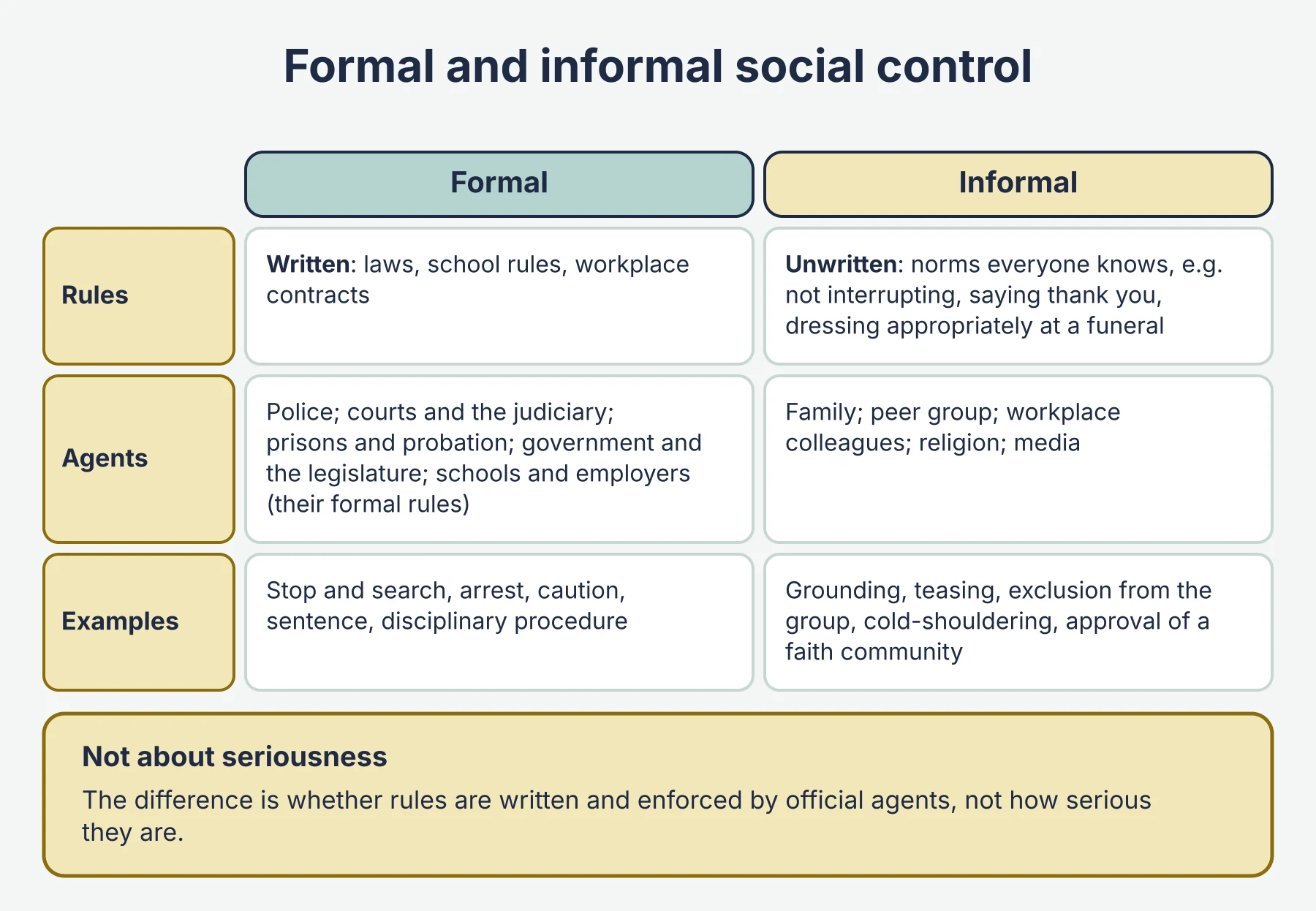
Formal social control
Formal social control is based on written rules, such as laws, school rules and workplace contracts, and is enforced by official agents of social control:
- Police: investigate, stop and search, arrest, issue cautions.
- Courts and the judiciary: decide guilt and impose sentences.
- Prisons and the probation system: punish, supervise and attempt rehabilitation.
- Government and the legislature: make the laws.
- Schools and employers, through their own formal rules and disciplinary procedures.
Informal social control
Informal social control is based on unwritten rules: norms and expectations that are never written down but that everyone knows, such as not interrupting, saying thank you or dressing appropriately at a funeral. It works through everyday relationships:
- Family: approval, disappointment, grounding, withdrawal of privileges.
- Peer group: acceptance, teasing, exclusion from the group.
- Workplace colleagues: respect or cold-shouldering.
- Religion: teachings about right and wrong, and the approval of a faith community.
- Media: praising some behaviour and condemning other behaviour.
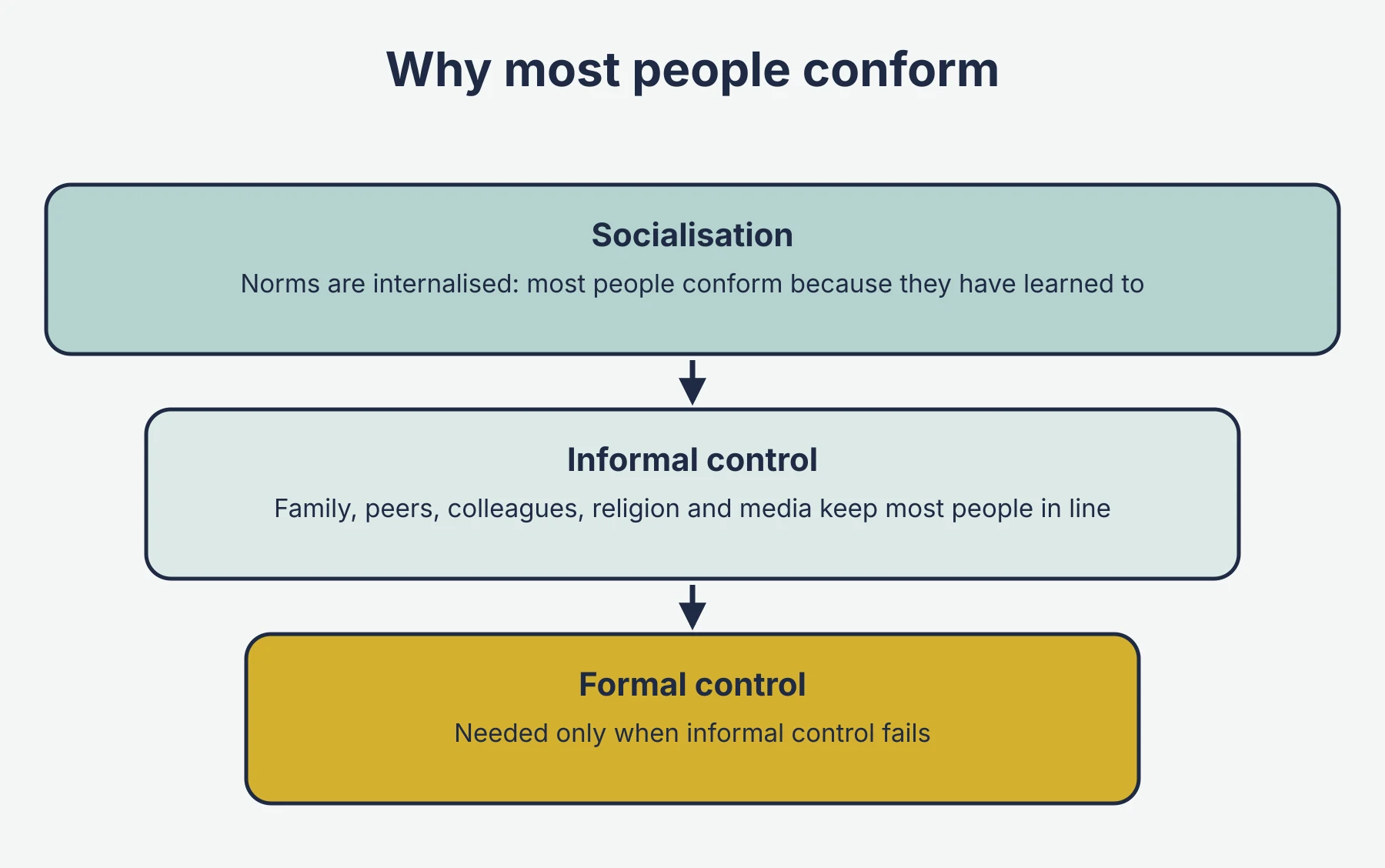
Most people conform mainly because of informal control. They have internalised norms through socialisation, so the formal system is needed only when informal control fails.
Sanctions
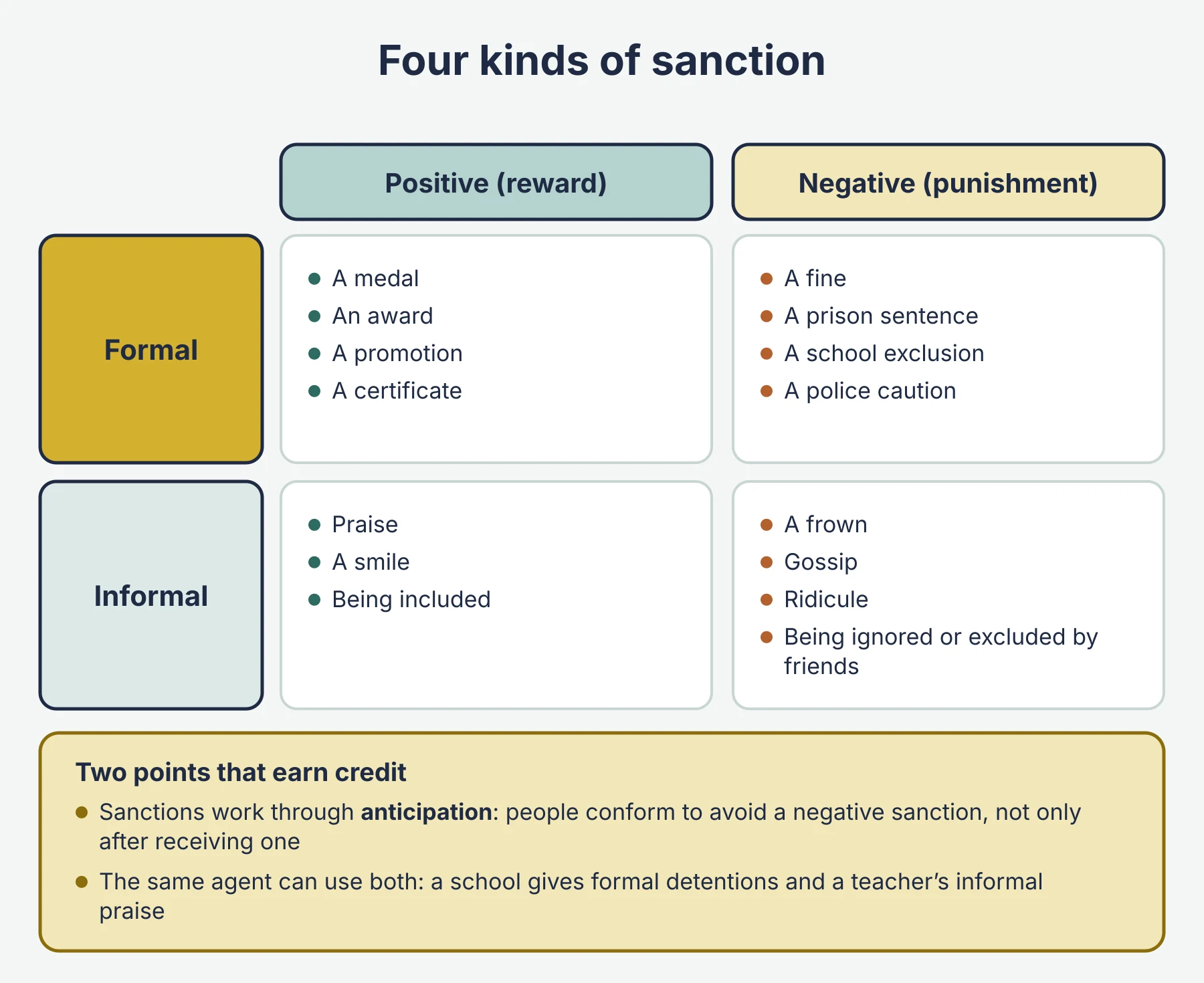
A sanction is a reward or punishment that encourages conformity. The specification names sanctions directly, and a two-by-two grid is the clearest way to learn them:
| Positive (reward) | Negative (punishment) | |
|---|---|---|
| Formal | A medal, an award, a promotion, a certificate | A fine, a prison sentence, a school exclusion, a police caution |
| Informal | Praise, a smile, being included | A frown, gossip, ridicule, being ignored or excluded by friends |
Two points earn credit in explanations. First, sanctions work through anticipation: people conform to avoid a negative sanction, not only after receiving one. Second, the same agent can use both kinds: a school gives formal detentions but also uses a teacher’s informal praise.
Perspectives on social control
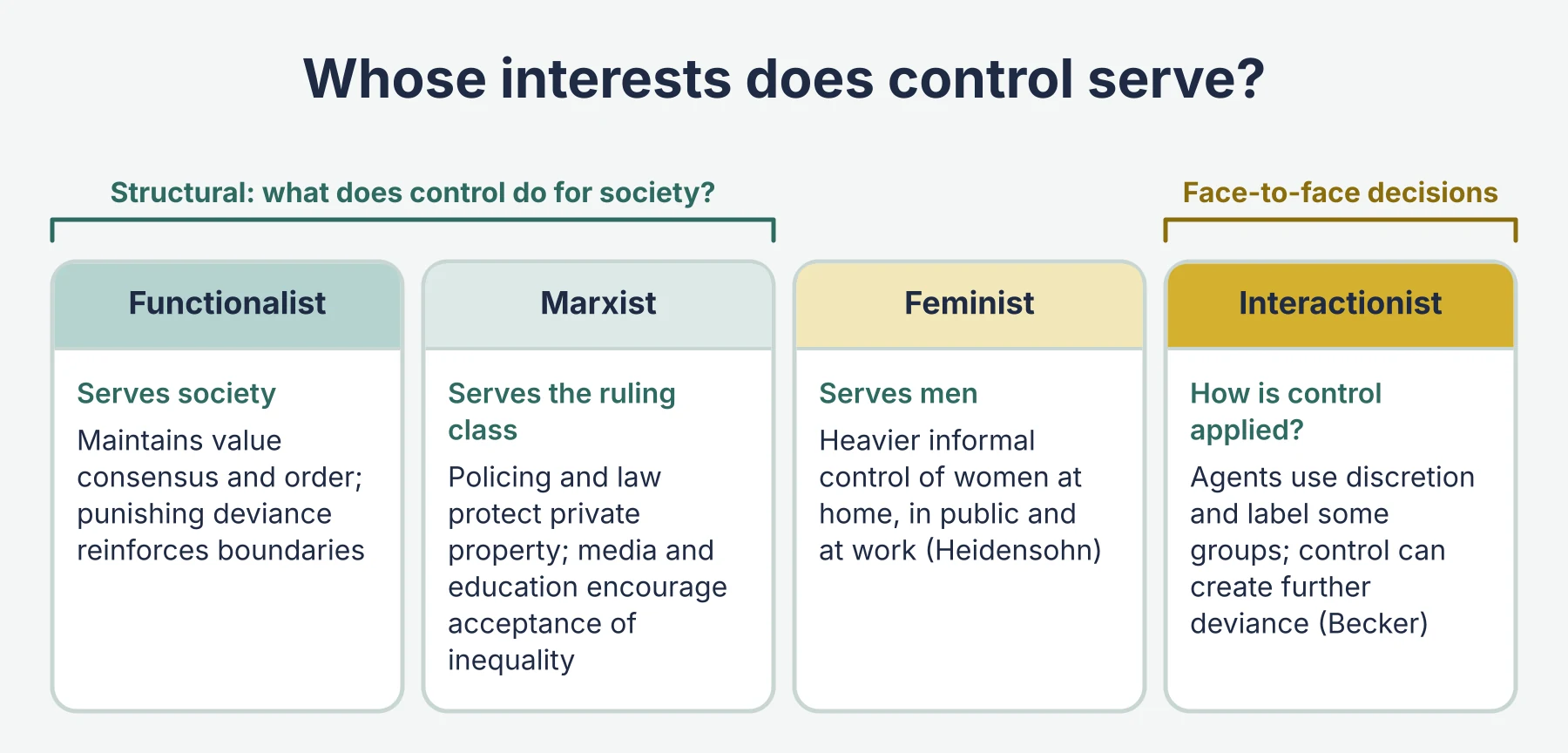
| Perspective | Whose interests control serves | How it works |
|---|---|---|
| Functionalist | Society as a whole | Social control maintains value consensus and social order. Socialisation and sanctions keep people within shared norms, and punishing deviance reinforces boundaries |
| Marxist | The ruling class | Formal control, such as policing and the law, protects private property and the capitalist system. Informal control through institutions such as the media and education encourages people to accept inequality |
| Feminist | Men (patriarchy) | Women face heavier informal control at home, in public and at work, which keeps them in subordinate roles (Heidensohn) |
| Interactionist | The question is how control is applied | Agents of social control use discretion and label some groups more readily than others; control can create further deviance through labelling (Becker) |
Notice the difference in emphasis. Functionalists and Marxists are structural perspectives: they look at what control does for society or the ruling class. Interactionists look at face-to-face decisions by police officers, teachers and others about whom to stop, warn or label.
Heidensohn on female conformity
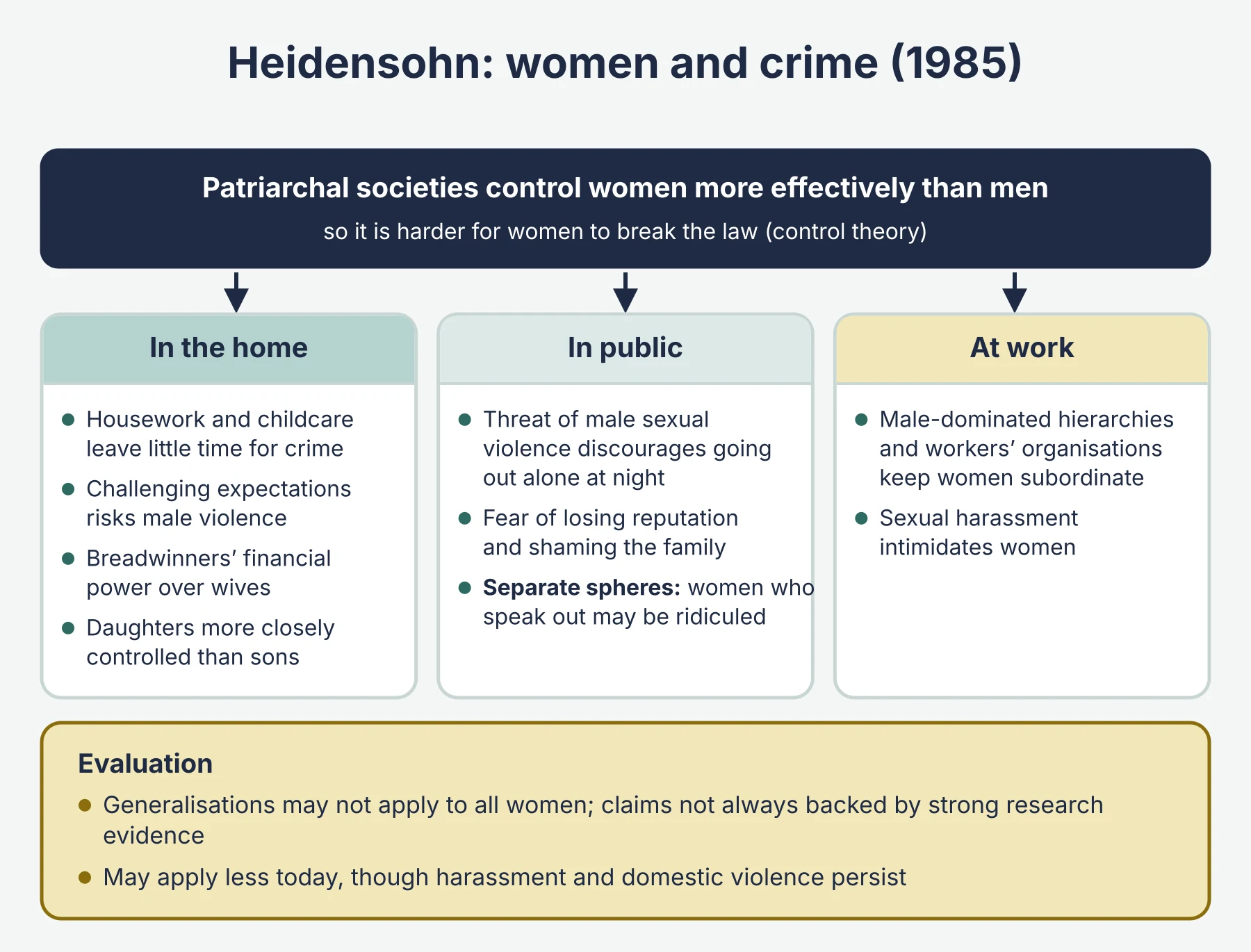
Frances Heidensohn (Women and Crime, 1985) wrote from a feminist perspective. She used control theory, which starts from the assumption that people will make a rational choice to commit crime when the advantages outweigh the disadvantages, to explain why women commit fewer crimes than men. Her argument is that male-dominated patriarchal societies control women more effectively than men, making it difficult for women to break the law.
She identifies control in three settings.
In the home
- Women are expected to spend most of their time on housework and childcare, which leaves little time or opportunity for crime.
- Women who challenge these expectations risk male violence used to assert patriarchal authority.
- Men as main or sole breadwinners have financial power over their wives.
- Daughters are more closely controlled than sons: more limits on when they can leave home, and more domestic tasks.
In public
- Women are controlled by the threat of male sexual violence, which discourages them from going out alone, especially at night.
- The fear that “inappropriate” behaviour may bring loss of reputation and shame on their families.
- The idea of separate spheres, which places women in the home; women who raise concerns in public may be ridiculed and told to return to where they belong.
At work
- Male-dominated hierarchies and workers’ organisations keep women in subordinate positions.
- Sexual harassment intimidates women and limits their behaviour.
Evaluation: Heidensohn has been criticised for making generalisations that do not apply to all women and for not always supporting her claims with strong research-based evidence. Her ideas may also apply less today, as more women work full time and gender roles have changed, although the persistence of harassment and domestic violence suggests many forms of control continue.
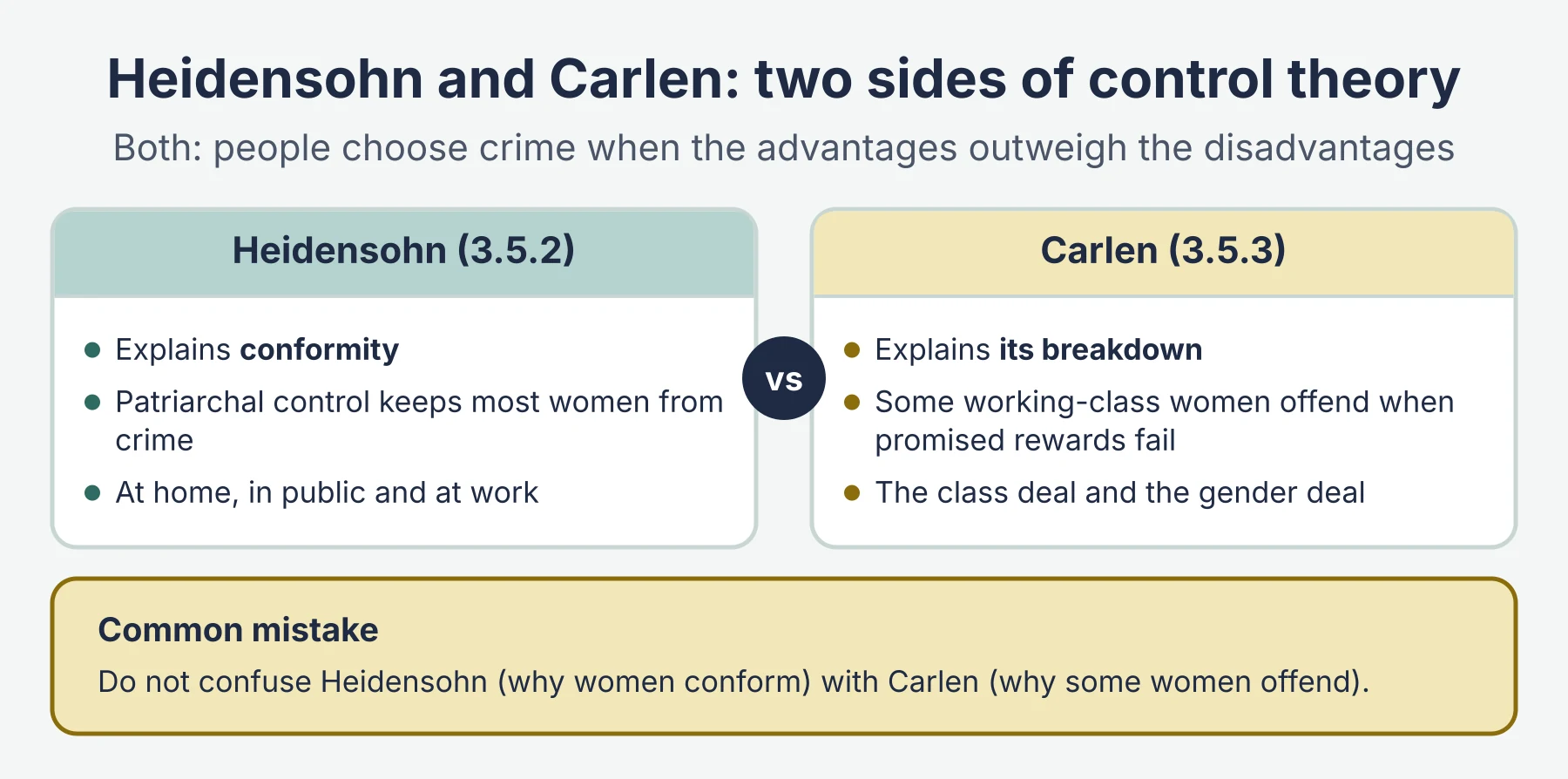
Link to 3.5.3: Carlen also uses control theory, but explains why some working-class women do commit crime: the rewards promised for conformity fail. Heidensohn explains conformity; Carlen explains its breakdown.
Worked example: an annotated 4-mark answer
Question (practice): Identify and explain one way in which, according to Heidensohn, women are controlled in public. [4]
Women are controlled in public by the threat of male sexual violence [identifies: 1]. Fear of being attacked may lead women to avoid going out alone at night or to avoid certain places [explains how it limits behaviour: 1]. This reduces their opportunity to be in situations where crime might take place [links control to fewer crimes: 1]. Heidensohn argues this is part of a wider pattern in which patriarchal societies control women more effectively than men, which helps explain women’s lower rate of offending [links to her overall argument: 1].
Common mistakes
- Defining informal control as “control that is not serious”. The difference is whether rules are written and enforced by official agents, not how serious they are.
- Giving formal and informal examples without saying which agent applies them.
- Forgetting positive sanctions; sanctions are rewards as well as punishments.
- Describing Heidensohn’s ideas as “women are nicer than men”. Her argument is about control, not nature.
- Confusing Heidensohn (why women conform) with Carlen (why some women offend).
- Leaving out the interactionist view, which the specification lists for this sub-section.
Exam technique for the command words
- Identify: name a method or agent of control, such as peer group pressure.
- Describe: set out how it works, with an example.
- Explain: show why it leads to conformity, for example by anticipation of a sanction.
- Discuss how far: compare functionalist, Marxist, feminist and interactionist views of whose interests control serves, and conclude.
Official syllabus
AQA GCSE Sociology (8192) specification, Version 1.2 (June 2026), for GCSE exams 2019 onwards: section 3.5.2 Social control, and the summary of Heidensohn in Appendix B.
Related resources
-
Practice questions
AQA GCSE Sociology (8192): Social control – Practice Questions
Original AQA GCSE Sociology 8192 practice on 3.5.2 with marked answers: formal and informal control, sanctions, perspectives and Heidensohn.
Sociology · AQA · GCSE
Try questions -
Revision notes
AQA GCSE Sociology (8192): Social control – Revision Notes
Condensed AQA GCSE Sociology 8192 notes on 3.5.2: formal and informal control, the sanctions grid, four perspectives, Heidensohn and a self-test.
Sociology · AQA · GCSE
Revise topic -
Study guides
AQA GCSE Sociology (8192): The social construction of crime and deviance
In-depth AQA GCSE Sociology 8192 guide to 3.5.1: how crime and deviance are socially constructed, Merton's anomie, Becker's labelling and four perspectives.
Sociology · AQA · GCSE
Read guide
Related articles
Get free revision emails (optional)
Occasional emails with practice questions, worked explanations and links to free resources for the qualification and subjects you choose. No spam, and you can unsubscribe from any email. The free tools on this site never need an email.