
Study Guides
AQA GCSE Sociology (8192): The social construction of crime and deviance
In-depth AQA GCSE Sociology 8192 guide to 3.5.1: how crime and deviance are socially constructed, Merton's anomie, Becker's labelling and four perspectives.
- Subject
- Sociology
- Level
- GCSE
- Topic
- Crime and deviance
- Author
- Marlbridge Academic Team
- Updated
- Reviewed by
- Naqiya Yousaf (what this means)
Aligned to AQA GCSE Sociology (8192), first teaching 2017. Official specification .
Syllabus page (what it covers and how it is assessed): AQA GCSE Sociology.
Syllabus points this page covers
8192
- 3.5.1 The social construction of crime and deviance
Found an error? Report a correction.
Need help with this topic? Request a free trial class for GCSE Sociology (8192).
This guide goes deep on one sub-section of the AQA GCSE Sociology (8192) specification: 3.5.1 The social construction of crime and deviance, assessed in Paper 2: The sociology of crime and deviance and social stratification. The specification asks you to “explain the social construction of concepts of crime and deviance”, to explain “anomie, labelling, structural theories, subcultural theories and interactionist theory”, to compare interactionist, functionalist, feminist and Marxist perspectives, and to describe the key ideas of Merton and Becker “on the causes of crime”.
For the whole topic, start with the Crime and deviance study guide. To revise this sub-section, use the social construction of crime and deviance revision notes, then test yourself with the social construction of crime practice questions.
What “socially constructed” means
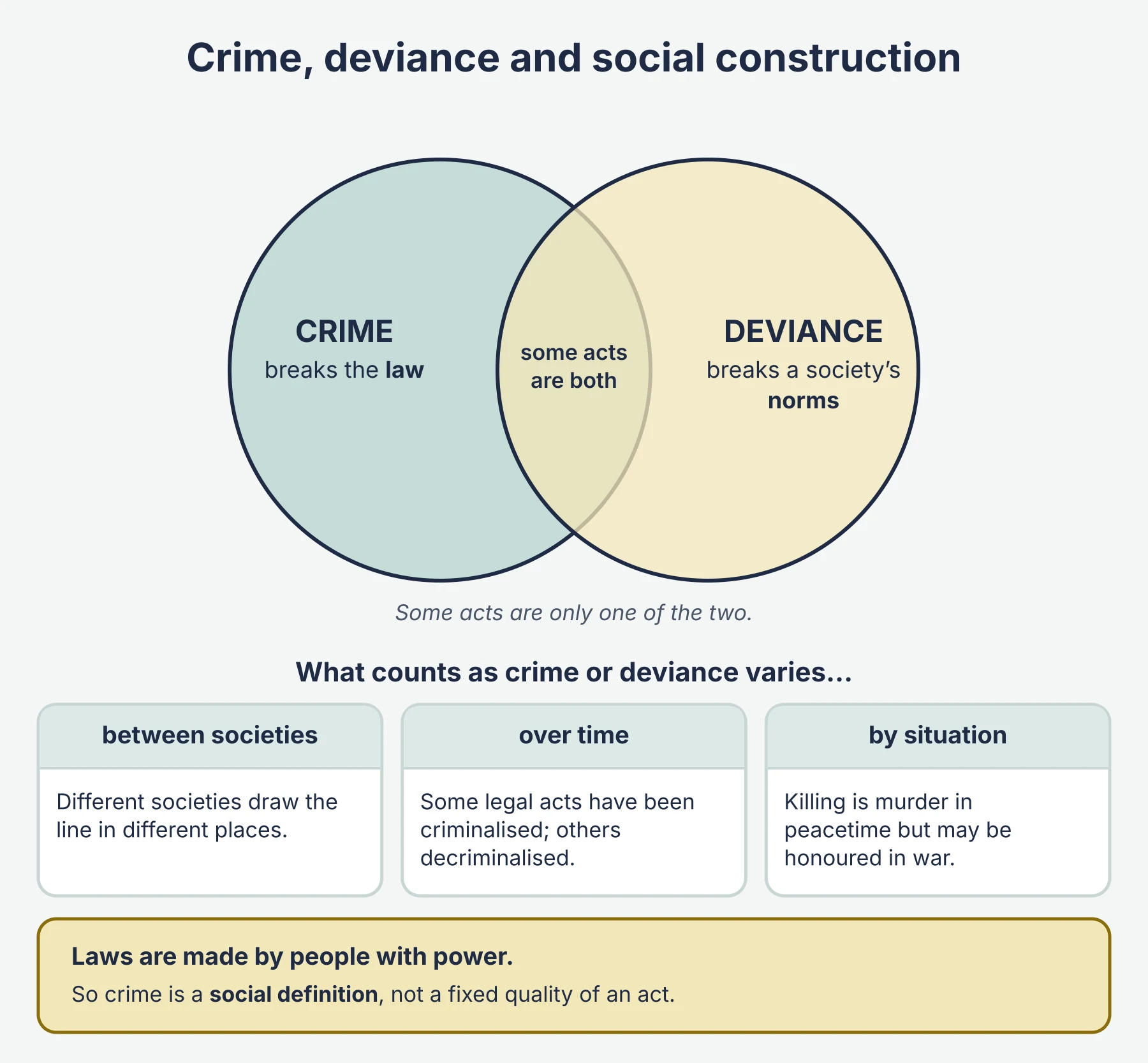
A social construct is something whose meaning is created by people in a society rather than fixed by nature. To say crime and deviance are socially constructed is to say that no act is criminal or deviant in itself. An act becomes a crime because a society has passed a law against it, and becomes deviant because people regard it as breaking their norms.
- Crime is behaviour that breaks the criminal law and can be punished by the state.
- Deviance is behaviour that breaks a society’s norms, whether or not it is illegal.
Some acts are both (assault). Some are deviant but legal (picking your nose at a job interview). Some are illegal but widely tolerated (minor speeding). The overlap is never fixed, which is exactly the point.
Three ways definitions vary
Over time
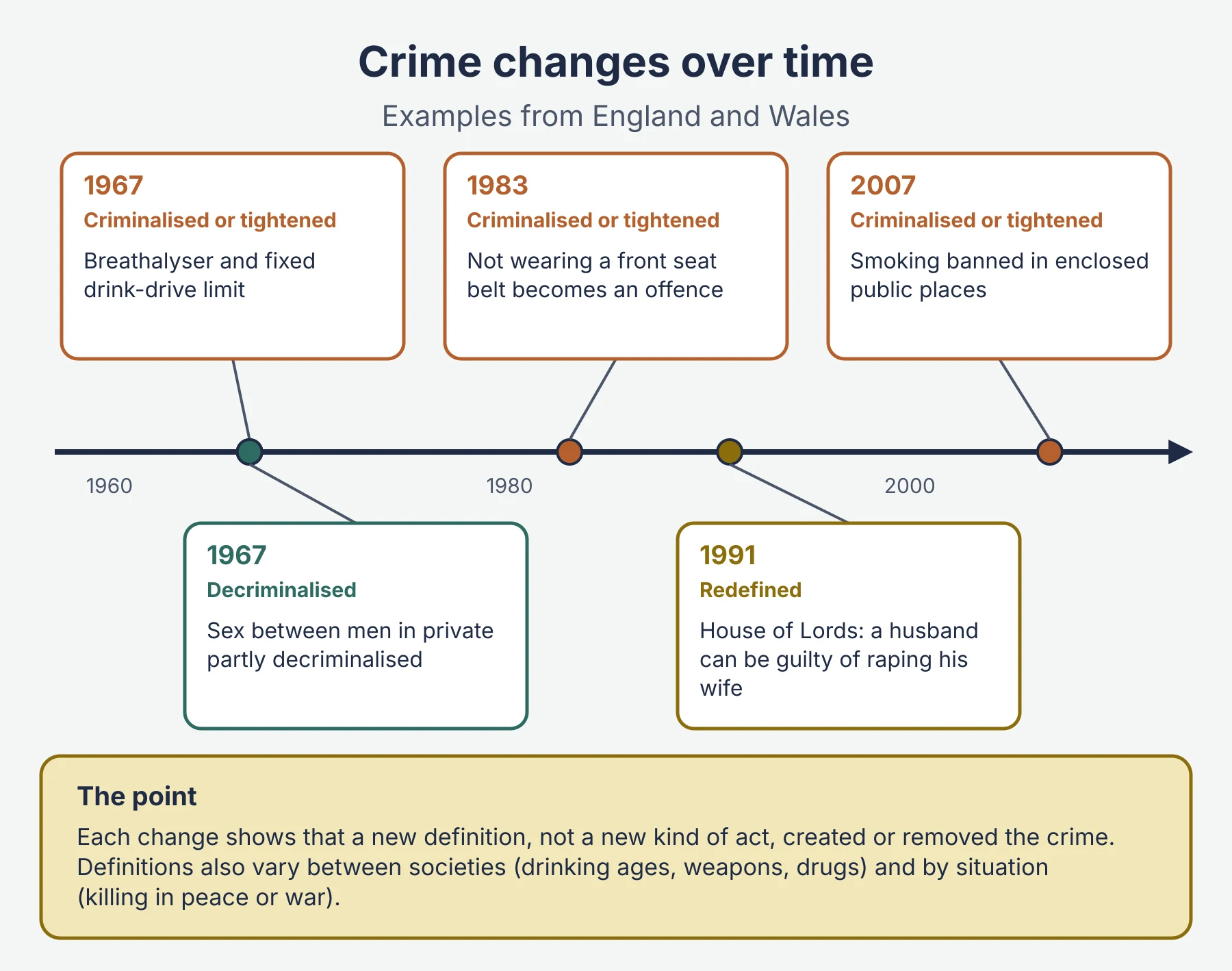
Laws change as attitudes and power relationships change. Examples from England and Wales:
| Change | What happened |
|---|---|
| Criminalised or tightened | A fixed legal alcohol limit for drivers and the breathalyser came in in 1967; not wearing a front seat belt became an offence in 1983; smoking in enclosed public places was banned in 2007 |
| Decriminalised | Sex between men in private was partly decriminalised by the Sexual Offences Act 1967 |
| Redefined | In 1991 the House of Lords ruled that a husband could be guilty of raping his wife, ending the idea that marriage implied permanent consent |
Each change shows that a new definition, not a new kind of act, created or removed the crime.
Between societies
The same act can be legal in one country and a serious crime in another. The legal age for drinking alcohol, rules on carrying weapons and laws on drug use all differ between nations.
By situation
The context changes the meaning. Killing is murder in peacetime but may be honoured as duty in war. Nudity is deviant in a supermarket but normal in a changing room. Shouting is deviant in a library and expected at a football match.
Who makes the definitions?
If crime is a social definition, sociologists ask who has the power to define it. Laws are made by Parliament and enforced by agents of social control such as the police and courts. This links 3.5.1 to the perspectives the specification lists.
Explanations named in the specification
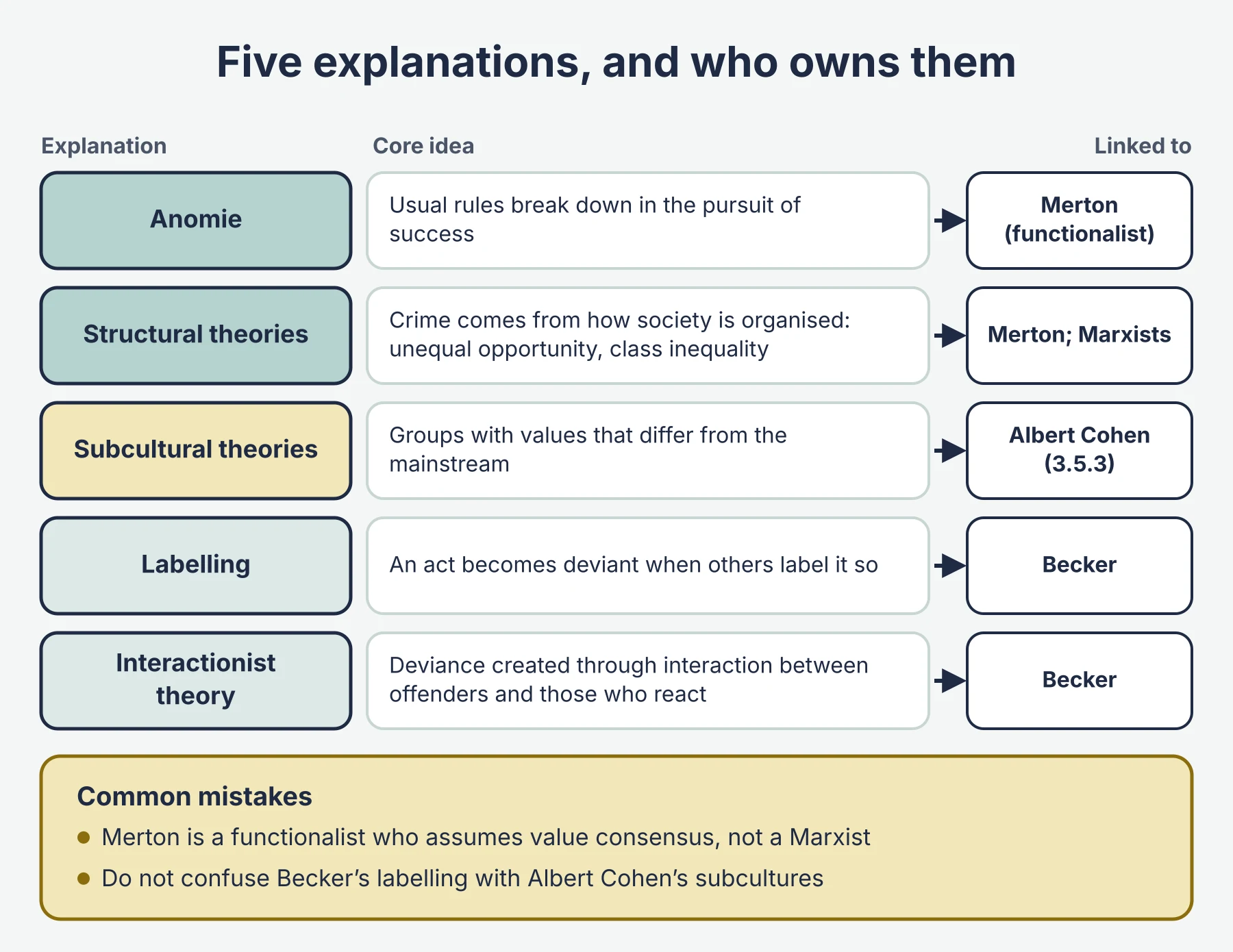
The specification lists five kinds of explanation. Learn which sociologist or perspective each belongs to.
| Explanation | Core idea | Linked to |
|---|---|---|
| Anomie | Crime results when the usual rules break down in the pursuit of success | Merton (functionalist) |
| Structural theories | Crime comes from the way society is organised, for example unequal access to opportunities or class inequality | Merton; Marxists |
| Subcultural theories | Crime comes from groups whose values differ from the mainstream | Albert Cohen (3.5.3) |
| Labelling | An act becomes deviant when others label it so | Becker |
| Interactionist theory | Deviance is created through interaction between offenders and those who react to them | Becker |
Merton on the causes of crime
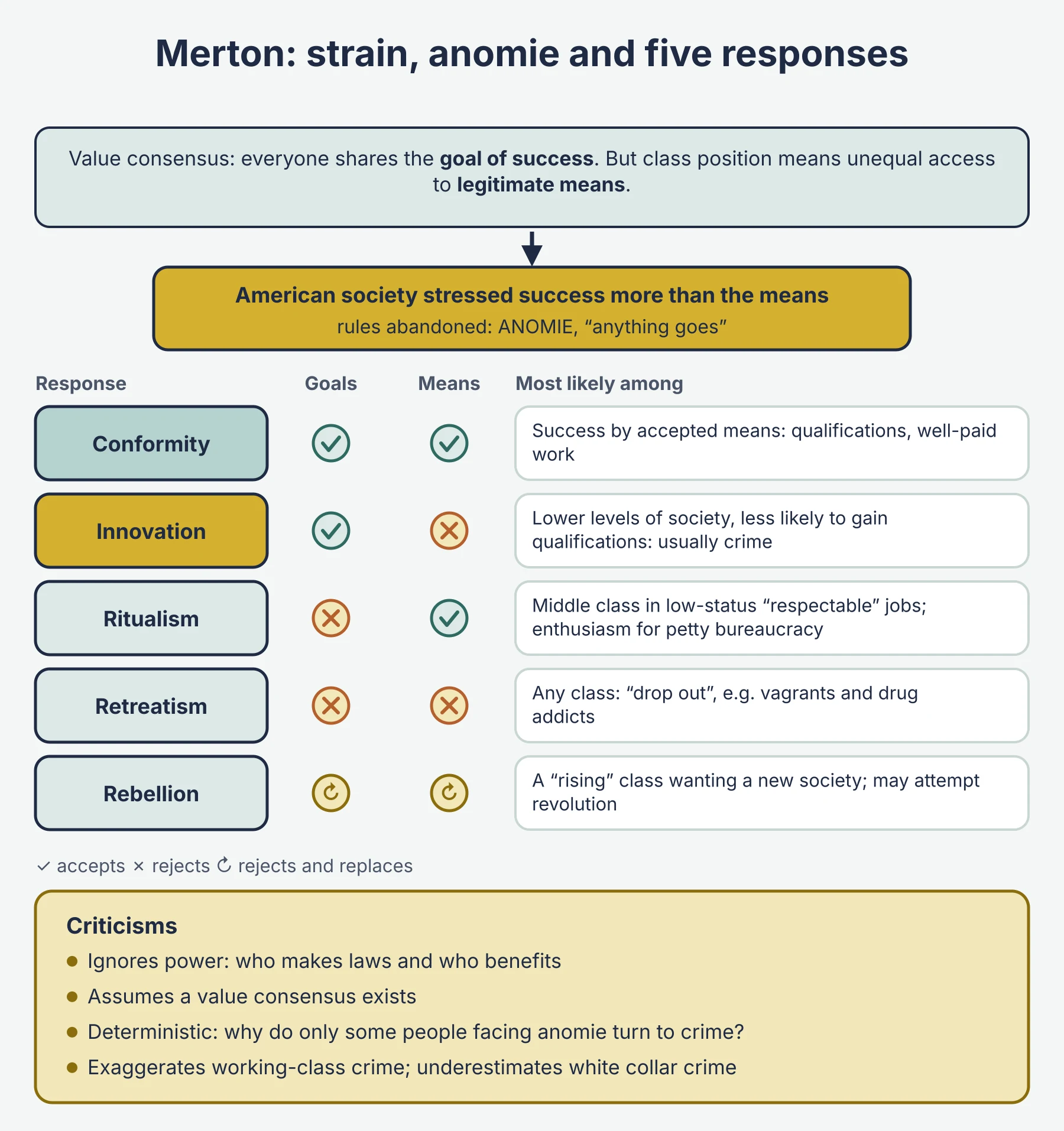
Robert K. Merton, writing from a functionalist perspective, argued that deviance results from the culture and structure of society. He started from value consensus: everyone shares the goal of success. But people hold different positions in the social structure, for example by class, so they do not have the same opportunity to reach that goal by legitimate means.
American society, he argued, was unbalanced: it placed greater importance on success than on the ways it was achieved. In the search for success by almost any means, the usual rules are abandoned, producing anomie, a situation where “anything goes”.
Merton described five responses. The specification adds detail on who is most likely to take each one:
- Conformity: pursuing success by accepted means, such as qualifications leading to well-paid work.
- Innovation: turning to deviant means, usually crime, when legitimate routes are blocked; most likely among people from the lower levels of society who are less likely to gain the qualifications needed.
- Ritualism: typically middle-class people stuck in low-status “respectable” jobs, who give up on success goals but keep to the rules, sometimes with enthusiasm for petty bureaucracy.
- Retreatism: people from any class who abandon both goals and means and “drop out”, such as vagrants and drug addicts.
- Rebellion: people who reject and replace both goals and means, wanting a new society; Merton saw them as typically members of a “rising” social class who may attempt revolution.
Criticisms: Merton ignores power relations, such as who makes laws and who benefits from them; assumes a value consensus exists; is deterministic, failing to explain why only some people who experience anomie turn to crime; and exaggerates working-class crime while underestimating white collar crime.
Becker on the causes of crime
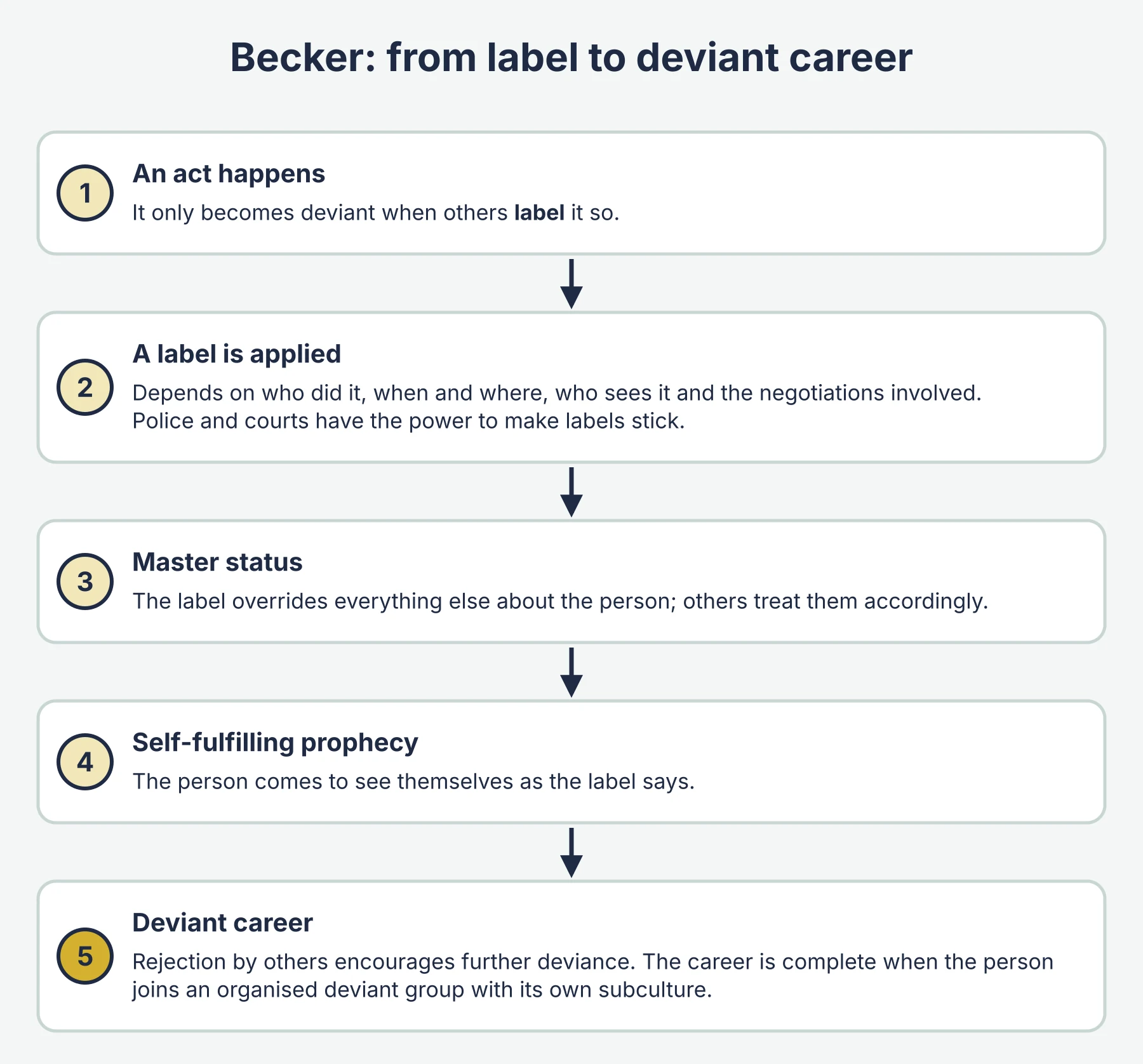
Howard Becker, writing from an interactionist perspective, argued that an act only becomes deviant when others define it as such. In his often-quoted phrase, deviant behaviour is “behaviour that people so label”.
Whether a label is applied depends on:
- who commits the act;
- when and where it is committed;
- who observes it;
- the negotiations between the people involved.
The agents of social control, such as the police and courts, have the power to make a label stick. Once applied, the label becomes a master status: the person is seen first as “a criminal”. Others assume the person has the negative characteristics linked to the label, the person starts to see themselves in those terms (a self-fulfilling prophecy), and rejection from social groups may encourage further deviance. This begins a deviant career, completed when the person joins an organised deviant group whose subculture justifies and supports deviant identities.
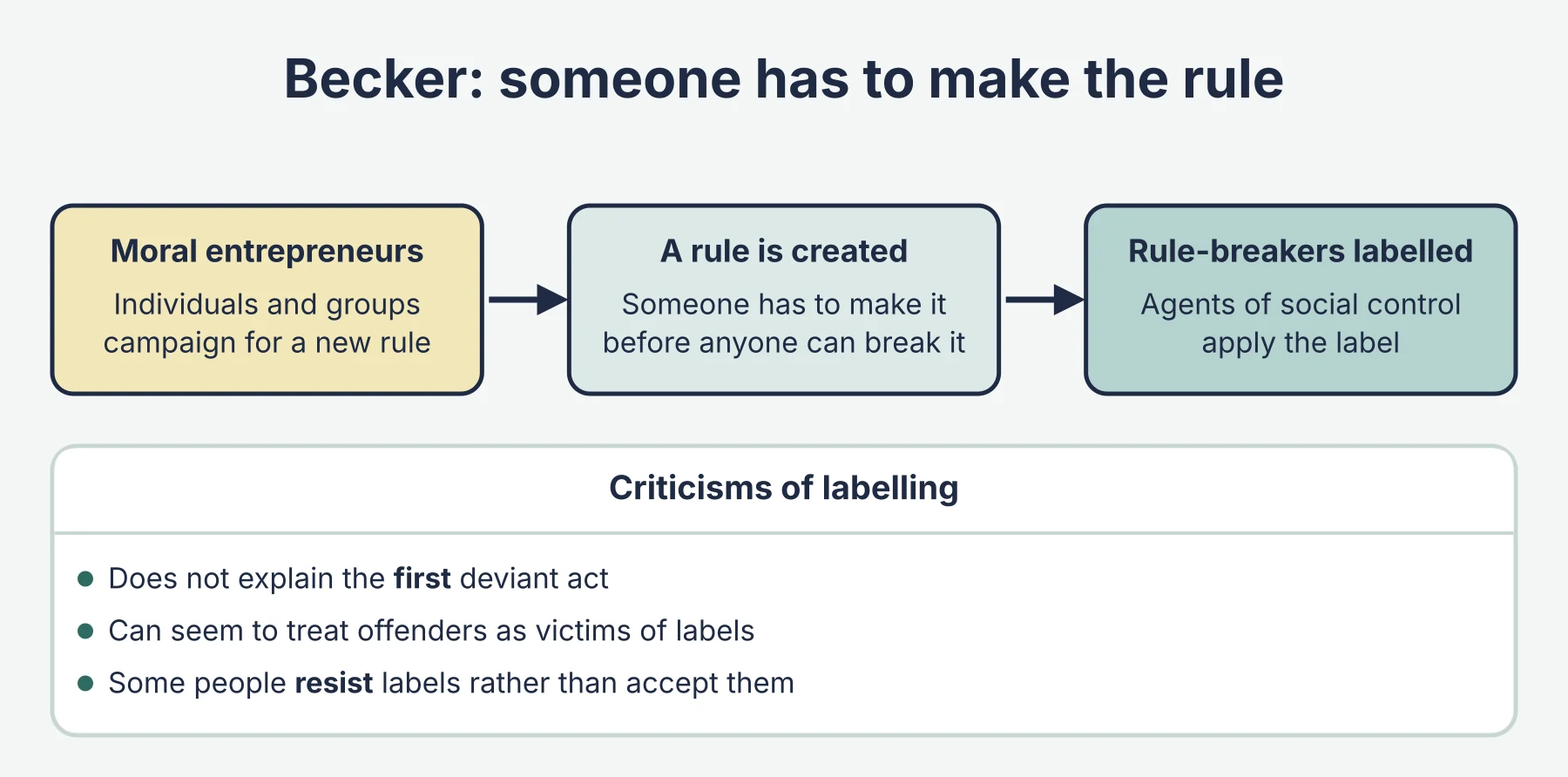
Becker also used the term moral entrepreneurs for individuals and groups who campaign for new rules, showing that someone has to create a rule before anyone can break it.
Criticisms: labelling does not explain why people commit the first deviant act; it can seem to treat offenders as victims of labels; and some people resist labels rather than accepting them.
The four perspectives compared
| Perspective | View of how crime and deviance are constructed |
|---|---|
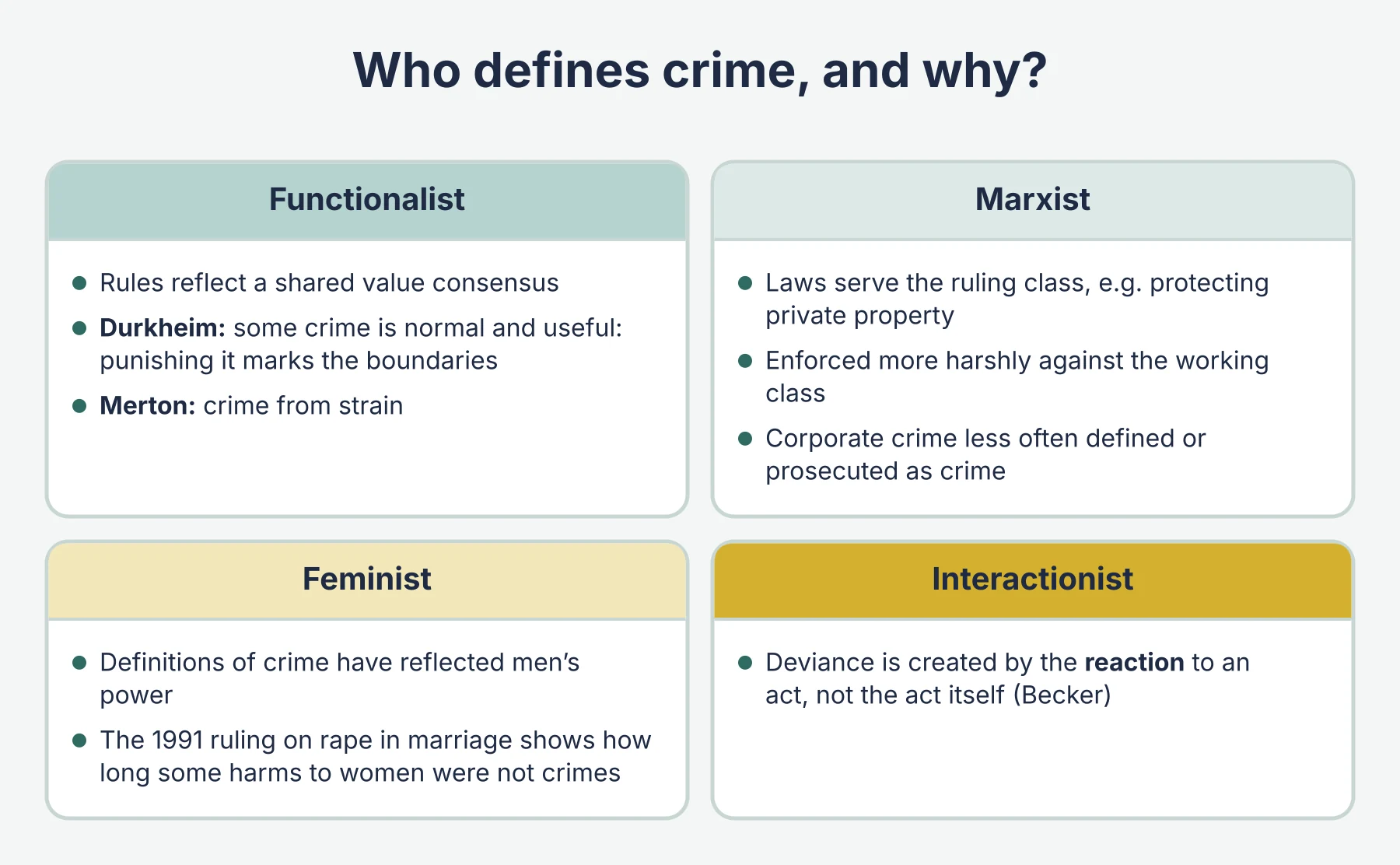
| Functionalist | Rules reflect a shared value consensus. Durkheim argued some crime is normal and even useful, because punishing it reminds everyone where the boundaries of acceptable behaviour lie. Merton explains crime through strain. |
| Marxist | Laws are made in the interests of the ruling class, such as protecting private property, and are enforced more harshly against the working class. Crimes of the powerful, such as corporate crime, are less often defined or prosecuted as crime. |
| Feminist | Definitions of crime have reflected men’s power. The 1991 ruling on rape in marriage shows how long some harms to women were not treated as crimes. |
| Interactionist | Deviance is created by the reaction to an act, not the act itself (Becker). |
Worked example: an annotated 4-mark answer
Question (practice): Identify and explain one way in which deviance is socially constructed. [4]
Deviance varies over time [identifies: 1]. Smoking in pubs was once normal, but since 2007 it has been banned in enclosed public places in England [gives an accurate example: 1]. The act itself did not change; what changed was society’s definition of it, influenced by new attitudes to health [explains the construction: 1]. This shows deviance depends on the norms a society holds at a particular time rather than on anything fixed in the act [draws the conclusion: 1].
Common mistakes
- Saying deviance is “anything bad”. It is behaviour that breaks norms, which vary.
- Listing Merton’s five adaptations without explaining goals and means.
- Calling Merton a Marxist because he discusses inequality. He is a functionalist who assumes value consensus.
- Confusing Becker’s labelling with Albert Cohen’s subcultures (3.5.3).
- Giving examples with no indication of time, place or situation.
Exam technique for the command words
- Identify: name a way crime is constructed, or an explanation, in a few words.
- Describe: give the features of Merton’s or Becker’s ideas.
- Explain: show the step by step link, for example from blocked means to innovation.
- Discuss how far: set Merton and functionalists against Becker, Marxists and feminists; finish with a judgement on the question asked.
Official syllabus
AQA GCSE Sociology (8192) specification, Version 1.2 (June 2026), for GCSE exams 2019 onwards: section 3.5.1 The social construction of crime and deviance, and the summaries of Merton and Becker in Appendix B.
Related resources
-
Revision notes
AQA GCSE Sociology (8192): The social construction of crime and deviance – Revision Notes
Condensed AQA GCSE Sociology 8192 notes on 3.5.1: crime and deviance as social constructs, the five explanations, Merton, Becker, perspectives and a self-test.
Sociology · AQA · GCSE
Revise topic -
Study guides
AQA GCSE Sociology (8192): Crime and Deviance – Study Guide
Study guide to AQA GCSE Sociology 8192 Crime and deviance 3.5.1-3.5.4: Merton, Becker, Heidensohn, Albert Cohen, Carlen, social control and crime statistics.
Sociology · AQA · GCSE
Read guide -
Revision notes
AQA GCSE Sociology (8192): Crime and Deviance – Revision Notes
Revision notes for AQA GCSE Sociology 8192 sections 3.5.1 and 3.5.3: social construction, Merton, Becker, Albert Cohen, Carlen and public debates on crime.
Sociology · AQA · GCSE
Revise topic
Related articles
Get free revision emails (optional)
Occasional emails with practice questions, worked explanations and links to free resources for the qualification and subjects you choose. No spam, and you can unsubscribe from any email. The free tools on this site never need an email.