
Revision Notes
AQA GCSE Sociology (8192): Divorce – Revision Notes
Condensed AQA GCSE Sociology 8192 notes on 3.3.6 divorce: the trend since 1945, key laws, four reasons, consequences, perspectives and a self-test.
- Subject
- Sociology
- Level
- GCSE
- Topic
- Families
- Author
- Marlbridge Academic Team
- Updated
- Reviewed by
- Naqiya Yousaf (what this means)
Aligned to AQA GCSE Sociology (8192), first teaching 2017. Official specification .
Syllabus page (what it covers and how it is assessed): AQA GCSE Sociology.
Syllabus points this page covers
8192
- 3.3.6 Divorce
Found an error? Report a correction.
Need help with this topic? Request a free trial class for GCSE Sociology (8192).
These notes condense 3.3.6 Divorce from the AQA GCSE Sociology (8192) specification, assessed in Paper 1. The specification asks for “the pattern of divorce in Britain since 1945 using relevant statistical data”, four reasons for the rise (“changes in the law, changes in social attitudes and values, secularisation, changes in the status of women in society”), the consequences for husband and wife, children and extended family, the increase in lone parent families, and functionalist, feminist and Marxist views.
For full explanations and worked answers, read the divorce study guide. Then try the divorce practice questions.
Key terms
| Term | Meaning |
|---|---|
| Divorce | The legal ending of a marriage |
| Separation | Living apart without a legal divorce |
| Divorce rate | Divorces per 1,000 married people in a year |
| Irretrievable breakdown | The single ground for divorce introduced by the Divorce Reform Act 1969 |
| No-fault divorce | Divorce without either partner blaming the other (in force from 2022) |
| Empty shell marriage | A marriage that continues in law but not as a loving relationship |
| Serial monogamy | A series of marriages or partnerships over a lifetime |
| Secularisation | The declining influence of religion |
| Stigma | Social disapproval attached to a status or behaviour |
| Lone parent family | One parent with dependent children |
| Reconstituted family | A family including children from a partner’s previous relationship |
| Social change / changing social attitudes | Shifts in shared values over time |
The pattern in six steps (England and Wales)
- Late 1940s: short-lived rise as wartime marriages ended; legal aid for divorce followed the Legal Aid and Advice Act 1949.
- 1950s–1960s: divorce relatively rare and stigmatised; a “matrimonial offence” had to be proved.
- 1970s: sharp rise after the Divorce Reform Act 1969 came into force in 1971.
- 1980s–early 1990s: further growth; the 1984 Act allowed applications after one year of marriage; the number peaked in the early 1990s.
- Late 1990s–2010s: general fall, as fewer people married and more cohabited.
- 2022 onwards: no-fault divorce under the Divorce, Dissolution and Separation Act 2020.
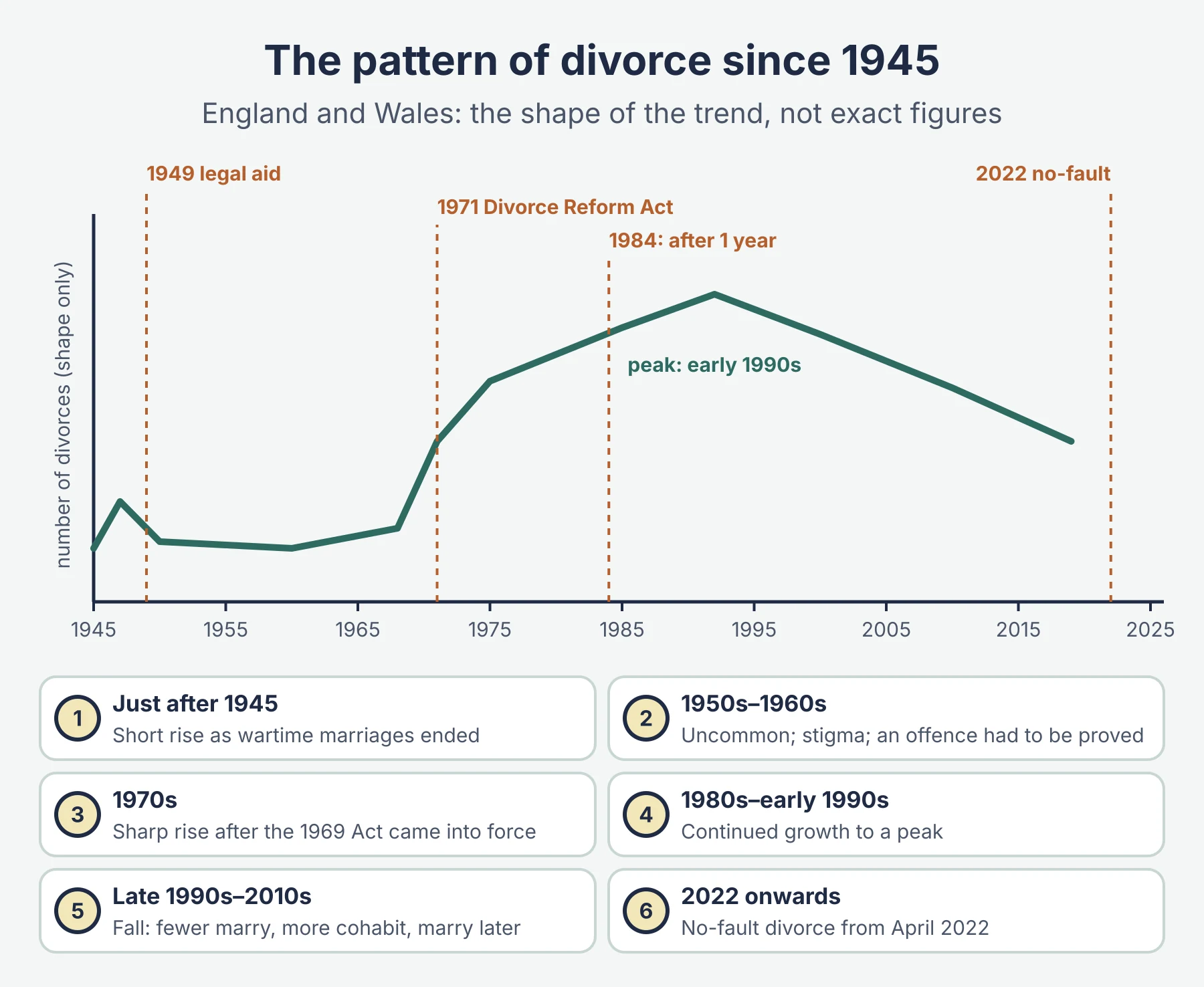
Laws at a glance
| Law | Change |
|---|---|
| Legal Aid and Advice Act 1949 | Help with legal costs made divorce more affordable |
| Divorce Reform Act 1969 (in force 1971) | Single ground of irretrievable breakdown |
| Matrimonial and Family Proceedings Act 1984 | Application possible after one year of marriage instead of three |
| Divorce, Dissolution and Separation Act 2020 (in force 2022) | No-fault divorce; joint applications |
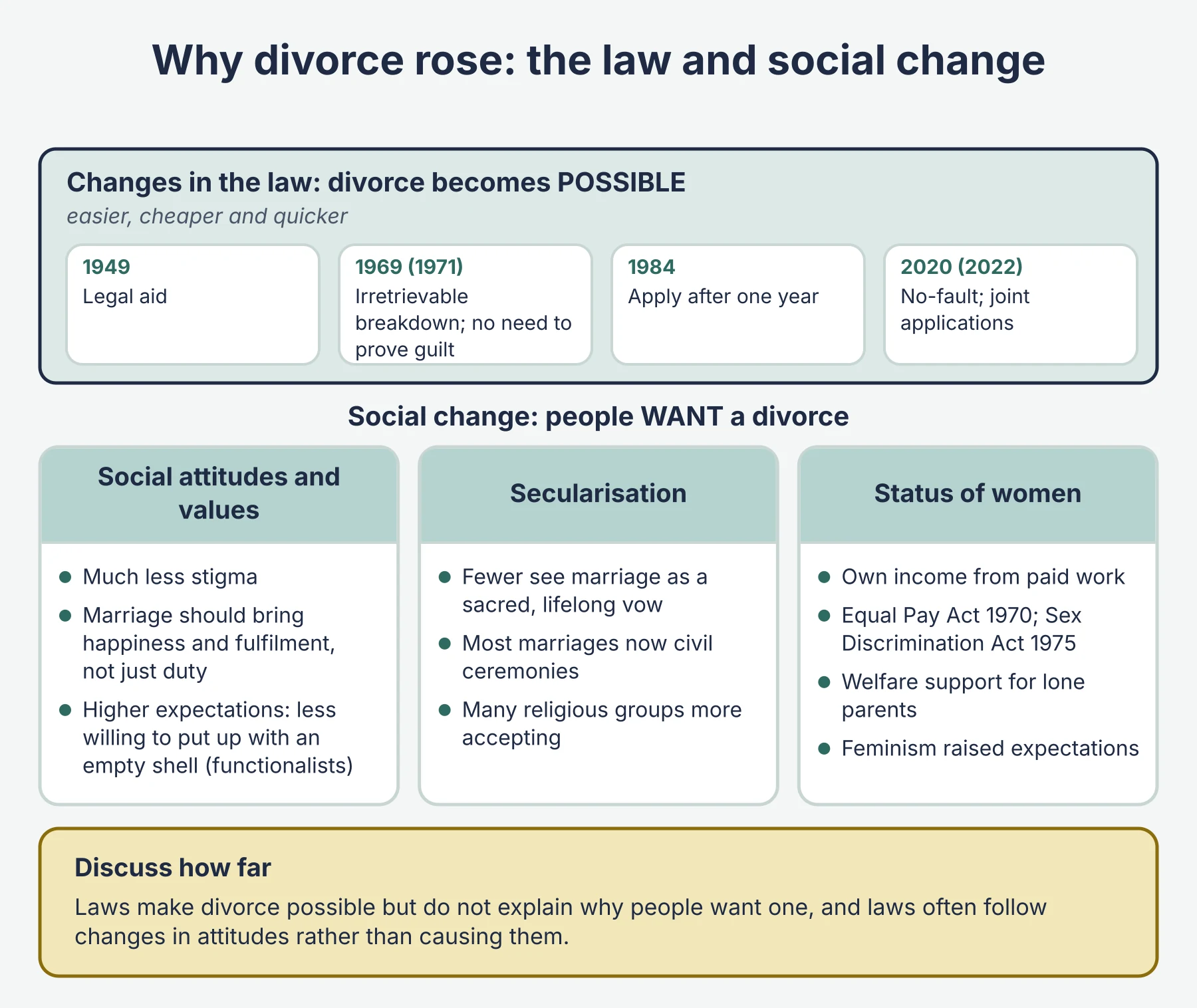
Four reasons in one line each
- Law: easier, cheaper, quicker divorce; but laws may follow attitudes rather than cause them.
- Attitudes and values: less stigma; higher expectations of personal happiness in marriage.
- Secularisation: marriage seen less as a sacred lifelong vow; most weddings now civil ceremonies.
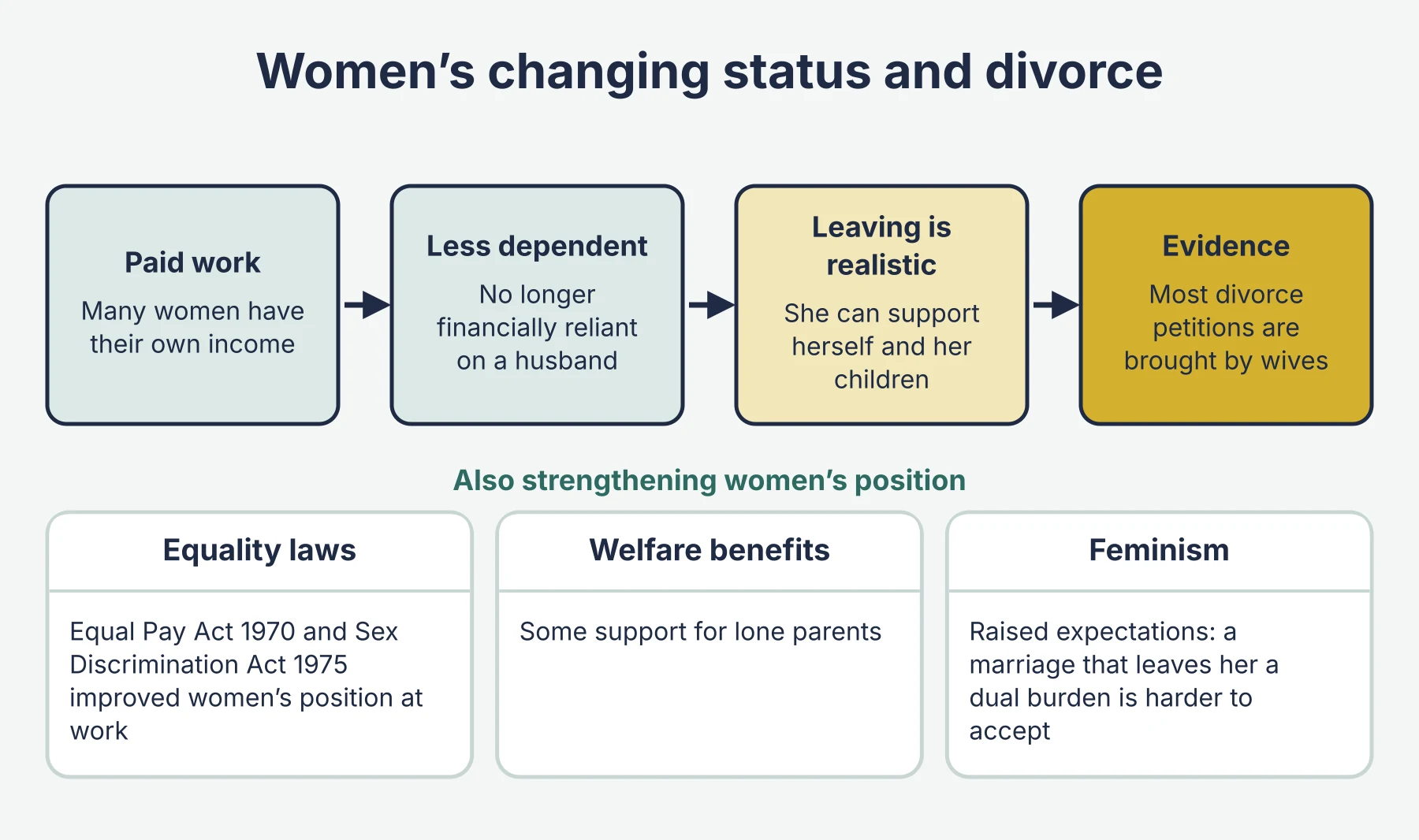
- Status of women: paid work and income, equality laws, benefits and feminist expectations make leaving possible; most petitions are brought by wives.
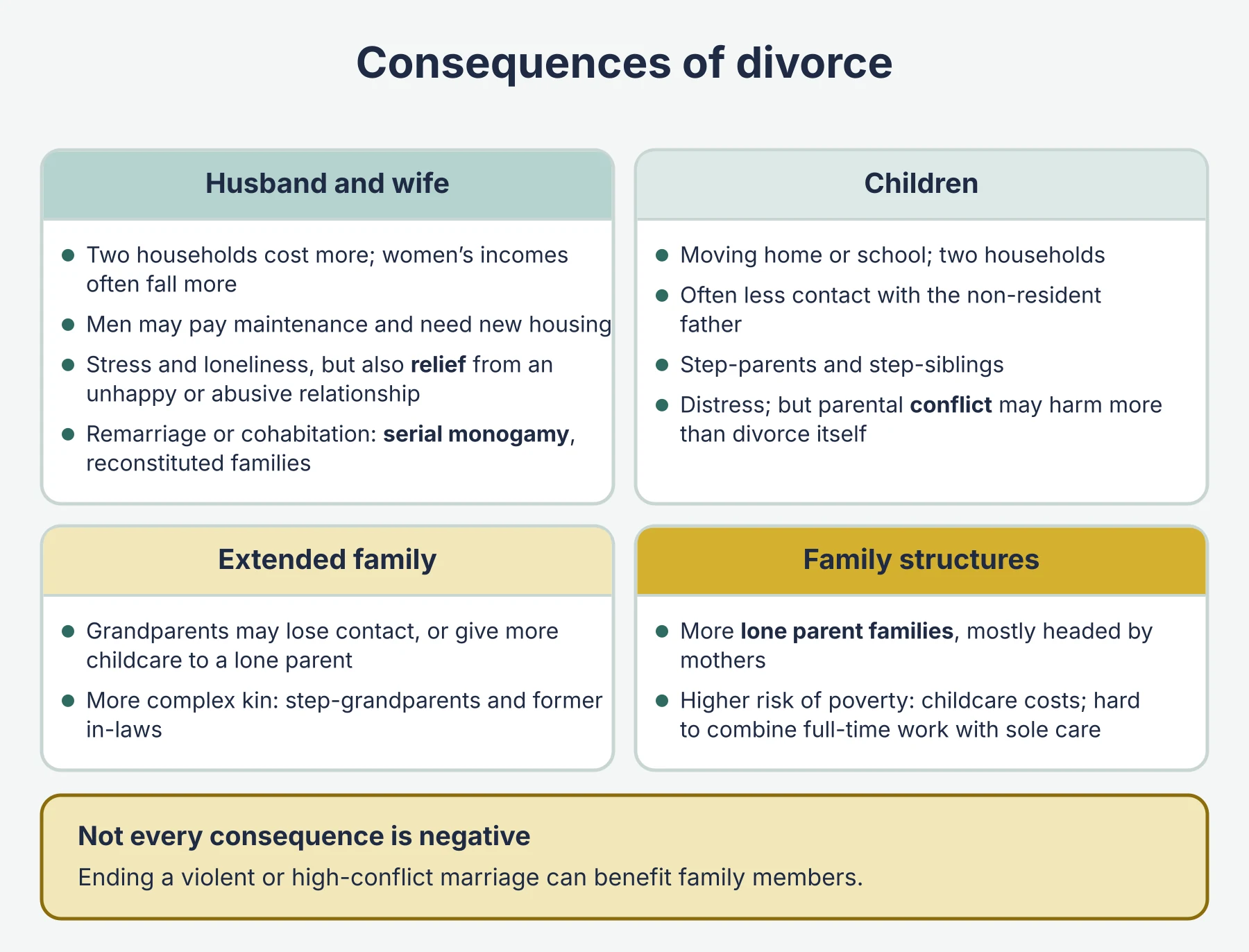
Consequences
| Who | Possible consequences |
|---|---|
| Husband and wife | Lower income (often more so for women with children), new housing, stress or relief, remarriage and serial monogamy |
| Children | Moving home or school, two households, less contact with one parent, step-families; conflict may harm more than divorce itself |
| Extended family | Grandparents lose contact or give more support; more complex kin networks |
| Family structures | More lone parent families (mostly mother-headed, higher poverty risk) and reconstituted families |
Perspectives
- Functionalist: higher expectations explain the rise; remarriage shows marriage is still valued; divorce can disrupt socialisation.
- Feminist: divorce frees women from patriarchal or abusive marriages, but women often bear the economic costs afterwards.
- Marxist: financial strain and alienation under capitalism put pressure on families; Zaretsky’s view that families cannot meet psychological needs predicts breakdown.
Reading divorce data: a checklist
- State the overall trend in one sentence.
- Quote at least two figures, with years.
- Note any exception, such as a fall after a peak.
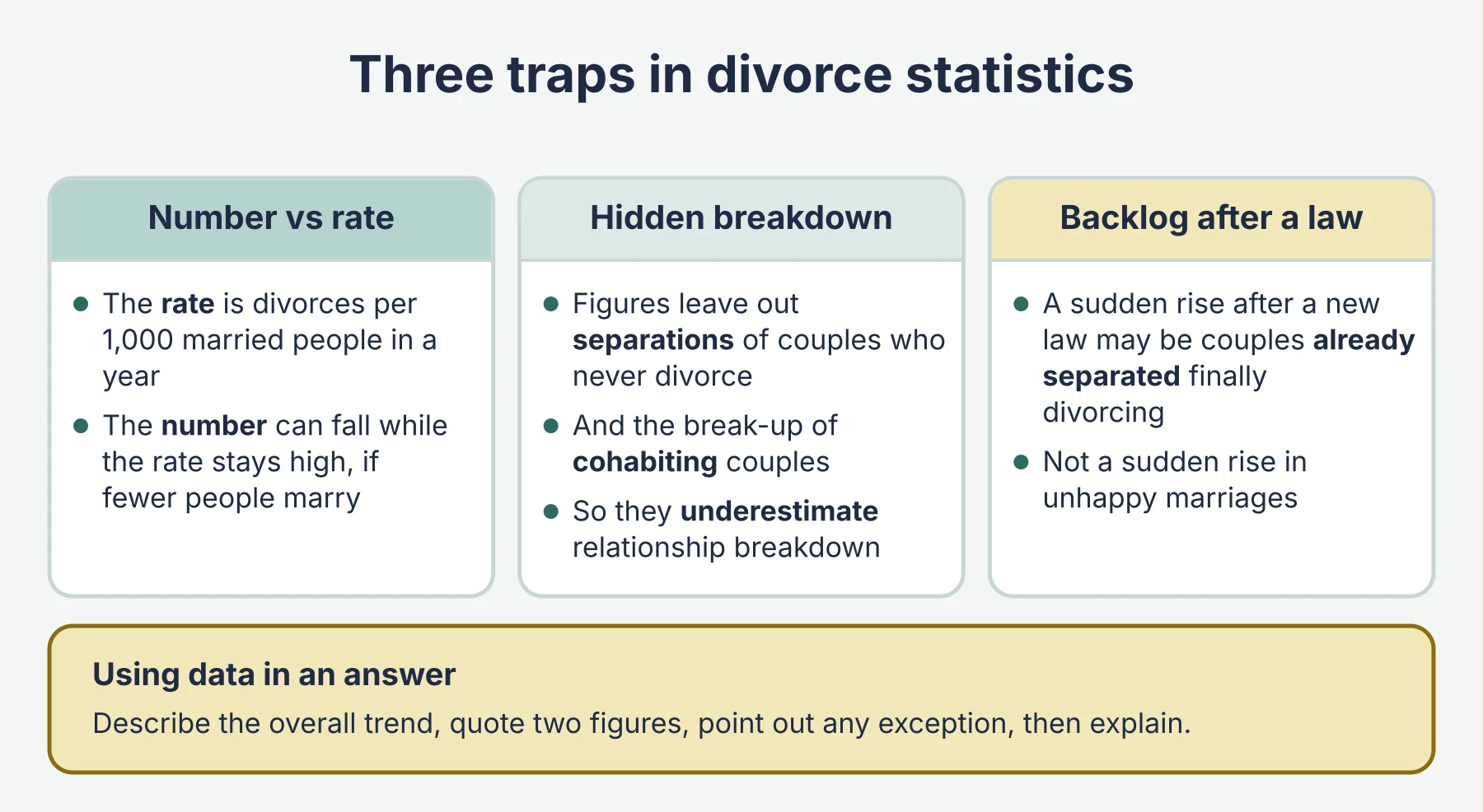
- Distinguish the number of divorces from the rate.
- Remember what the data leave out: separations and cohabiting couples who split.
- Link a sudden jump to a law change, and consider a backlog.
Exam traps
- Describing a steady rise since 1945 and missing the peak and fall.
- Saying the 1969 Act made divorce instant or automatic.
- Mixing up numbers and rates.
- Listing reasons without explaining the mechanism.
- Treating all consequences as harmful.
- Leaving out the extended family.
Quick self-test
- What did the Divorce Reform Act 1969 introduce?
- When did it come into force?
- What did the 1984 Act change?
- When did no-fault divorce come into force?
- Roughly when did the number of divorces in England and Wales peak?
- Give one reason the number of divorces has fallen since then.
- What is secularisation, and how might it raise divorce?
- Why does women’s paid work make divorce more possible?
- Give one consequence of divorce for children.
- Give one consequence of divorce for the extended family.
- Why might divorce statistics underestimate relationship breakdown?
- How do feminists see divorce both positively and negatively?
Answers
- Divorce on the single ground of irretrievable breakdown.
-
- Couples could apply for divorce after one year of marriage instead of three.
- April 2022.
- The early 1990s.
- Fewer people marry and more cohabit, and people marry later.
- The declining influence of religion; fewer people see marriage as a sacred, lifelong vow.
- Women with their own income are less financially dependent on a husband, so leaving is realistic.
- Any one: moving home or school; less contact with one parent; living in a reconstituted family; emotional distress.
- Grandparents may lose contact, or give more support; kin networks become more complex.
- They leave out separations without divorce and the break-up of cohabiting couples.
- Positively, divorce frees women from unhappy or patriarchal marriages; negatively, women often face lower incomes as lone parents afterwards.
Official syllabus
AQA GCSE Sociology (8192) specification, Version 1.2 (June 2026), for GCSE exams 2019 onwards: section 3.3.6 Divorce.
Related resources
-
Practice questions
AQA GCSE Sociology (8192): Family Functions, Forms, Relationships and Criticisms – Practice Questions
Original AQA GCSE Sociology 8192 practice on Parsons, the Rapoports, Willmott and Young, Zaretsky and Delphy and Leonard, with item-based and 12-mark answers.
Sociology · AQA · GCSE
Try questions -
Study guides
AQA GCSE Sociology (8192): Family forms
In-depth AQA GCSE Sociology 8192 guide to 3.3.2 family forms: nuclear to single sex families, the Rapoports' five types of diversity and global variation.
Sociology · AQA · GCSE
Read guide -
Practice questions
AQA GCSE Sociology (8192): Family forms – Practice Questions
Original AQA GCSE Sociology 8192 practice on 3.3.2 family forms: definitions, a fictional data table, the Rapoports, global family forms and 12-mark answers.
Sociology · AQA · GCSE
Try questions
Related articles
Get free revision emails (optional)
Occasional emails with practice questions, worked explanations and links to free resources for the qualification and subjects you choose. No spam, and you can unsubscribe from any email. The free tools on this site never need an email.