
Study Guides
AQA GCSE Sociology (8192): Family forms
In-depth AQA GCSE Sociology 8192 guide to 3.3.2 family forms: nuclear to single sex families, the Rapoports' five types of diversity and global variation.
- Subject
- Sociology
- Level
- GCSE
- Topic
- Families
- Author
- Marlbridge Academic Team
- Updated
- Reviewed by
- Naqiya Yousaf (what this means)
Aligned to AQA GCSE Sociology (8192), first teaching 2017. Official specification .
Syllabus page (what it covers and how it is assessed): AQA GCSE Sociology.
Syllabus points this page covers
8192
- 3.3.2 Family forms
Found an error? Report a correction.
Need help with this topic? Request a free trial class for GCSE Sociology (8192).
This guide goes deep on one sub-section of the AQA GCSE Sociology (8192) specification: 3.3.2 Family forms, assessed in Paper 1: The sociology of families and education. The specification asks you to study “how family forms differ in the UK and within a global context” and “the work of the Rapoports on family diversity”, and to “identify, describe and explain various family forms (nuclear, extended, reconstituted, lone parent, single sex)”.
For the whole of Paper 1, start with the Families and Education overview. To revise this sub-section, use the family forms revision notes, then test yourself with the family forms practice questions.
Families and households
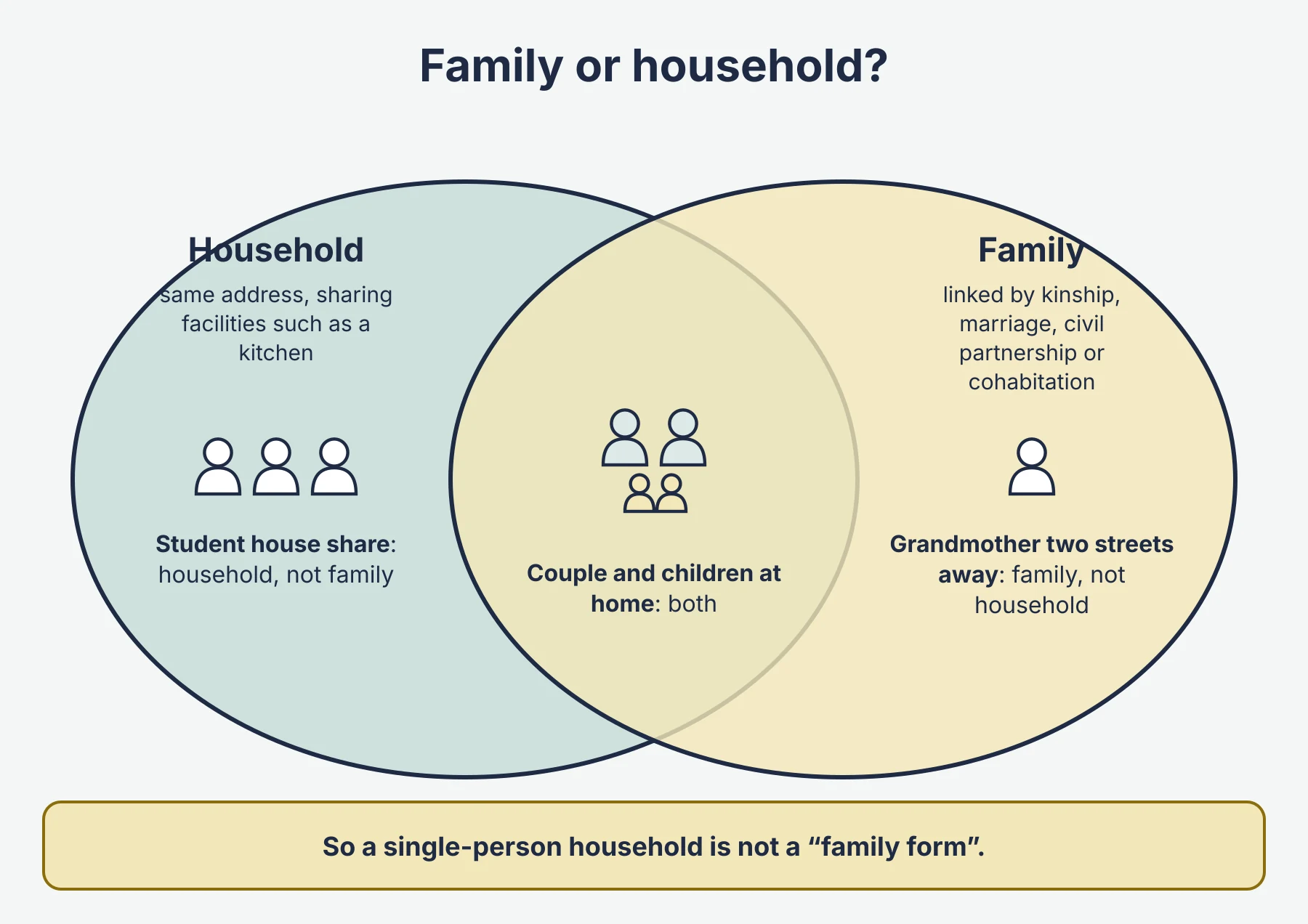
Sociologists separate two ideas. A household is a person or group of people living at the same address and sharing facilities, such as a kitchen. A family is a group linked by kinship, marriage, civil partnership or cohabitation. A student house share is a household but not a family; a grandmother living two streets away is family but not part of the household. Keeping these apart stops you counting single-person households as a “family form”.
The five family forms in the specification
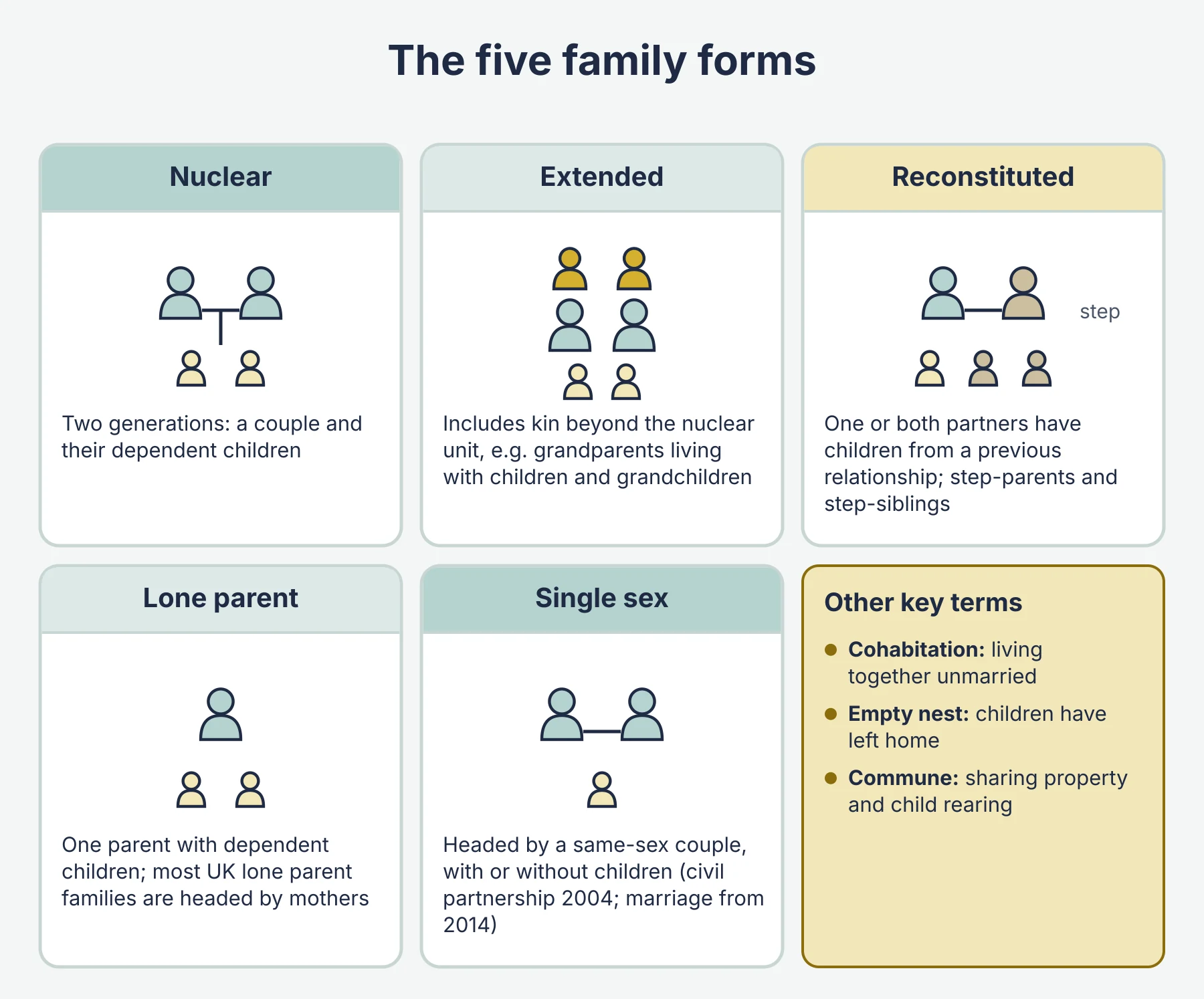
Nuclear family. Two generations: a couple and their dependent children, living together. Functionalists such as Parsons saw it as the family best suited to industrial society because it is small and geographically mobile. Oakley called the married version of it the conventional family.
Extended family. A family that includes kin beyond the nuclear unit.
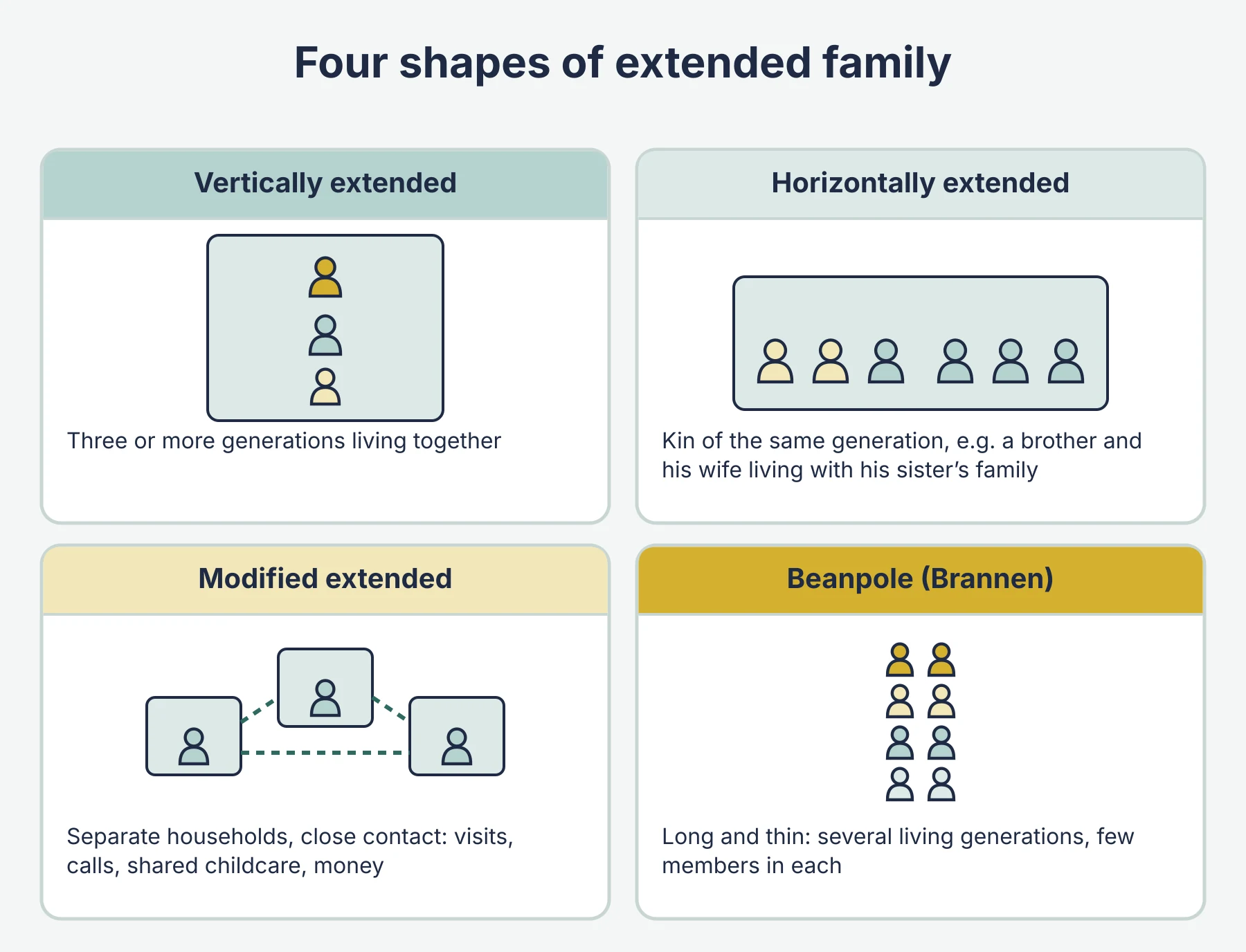
- A vertically extended family spans three or more generations, such as grandparents living with their children and grandchildren.
- A horizontally extended family includes kin of the same generation, such as a brother and his wife living with his sister’s family.
- A modified extended family lives in separate households but keeps close contact, through visits, phone calls, shared childcare and money. Many sociologists argue this is now the most common way extended kin stay involved in the UK.
A related idea is the beanpole family, associated with Julia Brannen: long and thin, with several living generations but few members in each, because people live longer and have fewer children.
Reconstituted (or blended) family. A family in which one or both partners have children from a previous relationship. It can include a step-parent, step-siblings and half-siblings. Children may move between two households, which creates questions about who counts as “family” and who makes decisions about them.
Lone parent family. One parent living with one or more dependent children. It can form through divorce, separation, the death of a partner, or a parent choosing to raise a child alone. Most lone parent families in the UK are headed by mothers, which is one reason feminists link this form to women’s lower incomes.
Single sex family. A family headed by a same-sex couple, with or without children. Legal change has made these families more visible: the Civil Partnership Act 2004 gave same-sex couples legal recognition, and the Marriage (Same Sex Couples) Act 2013 allowed same-sex marriage in England and Wales from 2014. Children may join through adoption, fostering, surrogacy, donor conception or a previous relationship.
Other terms from the specification’s key terms list are worth using accurately: cohabitation (living together as a couple without being married), the empty nest family (a couple whose children have left home), and the commune (a group sharing property and child rearing outside conventional family ties).
The Rapoports on family diversity
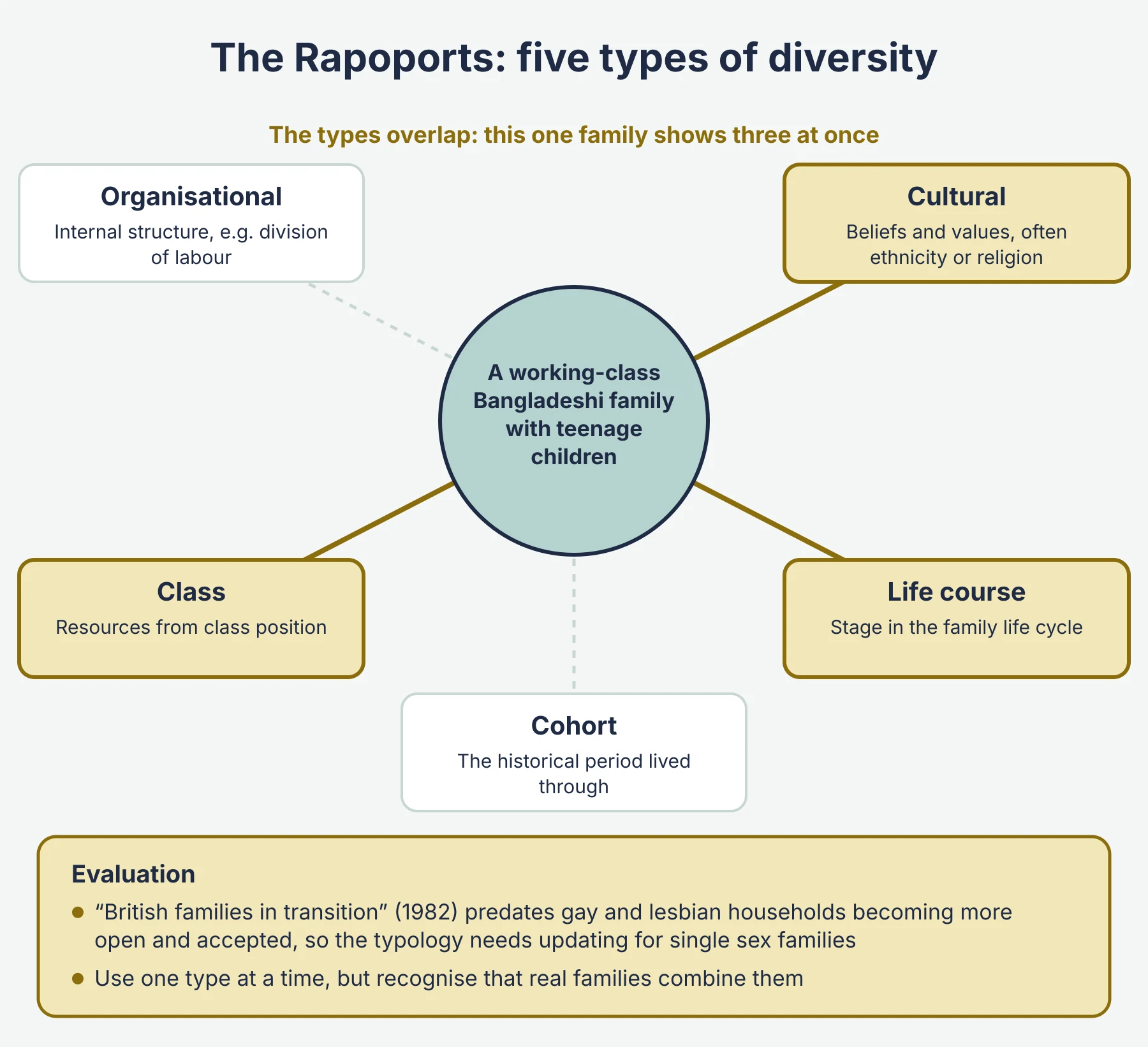
Robert and Rhona Rapoport wrote “British families in transition” (1982). They argued that diversity, not one standard type, is the central feature of British family life. The specification lists their five aspects of diversity. Learn each with a UK example.
| Type of diversity | What it means | Example |
|---|---|---|
| Organisational | Differences in how the family is structured internally, such as the domestic division of labour | A dual-earner couple who share childcare compared with a family with a full-time homemaker |
| Cultural | Differences in beliefs and values, often linked to ethnicity or religion | A family whose religion shapes marriage, diet or the role of elders |
| Class | How the family’s position in the class system affects its resources | A wealthy family paying for private childcare compared with a low-income family relying on grandparents |
| Life course | The stage reached in the family life cycle | Newly-weds, parents of teenagers and retired couples live very differently |
| Cohort | The historical period the family lives through | Couples who married in the 1950s faced different expectations about divorce than those marrying today |
Two points earn credit in evaluation. First, the specification notes that their work “predates the emergence of gay and lesbian households as a more open and accepted feature of society”, so their typology needs updating for single sex families. Second, the types overlap: a working-class Bangladeshi family with teenage children shows class, cultural and life course diversity at once. A good answer uses one type at a time but recognises that real families combine them.
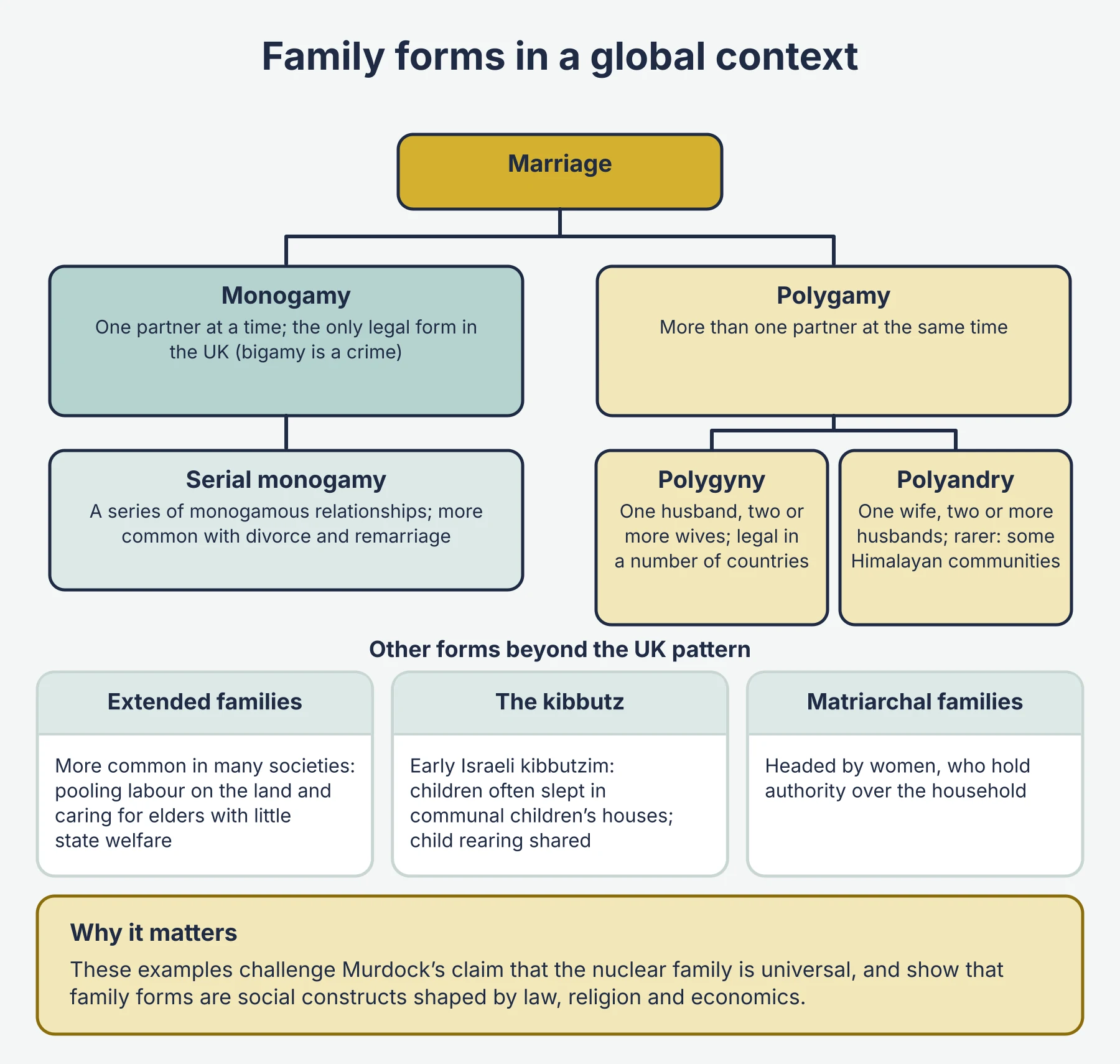
Family forms in a global context
The specification also asks how family forms differ “within a global context”. Use these ideas to show that the UK pattern is not universal.
- Monogamy is marriage to one partner at a time, and is the only legal form of marriage in the UK. Marrying a second person while still married is bigamy, a criminal offence. Serial monogamy describes a series of monogamous relationships across a lifetime, made more common by divorce and remarriage.
- Polygamy is marriage to more than one partner at the same time. Polygyny is one husband with two or more wives, which is legally permitted in a number of countries. Polyandry is one wife with two or more husbands; it is much rarer and has been documented in some Himalayan communities, where brothers have shared a wife.
- Extended families remain more common in many societies than in the UK, often because they pool labour on the land and care for older relatives where there is little state welfare.
- The kibbutz in Israel is a collective community. In early kibbutzim, children spent much of their time, and often slept, in communal children’s houses, so child rearing was shared by the community rather than left mainly to parents.
- Matriarchal families are headed by women, who hold authority over the household.
These examples are used in exams to challenge the claim, associated with Murdock, that the nuclear family is universal. They also show that family forms are social constructs shaped by law, religion and economics, not by biology alone.
Perspectives on family diversity
- Functionalist: the nuclear family fits industrial society best (Parsons). Other forms may struggle to perform functions such as primary socialisation, though many functionalists accept that diverse families can perform them.
- Feminist: diversity can mean greater choice for women, who are less trapped in the conventional family. Oakley concluded that official stereotypes were “increasingly archaic” and some groups were moving towards “a more open appraisal of other ways of living”.
- Marxist: whatever its form, the family still acts as a unit of consumption and reproduces the labour force, so diversity changes little about whom the family serves.
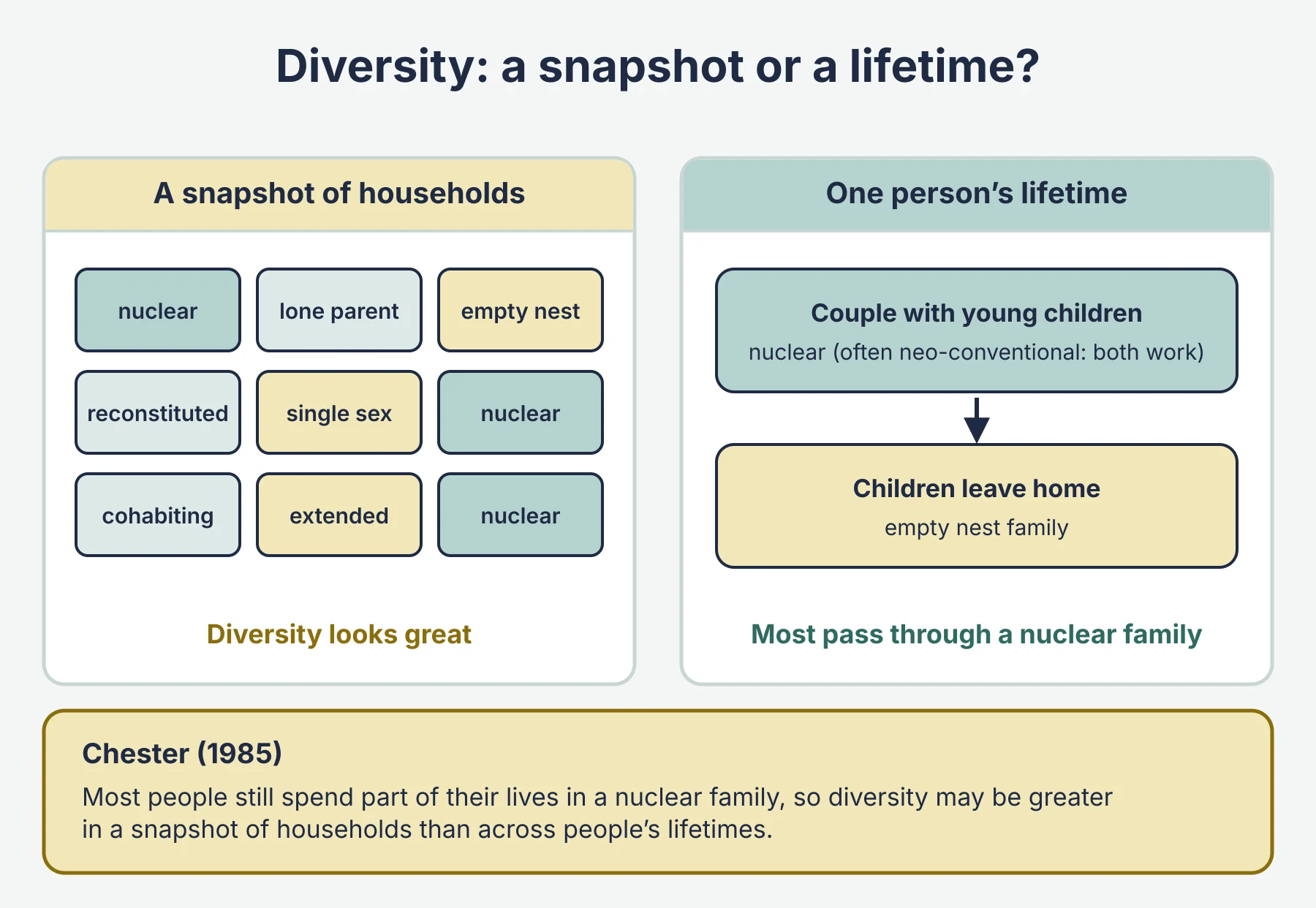
A useful counter-argument is Robert Chester’s (1985) claim that most people still spend part of their lives in a nuclear family, which he called neo-conventional because both partners often work. Diversity may be greater in a snapshot of households than across people’s lifetimes.
Worked example: 4 marks
Question: Identify and explain one reason why reconstituted families have become more common in the UK. [4]
The rise in divorce (identifies). Since the Divorce Reform Act 1969, more marriages have ended in divorce, and many divorced people form new relationships (explains the link). When a parent with children moves in with or marries a new partner, a reconstituted family is created, with a step-parent and sometimes step-siblings (applies the term accurately). Because divorce and remarriage are now less stigmatised, more people are willing to form these families openly (develops with a second factor).
Worked example: using the Rapoports in an extended answer
Question: Discuss how far sociologists would agree that the nuclear family is no longer the typical family form in the UK. [12]
The Rapoports argue that diversity is the central feature of British family life. Organisational diversity means that even nuclear families differ in how they divide paid work and housework, so a “typical” family is hard to describe. Life course diversity also matters: a couple may live in a nuclear family when their children are young, then become an empty nest family, so whether the nuclear family looks typical depends on when you look. This suggests the nuclear family is one stage rather than a fixed type. However, Chester would argue that because most people pass through a nuclear family at some point, it remains the norm, even if it is now neo-conventional.
Common mistakes
- Confusing reconstituted with extended. Step-relations come from a new partnership, not from a wider kin group.
- Defining a lone parent family as “a single person”. It must include dependent children.
- Listing the Rapoports’ types without examples. Each needs an illustration.
- Treating polygamy and polygyny as the same thing. Polygyny is one type of polygamy.
- Saying the Rapoports discussed same-sex families. The specification notes their work predates their wider acceptance.
- Claiming the nuclear family has disappeared. The debate is about how dominant it is.
Exam technique
- Identify and describe a family form: give the name, then two features (who lives together and how it forms).
- Identify and explain a type of diversity: name the Rapoports’ type, define it, give a UK example, and say what it shows about family life.
- Discuss how far: use the Rapoports and global examples against Parsons and Chester, and judge whether diversity is growing or just more visible.
Official syllabus
AQA GCSE Sociology (8192) specification, Version 1.2 (June 2026), for GCSE exams 2019 onwards: section 3.3.2 Family forms and Appendix B, 7.1 Families (Rapoport and Rapoport; Oakley).
Related resources
-
Practice questions
AQA GCSE Sociology (8192): Family forms – Practice Questions
Original AQA GCSE Sociology 8192 practice on 3.3.2 family forms: definitions, a fictional data table, the Rapoports, global family forms and 12-mark answers.
Sociology · AQA · GCSE
Try questions -
Revision notes
AQA GCSE Sociology (8192): Family forms – Revision Notes
Condensed AQA GCSE Sociology 8192 notes on 3.3.2 family forms: definitions, the Rapoports' five types of diversity, global family forms, traps and a self-test.
Sociology · AQA · GCSE
Revise topic -
Study guides
AQA GCSE Sociology (8192): Functions of families
In-depth AQA GCSE Sociology 8192 guide to 3.3.1: the four functions of families, Parsons on socialisation and stabilisation, and Marxist and feminist replies.
Sociology · AQA · GCSE
Read guide
Related articles
Get free revision emails (optional)
Occasional emails with practice questions, worked explanations and links to free resources for the qualification and subjects you choose. No spam, and you can unsubscribe from any email. The free tools on this site never need an email.