
Study Guides
AQA GCSE Sociology (8192): Functions of families
In-depth AQA GCSE Sociology 8192 guide to 3.3.1: the four functions of families, Parsons on socialisation and stabilisation, and Marxist and feminist replies.
- Subject
- Sociology
- Level
- GCSE
- Topic
- Families
- Author
- Marlbridge Academic Team
- Updated
- Reviewed by
- Naqiya Yousaf (what this means)
Aligned to AQA GCSE Sociology (8192), first teaching 2017. Official specification .
Syllabus page (what it covers and how it is assessed): AQA GCSE Sociology.
Syllabus points this page covers
8192
- 3.3.1 Functions of families
Found an error? Report a correction.
Need help with this topic? Request a free trial class for GCSE Sociology (8192).
This guide goes deep on one sub-section of the AQA GCSE Sociology (8192) specification: 3.3.1 Functions of families, assessed in Paper 1: The sociology of families and education. The specification asks you to study “differing views of the functions of families”, to know Parsons’ “functionalist perspective on primary socialisation and the stabilisation of adult personalities”, to “identify, describe and explain the functions of families (sexual, reproductive, economic and educational)”, and to compare functionalist, feminist and Marxist perspectives.
For the whole of Paper 1, start with the Families and Education overview. To revise this sub-section, use the functions of families revision notes, then test yourself with the functions of families practice questions.
What 3.3.1 asks you to do
| Specification wording | What it means in an answer |
|---|---|
| Identify, describe and explain the four functions | Name each function, say what families do, and say why it matters for individuals or society |
| Parsons on primary socialisation and stabilisation of adult personalities | Explain his two “basic and irreducible” functions and why he thought they were all that was left |
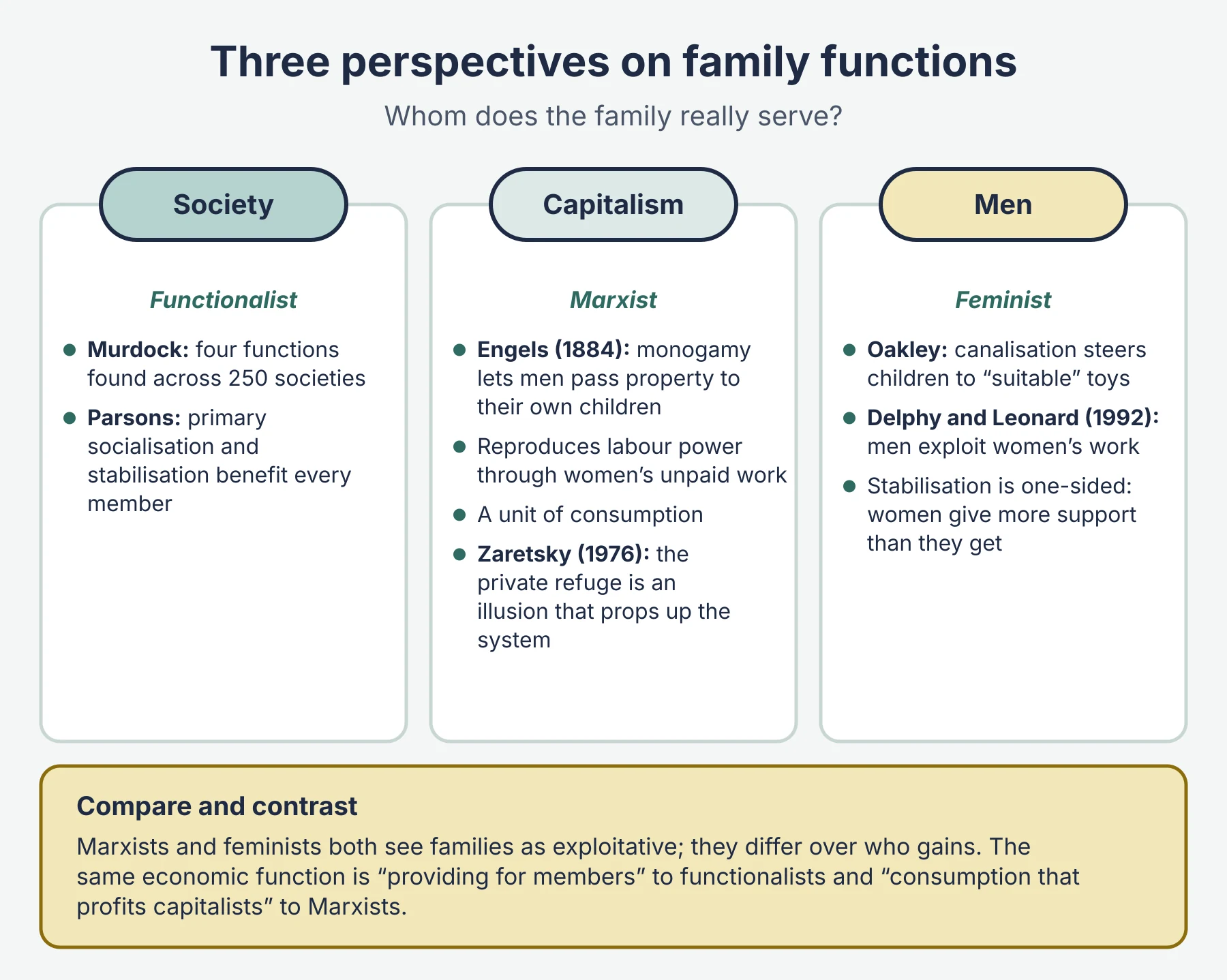
| Compare functionalist, feminist and Marxist views | Show whom each perspective thinks the family really serves: society, men, or capitalism |
A “function” in sociology is the contribution a part of society makes to keeping the whole system going. The debate in 3.3.1 is not really about whether families do these things. It is about whether they do them for everyone’s benefit.
The four functions in the specification
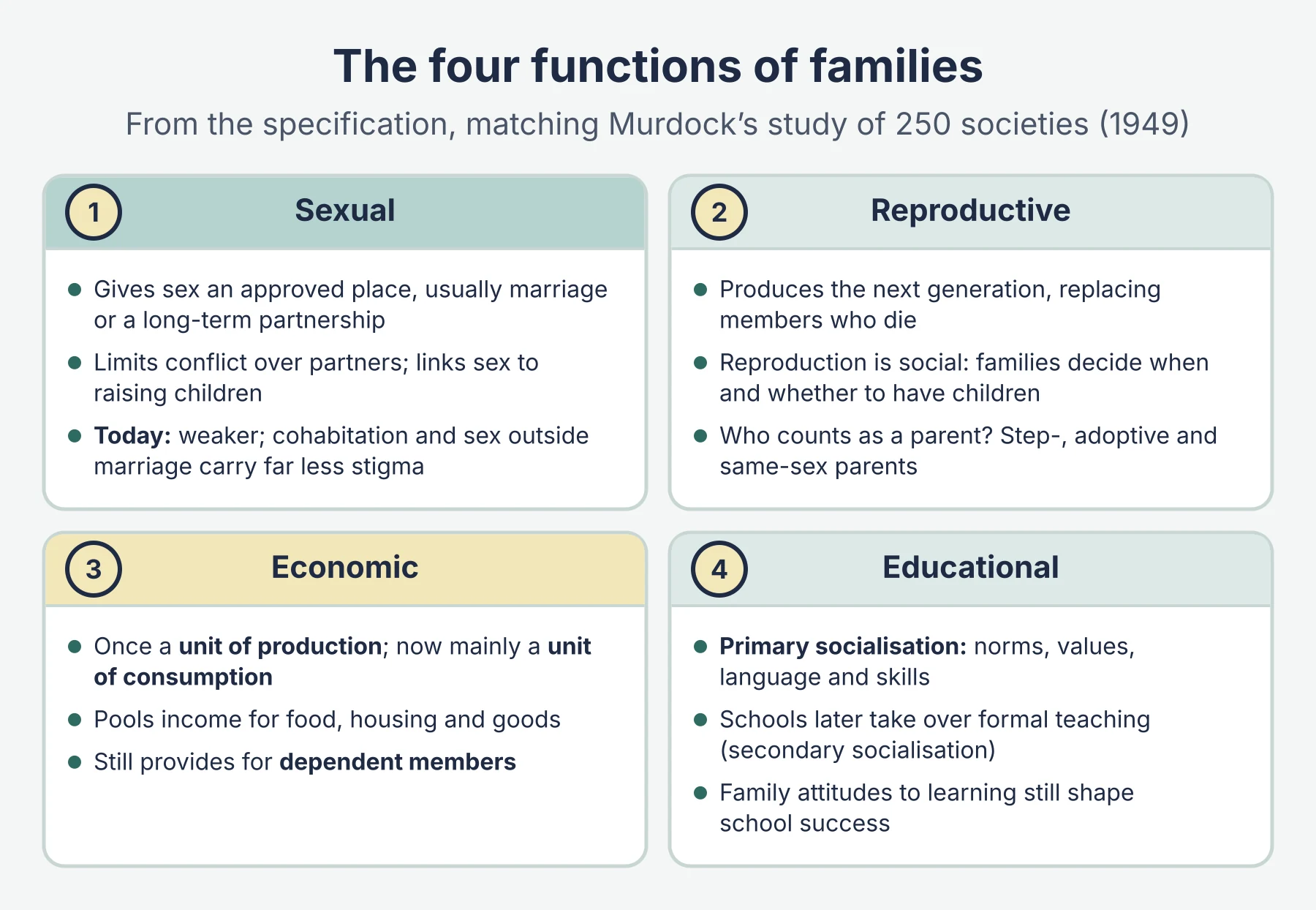
The four functions listed in the specification match those that the functionalist George Murdock (1949) claimed to find in families across the 250 societies he compared. Learn each with a definition, an example and a link to wider society.
Sexual function. Families regulate sexual behaviour by giving it an approved place, usually within marriage or a long-term partnership. This limits conflict over partners and links sex to the responsibility of raising children. Today the function is weaker: cohabitation and sex outside marriage carry far less stigma than in the 1950s, so the family no longer holds the monopoly it once did.
Reproductive function. Families produce the next generation, replacing members who die and keeping society going. A sociological point to add is that reproduction is social, not just biological: the family decides when and whether to have children, and who counts as a parent, as step-parents, adoptive parents and same-sex parents show.
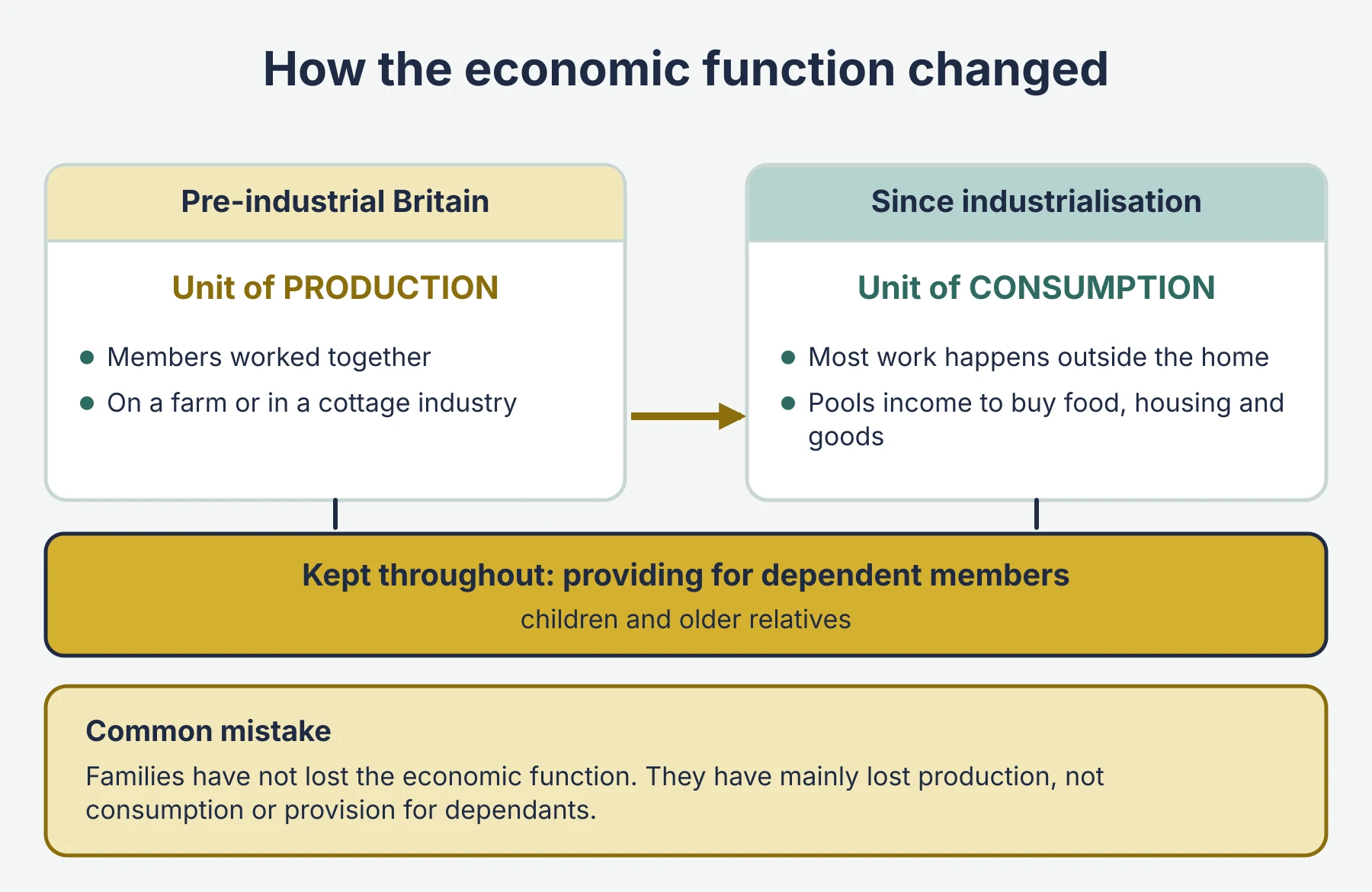
Economic function. In pre-industrial Britain the family was often a unit of production: members worked together on a farm or in a cottage industry. Since industrialisation, most work happens outside the home, so the family has become mainly a unit of consumption, pooling income to buy food, housing and goods. It still provides for dependent family members, such as children and older relatives.
Educational function. Families teach children the norms, values, language and skills of their culture. This is primary socialisation, the first and most basic stage of learning. Schools later take over much of the formal teaching (secondary socialisation), but family attitudes to learning still shape how children do at school.
Parsons: two basic and irreducible functions
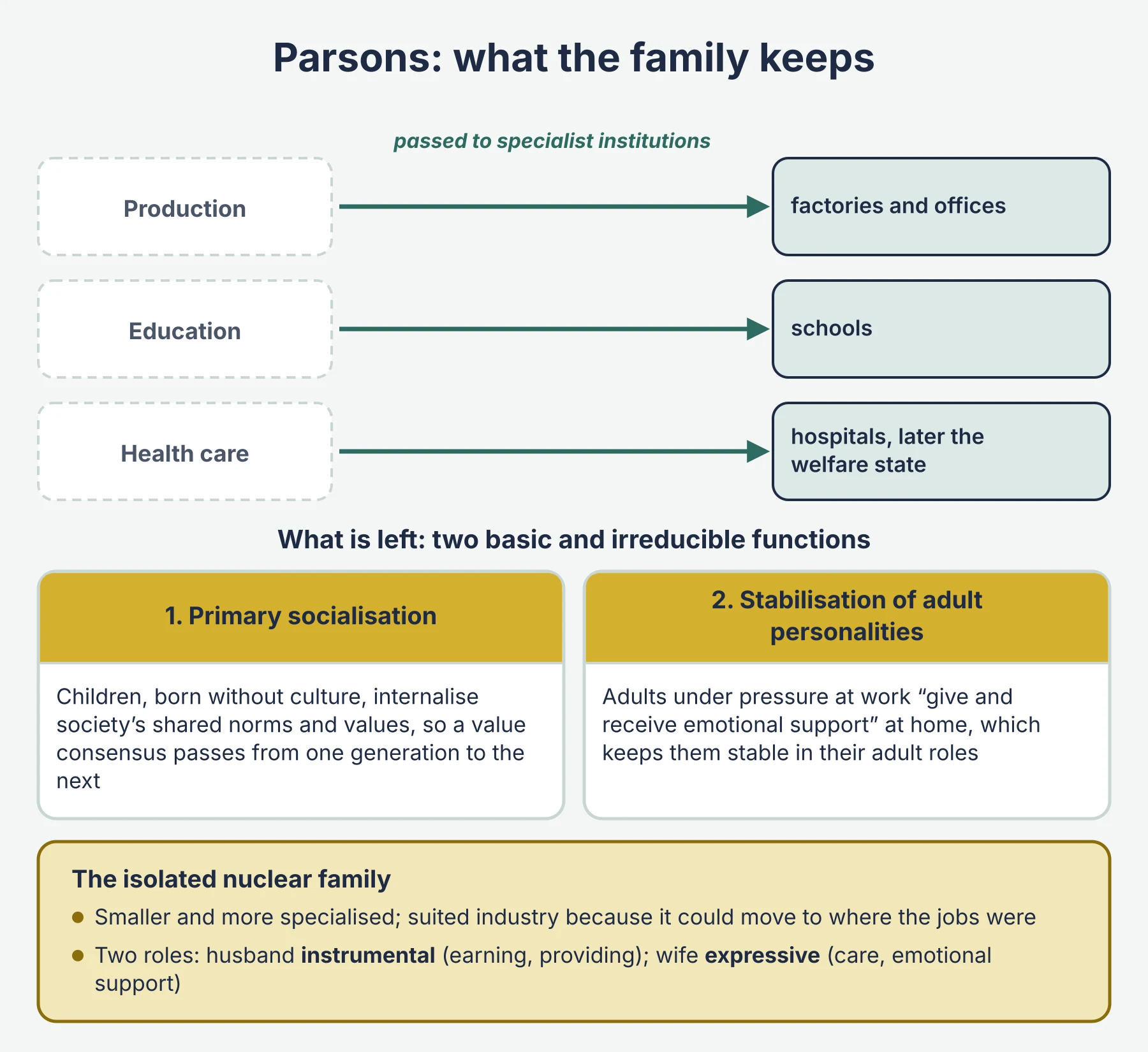
Talcott Parsons wrote from a functionalist perspective about the American family of the 1950s. The specification’s summary says he believed the family “retained two basic and irreducible functions which are common to all families in all societies”.
- Primary socialisation of children. Children are born without culture. In the family they internalise the shared norms and values of society, so that those values become part of their personality. This is how a value consensus is passed on from one generation to the next.
- Stabilisation of adult personalities. Adults face pressure and competition at work. The family gives them a place to “give and receive emotional support”, which keeps them stable enough to carry on in their adult roles.
Parsons also argued that, as society industrialised, many functions passed to specialist institutions: production moved to factories and offices, education to schools, and health care to hospitals and later the welfare state. The family became smaller and more specialised, which is why only two functions were “irreducible”. He linked this to the isolated nuclear family, which suited industry because it could move to where the jobs were.
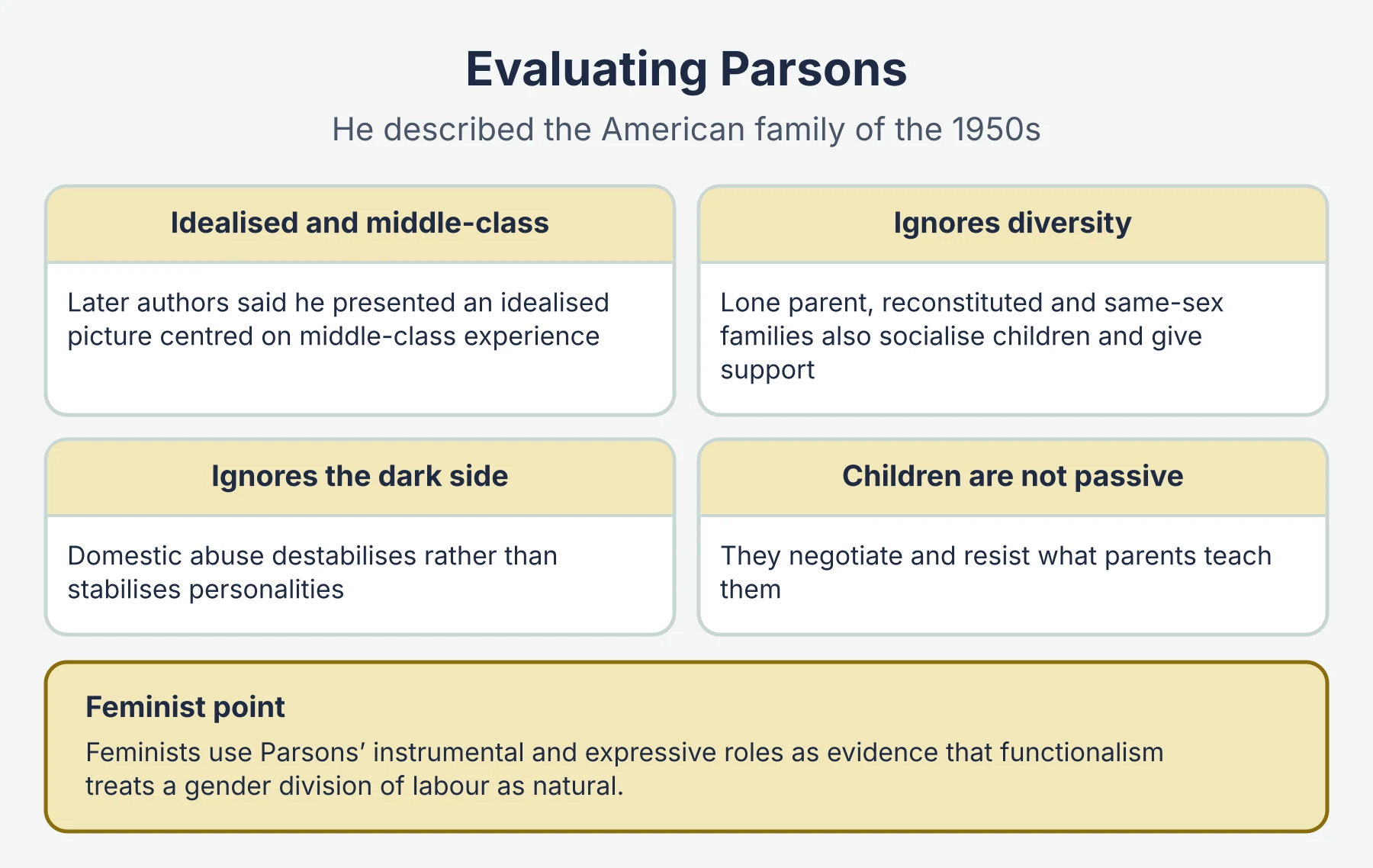
Within that family Parsons described two roles: an instrumental role for the husband (earning money and providing) and an expressive role for the wife (care and emotional support). This matters for 3.3.1 because feminists use it as evidence that functionalism treats a gender division of labour as natural.
Evaluation. The specification notes that later authors “criticised his work as presenting an idealised picture of family life centred on the middle-class experience”. Add three further points:
- It ignores family diversity, such as lone parent, reconstituted and same-sex families, which can also socialise children and give emotional support.
- It ignores the dark side of families, such as domestic abuse, where the family destabilises rather than stabilises personalities.
- Children are not passive: they negotiate and resist what parents teach them.
The Marxist view: functions for capitalism
Marxists agree that families perform functions but argue they serve capitalism and the ruling class, not society as a whole.
- Inheritance of private property. Friedrich Engels (1884) argued that monogamous marriage developed so that men could be sure who their children were and pass property on to them. The family therefore helps keep wealth in the hands of the few.
- Reproducing labour power. Families produce and raise the next generation of workers, and women’s unpaid domestic labour does this at no cost to employers.
- Unit of consumption. Families buy the goods capitalism produces, and pressure to keep up with others keeps demand high.
- Cushioning. Zaretsky (1976) argued that the family seems to offer a private refuge from work, but this is an illusion: it cannot meet people’s psychological needs and it props up the system that causes their alienation.
Notice how the same function looks different through each lens. Functionalists call it the economic function; Marxists call it consumption that profits capitalists.
The feminist view: functions for men
Feminists argue that families mainly benefit men and maintain patriarchy (male dominance).
- The educational function includes gender socialisation. Oakley described canalisation, steering children towards toys and activities seen as suitable for their sex, which prepares girls for domestic roles.
- The economic function depends on women’s unpaid labour. Delphy and Leonard (1992) see the family as “an economic system” in which men exploit women’s work, even when wives also have paid jobs.
- The stabilisation function is one-sided: women provide most of the emotional support and receive less of it.
Feminists also question the “conventional family” Parsons took for granted. Oakley defined it as “nuclear families composed of legally married couples, voluntarily choosing the parenthood of one or more children”, and argued that the idea of this family has great power even though many people do not live in one.
Comparing the three perspectives
| Functionalist | Marxist | Feminist | |
|---|---|---|---|
| Who benefits? | Society and all its members | Capitalism and the ruling class | Men |
| Key writers | Murdock, Parsons | Engels, Zaretsky | Oakley, Delphy and Leonard |
| Socialisation is… | Passing on shared values | Teaching acceptance of hierarchy | Teaching gender roles |
| Economic function is… | Providing for members | Consumption and reproducing workers | Exploiting women’s unpaid work |
| View of change | Loss of functions to specialist institutions | Family still props up capitalism | Women’s position has improved but inequality persists |
Worked example: a 4-mark “identify and explain” answer
Question: Identify and explain one function of families that Parsons believed was basic and irreducible. [4]
The stabilisation of adult personalities (identifies). Parsons argued that adults face stress in the competitive world of work, and the family is where they can give and receive emotional support (describes). For example, a parent who has a difficult day at work can relax with their partner and children rather than taking the stress out on others (applies). This keeps adults emotionally stable, so they can carry on in their work roles and society runs smoothly (explains the link to society).
Why it works: one function only, Parsons’ own wording, an example, and a final sentence that explains why the function matters for society.
Worked example: a paragraph for “discuss how far” (12 marks)
Question: Discuss how far sociologists would agree that families today mainly perform functions for capitalism. [12]
Marxists argue that the economic function of the family serves capitalism. Zaretsky claimed the family is a vital unit of consumption, so a household that buys new phones and clothes each year keeps up the demand on which profit depends. It also reproduces the next generation of workers through women’s unpaid domestic labour, which saves employers money. However, functionalists such as Parsons would reply that the family’s main functions today are primary socialisation and the stabilisation of adult personalities, which benefit every member, not just capitalists. Feminists would accept that families are exploitative but argue, like Delphy and Leonard, that it is men rather than capitalists as such who mainly benefit.
A full answer would add the Marxist view of inheritance (Engels), evaluate Parsons (idealised and middle-class), and end with a judgement, for example that families perform functions for capitalism but also for men and for their members, so “mainly” is too strong.
Common mistakes
- Listing the four functions as Parsons’ functions. Parsons named two; the four come from the specification (and Murdock).
- Writing “socialisation” without saying primary. Schools carry out secondary socialisation.
- Saying families have lost the economic function. They have mainly lost production, not consumption or provision for dependants.
- Treating all feminists or all Marxists as saying the same thing. Name a writer and their specific claim.
- Describing a perspective with no example or no link back to the question.
Exam technique for the command words
- Identify: name the function or idea; no development is needed.
- Describe: say what it involves, with detail or an example.
- Explain: say why or how, using “because”, “so” or “this means”.
- Discuss how far: set at least two perspectives against each other, use named writers, and reach a supported judgement.
- Compare and contrast: point out similarities as well as differences. Marxists and feminists both see families as exploitative; they differ over who gains.
Official syllabus
AQA GCSE Sociology (8192) specification, Version 1.2 (June 2026), for GCSE exams 2019 onwards: section 3.3.1 Functions of families and Appendix B, 7.1 Families (Parsons, Oakley, Delphy and Leonard, Zaretsky).
Related resources
-
Practice questions
AQA GCSE Sociology (8192): Functions of families – Practice Questions
Original AQA GCSE Sociology 8192 practice on 3.3.1 functions of families: Parsons, Engels, Zaretsky and feminist views, with marked answers and 12-mark plans.
Sociology · AQA · GCSE
Try questions -
Revision notes
AQA GCSE Sociology (8192): Functions of families – Revision Notes
Condensed AQA GCSE Sociology 8192 notes on 3.3.1 functions of families: the four functions, Parsons, Marxist and feminist views, traps and a self-test.
Sociology · AQA · GCSE
Revise topic -
Study guides
AQA GCSE Sociology (8192): Changing relationships within families
In-depth AQA GCSE Sociology 8192 guide to 3.3.4: family change from pre-industrial to today, Willmott and Young's four stages, and contemporary family issues.
Sociology · AQA · GCSE
Read guide
Related articles
Get free revision emails (optional)
Occasional emails with practice questions, worked explanations and links to free resources for the qualification and subjects you choose. No spam, and you can unsubscribe from any email. The free tools on this site never need an email.